- Product Description Description
- Table of Contents TOC
- List of Table & Figure LOT
- Get Free Sample PDF Sample PDF
Market Size, 2025
$2.58 BnMarket Estimate, 2026
$2.67 BnMarket Forecast, 2034
$3.52 BnCAGR, 2026–2034
3.51%Executive Summary: Global Demulsifier Market
- Market Scope: Comprehensive global analysis covering chemical types, applications, industrial segments, and regional market dynamics for crude oil and petroleum processing chemical treatments.
- Market Valuation: Valued at USD 2.58 billion (2025), estimated at USD 2.67 billion (2026), and projected to reach USD 3.52 billion by 2034, registering a CAGR of 3.51% (2026–2034).
- Primary Growth Drivers: Escalating global crude oil production post-pandemic, expanding deepwater and unconventional oil exploration, and the vital need to mitigate pipeline corrosion and refinery disruptions caused by water-in-oil emulsions.
Key Market Segment Metrics (2026–2034)
| Category | Leading Segment (2025 Position) | Fastest-Growing / Key Segment Trends |
|---|---|---|
| By Type | Oil-Soluble Demulsifier (capturing major market volume due to high dosage effectiveness) | Water-Soluble Demulsifiers (specialized surfactant solutions for targeted oil-in-water separation) |
| By Application | Crude Oil Processing (largest application sector driven by global extraction volumes) | Petro Refineries & Sludge Oil Treatment (addressing heavier crude blends and tighter environmental standards) |
| By Region | Middle East & North America (dominated by massive onshore/offshore reserves and shale activities) | Asia-Pacific & Latin America (expanding rapidly due to industrialization and infrastructure modernization) |
Major Market Players & Market Structure
Market Structure: Highly competitive global arena featuring major oilfield service providers and specialty chemical corporations focusing on customer-centric green formulations, tailored bottle-testing solutions, and advanced silicone-based or polymeric technologies.
Key Companies: Baker Hughes Incorporated, Clariant, The Dow Chemical Company, Croda International, Ecolab Inc. (Nalco Champion), Halliburton, Schlumberger Limited, BASF SE, Nouryon, Momentive Performance Materials, SI Group, Innospec Inc., Dorf Ketal, and Huntsman Corporation.
Global Demulsifier Market Size
The global demulsifier market was valued at USD 2.58 billion in 2025 and is expected to reach USD 3.52 billion by 2034 from USD 2.67 billion in 2026, growing at a CAGR of 3.51%.
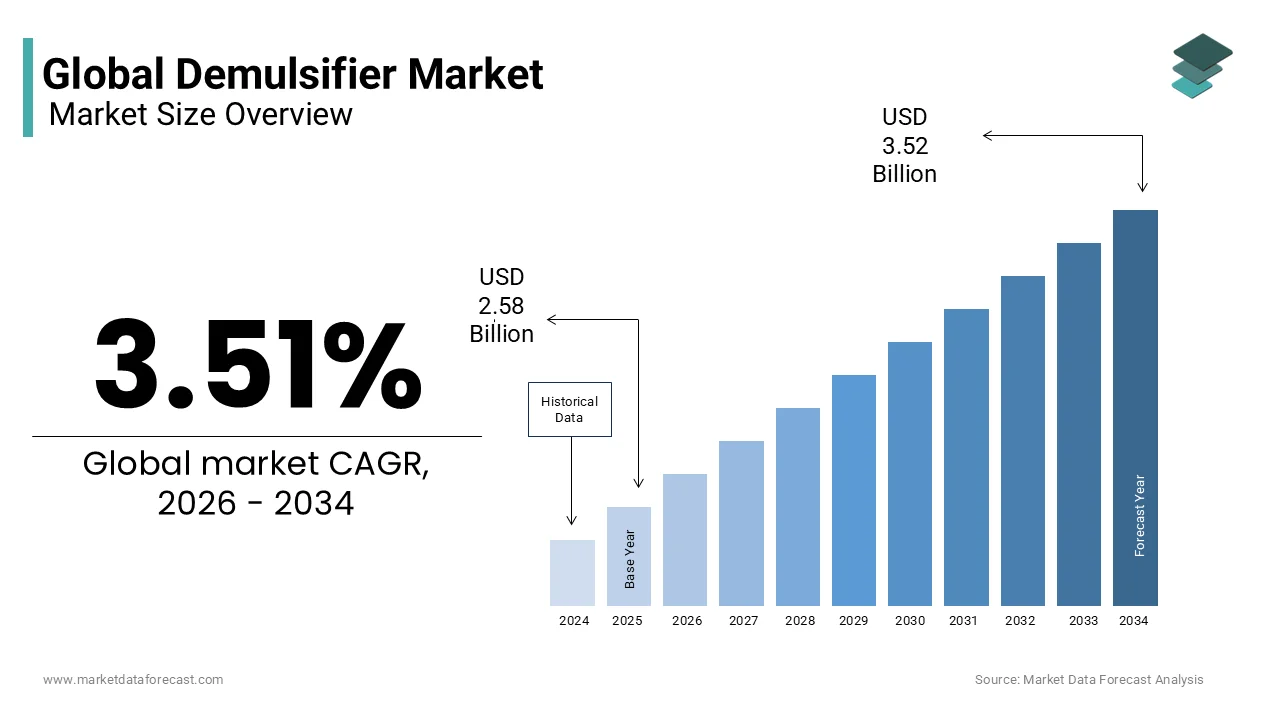
A demulsifier, also known as an emulsion breaker, is a special chemical additive used to separate stable mixtures of two liquids that do not normally mix, such as oil and water. This specialized chemical intervention ensures that extracted hydrocarbons meet pipeline specifications and refinery standards while minimizing corrosion risks in downstream infrastructure. According to the International Energy Agency, global oil demand reached a record 102 million barrels per day in 2023, driven primarily by a strong rebound in air traffic and pent-up demand from expanding economies in Asia. As per the American Petroleum Institute, oil and natural gas producers implement standardized mechanical separating equipment and chemical injection programs to isolate water from raw hydrocarbons at gathering stations. These show that demulsifiers are required to manage the massive volumes of water and oil mixed together during oil extraction. As offshore drilling operations expand into deeper waters and unconventional shale reserves continue to yield significant outputs, the complexity of emulsions increases due to higher salinity and temperature variations. Consequently, the demand for advanced demulsifier formulations grows in tandem with these technical challenges. The market dynamics are heavily influenced by the need for environmentally compliant solutions that reduce chemical discharge while maximizing oil recovery rates. This intersection of regulatory pressure and operational necessity defines the current landscape for demulsifier applications across major producing regions.
MARKET DRIVERS
Rising Global Crude Oil Production Volumes
Increasing global crude oil output directly fuels the growth of the demulsifiers market. This trend is driven by producers seeking to manage larger volumes of produced water efficiently. According to the International Energy Agency, global oil supply increased by 2 million barrels per day in 2023 to hit a record 102 million barrels per day, led by surging output from the United States and Brazil. This surge in production inherently generates greater quantities of water oil emulsions that require immediate chemical treatment to prevent equipment damage and ensure product quality. As per the Society of Petroleum Engineers, crude processing installations experience escalating operational costs and prolonged separation timelines when handling mature reservoir fluids where water cuts reach 80% to 90%. Each barrel of produced fluid contains varying degrees of stable emulsions that resist natural separation due to the presence of asphaltenes and resins. Demulsifiers disrupt these interfacial films by reducing surface tension and promoting coalescence of water droplets. As operators drill in more complex geological formations such as heavy oil sands and deepwater reservoirs, the stability of these emulsions intensifies. This technical challenge mandates the use of customized chemical blends tailored to specific crude characteristics. The correlation between rising extraction rates and demulsifier demand remains linear because every additional barrel of oil extracted brings proportionally more water into the processing stream. Operators cannot bypass this chemical step without risking severe operational disruptions and financial losses from off specification crude sales.
Stringent Environmental Regulations on Produced Water Discharge
Strict environmental mandates governing produced water disposal compel oil and gas operators to adopt advanced demulsification technologies to minimize ecological impact, and thereby accelerate the Demulsifier Market expansion. According to the United States Environmental Protection Agency, offshore oil and gas extraction facilities must limit the oil and grease concentration in produced water discharges to a daily maximum of 42 milligrams per liter and a monthly average of 29 milligrams per liter. Compliance with these standards necessitates highly efficient separation processes where demulsifiers play a pivotal role in breaking tight emulsions before water treatment stages. As per the International Maritime Organization, commercial vessel operators install specialized exhaust gas cleaning systems that generate up to 90 cubic meters of washwater per megawatt-hour in open-loop configurations. Failure to achieve adequate separation results in costly penalties and potential shutdowns of production assets. Demulsifiers enable operators to recover maximum oil content from produced water streams, thereby reducing the volume of hazardous waste requiring disposal. This regulatory pressure drives innovation in bio based and low toxicity demulsifier formulations that align with sustainability goals while maintaining performance efficacy. Companies investing in greener chemical solutions gain competitive advantages in markets with stringent oversight. The link between regulatory compliance and demulsifier adoption is direct because inadequate separation leads to non compliant effluent that violates legal thresholds. Governments are tightening discharge limits globally. Consequently, the reliance on precision chemical treatments becomes unavoidable for continued operational legitimacy in the upstream sector.
MARKET RESTRAINTS
Volatility in Raw Material Prices for Chemical Synthesis
Fluctuating costs of petrochemical feedstocks create significant financial uncertainty for manufacturers and end users in the Demulsifier Market . As per the American Chemistry Council, chemical manufacturers face ongoing profit margin compression due to the high volatility of critical petrochemical-based inputs like ethylene oxide and propylene oxide. These inputs form the backbone of nonionic surfactants commonly used in demulsifier formulations, meaning any price spike directly inflates production costs for chemical suppliers. According to the European Chemical Industry Council, energy-intensive basic chemical installations face severe operational challenges from extreme natural gas price spikes that account for over 30% of total production costs. When raw material costs surge, demulsifier producers must either absorb margins or pass increases to oilfield service companies and operators. This pricing instability discourages long term contracting and forces buyers to seek alternative suppliers or delay procurement decisions. Small and mid sized chemical manufacturers struggle to hedge against such fluctuations, leading to market consolidation where only large players with diversified supply chains survive. The unpredictability of input costs undermines investment in research and development for new demulsifier technologies. Operators facing budget constraints may opt for cheaper but less effective alternatives, compromising separation efficiency. This dynamic creates a challenging environment where cost management becomes as critical as technical performance. The direct relationship between feedstock volatility and market stability means that demulsifier availability and pricing remain susceptible to broader macroeconomic shocks affecting the petrochemical industry.
Technical Complexity of Heavy Oil and Unconventional Reservoirs
The increasing exploitation of heavy oil deposits and unconventional shale formations is also a formidable technical barrier to effective demulsification, which impedes the expansion of the Demulsifier Market . As per the Canadian Association of Petroleum Producers, operators process heavy bitumen through thermal extraction methods to decrease viscosity and accelerate fluid flow out of the sand matrix. These complex fluids contain elevated concentrations of solids, asphaltenes, and naphthenic acids that stabilize water in oil dispersions and resist standard chemical breakdown methods. According to the Society of Petroleum Engineers, production teams employ specialized chemical surfactants to break down highly stable oil-in-water emulsions formed by high-salinity reservoir fluids. Such extreme conditions demand custom formulated chemicals that can function under high temperature and high pressure environments typical of hydraulic fracturing operations. Standard off the shelf demulsifiers frequently fail to achieve desired separation efficiencies in these scenarios, leading to prolonged settling times and increased operational costs. Developing tailored solutions requires extensive laboratory testing and field trials, which extend project timelines and inflate expenses. The heterogeneity of unconventional reservoirs means that a single demulsifier formulation rarely works across multiple wells or regions. This lack of standardization complicates supply chain logistics and inventory management for service providers. Operators must continuously adapt their chemical strategies as reservoir characteristics change during production life cycles. The technical difficulty of treating these challenging emulsions restricts market growth by limiting the applicability of existing products and raising barriers to entry for new competitors lacking advanced formulation capabilities.
MARKET OPPORTUNITIES
Expansion of Offshore Deepwater Exploration Activities
Growing investments in deepwater and ultra-deepwater oil exploration open new avenues for demulsifier applications in harsh marine environments, which are expected to boost their global market growth. According to Rystad Energy, active field developments and upcoming startups are expected to drive total US deepwater output to an all-time high of nearly 2.2 million barrels of oil equivalent per day by 2026. These offshore facilities operate under extreme conditions including high pressures, low temperatures, and limited space for separation equipment, necessitating highly efficient demulsifiers that work rapidly within compact processing systems. As per the International Association of Oil and Gas Producers, exploration and production operators implement standardized, multi-tiered operational management frameworks to systematically mitigate environmental, asset integrity, and process safety risks. The shift toward early stage chemical treatment creates demand for products with enhanced stability and compatibility with subsea infrastructure materials. Deepwater emulsions often contain unique compositional profiles due to geological factors, prompting the development of region specific formulations. The logistical challenges of supplying remote offshore locations favor suppliers who can provide reliable just in time delivery and technical support. As exploration moves into frontier regions such as West Africa and the Gulf of Mexico, the need for robust demulsification solutions intensifies. Operators prioritize chemicals that minimize downtime and maximize oil recovery in capital intensive projects. This trend offers substantial growth potential for manufacturers capable of delivering high performance products tailored to deepwater operational requirements.
Adoption of Digital Monitoring and Smart Chemical Injection Systems
Integration of digital technologies and automated chemical injection systems provides a transformative opportunity for optimizing their usage and performance, which is anticipated to propel the Demulsifier Market . According to Rystad Energy, upstream exploration and production companies investing heavily in digital architectures and artificial intelligence will create more than $80 billion in additional market value in 2030 compared to 2025. The smart systems analyze parameters such as water cut, temperature, and flow rate to dynamically control demulsifier injection rates, ensuring optimal separation efficiency while minimizing waste. As per the Society of Petroleum Engineers, production teams leverage specialized chemical surfactants that co-adsorb alongside natural crude components to modify oil-water interfacial viscoelastic properties. The data driven approach enhances operational reliability and reduces the risk of off specification crude production. Digital integration also facilitates remote monitoring of offshore and remote onshore facilities, lowering labor costs and improving safety by reducing manual intervention. Suppliers offering integrated chemical and digital solutions gain competitive differentiation in a market increasingly focused on operational excellence. The ability to demonstrate quantifiable savings through reduced chemical usage appeals to cost conscious operators facing margin pressures. Furthermore, digital records of chemical performance support regulatory compliance reporting and environmental auditing. This technological convergence creates new revenue streams for demulsifier providers who transition from pure product suppliers to comprehensive service partners. The synergy between advanced chemicals and intelligent monitoring systems unlocks value by transforming demulsification from a reactive process into a proactive optimization strategy.
MARKET CHALLENGES
Supply Chain Disruptions Affecting Raw Material Availability
Persistent supply chain hurdles disrupt the consistent availability of critical raw materials needed for their production, which limits the Demulsifier Market growth. As a result, the market faces ongoing operational challenges. As per the American Chemistry Council, specialty chemical supply chains face prolonged bottlenecks due to strict statutory evaluation timelines under revised federal chemical tracking frameworks. These disruptions force demulsifier manufacturers to maintain higher inventory levels, tying up capital and increasing storage costs while still facing occasional stockouts of key ingredients. According to the European Chemical Industry Council, local chemical networks experience severe systemic supply vulnerabilities whenever regional upstream manufacturing installations encounter prolonged operational or economic shutdowns. Oilfield operators experience delayed deliveries of demulsifiers, which can halt production if separation facilities run out of treatment chemicals. Just in time inventory models prove vulnerable to such disruptions, compelling companies to reconsider sourcing strategies and diversify supplier bases. However, qualifying alternative suppliers requires extensive testing and validation, which takes months to complete. This lag time leaves operators exposed to supply risks during transition periods. Smaller demulsifier producers lack the bargaining power to secure priority shipments, exacerbating their vulnerability to market shocks. The unpredictability of supply availability undermines confidence in long term planning and contract fulfillment. Operators may resort to holding excess safety stock, which increases working capital requirements and storage hazards. These supply chain fragilities challenge the market by introducing operational uncertainties that complicate procurement and inventory management for both manufacturers and end users.
Limited Technical Expertise in Emerging Producing Regions
There is a critical shortage of personnel skilled in emulsion chemistry and demulsifier application, which inhibits its global market expansion. This deficiency directly hinders market growth across emerging oil-producing regions. As per the International Association of Oil and Gas Producers, exploration and production operators implement standardized, multi-tiered operational management frameworks to systematically mitigate environmental, asset integrity, and process safety risks. The expertise deficit leads to improper demulsifier selection, incorrect dosage applications, and inadequate monitoring of separation performance, resulting in suboptimal oil recovery and increased operational costs. Local operators often rely on generic chemical solutions rather than customized formulations tailored to their specific crude characteristics, reducing overall treatment effectiveness. According to the Society of Petroleum Engineers, production teams leverage specialized chemical surfactants that co-adsorb alongside natural crude components to modify oil-water interfacial viscoelastic properties. Training programs are insufficient to meet growing demand, leaving field teams ill equipped to troubleshoot separation issues or optimize chemical usage. Misapplication of demulsifiers can cause severe problems such as rag layer formation, equipment fouling, and downstream processing complications. Without proper technical support, operators may blame chemical products for failures stemming from user error, damaging supplier reputations and slowing adoption of advanced solutions. This knowledge gap restricts market penetration in high growth regions where production volumes are increasing but technical capabilities lag behind. Addressing this challenge requires substantial investment in local training initiatives and knowledge transfer partnerships between global suppliers and regional operators.
REPORT COVERAGE
| REPORT METRIC | DETAILS |
| Market Size Available | 2025 to 2034 |
| Base Year | 2025 |
| Forecast Period | 2026 to 2034 |
| CAGR | 3.51% |
| Segments Covered | By Type, Application, and Region. |
| Various Analyses Covered | Global, Regional & Country Level Analysis, Segment-Level Analysis, DROC, PESTLE Analysis, Porter’s Five Forces Analysis, Competitive Landscape, Analyst Overview of Investment Opportunities |
| Regions Covered | North America, Europe, APAC, Latin America, Middle East & Africa |
| Market Leaders Profiled | Baker Hughes Incorporated (US), Clariant (Switzerland), The Dow Chemical Company (US), Croda International (US), Ecolab Inc. (US), Halliburton (US), Schlumberger Limited (US), BASF SE (Germany), Nouryon (Netherlands), Momentive Performance Materials (US), Nova Star LP (US), SI Group (US), Impact Chemicals Technologies (US), Innospec Inc. (US), Dorf Ketal (India), and others. |
SEGMENTAL ANALYSIS
By Type Insights
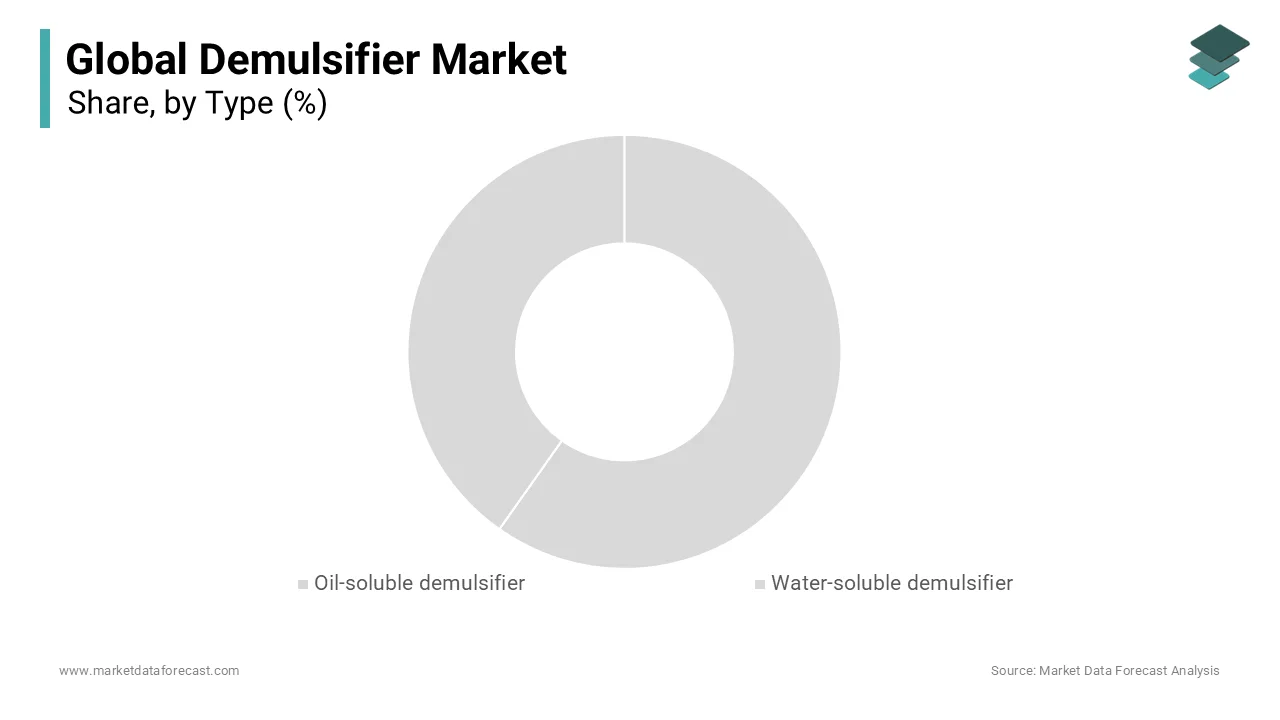
The oil soluble demulsifiers segment remained the largest in 2025 and held a significant share of the global market. Its superior efficacy in treating water in oil emulsions prevalent in upstream extraction operations has contributed to the supremacy of this segment. As per the Society of Petroleum Engineers, global crude oil production continues to generate high volumes of water-in-oil emulsions that require chemical de-watering before pipeline transport. This segment accounts for the majority of chemical consumption because these products dissolve directly into the crude stream and migrate to the interface to disrupt stabilizing films. According to the American Petroleum Institute, conventional onshore fields exhibit a rising volume of co-produced water that dictates ongoing chemical adjustments at the wellhead. The direct relationship between this statistic and market leadership is evident as each barrel of produced fluid necessitates proportional chemical dosage. Operators prioritize oil soluble variants because they integrate seamlessly with existing injection infrastructure without requiring additional mixing equipment or phase inversion steps. Their compatibility with downstream refinery processes further solidifies their position since residual chemicals do not interfere with catalytic cracking units. This technical alignment with standard industry workflows ensures sustained preference despite emerging alternatives.
The entrenched infrastructure of global oilfield operations heavily favors oil soluble demulsifiers due to established injection protocols and separation vessel designs. As per the International Association of Oil and Gas Producers, exploration and production operators implement standardized, multi-tiered operational management frameworks to systematically mitigate environmental, asset integrity, and process safety risks. According to the Institution of Chemical Engineers, process safety engineering assessments emphasize that manufacturing facilities must install robust process design safeguards, automated safety interlocks, and redundant mitigation layers to effectively minimize major industrial hazard risks. The financial barrier reinforces the dominance of oil soluble products as operators optimize operational expenditure rather than pursuing costly upgrades. The statistical correlation between infrastructure prevalence and segment leadership demonstrates how legacy system design locks in demand patterns. Field personnel possess decades of operational experience with oil soluble chemistries, reducing training requirements and minimizing application errors. Supply chains have evolved around this segment with regional distribution networks optimized for bulk liquid delivery to well sites. This ecosystem maturity creates a self reinforcing cycle where continued investment flows toward optimizing existing oil soluble technologies rather than developing parallel systems for niche alternatives. The inertia of installed base infrastructure thus serves as a fundamental pillar supporting market dominance.
The water-soluble demulsifiers segment is expected to exhibit a noteworthy CAGR of 6.8% from 2026 to 2034 due to increasing adoption in produced water treatment and environmental compliance applications. According to the United States Environmental Protection Agency, daily oil and grease discharges into federal waters face stringent regional monitoring constraints that require active water treatment technologies. The regulatory driver directly correlates with the accelerated growth rate as facilities upgrade separation trains to meet tightening effluent standards. As per the International Maritime Organization, offshore deepwater installations utilize chemical injection protocols to prevent hydrocarbon carryover during offshore ocean discharges. These points show how environmental rules create new types of demand that are entirely different from standard crude dehydration. Water soluble variants excel in removing residual oil from water phases after primary separation, addressing a gap that oil soluble products cannot fill effectively. Their molecular structure allows dispersion in aqueous environments where they coalesce microscopic oil droplets for removal via flotation or filtration. As sustainability metrics gain prominence in corporate reporting, operators seek chemicals that demonstrate measurable improvements in water quality outcomes. This shift toward holistic produced water management rather than mere crude specification compliance fuels the segment’s above average expansion trajectory.
Innovation in environmentally benign water soluble demulsifiers accelerates market penetration as operators seek sustainable alternatives to traditional solvent based products. According to the European Chemical Industry Council, European specialty chemical sales indicate growing regional volumes for bio-based formulations amid stricter substance registration compliance schedules. This growth statistic reflects a structural shift in procurement criteria where environmental profile now weighs equally with technical performance in vendor selection processes. As per the Green Chemistry Institute, commercial bio-based oilfield chemicals show improving environmental performance trends that reduce toxicity metrics in surrounding aquatic ecosystems. Such performance parity removes historical barriers to adoption that previously limited water soluble variants to niche applications. Regulatory frameworks like REACH in Europe and TSCA in the United States increasingly favor substances with favorable ecotoxicological profiles, creating preferential treatment for compliant water soluble products. Operators operating in sensitive marine environments face stricter oversight and therefore lead adoption curves for greener alternatives. The convergence of regulatory pressure, technological maturation, and corporate responsibility commitments creates multiple reinforcing drivers for this segment. Unlike mature oil soluble markets driven primarily by volume, water soluble growth stems from value added differentiation aligned with evolving stakeholder expectations regarding environmental stewardship in upstream operations.
By Application Insights
In 2025, the crude oil segment accounted for a commanding share of the Demulsifier Market because of the fundamental necessity of water removal before transportation and refining. According to the International Energy Agency, global oil demand trends influence the chemical processing requirements for extracted petroleum streams prior to delivery at terminal facilities. The massive volumetric base establishes crude oil as the dominant application segment by several orders of magnitude over downstream uses. As per the American Petroleum Institute, crude oil transportation protocols involve standardized testing guidelines for measuring basic sediment and water to preserve network infrastructure. The direct linkage between production volumes and chemical consumption means that fluctuations in global output translate immediately into demulsifier demand changes. Upstream operators view demulsifiers as essential operating consumables rather than discretionary expenses, ensuring stable purchasing patterns even during commodity price downturns. The technical complexity of field emulsions varies significantly by reservoir type, necessitating customized chemical programs that deepen supplier relationships and increase switching costs. Refineries also consume demulsifiers for desalting operations, adding secondary demand layers beyond wellhead treatment. This dual point of consumption across the value chain consolidates crude oil’s market leadership. No other application approaches this scale because alternative segments address specific process needs rather than universal production requirements.
Commercial crude sales contracts universally enforce strict water content limits that make demulsifier application mandatory for revenue realization. According to sources, benchmark crude grade pricing models apply commercial adjustments based on verified assay quality metrics at delivery hubs. As per the London Metal Exchange, global industrial metal contracts rely on strict physical delivery standards to mitigate contract disputes between international trading counter-parties. These facts prove that market rules link demulsifier needs directly to the value of oil trading. Operators cannot defer or reduce chemical usage without accepting tangible revenue losses, making demand highly inelastic relative to price. Long term supply agreements often include performance guarantees tied to specification compliance, further institutionalizing demulsifier consumption as a contractual obligation rather than operational choice. The global nature of crude trading means these standards apply uniformly across producing regions, preventing geographic arbitrage or substitution. This harmonization of commercial requirements ensures consistent demand fundamentals regardless of local regulatory variations or operational differences.
The sludge oil treatment segment is predicted to witness the highest CAGR of 7.4% during the forecast period owing to waste valorization initiatives and circular economy mandates. According to the World Bank, developing economies face escalating solid waste management burdens that require substantial investments in urban public infrastructure. The data on waste volumes underscores a significant commercial opportunity as industry players and regulators work to monetize waste through reprocessing. As per the Basel Convention Secretariat, international controls on the transboundary movement of hazardous substances compel member states to implement national reporting systems for tracked waste groups. The regulatory and economic drivers converge to accelerate adoption of specialized demulsifiers formulated for high solids and aged emulsion matrices. Unlike fresh crude emulsions, sludge contains oxidized compounds and fine particulates that resist conventional treatment, creating demand for premium specialty chemicals. Recovered oil from sludge can be blended back into crude streams or sold as fuel oil, generating returns that justify chemical investment. Environmental liability concerns also motivate treatment as untreated sludge poses groundwater contamination risks. The combination of regulatory pressure, economic incentive, and technological advancement creates a unique growth dynamic distinct from mature crude oil applications. This segment benefits from being both a compliance solution and a profit center, attracting investment from diverse stakeholders including waste management firms and refiners seeking feedstock security.
Stringent waste management regulations globally compel industrial facilities to treat oily sludge rather than landfill or incinerate it, directly stimulating demulsifier demand in this segment. According to the European Environment Agency, municipal and industrial waste management strategies across Europe emphasize diversion from landfills toward circular processing frameworks. The regulatory tightening creates guaranteed demand for sludge treatment services and associated chemicals as facilities scramble to comply with diversion mandates. According to the United Nations Environment Programme, national environmental policy frameworks utilize extended producer responsibility models to shift the economic burden of post-consumer material management onto product manufacturers. The policy frameworks transform sludge from a cost center into a managed material stream requiring systematic processing. Demulsifiers enable the critical first step of separating recoverable oil from water and solids fractions, determining overall process economics. Without effective chemical pretreatment, mechanical separation equipment cannot achieve sufficient throughput or purity levels to justify operation. The statistical correlation between regulatory stringency and market growth demonstrates how policy acts as an exogenous driver independent of oil prices or production volumes. Facilities facing closure threats for non compliance represent captive demand with low price sensitivity. This regulatory foundation provides stability and predictability that attracts long term investment in sludge treatment infrastructure and chemical supply chains.
REGIONAL ANALYSIS
North America Demulsifier Market Analysis
North America dominated the global Demulsifier Market and captured a substantial share in 2025. This region’s dominance was driven by high shale activity and stringent environmental oversight. According to the United States Energy Information Administration, domestic crude oil production set an annual record average of 12.9 million barrels per day in 2023, expanding operational requirements across major producing basins. This production volume anchors regional market stability despite cyclical commodity price movements. According to Natural Resources Canada, expanding oil sands mining and in-situ extraction operations continue to accumulate substantial fluid tailings volumes requiring active chemical and physical management. These statistics reflect the region’s dual character as both a high volume conventional producer and a complex unconventional operator requiring diverse chemical solutions. North American operators lead adoption of digital optimization and green chemistry innovations due to investor pressure and regulatory expectations. The presence of major chemical manufacturers and service companies fosters competitive intensity and rapid technology diffusion. Mature infrastructure enables efficient distribution while skilled workforce supports sophisticated application programs. Regional trade integration allows cross border supply balancing between US and Canadian markets. Despite maturity, growth continues through efficiency gains and environmental compliance upgrades rather than greenfield expansion. This evolution toward value added services distinguishes North America from volume driven emerging regions.
Europe Demulsifier Market Analysis
Europe is moving ahead steadfastly in the Demulsifier Market . It occupies a distinctive position emphasizing environmental compliance and offshore expertise over sheer production volume in this market. As per Eurostat, indigenous crude oil and liquid hydrocarbon extraction across European basins exhibits an ongoing structural decline that alters operational field economics. This inverse relationship between volume and value demonstrates how regulatory maturity sustains demand despite resource depletion. According to the Oslo Paris Commission, offshore oil and gas operators must comply with performance standards that restrict dispersed hydrocarbon concentrations in discharged produced water across the Northeast Atlantic. These regulatory frameworks create premium markets for advanced chemicals that command higher margins than commodity products elsewhere. European operators serve as global test beds for next generation technologies before wider commercialization. Strong research institutions and chemical industry clusters support formulation development and validation. Offshore decommissioning activities generate additional demand for sludge treatment and facility cleaning applications. Regional focus on circular economy principles promotes waste valorization projects using specialized demulsifiers. While production volumes constrain absolute market size, technological leadership and regulatory influence extend Europe’s impact beyond its geographic boundaries. This knowledge intensive model contrasts sharply with volume oriented strategies in other regions.
Asia Pacific Demulsifier Market Analysis
Asia Pacific was the fastest and the second most prominent region in the Demulsifier Market in 2025. This expansion of the APAC market was fuelled by expanding energy demand and diversifying supply sources. According to the Asian Development Bank, economic growth and robust domestic demand across developing Asian economies influence regional oil and gas price pressures and upstream energy investments. This demand side pressure translates into increased exploration and production activity requiring corresponding chemical support. According to the China National Petroleum Corporation, deepwater, high water-cut, and ultra-heavy oil reservoirs dictate continuous engineering optimization and horizontal well deployment to manage mature fields. These facts highlight the region’s transition from pure importer to active producer with complex technical requirements. Rapid infrastructure buildout includes new refineries and pipelines that incorporate modern separation standards from inception. Emerging producers in Malaysia Indonesia and Vietnam adopt international best practices, accelerating technology transfer. Price sensitivity remains higher than in Western markets, favoring cost effective formulations alongside premium options. Local manufacturing capacity is expanding to reduce import dependency and tailor products to regional crude characteristics. Urbanization and industrialization sustain long term energy demand trajectories. This combination of growth momentum and technical evolution positions Asia Pacific as the primary engine of future market expansion globally.
Latin America Demulsifier Market Analysis
Latin America is likely to grow notably in the Demulsifier Market from 2026 to 2034. Specifically, this upward trend is driven by Brazil’s deepwater, pre-salt reserves and Mexico’s revitalized upstream sector. As per the Brazilian National Agency for Petroleum, Natural Gas and Biofuels, deepwater pre-salt fields drive structural expansions in national petroleum production through the integration of new offshore floating production units. This concentration of complex offshore assets creates concentrated demand for high performance demulsifiers capable of functioning under extreme pressure and temperature conditions. According to the United States Energy Information Administration, liquid fuels production in Mexico has experienced structural field declines at legacy marine complexes, modifying the nation's net exporter dynamics. These production numbres underscore the region’s role as a major global supplier requiring sophisticated chemical support. Deepwater operations demand specialized logistics and just in time supply chains due to remote locations. High salinity and asphaltene content in pre salt crudes necessitate custom formulations rather than standard products. Local content requirements encourage development of regional supply capabilities and partnerships with international firms. Political and regulatory uncertainties introduce volatility but resource endowment ensures long term relevance. Investment cycles drive periodic demand surges aligned with project sanctions. This resource driven profile distinguishes Latin America from consumption led or regulation led markets elsewhere.
Middle East and Africa Demulsifier Market Analysis
The Middle East and Africa region continues to be a key player in the Demulsifier Market . Within this region, demulsifier demand scales directly with massive reserve bases and national oil company operations. As per the Organization of the Petroleum Exporting Countries, participating core member nations coordinate voluntary crude production adjustments to stabilize global oil market allocations. The production dominance ensures the region remains the single largest consumer of demulsifiers by absolute quantity. According to the African Energy Chamber, deepwater hydrocarbon discoveries offshore Namibia attract significant upstream capital but require substantial local infrastructure development to fast-track monetization. These facts illustrate the region’s dual character as established giant and emerging frontier simultaneously. National oil companies dominate procurement through centralized tendering systems that emphasize reliability and long term supply security over spot pricing. Harsh desert and offshore environments demand robust formulations resistant to extreme temperatures and salinity. Mega projects involving enhanced oil recovery and gas injection create specialized chemical requirements. Localization initiatives promote in country manufacturing and technology transfer. Geopolitical factors influence supply chain resilience and vendor selection. Despite lower per barrel chemical intensity than mature regions, sheer scale guarantees enduring market centrality. This volume supremacy combined with growth potential makes the region indispensable to global demulsifier suppliers
COMPETITIVE LANDSCAPE
The demulsifier market features intense competition characterized by a mix of global chemical giants and specialized regional players vying for contracts in upstream oil and gas operations. Large multinational corporations leverage their extensive research and development capabilities to offer innovative customized solutions that address complex emulsion challenges in diverse geological settings. These firms compete on technical performance environmental compliance and digital integration rather than price alone creating high barriers to entry for smaller competitors. Regional players often focus on niche markets or specific crude types where they possess deep local knowledge and established distribution networks. Competition is further intensified by the need for rapid response times and reliable supply chains in remote offshore locations where downtime costs are prohibitive. Companies differentiate themselves through service quality technical support and ability to provide total cost of ownership reductions via optimized chemical usage. Regulatory pressures drive continuous innovation in green chemistry forcing all participants to invest in sustainable formulations to remain eligible for major contracts. Consolidation trends see larger firms acquiring specialized boutiques to gain access to proprietary technologies or regional footholds. This dynamic environment rewards agility technical expertise and customer centricity while penalizing those unable to adapt to evolving environmental standards and digital transformation demands in the energy sector.
Key Market Players
Some of the key players in the global demulsifier market are
- Baker Hughes Incorporated (US)
- Clariant (Switzerland)
- The Dow Chemical Company (US)
- Croda International (US)
- Ecolab Inc. (US)
- Halliburton (US)
- Schlumberger Limited (US)
- BASF SE (Germany)
- Nouryon (Netherlands)
- Momentive Performance Materials (US)
- Nova Star LP (US)
- SI Group (US)
- Impact Chemicals Technologies (US)
- Innospec Inc. (US)
- Dorf Ketal (India)
- Others
Top Players in the Market
- Baker Hughes leverages its extensive global footprint to deliver integrated chemical solutions that address complex emulsion challenges in upstream operations. The company focuses on developing advanced demulsifier formulations compatible with digital monitoring systems to optimize dosage and enhance separation efficiency. Recent initiatives include expanding its chemical manufacturing capabilities in key producing regions to ensure supply chain resilience and reduce delivery lead times for critical offshore projects. Baker Hughes collaborates closely with national oil companies to customize products for specific reservoir characteristics such as high salinity or heavy bitumen content. This technical partnership approach strengthens customer loyalty and ensures long term contract stability. The firm invests heavily in research and development to create environmentally compliant products that meet stringent regulatory standards in Europe and North America. By combining chemical expertise with digital innovation, Baker Hughes positions itself as a technology leader rather than a mere commodity supplier. This strategic differentiation allows the company to command premium pricing while delivering measurable operational improvements for clients seeking both performance and sustainability outcomes in their produced water management processes.
- Clariant specializes in high performance specialty chemicals including tailored demulsifiers designed for challenging crude oil applications across diverse geological settings. The company emphasizes sustainability by offering bio based and low toxicity formulations that align with global environmental regulations and corporate responsibility goals. Clariant recently expanded its production facilities in Asia Pacific to cater to growing demand from emerging markets and support local content requirements. The firm engages in joint development programs with major energy operators to solve specific separation issues related to enhanced oil recovery techniques and unconventional shale resources. These collaborative efforts result in proprietary solutions that provide competitive advantages to clients facing unique operational constraints. Clariant also integrates its chemical offerings with analytical services to help customers monitor emulsion stability and optimize treatment protocols in real time. This holistic service model enhances value proposition beyond product supply alone. By focusing on innovation and regional expansion, Clariant strengthens its position as a preferred partner for operators seeking reliable and environmentally responsible demulsification technologies that improve overall process efficiency and compliance.
- Ecolab provides comprehensive water and process treatment solutions including specialized demulsifiers that support efficient oil water separation in upstream and midstream sectors. The company utilizes its vast data analytics platform to offer predictive insights that help operators adjust chemical usage based on changing field conditions and production profiles. Ecolab recently launched new digital tools that enable remote monitoring of demulsifier performance and automated dosing adjustments to minimize waste and maximize recovery rates. The firm prioritizes sustainability by developing formulations that reduce environmental impact while maintaining high separation efficiency in harsh operating environments. Ecolab expands its global service network to ensure timely technical support and rapid response to operational issues in remote locations. Strategic partnerships with technology providers allow the company to integrate chemical treatments with smart infrastructure for enhanced operational visibility. This combination of chemical expertise and digital capability differentiates Ecolab in a crowded market. By focusing on total cost of ownership reduction through optimized chemical consumption and improved asset reliability, Ecolab delivers tangible economic benefits that strengthen customer relationships and drive long term growth in the global demulsifier sector.
Top Strategies Used by Key Market Participants
Key players in the Demulsifier Market primarily employ product innovation and strategic geographic expansion to maintain competitive advantage and capture emerging opportunities. Companies invest heavily in research and development to create customized formulations that address specific reservoir challenges such as high salinity extreme temperatures or heavy oil viscosity. This technical differentiation allows suppliers to move beyond commoditized offerings and establish deeper client relationships through solved problem value propositions. Simultaneously firms expand their manufacturing and distribution networks in high growth regions like Asia Pacific and Latin America to reduce logistics costs and meet local content mandates. Another critical strategy involves integrating digital technologies with chemical services to offer predictive maintenance and optimized dosing solutions that reduce operational expenses for clients. Sustainability drives formulation changes as companies develop bio based and low toxicity products to comply with tightening environmental regulations globally. Strategic collaborations with national oil companies and technology providers enable knowledge sharing and joint solution development that accelerate market penetration. These multifaceted approaches ensure resilience against price volatility and supply chain disruptions while positioning leaders as comprehensive service partners rather than simple chemical vendors in an evolving industry landscape.
MARKET SEGMENTATION
This research report on the global demulsifier market has been segmented and sub-segmented based on type, application, and region.
By Type
- Oil-soluble demulsifier
- Water-soluble demulsifier
By Application
- Crude oil
- Sludge oil treatment
- Petro refineries
- Lubricant manufacturing
- Oil-based power plants
By Region
- North America
- Europe
- Asia Pacific
- Latin America
- The Middle East and Africa