- Product Description Description
- Table of Contents TOC
- List of Table & Figure LOT
- Get Free Sample PDF Sample PDF
Market Size, 2025
$773.92 MnMarket Estimate, 2026
$859.83 MnMarket Forecast, 2034
$1,995 MnCAGR, 2026–2034
11.10%Global Diammonium Hydrogen Phosphate Market Size, Growth, Trends & Forecast (2026–2034)
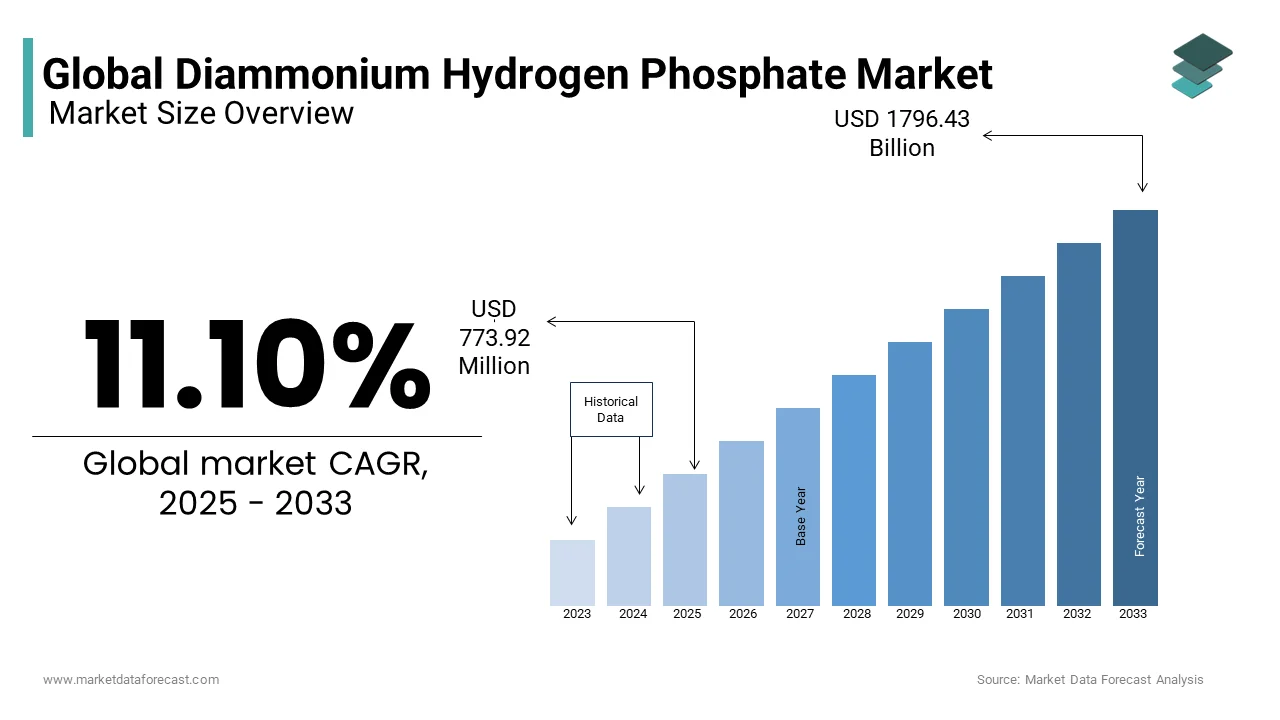
The global diammonium hydrogen phosphate (DAP) market size was valued at USD 773.92 million in 2025, is anticipated to reach USD 859.83 million in 2026, and is projected to scale up to USD 1,995.83 million by 2034, registering a compound annual growth rate (CAGR) of 11.10% during the forecast period from 2026 to 2034. Driven by shrinking cultivable land, increasing population demands for higher crop yields, and broad industrial utility across fire retardants and fermentation, the market continues to experience steady expansion.
Key Executive Metrics (At-a-Glance)
- 2025 Base Valuation: USD 773.92 Million
- 2026 Current Valuation: USD 859.83 Million
- 2034 Forecast Valuation: USD 1,995.83 Million
- Compound Annual Growth Rate (CAGR): 11.10% (2026–2034)
- Dominant Application Segment: Fertilizers (holding high historical volume share due to vital phosphorus and nitrogen nutrient contents)
- Fastest-Growing Application Segment: Fire Retardants & Food Additives (expanding via commercial safety mandates and brewing/wine yeast fermentation)
- Dominant End-User Segment: Fertilizer Sector (leading agricultural applications for crops like peanut, paddy, cotton, and vegetables)
- Regional Leaders: North America (estimated largest market share) and Asia-Pacific (fastest-growing regional hub projected to become the second-largest shareholder)
Core Market Drivers
- Shrinking Arable Land & Population Growth: Heightened reliance on high-performance phosphorus fertilizers to maximize agricultural productivity.
- Industrial Safety Standards: Surging demand for commercial and residential firefighting products and structural fire retardants.
- Diverse Industrial Integration: Essential utilization in yeast fermentation (wine and brewing), metal finishing, and chemical manufacturing.
Primary Market Restraints & Challenges
- Alternative Bio-Fertilizers: Ongoing market development and adoption of eco-friendly, bio-based agricultural substitutes limiting chemical fertilizer dominance.
- Environmental Compliance: Regulatory restrictions governing chemical runoff and volatile compound usage.
Global Diammonium Hydrogen Phosphate Market Segmentation Breakdown
| Segment Category | Leading Sub-Segment (2025 Base) | Fastest-Growing Sub-Segment (2026–2034) |
|---|---|---|
| By Application | Fertilizers (dominant share for crop nutrient supply) | Fire Retardants & Food Additives (fastest-growing via safety and brewing demands) |
| By End-User | Fertilizer Sector (leading agricultural use for staple and vegetable crops) | Chemical & Safety & Hazard (expanding via industrial safety and manufacturing) |
| By Region | North America (largest established regional market share) | Asia-Pacific (fastest-growing regional market poised to become the second-largest shareholder) |
Major Industry Players Profiled
Key enterprises shaping the competitive landscape of the global diammonium hydrogen phosphate market include Bunge, PhosAgro AG, SABIC, Mosaic Co., China Blue Chemicals Ltd., Sichuan Chuanxi Xingda Chemical Co., JR Simplot, and Gujarat Narmada Valley.
 Download Free Sample Report
Global Diammonium Hydrogen Phosphate Market Size
The global diammonium hydrogen phosphate market size was valued at USD 773.92 million in 2025 and is anticipated to reach a valuation of USD 859.83 million in 2026 and USD 1995.83 million by 2034, growing at a CAGR of 11.10% during the forecast period from 2026 to 2034.
Diammonium hydrogen phosphate (DAP) is one of the commonly used phosphorus fertilizers. It has appropriate physical properties and high nutrient content required for crop nurture. DAP fertilizer is extremely soluble and dissolves quickly in soil to release ammonium and phosphorus. Diammonium hydrogen phosphate has various applications such as fire retardants, corrosion inhibitors, chemical additives, and so on. Diammonium hydrogen phosphate is also used for several industrial processes, such as brewing, chemical manufacturing, metal finishing, and many more. Diammonium hydrogen phosphate also helps in yeast fermentation in wine manufacturing.
MARKET DRIVERS
The significant drivers for diammonium hydrogen phosphate are rising dependence on fertilizers because of the shrinking cultivable land and the necessity for higher production yields of crops for the increasing population. Also, a surge in demand for firefighting products aimed at maintaining the environment, health & safety in commercial, industrial, and residential buildings and surroundings in developing economies will boost this industry. However, the development of bio-based and eco-friendly fertilizers limits this industry.
REPORT COVERAGE
| REPORT METRIC | DETAILS |
| Market Size Available | 2025 to 2034 |
| Base Year | 2025 |
| Forecast Period | 2026 to 2034 |
| CAGR | 11.10% |
| Segments Covered | By Application, End Users, and Region. |
| Various Analyses Covered | Global, Regional & Country Level Analysis, Segment-Level Analysis, DROC, PESTLE Analysis, Porter’s Five Forces Analysis, Competitive Landscape, Analyst Overview on Investment Opportunities |
| Regions Covered | North America, Europe, APAC, Latin America, Middle East & Africa |
| Market Leaders Profiled | Bunge, PhosAgro AG, SABIC, Mosaic Co., China Blue Chemicals Ltd., Sichuan Chuanxi Xingda Chemical Co., JR Simplot, and Gujarat Narmada Valley and Others. |
SEGMENTAL ANALYSIS
By End-User Insights
Diammonium Hydrogen Phosphate fertilizer is mostly used for peanut, broomcorn, cotton, paddy, and vegetable crops; hence, the demand is dependent on the production of these crops. The next major application is seen in the wine industry and the yeast industry.
REGIONAL ANALYSIS
North America is estimated to constitute the largest share in this market, while the Asia Pacific region is expected to witness the fastest growth and overtake North America, becoming the second-largest shareholder in the market during the forecast period.
KEY MARKET PLAYERS
Bunge, PhosAgro AG, SABIC, Mosaic Co., China Blue Chemicals Ltd., Sichuan Chuanxi Xingda Chemical Co., JR Simplot, and Gujarat Narmada Valley are the leaders in the global Diammonium Hydrogen Phosphate market. These are some market players that dominate the global diammonium hydrogen market.
MARKET SEGMENTATION
This research report on the global diammonium hydrogen phosphate market is segmented and sub-segmented based on application, end-user, and region.
By Application
- Food Additive,
- Fertilizers,
- and Fire Retardants.
By End-User
- Fertilizer
- Chemical
- and Safety & Hazard.
By Region
- North America
- Europe
- Asia-Pacific
- Latin America
- Middle East Asia