- Product Description Description
- Table of Contents TOC
- List of Table & Figure LOT
- Get Free Sample PDF Sample PDF
Market Size, 2025
$836.5 MnMarket Estimate, 2026
$897.2 MnMarket Forecast, 2034
$1,570.6 MnCAGR, 2026–2034
7.25%Executive Summary: Global Dimethylformamide (DMF) Market
- Market Scope: Comprehensive global evaluation covering solvent types (reactant and feedstock), key application sectors (chemical, electronics, healthcare & pharmaceutical, and agrochemical), and major geographical regions.
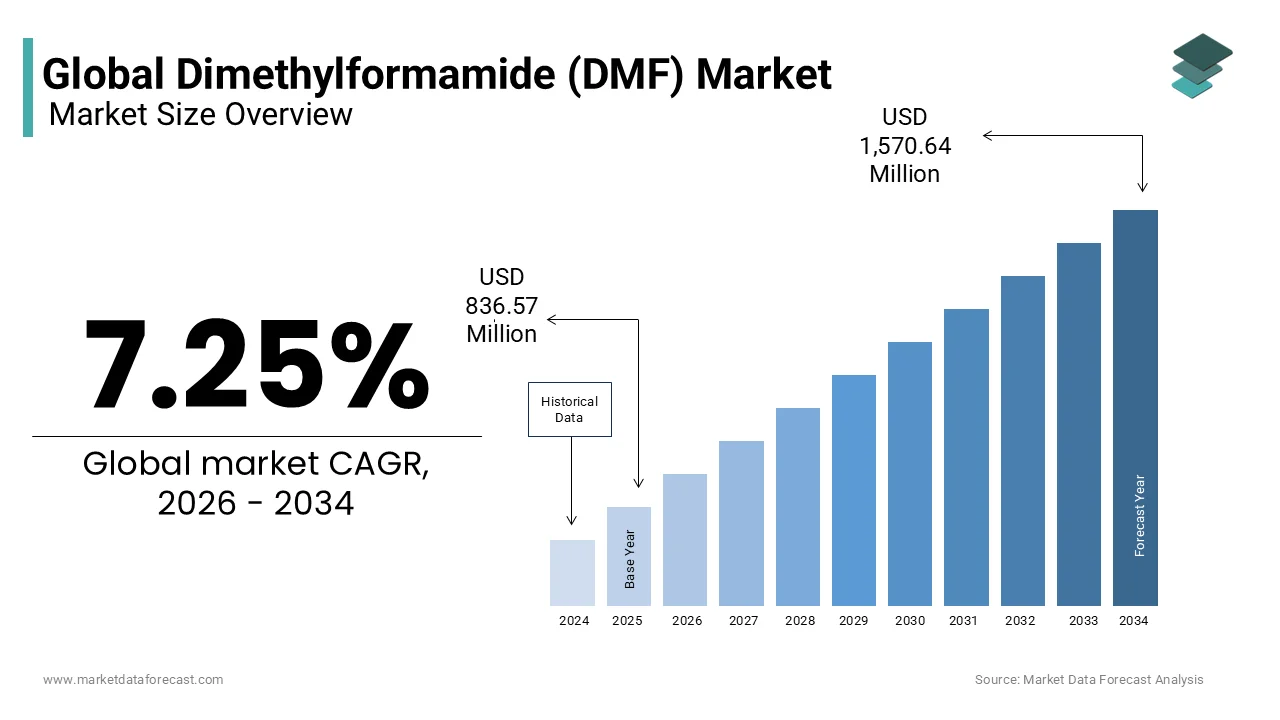
- Market Valuation: Valued at USD 836.57 million in 2025, estimated at USD 897.22 million in 2026, and projected to reach USD 1,570.64 million by 2034, registering a compound annual growth rate (CAGR) of 7.25%.
- Primary Growth Drivers: Escalating demand from chemical, pharmaceutical, electronics, and agrochemical industries, alongside heavy utilization in manufacturing polyurethane products, synthetic leather, shoe soles, and adhesive coatings.
Key Market Segment Metrics (2026–2034)
| Category | Leading Segment Focus | Fastest-Growing / Key Structural Trends |
|---|---|---|
| By Type | Reactant & Feedstock (versatile grades acting as essential hydrophilic aprotic solvents and chemical building blocks) | Specialty Reactants (growing traction driven by precision applications in drug recrystallization and wire enamels) |
| By Application | Chemical & Pharmaceuticals (dominant consumers utilizing DMF for chemical synthesis, pesticide manufacturing, and active pharmaceutical ingredient processing) | Chemical Industry Segment (projected to expand at the highest CAGR during the forecast period due to infrastructure improvements and rising healthcare accessibility) |
| By Region | Asia-Pacific (dominates the global market in terms of volume and value, propelled by rapid industrialization and high output in China) | North America (the second-largest producer, expected to grow at a steady CAGR of 4.8% supported by natural product affordability) |
Major Market Players & Market Structure
Market Structure: Concentrated global landscape driven by major chemical conglomerates focusing on high-purity solvent grades while navigating stringent government environmental restrictions and compliance measures.
Key Companies: INEOS AG, Arkema Group, Henkel AG & Co., Imperial Chemical Corporations, Asahi Corporations, and others.
Global Dimethylformamide (DMF) Market Size
The global dimethylformamide (DMF) market was valued at USD 836.57 million in 2025 and is expected to reach USD 1,570.64 million by 2034 from USD 897.22 million in 2026, growing at a CAGR of 7.25%.
As per the European Chemicals Agency, dimethylformamide is subjected to strict harmonized derived no effect levels requiring worker inhalation exposure to remain below 6 mg/m3 and dermal exposure under 1.1 mg/kg daily. Dimethylformamide (DMF) comprises the global production and commercial distribution of this versatile, polar aprotic solvent, essential for synthesis and spinning processes. According to the United States Food and Drug Administration, regulatory submissions for active pharmaceutical ingredients utilize Drug Master Files to establish chemical safety compliance and processing standards. This polar organic medium serves as a foundational solvent in active pharmaceutical ingredient purification, synthetic leather polyurethane processing, and acrylic fiber wet spinning operations. Strong polar solvency characteristics allow rapid dissolution of high molecular weight polymers, supporting consistent industrial chemical processing workflows across global manufacturing sectors.
MARKET DRIVERS
Surging Demand for Active Pharmaceutical Ingredient Synthesis
Expanding pharmaceutical synthesis operations is a key factor propelling the global dimethylformamide (DMF) market expansion. As per the European Chemicals Agency, thousands of bulk active pharmaceutical substances rely on high purity polar solvents during critical chemical reaction steps and purification phases. The molecule provides high reaction rate acceleration and excellent intermediate solubility, making it indispensable for complex peptide chemical syntheses and heterocycle formation routines. According to the United States Food and Drug Administration, comprehensive Drug Master Files enforce precise chemical purity standards across commercial synthesis operations. Pharmaceutical contract manufacturing organizations scale their solvent procurement to meet escalating global demand for generic and branded therapeutic compounds. Higher yield efficiencies achieved in peptide coupling reactions directly encourage commercial processing plants to utilize this solvent over less effective traditional alternatives. Consequently, growing pharmaceutical production volumes continuously expand the commercial market footprint.
Expanding Application in Polyurethane Synthetic Leather Production
The rising consumer preference for animal free synthetic leather drives the global dimethylformamide (DMF) market further forward. According to the European Chemicals Agency, industrial polymer manufacturing relies on specialized aprotic organic media to process complex synthetic resins. Polyurethane resin formulations dissolved in this polar medium deliver superior viscosity control during continuous coagulation coating operations. As per the United States Bureau of Labor Statistics, industrial chemical processing units supply essential raw material streams to large scale textile and footwear manufacturing supply chains. Continuous technical textile production demands consistent solvent purity to prevent structural defects in coated artificial leather fabrics. The expanding automotive interior and fashion footwear sectors require durable, water resistant polyurethane surfaces, ensuring high recurring solvent consumption. Therefore, scaling technical textile production directly boosts commercial market demand.
MARKET RESTRAINTS
Strict Occupational Exposure Regulations and Health Protections
Stringent workplace safety legislation restricts regional solvent usage and increases baseline operational compliance costs, which impedes the global market growth. As per the European Chemicals Agency, regulatory frameworks enforce a harmonized worker long term inhalation limit of 6 mg/m3 alongside strict dermal exposure caps to mitigate reproductive toxicity risks. Chemical processing facilities must install costly continuous air monitoring systems and closed loop recovery equipment to satisfy occupational safety standards. According to the United States Food and Drug Administration, pharmaceutical and chemical manufacturing sites undergo rigorous environmental control audits to enforce workplace hazard protocols. Elevated worker safety compliance burdens pressure small chemical formulators to seek alternative less toxic chemical solutions. Regulatory scrutiny surrounding toxic solvent emissions increases administrative overhead and operational complexity for chemical producers. Consequently, regulatory compliance mandates significantly hamper market growth across developed regions.
High Environmental Volatility and Hazardous Waste Management Costs
Complex environmental waste disposal requirements hinder profit margins across industrial manufacturing facilities and hamper the global market expansion. According to the European Chemicals Agency, strict waste disposal mandates govern toxic organic solvent emissions to prevent contamination of aquatic ecosystems. Chemical processors face high capital expenditures to maintain advanced distillation towers and thermal oxidizers required for waste stream management. As per the United States Environmental Protection Agency regulatory guidelines, hazardous chemical waste management facilities must comply with rigorous containment and disposal protocols. The substantial energy input needed to distill and recycle contaminated solvent streams inflates baseline utility expenses for chemical manufacturers. High operational costs associated with hazardous solvent recovery reduce overall cost competitiveness against water based alternative processing systems. These escalating environmental management burdens impede ongoing market expansion.
MARKET OPPORTUNITIES
Strategic Integration in Modern Lithium Battery Separator Manufacturing
Accelerating electric vehicle battery manufacturing creates a lucrative commercial pathway for high purity solvent grades. According to the European Chemicals Agency, industrial polymer processing solvents are critical in forming high performance microporous synthetic membranes. Wet process lithium ion battery separators require precise solvent extraction phases to create uniform microporous structures necessary for high ion conductivity. As per the United States Department of Energy, scaling domestic battery supply chains requires massive volume inputs of high purity chemical processing solvents. Advanced separator membrane production lines demand specialized electronic grade purity to eliminate metallic impurities and moisture traces. Membrane manufacturers actively partner with chemical refiners to secure long term bulk solvent contracts designed for battery component lines. Thus, expanding energy storage manufacturing presents an excellent growth opportunity for specialized solvent suppliers.
Growth in High Performance Polyacrylonitrile Carbon Fiber Precursors
Surging industrial demand for lightweight carbon fiber materials opens new high volume market avenues. As per the European Chemicals Agency, high purity polar solvents serve as crucial media during wet spinning processes for advanced synthetic fibers. Polyacrylonitrile precursor spinning relies on uniform polymer dissolution to achieve high tensile strength continuous carbon fiber filaments used in aerospace and wind turbine blades. According to the United States Bureau of Labor Statistics, advanced materials manufacturing sectors expand their chemical inputs to support next generation composite production schedules. Industrial fiber spinners select high efficiency polar media to maintain continuous spinning bath stability and eliminate fiber voids during coagulation. High demand from aerospace structural components and automotive lightweighting drives long term procurement agreements. Consequently, carbon fiber industrialization offers a vital commercial opportunity for high quality solvent providers.
MARKET CHALLENGES
Volatile Petrochemical Raw Material Pricing and Supply Chains
Persistent price fluctuations in underlying petrochemical feedstocks challenge the global dimethylformamide (DMF) market growth. According to the European Chemicals Agency, industrial organic chemical synthesis directly connects to volatile basic petrochemical intermediate supply chains. Direct synthetic routes rely on dimethylamine and carbon monoxide derived from natural gas or crude oil refining processes. As per the United States Energy Information Administration, global crude oil and natural gas price swings directly destabilize downstream chemical manufacturing cost structures. Raw material price volatility forces solvent producers to frequently adjust bulk contract prices, creating friction with industrial procurement managers. Unpredictable feedstock supply disruptions reduce operating margins and prevent steady long term price agreement modeling. Operating within fluctuating energy commodity pricing environments presents a major ongoing challenge for market participants.
Accelerating Commercial Shift Toward Green Solvent Alternatives
Growing industrial preference for non-toxic renewable solvent substitutes directly challenges conventional chemical product lines. As per the European Chemicals Agency, regulatory pressure accelerates research into sustainable alternative solvents to replace hazardous traditional aprotic media. Green alternatives, such as bio based dimethyl isosorbide and dipolar alternative solvents, demonstrate lower toxicity profiles while delivering similar solvency performance. According to the United States Food and Drug Administration, pharmaceutical processing guidelines encourage sustainable chemical engineering strategies that eliminate hazardous reaction solvents. Major pharmaceutical and chemical firms invest heavily in bio based processing technology to satisfy environmental corporate governance targets. Transitioning downstream processes away from hazardous substances threatens long term order volumes for traditional organic solvents. Surmounting competitive displacement by green chemical substitutes remains a pivotal long term market challenge.
REPORT COVERAGE
| REPORT METRIC | DETAILS |
| Market Size Available | 2025 to 2034 |
| Base Year | 2025 |
| Forecast Period | 2026 to 2034 |
| CAGR | 7.25% |
| Segments Covered | By Type, Application, and Region |
| Various Analyses Covered | Global, Regional & Country Level Analysis, Segment-Level Analysis, DROC, PESTLE Analysis, Porter’s Five Forces Analysis, Competitive Landscape, Analyst Overview on Investment Opportunities |
| Regions Covered | North America, Europe, Asia Pacific, Latin America, and Middle East & Africa |
| Market Leaders Profiled | Key companies operating in the market include INEOS AG, BASF SE, Arkema Group, Henkel AG & Co., Eastman Chemical Company, Imperial Chemical Corporations, Luxi Chemical Group Co., Ltd., and Asahi Corporations |
SEGMENTAL ANALYSIS
By Type Insights
The feedstock segment led the market by capturing the largest share of the global dimethylformamide (DMF) market in 2025 due to the high volume consumption as a foundational building block in organic synthesis. As per the European Chemicals Agency, large scale chemical processing facilities process high volume organic intermediate chemicals across continuous production cycles. Industrial chemical plants utilize the molecule as an active carbonylation and formylation building block to synthesize complex agricultural pesticides, pharmaceuticals, and dyes. According to the United States Food and Drug Administration, bulk chemical precursors undergo stringent quality control during pharmaceutical active substance manufacturing processes. Large scale chemical synthesize schedules require stable, continuous feedstock supply lines to support uninterrupted multi ton batch operations. The chemical stability and versatile reactivity profile of the molecule ensure its primary status in basic organic manufacturing plants. Chemical facilities prioritize bulk procurement agreements to lower unit production costs for downstream intermediate compounds. High foundational utility in continuous chemical synthesis guarantees this segment maintains the primary position in global volume distribution.
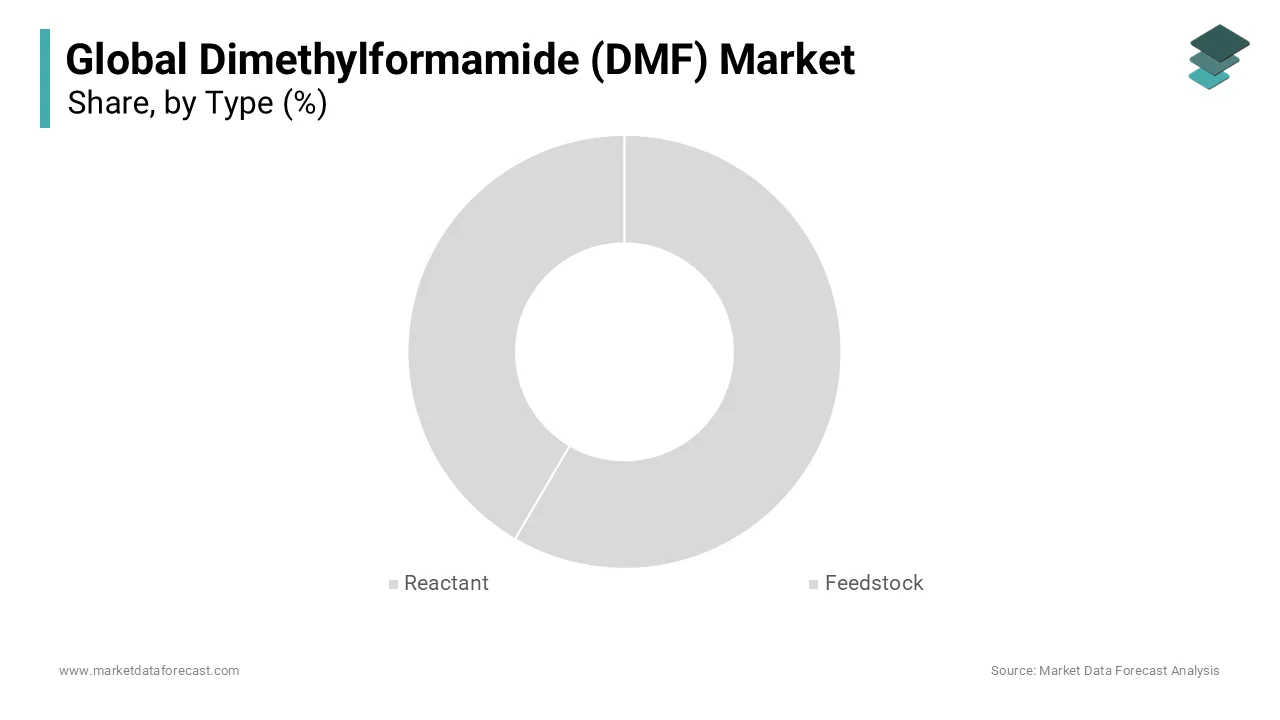
On the other end, the reactant segment represents the fastest growing category and is projected to witness a CAGR of 7.04% over the forecast period in the global market owing to the accelerating utilization in specialized organic reactions and active compound synthesis. As per the European Chemicals Agency, specialized chemical reactions require precise polar media to act simultaneously as a reaction promoter and functional reagent. Advanced chemical synthesis methods utilize the compound directly in Vilsmeier Haack formylation reactions to synthesize complex aromatic aldehydes and heterocycles. According to the United States Food and Drug Administration, novel drug discovery frameworks rely on versatile reagent molecules to streamline complex multi-step therapeutic compound synthesis. High reaction selectivity and rapid conversion rates achieved in specialized fine chemical synthesis boost segment demand across modern research laboratories and active pharmaceutical ingredient plants. Increasing adoption in agricultural chemical formulation synthesis further accelerates global reactant volume consumption. Rapid innovation in active molecule design continues to propel fast growth for reactant application models.
By Application Insights
The chemical segment held the largest share of the global market in 2025 due to widespread reliance on high capacity polar solvents across resin manufacturing, fiber spinning, and chemical synthesis. As per the European Chemicals Agency, industrial chemical enterprises constitute a primary employment and manufacturing sector utilizing polar organic solvents for multi ton processing. Synthetic resin producers depend on powerful solvency performance to manufacture polyurethane coatings, polyacrylonitrile solutions, and specialized wire enamels. According to the United States Bureau of Labor Statistics, chemical manufacturing establishments maintain large scale processing infrastructure to support industrial material supply chains. Bulk chemical plants require high stability processing solvents that resist thermal degradation during continuous recovery and redistillation loops. The sheer volume of industrial polymers, synthetic leathers, and plastic coatings processed globally secures the chemical segment as the largest market volume consumer. Uninterrupted demand from global industrial manufacturing hubs sustains this segment as the primary revenue contributor.
However, the healthcare and pharmaceutical segment is anticipated to showcase a CAGR of 6.8% over the forecast period in the global market owing to the surging global drug manufacturing and complex peptide synthesis routines. As per the European Chemicals Agency, active pharmaceutical ingredient production relies heavily on high purity solvent media to maintain critical reaction yields. The rapid rise in chronic disease treatments accelerates global production of specialized generic and branded therapeutic active substances. According to the United States Food and Drug Administration, regulatory agencies require ultra-pure solvent grades during active substance crystallization to guarantee drug safety. Modern biopharmaceutical synthesis routines, including automated solid phase peptide synthesis, utilize high volumes of specialized pure solvent media. Increasing global healthcare expenditures, combined with expanding contract pharmaceutical manufacturing networks across emerging markets, drive strong demand growth. Tight quality requirements for pharmaceutical grade chemical inputs ensure high value revenue expansion for specialized solvent producers.
REGIONAL ANALYSIS
North America Dimethylformamide (DMF) Market Analysis
North America had the highest share of the global market in 2025 and is estimated to maintain a strong position in the global market over the forecast period owing to the advanced pharmaceutical manufacturing infrastructure and robust industrial chemical production. According to the United States Food and Drug Administration, domestic active pharmaceutical ingredient processing facilities adhere to strict Drug Master File regulatory standards. The strong presence of major biopharmaceutical developers accelerates demand for ultra-pure chemical solvents used in peptide synthesis and active drug purification. As per the United States Bureau of Labor Statistics, domestic chemical manufacturing sectors maintain significant employment and production output across specialized industrial applications. High demand for high performance electronics and lithium ion battery separator membranes further expands regional consumption. However, stringent occupational safety guidelines enforced by federal health agencies mandate advanced closed loop recovery installations. Large scale investments in modern pharmaceutical contract manufacturing facilities sustain steady demand for high purity solvent grades across the United States and Canada.
Europe Dimethylformamide (DMF) Market Analysis
Europe holds a significant share of the global market due to the rigorous environmental oversight and advanced chemical engineering standards. As per the European Chemicals Agency, worker exposure regulations enforce strict derived no effect levels of 6 mg/m3 for inhalation exposure across regional processing plants. European chemical producers lead in implementing closed loop recycling systems and low emission handling equipment to satisfy environmental directives. According to Eurostat, chemical and pharmaceutical manufacturing represents a vital industrial sector supporting high value regional export economies. High demand from technical textile manufacturers, fine chemical synthesis units, and automotive coating plants supports steady volume procurement. Regional facility managers heavily prioritize certified safety and quality standards to maintain regulatory compliance across European Union member states. Strong emphasis on sustainable chemical processing drives European producers toward highly efficient solvent recovery and closed loop operational models.
Asia Pacific Dimethylformamide (DMF) Market Analysis
Asia Pacific commands the primary market position due to the massive industrial chemical production capacity, expanding textile manufacturing, and growing active drug synthesis hubs. As per the European Chemicals Agency, global industrial solvent processing is heavily concentrated in expanding manufacturing economies. China and India represent major global production hubs for synthetic leather, polyacrylonitrile fibers, and bulk generic active pharmaceutical ingredients. According to the United States Food and Drug Administration, international drug ingredient manufacturing sites supply a significant portion of global pharmaceutical active substances under strict Drug Master File compliance. Rapid expansion of regional electronics manufacturing and lithium ion battery separator production creates high demand for specialized electronic grade solvent batches. Lower local production costs combined with vast raw material availability support large scale manufacturing capacity expansion across major regional industrial parks. Unmatched chemical synthesis capacity secures Asia-Pacific as the dominant global market center.
Latin America Dimethylformamide (DMF) Market Analysis
Latin America occupies a developing market position and is driven by expanding agrochemical processing, pharmaceutical formulation, and industrial textile manufacturing. As per the European Chemicals Agency, international chemical trade supports expanding agricultural and industrial formulation operations across emerging markets. Growing regional production of crop protection chemicals relies on efficient chemical solvents to synthesize active pesticide molecules. According to the United States Bureau of Labor Statistics, international demand for industrial intermediate chemicals drives expanded supply chain logistics across Latin American trade corridors. Industrial growth in Brazil and Mexico accelerates commercial demand for polyurethane synthetic leather and automotive interior coatings. Expanding local active drug manufacturing facilities seek high quality solvent supplies to support local pharmaceutical self-sufficiency targets. Modernization of regional chemical processing facilities gradually increases domestic demand for high purity industrial solvent lines.
Middle East and Africa Dimethylformamide (DMF) Market Analysis
Middle East and Africa represents an emerging market region due to the expanding downstream petrochemical integration projects and industrial diversification programs. As per the European Chemicals Agency, international petrochemical manufacturing partnerships enhance downstream organic chemical synthesis capabilities across energy rich territories. Regional industrial development plans focus on converting basic oil and gas feedstocks into higher value intermediate solvents and fine chemicals. According to the United States Energy Information Administration, large scale investments in domestic refining infrastructure expand feedstock availability for synthetic chemical plants. Expanding regional industrial infrastructure supports growing consumption in industrial coatings, pesticide formulations, and water treatment chemical manufacturing. State backed economic diversification initiatives across the Gulf Cooperation Council encourage investment in modern industrial parks equipped for downstream chemical synthesis. Growing local industrialization ensures long term expanding market potential across major regional economic zones.
COMPETITIVE LANDSCAPE
The competitive landscape of the Dimethylformamide (DMF) Market is consolidated among major multinational chemical corporations and large scale Asian chemical synthesis groups. Key competitors engage in intense rivalry based on bulk pricing structures, product purity levels, regulatory compliance capabilities, and raw material integration advantages. Large vertically integrated chemical manufacturers hold significant competitive edges due to their direct access to essential feedstocks like dimethylamine and carbon monoxide, lowering unit production costs. Multinational vendors maintain dominant positions in high value pharmaceutical and electronic grade market segments due to advanced purity certification capabilities and extensive regulatory compliance documentation. The market experiences ongoing capital investment as leading players upgrade environmental management systems and acquire regional chemical distributors to strengthen customer reach across developing industrial manufacturing territories.
KEY MARKET PLAYERS
The major key players in the global Dimethylformamide (DMF) Market are
- INEOS AG
- BASF SE
- Arkema Group
- Henkel AG & Co.
- Eastman Chemical Company
- Imperial Chemical Corporations
- Luxi Chemical Group Co., Ltd.
- Asahi Corporations
Top Players in the Market
- BASF SE contributes significantly to the market through its extensive global chemical production network, supplying high purity organic solvents for pharmaceutical synthesis, electronics manufacturing, and polymer processing. The company focuses on integrated production site efficiency, ensuring high quality supply chains across international markets. To strengthen its market position, BASF SE expanded its global methylamines and higher carboxylic acid amine derivatives production capacity in early 2023, enhancing its core feedstock integration and stabilizing solvent production capacity across major regional manufacturing hubs.
- Eastman Chemical Company provides vital market contributions by manufacturing high performance chemical intermediates and specialized solvents for industrial coatings, active pharmaceutical ingredients, and agricultural formulations. The firm prioritizes sustainable operational technology, efficient solvent distribution, and high purity product grades. To reinforce its competitive market standing, Eastman Chemical Company expanded its specialized chemical distribution network in late 2022, securing key supply chain agreements with international pharmaceutical and technical textile manufacturers across North America and Europe.
- Luxi Chemical Group Co., Ltd. contributes extensively to the market through its massive chemical manufacturing complexes, delivering large volume industrial solvents and organic intermediate building blocks. The organization utilizes vertically integrated manufacturing parks to optimize production economics and support major industrial markets. To solidify its market presence, Luxi Chemical Group Co., Ltd. completed major chemical synthesis facility modernizations in mid-2023, upgrading its environmental protection infrastructure and expanding high volume synthesis lines to serve growing Asian electronics and pharmaceutical sectors.
Top Strategies Used by Key Market Participants
Key participants in the Dimethylformamide (DMF) Market prioritize strategic chemical facility expansion, vertical raw material integration, and closed loop solvent recovery technology to secure long term market growth. Leading chemical vendors allocate substantial capital toward modernizing synthetic plants, enabling continuous production optimization and precise quality control. Companies actively integrate advanced emissions capture hardware and closed loop distillation units to satisfy strict environmental and occupational exposure regulations. Strategic partnerships with multinational pharmaceutical active substance producers and lithium battery separator manufacturers ensure predictable, long term volume off take contracts. Furthermore, key players focus on expanding geographic distribution networks and offering high purity electronic grade solvent lines to capture premium margins across expanding high tech battery and semiconductor manufacturing sectors.
Global Dimethylformamide (DMF) Market News
- In October 2022, Eastman Chemical Company, a global specialty chemical firm, expanded its international intermediate solvent distribution network through new strategic logistics partnerships. This expansion is anticipated to allow Eastman Chemical Company to offer more efficient chemical supply solutions and strengthen the Dimethylformamide (DMF) Market.
- In March 2023, BASF SE, a leading multinational chemical manufacturer, completed a major capacity expansion for key amine derivative intermediates at its Verbund production sites. This expansion is anticipated to allow BASF SE to offer increased feedstock stability and strengthen the Dimethylformamide (DMF) Market.
- In July 2023, Luxi Chemical Group Co., Ltd., a major chemical enterprise, upgraded its high volume chemical synthesis facilities with advanced environmental emissions control hardware. This technical upgrade is anticipated to allow Luxi Chemical Group Co., Ltd. to improve regulatory compliance and strengthen the Dimethylformamide (DMF) Market.
- In November 2023, Zhejiang Jiangshan Chemical Co., Ltd., a prominent chemical manufacturer, optimized its organic solvent distillation units to enhance product purity grades for electronics manufacturing. This process optimization is anticipated to allow Zhejiang Jiangshan Chemical Co., Ltd. to access high value battery separator accounts and strengthen the Dimethylformamide (DMF) Market.
- In May 2024, Jiutian Chemical Group Limited, a key alkylamines and organic solvent producer, completed comprehensive maintenance and efficiency upgrades across its main chemical production lines. This operational enhancement is anticipated to allow Jiutian Chemical Group Limited to deliver higher manufacturing reliability and strengthen the Dimethylformamide (DMF) Market.
MARKET SEGMENTATION
This research report on the global dimethylformamide (DMF) market has been segmented and sub-segmented based on type, application, and region.
By Type
- Reactant
- Feedstock
By Application
- Chemical
- Electronics
- Healthcare & Pharmaceutical
- Agrochemical
By Region
- North America
- Europe
- Asia Pacific
- Latin America
- The Middle East and Africa