- Product Description Description
- Table of Contents TOC
- List of Table & Figure LOT
- Get Free Sample PDF Sample PDF
Market Size, 2025
$497.26 MnMarket Estimate, 2026
$537.54 MnMarket Forecast, 2034
$1,002.00 MnCAGR, 2026–2034
8.10%Executive Summary: Global Document Cameras Market
- Market Scope: Comprehensive global market analysis of document cameras (visual presentation systems) covering types, applications, connectivity interfaces, end users, and regional performance.
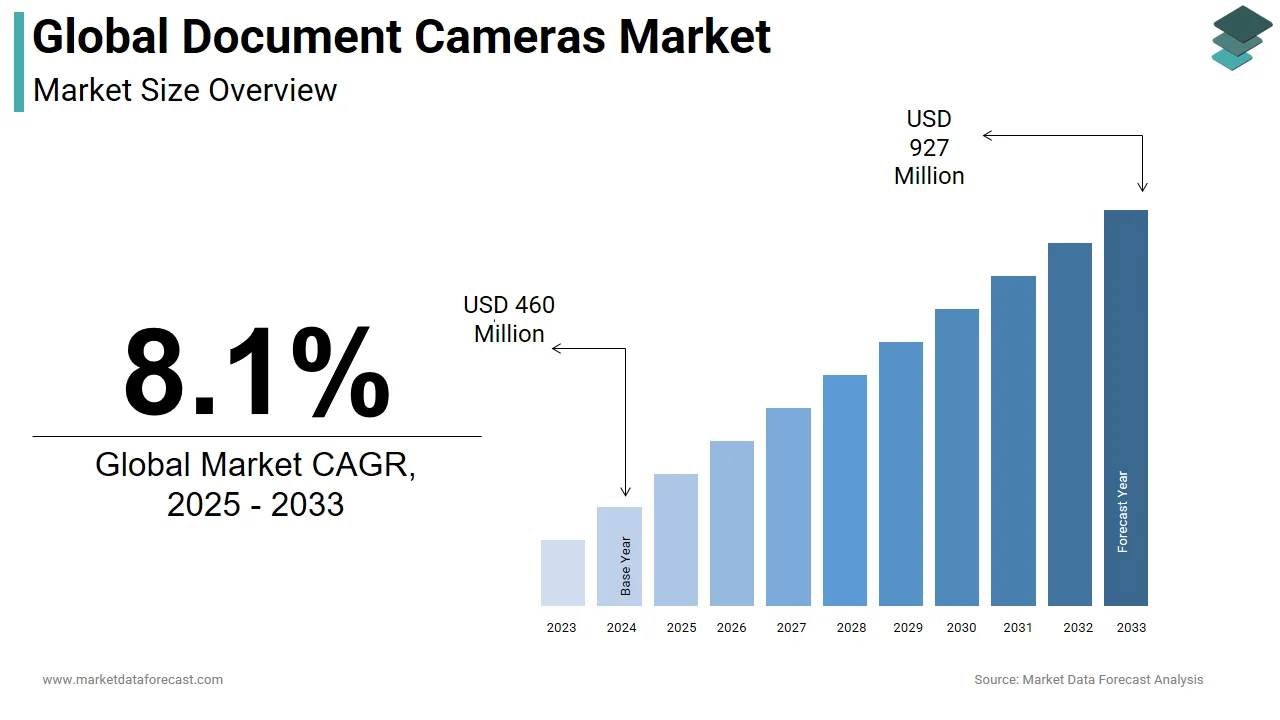
- Market Valuation: Valued at USD 497.26 million (2025), estimated at USD 537.54 million (2026), and projected to reach USD 1,002 million by 2034, growing at a CAGR of 8.1% (2026–2034).
- Primary Growth Drivers: Rising demand for digitized content in education and business sectors, rapid digitization and adoption of e-learning tools, and investments in advanced conference room systems.
Key Market Segment Metrics (2026–2034)
| Category | Leading Segment Focus | Fastest-Growing Segment Focus |
|---|---|---|
| By Type | Portable Document Cameras | Portable & Compact Units |
| By Application / End User | Educational Institutions (Schools, Universities) | Corporate & Online Education Sectors |
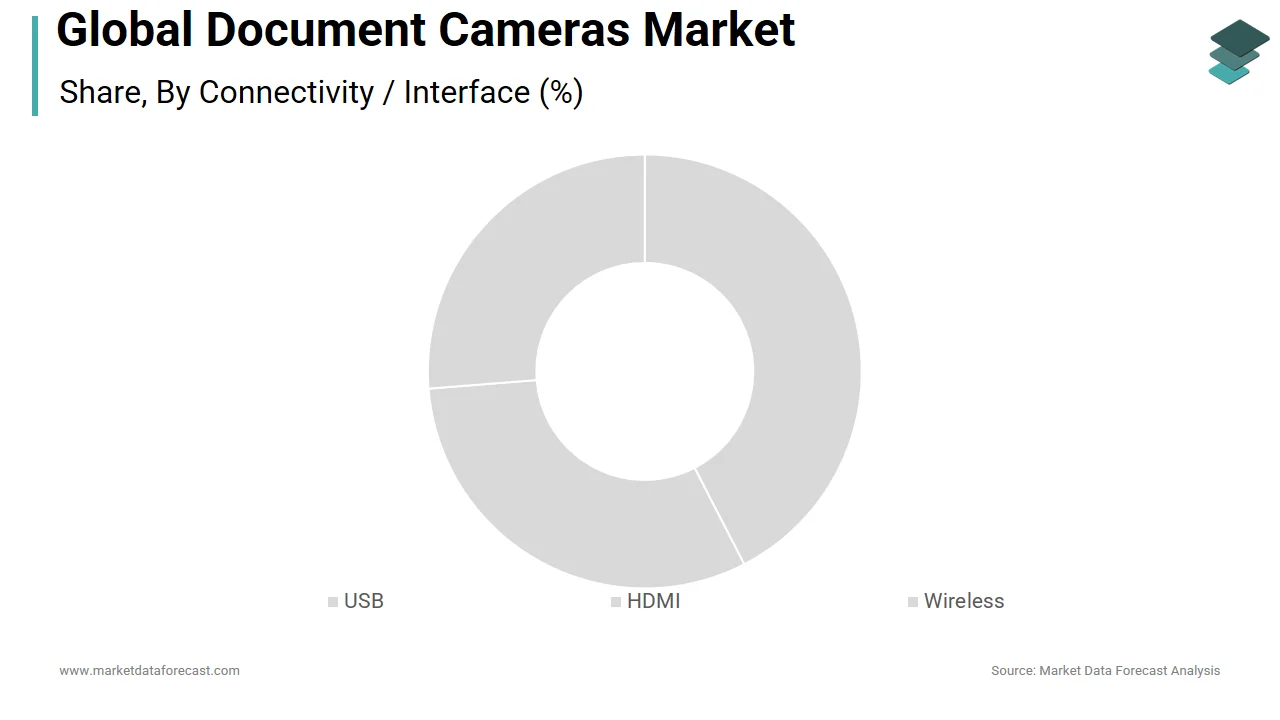
| By Connectivity / Interface | Wired Connectivity (USB, HDMI) | Wireless Connectivity Solutions |
| By Region | North America (significant market share & established tech presence) | Asia-Pacific (highest growth rate driven by EdTech adoption in China & India) |
Major Market Players & Market Structure
Market Structure: Competitive global landscape populated by prominent imaging and display technology manufacturers focusing on high-definition 4K output, portability, and seamless integration with digital classrooms and conference systems.
Key Companies: AVer Information, ELMO USA Corp, Seiko Epson Corporation, IPEVO Inc., Lumens, and WolfVision.
 Download Free Sample Report
Global Document Cameras Market Size
The global document cameras market was valued at USD 497.26 million in 2025. The market is estimated at USD 537.54 million in 2026 and is projected to reach USD 1,002 million by 2034, growing at a CAGR of 8.1% from 2026 to 2034.
Document cameras are specialized visual presentation devices used to capture and display physical documents, objects, and three-dimensional items in real time for educational, corporate, and professional settings. These devices have become essential tools for hybrid learning environments and remote collaboration workflows. The widespread connectivity ensures that captured images can be seamlessly shared across networks. The effective technology integration improves student engagement and comprehension by allowing teachers to model tasks visually and interactively.
MARKET DRIVERS
Expansion of Hybrid and Remote Learning Models
The widespread adoption of hybrid and remote learning models is accelerating the growth of the propelling the growth of the document cameras market. Educators require devices that can share handwritten notes, textbooks, and physical experiments with students participating virtually. According to the United Nations Educational, Scientific and Cultural Organization, over 1.6 billion learners were affected by school closures during recent global health crises, which accelerated the permanent integration of digital teaching aids. This shift necessitates equipment that allows teachers to maintain traditional teaching methods while reaching remote audiences. Educational institutions are investing heavily in classroom technology upgrades to support flexible learning formats, ensuring that faculty can effectively engage both in-person and online students simultaneously. Document cameras enable real-time annotation and demonstration, which are difficult to replicate with standard webcams. The demand for high-definition video output ensures that small text and details are visible to all participants. Schools prioritize user-friendly interfaces to minimize technical barriers for educators.
Corporate Digital Transformation and Collaboration
The accelerating digital transformation in corporate environments is boosting the growth of the document camera market. Businesses utilize these devices to share physical contract prototypes and whiteboard sessions during virtual meetings with clients and distributed teams. Remote work has increased significantly, with many organizations adopting permanent hybrid policies that require robust visual communication tools. Document cameras facilitate clear visibility of physical artifacts, which is essential for industries such as engineering, healthcare, and legal services. Companies are prioritizing technology investments that improve employee productivity and collaboration efficiency in decentralized work structures. The ability to instantly digitize and share physical documents reduces delays and errors in decision-making. High-resolution imaging ensures that fine details in blueprints or medical scans are accurately conveyed. Integration with popular video conferencing platforms simplifies workflow for users. Corporations seek durable and portable solutions for flexible office setups.
MARKET RESTRAINTS
High Initial Costs and Budget Constraints
The significant financial investment requirements to limit procurement capabilities for underfunded educational institutions and small businesses that is restraining the growth of the document cameras market. High-end models with advanced features, such as 4K resolution and wireless connectivity, command premium prices that may exceed available budgets. Many school districts face persistent funding gaps, which force administrators to prioritize essential infrastructure over supplementary teaching technologies. This financial pressure delays or cancels orders for new visual presentation equipment. Small enterprises often operate with limited capital reserves, making it difficult to justify the expense of specialized hardware when free software alternatives exist. Maintenance and replacement costs further add to the total cost of ownership. Technical support and training expenses also strain limited resources. Organizations may opt for lower-quality substitutes that offer inferior performance. The lack of bulk purchasing power for smaller entities exacerbates the cost barrier.
Competition from Smartphone and Tablet Alternatives
The prevalence of multifunctional mobile devices is hampering the growth of the document cameras market. Smartphones and tablets equipped with high-resolution cameras and scanning applications can perform many functions of dedicated document cameras without additional hardware investment. Many adults in developed nations own a smartphone, which serves as an immediate tool for digitizing documents and sharing images via email or messaging apps. This ubiquity reduces the perceived necessity of purchasing standalone document camera units. The tablet shipments remain robust, with many users leveraging built-in cameras for educational and professional tasks, eliminating the need for separate peripherals. Mobile apps offer optical character recognition and automatic edge detection, which enhance usability. The convenience of carrying a single device for multiple purposes appeals to budget-conscious consumers. Educational institutions may rely on student-owned devices rather than installing fixed systems.
MARKET OPPORTUNITIES
Integration with Artificial Intelligence and Software
The incorporation of artificial intelligence capabilities to enhance functionality and user experience through smart features is solely to create new opportunities for the growth of the document cameras market. AI-driven software can automatically crop images, correct perspective distortions, and convert handwritten text into editable digital formats in real time. The advancements in computer vision algorithms have improved object recognition accuracy by enabling more reliable automated document processing. This technological integration adds value beyond simple image capture. Machine learning models can analyze educational content to provide instant feedback and suggestions for improvement, which supports interactive learning environments. Teachers can use these features to grade assignments or annotate diagrams efficiently. Corporate users benefit from automated data entry and archival systems. Software subscriptions create recurring revenue streams for manufacturers. Cloud connectivity allows for seamless storage and sharing of processed documents. The opportunity lies in transforming hardware into intelligent productivity hubs.
Growth in Healthcare and Medical Training Applications
The expanding use of document cameras in healthcare and medical training is additional factor to escalate the growth of the document cameras market. Medical professionals utilize these devices to display patient records, X-rays, and surgical procedures for collaborative diagnosis and education. Telemedicine usage has stabilized at higher levels post-pandemic, requiring tools that facilitate remote consultation and visual examination of physical evidence. Document cameras enable specialists to review detailed medical images with colleagues in real time. Medical schools are increasingly adopting digital simulation and visualization tools to enhance student understanding of complex anatomical structures and clinical techniques. High-resolution cameras allow for precise viewing of small samples and instruments. The hygiene benefits of contactless document sharing are valued in clinical settings. Portable units support field diagnostics and remote patient monitoring. The market can develop specialized medical-grade models with enhanced sterilization features.
MARKET CHALLENGES
Rapid Technological Obsolescence
The fast pace of technological advancement is shortening product life cycles and increasing pressure on manufacturers to innovate continuously, which is one of the key factors impeding the growth of the document cameras market. Consumers expect regular updates in resolution, connectivity, and software features, which renders older models obsolete quickly. The average replacement cycle for electronic peripherals has decreased to less than three years due to rapid improvements in sensor technology and processing power. This trend forces companies to invest heavily in research and development to stay competitive. Frequent product launches create inventory management challenges and risk of unsold stock for distributors and retailers. Customers may delay purchases in anticipation of newer models. Supporting legacy devices becomes costly for manufacturers. The need for constant firmware updates and compatibility checks strains technical support resources. Rapid obsolescence affects customer satisfaction and brand loyalty. Companies must balance innovation with product durability.
Complexity of Integration and Compatibility Issues
Difficulties in integrating document cameras with diverse existing systems create friction for users and increase support burdens, which also contributes to the decline of the document cameras market. Variations in operating systems, video conferencing platforms, and display standards can lead to connectivity problems and performance inconsistencies. Many educators report technical difficulties when connecting peripheral devices to classroom infrastructure, which reduces instructional time and causes frustration. Lack of universal plug-and-play compatibility complicates setup for non-technical users. Differing video output protocols require adapters and specific drivers, which may not be readily available or easy to install. IT departments struggle to manage heterogeneous device environments. Software conflicts can cause crashes or reduced image quality. Users require extensive training to troubleshoot common issues. Manufacturers face higher customer service costs due to compatibility queries. Standardization efforts are ongoing, but progress is slow.
REPORT COVERAGE
| REPORT METRIC | DETAILS |
| Market Size Available | 2025 to 2034 |
| Base Year | 2025 |
| Forecast Period | 2026 to 2034 |
| Segments Covered | By Type, Application, Connectivity / Interface, End User, and Region. |
| Various Analyses Covered | Global, Regional, and Country-Level Analysis, Segment-Level Analysis, Drivers, Restraints, Opportunities, Challenges; PESTLE Analysis; Porter’s Five Forces Analysis, Competitive Landscape, Analyst Overview of Investment Opportunities |
| Regions Covered | North America, Europe, Asia-Pacific, Latin America, Middle East and Africa |
| Market Leaders Profiled | AVer Information, ELMO USA Corp, WolfVision Inc, Seiko Epson Corporation, IPEVO Inc, Lumens, and others. |
SEGMENTAL ANALYSIS
By Type Insights
The desktop document cameras segment was the largest, accounting for a prominent share of the document cameras market due to its stability, high image quality, and suitability for fixed installation in classrooms and conference rooms. These units offer superior optical zoom and lighting conditions, which are essential for detailed presentations of textbooks and small objects. The advanced infrastructure supports the dominance of desktop models in institutional settings. Teachers report higher satisfaction with desktop cameras due to their ease of use and reliable connectivity compared to portable alternatives, which often suffer from battery or connection issues. The robust build quality ensures longevity in high-traffic environments. Schools and corporations prioritize durability and image fidelity for daily instructional use. Desktop models integrate seamlessly with existing projector and interactive whiteboard setups. The segment benefits from bulk procurement contracts by educational districts. Professional users value the hands-free operation provided by stable stands.
The portable document cameras segment is likely to grow at the fastest CAGR of 9.2% from 2026 to 2034 with the increasing demand for flexibility and remote work capabilities. These lightweight devices allow users to share physical documents from any location, making them ideal for hybrid work and field operations. The number of remote workers has increased significantly, with many professionals requiring compact tools to digitize and share paperwork during virtual meetings. This trend accelerates the adoption of USB-powered portable cameras. Sales of mobile peripherals, including portable scanners and cameras, have risen, as consumers seek versatile solutions for home offices and travel. The ability to connect directly to laptops and tablets without external power sources enhances convenience. Educators appreciate the portability for sharing student work across different classrooms. Healthcare workers use portable units for telemedicine consultations involving physical records. Manufacturers focus on miniaturization and wireless connectivity to meet user needs.
By Application Insights
The education segment was the largest, holding 44.8% of the document cameras market share in 2025 due to the widespread integration of visual aids in modern teaching methodologies. Teachers rely on these devices to project textbook pages, worksheets, and science experiments to entire classes, enhancing engagement and comprehension. The high usage rate sustains strong demand for educational grade equipment. School districts continue to allocate significant portions of their technology budgets to classroom hardware upgrades, including document cameras to support digital curriculum initiatives. The shift toward interactive learning environments favors devices that allow real-time annotation. Universities also adopt these tools for lecture capture and remote instruction. The segment benefits from government grants aimed at improving educational technology infrastructure. Standardized testing and assessment processes often require digital submission of handwritten work.
The healthcare segment is likely to grow at the fastest CAGR of 9.2% from 2026 to 2034 with the expansion of telemedicine and digital health records. Medical professionals use these devices to share patient charts, lab results, and diagnostic images during remote consultations and multidisciplinary team meetings. Telemedicine visits have stabilized at higher levels post-pandemic, creating a sustained need for tools that facilitate visual examination of physical documents. This demand drives adoption in hospitals and clinics. Medical training programs are increasingly incorporating digital visualization tools to enhance student learning and collaborative diagnostic skills. High-resolution cameras allow for detailed viewing of X-rays and skin conditions. The hygiene benefits of contactless document sharing are valued in clinical settings. Portable units support field diagnostics and home health visits. Regulatory requirements for accurate record-keeping also boost demand.
By End User Insights
The educational institutions segment was the largest, accounting for 34.6% of the document cameras market share in 2025, as they represent the largest volume of users requiring visual presentation tools for daily instruction. Schools, colleges, and universities deploy these devices in classrooms, lecture halls, and libraries to support teaching and learning activities. The widespread infrastructure supports high penetration rates. Higher education institutions are investing in classroom technology to support hybrid learning models and ensure that faculty can effectively engage both in-person and online students. The need to share physical materials such as manuscripts and artifacts drives demand. Administrative offices also use these devices for processing student records and forms. Bulk purchasing agreements with district-level authorities ensure steady sales volumes. Teacher training programs emphasize the use of visual aids for effective pedagogy. The segment benefits from recurring replacement cycles as technology evolves.
The corporate offices segment is expected to grow at the fastest CAGR of 5.4% during the forecast period with the normalization of hybrid work and the need for efficient document collaboration. Businesses utilize these devices to share contract prototypes and whiteboard sessions during virtual meetings with clients and distributed teams. The remote and hybrid work arrangements have become permanent for many organizations, requiring robust visual communication tools to maintain productivity. This shift drives procurement for conference rooms and home office setups. Companies are prioritizing technology investments that improve employee collaboration and reduce travel costs associated with in-person meetings. Legal and financial firms use document cameras for secure review of sensitive physical documents. Engineering teams share blueprints and design sketches in real time. The demand for high-definition and secure data transmission features is increasing. Portable models appeal to employees who split time between office and home.
REGIONAL ANALYSIS
North America Document Cameras Market Analysis
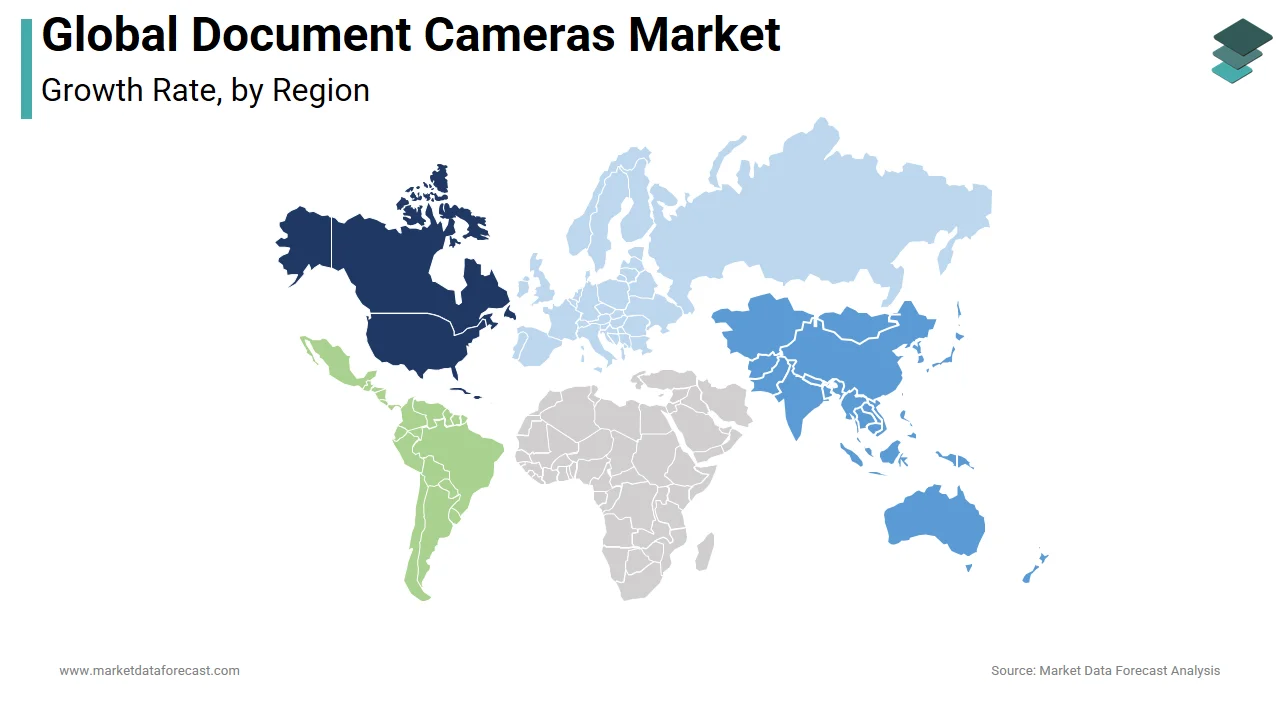
North America was the top performer in the document cameras market, capturing a 49.4% share in 2025 due to its advanced educational infrastructure and early adoption of digital teaching tools. The region benefits from high spending on classroom technology and a strong presence of major manufacturers. The United States has one of the highest ratios of computers to students globally, which facilitates seamless integration of document cameras into daily lessons. This technological readiness drives consistent demand. US universities are leading in the implementation of hybrid learning models, which requires substantial investment in visual presentation hardware to support remote participants. Government initiatives such as the E Rate program provide funding for school technology upgrades. The corporate sector also contributes significantly, with high adoption rates in professional services. Consumers prefer high-resolution and feature-rich models. Strong distribution networks ensure wide availability.
Europe Document Cameras Market Analysis
Europe document cameras market was ranked second, with 32.2% of the share in 2025 with the strong regulatory standards and focus on digital equity in education. The region sees steady adoption driven by government initiatives to modernize school infrastructure. The Digital Education Action Plan aims to equip all schools with high-speed internet and digital devices, which includes visual presentation tools like document cameras. Countries invest heavily in teacher training for technology integration, ensuring effective use of classroom hardware. Germany, France, and the United Kingdom are key markets with high procurement volumes. Privacy regulations such as GDPR influence data handling features in devices. The corporate sector adopts these tools for cross-border collaboration. Environmental sustainability standards drive demand for energy-efficient models. European manufacturers focus on quality and durability.
Asia Pacific Document Cameras Market Analysis
Asia Pacific document cameras market growth is expected to grow at the fastest CAGR in the coming years due to rapid modernization of educational systems and growing corporate sectors. Countries like China, India, and Japan are investing heavily in digital classroom solutions to improve learning outcomes. Asia has seen a significant increase in internet connectivity in schools, which enables the use of cloud-based document camera applications. Large-scale initiatives to equip rural schools with digital tools have boosted demand for affordable and durable document cameras. The region benefits from local manufacturing capabilities, which reduce costs. Corporate adoption is rising in tech hubs such as Bangalore and Singapore. Consumers prefer value-for-money products with essential features. Government tenders drive bulk purchases in the public sector.
Latin America Document Cameras Market Analysis
Latin America document cameras market growth is to grow steadily in coming years with the interest in digital education and remote work solutions. The investments in digital infrastructure are facilitating the adoption of educational technologies in public schools across the region. As per the Economic Commission for Latin America and the Caribbean, the shift toward remote work in urban centers has increased demand for home office equipment including document cameras for professional use. Brazil and Mexico are key contributors with active educational technology sectors. Economic volatility affects purchasing power, but international aid programs support school upgrades. Local distributors focus on affordable entry-level models. Internet connectivity improvements enable cloud-based features. Teachers seek simple and robust solutions for limited resources.
Middle East and Africa Document Cameras Market Analysis
The Middle East and Africa document cameras market growth is driven by government visions for digital transformation and education reform. Gulf countries are investing in smart city projects and modern school facilities. The initiative creates demand for basic document cameras. The digital literacy programs in the Middle East are encouraging the use of technology in classrooms to improve student engagement and outcomes. South Africa and the United Arab Emirates are leading adopters in the region. The market is influenced by import dependencies and currency fluctuations. International donors support educational technology projects. Corporate adoption is growing in financial and legal sectors. The region prefers durable and low-maintenance devices.
COMPETITIVE LANDSCAPE & STRATEGIES
The document cameras market features a moderately fragmented competitive landscape with a mix of established electronics manufacturers and specialized educational technology providers. Competition is driven by image quality, ease of integration, and price competitiveness. Key participants compete by offering high-resolution sensors, wireless connectivity, and user-friendly software interfaces. Companies differentiate themselves through proprietary software features such as optical character recognition and real-time annotation tools. Strategic partnerships with school districts and corporate IT departments are common to secure long-term contracts. The presence of low-cost alternatives from generic brands pressures margins for premium players. Innovation in portability and battery life is a key differentiator for remote work applications. Intellectual property protection for software algorithms remains crucial.
KEY MARKET PLAYERS
The leading companies operating in the global document cameras market include
- AVer Information
- ELMO USA Corp.
- WolfVision Inc.
- Seiko Epson Corporation
- IPEVO Inc.
- Lumens
TOP PLAYERS IN THE MARKET
- IPEVO Inc. operates as a leading innovator in the document camera sector by focusing on portable and versatile visual presentation solutions for education and business. The company recently launched updated models with enhanced resolution and wireless connectivity features to support hybrid learning environments. These advancements allow teachers and professionals to share physical documents seamlessly across digital platforms. IPEVO emphasizes user-friendly design and durability, which appeals to educational institutions seeking reliable classroom tools. The company actively engages with educators through training workshops and online resources to maximize product utility. Its commitment to customer support ensures high satisfaction rates among institutional buyers.
- Elmo USA Corp contributes significantly to the document cameras market by providing high-quality desktop and portable document cameras known for superior image clarity and robust build. The company recently introduced advanced models featuring artificial intelligence-powered autofocus and real-time annotation capabilities. These features enhance instructional efficiency and engage students through interactive visual experiences. Elmo collaborates with educational technology integrators to ensure seamless compatibility with existing classroom infrastructure. The company also offers comprehensive warranty and support services, which build trust among school administrators. Elmo focuses on developing eco-friendly manufacturing processes to align with sustainability goals. Its products are widely used in higher education and corporate training settings.
- WolfVision Inc. plays a vital role in the document camera market by specializing in high-end visualizers for professional and industrial applications. The company recently expanded its product line to include 4K resolution units with advanced color reproduction and low-light performance. These capabilities meet the stringent requirements of medical, legal, and engineering sectors. WolfVision focuses on ergonomic design and intuitive software integration to streamline workflow for professionals. The company partners with system integrators to provide customized solutions for complex presentation needs. Its devices are renowned for longevity and minimal maintenance requirements. WolfVision invests heavily in research and development to stay ahead of technological trends.
MARKET SEGMENTATION
This research report on the global document cameras market has been segmented and sub-segmented based on type, application, connectivity / interface, end user, and region.
By Type
- Portable Document Cameras
- Desktop Document Cameras
By Application
- Education
- Corporate
- Healthcare
- Government
- Legal & Others
By Connectivity / Interface
- USB
- HDMI
- Wireless
By End User
- Educational Institutions (Schools, Universities)
- Corporate Offices
- Healthcare Facilities (Hospitals, Clinics)
- Government & Legal Organizations
By Region
- North America
- Europe
- Asia-Pacific
- Latin America
- Middle East and Africa