- Product Description Description
- Table of Contents TOC
- List of Table & Figure LOT
- Get Free Sample PDF Sample PDF
Market Size, 2025
$9.51 BnMarket Estimate, 2026
$10.13 BnMarket Forecast, 2034
$16.82 BnCAGR, 2026–2034
6.54%Global Drilling Fluid Market Summary
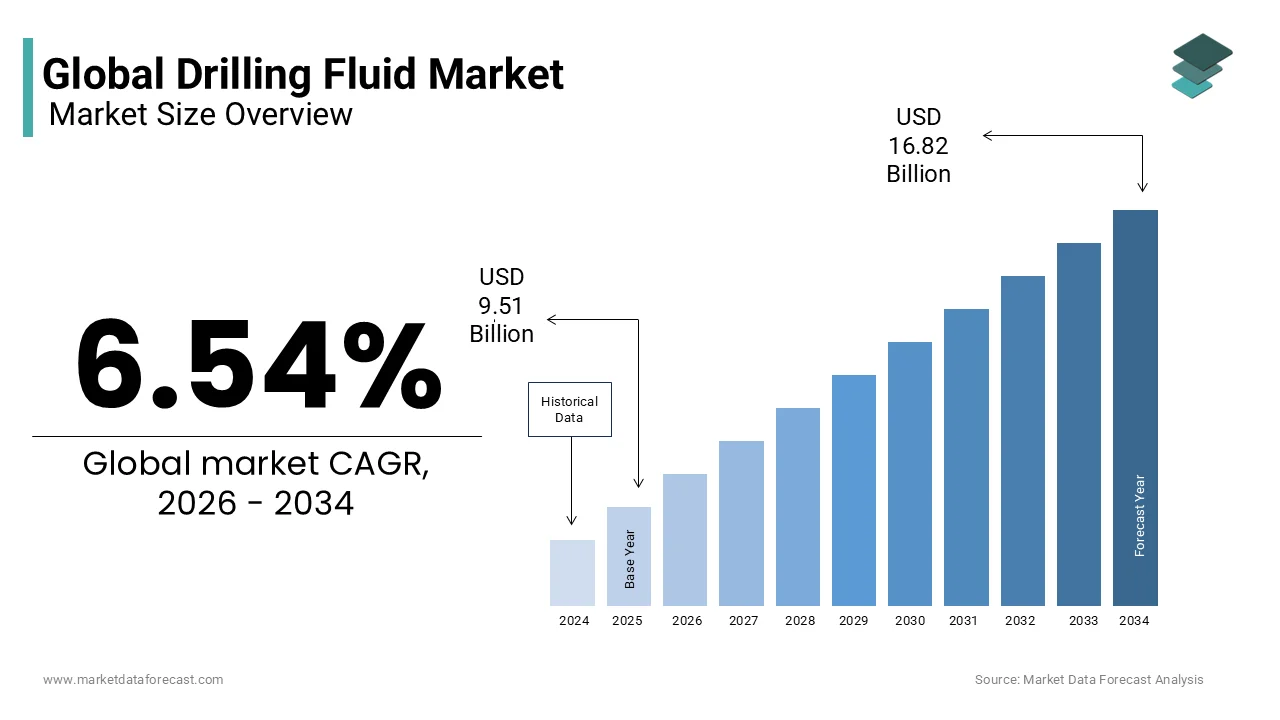
The global drilling fluid market size was valued at USD 9.51 billion in 2025, is anticipated to reach USD 10.13 billion in 2026, and is projected to reach USD 16.82 billion by 2034, growing at a CAGR of 6.54% from 2026 to 2034. The growth of the global drilling fluid market is driven by the rising number of oil and gas exploration activities, technological advancements in drilling techniques, increasing demand for horizontal and directional drilling, and the growing need for efficient mud systems to improve drilling performance and reduce costs.
Key Market Trends
- Increasing use of eco-friendly drilling fluids to reduce environmental impact.
- Rising adoption of water-based muds (WBMs) due to lower cost and environmental compliance.
- Growth in deepwater and offshore drilling projects creating new opportunities.
- Development of high-performance synthetic and oil-based fluids for complex wells.
- Strategic collaborations between oilfield service providers and chemical suppliers.
Segmental Insights
- Based on type, the water-based muds (WBMs) segment held 58.3% of the global drilling fluid market share in 2025.
- Based on application, the onshore segment was the largest, capturing a dominant share of the market in 2025.
Regional Insights
- North America was the top performer in the global drilling fluid market, holding 34.3% of the market share in 2025, driven by shale gas exploration and offshore drilling in the Gulf of Mexico.
- Asia-Pacific is expected to grow steadily with increasing oilfield developments in China and India.
- Middle East & Africa remain critical markets, supported by ongoing exploration in Saudi Arabia, UAE, and offshore Africa.
- Europe maintains consistent demand, particularly from the North Sea drilling projects.
Competitive Landscape
Prominent players in the global drilling fluid market include Schlumberger, Halliburton, Newpark, Baker Hughes, TETRA Technologies, Canadian Energy Services, NOV, Secure Energy, Weatherford, Q’Max Solutions Inc., Global Drilling Fluids and Chemical Limited, Sagemines, Scomi Group Bhd, Catalyst Middle East, and Flotek Industries, Inc. These companies focus on R&D, eco-friendly fluid formulations, and expanding their service portfolios to strengthen their market presence.
Global Drilling Fluid Market Size
The global drilling fluid market size was valued at USD 9.51 billion in 2025 and is anticipated to reach USD 10.13 billion in 2026 from USD 16.82 billion by 2034, growing at a CAGR of 6.54% during the forecast period from 2026 to 2034.
The drilling fluid is an engineered fluid used in oil, gas, and geothermal well construction to facilitate safe and efficient borehole drilling. Also known as "mud," these fluids serve critical functions including cooling and lubricating the drill bit, transporting cuttings to the surface, maintaining wellbore stability, and controlling subsurface pressure. Composed of base fluids (water, oil, or synthetic), clays, weighting agents like barite, and chemical additives, drilling fluids are tailored to geological conditions and operational depth.
MARKET DRIVERS
Expansion of Offshore and Deepwater Exploration Activities
The global surge in offshore and deepwater hydrocarbon exploration is majorly fuelling the growth of the drilling fluid market. These environments present extreme pressures, high temperatures, and complex geologies, necessitating advanced fluid systems capable of maintaining stability and preventing well collapse. According to the International Energy Agency, offshore oil production accounted for 28% of total global crude output in 2023, with deepwater projects contributing over 10 million barrels per day. Similarly, Brazil’s pre-salt fields, which require drilling through salt layers at depths exceeding 6,000 meters, rely heavily on synthetic-based muds (SBMs) for superior lubricity and shale inhibition. Companies like Petrobras have deployed over 200 deepwater rigs since 2020, each consuming thousands of barrels of specialized fluid.
Growth in Shale Gas and Tight Oil Extraction via Hydraulic Fracturing
The proliferation of unconventional oil and gas extraction through hydraulic fracturing in shale formations is additionally to enhance the growth of drilling fluid market. Horizontal drilling in shale basins such as the Permian, Marcellus, and Eagle Ford requires fluids that minimize formation damage while ensuring borehole stability during extended lateral sections. According to the U.S. Energy Information Administration, U.S. shale oil production reached 9.3 million barrels per day in 2023. Water-based muds (WBMs) with advanced rheology modifiers and shale inhibitors are widely used to reduce environmental impact and cost.
MARKET RESTRAINTS
Stringent Environmental Regulations on Fluid Disposal and Composition
Environmental regulations governing the use and disposal of drilling fluids, particularly oil-based and synthetic-based muds is restricting the growth of drilling fluid market. Regulatory bodies such as the U.S. Environmental Protection Agency and the North Sea’s OSPAR Commission impose strict limits on hydrocarbon discharge and chemical toxicity. According to the European Environment Agency, discharge of oil-based muds is prohibited in offshore waters of EU member states, forcing operators to use closed-loop systems or switch to less harmful alternatives. Additionally, the U.S. Bureau of Safety and Environmental Enforcement requires comprehensive chemical disclosure and risk assessments for offshore operations.
Volatility in Base Material and Additive Supply Chains
The drilling fluid industry is highly dependent on the availability and pricing of key raw materials such as barite, bentonite, and specialty polymers, which is making it vulnerable to supply chain disruptions. In the U.S., over 90% of barite is imported, with geopolitical tensions affecting supply reliability. Similarly, polyacrylamide and xanthan gum, used as viscosifiers, are subject to fluctuations in agricultural and petrochemical feedstocks.
MARKET OPPORTUNITIES
Development of Biodegradable and Low-Toxicity Fluid Systems
The shift toward environmentally sustainable drilling practices is creating substantial opportunities for biodegradable and low-toxicity drilling fluid formulations. According to the Society of Petroleum Engineers, over 60% of new offshore wells in the North Sea now use low-toxicity synthetic-based muds, reflecting a regional commitment to environmental stewardship. In Canada, the Alberta Energy Regulator mandates that drilling fluids used in sensitive boreal regions must pass biodegradability and aquatic toxicity tests, accelerating adoption of green chemistries. Companies like Schlumberger and Halliburton have launched product lines such as EnviroDrill and GeoClean, which degrade naturally and minimize marine impact. Additionally, research institutions like the Norwegian University of Science and Technology are developing algae-based fluid additives that reduce reliance on petrochemicals.
Integration of Digital Monitoring and Real-Time Fluid Optimization
The integration of digital technologies into drilling operations with fluid performance and reducing non-productive time is additionally to elevate the growth of drilling fluid market. Real-time monitoring systems equipped with sensors and AI-driven analytics enable continuous assessment of fluid properties such as viscosity, density, and filtration rate. Baker Hughes’ DrillPlan and Weatherford’s Harmony platforms use predictive modeling to adjust fluid composition dynamically based on downhole conditions. In the Permian Basin, operators using closed-loop fluid monitoring reported a 15% reduction in fluid loss and a 12% improvement in rate of penetration, as per a 2023 SPE case study. Additionally, digital twins of drilling operations allow for pre-emptive fluid testing and scenario planning.
MARKET CHALLENGES
Managing Fluid Loss in Fractured and Depleted Formations
The fluid loss into fractured, vugular, or depleted formations, which is leading to increased costs, well control risks, and formation damage is likely to challenge the growth of drilling fluid market. In naturally fractured reservoirs such as carbonates or depleted zones, conventional fluid-loss control methods often fail to seal micro-annuli effectively. According to the Society of Petroleum Engineers, fluid loss accounts for 10–15% of non-productive time in deepwater drilling, with remediation costs exceeding $1 million per incident in extreme cases. While solutions such as bridging agents, cross-linked polymers, and deformable particles exist, their effectiveness varies with formation heterogeneity.
Balancing Performance, Cost, and Environmental Compliance in Remote Locations
The complex challenge of balancing fluid performance, logistical feasibility, and environmental compliance is also to limit the growth of drilling fluid market. Transporting large volumes of fluid and additives to these areas is costly and time-consuming. According to the U.S. Department of Transportation, shipping one barrel of drilling fluid to a remote Alaskan site can cost over $1,200, compared to $150 in onshore Texas. In Guyana’s offshore Stabroek Block, ExxonMobil has had to design closed-loop fluid systems that eliminate discharge, increasing capital expenditure.
REPORT COVERAGE
| REPORT METRIC | DETAILS |
| Market Size Available | 2025 to 2034 |
| Base Year | 2025 |
| Forecast Period | 2026 to 2034 |
| CAGR | 6.54% |
| Segments Covered | By Type, Application, and Region |
| Various Analyses Covered | Global, Regional & Country Level Analysis, Segment-Level Analysis, DROC, PESTLE Analysis, Porter’s Five Forces Analysis, Competitive Landscape, Analyst Overview of Investment Opportunities |
| Regions Covered | North America, Europe, APAC, Latin America, Middle East & Africa |
| Market Leaders Profiled | Schlumberger, Halliburton, Newpark, Baker Hughes, TETRA Technologies, Inc., Canadian Energy Services, NOV, Secure Energy, Weatherford, Q’Max Solutions Inc., Global Drilling Fluids and Chemical Limited, Sagemines, Scomi Group Bhd, Catalyst Middle East, and Flotek Industries, Inc. |
SEGMENTAL ANALYSIS
By Type Insights
The Water-based muds (WBMs) segment held 58.3% of the drilling fluid market share in 2025 with their cost-effectiveness, ease of handling, and lower environmental impact compared to oil- or synthetic-based alternatives. According to the International Association of Oil & Gas Producers (IOGP), over 70% of onshore wells globally utilize water-based systems in shale gas and conventional reservoirs where formation compatibility is favorable. As per U.S. Environmental Protection Agency, WBMs are classified as non-hazardous in most jurisdictions by enabling simpler disposal protocols and reducing regulatory burden. In China, where over 3,500 onshore wells were drilled in 2023, as per the China National Petroleum Corporation, WBMs are the default choice due to their affordability and availability of raw materials like bentonite and starch-based additives. Additionally, advancements in shale inhibitors and rheology modifiers have improved performance in reactive formations, expanding their applicability.
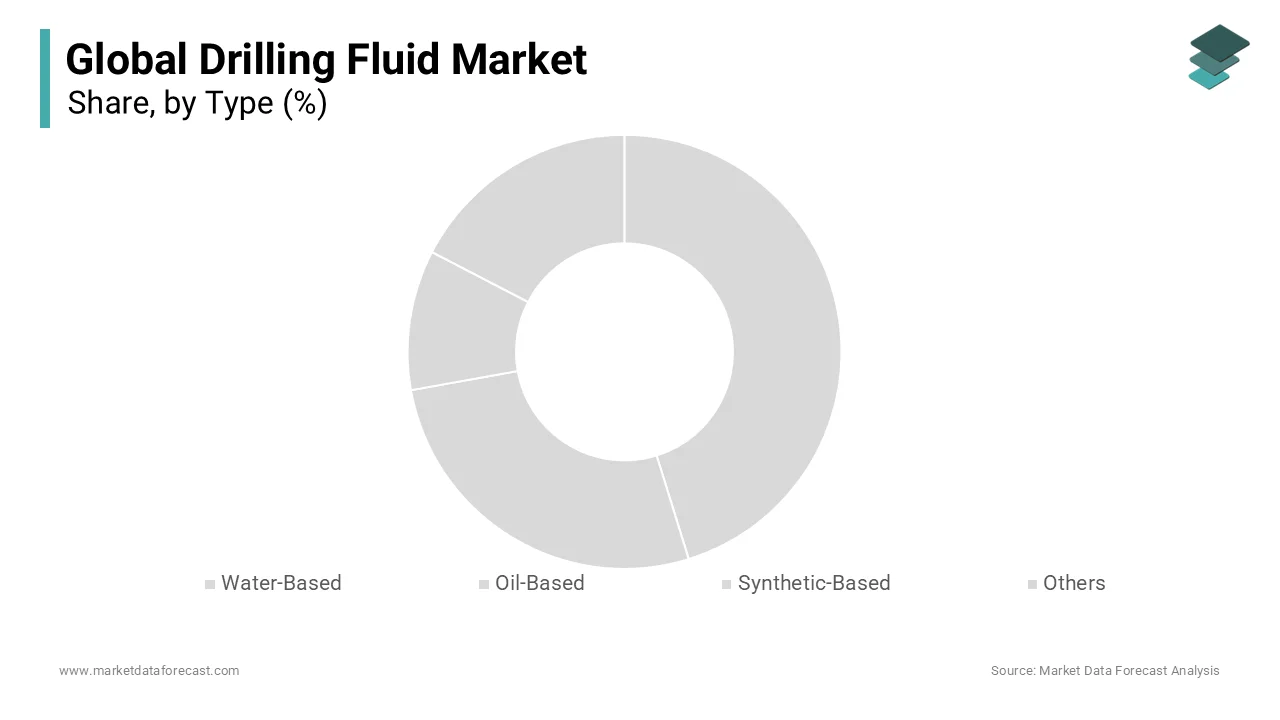
The synthetic-based segment is projected to expand at a CAGR of 7.6% during the forecast period with their superior performance in deepwater and high-pressure, high-temperature (HPHT) environments, where thermal stability and minimal formation damage are critical. According to the Society of Petroleum Engineers, synthetic-based muds reduce torque and drag by up to 40% compared to water-based systems by enhancing drilling efficiency in extended-reach wells. In the Gulf of Mexico, over 85% of deepwater wells drilled in 2023 used synthetic fluids, as per the U.S. Bureau of Ocean Energy Management. Companies like Halliburton and Schlumberger have optimized ester- and olefin-based formulations that degrade naturally, aligning with ESG goals.
By Application Insights
The onshore segment was the largest by capturing a dominant share of the global drilling fluid market in 2025 with the sheer scale of land-based hydrocarbon extraction. According to the Energy Information Administration, over 90% of active drilling rigs operate onshore in the Permian, Bakken, and Haynesville basins. In Saudi Arabia, onshore fields like Ghawar and Shaybah continue to drive production, with Saudi Aramco drilling over 1,200 new wells annually, according to its 2023 operational review. Water-based muds are predominantly used, reducing costs and environmental footprint. The ability to rapidly deploy rigs, reuse fluids in closed-loop systems, and leverage existing infrastructure makes onshore drilling the most economically viable segment.
The offshore application segment is likely to grow with an expected CAGR of 8.1% from 2026 to 2034 with the rising deepwater and ultra-deepwater exploration. Offshore drilling requires more complex, high-performance fluid systems, significantly increasing per-well fluid consumption and value. According to Rystad Energy, global offshore drilling expenditure reached $125 billion in 2023, with Brazil, Guyana, and the Eastern Mediterranean emerging as key growth zones. In the Stabroek Block offshore Guyana, ExxonMobil has drilled over 40 discovery wells since 2015, each relying on advanced fluid systems to manage narrow pressure windows and high temperatures. Additionally, national oil companies in Angola and Nigeria are revitalizing offshore assets with international partnerships.
REGIONAL ANALYSIS
North America Market Analysis
North America was the top performer of the global drilling fluid market with a 34.3% of share in 2025 with the U.S. shale revolution and advanced drilling technologies. The rise of extended-reach horizontal wells some exceeding 15,000 feet in lateral length has increased demand for high-performance fluid systems with superior shale inhibition and lubricity. Environmental regulations in California and the Gulf Coast have also accelerated the adoption of closed-loop fluid systems and biodegradable additives.
Middle East & Africa Market Analysis
The Middle East & Africa drilling fluid market growth is likely to grow with the Gulf Cooperation Council countries and West Africa as primary demand centers. Saudi Arabia is the largest market in the region, operates over 100 onshore drilling rigs, as reported by Saudi Aramco’s 2023 activity report, targeting both conventional and unconventional gas reserves. The country’s Jafurah shale project alone requires over 1,000 new wells, each using tailored water-based muds with advanced filtration control. Offshore West Africa is also gaining momentum Equinor and TotalEnergies are developing deepwater fields in Nigeria and Angola, where synthetic-based fluids are essential.
Asia Pacific Market Analysis
Asia Pacific drilling fluid market is likely to grow steadily in the coming years. China remains the largest consumer in the region, drilling over 3,500 onshore wells annually, as reported by the China National Petroleum Corporation. The country has invested heavily in domestic fluid formulation, reducing reliance on imports. Additionally, deepwater exploration in the South China Sea and Bay of Bengal is driving demand for synthetic fluids.
Latin America Market Analysis
Latin America drilling fluid market growth is propelling with Brazil as major contributor. Brazil’s pre-salt fields, located beneath salt layers at depths exceeding 6,000 meters, require advanced synthetic-based muds to manage high pressure, temperature, and corrosion. Petrobras drilled over 80 deepwater wells in 2023, as reported in its annual operational review, each consuming thousands of barrels of high-performance fluid. In Guyana, the Stabroek Block has become one of the most prolific discoveries of the decade, with ExxonMobil planning to install 10 FPSOs by 2027, each supported by extensive drilling campaigns. The region’s reliance on international oil companies and service providers has accelerated the adoption of cutting-edge fluid technologies.
Europe Market Analysis
Europe drilling fluid market is steadily growing with growing support from the government authorities. According to the UK’s Oil and Gas Authority, HPHT drilling activity increased by 22% in 2023, which is driven by projects like Culzean and Glengorm. Additionally, geothermal drilling in Germany and France is creating niche demand for high-temperature stable muds. Although new exploration is limited, the focus on safety, environmental compliance, and digital fluid monitoring keeps Europe at the forefront of technological adoption.
COMPETITIVE LANDSCAPE
KEY MARKET PLAYERS
A few of the notable players in the global drilling fluid market include
- Schlumberger
- Halliburton
- Newpark
- Baker Hughes
- TETRA Technologies, Inc.
- Canadian Energy Services
- NOV
- Secure Energy
- Weatherford
- Q’Max Solutions Inc.
- Global Drilling Fluids and Chemical Limited
- Sagemines
- Scomi Group Bhd
- Catalyst Middle East
- Flotek Industries, Inc.
TOP STRATEGIES USED BY KEY MARKET PLAYERS
Key players in the drilling fluid market are advancing through technological differentiation, regional customization, and sustainability integration. Companies are investing in synthetic and low-toxicity formulations to comply with environmental regulations in offshore and ecologically sensitive zones. Digitalization is a growing priority, with real-time monitoring, AI-based fluid optimization, and predictive analytics enhancing drilling efficiency. Expansion into high-growth regions like Asia Pacific and Latin America is achieved through localized blending facilities and technical support centers.
COMPETITION OVERVIEW
The drilling fluid market is marked by intense competition among global service giants, regional specialists, and niche innovators, with differentiation hinging on technical performance, environmental compliance, and operational integration. While multinational corporations leverage R&D scale and digital platforms, regional players compete through cost efficiency and geological expertise. The shift toward deepwater, HPHT, and unconventional reservoirs has elevated the importance of fluid performance, making formulation precision a key battleground. Environmental regulations in Europe and offshore Asia are pushing companies to adopt low-toxicity and biodegradable systems, reshaping product portfolios.
TOP PLAYERS IN THE MARKET
Schlumberger
Schlumberger has established a robust presence in the Asia Pacific drilling fluid market through technological innovation and localized service integration. The company offers its proprietary NEOS™ synthetic fluid and HYBRID-Clean™ water-based systems, tailored for challenging environments in deepwater Indonesia and high-pressure shale basins in China. In 2023, SLB launched a digital fluid monitoring platform, DrillOps Fluids, in collaboration with Indian Oil Corporation, enabling real-time rheology and contamination analysis across onshore Gujarat operations. The company also expanded its fluid blending facility in Perth, Australia, to support offshore projects in the Northwest Shelf. In 2025, Schlumberger partnered with PETRONAS to deploy low-toxicity synthetic muds in Malaysia’s deepwater Block SK318 by aligning with regional ESG mandates.
Halliburton
Halliburton plays a pivotal role in shaping the Asia Pacific drilling fluid landscape through its Baroid division, which delivers engineered fluid systems for complex onshore and offshore applications. The company has strengthened its regional footprint by establishing technical centers in Kuala Lumpur, Mumbai, and Jakarta, enabling rapid customization for local geologies. In early 2025, Halliburton launched a mobile fluid recycling unit in Vietnam, allowing operators to recondition and reuse mud in remote locations, cutting costs and waste.
Newpark Resources, Inc.
Newpark Resources has deepened its engagement in the Asia Pacific market by focusing on environmentally advanced drilling fluid systems and waste management integration. The company’s THERMASEAL™ and ECOTHERM™ fluid lines are increasingly adopted in Australia’s coal seam gas fields and India’s shale exploration projects for their thermal stability and low ecotoxicity. The company also inaugurated a new fluid service hub in Chennai in early 2025 to support ONGC’s drilling campaigns in the Krishna-Godavari basin. Newpark’s proprietary micro-fine cuttings drying technology, deployed in offshore Thailand, enables zero-discharge operations, meeting strict environmental standards.
MARKET SEGMENTATION
This research report on the global drilling fluid market is segmented and sub-segmented into the following categories.
By Type
- Water-Based
- Oil-Based
- Synthetic-Based
- Others
By Application
- Onshore
- Offshore
By Region
- North America
- Europe
- Asia Pacific
- Latin America
- The Middle East and Africa