- Product Description Description
- Table of Contents TOC
- List of Table & Figure LOT
- Get Free Sample PDF Sample PDF
Market Size, 2025
$1574.56 MnMarket Estimate, 2026
$1775 MnMarket Forecast, 2034
$4,622 MnCAGR, 2026–2034
12.71%Executive Summary: E-Tourism Market
- Market Scope: Comprehensive global e-tourism industry analysis covering system types, application verticals, regional leadership frameworks, strategic developments, and competitive landscapes.
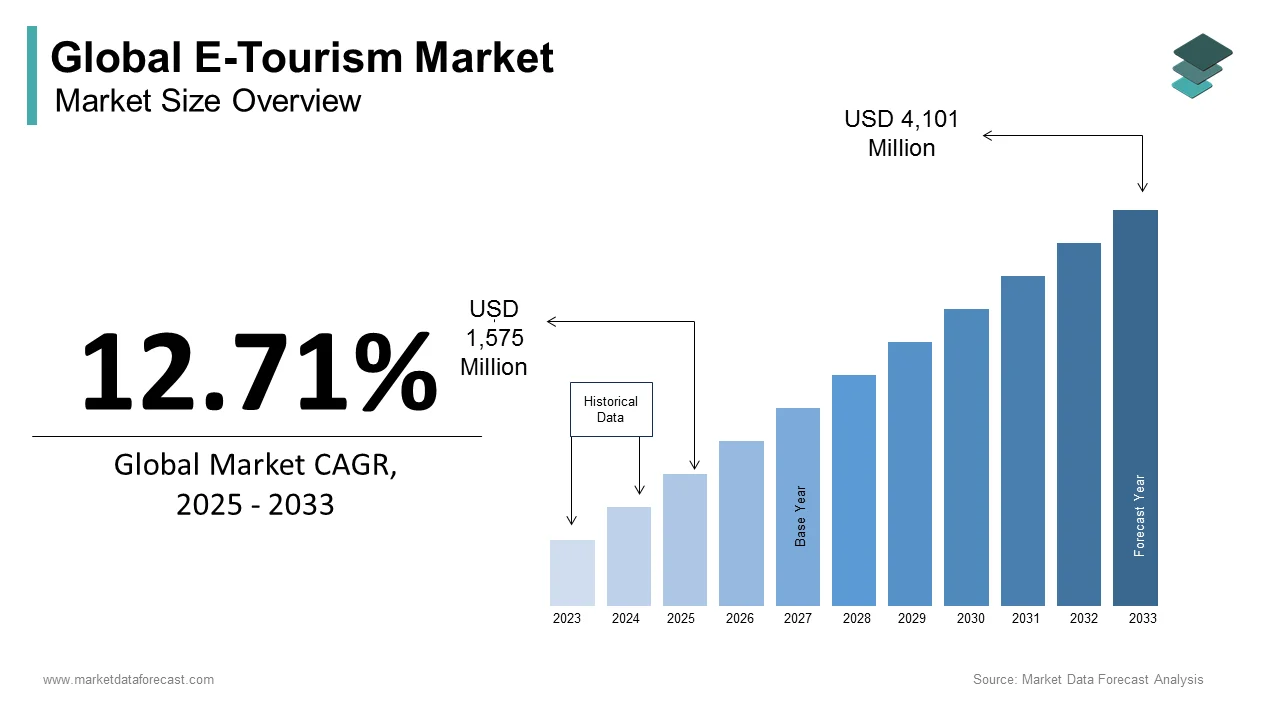
- Market Valuation: Valued at USD 1,574.56 million (2025), estimated at USD 1,775 million (2026), and projected to reach USD 4,622 million by 2034, registering a robust CAGR of 12.71% (2026–2034).
- Primary Growth Drivers: Convenience and control provided by e-tourism platforms, fast and secure access to comprehensive travel information, digitization of tourism value chains, low-cost reservation services, and rising internet penetration. Restraints include technology dependence and information misinterpretation.
Key Market Segment Metrics (2026–2034)
| Category | Leading Segment / Region | Fastest-Growing / Key Regional Trend |
|---|---|---|
| By System Type | Computer Reservation Systems (led the global market as the dominant booking platform) | Integrated digital travel management and e-commerce solutions |
| By Region (Dominant) | North America (held the highest regional share, followed by Europe) | Advanced technological infrastructure and superior digital information access |
| By Region (Emerging) | Asia-Pacific (identified as one of the fastest-growing markets globally) | Driven by Japan, India, and China expanding demand for secure digital travel services |
Major Market Players & Market Structure
Market Structure: Highly dynamic global e-tourism ecosystem characterized by digital transformation initiatives, investment activity in technology funds, and cloud-focused infrastructure shifts supporting long-term market innovation.
Key Companies: G Adventures, Fred Harvey Company, Balkan Holidays Ltd., Accor Group, and Crown Ltd.
 Download Free Sample Report
Global E-Tourism Market Size
The size of the global E-Tourism market was worth USD 1,574.56 million in 2025. The global market is anticipated to grow at a CAGR of 12.71% from 2026 to 2034 and be worth USD 4,622 million by 2033, up from USD 1,775 million in 2026.
E-tourism is a value chain encompassing electronic information distribution, online transaction processing, and virtual experience delivery across global destinations. This sector transcends simple booking engines to integrate artificial intelligence, blockchain verification, and immersive technologies that fundamentally reshape traveler engagement and destination management. This ecosystem enables hyper-personalized itineraries through predictive analytics, while simultaneously supporting sustainable destination carrying capacity management through smart data flows. The definition has evolved from static web presence to dynamic interoperable systems connecting stakeholders across borders.
MARKET DRIVERS
Proliferation of Mobile-First Traveler Behavior and Digital Payment Adoption
The ubiquitous adoption of mobile technology, transforming how consumers discover, book, and experience destinations, is bolstering the growth of the e-tourism market. According to the data, global mobile internet users reached 5.6 billion in 2025, with travel-related app usage growing 28% year on year among millennials and Generation Z demographics. This behavioral shift compels industry stakeholders to develop seamless mobile native experiences that reduce friction throughout the customer journey. Consumer expectations for instant confirmation and real-time service modification drive platform innovation at unprecedented velocity. This demand-side pressure forces traditional operators to digitize inventory management and adopt open API architectures. Consequently, mobile-first design principles have become baseline requirements rather than competitive differentiators. The emergence of affordable smartphones, widespread 5G coverage, and secure fintech solutions creates self-reinforcing adoption cycles that continuously expand addressable user bases across previously underserved geographic regions and demographic segments worldwide.
Integration of Artificial Intelligence for Hyper-Personalized Experience Curation
Artificial intelligence deployment addresses escalating consumer demand for tailored travel experiences that reflect individual preferences rather than generic package offerings, which is additionally levelling up the growth of the e-tourism market. Machine learning algorithms analyze vast behavioral datasets to predict destination preferences, optimal timing, and ancillary service needs with remarkable accuracy. In response, leading platforms invest heavily in natural language processing and computer vision to enable conversational booking interfaces and visual search capabilities. This technology reduces decision fatigue for travelers overwhelmed by excessive choice while increasing conversion rates for suppliers. Demand for authentic local experiences further accelerates AI adoption as algorithms connect niche interests with microentrepreneurs offering specialized services. Ultimately, intelligent systems transform passive browsing into active co-creation of unique journeys that satisfy evolving expectations for meaningful and efficient travel planning.
MARKET RESTRAINTS
Persistent Digital Divide and Infrastructure Disparities Across Regions
The unequal access to reliable digital infrastructure severely constrains universal participation in electronic tourism ecosystems is gearing up the growth of the e-tourism market. According to the International Telecommunication Union, 2.6 billion people remained offline in 2025, with rural connectivity gaps particularly acute in developing tourism-dependent nations. This exclusion prevents small-scale local operators from accessing global distribution channels and limits destination marketing reach. Businesses in low-income countries possess adequate digital skills to leverage e-tourism platforms effectively. Bandwidth limitations in remote scenic areas degrade user experience and discourage platform adoption among both suppliers and visitors. The cultural heritage sites in Africa lack basic internet connectivity necessary for virtual promotion or digital ticketing. These infrastructural deficits perpetuate economic leakage as international platforms capture disproportionate value, while local communities remain marginalized. Government modernization programs often prioritize urban centers, leaving peripheral tourism zones underserved. Consequently, market expansion faces hard ceilings determined by physical network availability rather than consumer willingness. Until universal broadband access becomes reality, significant portions of global tourism supply cannot participate meaningfully in digital marketplaces regardless of platform sophistication or marketing investment directed toward bridging this persistent structural barrier.
Data Privacy Regulations and Cross-Border Compliance Complexity
The stringent data protection frameworks create substantial operational friction for e-tourism platforms managing sensitive traveler information across multiple jurisdictions. This factor is impeding the growth of the e-tourism market. According to the European Union Agency for Cybersecurity, GDPR compliance costs average 1.3 million euros annually for mid-sized travel technology firms operating within Europe. Divergent regulatory requirements between regions force companies to maintain parallel data governance systems, increasing complexity and expense. Over 137 countries have enacted data protection legislation by 2025, creating a fragmented compliance sector. Consent management for marketing communications varies significantly between jurisdictions, requiring sophisticated preference tracking mechanisms. Breach notification timelines differ dramatically with some regions mandating disclosure within 72 hours, while others allow 30 days. These inconsistencies complicate incident response protocols for multinational operators. Consumer trust erosion following high-profile data incidents further compounds challenges as travelers increasingly scrutinize privacy practices before sharing personal details. Regulatory uncertainty discourages innovation in personalized services reliant on extensive data processing. Platforms must balance legitimate business needs against legal exposure, creating inherent tension between service quality and compliance obligations that constrains feature development velocity.
MARKET OPPORTUNITIES
Expansion of Immersive Virtual Previews and Metaverse Destination Marketing
The emerging extended reality technologies for destination storytelling and pre-visitation engagement transcend traditional media limitations, which is likely to foster new opportunities for the growth of the e-tourism market. According to the study, global spending on virtual and augmented reality in travel is projected to reach 18.4 billion dollars by 2027, representing compound annual growth of 31%. These immersive experiences enable potential visitors to explore attractions virtually before committing financial resources, reducing purchase anxiety and increasing conversion confidence. The destinations offering high-quality virtual previews see 27% higher booking rates compared to those relying solely on conventional photography. Museums and heritage sites utilize digital twins to provide accessibility for mobility-impaired travelers, while preserving fragile physical assets from overtourism pressures. This technology also facilitates sustainable tourism planning by allowing stakeholders to simulate visitor flows and infrastructure impacts before construction begins. Educational institutions partner with destinations to create curriculum-aligned virtual field trips, generating early brand affinity among future travelers. As hardware costs decline and content creation tools democratize, smaller destinations gain access to marketing capabilities previously reserved for well-funded national tourism organizations. This paradigm shift redefines destination competitiveness based on digital experience quality alongside physical attributes.
Blockchain-Enabled Trust Infrastructure for Transparent Sustainable Tourism
Distributed ledger technology offers unprecedented opportunities to verify sustainability claims and ensure fair revenue distribution throughout tourism value chains, addressing growing consumer skepticism about greenwashing. The blockchain-enabled trust infrastructure for transparent sustainable tourism is additionally to accelerate the growth of the e-tourism market. Blockchain provides immutable records of carbon offset purchases, local supplier payments, and conservation fund allocations, enabling transparent auditing by independent third parties. Smart contracts automate royalty distributions to indigenous communities, ensuring equitable benefit sharing without intermediary extraction. Tokenized loyalty programs incentivize regenerative behaviors like off-peak visitation or volunteer conservation work, creating circular value ecosystems. Decentralized identity solutions empower travelers to control personal data sharing while still receiving personalized services. As climate consciousness intensifies among younger demographics, verifiable sustainability credentials become decisive competitive advantages. Early adopters establish reputational moats difficult for laggards to replicate. This technological foundation enables genuine alignment between profit motives and planetary boundaries, transforming sustainability from marketing narrative into auditable operational reality.
MARKET CHALLENGES
Algorithmic Bias and Discriminatory Pricing Dynamics
Automated pricing and recommendation systems frequently perpetuate or amplify existing social inequities, creating ethical dilemmas and regulatory scrutiny for platform operators, which is a major challenge for the growth of the e-tourism market. According to the study, dynamic pricing models in travel demonstrate statistically significant price discrimination based on user location, device type, and browsing history, with variations exceeding 30% for identical services. Machine learning trained on historical booking data inherits past biases, resulting in reduced visibility for minority owned accommodations or female-led tour operators. Such practices undermine fair competition and erode consumer trust in platform neutrality. Regulatory bodies increasingly view algorithmic opacity as a violation of consumer protection statutes, yet technical complexity hinders effective oversight. MIT Technology Review documents cases where facial recognition check-in systems exhibited higher error rates for darker-skinned travelers, causing denied service incidents. Correcting these issues requires diverse training datasets and continuous bias auditing processes that increase development costs substantially. Public backlash against discriminatory outcomes generates reputational damage exceeding short term revenue optimization gains. Platforms face difficult tradeoffs between personalization efficiency and equitable treatment with no universally accepted fairness metrics.
Cybersecurity Vulnerabilities and Ransomware Threat Escalation
The sophisticated cyberattacks targeting travel infrastructure pose existential risks to business continuity and consumer safety in an increasingly connected ecosystem is anticipated to inhibit the growth of the e-tourism market. Ransomware gangs specifically pursue tourism entities due to time-sensitive operations and valuable personal data holdings. Small and medium enterprises lack dedicated security teams, leaving them vulnerable to phishing campaigns and credential theft. Cloud migration introduces new attack surfaces, as misconfigured storage buckets expose millions of passenger records. Beyond financial costs, incidents cause irreversible brand damage and regulatory penalties under data protection laws. Supply chain attacks compromise trusted vendors, creating cascading failures across interconnected platforms. Geopolitical tensions increase state-sponsored threats targeting critical tourism infrastructure as an economic warfare tactic. Insurance premiums skyrocket as carriers reassess risk exposure, forcing some operators to accept uninsured liability. Continuous security investment diverts resources from innovation, creating competitive disadvantages against less scrupulous actors.
REPORT COVERAGE
| REPORT METRIC | DETAILS |
| Market Size Available | 2025 to 2034 |
| Base Year | 2025 |
| Forecast Period | 2026 to 2034 |
| Segments Covered | By Type of System, Application, and Region. |
| Various Analyses Covered | Global, Regional, and Country-Level Analysis, Segment-Level Analysis, Drivers, Restraints, Opportunities, Challenges; PESTLE Analysis; Porter’s Five Forces Analysis, Competitive Landscape, Analyst Overview of Investment Opportunities |
| Regions Covered |
|
| Market Leaders Profiled | G Adventures, Fred Harvey Company, Booking Holdings, Balkan Holidays Ltd., Accor Group, Crown Ltd., Airbnb, Expedia Group, and Others. |
SEGMENTAL ANALYSIS
By System Type Insights
The distribution systems segment accounted for a dominant share of the E-Tourism market in 2025 due to their indispensable role as primary transaction conduits connecting global supply with consumer demand. According to the study, online travel agencies and global distribution systems facilitated 67% of all digital travel bookings worldwide in 2025, generating over 890 billion dollars in gross transactions. These network effects, where larger inventory attracts more users, which in turn compels suppliers to maintain presence, create self-reinforcing competitive moats. European travelers begin trip planning on aggregator platforms rather than direct supplier websites, indicating entrenched user behavior favoring centralized comparison shopping. Distribution systems invest heavily in performance marketing, spending an estimated 18 billion dollars annually on search engine advertising, according to data. Their sophisticated revenue management algorithms optimize pricing dynamically across millions of rate plans, maximizing yield for partners while offering competitive rates to consumers. This dual value proposition sustains supplier loyalty despite commission pressures. Furthermore, integrated payment processing and fraud detection infrastructure reduces operational complexity for small accommodations lacking technical resources.
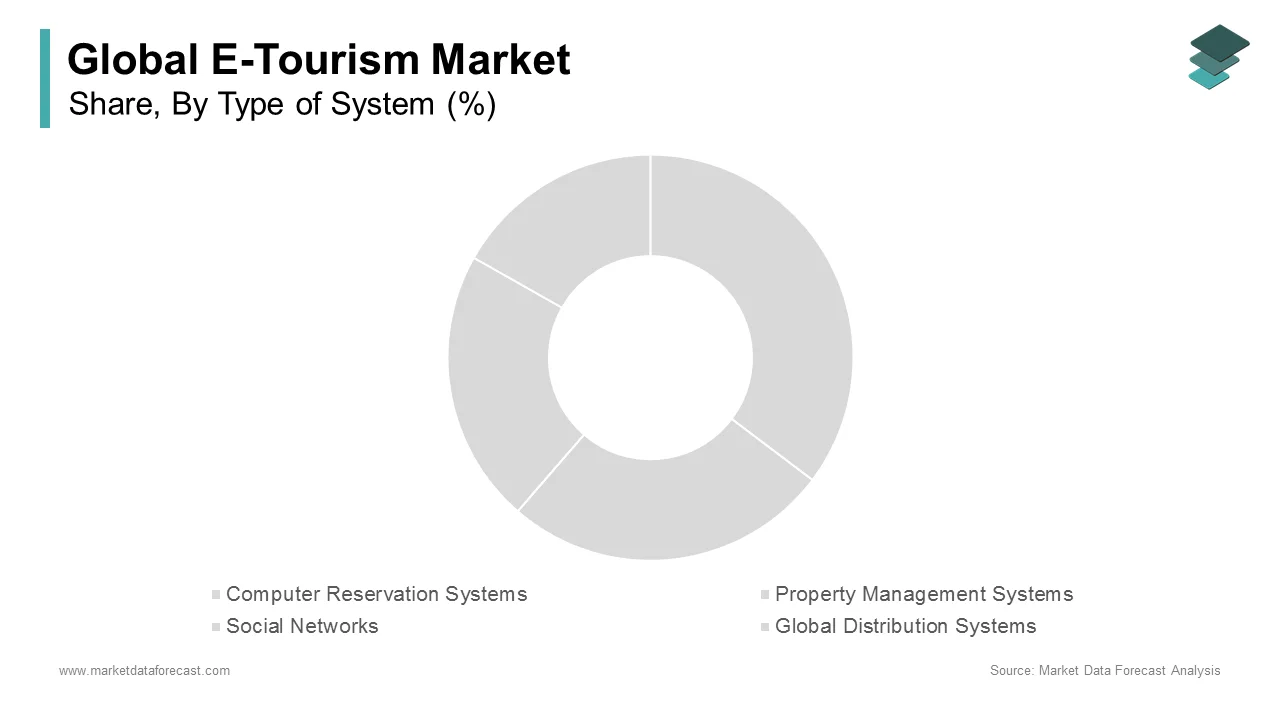
The social media segment is likely to register the fastest CAGR of 24.8% throughout the forecast period with seamless commerce integration and influencer marketing efficacy. According to the study, travel-related purchases initiated directly through Instagram and Facebook exceeded 45 billion dollars globally in 2025, representing 340% growth since 2022. This acceleration reflects platform evolution from inspiration channels to full-funnel transaction environments, eliminating friction between discovery and booking. Influencer partnerships generate exceptional returns, with Hootsuite documenting that travel brands earn 6.50 dollars for every dollar spent on creator collaborations, significantly outperforming traditional display advertising. User-generated content serves as authentic social proof, reducing perceived risk for experiential purchases where quality uncertainty traditionally impedes conversion. Platforms continuously enhance shoppable features, including live streaming commerce and augmented reality previews that create immersive pre-purchase experiences. Younger people increasingly distrust conventional review sites, preferring peer validation through visual storytelling formats native to social ecosystems.
By Application Insights
The hospitality segment was the largest, accounting for 47.2% of the e-tourism market share in 2025, with the foundational expenditure category that anchors all travel planning and enables cross-selling of ancillary services. Unlike medical or aerospace tourism, which serve niche segments, hospitality addresses universal traveler needs across leisure, business, and transit purposes, creating a massive addressable market base. Property management system adoption among hotels exceeds 94% in developed markets, enabling real-time inventory synchronization across multiple distribution points, according to research. Standardization of room categories simplifies digital merchandising compared to complex medical procedures requiring extensive consultation before purchase. Government visa policies and health regulations create additional barriers for medical tourism, limiting scalability, whereas hospitality benefits from open border agreements and standardized safety certifications facilitating frictionless cross-border digital transactions.
The medical tourism segment is anticipated to grow at the fastest CAGR of 29.3% from 2026 to 2034, with the healthcare cost disparities and specialized treatment availability abroad. Rising domestic healthcare costs in developed nations drive patients to seek affordable alternatives, with procedures like cardiac surgery costing 80% less in India or Thailand compared to United States prices, as per the study. Digital platforms specializing in medical travel facilitate complex decision-making through verified provider directories, outcome databases, and virtual consultations, reducing information asymmetry that historically deterred cross-border care-seeking. Accreditation bodies like Joint Commission International have certified over 1200 facilities globally, creating trust infrastructure essential for high-stakes medical purchasing decisions. Telehealth integration allows postoperative follow-up across borders, addressing continuity of care concerns that previously limited market growth.
REGIONAL ANALYSIS
North America E-Tourism Market Analysis
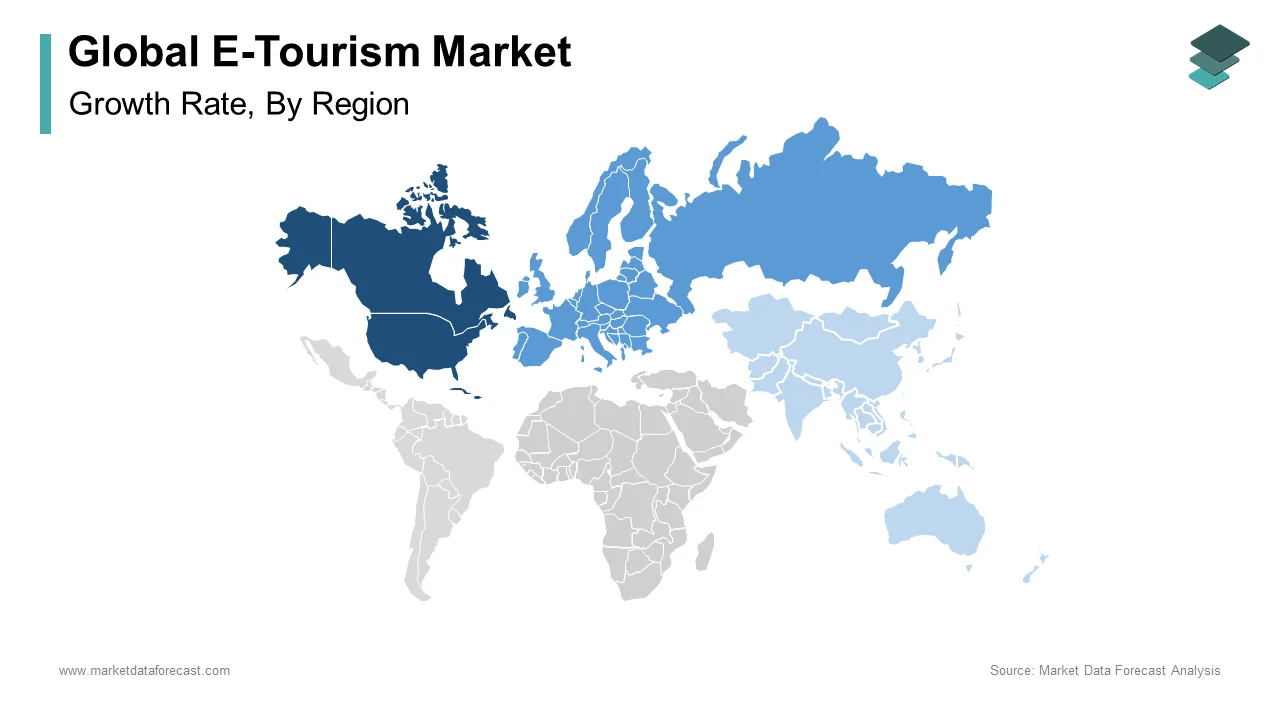
North America was the largest contributor in the global E-Tourism market by holding a 34.3% share in 2025, with mature digital infrastructure and high consumer sophistication. Corporate travel management platforms headquartered in this region process over 400 billion dollars in annual business travel spend, establishing enterprise-grade standards adopted worldwide, as per the study. Venture capital investment in travel technology startups reached 12 billion dollars in 2025, per Crunchbase data, sustaining innovation pipelines in artificial intelligence and sustainable travel solutions. Regulatory frameworks like the California Consumer Privacy Act set global benchmarks for data protection, influencing platform design beyond regional boundaries.
Europe E-Tourism Market Analysis
Europe e-tourism market was ranked second, holding 29.1% of the share in 2025, with the regulatory sophistication and multilingual platform capabilities serving diverse linguistic communities. The European tourism SMEs possess basic digital skills surpassing other regions due to extensive EU-funded training initiatives. Sustainability certification schemes like Green Key have been adopted by 3800 properties across 60 countries, with digital verification becoming mandatory for platform listing eligibility, as per European Travel Commission guidelines. Public sector digital transformation initiatives like France Connect enable single sign-on across government and tourism services, reducing friction for domestic travelers.
Asia Pacific E-Tourism Market Analysis
Asia Pacific e-tourism market is likely to witness the fastest CAGR in the coming years with mobile-first consumer behavior and super app ecosystems. As per the study, Southeast Asia’s digital travel gross merchandise value reached 42 billion dollars in 2025, growing at 38% annually, outpacing all other regions. China’s domestic travel market processed 1.8 trillion yuan through digital platforms in 2025, per Ministry of Culture and Tourism data, with WeChat and Alipay integrating booking, payment, and social sharing into unified interfaces. Japan’s aging population creates unique demand for senior-friendly digital interfaces, with many travelers over 65 now booking independently through simplified apps. ASEAN mutual recognition arrangements for tourism professionals facilitate cross-border service delivery supported by digital credential verification systems. Rural tourism digitization initiatives in Vietnam and Indonesia connect 18000 village enterprises to global markets through government-subsidized platform onboarding programs.
Latin America E-Tourism Market Analysis
Latin America e-tourism market growth is likely to grow with resilience and adaptation, despite infrastructural constraints and economic volatility. Chile and Peru lead in sustainable tourism digitization, with protected areas offering online reservation systems reducing overtourism pressures, according to the research. Mobile money solutions like Pix in Brazil processed 4.2 billion travel-related transactions in 2025, enabling instant settlements for small vendors previously excluded from the formal digital economy. WhatsApp serves as the primary customer service channel, with 91% of Latin American travelers preferring messaging over email for booking modifications, as per research. Government tourism promotion agencies increasingly partner with influencers rather than traditional media, with PromPeru documenting 300% higher engagement rates for creator-led campaigns.
Middle East and Africa E-Tourism Market Analysis
Middle East and Africa e-tourism market growth is likely to grow during the forecast period. South Africa dominates sub-Saharan digital tourism, with Stats SA recording 14 million international arrivals in 2025, predominantly booked through platforms like Travelstart, which captures 45% of regional online share. Nigeria’s burgeoning middle class drives 55% annual growth in online travel bookings per PwC Africa Hospitality Outlook, despite foreign exchange restrictions limiting outbound travel. Egypt launched a national e-visa platform, processing 8 million applications in 2025, reducing entry friction and improving visitor satisfaction scores by 34 points, as per the study. Rwanda’s smart destination initiative integrates IoT sensors and digital guides across national parks, creating premium positioning that justifies higher price points.
COMPETITIVE LANDSCAPE
The E-tourism market exhibits intense competition characterized by rapid technological innovation and shifting consumer preferences demanding continuous adaptation from established players and new entrants alike. Traditional online travel agencies face disruption from social media platforms integrating commerce features directly into content feeds, bypassing conventional search-based discovery paradigms entirely. Vertical specialization creates fragmented niches where focused operators outperform generalists in specific segments like luxury adventure or medical tourism through deeper expertise and curated supplier relationships. Price transparency enabled by comparison engines compresses margins, forcing differentiation through service quality, exclusive content, or superior user experience rather than cost leadership alone. Regulatory divergence across jurisdictions complicates global scaling strategies, favoring regional champions with localized compliance knowledge over uniform multinational approaches. Talent acquisition battles intensify as technology companies compete for scarce artificial intelligence and cybersecurity professionals essential for maintaining competitive advantage. Consolidation continues as larger entities acquire innovative startups to absorb capabilities and eliminate potential threats before they achieve scale.
KEY MARKET PLAYERS
The leading companies operating in the global e-tourism market include:
- G Adventures
- Fred Harvey Company
- Booking Holdings
- Balkan Holidays Ltd.
- Accor Group
- Crown Ltd.
- Airbnb
- Expedia Group
TOP PLAYERS IN THE MARKET
- Booking Holdings operates extensive digital travel platforms connecting millions of travelers with global accommodation and transportation providers through advanced technological infrastructure. The company continuously enhances artificial intelligence capabilities to personalize user experiences and streamline booking processes across diverse international markets. Recent strategic initiatives focus on integrating generative AI trip planning tools directly into primary applications, improving customer engagement and operational efficiency. They invest heavily in sustainable travel programs, enabling partners to display verified environmental certifications, helping eco-conscious travelers make informed decisions. Their connected trip vision aims to unify flights, hotels, and car rentals within seamless single transaction flows, reducing friction for complex multi-component journeys worldwide.
- Expedia Group leverages comprehensive travel technology ecosystems serving leisure and corporate clients through integrated online platforms and business-to-business solutions globally. The organization recently launched unified app experiences combining multiple brands under single interfaces, simplifying navigation and loyalty redemption for frequent travelers. Strategic emphasis on open banking partnerships enables flexible payment options, expanding accessibility across diverse economic segments and geographic regions. They deploy machine learning models optimizing dynamic pricing and inventory management for supply partners, enhancing yield performance while maintaining competitive consumer rates. Corporate travel division modernization strengthens enterprise client retention through enhanced duty of care tools and sustainability reporting capabilities, meeting evolving organizational compliance requirements.
- Airbnb transformed hospitality by creating peer-to-peer accommodation marketplaces connecting hosts with travelers seeking authentic local experiences beyond traditional hotel offerings. The platform recently introduced AI-powered listing quality enhancement tools helping hosts improve presentation and attract more bookings through automated photo optimization and description generation. Expansion into long term stays addresses remote work trends, capturing digital nomad demand segments previously underserved by conventional short term rental models. Host education initiatives provide training on professional standards and regulatory compliance, improving service consistency across global inventory. Community-driven verification systems build trust between strangers, enabling safe cross-cultural exchanges that redefine modern travel expectations and destination discovery patterns worldwide.
TOP STRATEGIES USED BY KEY MARKET PARTICIPANTS
Leading E-Tourism participants prioritize artificial intelligence integration to enhance personalization and operational efficiency across digital touchpoints. Companies invest substantially in generative AI chatbots and recommendation engines that reduce customer service costs, while improving conversion rates through contextual relevance. Strategic acquisitions of niche technology startups accelerate capability development in areas like virtual reality previews and blockchain verification without lengthy internal research cycles. Platform ecosystem expansion through open application programming interfaces attracts third-party developers, creating complementary services that increase user stickiness and data network effects. Sustainability credentialing programs differentiate offerings as environmentally conscious travelers increasingly factor ecological impact into purchasing decisions, requiring verifiable transparency mechanisms. Mobile-first design principles ensure seamless experiences across devices, capturing spontaneous booking opportunities during micro moments of travel inspiration. Loyalty program unification across brands and partners increases lifetime value by rewarding holistic engagement rather than isolated transactions. Direct supplier relationship cultivation reduces intermediary dependency, improving margin structures, while securing exclusive inventory access that competitors cannot replicate easily.
MARKET SEGMENTATION
This research report on the global E-tourism market has been segmented and sub-segmented based on type of system, application, and region.
By Type of System
- Computer Reservation Systems
- Property Management Systems
- Social Networks
- Global Distribution Systems
By Application
- The hospitality industry
- The aerospace and medical industry
By Region
- North America
- Europe
- Asia Pacific
- Latin America
- Middle East & Africa