- Product Description Description
- Table of Contents TOC
- List of Table & Figure LOT
- Get Free Sample PDF Sample PDF
Market Size, 2025
$1.72 BnMarket Estimate, 2026
$1.96 BnMarket Forecast, 2034
$5.62 BnCAGR, 2026–2034
14.07%Global Edible Insects Market Size, Share & Growth Analysis (2026–2034)
- Market Scope: Comprehensive global edible insects industry analysis covering diverse insect categories (crickets, mealworms, grasshoppers), commercial product formats (powders, meals, whole insects), human vs. animal consumption applications, and sustainable alternative protein trends.
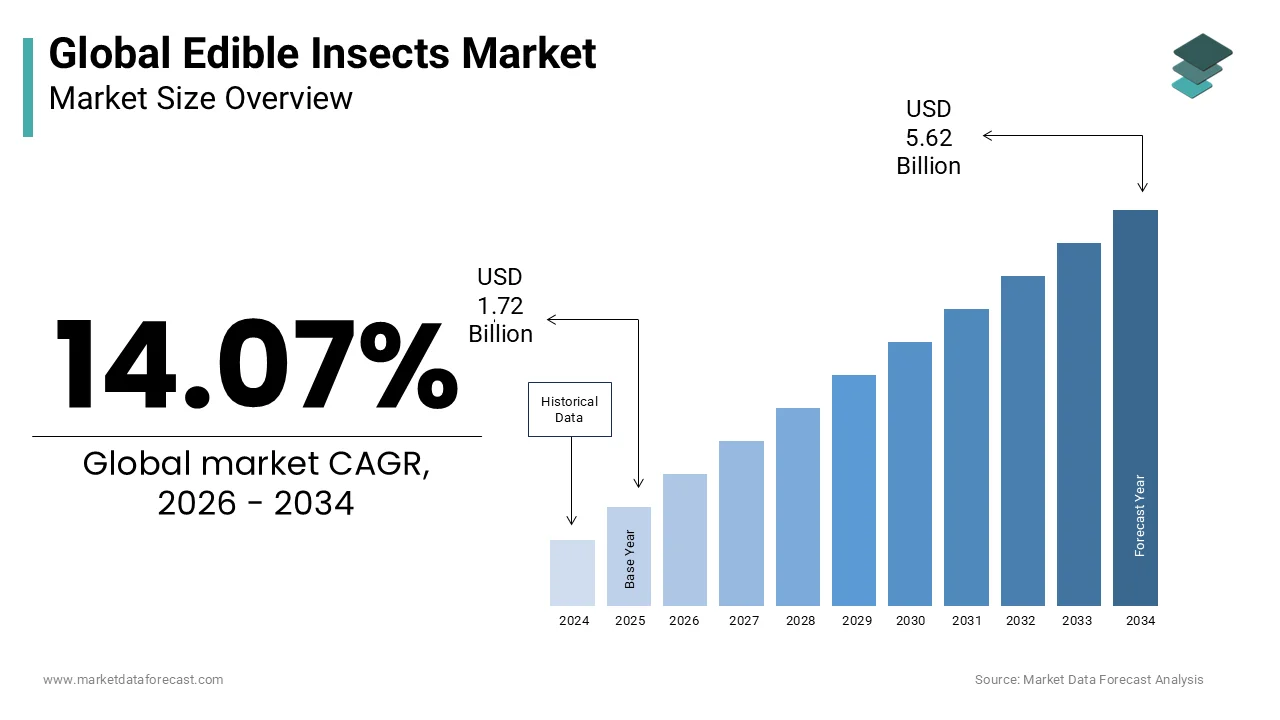
- Market Valuation: Valued at USD 1.72 billion in 2025, estimated at USD 1.96 billion in 2026, and projected to reach USD 5.62 billion by 2034, growing at a high-growth CAGR of 14.07% during the forecast period.
- Primary Growth Drivers: High protein and essential amino acid profiles, increasing global demand for sustainable and eco-friendly meat alternatives, rising health consciousness, and supportive regulatory frameworks (such as EU novel food approvals).
Global Edible Insects Market Segment Metrics (2026–2034)
| Market Category | Leading Edible Insects Segment (2025 Position) | Fastest-Growing / High-Potential Segment |
|---|---|---|
| By Product | Insect Powder (dominates market share by overcoming consumer stigma, offering easy integration into smoothies/shakes, and high digestibility) | Insect Meal (growing rapidly driven by animal feed and pet nutrition demands) |
| By Insect Type | Crickets (dominate market consumption due to scalable farming efficiency, high nutrient density, and protein bar/shake formulations) | Mealworms (expanding strongly as a popular snack and protein source in Asian markets) |
| By Application | Food and Beverages (dominates market demand through protein bars, baked goods, snacks, and processed powders) | Animal Feed & Pet Food (experiencing robust growth as a sustainable protein alternative for livestock and pets) |
| By End Use | Human Consumption (dominates overall market revenue driven by rising consumer interest in alternative protein sources) | Animal Nutrition (surging due to heightened focus on sustainable livestock and pet diets) |
| By Region / Country | North America (dominates global revenue supported by rising consumer awareness of protein deficiencies, eco-friendly diet choices, and food innovations in the US and Canada) | Asia-Pacific (fastest-growing regional market driven by traditional entomophagy, low raw material costs, and large-scale insect farming hubs in China, India, and South Korea) |
Major Edible Insects Producers & Market Structure
Market Structure: Specialized and emerging global alternative-protein landscape featuring dedicated entomoculture farms, agritech innovators, and feed producers competing on mass-rearing efficiency, food safety compliance, and product flavor masking.
Key Edible Insects Companies: Ÿnsect, Protix B.V., Enterra Feed Corporation, InnovaFeed, EnviroFlight, LLC, Nutrition Technologies Group, Entomo Farms, Hargol FoodTech, Aspire Food Group, All Things Bugs LLC, Beta Hatch, EntoCube OY, Armstrong Crickets Georgia, and Global Bugs Asia Co. Ltd.
Global Edible Insects Market Size
The global edible insects market size was valued at USD 1.72 billion in 2025, and is projected to reach USD 5.62 billion by 2034 from USD 1.96 billion in 2026, growing at a CAGR of 14.07%.
Edible insects are the varieties of insects that are safe to be consumed by humans. There are more than 2300 species of edible insects worldwide, and they are consumed frequently. The six commercially edible insect species are honeybee, domesticated silkworm, cricket, mopane caterpillar, yellow mealworm, and African palm weevil. Insects are said to be of high nutritional value, and human beings have been consuming insects since 7000 years ago. Insects are either captured in their natural habitat or farmed for eating purposes. The most commonly consumed orders of insects around the world are Orthopterans, Hymenopterans, Isopterans, Lepidopterans, etc. The practice of eating insects is called entomophagy and is quite a prevalent practice. The ethnic groups of Mexico, Africa, South America, and Asia are all vivid consumers of edible insects. The rising need for animal protein in recent times supports the expansion of the edible insects market.
MARKET DRIVERS
The edible insects market is expected to grow due to the high nutritional value and health advantages of consuming insects. Insects are a rich source of animal protein and are expected to contain around 40 to 75% of crude protein. Therefore, insects can help provide the adequate requirement of amino acids for adults. In addition, the nymph forms of many insects contain an abundance of all kinds of amino acids leading to good heart health and immune system upon consumption. Insects are also a rich source of fatty acids that are good for the body. The different fatty acids in insects can help reduce acne and skin lightening and provide anti-inflammatory properties. In addition, the linoleic acid present in several insects effectively protects the brain from strokes. Insects are also a good source of calories.
Linoleic acid is essential for humans as it is not naturally produced and is extremely important for proper visual function. Its lack can cause skin rashes, reproductive problems, retardation, etc. Therefore, the several benefits of insects with health support the growth of the market. Edible insects are also a very rich source of vitamins, as they contain vitamins like A, all 12 types of B, C, D, E, and K. All these vitamins are extremely important to promote growth and are often needed for the body. In addition, insects contain several micronutrients like magnesium, selenium, zinc, iron, sodium, phosphorous, etc. The presence of such an abundance of nutrition supports the market's growth. Furthermore, the growing lifestyle shifts toward healthier foods and the availability of edible insects in packaged and live forms due to growing insect farming supports the growth of the market.
Additionally, the application of edible insect nutrition in the medical and research field supports the market's growth. There has been continuous growth in the research on the advantages of insect consumption in recent times. The benefits of edible insects for not only humans but livestock and animals as feed support the further growth of the edible insect market. Insects of different shapes and sizes comprise different nutritional compositions and are consumed according to the individual's requirements. The growing economic crisis worldwide and the need to find a sustainable and cheap yet nutritious food source to avoid poverty support the growth of the edible insect market. The rising need to curb malnourishment, especially in children in developing regions of the world, supports the market's growth. Additionally, there has been a growth in sustainable meat alternatives recently.
MARKET RESTRAINTS
The reluctance to eat insects due to their appearance due to the fear of trying new foods (food neophobia) are a few of the drawbacks of the market. Insects are also found to have a lot of bacteria, viruses, parasites, and fungi that can be extremely dangerous and are the reason for multiple diseases. Common bacteria like E. coli and Campylobacter found in insects can cause serious harm to the body. Additionally, insects need to be appropriately processed and cleaned before being consumed. Therefore, the multiple risks associated with insect consumption support the growth of the market. On the other hand, the strict guidelines and rules associated with the approval process for edible insects also hinder market growth.
REPORT COVERAGE
| REPORT METRIC | DETAILS |
| Market Size Available | 2025 to 2034 |
| Base Year | 2025 |
| Forecast Period | 2026 to 2034 |
| CAGR | 14.07% |
| Segments Covered | By Product, Insect Type, Application, End Use, and Region. |
| Various Analyses Covered | Global, Regional and Country Level Analysis; Segment-Level Analysis; DROC; PESTLE Analysis; Porter’s Five Forces Analysis; Competitive Landscape; Analyst Overview of Investment Opportunities |
| Regions Covered | North America, Europe, APAC, Latin America, Middle East & Africa |
| Market Leaders Profiled | Taiyo Kagaku, Bemis, Innophos, Himalaya Drug Company, BioMax Life Sciences, Patanjali Ayurved, Dabur, Berry Plastics |
SEGMENTAL ANALYSIS
By Product Insights
The Insect powder segment is expected to dominate the edible insects market during the forecast period due to the ease of consumption in powder form. The powdered form makes insects easier to consume as they are not in their proper form, and therefore, there is no need to look at them and feel like eating insects. Additionally, powders can easily be mixed in smoothies and shakes and consumed. Therefore, the powdered form can help overcome the stigma associated with eating insects and is easy to digest.
The insect meal segment is also expected to grow as the use of insects as fodder for animals is rising. The growing consumption of meals with insects for inducing proteins in animals supports the growth of the segment. In addition, several pet animals also consume insect meals for healthy diets leading to segment growth.
By Insect Type Insights
The Crickets segment is expected to dominate the market during the forecast period due to the growing rates of cricket consumption due to easy farming, good nutritional benefits of the insect, and growing cricket products like shakes and protein bars.
The mealworms segment is also expected to grow during the forecast period due to being a rich source of proteins and a popular snack item in several Asian countries, driving the segment growth during the forecast period.
By Application Insights
The Food and Beverages segment is expected to dominate the market during the forecast period due to the increasing number of food products with insects. In addition, the growing global food shortage and the need for alternative protein sources support the market's growth. The feed segment is also expected to grow with the rising need for insects as a nutritional benefit for various livestock and pets.
By End Use Insights
The Human Consumption segment is expected to dominate the market during the forecast period due to the rising interest in consuming insects and the rising need for protein alternatives driving the segment. The animal nutrition segment is also expected to grow as more concerns over animal nutrition and diet increase.
REGIONAL ANALYSIS
The North American region is expected to dominate the market during the forecast period due to the growing awareness regarding the importance of protein in diets to avoid nutrition deficiency. Additionally, the growing interest in eco-friendly options for protein-filled food and the rising interest in insects support the region's market growth. Furthermore, the growing willingness to try new foods for health benefits in countries like the US and Canada supports the growth of the market in the region.
The edible insect market in Europe is also expected to grow due to the growing nutrition deficiency and the rising health concerns in the region. The countries like the UK, France, Italy, etc., are all regions with growing insect consumption. The EU passed several regulations regarding insect consumption in 2015 and considered insects as a novel food. In 2008 the EU approved 3 out of 4 regulations for using crickets and foods, and the insects have come a long way since then, leading to market growth in the region.
The Asia-Pacific region is also expected to grow during the forecast period due to the high consumption of insects as food, especially by locals in the region. The growing population and the need for food support the market's growth. Additionally, several Asian regions are known for being rich in the availability of various insects, supporting the growth of the market. Furthermore, the low cost of raw materials and transportation led to a significant rise in insect farming, with a heavy market for gathering and processing insects in countries like China, Japan, India, South Korea, etc.
KEY MARKET PLAYERS
Key Market players of Global Edible insects Market are Ÿnsect, Protix B.V., Enterra Feed Corporation, InnovaFeed, EnviroFlight, LLC, Nutrition Technologies Group, Entomo Farms, Hargol FoodTech, Aspire Food Group, All Things Bugs LLC, Beta Hatch, EntoCube OY, Armstrong Crickets Georgia, Global Bugs Asia Co.Ltd.
RECENT HAPPENINGS IN THE MARKET
- On March 3, 2023, an article expressing the views of pat crowley, the founder of the insect bar, came out. The article talked about pats views on the insect food industry and how he believes it will continue to grow in the future. Crowley introduced cricket-fueled chapul bars to America in 2012 and established a solid agricultural company called chapel farms.
- On March 20, 2023, the University of Maryland Eastern Shore announced that it would be hosting a celebrity chef series from April 3-6, and it has been decided that insect meals will be served in this series and contests.
- On February 22, 2023, The founder of circle harvest, Skye Blackburn, an entomologist and food scientist, spent the past 15 years researching and convincing people that consuming insects can help grow a better ecosystem and that it can solve world hunger. However, the company claims that the market in Australia is not growing due to a food shortage and the growing use of insects in feeds and fertilization practices.
- On MARCH 21, 2023, Hey Plant, an edible insect-based company, expanded into the US market. The company aims to expand its sustainable and healthy eating ideology by introducing products like cocoa orange and salty peanut fortified with buffalo beetle powder.
MARKET SEGMENTATION
This research report on the global edible insects market has been segmented and sub-segmented based on product, insect type, application, end-use & region.
By Product
- Insect meal
- Insect powder
- Whole insects
- Insect oil
By Insect Type
- Mealworms
- Crickets
- Silkworms
- Ants
- Buffalo Worms
- Grasshoppers
- Cicadas
- Black Soldier flies
- Other Edible Insects
By Application
- Feed
- Aquaculture Feed
- Animal Feed
- Pet Food
- Food and Beverages
- Processed Insect Powder
- Baked Products and Snacks
- Insect Beverages
- Insect Confectionaries
- Protein Bars and Shakes
- Processed Whole Insect
By End Use
- Animal Nutrition
- Human Consumption
By Region
- North America
- Europe
- Asia-Pacific
- Latin America
- Middle East and Africa