- Product Description Description
- Table of Contents TOC
- List of Table & Figure LOT
- Get Free Sample PDF Sample PDF
Market Size, 2025
$6.24 BnMarket Estimate, 2026
$7.18 BnMarket Forecast, 2034
$21.95 BnCAGR, 2026–2034
15%Executive Summary: Global Educational Tourism Market
- Market Scope: Comprehensive global educational tourism market analysis covering program types, age group demographics, educational levels, regional leadership metrics, key industry participants, and emerging experiential learning and student mobility trends.
- Market Valuation: Valued at USD 6.24 billion (2025), estimated at USD 7.18 billion (2026), and projected to reach USD 21.95 billion by 2034, registering a robust CAGR of 15% (2026–2034).
- Primary Growth Drivers: Rising demand for global exposure and cross-cultural learning, expansion of international student mobility and higher education partnerships, government support through visa facilitation and scholarships, and growing preference for experiential learning to enhance employability and intercultural competencies.
Key Market Segment Metrics (2026–2034)
| Category | Leading Segment (2025 Position) | Fastest-Growing Segment |
|---|---|---|
| By Program Type | Language courses (dominated the market with a 34.6% share in 2025) | Professional development courses (fastest-growing segment, expanding at a CAGR exceeding 12%) |
| By Age Group | Young adults (18–30 years) (held the largest share at 46.6% in 2025) | Teenagers (13–17 years) (fastest-growing demographic at a CAGR of nearly 11%) |
| By Level of Education | Undergraduate and graduate programs (led with a 42.2% share in 2025) | Continuing education and professional development courses (projected CAGR of around 12.5%) |
| By Region | North America (held the dominant share of 32.7% in 2025) | European and Asia-Pacific international study corridors |
Major Market Players & Market Structure
Market Structure: Highly competitive global educational travel and study-abroad landscape featuring major international program providers competing on digital platform customization, European university collaborations, and boutique academy acquisitions.
Key Companies: EF Education First, Kaplan International, CIEE, WorldStrides, STA Travel, Educational First Tours, American Councils for International Education, Rustic Pathways, Abbey Road Programs, Language International, INTO University Partnerships, and StudyGroup.
Global Educational Tourism Market Size
The global dental lasers market was worth US$ 6.24 billion in 2025 and is anticipated to reach US$ 21.95 billion by 2034 from US$ 7.18 billion in 2026, growing at a CAGR of 15% during the forecast period 2026 to 2034.
Educational tourism refers to travel undertaken primarily to gain knowledge, skills, or cultural exposure through structured learning experiences in a foreign environment. This form of tourism encompasses student exchange programs, language immersion courses, international internships, university study abroad programs, and vocational training initiatives conducted overseas. The Educational Tourism Market has evolved into a significant global sector that blends education with travel, offering participants both academic enrichment and cross-cultural engagement.
According to UNESCO, over 6 million students were enrolled in higher education institutions outside their home countries in 2022, reflecting a growing trend toward international academic mobility. As per the Institute of International Education, the United States alone welcomed more than 900,000 international students in the 2021–2022 academic year, demonstrating the appeal of studying abroad as part of educational development.
Moreover, short-term summer schools, internship-based tours, and cultural immersion camps are increasingly popular among high school and undergraduate students seeking experiential learning opportunities.
Governments and educational institutions worldwide have recognized the economic and social benefits of educational tourism, leading to policy support, scholarship programs, and visa facilitation initiatives.
MARKET DRIVERS
Rising Demand for Global Exposure and Cross-Cultural Learning
One of the primary drivers of the Educational Tourism Market is the increasing desire among students to gain global exposure and develop intercultural competencies. In an interconnected world, employers place high value on candidates who have lived and studied abroad, considering such experiences as indicators of adaptability, communication skills, and global awareness.
Universities and career advisors increasingly encourage students to participate in study abroad programs to enhance their employability and broaden their perspectives.
Besides, according to the European Commission’s Erasmus+ program report, over 340,000 students participated in international exchanges under the scheme in 2022, highlighting institutional support for international learning. Programs like these not only improve language proficiency but also foster soft skills such as problem-solving, teamwork, and critical thinking in diverse environments.
These trends indicate a sustained shift toward educational experiences that combine academic growth with cultural enrichment, fueling the expansion of the Educational Tourism Market.
Expansion of International Student Mobility and Higher Education Partnerships
The steady rise in international student mobility and the proliferation of global university partnerships represent a major catalyst for the Educational Tourism Market. Institutions worldwide are forging alliances to offer dual-degree programs, joint research initiatives, and semester-abroad opportunities that attract students seeking internationally recognized qualifications.
According to the OECD, global tertiary-level student mobility reached an all-time high in 2022, with over 6.5 million students pursuing higher education outside their home countries. Countries such as Canada, Australia, Germany, and the UK have introduced flexible visa policies and work permits to attract international learners, contributing to this upward trajectory.
Apart from these, many universities now integrate study abroad components directly into degree curricula, making international experiences a formal requirement rather than an optional add-on.
Moreover, emerging economies like India and China are witnessing a surge in outbound student mobility. According to the Chinese Ministry of Education, over 700,000 Chinese students pursued higher education abroad in 2022, representing a significant portion of global educational tourism flows. These developments highlight the expanding role of academic mobility in shaping the future of the Educational Tourism Market.
MARKET RESTRAINTS
High Costs Associated with Study Abroad Programs
A major restraint impeding the growth of the Educational Tourism Market is the high cost associated with international study and travel. Tuition fees, accommodation, transportation, health insurance, and living expenses can create significant financial burdens, limiting access for many students despite the growing demand for overseas educational experiences.
Moreover, as per a survey conducted by the Canadian Bureau for International Education, only 40% of Canadian students could afford to participate in study abroad programs without financial aid, underscoring the affordability gap in educational tourism.
In developing countries, where funding options are limited, the situation is even more challenging. These economic barriers restrict market expansion and limit participation to a relatively affluent segment of the student population, posing a significant challenge to the broader adoption of educational tourism.
Visa Restrictions and Bureaucratic Hurdles
Visa restrictions and complex bureaucratic procedures remain a persistent barrier to the growth of the Educational Tourism Market. Despite increasing global demand for international education, stringent visa requirements, long processing times, and unpredictable approval rates continue to deter prospective students from traveling abroad for academic purposes.
According to the study, visa rejection rates for students applying to study in the United States exceeded 25% in 2022, particularly affecting applicants from African and South Asian countries. Similarly, as per the UK Visas and Immigration Authority, processing delays for Tier 4 student visas averaged over six weeks during peak application periods, causing disruptions in enrollment timelines.
Besides, as per the Australian Department of Home Affairs, over 10% of international student visa applications were rejected in 2022, often due to documentation issues or insufficient proof of financial capability.
In some cases, geopolitical tensions and changing immigration policies further complicate matters. Like, student visa applications from certain Middle Eastern and North African countries faced increased scrutiny in recent years, slowing down the influx of international learners. These regulatory hurdles contribute to uncertainty and administrative complexity, discouraging potential participants and hindering the smooth expansion of the Educational Tourism Market.
MARKET OPPORTUNITIES
Growth of Short-Term and Immersive Language Programs
A significant opportunity within the Educational Tourism Market lies in the rising popularity of short-term and immersive language programs. Unlike traditional degree-based study abroad experiences, these programs offer flexibility, affordability, and focused skill development, attracting a broader demographic including professionals, young adults, and secondary students.
Countries such as Malta, Ireland, the UK, and Canada have emerged as top destinations for intensive language immersion, offering structured programs ranging from two weeks to several months.
Besides, as per the Japan Foundation, demand for Japanese language programs abroad grew between 2020 and 2022, fueled by interest in Japanese culture, technology, and business. Similar trends are observed in Spanish and Mandarin language programs, driven by economic and cultural ties with native-speaking countries.
Moreover, educational providers are leveraging digital marketing and partnerships with local schools to promote language tourism. This shift toward accessible, short-duration programs presents a lucrative avenue for market expansion, catering to learners seeking practical linguistic and cultural enrichment.
Increasing Collaborations Between Governments and Private Institutions
Another promising opportunity in the Educational Tourism Market is the growing collaboration between governments and private educational institutions to promote international student mobility and investment in cross-border learning initiatives. These partnerships aim to enhance the quality of educational offerings, streamline visa processes, and provide financial incentives to attract a larger pool of international students.
Bilateral education agreements have significantly simplified the process for students seeking to study abroad and enabled institutions to expand their global footprints.
Moreover, the European Union’s Erasmus+ program expanded its budget to accommodate more participants, reinforcing the public sector’s commitment to educational tourism.
Private institutions are also stepping in, with companies like INTO University Partnerships and Navitas forming strategic alliances with host universities to offer pathway programs tailored for international students. These collaborative efforts are reshaping the landscape of educational tourism, fostering sustainable growth and greater inclusivity in global learning experiences.
MARKET CHALLENGES
Health and Safety Concerns in International Destinations
Health and safety concerns pose a substantial challenge to the Educational Tourism Market, influencing student and parent decisions when choosing international study destinations. Political instability, crime rates, disease outbreaks, and inadequate healthcare infrastructure in certain regions can deter potential participants from engaging in overseas educational programs.
Also, several high-profile incidents involving international students being targeted in hate crimes or civil unrest occurred between 2020 and 2023, raising concerns about personal safety.
Universities and tour operators have responded by implementing enhanced risk assessments, mandatory orientation sessions, and 24/7 support networks for international students. However, ongoing geopolitical tensions and health risks continue to pose challenges to the seamless expansion of the Educational Tourism Market.
Cultural and Academic Adaptation Difficulties
Cultural and academic adaptation difficulties represent a significant hurdle for students participating in the Educational Tourism Market, impacting their overall experience and success. Differences in teaching styles, assessment methods, language barriers, and social norms can create stress and hinder academic performance, especially for first-time travelers.
According to a study published by the Journal of Studies in International Education, nearly 40% of international students reported experiencing academic adjustment issues during their first semester abroad, including unfamiliarity with participatory learning environments and differing expectations for coursework.
Also, as per the International Student Barometer, over 35% of surveyed students cited homesickness, isolation, and difficulty integrating into local communities as key challenges affecting their study abroad experience.
Language barriers further exacerbate these difficulties. According to the American Council on the Teaching of Foreign Languages, students with intermediate language proficiency often struggle to fully engage in lectures and discussions, limiting their academic progress.
To address these concerns, many institutions have implemented mentorship programs, language support services, and cultural integration workshops. Despite these efforts, ensuring smooth academic and social transitions remains a critical challenge in sustaining the growth of the Educational Tourism Market.
REPORT COVERAGE
| REPORT METRIC | DETAILS |
| Market Size Available | 2025 to 2034 |
| Base Year | 2025 |
| Forecast Period | 2026 to 2034 |
| Segments Covered | By Program Type, Age, Level of Education, and Region. |
| Various Analyses Covered | Global, Regional and Country-Level Analysis, Segment-Level Analysis, Drivers, Restraints, Opportunities, Challenges; PESTLE Analysis; Porter’s Five Forces Analysis, Competitive Landscape, Analyst Overview of Investment Opportunities |
| Regions Covered | North America, Europe, Asia Pacific, Latin America, the Middle East, and Africa |
| Market Leaders Profiled | EF Educational First, Kaplan International, CIEE, WorldStrides, STA Travel, Educational First Tours, American Councils for International Educational, Rustic Pathways, Abbey Road Programs, Language International, and Others. |
SEGMENTAL ANALYSIS
By Program Type Insights
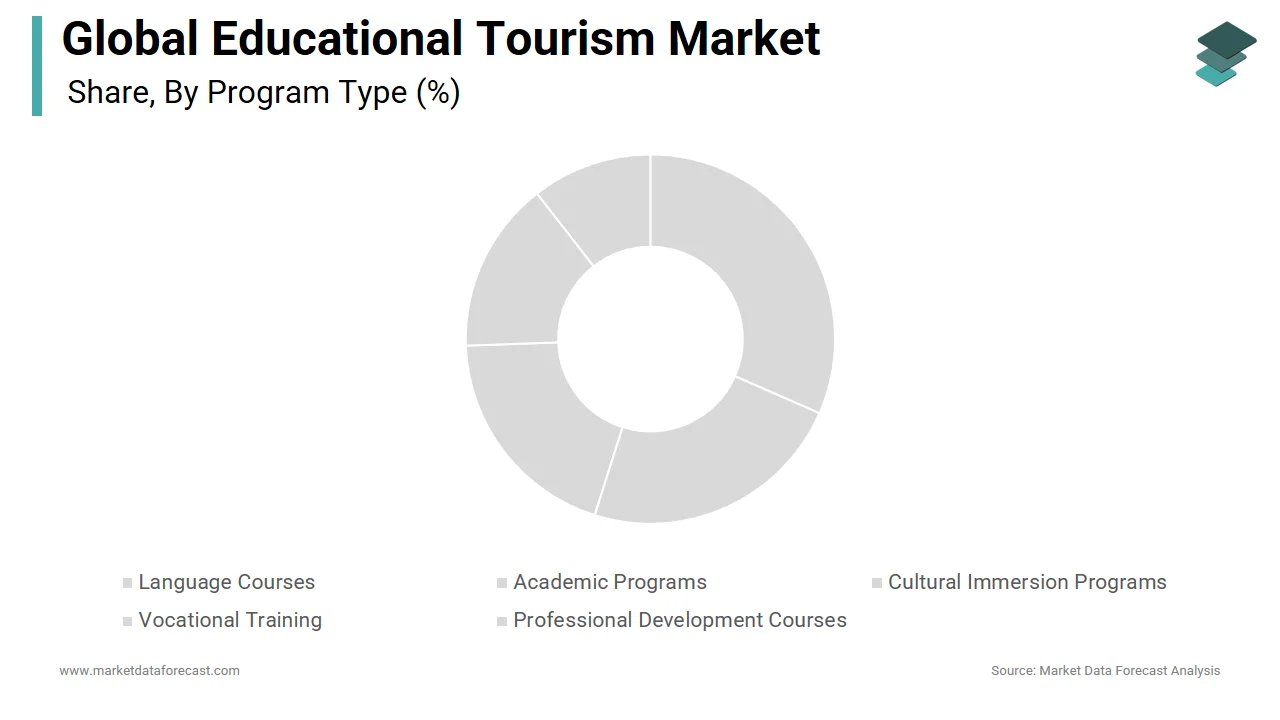
Language courses represented the largest segment in the Educational Tourism Market, accounting for 34.6% of total market revenue in 2025. This dominance is primarily attributed to the growing emphasis on multilingual proficiency in both academic and professional settings, particularly among students and young professionals seeking global career opportunities.
Countries such as the UK, the U.S., Canada, Australia, and Malta remain top destinations due to their high-quality language instruction and immersive cultural environments.
Moreover, as per EF Education First’s Global Language Report, English remains the most sought-after second language globally, with increasing demand observed in China, India, Brazil, and the Middle East. The report also notes that language tourism grew in 2023 compared to the previous year, driven by short-term summer camps and intensive courses designed for rapid skill acquisition.
Moreover, governments and educational institutions are actively promoting language-based educational tourism through scholarships, exchange programs, and visa facilitation.
Professional development courses are emerging as the fastest-growing segment in the Educational Tourism Market, projected to expand at a CAGR exceeding 12% in the future. This rapid growth is fueled by the increasing demand for upskilling and reskilling in response to evolving job market requirements and technological advancements.
According to the World Economic Forum, by 2025, over 50% of employees will require significant reskilling, prompting professionals to seek international training programs that offer exposure to global best practices. Universities, business schools, and vocational institutes across North America and Europe are capitalizing on this trend by offering short-term executive education, leadership workshops, and specialized certification programs.
Moreover, as per the Association to Advance Collegiate Schools of Business (AACSB), international enrollments in executive education programs rose by 18% between 2021 and 2023, indicating a shift toward experiential learning outside traditional degree structures.
Moreover, companies are increasingly investing in sending employees abroad for targeted skill enhancement. These trends underscore the rising importance of professional development as a key driver of the Educational Tourism Market, especially among mid-career professionals aiming to stay competitive in a rapidly transforming global economy.
By Age Group Insights
Young adults aged between 18 and 30 dominate the Educational Tourism Market, capturing 46.6% of total market share in 2025. This age group includes university students, recent graduates, and early-career professionals who pursue overseas experiences for academic credit, language improvement, internships, or personal enrichment.
According to UNESCO, more than 6 million students pursued higher education abroad in 2022, with the majority falling within the young adult demographic. These individuals are highly mobile, tech-savvy, and increasingly inclined toward experiential learning, making them the core participants in international study and work-integrated programs.
In addition, short-term summer schools, volunteer programs, and gap-year experiences attract a large number of young adults seeking both education and adventure.
Furthermore, as per the European Commission, Erasmus+ program participants predominantly consist of students aged 20–27, highlighting the significance of this cohort in driving educational mobility. With greater access to online information, flexible financing options, and employer recognition of international experience, young adults continue to be the primary force behind the expansion of the Educational Tourism Market.
Teenagers aged between 13 and 17 represent the fastest-growing age group in the Educational Tourism Market, projected to grow at a CAGR of nearly 11%. This surge is driven by increasing parental investment in early international exposure, language learning, and pre-university preparation.
Parents recognize the long-term benefits of early exposure to foreign cultures, language fluency, and independent living skills.
Moreover, teen-focused language programs often include homestays, school visits, and structured excursions, providing an ideal blend of education and cultural immersion.
In addition, many international schools and private academies now incorporate short-term overseas trips into their curricula. With rising disposable incomes in emerging economies and growing awareness of the value of early global experiences, teenage participation in educational tourism is expected to continue expanding at a robust pace.
By Level of Education Insights
Undergraduate and graduate programs led the level of education segment in the Educational Tourism Market, representing 42.2% of total market revenue in 2025. This segment includes full-degree programs, semester exchanges, dual degrees, and joint research initiatives undertaken by students pursuing higher education abroad.
Governments and universities have introduced flexible admission policies, scholarship programs, and post-graduation work visas to attract international students.
As per the U.S. Department of State, new F-1 student visa issuances increased in 2022 compared to the previous year, reflecting the resurgence of international undergraduate and graduate enrollments. Similarly, the Canadian Bureau for International Education reported a rise in international student admissions in 2023, with a majority enrolling in bachelor’s and master’s programs.
Besides, as per the UK Higher Education Statistics Agency, international student enrollment in postgraduate courses increased between 2021 and 2023, driven by demand for specialized qualifications in STEM, business, and health sciences.
Universities are increasingly integrating global experiences into standard curricula, encouraging students to spend semesters abroad as part of their degree. These factors collectively reinforce the dominant position of undergraduate and graduate programs in the Educational Tourism Market.
Continuing education and professional development courses are emerging as the booming level of education segment in the Educational Tourism Market, projected to expand at a CAGR of around 12.5%. This growth is driven by the need for lifelong learning and skill enhancement in response to rapid technological change and shifting employment landscapes.
According to the World Economic Forum, by 2025, 50% of all employees will require significant reskilling or upskilling, prompting a surge in short-term international training programs. These courses cover areas such as artificial intelligence, cybersecurity, renewable energy, finance, and leadership development.
As per the Association of MBAs (AMBA), executive education enrollments in international business schools increased in 2023, with participants ranging from mid-career professionals to corporate executives. Many organizations sponsor employees for overseas training to enhance global competencies and innovation capabilities.
Moreover, providers such as INSEAD, Harvard Extension School, and Oxford Executive Education are expanding their global offerings to meet this demand. With increasing acceptance of non-traditional credentials and a focus on experiential learning, continuing education is becoming a major growth engine in the Educational Tourism Market.
REGIONAL ANALYSIS
North America Educational Tourism Market Insights
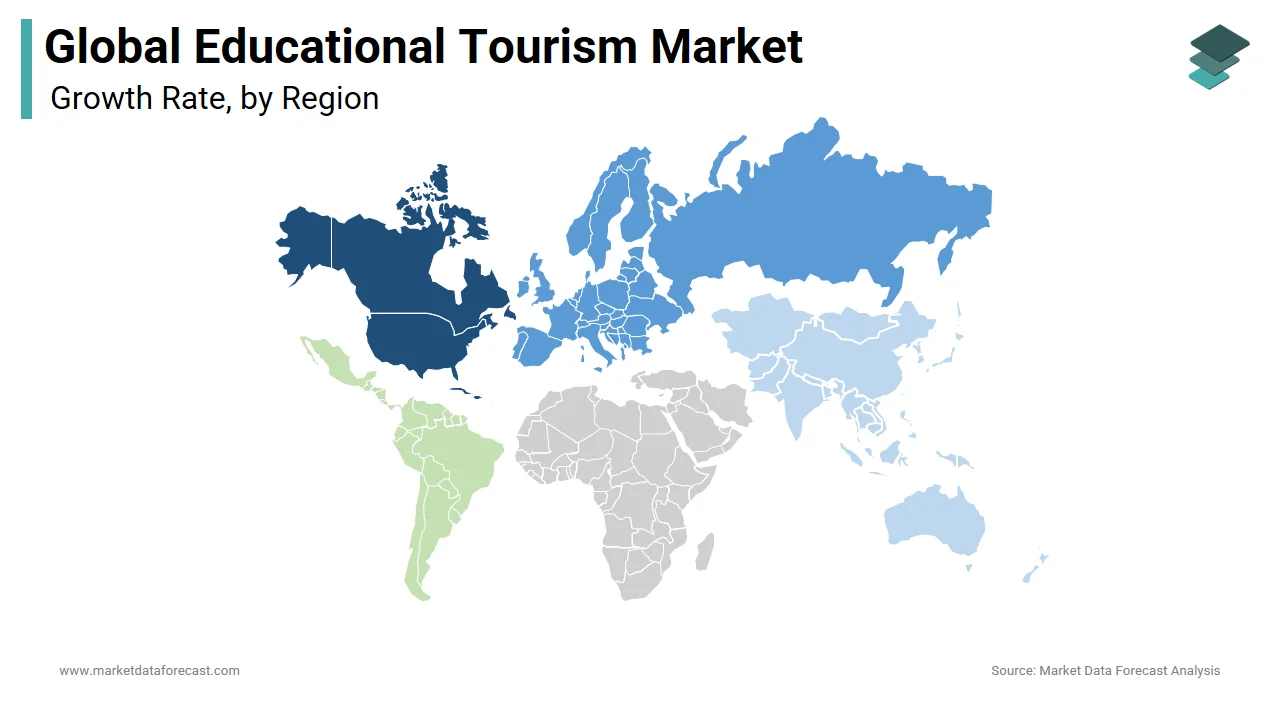
North America held the largest regional share of the educational tourism market at 32.7% in 2025, driven by strong academic institutions, diverse cultural experiences, and well-established international student support systems. The United States, in particular, remains a top destination due to its prestigious universities, cutting-edge research facilities, and flexible visa policies for international learners.
According to the Institute of International Education, the U.S. welcomed over 900,000 international students in the 2022–2023 academic year, marking a significant rebound following pandemic-related disruptions. Universities such as Harvard, MIT, Stanford, and NYU continue to attract students from Asia, the Middle East, and Latin America seeking world-class education and global networking opportunities.
Apart from these, as per the U.S. Department of Homeland Security, F-1 student visa approvals increased in 2025, supported by streamlined application processes and expanded Optional Practical Training (OPT) opportunities for post-graduation employment.
Canada complements the region's appeal with favorable immigration pathways and lower tuition costs compared to the U.S.
Europe Educational Tourism Market Insights
Europe remained a major player in the global Educational Tourism Market in 2025, supported by its rich academic heritage, multilingual environment, and extensive student exchange networks. The region is home to some of the world’s oldest and most respected universities, attracting students from across the globe for both degree programs and short-term study tours.
Germany, France, Spain, and the Netherlands are particularly popular due to affordable or tuition-free education models combined with high-quality instruction.
Moreover, as per the German Academic Exchange Service (DAAD), Germany welcomed over 400,000 international students in 2023, with many opting for English-taught programs in engineering, business, and environmental sciences. Europe’s commitment to internationalization, coupled with supportive visa policies and cultural diversity, ensures its continued prominence in the Educational Tourism Market.
Asia-Pacific Educational Tourism Market Insights
Asia-Pacific is witnessing rapidly expanding demand in the global Educational Tourism Market in 2025, driven by a combination of domestic outbound student mobility and growing attractiveness of regional study destinations. Countries like Australia, Japan, South Korea, Singapore, and New Zealand are strengthening their positions as preferred hubs for international students seeking quality education and cultural exposure.
The country offers a wide range of academic and vocational programs along with post-study work visas, enhancing its appeal.
In Japan, as per the Japan Student Services Organization, international student numbers exceeded 300,000 in 2023, supported by government initiatives such as the Global 30 Project aimed at internationalizing Japanese universities.
South Korea has also seen steady growth, driven by partnerships with Indian and ASEAN institutions. With improving infrastructure, scholarship programs, and policy reforms, Asia-Pacific is playing an increasingly influential role in shaping the global landscape of educational tourism.
Latin America Educational Tourism Market Insights
Latin America contributes a notable portion to the global Educational Tourism Market, with Brazil, Mexico, Argentina, and Chile leading the way. Though still in an early phase of development compared to North America and Europe, the region is gradually strengthening its educational tourism offerings through language immersion, cultural exchange, and academic collaborations.
According to the Brazilian Ministry of Education, outbound student mobility increased by 10% in 2025, with many students opting for short-term language programs in the U.S., Spain, and Portugal. In parallel, the country is also attracting inbound students through Portuguese language and cultural immersion programs.
Institutions such as Universidad Nacional Autónoma de México (UNAM) and Tecnológico de Monterrey are actively engaging in student exchange agreements with global partners.
While regulatory frameworks and institutional capacity are still developing, Latin America presents growing potential for future expansion in the Educational Tourism Market.
Middle East and Africa Educational Tourism Market Insights
The Middle East and Africa collectively accounted for a smaller share of the global Educational Tourism Market in 2025, The UAE, Saudi Arabia, South Africa, and Egypt emerging as key contributors. Although the region lags in terms of volume compared to other markets, it is showing gradual progress in educational infrastructure and international student engagement.
In the UAE, Vision 2030 includes strategic goals for higher education expansion, prompting investments in international branch campuses and student recruitment efforts.
Saudi Arabia, under its Vision 2030 initiative, launched the King Abdullah Scholarship Program, which has sent hundreds of thousands of students abroad for higher education.
South Africa, being the most developed scientific hub in the African continent, is expanding its capacity for international academic engagement. With ongoing improvements in higher education governance and international outreach, the MEA region presents untapped potential for future expansion in the Educational Tourism Market.
KEY MARKET PLAYERS
EF Educational First, Kaplan International, CIEE, WorldStrides, STA Travel, Educational First Tours, American Councils for International Education, Rustic Pathways, Abbey Road Programs, and Language International.
TOP LEADING PLAYERS IN THE MARKET
EF Education First
EF Education First is a global leader in language learning, academic programs, and cultural immersion experiences. The company offers a wide range of educational travel opportunities including summer camps, language courses, high school exchanges, and professional development programs across more than 50 countries. By integrating education with travel, EF has built a strong reputation for quality, safety, and experiential learning. Its focus on personalized itineraries, accredited instruction, and immersive environments makes it a preferred choice among students, educators, and corporate clients seeking international exposure
INTO University Partnerships
INTO University Partnerships plays a pivotal role in facilitating international student mobility by collaborating with leading universities to offer pathway programs that prepare students for undergraduate and postgraduate studies abroad. These programs help bridge academic and language gaps, ensuring smoother transitions into higher education systems. INTO operates in key destinations such as the U.S., UK, and Australia, partnering with prestigious institutions to attract students from diverse backgrounds. Its commitment to academic excellence and student support services strengthens its position as a major player in the Educational Tourism Market.
CEA Study Abroad (formerly College for International Studies)
CEA Study Abroad specializes in providing customized study abroad programs for university students, offering semester-long, summer, and faculty-led travel programs across the globe. With a strong network of academic partners and host institutions, CEA designs programs that integrate coursework with cultural immersion, internships, and service-learning components. The organization emphasizes academic integrity, cultural engagement, and student well-being, making it a trusted partner for colleges and universities looking to expand their international education offerings.
TOP STRATEGIES USED BY KEY MARKET PARTICIPANTS
One of the primary strategies adopted by key players in the Educational Tourism Market is expanding program diversity and customization, allowing participants to choose from a wide range of destinations, durations, and subject areas tailored to individual learning goals. This approach enhances appeal across different age groups and professional levels.
Another widely used strategy involves forming strategic partnerships with universities, governments, and local institutions, which helps streamline admissions, improve access to resources, and enhance credibility. These collaborations also facilitate visa facilitation, academic credit transfers, and housing arrangements, improving the overall experience for participants.
A third key strategy is investing in digital marketing, online platforms, and virtual engagement tools , enabling providers to reach a broader audience and offer interactive pre-travel preparation. These tools allow prospective participants to explore programs, connect with alumni, and receive guidance, increasing enrollment conversions and customer satisfaction in an increasingly competitive market landscape.
COMPETITION OVERVIEW
The competition in the Educational Tourism Market is highly dynamic, driven by a mix of established educational service providers, academic institutions, government-backed initiatives, and emerging private tour operators. While large firms like EF Education First and INTO dominate due to their global presence and extensive program networks, smaller niche players are gaining traction by offering specialized or localized experiences tailored to specific learner needs. Innovation remains a central theme, with companies focusing on differentiated program formats, enhanced cultural immersion, and integrated career development opportunities to stand out in a crowded marketplace. Strategic alliances between universities and private organizations are reshaping how educational tourism is delivered, often blending academic rigor with experiential travel. Additionally, as demand for short-term, skill-focused programs rises, providers are expanding beyond traditional degree-bound models to cater to professionals and lifelong learners. Governments are also playing a significant role by easing visa policies, funding scholarships, and promoting national education brands to attract international students. Amid these developments, maintaining quality assurance, ensuring student safety, and adapting to evolving consumer expectations remain critical challenges shaping the competitive dynamics of the Educational Tourism Market.
RECENT MARKET DEVELOPMENTS
- In March 2023, EF Education First launched a new digital platform that allows students to customize their educational travel itineraries, offering real-time course comparisons, virtual campus tours, and peer reviews to enhance decision-making and user engagement.
- In September 2023, INTO University Partnerships expanded its collaboration with three new universities in Europe, strengthening its academic offerings and broadening access to international students seeking pathway programs in business, engineering, and health sciences.
- In January 2024, CEA Study Abroad introduced a sustainability-focused track within its existing programs, incorporating eco-conscious travel practices and curriculum modules on environmental responsibility, aligning with growing student interest in ethical and sustainable education experiences.
- In May 2024, LanguageCourse.Net partnered with regional airlines and accommodation providers to offer bundled travel packages, reducing costs and logistical complexities for students participating in language immersion programs across multiple European destinations.
- In August 2024, StudyGroup, a global education provider, acquired a boutique firm specializing in teen-focused summer academies, enhancing its portfolio of youth-oriented educational tourism programs and expanding its reach in the Asia-Pacific region.
MARKET SEGMENTATION
This research report on the global educational tourism market research report is segmented and sub-segmented into the following categories.
By Program Type
- Language Courses
- Academic Programs
- Cultural Immersion Programs
- Vocational Training
- Professional Development Courses
By Age Group
- Children
- Teenagers
- Young Adults
- Seniors
By Level of Education
- Primary and Secondary Education
- Undergraduate and Graduate Programs
- Continuing Education
- Professional Development Courses
By Region
- North America
- Asia Pacific
- Europe
- Latin America
- Middle East & Africa