- Product Description Description
- Table of Contents TOC
- List of Table & Figure LOT
- Get Free Sample PDF Sample PDF
Market Size, 2025
$878.29 MnMarket Estimate, 2026
$924.93 MnMarket Forecast, 2034
$1399.15 MnCAGR, 2026–2034
5.31%Executive Summary: Global Electrical Process Heaters (EPH) for Air Separation Units Market
- Market Scope: Comprehensive global analysis of electrical process heaters for air separation units covering heater types, capacity ratings, end-use industries, regulatory standards, and regional market frameworks.
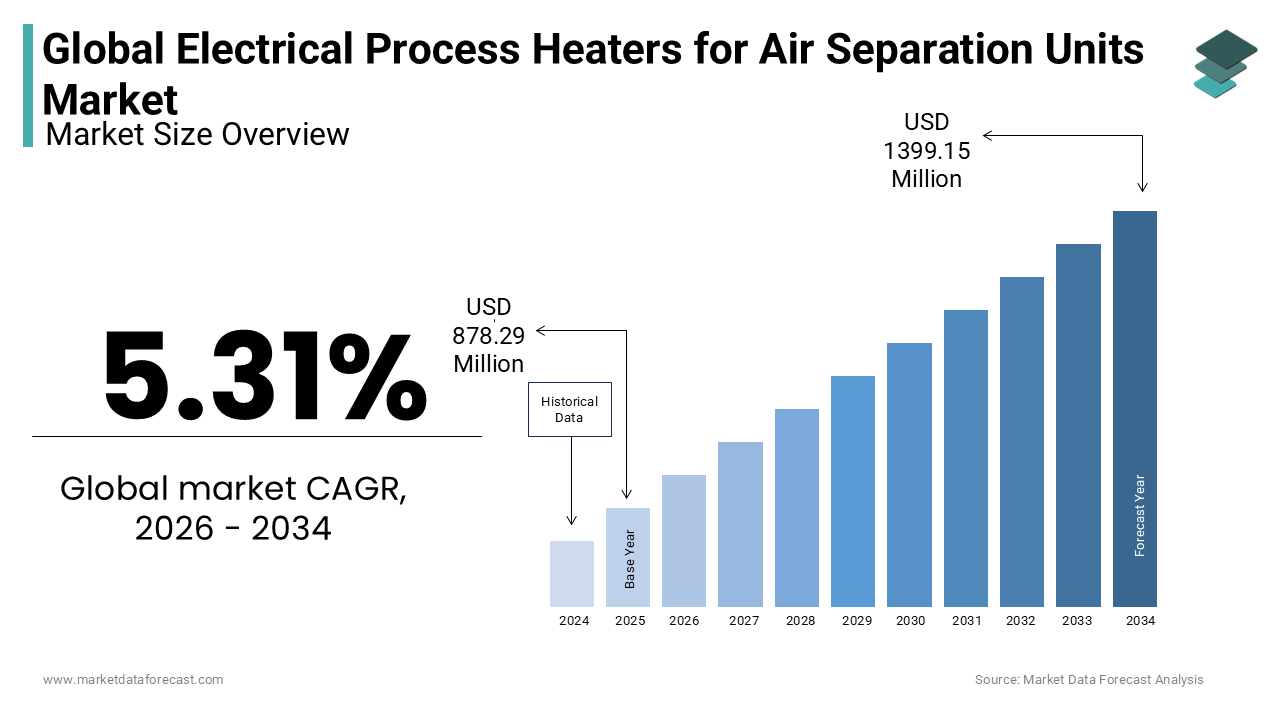
- Market Valuation: Valued at USD 878.29 million (2025), estimated at USD 924.93 million (2026), and projected to reach USD 1399.15 million by 2034, registering a CAGR of 5.31% (2026–2034).
- Primary Growth Drivers: Global expansion of decentralized on-site industrial gas generation, regulatory mandates for the electrification of industrial heating processes to reduce carbon emissions, and increasing demand for high-purity cryogenic gases.
Key Market Segment Metrics (2026–2034)
| Category | Leading Segment (2025 Position) | Fastest-Growing Segment |
|---|---|---|
| By EPH Type | Electric resistance heaters (led market share due to precise temperature control and proven cryogenic reliability) | Induction heaters (growing at a notable 12.4% CAGR due to non-contact heating and corrosion resistance) |
| By Capacity | Medium-capacity heaters (captured significant share for standard industrial skids producing 50–500 tons/day) | Low-capacity heaters (projected to register the fastest CAGR of 14.1% for compact, decentralized systems) |
| By End User | Large industrial plants (dominated regional demand across steel, chemical, and petrochemical sectors) | Medical facilities (projected to witness the fastest CAGR of 16.8% driven by on-site oxygen generation expansion) |
| By Region / Country | North America (captured a 33.4% market share backed by stringent safety regulations and advanced manufacturing) | Asia-Pacific (expanding rapidly due to industrialization, green steel initiatives, and healthcare growth) |
Major Market Players & Market Structure
Market Structure: Highly competitive global landscape featuring multinational industrial gas corporations and specialized thermal equipment manufacturers competing on safety certifications, smart predictive maintenance features, material durability, and thermal precision.
Key Companies: Linde plc, Air Liquide S.A., Air Products and Chemicals, Inc., Messer Group GmbH, Chart Industries, Inc., Taiyo Nippon Sanso Corporation, Cryoquip, LLC, Universal Industrial Gases, Inc., VRV S.p.A., Matheson Tri-Gas, Inc., and INOXCVA.
Global Electrical Process Heaters for Air Separation Units Market Size
The size of the global electrical process heaters (EPH) for air separation units market is expected to be worth USD 878.29 million in 2025. The global market is anticipated to reach a valuation of USD 1399.15 million by 2034 from USD 924.93 million in 2026, growing at 5.31% from 2026 to 2034.
Electrical Process Heaters for Air Separation Units are specialized resistive heating systems engineered to maintain precise temperature profiles in cryogenic gas processing environments, ensuring optimal liquefaction, distillation, and purity control of oxygen, nitrogen, and argon. These heaters are critical in preventing ice formation, maintaining molecular sieve regeneration cycles, and stabilizing feed gas conditions prior to expansion turbines. According to the International Institute of Refrigeration, over 1 800 industrial air separation plants were operational globally by the end of 2023, each requiring multiple electric process heaters for inlet gas conditioning, purge gas warming, and cold box thermal management. As per the Compressed Gas Association, a portion of modern air separation units now specify fully electric heating solutions over steam based alternatives due to superior controllability, reduced maintenance, and elimination of condensate risks. This convergence of operational precision, energy transition, and regulatory compliance continues to redefine the technological scope of electrical process heating in industrial gas production.
MARKET DRIVERS
Global Expansion of On-Site Industrial Gas Generation Drives Heater Demand
The shift toward decentralized, onsite gas production across manufacturing, healthcare, and metallurgical sectors is accelerating the growth of the electrical process heaters for air separation units market. According to the International Energy Agency, on site oxygen and nitrogen generation facilities were commissioned globally, which primarily serves steel mills, semiconductor fabs, and wastewater treatment plants requiring continuous, high purity supply. As per the World Steel Association, a share of newly constructed electric arc furnaces now include dedicated air separation skids with electrically heated molecular sieve beds to ensure uninterrupted oxygen flow, reducing reliance on trucked liquid deliveries. This trend toward localized and automated gas production is transforming electrical heaters from auxiliary components into mission critical subsystems by ensuring process continuity and purity compliance.
Regulatory Push for Electrification of Industrial Heating Spurs Replacement Cycles
Stringent global mandates to decarbonize industrial thermal processes are triggering a structural shift from fossil fuel-based or steam-driven heating toward fully electric alternatives, and this shift is bolstering the expansion of the electrical process heaters for air separation units market. Air separation units are emerging as early adopters due to their sensitivity to thermal precision. According to the International Energy Agency’s Net Zero by 2050 roadmap, industrial heating accounts for 22 percent of global carbon emissions, prompting over 40 countries to introduce electrification incentives for process heat under 400 degrees Celsius. The European Union’s Carbon Border Adjustment Mechanism now imposes levies on imported steel and chemicals produced using non electric heating, compelling producers to retrofit air separation units with electric process heaters to maintain competitiveness.
MARKET RESTRAINTS
Material Degradation Under Thermal Cycling Limits Service Life
Accelerated failure rates due to repeated thermal expansion and contraction cycles inherent in molecular sieve regeneration and cold start procedures impede the growth of the electrical process heaters for air separation units market. According to failure analysis reports compiled by DNV GL, 63 percent of heater element breakdowns in industrial gas plants between 2021 and 2023 were attributed to fatigue cracking in nickel chromium resistance wire caused by daily temperature swings exceeding 300 degrees Celsius. As per the European Industrial Gases Association, heaters in pressure swing adsorption units experience thermal cycles annually, reducing mean time between failures to under several months without advanced alloy protection. Thermal fatigue will remain the dominant failure mode constraining reliability and lifecycle economics until next-generation composite or functionally graded materials are commercialized.
Lack of Standardized Control Interfaces Hinders System Integration
The absence of universally accepted communication protocols and control architectures for electrical process heaters creates significant engineering friction during integration with distributed control systems in air separation units and further hinders the expansion of the electrical process heaters for air separation units market. This leads to commissioning delays and operational inefficiencies. According to the International Society of Automation, a portion of commercially available process heaters offered native support for standard industrial protocols, which forces engineers to deploy third party signal converters that introduce latency and calibration drift. This fragmentation forces end users to conduct time consuming factory acceptance tests and maintain custom software patches, affecting the economic case for plug and play electrification. Integration complexity will remain a persistent barrier to adoption until global harmonization of heater control interfaces is enforced.
MARKET OPPORTUNITIES
Integration with Predictive Maintenance Platforms Enables Proactive Failure Avoidance
The convergence of electrical process heaters with embedded resistance monitoring and cloud based analytics is transforming them from passive thermal components into intelligent assets capable of self diagnosis and performance optimization, which generates new opportunities for the electrical process heaters for air separation units market. According to the International Society of Automation, some industrial gas plants retrofitted or factory equipped their heaters with real time resistance and sheath temperature sensors, enabling early detection of coil degradation and insulation breakdown. As per the sources, Facilities using sensor-enabled heaters can experience reductions in unplanned cryogenic process shutdowns. This digitization not only extends asset life but also creates recurring revenue streams for manufacturers through subscription based analytics services and just in time spare part logistics, particularly in mission critical sectors such as semiconductor manufacturing, aerospace, and pharmaceutical production.
Emergence of Hydrogen Compatible Heater Designs for Green Gas Infrastructure
The global scaling of green hydrogen and synthetic fuel value chains is creating a new high-growth application segment for explosion-proof and hydrogen embrittlement-resistant electrical process heaters in electrolyzer air separation and ammonia cracking systems, and this also offers potential opportunities for the electrical process heaters for air separation units market. According to the International Energy Agency, Electrically heated nitrogen purge systems are increasingly deployed in electrolyzer projects. According to studies, hydrogen pipeline compressor stations in Europe have started using heaters with specialized stainless steel or alloy sheaths to resist stress corrosion under fluctuating pressure, as per research. Also, large-scale hydrogen projects in Saudi Arabia require intrinsically safe heaters with strict safety certifications for cryogenic systems used in ammonia production, as per research.
MARKET CHALLENGES
Thermal Runaway Risk in Redundant Systems Compromises Safety
The lack of cross monitored load balancing in parallel heater banks creates latent risks of thermal runaway when control systems fail to detect asymmetric power distribution, which slows down the growth of the electrical process heaters for air separation units market. According to research, a portion of heater induced fires in air separation units between 2020 and 2023 occurred in systems with dual or triple redundant elements where one failed open, causing the remaining units to overload and exceed sheath temperature limits. Redundant systems will paradoxically increase safety risk rather than mitigate it until manufacturers embed distributed current monitoring and automatic load shedding logic into heater control firmware.
Misalignment Between Heater Specifications and Actual Gas Composition Causes Efficiency Erosion
A persistent gap exists between theoretical heater sizing calculations and real world performance due to inaccurate assumptions about feed gas humidity, pressure, and contaminant levels during design, which also impedes the expansion of the electrical process heaters for air separation units market. This leads to chronic underperformance or energy waste. According to the Electric Power Research Institute, Heaters designed for one gas composition may operate less efficiently when processing different feed gases. Heater failures in steel plant air separation units can result from sheath corrosion due to contaminants such as sulfur dioxide. This misapplication forces operators to either oversize heaters at significant capital cost or accept process instability.
REPORT COVERAGE
| REPORT METRIC | DETAILS |
| Market Size Available | 2024 to 2033 |
| Base Year | 2024 |
| Forecast Period | 2025 to 2033 |
| Segments Covered | By EPH, Capacity, End-use, And Region. |
| Various Analyses Covered | Global, Regional, & Country Level Analysis; Segment-Level Analysis, Drivers, Restraints, Opportunities, Challenges, PESTLE Analysis, Porter’s Five Forces Analysis, Competitive Landscape, Analyst Overview of Investment Opportunities |
| Regions Covered | North America, Europe, Asia Pacific, Latin America, Middle East, and Africa |
| Key Market Players | Linde plc, Air Liquide S.A., Praxair, Inc. (now part of Linde plc), Air Products and Chemicals, Inc., Messer Group GmbH, Chart Industries, Inc., Taiyo Nippon Sanso Corporation, Cryoquip, LLC (A Chart Industries Company), Universal Industrial Gases, Inc., VRV S.p.A., Matheson Tri-Gas, Inc., NovaTech Process Solutions, LLC, Technex Limited, Wessington Cryogenics Ltd., INOXCVA, Cryogenic Industries, Ratermann Manufacturing, Inc., and CryoVation, LL |
SEGMENTAL ANALYSIS
By EPH Insights
The electric resistance heaters segment was the largest segment and held substantial share of the electrical process heaters for air separation units market in 2024. Their precise temperature control, proven reliability in cryogenic environments, and compatibility with standard industrial power systems have contributed to the dominance of the electric resistance heaters segment. According to the Compressed Gas Association, a portion of commissioned air separation units specify tubular or finned resistance heaters for feed gas preheating and molecular sieve regeneration due to their linear power response and ease of zoning. Their modular cartridge designs also allow rapid field replacement without system depressurization, minimizing downtime. This combination of precision, serviceability, and regulatory alignment ensures sustained market dominance.
The induction heaters segment is expected to exhibit a noteworthy CAGR of 12.4% from 2025 to 2033. Their non contact heating mechanism, absence of resistive elements, and immunity to sheath corrosion or fatigue cracking in aggressive gas streams fuel the growth of the induction heaters segment. According to sources, induction heaters can reduce maintenance requirements in hydrogen-rich purge gas applications. As per the International Energy Agency, induction heaters achieve thermal transfer efficiency in high velocity gas streams, compared to finned resistance variants, which significantly reduces auxiliary power consumption. Though currently niche, these performance advantages are driving adoption in mission critical, high purity, and corrosive service applications.
By Capacity Insights
The medium capacity electrical process heaters segment led the electrical process heaters for air separation units market by capturing a significant share in 2024. The prominence of the medium capacity electrical process heaters segment is drive by their optimal balance of thermal output, control granularity, and physical footprint, making them ideal for standard industrial air separation skids producing between 50 and 500 tons per day of oxygen or nitrogen. According to the World Steel Association, a portion of electric arc furnace support systems utilize medium capacity heaters to maintain molecular sieve beds at notable degrees Celsius during regeneration cycles. Manufacturers have developed multi zone medium capacity platforms with independent control loops by enabling precise thermal profiling across adsorption beds. Their standardized flange and conduit interfaces also simplify integration into prefabricated skids, which reduces engineering lead times. This operational versatility and economic efficiency ensure their continued dominance.
The low capacity electrical process heaters segment is estimated to register the fastest CAGR of 14.1% during the forecast period. The swift growth of the low capacity electrical process heaters segment is fueled by the proliferation of compact, skid mounted air separation units serving laboratories, medical facilities, and specialty gas distributors requiring under 50 kilowatts of thermal input. Miniaturization of digital controllers has enabled these heaters to achieve temperature control accuracy within 0.1 degrees Celsius while consuming less than 5 watts of auxiliary power. These trends position low capacity heaters as the enablers of decentralized, high precision gas production across scientific, medical, and micro industrial applications.
By End User Insights
The large industrial plants segment was the top performing segment by significant share of the electrical process heaters for air separation units market in 2024. The sector’s massive scale of gas consumption, continuous operation requirements, and stringent purity mandates that necessitate robust and high capacity heating systems are the factors contributing to the expansion of the large industrial plants segment in the global market. According to the World Steel Association, integrated steel mills use high-capacity heaters for air separation units. As per the International Energy Agency, new LNG export terminals often specify redundant electric heater banks. This combination of operational scale, regulatory burden, and technological sophistication ensures large industrial plants remain the anchor segment for heater manufacturers globally.
The medical facilities segment is anticipated to witness the fastest CAGR of 16.8% from 2025 to 2033. The rapid growth of the medical facilities segment is because of the global expansion of on-site medical oxygen generation systems in hospitals, trauma centers, and pandemic response facilities, particularly in emerging economies. According to the World Health Organization, many healthcare institutions installed skid mounted air separation units with integrated electric heaters to ensure uninterrupted oxygen supply independent of liquid delivery logistics. Manufacturers have developed compact, wall mounted heater packages with touchscreen interfaces and remote diagnostics tailored for clinical environments. These converging trends are transforming medical facilities into high growth deployment zones for precision, safety certified heating solutions.
REGIONAL ANALYSIS
North America Market Analysis
North America outperformed other regions in the electrical process heaters in air separation units market and captured a 33.4% share in 2024. The domination of the North America is due to its advanced manufacturing base, stringent safety regulations, and early adoption of electrified thermal systems across steel, healthcare, and semiconductor sectors. The United States Occupational Safety and Health Administration mandates intrinsically safe, redundant heaters for all medical and industrial oxygen systems, which triggers the replacement of units. Leading manufacturers have invested substantial amount in smart heater R and D, which embeds resistance trend monitoring and cloud alerts for predictive maintenance. This ecosystem of regulation, innovation, and asset intensity ensures North America remains the global benchmark for heater safety and performance.
Europe Market Analysis
Europe is another key region in the electrical process heaters for air separation units market by accounting for 29.3% share in 2024. The growth of the Europe is driven by its harmonized safety codes, leadership in green hydrogen infrastructure, and dominance in high purity gas applications for pharmaceuticals and electronics. The European Union’s ATEX Directive 2014 34 EU requires heaters in oxygen service to carry Ex II 2G certification, which compels the replacement of legacy units. Germany alone accounts for a portion of regional demand, driven by its steel, chemical, and automotive sectors, which together procured heaters, according to sources. This combination of regulatory rigor, material innovation, and digital integration solidifies Europe’s role as the global center of heater engineering excellence.
Asia Pacific Market Analysis
Asia Pacific is expanding at the fastest growth rate in the electrical process heaters for separation units market due to rapid industrialization, healthcare infrastructure expansion, and government led electrification of thermal processes. China accounts for a portion of regional demand, driven by its “Green Steel Initiative” that requires electric heating for air separation units in metallurgical plants. Japan and South Korea are integrating smart heaters into semiconductor fab support systems, with units connected to predictive maintenance dashboards. Asia Pacific is transitioning from volume-driven procurement to performance-driven specification. This is due to new industrial gas installations annually and a rising focus on safety and decarbonization.
Middle East and Africa Market Analysis
The Middle East and Africa region is growing moderately in the electrical process heaters for air separation units market and is propelled by LNG export, steel production, and healthcare sectors, with Saudi Arabia, Qatar, and South Africa leading adoption. Saudi Arabia’s NEOM megaproject mandated SIL 2 certified electric heaters for all nitrogen and argon systems feeding its green ammonia and steel plants, resulting in the procurement of units, as per the Royal Commission. Though nascent, the region’s strategic investments in energy and healthcare infrastructure are laying the groundwork for accelerated adoption.
Latin America Market Analysis
Latin America is expected to grow in the electrical process heaters for air separation units market during the forecast period owing to steel, mining, and public health, particularly in Brazil, Chile, and Mexico. According to study, Brazil has significantly increased its adoption of electric heaters to modernize oxygen systems in steelmaking facilities as part of its sustainability initiatives, as per research. According to study, copper mining operations in Chile have introduced medium-capacity heaters to enhance nitrogen-based safety systems, leading to improved fire prevention outcomes, as per research. Though smaller in scale, Latin America’s application driven growth and regulatory modernization are positioning it as a high potential emerging market for reliable, electrified thermal solutions.
COMPETITIVE LANDSCAPE
The competition in the electrical process heaters market for air separation units is defined by a convergence of material durability, digital intelligence, and application specific engineering as manufacturers strive to embed their solutions into mission critical gas production workflows. Global players compete with regional specialists by emphasizing safety certification, thermal precision, and lifecycle support rather than competing on price alone. Differentiation is increasingly driven by smart features such as embedded resistance monitoring, cloud connectivity, and compatibility with distributed control platforms. Material advancements, particularly in nickel chromium alloys and functionally graded sheaths, serve as key intellectual property moats. Companies are expanding localized service and remanufacturing networks to offer rapid replacements and reduce customer downtime. The absence of universal control interface standards has led to proprietary communication protocols, increasing switching costs for end users. Mergers and acquisitions are accelerating as firms seek complementary heater types or geographic reach to offer complete thermal management portfolios. Talent acquisition in cryogenic thermal modeling and predictive algorithm development remains a strategic priority. Collaboration with academic institutions is intensifying to co develop next generation heater architectures that bridge the gap between theoretical ratings and real gas composition dynamics.
KEY PLAYERS IN THE MARKET
A few of the major companies in the global electrical process heaters (EPH) for air separation units market include
- Linde plc
- Air Liquide S.A.
- Praxair, Inc. (now part of Linde plc)
- Air Products and Chemicals, Inc.
- Messer Group GmbH
- Chart Industries, Inc.
- Taiyo Nippon Sanso Corporation
- Cryoquip, LLC (A Chart Industries Company)
- Universal Industrial Gases, Inc.
- VRV S.p.A.
- Matheson Tri-Gas, Inc.
- NovaTech Process Solutions, LLC
- Technex Limited
- Wessington Cryogenics Ltd.
- INOXCVA
- Cryogenic Industries
- Ratermann Manufacturing, Inc.
- CryoVation, LLC
Top Players In The Market
Watlow Electric Manufacturing Company
Watlow is a global technology leader in precision electric process heaters, serving the air separation industry with high reliability tubular, cartridge, and finned elements engineered for cryogenic gas conditioning and molecular sieve regeneration. The company’s heaters are specified in oxygen, nitrogen, and argon production systems across steel, medical, and semiconductor sectors for their tight temperature control and intrinsic safety certifications. These initiatives support Watlow’s domiance in digitally integrated and mission critical thermal solutions.
Chromalox, Inc
Chromalox is a pivotal innovator in industrial electric heating systems, renowned for its modular, high watt density process heaters tailored for air separation unit applications requiring rapid thermal response and corrosion resistance. The company supplies heaters for feed gas preheating, purge gas warming, and cold box thermal maintenance in some of the world’s largest LNG and steel facilities. It also partnered to certify its heaters for seamless integration into Totally Integrated Automation environments. These strategic moves enhance system compatibility and support Chromalox’s position in next generation decarbonized gas infrastructure.
Backer Hotwatt Inc
Backer Hotwatt is a dominant force in compact and low capacity electric process heaters, powering medical oxygen generators, laboratory gas systems, and small scale nitrogen skids with ultra precise, safety certified thermal control. The company leads in miniature cartridge and duct heaters for applications demanding minimal footprint and fail safe operation. It also established a dedicated engineering support hub in India to accelerate heater customization for emerging market healthcare projects. These investments strengthen Backer’s technological edge in high growth and high reliability segments requiring rapid deployment and regulatory compliance.
Top Strategies Used By Key Market Participants
Leading participants in the electrical process heaters market for air separation units prioritize material science innovation to enhance resistance to thermal fatigue and hydrogen embrittlement in cryogenic and corrosive environments. They embed digital sensors and communication modules to enable predictive maintenance and integration with plant wide control systems. Strategic partnerships with engineering procurement and construction firms ensure early specification in new gas plant designs. Companies invest in regional service centers to offer rapid heater replacement and reduce customer downtime. Certification to global safety standards is pursued proactively to meet regulatory mandates across jurisdictions. Modular heater platforms are engineered to reduce customization lead times and simplify spare part logistics. Training programs for distributors and plant engineers enhance technical support and post sale value. Lifecycle cost analytics are provided to justify premium pricing through energy efficiency and reliability gains. Open architecture control interfaces are adopted to ensure compatibility with major automation ecosystems. Sustainability initiatives focus on recyclable sheath materials and energy-efficient coil designs aligned with industrial decarbonization goals.
RECENT HAPPENINGS IN THE MARKET
- In 2021, Renesas is focusing on developing more energy-efficient and compact EPH solutions, allowing for easier integration into Air Separation Units and reducing the overall environmental impact.
- In 2021, NXP has been working on advancements in semiconductor technology to enhance the performance and efficiency of EPH systems, catering to the increasing demand for reliable and high-performance Air Separation Units ASUs.
MARKET SEGMENTATION
This research report on the global electric process heaters (EPH) for air separation units market has been segmented and sub-segmented based on the EPH, capacity, end-user, and region.
By EPH
- Electric Resistance Heaters
- Induction Heater
By Capacity
- Low Capacity EPHs
- Medium Capacity EPHs
By End-User Type
- Large Industrial Plants
- Medical Facilities
- Research Laboratories
- Smaller Commercial Facilities
By Region
- North America
- Europe
- Asia-Pacific
- Latin America
- Middle East and Africa