- Product Description Description
- Table of Contents TOC
- List of Table & Figure LOT
- Get Free Sample PDF Sample PDF
Market Size, 2025
$32.64 MnMarket Estimate, 2026
$36.03 MnMarket Forecast, 2034
$79.51 MnCAGR, 2026–2034
10.4%Global Electronic Nose Market Size
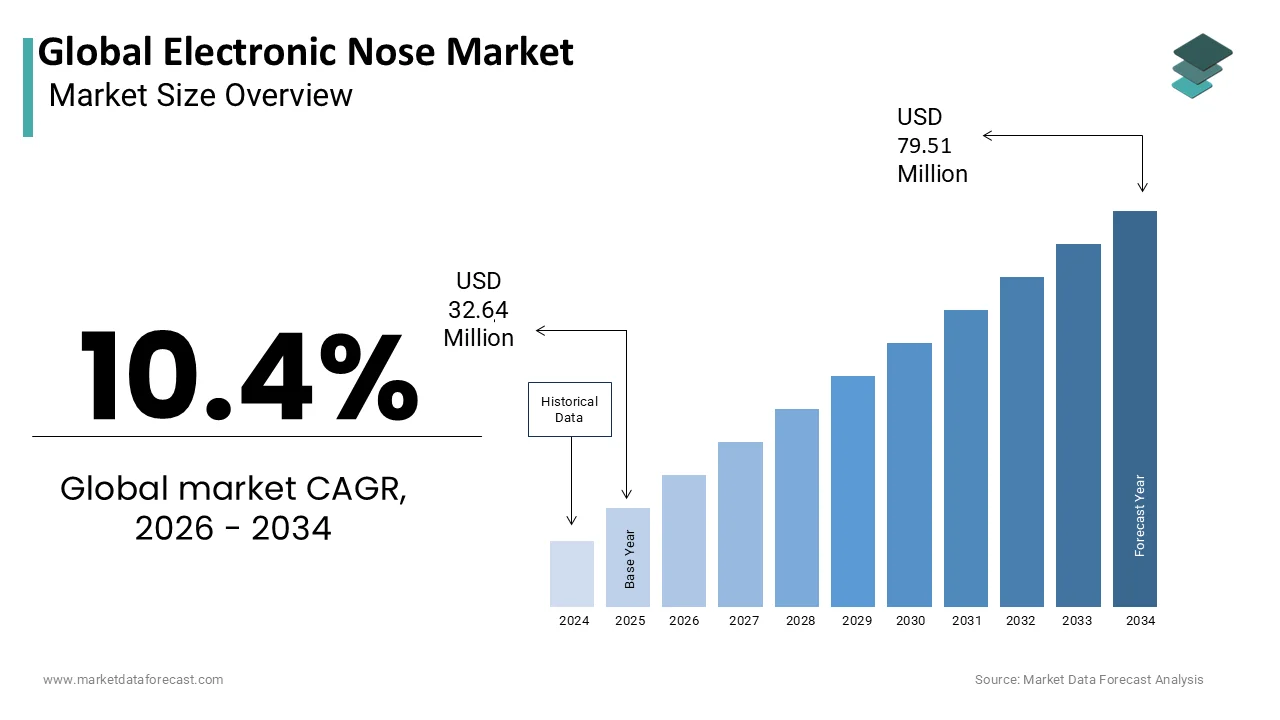
The global Electronic Nose Market was valued at USD 32.64 million in 2025, is estimated to reach USD 36.03 million in 2026, and is projected to reach USD 79.51 million by 2034, growing at a CAGR of 10.4% from 2026 to 2034.
An electronic nose is an advanced analytical instrument that emulates mammalian olfaction by employing an array of chemical sensors coupled with pattern recognition algorithms to detect, identify, and quantify volatile organic compounds in complex gaseous environments. Unlike traditional gas chromatography or mass spectrometry, electronic noses deliver real-time, non-invasive, and often portable analysis, making them indispensable in sectors where rapid odor profiling or contamination detection is important. As per the United States Department of Agriculture, foodborne pathogens cause approximately forty-eight million illnesses in the United States each year, many of which could be intercepted earlier through non-destructive aroma profiling. The European Space Agency has deployed electronic nose prototypes aboard the International Space Station since fifteen to monitor cabin air quality and detect trace contaminants in closed-loop life support systems. In clinical settings, research published in the Lancet Digital Health demonstrated that electronic noses achieved eighty-nine percent accuracy in distinguishing lung cancer patients from healthy controls based solely on exhaled breath signatures. This convergence of environmental, industrial, and biomedical urgency is transforming electronic noses from laboratory curiosities into frontline diagnostic and safety tools across global value chains.
MARKET DRIVERS
Rising Demand for Non-Invasive Medical Diagnostics is Accelerating Clinical Adoption
The global healthcare sector is pivoting toward early, non-invasive, and cost-effective diagnostic modalities, which drives the growth of the electronic nose market. This shift is propelling electronic nose technology into mainstream clinical workflows. The technology is particularly used for respiratory and metabolic disease screening. According to the Global Burden of Disease Study published in The Lancet, chronic respiratory diseases, including asthma and chronic obstructive pulmonary disease, affect over five hundred and forty five million people worldwide, creating an urgent need for point-of-care tools that bypass sputum cultures and imaging delays. Research conducted at the University of Cambridge and published in the American Journal of Respiratory and Critical Care Medicine demonstrated that an electronic nose correctly classified asthma phenotypes with ninety-two percent accuracy by analyzing exhaled volatile biomarkers, reducing diagnostic time from weeks to minutes.
Stringent Food Safety Regulations are Mandating Real-Time Quality Control in Production Chains
Global regulatory agencies are increasingly enforcing real-time and non-destructive quality verification protocols across food manufacturing and distribution, and these are propelling the expansion of the electronic nose market. This compels producers to adopt electronic nose systems as preventive control points against spoilage, contamination, and fraud. According to the Food and Agriculture Organization of the United Nations, approximately one point three billion tons of food are lost or wasted annually, with microbial spoilage accounting for over thirty percent of post-harvest losses in perishable categories. Seafood exporters face a similar burden. This regulatory and economic convergence is transforming electronic noses from optional sensors into mandatory sentinels of food integrity.
MARKET RESTRAINTS
Lack of Standardized Calibration Protocols Affects Cross-Application Reliability
The absence of universally accepted calibration and validation frameworks for electronic nose systems severely limits their reproducibility across laboratories, industries, and geographies, which impedes widespread regulatory acceptance and clinical deployment and thereby restricts the growth of the electronic nose market. According to the International Union of Pure and Applied Chemistry, a portion of published electronic nose studies between two thousand and twenty and two thousand and twenty-four included traceable reference standards or inter-laboratory validation, rendering results non-comparable. Clinical adoption faces even greater hurdles. Electronic noses will remain confined to adjunct or pilot roles rather than becoming primary decision-making instruments until metrological traceability and performance stability are codified into international standards.
High Cost of Sensor Array Replacement and Maintenance Deters SME Adoption
These systems remain prohibitively expensive for small and medium enterprises due to the recurring cost of sensor cartridge replacement, recalibration services, and proprietary software licensing, which restrain the expansion of the electronic nose market. According to a cost of ownership analysis published by the Fraunhofer Institute for Process Engineering and Packaging, the average electronic nose deployed in food quality control requires sensor array replacement every six to nine months at a cost ranging from two thousand to five thousand euros per unit, excluding labor. Small wineries and artisanal cheese producers surveyed by the International Dairy Federation pointed out that over eighty percent abandoned electronic nose trials within twelve months due to unsustainable maintenance expenses. Sensor degradation is accelerated in harsh industrial environments.
MARKET OPPORTUNITIES
Integration with Artificial Intelligence Enables Predictive Quality and Early Pathogen Detection
The fusion of electronic nose data streams with machine learning algorithms is unlocking predictive analytics capabilities that transform reactive odor detection into proactive risk mitigation across food safety and clinical diagnostics, and thereby providing new opportunities for the electronic nose market. According to research published in Nature Machine Intelligence, convolutional neural networks trained on longitudinal electronic nose datasets from poultry processing plants predicted Salmonella contamination outbreaks with ninety-four percent accuracy up to seventy-two hours before conventional microbiological tests returned positive results. Tyson Foods implemented this technology across three U S facilities in thousand twenty four reducing product hold times by fifty-eight percent and avoiding an estimated thirty-two million dollars in potential recall costs.
Expansion into Environmental Monitoring and Smart City Infrastructure Unlocks Municipal Scale Deployments
Municipal governments and environmental agencies are increasingly deploying networked electronic nose arrays as foundational sensors in smart city ecosystems to monitor air quality, detect hazardous leaks, and enforce emission regulations in real time, which creates major opportunities for the expansion of the electronic nose market. According to the World Meteorological Organization, urban air pollution contributes to over four point two million premature deaths annually, creating political and public pressure for hyperlocal monitoring solutions beyond traditional fixed station networks. The City of Barcelona installed one hundred and twenty electronic nose nodes across its industrial corridor in 2023, achieving a thirty-nine percent improvement in illegal emission detection compared to satellite and drone-based methods. This municipal and infrastructural embedding is transforming electronic noses from isolated instruments into distributed environmental sentinels.
MARKET CHALLENGES
Cross-Sensor Interference and Limited Compound Specificity Hamper Diagnostic Precision
Cross-sensitivity among volatile compounds is leading to false positives or ambiguous classifications, which challenge the growth of the electronic nose market. This affects its reliability in safety-critical or diagnostic applications. According to peer-reviewed research in Analytical Chemistry, commercial metal oxide sensor arrays exhibit response overlap for over sixty percent of common volatile organic compounds, including aldehydes,, ketones, and terpenes, making it impossible to isolate individual analytes without supplementary separation techniques. In clinical validation trials conducted at the Cleveland Clinic in 2025, electronic noses misclassified lung cancer signatures in twenty-two percent of cases due to interference from coexisting conditions such as gastroesophageal reflux or sinusitis, which emit overlapping biomarkers.
Absence of Regulatory Endorsement in Clinical and Food Safety Domains Restricts Commercial Scalability
The systems have not received a formal regulatory endorsement as standalone diagnostic or quality control instruments in major jurisdictions, which creates a significant barrier to the electronic nose market. According to the U S Food and Drug Administration, no electronic nose device has been cleared through the premarket approval pathway for primary diagnosis of any disease as of mid two thousand and twenty four due to insufficient evidence of analytical and clinical validity under real-world conditions. The European Medicines Agency similarly rejected two manufacturer submissions in 2020 twenty citing a lack of standardized operating procedures and inter-site reproducibility data.
REPORT COVERAGE
| REPORT METRIC | DETAILS |
| Market Size Available | 2025 to 2034 |
| Base Year | 2025 |
| Forecast Period | 2026 to 2034 |
| Segments Covered | By Application, and Region. |
| Various Analyses Covered | Global, Regional and Country-Level Analysis, Segment-Level Analysis, Drivers, Restraints, Opportunities, Challenges; PESTLE Analysis; Porter’s Five Forces Analysis, Competitive Landscape, Analyst Overview of Investment Opportunities |
| Countries Covered | North America, Europe, Asia Pacific, Latin America, Middle East & Africa |
| Market Leaders Profiled | Odotech (Canada), The eNose Company (Netherlands), Scent Sciences (US), Scentsational Technologies (US), FOODsniffer (US), AIRSENSE Analytics (Germany), Scensive Technologies (UK), Intelesens Ltd (UK), RoboScientific Ltd (UK), OlfaGuard (Israel), Aryballe (France) |
SEGMENTAL ANALYSIS
By Application Insights
In 2025, the food and beverage segment led the electronic nose market by accounting for 43.6% share 2025. The dominant food and beverage segment is driven by the industry’s acute vulnerability to spoilage, a deterioration, and regulatorynon-compliancee which electronic noses mitigate through non-invasive real-time aroma profiling. According to the Food and Agriculture Organization of the United Nations, foodborne illnesses cost the global economy over one hundred and ten billion dollars annually, with microbial spoilage accounting for over thirty percent of losses in perishable supply chains. The European Food Safety Authority mandated continuous aroma monitoring for all dairy and meat processors under its jurisdiction starting in thousand twenty compelling widespread adoption.
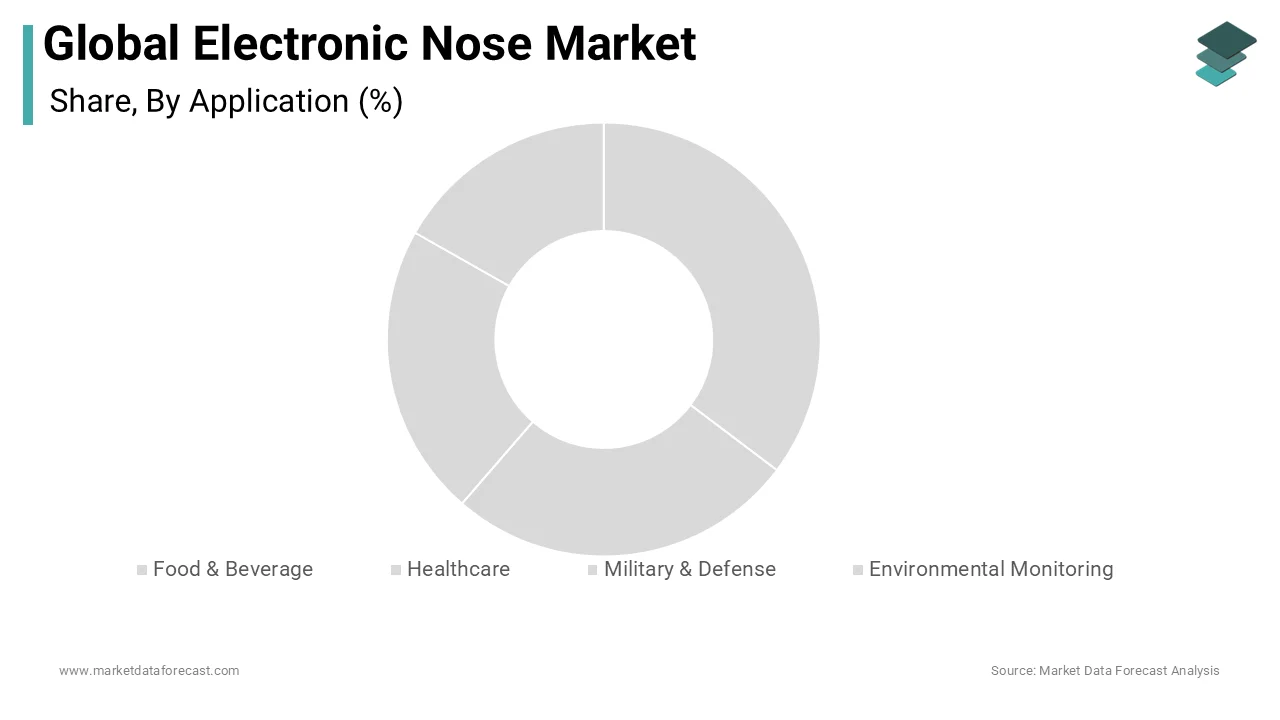
The healthcare segment is on the rise and is expected to be the fastest-growing segment in the global market by witnessing a CAGR of 29.6% from 2025 to 2033. The rapid growth is fueled by the global healthcare system’s urgent need for non-invasive, rapid, and cost-effective diagnostic tools to manage chronic respiratory and metabolic diseases. According to the World Health Organization, chronic obstructive pulmonary disease and asthma collectively affect over five hundred and forty-five million people worldwide, with diagnostic delays contributing to preventable hospitalizations. As per a multicenter trial coordinated by the Karolinska Institute in twenty four, electronic noses detected stage one lung cancer with eighty-six percent sensitivity using only exhaled breath samples, outperforming conventional imaging in early specificity.
REGIONAL ANALYSIS
Europe Electronic Nose Market Analysis
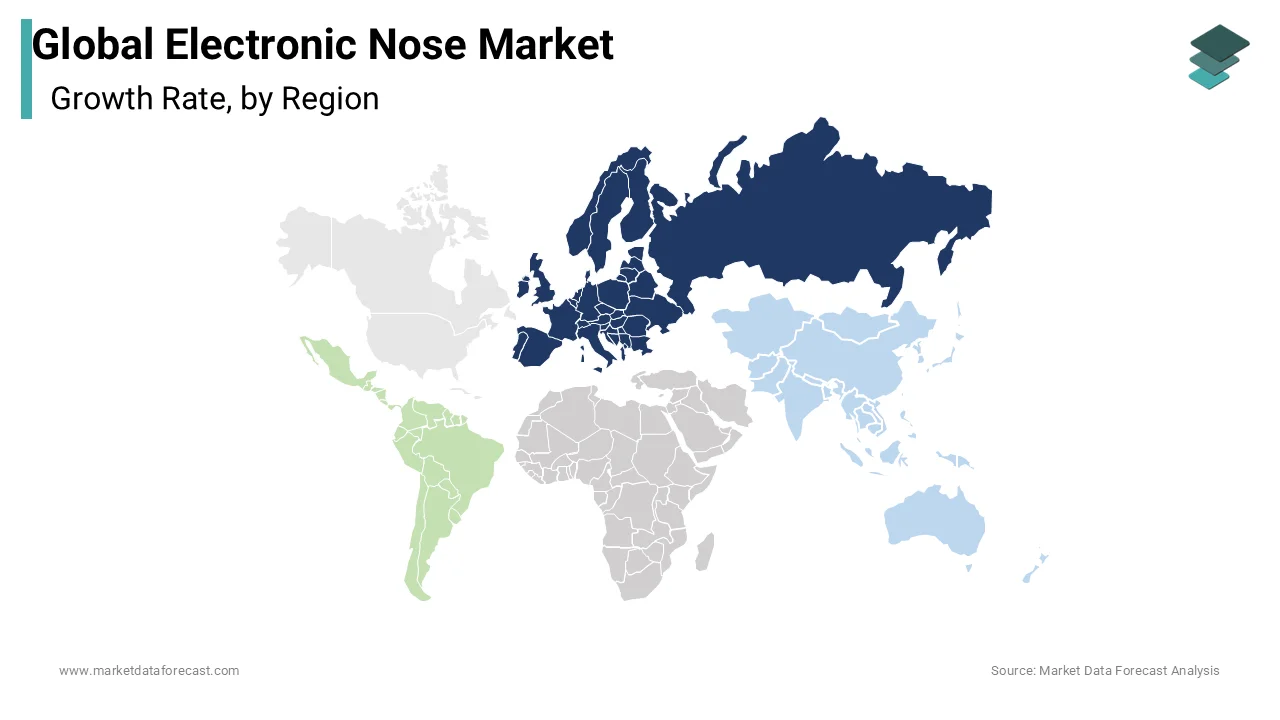
Europe was the top performer in the global electronic nose market by capturing 39.4% of the worldwide market share in 2025. The prominence of Europe is propelled by its early adoption of preventive quality control mandates across food manufacturing and environmental monitoring. The European Food Safety Authority’s twenty-two directive requiring continuous aroma monitoring in meat and dairy facilities triggered mass deployment with Nestlé and Danone collectively installing over eight hundred units across their EU production sites. According to Germany’s Federal Institute for Risk Assessment, there has been a forty-two percent reduction in product recalls among compliant processors within the first eighteen months. Europe’s combination of regulatory rigor, industrial scale, and public health investment ensures its continued market primacy.
North America Electronic Nose Market Analysis
North America remained the next major region in the electronic nose market by occupying 32.8% share in 2025. The growth of North America is driven by innovation in clinical diagnostics, defense applications, and agri-food safety. According to the United States Department of Agriculture, electronic nose systems are now deployed in over sixty percent of federally inspected meat packing plants to supplement organoleptic evaluation with real-time spoilage detection. As per Tyson Foods in its twenty-four sustainability report, its electronic nose network reduced hold times for microbiological testing by fifty-eight percent. North America’s strength lies in its convergence of regulatory pragmatism, defense funding, and venture-backed innovation.
Asia Pacific Electronic Nose Market Analysis
Asia Pacific is expected to be the most lucrative region in the electronic nose market, with prominence revolving around Japan, South Korea, China, and India. According to Japan’s Ministry of Health Labour and Welfare electronic noses were integrated into seventy three percent of municipal water treatment facilities by two thousand and twenty four to detect early onset contamination events. China’s State Administration for Market Regulation launched a national pilot in thousand twenty three requiring electronic nose verification for all infant formula production lines following prior contamination scandals. India’s Central Pollution Control Board mandated fence-line odor monitoring for all petrochemical complexes exceeding fifty acres, effective January 2025.
Latin America Electronic Nose Market Analysis
Latin America is moving ahead consistently in the electronic nose market, with adoption led by Brazil, Argentina, and Chile in food safety and environmental monitoring. According to Brazil’s Ministry of Agriculture electronic nose systems were deployed in over two hundred meat processing plants by mid two thousand and twenty four to meet European Union export compliance standards. The country saw a thirty-nine percent reduction in rejected shipments to Germany and France following implementation. Argentina’s National Institute of Industrial Technology launched a wine authenticity program in Mendoza in early 2014 using electronic noses to detect adulteration in premium Malbec exports.
Middle East and Africa Electronic Nose Market Analysis
The Middle East and Africa region is anticipated to grow in the electronic nose market, with activity centered in South Africa, the United Arab Emirates, Saudi Arabia, and Egypt. According to South Africa’s Department of Health, the electronic noses were piloted in three major tuberculosis clinics in Johannesburg nd twenty-four to enable non-invasive screening in high-burden communities. The United Arab Emirates’ Ministry of Climate Change and Environment mandated odor emission monitoring for all wastewater treatment plants in Dubai and Abu Dhabi as of January thousand twenty with Veolia pointing out an eighteen percent reduction in hydrogen sulfide releases.
COMPETITIVE LANDSCAPE
The electronic nose market is defined by a strategic divergence between industrial quality control specialists and clinical diagnostics pioneers, each advancing distinct technological and regulatory pathways. Industrial players compete on ruggedness, ss calibration stability,ity,, and integration depth with manufacturing execution systems, while medical entrants prioritize clinical validation,n regulatory clearance, and physician usability. Competition is no longer about sensor count or algorithm complexity but about who can deliver actionable intelligence within the operational constraints of the target environment. In food and beverage reliability under high humidity and temperature swings is paramount, while in healthcare reproducibility across patient populations and comorbidities determines adoption. Regulatory endorsement remains the ultimate differentiator, with players investing millions in longitudinal clinical trials and method validation to secure United States Food and Drug Administration or European Conformity marks. Startups are disrupting with edge computing architectures that eliminate cloud dependency while incumbents leverage decades of application libraries and global service networks. Talent wars focus on analytical chemists, machine learning engineers, and regulatory affairs specialists. The most successful players treat odor not as a signal to be measured but as a language to be interpreted within domain-specific contexts. Innovation cycles are accelerating with quarterly firmware updates replacing annual hardware refreshes. The market rewards those who master application specificity, not just sensor sensitivity.
KEY MARKET PLAYERS
Some of the key players in the market
- Odotech (Canada)
- The eNose Company (Netherlands)
- Scent Sciences (US)
- Scentsational Technologies (US)
- FOODsniffer (US)
- AIRSENSE Analytics (Germany)
- Scensive Technologies (UK)
- Intelesens Ltd (UK)
- RoboScientific Ltd (UK)
- OlfaGuard (Israel)
- Aryballe (France)
TOP LEADING PLAYERS IN THE MARKET
- Alpha MOS is a pioneer in analytical olfaction systems with global deployments across food safety, environmental monitoring, and pharmaceutical quality control. The company strengthened its clinical foothold in earld four by partnering with the French National Institute of Health and Medical Research to validate its HERACLES platform for non-invasive lung cancer screening using exhaled breath biomarkers. It also launched a cloud-based aroma analytics dashboard, enabling real-time comparison of sensor data across multinational production sites. Alpha MOS expanded its regulatory support team to assist clients in navigating the United States Food and Drug Administration and European Medicines Agency submission pathways for diagnostic applications.
- Aryballe Technologies specializes in compact portable electronic nose solutions targeting industrial and field-based applications with an emphasis on user-friendly interfaces. In mid two thousand and twenty four Aryballe introduced its NeOse Pro Edge device, featuring onboard machine learning for autonomous odor classification without cloud dependency. The company secured certification under International Organization for Standardization one seven zero two five for calibration traceability, enhancing credibility in regulated sectors. Aryballe also signed integration agreements with SAP and Siemens to embed its odor analytics into enterprise quality management and predictive maintenance workflows.
- eNose Company has carved a distinct niche in medical diagnostics by focusing exclusively on breath-based disease detection with clinically validated algorithms. The company initiated a multicenter European trial in January 2025 to expand indications for chronic obstructive pulmonary disease and idiopathic pulmonary fibrosis. eNose Company also launched a clinician training portal with interactive case libraries to accelerate adoption in respiratory clinics and reduce interpretation variability.
TOP STRATEGIES USED BY KEY MARKET PARTICIPANTS
Leading players prioritize clinical and regulatory validation by partnering with academic medical centers to generate peer-reviewed evidence supporting diagnostic accuracy and reproducibility. They embed artificial intelligence directly into device firmware to enable autonomous classification and reduce dependency on cloud connectivity. Strategic alliances with enterprise software providers allow seamless integration into existing quality management and maintenance systems. Modular sensor cartridge designs facilitate field replacement and reduce downtime in industrial environments. Companies invest in metrological traceability obtaining International Organization for Standardization one seven zero two five certification to build trust in regulated sectors. Portable and handheld form factors expand addressable markets into field inspection and point-of-care settings. Bilingual and region-specific odor libraries ensure performance across diverse environmental and product matrices. Subscription-based analytics platforms create recurring revenue and lock in long-term customer relationships. Training and certification programs for operators reduce interpretation errors and enhance adoption velocity. Open application programming interfaces encourage third-party algorithm development and ecosystem expansion.
GLOBAL ELECTRONIC NOSE MARKET NEWS
- A new device can detect the presence of COVID-19 in a crowded space. According to RoboScientific, the highly accurate ceiling-mounted sensor can raise a coronavirus alarm in as little as 15 minutes. The room monitor, which is about the size of a smoke detector, detects changes in odour on the skin or in the breath of persons who are sick.
- Aryballe Technologies, a French startup, has invented a portable 'artificial nose' using bio-optic scent sensors to aid food businesses in quality control testing and new product creation (NPD).
- Amazon has been granted a patent for a refrigerator that detects rotten food using cameras and chemical sensors developed by FOODsniffer.
MARKET SEGMENTATION
By Application
- Food & Beverage
- Healthcare
- Military & Defense
- Environmental Monitoring
- Others
By Region
- North America
- Europe
- Asia Pacific
- Latin America
- Middle East & Africa