- Product Description Description
- Table of Contents TOC
- List of Table & Figure LOT
- Get Free Sample PDF Sample PDF
Market Size, 2025
$16.90 BnMarket Estimate, 2026
$18.01 BnMarket Forecast, 2034
$29.96 BnCAGR, 2026–2034
6.57%Emulsion Polymers Market Summary
The global emulsion polymers market was valued at USD 16.90 billion in 2025 and is projected to reach USD 18.01 billion in 2026 and USD 29.96 billion by 2034, growing at a CAGR of 6.57% from 2026 to 2034. The growth of the emulsion polymers market is driven by the rising demand from the paints and coatings sector, increasing construction and automotive activities, advancements in water-based polymer technologies, and growing environmental awareness leading to the shift toward low-VOC and sustainable formulations.
Key Market Trends
- Rising adoption of eco-friendly, water-based polymer emulsions over solvent-based systems.
- Increasing application of emulsion polymers in architectural and industrial coatings for improved performance.
- Rapid urbanization and infrastructure development, particularly in emerging economies.
- Technological advancements in bio-based and hybrid polymer formulations.
- Expanding usage in adhesives, paper coatings, and textiles industries due to excellent binding and film-forming properties.
Segmental Insights
- Based on type, the acrylic segment dominated the global emulsion polymers market in 2025, accounting for 52.3% of the total share, owing to its superior weather resistance, adhesion, and cost-effectiveness across multiple applications, especially in coatings and adhesives.
- Based on end-use industries, the paints and coatings sector held the largest share of 61.3% in 2025, driven by the growing construction and automotive production activities and the shift toward water-based formulations to meet stringent environmental regulations.
Regional Insights
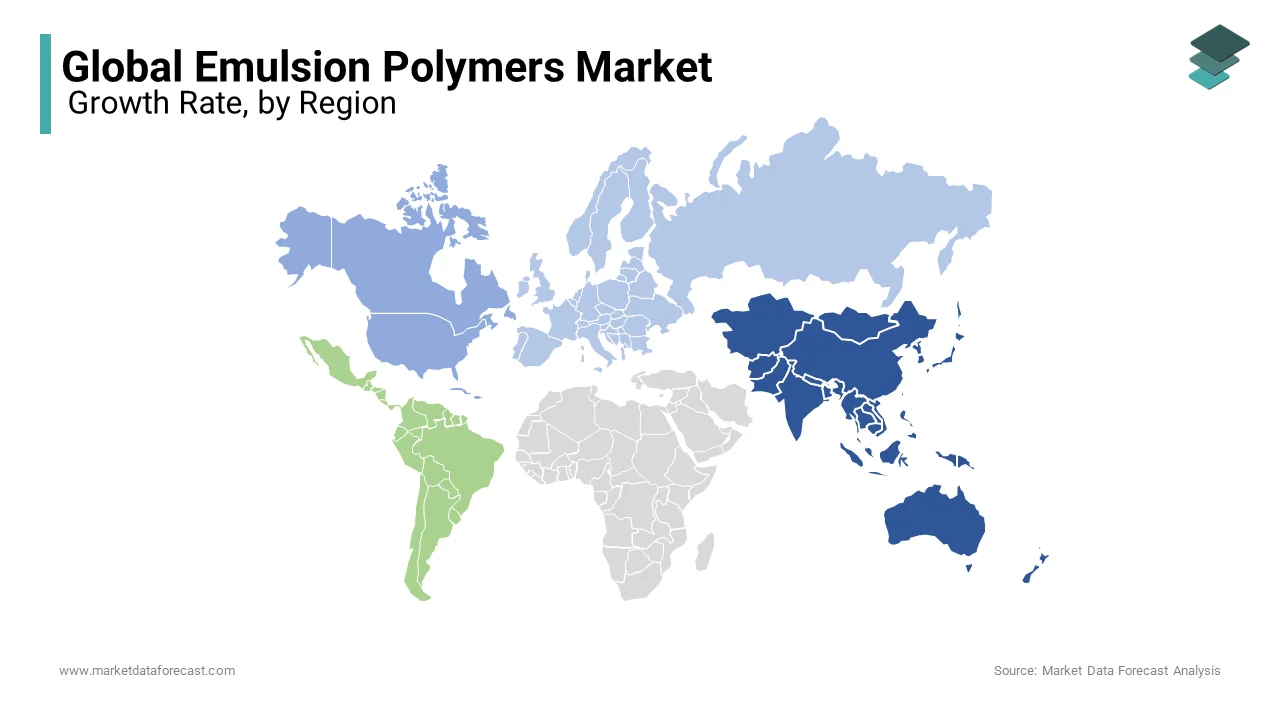
- Asia-Pacific held 44.3% of the global share in 2025, driven by rapid industrialization, expanding construction activities, and strong growth in paints and coatings demand from China, India, and Southeast Asia.
- North America is expected to grow steadily due to the presence of major polymer manufacturers, strict environmental regulations favoring low-VOC products, and technological adoption in sustainable coating solutions.
- Europe is witnessing consistent growth supported by regulatory pressure to adopt eco-friendly materials, coupled with innovation in high-performance emulsion polymers used in automotive and industrial coatings.
- Latin America is experiencing moderate growth driven by urban development and the expanding manufacturing and packaging industries in Brazil and Mexico.
- Middle East & Africa is showing emerging potential due to increasing construction projects and industrial expansion in GCC countries and South Africa.
Competitive Landscape
The emulsion polymers market is moderately fragmented, with leading players focusing on product innovation, capacity expansion, and sustainable polymer development. Strategic mergers, acquisitions, and partnerships are shaping the competitive dynamics as companies enhance their global footprint. Major players in the global emulsion polymers market include Synthomer, OMNOVA Solutions, Allnex GmbH, Arkema, Dow Inc., DIC Corporation, BASF SE, Celanese Corporation, Wacker Chemie AG, Momentive, Mallard Creek Polymers, Solvay, Clariant, and Asahi Kasei Corporation.
Global Emulsion Polymers Market Size
The global emulsion polymers market size was valued at USD 16.90 billion in 2025 and is anticipated to reach a valuation of USD 18.01 billion in 2026 and USD 29.96 billion by 2034, growing at a CAGR of 6.57%, from 2026 to 2034.
Emulsion polymers are colloidal dispersions of polymer particles in water, synthesized through emulsion polymerization, and widely used as binders, coatings, and adhesives across industrial and consumer applications. According to the U.S. Environmental Protection Agency, water-based coatings and adhesives contribute to a 60–90% reduction in volatile organic compound emissions compared to solvent-based counterparts, making them pivotal in sustainable manufacturing.
MARKET DRIVERS
Stringent Environmental Regulations Promoting Low-VOC Formulations
The global regulatory frameworks targeting volatile organic compound (VOC) emissions are propelling the growth of the emulsion polymers market. According to the European Union’s REACH and EU Ecolabel programs, which mandate low-emission formulations, over 80% of decorative paints in Western Europe are now classified as low-VOC, as reported by the European Coatings Federation. In China, the Ministry of Ecology and Environment implemented VOC emission limits for coatings in 2020, accelerating the replacement of solvent-based systems.
Expanding Demand in Construction and Infrastructure Sectors
The global construction boom in emerging economies is significantly boosting the emulsion polymers market. Acrylic emulsions serve as key binders in architectural coatings, providing durability, water resistance, and color retention. According to the International Labour Organization, global construction output is projected to grow by 4.2% annually through 2030, with the Asia Pacific accounting for over 50% of new building activity. The use of styrene-acrylic and VAE emulsions in tile adhesives and flexible renders has become standard in modern building practices. Emulsion polymers are increasingly integrated into green building materials, including self-cleaning facades and thermal insulation systems, with their strategic role in next-generation construction.
MARKET RESTRAINTS
Raw Material Price Volatility and Supply Chain Disruptions
The production of emulsion polymers is highly sensitive to fluctuations in petrochemical feedstocks such as butadiene, styrene, and acrylate monomers, which are derived from crude oil and natural gas. In 2022, the U.S. Energy Information Administration reported that styrene prices surged by over 35% due to supply chain disruptions and energy cost spikes in Europe, directly impacting polymer manufacturing margins. Similarly, butadiene prices in Asia fluctuated by ±20% within a six-month window in 2025, which is creating uncertainty for formulators. These instabilities are exacerbated by geopolitical tensions and logistical bottlenecks, limiting the ability of producers to maintain consistent pricing and supply. Additionally, the shift toward bio-based monomers remains limited by cost and scalability, which is leaving the industry reliant on fossil-derived inputs.
Performance Limitations in Extreme Environmental Conditions
The low-temperature, high-humidity, or chemically aggressive environments are degrading the growth of the emulsion polymers market. Many water-based systems require a minimum film formation temperature (MFFT) to coalesce into a continuous film, limiting their application in cold climates. According to the American Coatings Association, standard acrylic emulsions have an MFFT of 10–15°C, rendering them ineffective for winter construction in northern regions without additives. Additionally, prolonged exposure to moisture can lead to hydrolytic degradation, which reduces adhesion and durability in exterior coatings. A 2025 study by the Society of Coatings Technology found that water-based industrial primers exhibited 25% lower corrosion resistance compared to epoxy-solvent formulations in salt spray tests. These limitations restrict the use of emulsion polymers in demanding applications such as marine coatings, heavy-duty machinery, and high-temperature processing, which is forcing formulators to rely on hybrid systems or performance compromises.
MARKET OPPORTUNITIES
Growth in Sustainable and Bio-Based Emulsion Polymers
The push for circular economy principles and carbon footprint reduction is accelerating the growth of emulsion polymers. Companies are investing in monomers derived from plant oils, sugars, and recycled feedstocks to reduce dependence on fossil fuels. According to the U.S. Department of Energy, bio-acrylic acid production could displace up to 30% of petrochemical-based acrylics by 2030, driven by advances in fermentation and catalytic conversion technologies. Arkema’s Sartomer division has commercialized bio-based acrylates from glycerol, while Dow has launched ECOVAE™, a vinyl acetate-ethylene emulsion made with renewable content. Additionally, regulatory incentives such as the EU Green Deal and the U.S. BioPreferred Program are encouraging adoption.
Technological Advancements in Hybrid and Multifunctional Formulations
Innovation in hybrid emulsion systems, such as acrylic-silicone, polyurethane-acrylic, and core-shell nanoparticles, is expected to enhance the growth of the emulsion polymer market. These advanced dispersions combine the environmental benefits of water-based systems with enhanced durability, flexibility, and weather resistance. In the automotive sector, BASF has introduced hybrid emulsion primers that improve adhesion to lightweight composites, supporting electrification trends. Additionally, self-healing and antimicrobial emulsions are being developed for healthcare and smart building applications. The integration of nanotechnology and stimuli-responsive polymers is enabling smart coatings that react to humidity, temperature, or UV exposure.
MARKET CHALLENGES
Complex Formulation and Stability Issues in Water-Based Systems
Emulsion polymers require precise formulation to maintain colloidal stability, shelf life, and performance consistency, which is a challenging factor for the growth of the market. Factors such as pH, ionic strength, surfactant selection, and freeze-thaw cycles can destabilize the dispersion, leading to coagulation or phase separation. Formulators must balance surfactant levels to ensure particle dispersion without compromising water resistance. Additionally, the use of biocides to prevent microbial growth in aqueous systems raises regulatory and consumer concerns. In 2025, the European Chemicals Agency restricted several isothiazolinone-based preservatives, forcing reformulation across the region. Achieving compatibility with pigments, fillers, and crosslinkers further complicates the process.
Intense Competition from Alternative Binding Technologies
The growing competition from alternative binding and coating technologies that offer superior performance or lower cost in specific applications is also enhancing the growth of the emulsion polymers market. Powder coatings, which are 100% solids and emit zero VOCs, are gaining share in metal finishing, particularly in appliances and automotive parts. Similarly, solvent-free epoxy and polyurethane systems dominate in high-performance flooring and marine coatings due to their superior chemical and abrasion resistance. In adhesives, reactive hot-melts and UV-curable resins offer faster curing and stronger bonds than water-based emulsions. Additionally, emerging technologies like plasma polymerization and atomic layer deposition are being explored for ultra-thin, durable coatings.
REPORT COVERAGE
| REPORT METRIC | DETAILS |
| Market Size Available | 2025 to 2034 |
| Base Year | 2025 |
| Forecast Period | 2026 to 2034 |
| CAGR | 6.57% |
| Segments Covered | By Type, End-Use, and Region. |
| Various Analyses Covered | Global, Regional, & Country Level Analysis; Segment-Level Analysis; DROC, PESTLE Analysis; Porter’s Five Forces Analysis; Competitive Landscape; Analyst Overview of Investment Opportunities |
| Regions Covered | North America, Europe, APAC, Latin America, Middle East & Africa |
| Market Leaders Profiled | Synthomer, OMNOVA Solutions, Allnex GMBH, Arkema, Dow Inc., DIC CORPORATION, BASF SE, Celanese Corporation, Wacker Chemie AG, Momentive, Mallard Creek Polymers, Solvay, Clariant, Asahi Kasei Corporation |
SEGMENTAL ANALYSIS
By Type Insights
The acrylic segment accounted in holding 52.3% of the global emulsion polymers market share in 2025, with its superior performance in architectural coatings, where it provides excellent UV resistance, color retention, and water repellency. According to the U.S. Department of Energy, acrylic-based paints account for over 70% of exterior wall coatings in North America, due to their durability and low maintenance requirements. In Europe, the European Coatings Federation states that nearly 80% of low-VOC decorative paints use acrylic dispersions, driven by REACH regulations and consumer demand for eco-friendly finishes. Additionally, advancements in co-polymerization have enhanced freeze-thaw stability and film formation, expanding usability in colder climates.
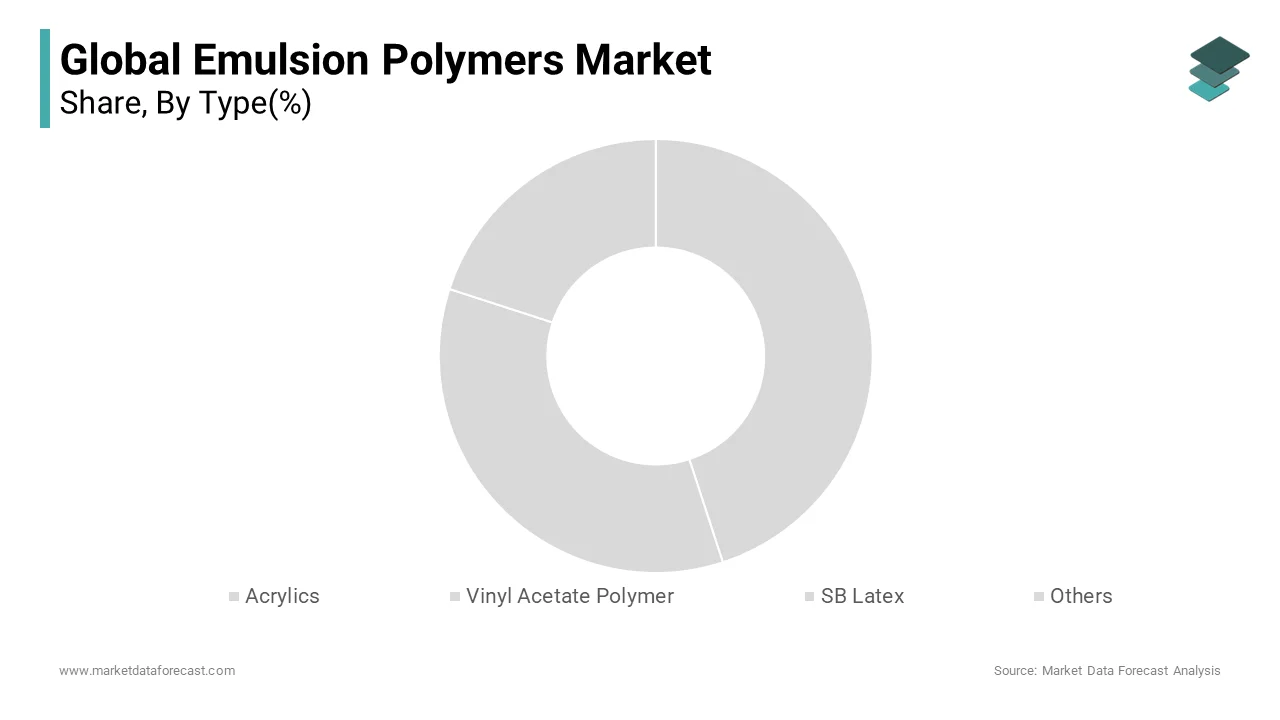
The SB Latex segment is lucratively growing with an expected CAGR of 6.8% from 2025 to 2033, with the surging demand in paper coating, carpet backing, and specialty adhesives. According to the International Council of Forest and Paper Associations, global coated paper production reached 28 million metric tons in 2025, with the Asia Pacific accounting for over 50% of output. The rise of e-commerce has intensified demand for high-quality corrugated packaging, where SB latex improves moisture resistance and lamination strength. Additionally, the automotive sector uses SB-based adhesives in tire cord bonding and underbody coatings.
By End Use Industries Insights
The paints and coatings sector was the largest and held 61.3% of the global emulsion polymer market in 2025, playing the role of primary binders in water-based architectural and industrial formulations. Acrylic and VAE emulsions form the backbone of interior and exterior wall paints, providing adhesion, durability, and low VOC emissions. According to the World Green Building Council, over 60% of new buildings in Europe and North America now use low-VOC paints, aligning with green certification standards like LEED and BREEAM. The shift from solvent-based to water-based systems is further accelerated by regulations such as China’s GB 18582 standard, which limits VOC content in interior finishes.
The adhesives and sealants segment is likely to grow with an expected CAGR of 7.2% during the forecast period due to rising demand in packaging, woodworking, and automotive assembly. Emulsion polymers such as PVAc, acrylics, and SBR are widely used in pressure-sensitive adhesives, laminating glues, and construction sealants. The e-commerce boom has driven demand for high-performance box-sealing tapes and carton adhesives; in the U.S., the Fiber Box Association notes that over 90% of shipping containers use emulsion-based adhesives for lamination and joint bonding. In furniture manufacturing, VAE emulsions are preferred for their flexibility and non-yellowing properties.
REGIONAL ANALYSIS
Asia Pacific Market Analysis
Asia Pacific emulsion polymers market held 44.3% of the share in 2025, with the rapid urbanization, infrastructure development, and manufacturing expansion. China is the largest producer and consumer, accounting for over 60% of regional demand, according to the China Polymer Industry Association. India’s government-led housing and smart city initiatives are fueling deman;, over 10 million affordable homes have been completed under the Pradhan Mantri Awas Yojana as of 2025, each requiring significant paint and adhesive input. Japan remains a leader in high-performance emulsion technologies, particularly in automotive and electronics adhesives.
North America Market Analysis
North America's emulsion polymers market held 23.2% of the share in 2025. The U.S. Environmental Protection Agency’s Architectural Coatings Rule has pushed over 90% of flat wall paints sold in the U.S. to be water-based, as reported by the American Coatings Association. Additionally, the rise of green building standards has increased demand for high-performance emulsions in energy-efficient façades and indoor air-quality-compliant adhesives. Companies like Dow and Arkema have launched bio-acrylic and hybrid emulsion lines from renewable feedstocks.
Europe Market Analysis
EEurope'semulsion polymers market is expected to grow with a significant CAGR during the forecasperiodo , driven by the stringent environmental regulations and a focus on circularity. As per the European Coatings Federation, water-based coatings now represent 78% of the architectural paint market in Western Europe. Germany was the largest national market, producing over 1.8 million metric tons of paints annually, with a strong emphasis on low-emission and durable finishes. Additionally, the EU’s Construction Products Regulation (CPR) enforces strict durability and fire safety standards, pushing formulators toward high-performance acrylic and polyurethane dispersions.
Latin American Market Analysis
Latin America's emulsion polymers market growth is likely to grow with Brazil and Mexico as the primary markets. The region’s growth is fueled by expanding construction and packaging sectors. In Brazil, the National Housing Bank reports that over 600,000 new homes were financed in 2025, driving demand for paints and adhesives. Additionally, government initiatives like Mi Casa, Mi Vida in Colombia are boosting affordable housing. While infrastructure and raw material availability remain challenges, rising urbanization and industrial modernization are laying the foundation for sustained growth in emulsion polymer consumption across the region.
Middle East & African Market Analysis
The Middle East & Africa emulsion polymers market is expected to have steady growth in the coming years. The UAE and Saudi Arabia are investing heavily in urban development under Vision 2030 and UAE Centennial 2071, with over $1.2 trillion allocated to construction projects in GCC countries by 2030, according to the Gulf Business Reports. These projects require high-performance, heat-resistant coatings, driving demand for acrylic emulsions with enhanced UV stability. In Saudi Arabia, the Saudi Building Code now mandates low-VOC paints in all new constructions, accelerating the shift from solvent-based systems.
COMPETITIVE LANDSCAPE
The emulsion polymers market features a competitive landscape where technological differentiation, environmental compliance, and regional agility define success. Global chemical giants leverage R&D scale and integrated supply chains, while regional players compete through cost efficiency and application-specific customization. The shift toward sustainable, low-carbon formulations has intensified innovation in bio-based and hybrid dispersions, with companies racing to achieve environmental certifications and reduce reliance on petrochemicals. Digitalization is reshaping customer support, with AI-driven formulation platforms enhancing precision and speed. Competition is no longer limited to price and performance but extends to lifecycle impact, carbon footprint transparency, and technical collaboration.
KEY MARKET PLAYERS
A few of the market players in the global emulsion polymers market include
- Synthomer
- OMNOVA Solutions
- Allnex GMBH
- Arkema
- Dow Inc.
- DIC CORPORATION
- BASF SE
- Celanese Corporation
- Wacker Chemie AG
- Momentive
- Mallard Creek Polymers
- Solvay
- Clariant
- Asahi Kasei Corporation
Top Players In The Market
- Dow is a leading innovator in emulsion polymers with a strong footprint across the Asia Pacific through its comprehensive portfolio of acrylic, VAE, and styrene-butadiene dispersions. The company has deep integration with paint, adhesive, and paper manufacturers in China, India, and Southeast Asia, providing tailored solutions for high-performance, low-VOC applications. In 2025, Dow launched its ECOVAE™ line in Shanghai, a renewable-content vinyl acetate-ethylene emulsion designed for sustainable construction adhesives and eco-friendly coatings. It also expanded technical service capabilities at its Innovation Center in Hyderabad to support regional customers in formulating compliant, high-efficiency products. Dow’s collaboration with major Asian paint brands like Nippon Paint and AkzoNobel has accelerated the adoption of durable, weather-resistant acrylic systems.
- BASF plays a pivotal role in shaping the Asia Pacific emulsion polymers landscape through its dispersions and resins division, offering advanced acrylic, SBR, and polyurethane dispersions for coatings, adhesives, and paper applications. The company has strengthened its regional presence by launching site-specific formulations for tropical climates, where high humidity and UV exposure challenge product performance. In 2025, BASF introduced Acronal S 923, a high-gloss, low-VOC acrylic emulsion for architectural paints, across Thailand and Indonesia by aligning with tightening environmental regulations.
- Synthomer has intensified its engagement in the Asia Pacific market by expanding production and technical support for specialty emulsion polymers used in adhesives, construction, and textiles. The company acquired a manufacturing facility in Ningbo, China, in 2025, enabling the localized supply of acrylic and VAE dispersions to Chinese paint and adhesive manufacturers. This move supports its strategy to reduce lead times and comply with regional regulatory requirements, including China’s GB standards for VOC emissions.
Top Strategies Used by Key Market Participants
Key players in the emulsion polymers market are advancing through product innovation, regional localization, and sustainability integration. Companies are investing in bio-based monomers, low-VOC formulations, and hybrid systems to meet evolving regulatory and consumer demands. Expansion into high-growth regions like the Asia Pacific is achieved through localized manufacturing, technical service centers, and strategic partnerships with formulators. Digital tools for formulation optimization and predictive performance modeling are being deployed to enhance customer engagement. Additionally, companies are focusing on circular economy initiatives, including recyclable packaging and closed-loop production. Strategic acquisitions and joint ventures are enabling access to new technologies and markets by ensuring long-term competitiveness in a rapidly evolving, environmentally conscious industrial landscape.
MARKET SEGMENTATION
This research report on the global emulsion polymers market is segmented and sub-segmented into the following categories.
By Type
- Acrylics
- Vinyl Acetate Polymer
- SB Latex
- Others
By End-Use
- Paints & Coatings
- Adhesives & Sealants
- Paper & Paperboard
- Others
By Region
- North America
- Europe
- Asia Pacific
- Latin America
- Middle East and Africa