- Product Description Description
- Table of Contents TOC
- List of Table & Figure LOT
- Get Free Sample PDF Sample PDF
Market Size, 2025
$219.59 BnMarket Estimate, 2026
$232.02 BnMarket Forecast, 2034
$360.42 BnCAGR, 2026–2034
5.66%Global Ethylene Market Summary
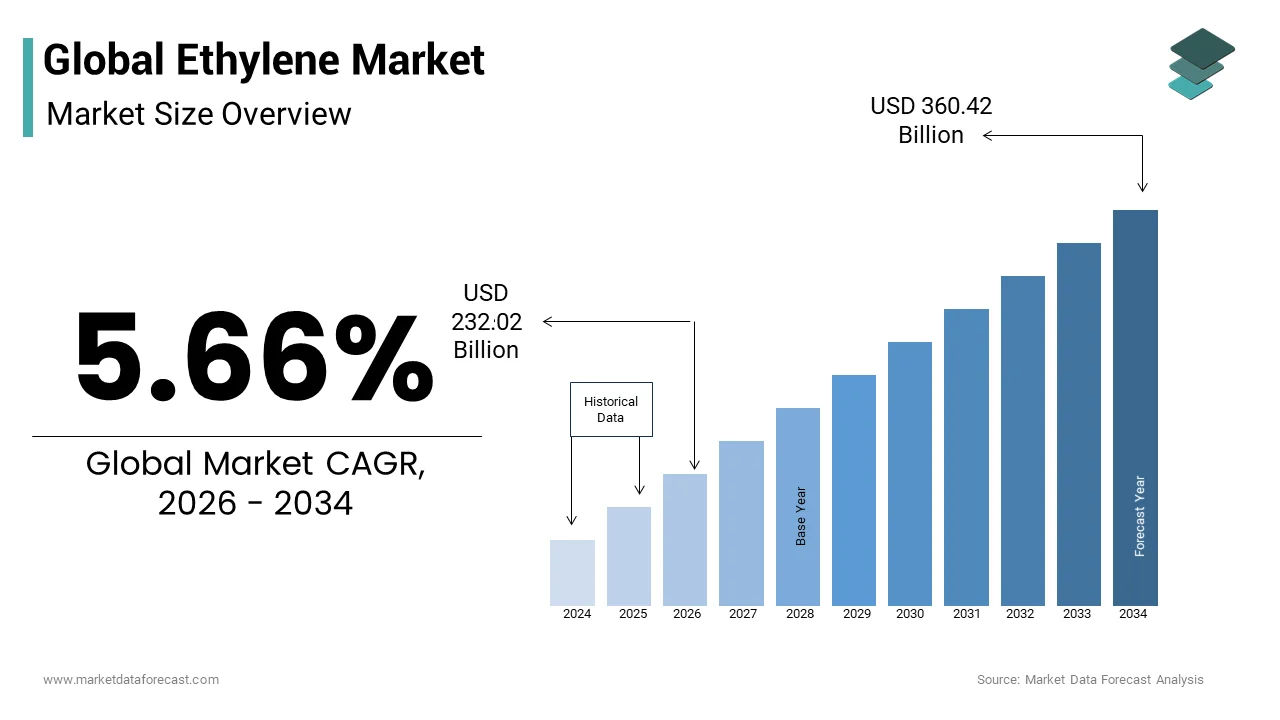
The global ethylene market size was valued at USD 219.59 billion in 2025, is anticipated to reach USD 232.02 billion in 2026, and is projected to reach USD 360.42 billion by 2034, growing at a CAGR of 5.66% from 2026 to 2034. The growth of the global ethylene market is driven by rising demand for plastics in packaging, construction, and automotive industries, coupled with rapid industrialization in emerging economies. Additionally, technological advancements in ethylene production processes and the increasing use of ethylene derivatives in consumer goods and industrial applications are supporting steady market expansion.
Key Market Trends
- Increasing demand for lightweight and durable plastics in packaging and automotive applications.
- Rising production of ethylene derivatives such as polyethylene, ethylene oxide, and ethylbenzene.
- Expansion of petrochemical complexes in the Asia-Pacific and the Middle East.
- Growing adoption of shale gas-based ethylene production in North America.
- Focus on sustainable and bio-based ethylene production to reduce carbon footprint.
Segmental Insights
- Based on product type, the High-Density Polyethylene (HDPE) segment led the ethylene market by capturing 38.6% of the market share in 2025, supported by demand in packaging, piping, and construction applications.
Regional Insights
- Asia-Pacific was the top performer in the global ethylene market in 2025, accounting for 52.9% of the share, driven by strong petrochemical capacity in China, India, and Southeast Asia.
- North America benefited from low-cost shale gas feedstock, driving ethylene production expansion.
- Europe showed steady growth, supported by demand for ethylene derivatives in packaging and consumer goods.
- Latin America presented growth opportunities, led by Brazil’s expanding petrochemical industry.
- Middle East & Africa remained key producers with large-scale ethylene manufacturing facilities.
Competitive Landscape
Major companies dominating the global ethylene market include Reliance Industries Limited (India), China Petroleum & Chemical Corporation (China), LyondellBasell Industries Holdings (Netherlands), Exxon Mobil Corporation (U.S.), Shell International (Netherlands), SABIC (Saudi Arabia), Borealis AG (Austria), Braskem SA (Brazil), Chevron Phillips Chemical Company (U.S.), and INEOS Group AG (UK). These players are focusing on capacity expansions, technological upgrades, and sustainable ethylene production initiatives to strengthen their market presence.
Global Ethylene Market Size
The global ethylene market size was valued at USD 219.59 billion in 2025 and is anticipated to reach USD 232.02 billion in 2026 to reach USD 360.42 billion by 2034, growing at a CAGR of 5.66% during the forecast period from 2026 to 2034.
Ethylene is a fundamental petrochemical building block and serves as a precursor to an expansive range of industrial products, including polyethylene, ethylene oxide, and vinyl chloride monomer. It is predominantly produced through steam cracking of hydrocarbons, with naphtha and ethane being the primary feedstocks. As of 2023, the global ethylene market was estimated at 316.8 million metric tons, significantly more than the 180 million metric tons mentioned. According to a study, ethylene accounts for a portion of all organic chemical production by volume worldwide. Geographically, Asia-Pacific dominates output, driven by China’s expansive downstream polymer demand. The chemical’s gaseous state and high reactivity necessitate sophisticated handling and immediate integration into derivative processes, which shape the logistical and operational design of integrated petrochemical complexes.
MARKET DRIVERS
Surge in Global Packaging Demand Fueled by Polyethylene Consumption
The escalating global demand for flexible and rigid packaging, particularly in food, pharmaceuticals, and e-commerce, is fuelling the expansion of the ethylene market. Polyethylene, which consumes a portion of globally produced ethylene, is the dominant material in packaging films, bottles, and containers. According to the study, notable metric tons of food are lost or wasted annually, prompting increased reliance on durable, lightweight plastic packaging to extend shelf life. Furthermore, as per the study, plastic packaging consumption grew, with Asia-Pacific leading adoption. E-commerce proliferation has intensified this trend.
Expansion of Shale Gas Infrastructure in North America
The development of shale gas reserves in the United States has significantly altered the global ethylene production landscape, which has elevated the growth rate of the ethylene market. This is because it provides a low-cost, abundant source of ethane feedstock. As per the research, U.S. dry natural gas production reached substantial cubic feet, an increase from 2010 levels, largely due to hydraulic fracturing and horizontal drilling advancements. Ethane, a byproduct of shale gas, offers a cost advantage over naphtha-based cracking, which makes North American ethylene facilities among the most competitive globally. This economic edge has spurred petrochemical investments along the Gulf Coast, including new ethylene crackers with combined capacity exceeding millions of metric tons per year. According to a study, U.S. ethylene production capacity grew. This feedstock-driven advantage strengthens domestic manufacturing and enhances export potential to regions with higher production costs.
MARKET RESTRAINTS
Stringent Environmental Regulations Targeting Plastic Waste and Carbon Emissions
Increasing regulatory burden on single-use plastics and greenhouse gas emissions hampers the growth of the ethylene market. The European Union’s Single-Use Plastics Directive (SUPD), which primarily took effect in July 2021, restricts certain single-use plastic products for which affordable and sustainable alternatives exist, rather than specifically targeting plastics derived from ethylene. The goal is to reduce marine litter and promote a circular economy by banning items like plastic cutlery, plates, straws, and expanded polystyrene food containers. Apart from these, ethylene production is energy-intensive, emitting metric tons of CO₂ per ton of ethylene produced, according to the study. Countries committed to net-zero targets, including Germany and Canada, are enforcing carbon pricing mechanisms that increase operational costs for steam crackers. China, despite being the largest ethylene producer, has imposed capacity controls and environmental compliance standards under its Five-Year Plan to curb industrial pollution. These regulatory headwinds compel producers to invest in carbon capture, circular economy models, and alternative feedstocks, which delays project approvals and increases capital expenditures.
Feedstock Price Volatility and Geopolitical Instability
Ethylene production is highly sensitive to fluctuations in hydrocarbon feedstock prices, which restrain the growth of the ethylene market. This is especially true for ethane and naphtha, which are both subject to the dynamics of the global energy market. According to the research, crude oil prices experienced a year-on-year increase in 2022 due to geopolitical tensions, including the Russia-Ukraine conflict, directly impacting naphtha prices and, consequently, ethylene margins in regions reliant on crude-derived feedstocks. For instance, Northeast Asian naphtha costs surged per ton in Q2 2022, reducing profit margins for steam crackers by up to a portion, as per a study. Meanwhile, ethane availability remains uneven. The U.S. benefits from shale abundance. In contrast, Europe and parts of Asia face constrained access, forcing them to rely on imported liquefied ethane at higher costs.
MARKET OPPORTUNITIES
Advancement in Crude-to-Chemicals (CTC) Technologies
Emerging crude-to-chemicals (CTC) technologies provide potential opportunities for the expansion of the ethylene market. Saudi Aramco’s CTC demonstration plant in Saudi Arabia achieves ethylene yields of up to a portion from crude, significantly higher than typical in conventional steam crackers, as per the study. This innovation reduces capital and energy requirements while enhancing feedstock flexibility. Integrating CTC units allows national oil companies to pivot toward higher-value chemicals as global refining margins are under pressure. CTC adoption could increase petrochemical output by millions of metric tons annually by 2030 without additional crude input. This technological leap positions CTC as a strategic pathway for Gulf-based producers to maintain market relevance amid evolving energy transitions.
Growth in Bio-Based and Circular Ethylene Pathways
The development of bio-based ethylene and chemical recycling technologies boosts new opportunities for the growth of the ethylene market. This bio-ethylene is chemically identical to fossil-based ethylene, enabling drop-in use in existing polyethylene production. Concurrently, chemical recycling of polyethylene waste via pyrolysis and gasification is gaining traction. As per the study, chemical recycling capacity in Europe is projected to reach notable metric tons by 2030, up from that in 2022. Companies have already commercialized circular polyethylene products. These alternative pathways are poised to capture a growing share of ethylene demand in consumer-facing industries, as governments enforce extended producer responsibility schemes and recycled content mandates.
MARKET CHALLENGES
Aging Cracker Infrastructure in Mature Markets
A significant portion of ethylene production capacity in Western Europe and Japan relies on aging steam crackers, which challenges the expansion of the ethylene market. According to the study, a portion of ethylene plants in Europe are more than 35 years old, requiring frequent maintenance and exhibiting lower energy efficiency compared to modern units. These facilities often lack integration with downstream units or access to cost-effective feedstocks, which diminishes their competitiveness. Retrofitting or replacing these plants demands substantial capital, often exceeding per unit, and faces regulatory and public opposition. Newer and more efficient crackers are coming online in the Middle East and North America. The economic viability of maintaining legacy assets in mature markets becomes increasingly questionable, which threatens regional supply resilience.
Intensifying Competition from Alternative Polymers and Materials
The mounting burden from the rise of alternative polymers and non-plastic materials designed to meet sustainability goals is hindering the growth of the ethylene market. Polylactic acid (PLA), polyhydroxyalkanoates (PHA), and other biopolymers are gaining traction in packaging and consumer goods. According to the study, global bioplastics production capacity reached notable metric tons. Besides, materials such as molded fiber, paper composites, and aluminum laminates are increasingly replacing polyethylene in single-use applications. As per the research, consumer brands have committed to reducing virgin plastic use, accelerating substitution trends. In the automotive sector, lightweight composites and recycled metals are displacing plastic components, which reduces ethylene-derived polymer demand.
REPORT COVERAGE
| REPORT METRIC | DETAILS |
| Market Size Available | 2025 to 2034 |
| Base Year | 2025 |
| Forecast Period | 2026 to 2034 |
| CAGR | 5.66% |
| Segments Covered | By Application, and Region |
| Various Analyses Covered | Global, Regional & Country Level Analysis, Segment-Level Analysis, DROC, PESTLE Analysis, Porter’s Five Forces Analysis, Competitive Landscape, Analyst Overview of Investment Opportunities |
| Regions Covered | North America, Europe, APAC, Latin America, Middle East & Africa |
| Market Leaders Profiled | Reliance Industries Limited (Mumbai, India), China Petroleum & Chemical (Beijing, China), LyondellBasell Industries Holdings (Rotterdam, Netherlands), Exxon Mobil Corporation (Texas, United States), Shell International (The Hague, Netherlands), SABIC (Riyadh, Saudi Arabia), BOREALIS AG (Vienna, Austria), BRASKEM SA (São Paulo, Brazil), Chevron Phillips Chemical Company (Texas, United States), INEOS GROUP AG (London, UK), Other Key Players |
SEGMENTAL ANALYSIS
By High-Density Polyethylene (HDPE) Insights
The High-Density Polyethylene (HDPE) segment led the ethylene market by capturing 38.6% of the market share in 202. The growth of the High-Density Polyethylene (HDPE) segment is primarily driven by its widespread use in blow-molded containers, pipes, and geomembranes, particularly in infrastructure and consumer packaging. The global HDPE demand surpassed millions of metric tons, with packaging alone accounting for a portion of this volume, according to the research. The material’s superior strength-to-density ratio and resistance to moisture and chemicals, which make it ideal for milk jugs, detergent bottles, and pharmaceutical containers, also propel the prominence of this segment. This combination of functional performance and relatively advanced end-of-life management strengthens HDPE’s entrenched position in the ethylene value chain. Another important driver is the rapid expansion of water and gas pipeline networks in emerging economies, where HDPE piping is replacing traditional materials due to its corrosion resistance and longevity.

By Ethylene Oxide (EO) Insights
The Ethylene Oxide (EO) segment is estimated to register the fastest CAGR of 5.8% over the forecast period, owing to its indispensable role in producing ethylene glycols and ethanolamines, which are important in antifreeze, polyester fibers, and personal care formulations. Global EO demand reached millions of metric tons, with a portion directed toward monoethylene glycol (MEG) production for polyester and PET resin, according to the study. The textile industry’s resurgence, particularly in South and Southeast Asia, has intensified demand for polyester, which accounts for a share of all synthetic fibers used globally, as per research. The rising demand for surfactants in household and industrial cleaning products, where EO-based nonionic surfactants offer superior emulsification and low-temperature performance, is an additional factor driving the growth of this segment. The COVID-19 pandemic strengthened hygiene awareness, which led to sustained high usage of disinfectants and sanitizers, many of which rely on EO-derived excipients.
REGIONAL ANALYSIS
Asia Pacific Market Analysis
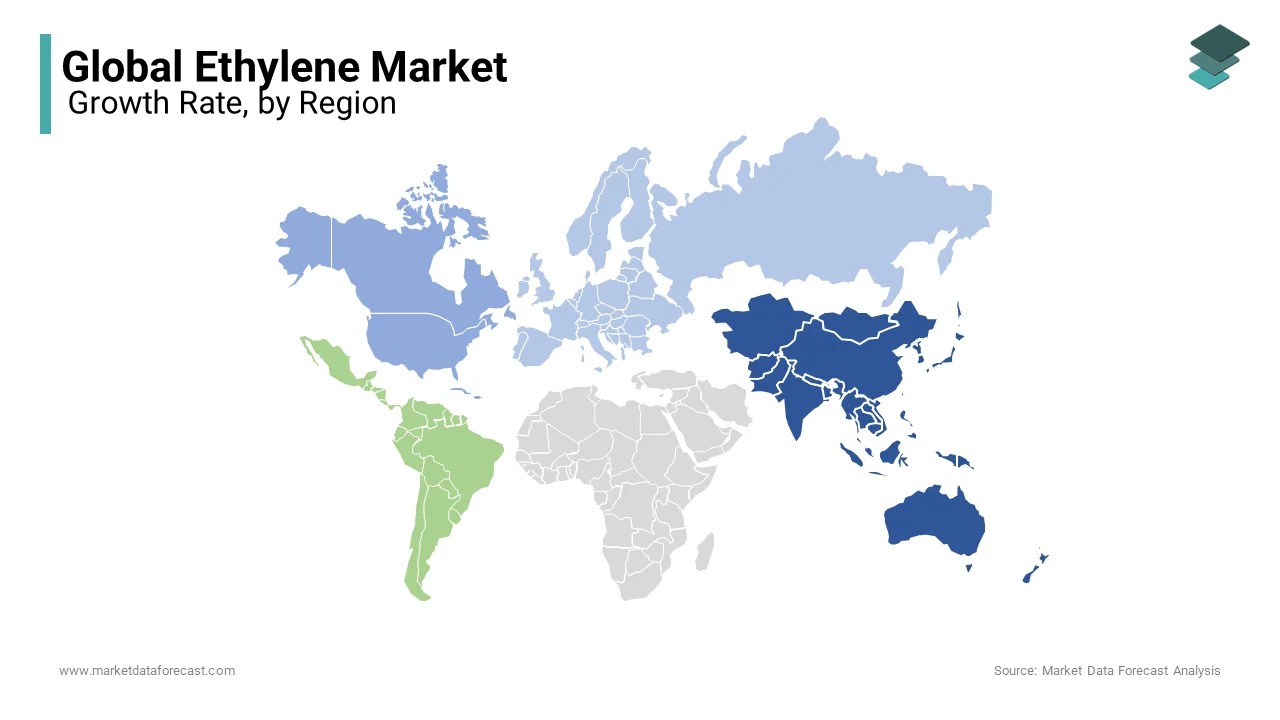
Asia-Pacific was the top performer in the global ethylene market by accounting for 52.9% of the market share in 2025. The domination of Asia Pacific in the global market is mainly attributed to China’s expansive petrochemical infrastructure and India’s rapidly industrializing economy. China alone operates millions of metric tons of ethylene production capacity. This growth is synchronized with rising domestic demand for polyethylene in packaging, agriculture, and construction. India’s ethylene consumption grew, driven by urbanization and government-led initiatives and rural electrification, which require vast quantities of polymer-insulated cables and piping. According to a study, infrastructure investment in the region surged, directly stimulating downstream polymer demand. Moreover, Southeast Asian nations such as Vietnam and Indonesia are emerging as manufacturing hubs for electronics and fast-moving consumer goods, which further intensifies ethylene-based packaging needs.
North America Market Analysis
North America is another key region in the ethylene market and captured 22.5% share of the global market in 2024 due to the United States’ shale gas revolution and highly integrated Gulf Coast petrochemical complexes. As per the research, U.S. ethylene production capacity reached millions of metric tons, representing an increase since 2015. The abundance of ethane from shale formations such as the Marcellus and Permian basins has given North American producers a sustained cost advantage, with ethane-based cracking yielding lower production costs than naphtha-based routes, according to the study. This economic edge has attracted new investments since 2010. The region also serves as a major export hub. The U.S. exported metric tons of ethylene derivatives, an increase from the previous year, as per the study. Apart from these, there is a strong domestic demand for HDPE in agriculture and construction. Thus, North America maintains a strategic position as a low-cost and high-efficiency supplier in the global ethylene landscape.
Europe Market Analysis
Europe is a major player in the steadily expanding ethylene market, with Germany, Belgium, and France serving as core manufacturing hubs within an increasingly constrained operational environment. High energy prices, particularly after the 2022 energy crisis, severely impacted competitiveness. In Europe, natural gas prices in the industrial sector peaked in August 2022, more than the 2020 average. This eroded profit margins for naphtha-based crackers, which led to temporary shutdowns at facilities in Germany and the Netherlands. Nevertheless, the region maintains technological dominance in circular economy initiatives. Regulatory burden under the EU Green Deal and the Carbon Border Adjustment Mechanism is accelerating investments in electrified cracking and bio-based feedstocks. Europe’s focus on sustainability positions it as a pioneer in next-generation ethylene production, despite diminishing volume share.
Middle East & Africa Market Analysis
The Middle East & Africa are growing gradually in the ethylene market, with the Gulf Cooperation Council (GCC) countries, particularly Saudi Arabia and Iran, acting as the primary engines of production. As per the research, GCC ethylene capacity reached notable metric tons in 2023, supported by low-cost associated gas from oil extraction. Saudi Arabia alone accounts for a portion of regional capacity, with Saudi Aramco and SABIC driving integration across the value chain. The kingdom’s Vision 2030 strategy aims to increase non-oil exports, with petrochemicals targeted to grow annually, according to the study. Iran, despite sanctions, expanded its ethylene output to metric tons, primarily through the South Pars gas field developments, as per a study. In Africa, demand remains nascent but is rising. Nigeria and Egypt are investing in domestic crackers to reduce plastic imports. The region’s advantage lies in feedstock availability, though geopolitical risks and underdeveloped downstream sectors limit full market realization.
Latin America Market Analysis
Latin America is likely to grow in the ethylene market with Brazil and Mexico forming the core of regional activity, though structural limitations constrain broader expansion. Brazil, the largest producer in the region, operates a domestic ethylene capacity of metric tons, as per research. The country’s reliance on naphtha and bio-based feedstocks, particularly sugarcane ethanol for green ethylene, differentiates its production model. Braskem’s Triunfo complex produces notable metric tons of bio-ethylene annually by aligning with national sustainability goals. However, infrastructure barriers persist. In Mexico, the state-owned Pemex struggles with aging infrastructure, and ethylene output declined, according to the study. Yet, growing demand for flexible packaging, driven by a middle-class exceeding millions of people, as per the research, creates import dependency. The region imports a portion of its polyethylene needs, which signals untapped potential should investment in modern cracking capacity materialize.
COMPETITIVE LANDSCAPE
Competition in the ethylene market is shaped by a convergence of geopolitical, technological, and environmental forces. While traditional giants maintain scale advantages, regional players are leveraging local feedstock access and government support to challenge dominance. The rise of integrated energy-chemical conglomerates, particularly in the Middle East and Asia, has intensified price competition and innovation. Differentiation increasingly hinges on sustainability credentials, with leaders investing in carbon-neutral cracking and circular polymers. Smaller producers face a burden from high capital intensity and regulatory scrutiny, narrowing the competitive field. Strategic alliances between petrochemical firms and technology providers are emerging to enhance process efficiency. Moreover, the uneven global distribution of feedstock and energy costs creates distinct regional competitive landscapes. North America emphasizes cost dominance, Europe focuses on decarbonization, and Asia drives volume growth. This multi-dimensional rivalry is redefining market dynamics beyond mere production capacity.
KEY MARKET PLAYERS
A few of the dominating players in the global ethylene market include
- Reliance Industries Limited (Mumbai, India)
- China Petroleum & Chemical (Beijing, China)
- LyondellBasell Industries Holdings (Rotterdam, Netherlands)
- Exxon Mobil Corporation (Texas, United States)
- Shell International (The Hague, Netherlands)
- SABIC (Riyadh, Saudi Arabia)
- BOREALIS AG (Vienna, Austria)
- BRASKEM SA (São Paulo, Brazil)
- Chevron Phillips Chemical Company (Texas, United States)
- INEOS GROUP AG (London, UK)
- Other Key Players
Top Players In the Market
- SABIC has established a formidable presence in the Asia-Pacific ethylene landscape through strategic joint ventures and technology-driven expansions. The company operates integrated assets in China, including the SABIC Tianjin Petrochemical Complex, which produces high-performance polyethylene for automotive and packaging sectors. SABIC continues to invest in digital twin technologies and carbon capture integration at its Jubail facilities, with implications for its Asia supply chain efficiency. The initiatives emphasize SABIC’s commitment to technological innovation and circular economy principles, which position it as a forward-looking supplier in the region’s evolving petrochemical ecosystem.
- ExxonMobil plays a pivotal role in the Asia-Pacific ethylene market through large-scale supply agreements and downstream integration with key manufacturers. The company supplies ethylene derivatives to major converters in India, Vietnam, and Indonesia, supporting growing packaging and infrastructure demands. The company is advancing its Blue Hydrogen and Carbon Capture projects in Baytown, which, while based in the U.S., inform its low-emission ethylene production roadmap applicable to future Asia-focused ventures. ExxonMobil’s technical service teams work closely with Asian customers to optimize resin performance, particularly in agriculture films and pipe applications. These efforts reflect its strategy to combine operational excellence with customer-centric innovation across the Asia-Pacific value chain.
- Reliance Industries is a dominant force in the domestic ethylene market and an emerging influencer across South and Southeast Asia. Its Jamnagar refinery complex houses one of the world’s largest integrated petrochemical facilities, producing millions of tons of ethylene annually for polyethylene and other derivatives. The company supplies resins to processors across India and exports to Bangladesh, Sri Lanka, and Nepal. The company is investing in proprietary cracking technology to improve ethane utilization efficiency. Reliance is positioning itself as a regional leader in sustainable ethylene-based polymers, strengthening its footprint beyond traditional markets.
Top Strategies Used by Key Market Participants
Key players in the ethylene market are prioritizing feedstock diversification, vertical integration, and sustainability-driven innovation to consolidate their positions. Companies are expanding into shale-rich regions or securing long-term gas supply agreements to ensure cost-advantaged production. Many are investing in circular economy models, including chemical recycling and bio-based ethylene, to meet regulatory and consumer demands. Strategic joint ventures with downstream converters enhance market reach, while digitalization of plant operations improves yield and reduces emissions. Greenfield projects in emerging markets and retrofits of aging crackers are common growth levers. Besides, firms are leveraging low-carbon hydrogen and carbon capture technologies to future-proof assets amid tightening climate policies, which ensures long-term competitiveness in a transitioning industrial landscape.
MARKET SEGMENTATION
This research report on the global ethylene market is segmented and sub-segmented into the following categories.
By Application
- HDPE
- LDPE
- Ethylene Oxide
- Ethyl Benzene
- Others
By Region
- North America
- Europe
- Asia Pacific
- Latin America
- The Middle East and Africa