- Product Description Description
- Table of Contents TOC
- List of Table & Figure LOT
- Get Free Sample PDF Sample PDF
Market Size, 2025
$6.48 BnMarket Estimate, 2026
$6.86 BnMarket Forecast, 2034
$10.79 BnCAGR, 2026–2034
5.82%Executive Summary: Global Ethylene Propylene Diene Monomer (EPDM) Market
- Market Scope: Global EPDM market analysis covering manufacturing processes, application verticals, regional frameworks, and strategic developments.
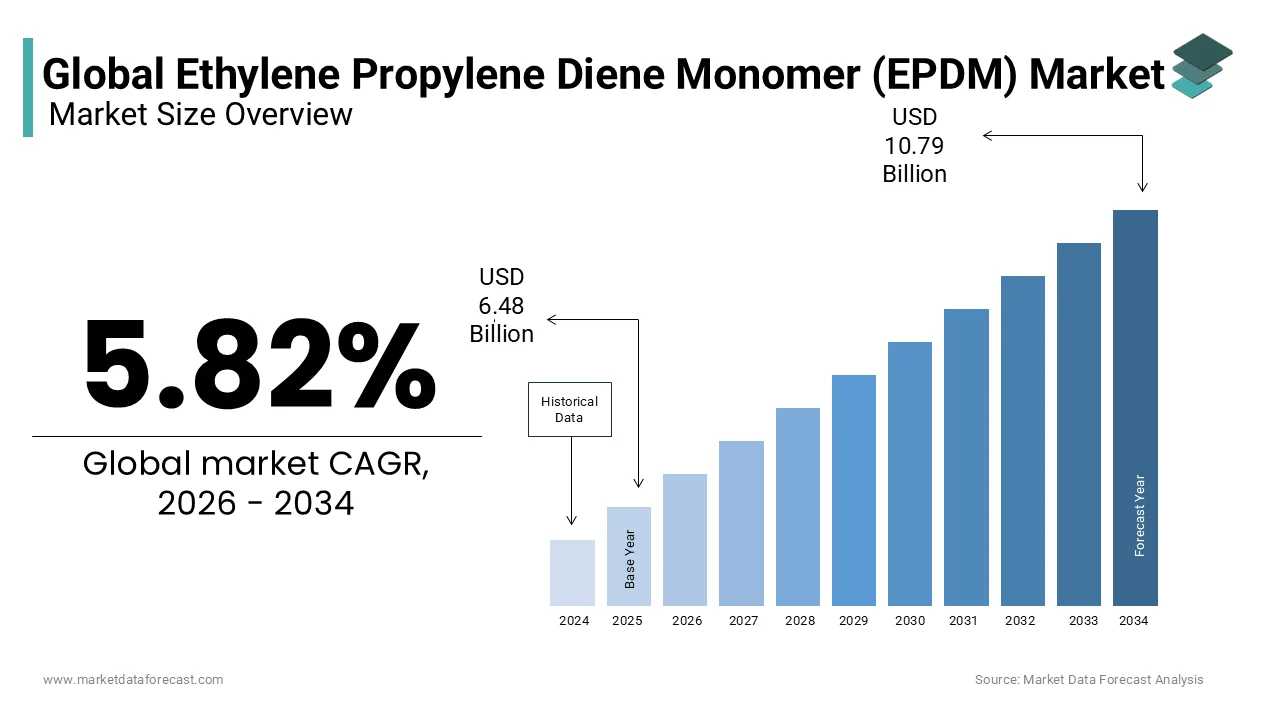
- Market Valuation: Valued at USD 6.48 billion (2025), estimated at USD 6.86 billion (2026), and projected to reach USD 10.79 billion by 2034, growing at a steady CAGR of 5.82% (2026–2034).
- Primary Growth Drivers: Expansion of the global automotive sector, increased demand for durable weatherproofing and EV sealing solutions, and rising adoption of EPDM in sustainable construction and green roofing. Key challenges include crude oil feedstock price volatility and regulatory constraints on specific vulcanization accelerators.
Key Market Segment Metrics (2025–2034)
| Category | Leading Segment (2025 Position) | Fastest-Growing Segment |
|---|---|---|
| By Manufacturing Process | Solution polymerization process (held leading share of 62.7% in 2025 due to high purity and precise molecular control) | Gas-phase polymerization process (witnessing the fastest CAGR of 6.8% due to solvent elimination and lower capital costs) |
| By Application | Automotive segment (captured 45.2% share in 2025 for weatherstripping, seals, and hoses) | Building and construction segment (experiencing fastest CAGR of 7.2% driven by single-ply roofing and green building standards) |
| By Region | Asia-Pacific (dominated by occupying 48.5% share in 2025 supported by massive production and infrastructure growth) | Asia-Pacific and Middle East & Africa regional expansion zones |
Major Market Players & Market Structure
Market Structure: Highly competitive landscape featuring integrated petrochemical conglomerates and specialty elastomer leaders focusing on advanced catalysts, bio-based initiatives, and localized production networks.
Key Companies: ExxonMobil Chemical Company, Mitsui Chemicals Inc., PetroChina Co. Ltd, JSR Corporation, Lanxess AG, SK Global Chemical Co. Ltd, Carlisle Companies Inc., Dow Elastomers, John Manville Inc., and Kumho Polychem Co. Ltd.
 Download Free Sample Report
Global Ethylene Propylene Diene Monomer (EPDM) Market Size
The ethylene propylene diene monomer (EPDM) market size was valued at USD 6.48 billion in 2025 and is expected to reach USD 10.79 billion by 2034 from USD 6.86 billion in 2026. The market is projected to grow at a CAGR of 5.82%.
Ethylene Propylene Diene Monomer (EPDM) is a synthetic terpolymer rubber composed of ethylene, propylene, and a non-conjugated diene, engineered for exceptional resistance to ozone, UV radiation, weathering, and extreme temperatures. Its molecular structure enables cross-linking via sulfur vulcanization, making it ideal for applications requiring long-term elastomeric performance. EPDM is extensively used in automotive seals, roofing membranes, wire and cable insulation, and HVAC systems due to its thermal stability ranging from -50°C to +150°C. According to the International Rubber Study Group, global synthetic rubber production reached 16.2 million metric tons in 2023, with EPDM accounting for approximately 11% of specialty elastomer output. As per the U.S. Department of Transportation, EPDM is widely used in automotive seals, hoses, and roofing membranes. Apart from these, EPDM membranes are also commonly installed in commercial roofing worldwide, which emphasizes its role in sustainable building infrastructure.
MARKET DRIVERS
Expansion of the Global Automotive Industry and Demand for Durable Sealing Solutions
The sustained growth of the automotive sector, particularly in emerging economies, is a key driver of the Ethylene Propylene Diene Monomer (EPDM) market growth. It is driven by its irreplaceable role in weatherproofing and vibration damping components. According to the International Organization of Motor Vehicle Manufacturers, over 89 million passenger and commercial vehicles were produced globally in 2023, with Vehicle production increased across key markets in 2023, including India, Indonesia, and Mexico. Each vehicle contains an average of 15–20 kg of EPDM, primarily in door seals, window gaskets, and radiator hoses. As per the Society of Automotive Engineers, modern vehicles require seals capable of enduring 15+ years of exposure to thermal cycling and environmental stress, a performance threshold met only by high-grade EPDM. Furthermore, the shift toward electric vehicles (EVs) has intensified demand for reliable sealing in battery enclosures and high-voltage connectors. As per the International Energy Agency Global, electric vehicle production reached approximately 10–11 million units in 2023.
Rising Adoption of EPDM in Sustainable Construction and Green Roofing
The global construction industry’s pivot toward energy-efficient and durable building materials has significantly elevated EPDM’s prominence, particularly in single-ply roofing systems, which accelerates the expansion of the Ethylene Propylene Diene Monomer (EPDM) market. As per the U.S. Energy Information Administration, commercial buildings account for nearly 20% of total energy consumption in the United States, with roofing integrity directly influencing heating and cooling efficiency. EPDM membranes, known for their 30–50 year service life and low maintenance, are installed on large square feet of rooftops annually worldwide, according to research. The European Commission’s Energy Performance of Buildings Directive mandates that all new public buildings meet nearly zero-energy standards by 2026 by accelerating the use of high-performance waterproofing materials like EPDM. Besides, the World Meteorological Organization confirms a 23% increase in extreme weather events between 2010 and 2022 and this validates the need for resilient building envelopes thus entrenching EPDM’s role in climate-adaptive infrastructure.
MARKET RESTRAINTS
Volatility in Crude Oil and Feedstock Derivative Pricing
High sensitivity towards fluctuations in crude oil and its derivatives impedes the growth of the Ethylene Propylene Diene Monomer (EPDM) market. This is because ethylene and propylene are its primary feedstocks, which are derived from refining and cracking processes. According to the International Energy Agency, crude oil prices fluctuated between $73 and $97 per barrel in 2023, directly influencing propylene prices, which rose by 28% year-on-year as reported by ICIS. This volatility compresses profit margins for EPDM manufacturers, particularly those without integrated upstream operations. In regions like Europe, where naphtha-based cracking dominates, production costs higher than in ethane-rich regions such as North America, as per research. These price instabilities deter long-term investment in new capacity and complicate supply chain planning, which limits the scalability of EPDM production in cost-sensitive markets.
Regulatory Burden on Chemical Additives and Vulcanization Byproducts
Increasing regulatory scrutiny on sulfur-based vulcanization and certain polymer additives used in EPDM manufacturing is constraining operational flexibility, which in turn restricts the expansion of the Ethylene Propylene Diene Monomer (EPDM) market. The European Chemicals Agency (ECHA) has classified several accelerators, such as tetramethylthiuram disulfide (TMTD), as substances of very high concern (SVHC) due to their potential endocrine-disrupting properties. As of 2023, REACH regulations restrict the use of such compounds in consumer-facing products, compelling manufacturers to reformulate EPDM compounds for automotive and construction applications. Many U.S. rubber manufacturing facilities are required to report VOC and H₂S emissions. Compliance with these standards necessitates costly abatement systems, which can increase capital expenditure per line. In Japan, the Ministry of Health, Labour and Welfare enforces strict workplace exposure limits for nitrosamines. This further complicates production. These regulatory burdens delay product approvals and elevate manufacturing complexity, particularly for small and mid-sized EPDM producers.
MARKET OPPORTUNITIES
Development of Bio-Based and Recycled EPDM for Circular Economy Integration
Innovations in bio-based monomers and chemical recycling of end-of-life rubber are opening new opportunities for the Ethylene Propylene Diene Monomer (EPDM) market growth. As per studies, Bio-ethylene from sugarcane offers potential to replace a portion of fossil-based ethylene. Braskem’s Green Ethylene project in Brazil, producing over 200,000 metric tons annually, has already supplied feedstock for pilot-scale bio-EPDM batches. Concurrently, chemical depolymerization technologies are advancing. Evonik and Heraeus have jointly developed a process to recover EPDM from automotive scrap using supercritical fluids, which achieves high purity in laboratory trials. According to the Ellen MacArthur Foundation, only 12% of rubber products are currently recycled, indicating vast untapped potential. As per sources, chemical recycling capacity is expected to expand globally. Extended producer responsibility schemes like France’s AGEC Law are being enforced by governments, a move poised to increase demand for certified recycled content in construction and automotive sectors which will create a new generation of circular EPDM solutions.
Penetration of EPDM in Renewable Energy Infrastructure
"The global expansion of solar and wind energy systems is creating new opportunities for the expansion of the Ethylene Propylene Diene Monomer (EPDM) market. This is seen in sealing, insulation, and protective components. According to the International Renewable Energy Agency, solar photovoltaic (PV) installations reached 445 gigawatts in 2023, requiring durable gaskets and cable jackets capable of withstanding decades of outdoor exposure. EPDM is the preferred material for PV module encapsulation and junction box seals due to its resistance to UV degradation and thermal cycling. As per research, EPDM sealing systems are widely used in U.S. utility-scale solar farms. In wind energy, EPDM is used in blade root seals, pitch bearings, and nacelle enclosures. Furthermore, offshore wind farms, which face harsh saline environments, rely on EPDM’s corrosion resistance. EPDM's role in energy transition infrastructure is set to expand significantly as global renewable capacity is projected to double by 2030, according to the International Energy Agency.
MARKET CHALLENGES
Limited Substitution Flexibility in High-Performance Applications
Its irreplaceability in vital applications paradoxically heightens supply chain vulnerability, which challenges the growth of the Ethylene Propylene Diene Monomer (EPDM) market. Unlike commodity elastomers, few alternatives match EPDM’s combination of ozone resistance, thermal stability, and compression set performance. According to the American Society for Testing and Materials, silicone rubber degrades under prolonged mechanical stress, while chloroprene exhibits inferior UV resistance, limiting substitution in automotive and construction sectors. The lack of flexibility exposes end-users to production delays during feedstock shortages or plant outages. For instance, the 2021 Texas freeze disrupted 70% of U.S. ethylene production, causing EPDM lead times to extend from 8 to 20 weeks, as reported by the Rubber Manufacturers Association. The market faces structural barriers that hinder resilience especially in regions without local manufacturing capabilities because only a handful of global producers can meet technical specifications.
High Capital Intensity and Long Payback Periods for New Production Facilities
Establishing new EPDM production lines involves substantial capital investment and extended timelines, which constrains the expansion of the Ethylene Propylene Diene Monomer (EPDM) market. This deters new entrants and limiting capacity expansion. A single train for EPDM synthesis, including solution or suspension polymerization units, catalyst systems, and finishing lines, requires an investment of $400–600 million, according to the International Council of Chemical Associations. The construction and commissioning process typically spans 3–4 years, with additional time needed for regulatory approvals and customer qualification. The U.S. Department of Commerce notes that the average payback period for new synthetic rubber plants exceeds seven years under current market conditions. In China, only a limited number of new EPDM lines have been commissioned since 2020 due to technological complexity and environmental compliance requirements. Moreover, achieving consistent product quality across batches demands advanced process control systems by increasing operational complexity. As per sources, Access to financing for petrochemical projects in emerging markets has declined in recent years, which further constrains investment in this capital-intensive segment.
REPORT COVERAGE
| REPORT METRIC | DETAILS |
| Market Size Available | 2025 to 2034 |
| Base Year | 2025 |
| Forecast Period | 2026 to 2034 |
| CAGR | 5.82% |
| Segments Covered | By Manufacturing Process, Application, and Region |
| Various Analyses Covered | Global, Regional, & Country Level Analysis; Segment-Level Analysis; DROC; PESTLE Analysis; Porter’s Five Forces Analysis; Competitive Landscape; Analyst Overview of Investment Opportunities |
| Regions Covered | North America, Europe, APAC, Latin America, Middle East & Africa |
| Market Leaders Profiled | ExxonMobil Chemical Company (U.S.), Mitsui Chemicals Inc. (Japan), PetroChina Co. Ltd (China), JSR Corporation (Japan), Lanxess AG (Germany), SK Global Chemical Co. Ltd (South Korea), Carlisle Companies Inc. (U.S.), Dow Elastomers (U.S.), John Manville Inc. (U.S.), and Kumho Polychem Co. Ltd (South Korea), and others |
SEGMENTAL ANALYSIS
By Manufacturing Process Insights
In 2025, the solution polymerization process segment held a leading share of 62.7% of the global Ethylene Propylene Diene Monomer (EPDM) market. Its ability to produce high-purity and consistent-quality EPDM with superior control over molecular architecture has majorly contributed to the dominance of the solution polymerization process segment in the global market. The process allows precise tuning of polymer microstructure, important for applications demanding exceptional weatherability and elasticity, such as automotive seals and roofing membranes. Its compatibility with a wide range of diene monomers enhances copolymer versatility. According to a 2023 technical assessment by the American Chemical Society, solution-based systems achieve over 95% monomer conversion efficiency under optimized catalytic conditions using vanadium or metallocene catalysts, significantly reducing raw material waste. Apart from these, the Integration of advanced process control systems has contributed to measurable energy savings in EPDM plants since 2018, as per studies, which makes it not only technically superior but also increasingly sustainable.
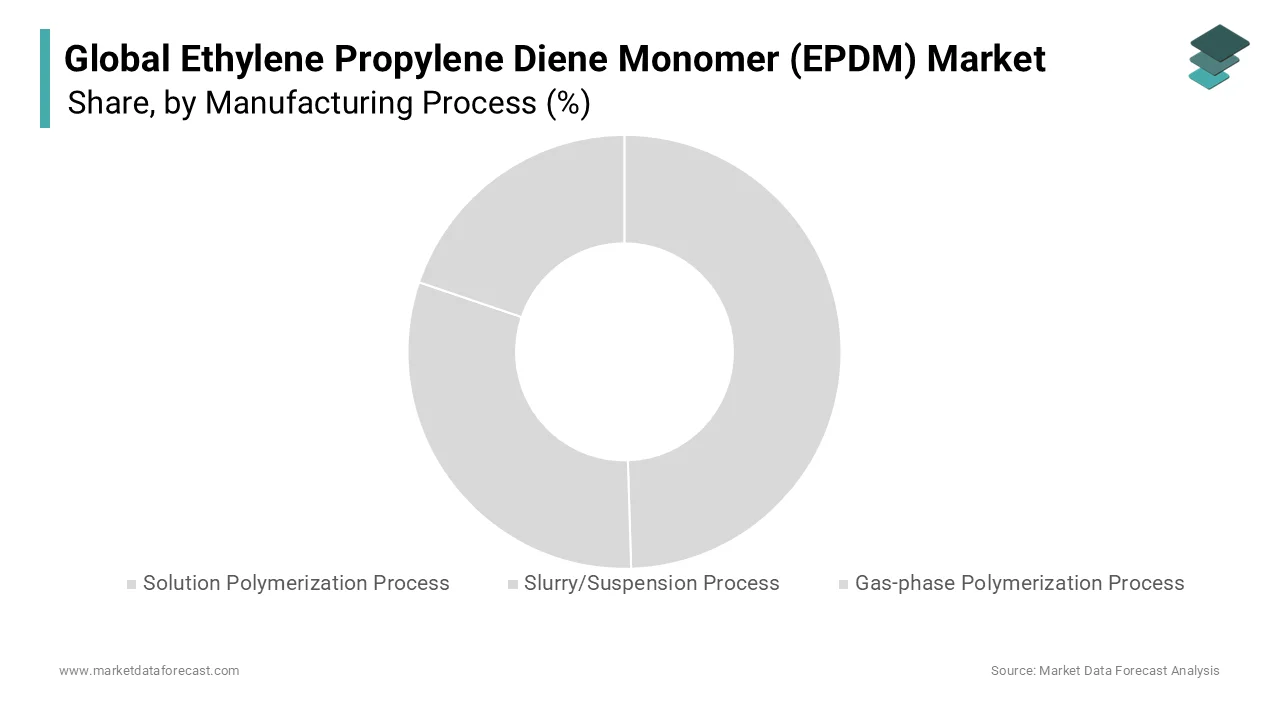
The gas-phase polymerization process segment is anticipated to witness the fastest CAGR oF 6.8% from 2026 to 2034. Factors such as its inherent operational advantages, including elimination of solvents, lower capital and operating costs, and reduced environmental footprint, are boosting the growth of the gas-phase polymerization process segment. Unlike slurry or solution processes, gas-phase reactors operate without liquid media, cutting downstream separation and recovery steps. Gas-phase plants emit lower VOC levels compared with liquid-phase units. Moreover, technological breakthroughs such as fluidized-bed reactor designs from companies like LyondellBasell and ExxonMobil have improved heat dissipation and particle morphology control, enabling commercial-scale production of specialty grades. The process also benefits from modular scalability. New gas-phase units can be commissioned faster than liquid-phase equivalents, which accelerates time-to-market in high-growth regions like Southeast Asia.
By Application Insights
The automotive segment led the Ethylene Propylene Diene Monomer (EPDM) market by capturing 45.2% share in 2025. EPDM’s irreplaceable role in sealing systems, HVAC hoses, and weatherstripping due to its resilience against ozone, UV radiation, and temperature extremes ranging from -45°C to +150°C accelerates the growth of the automotive segment. With over 79 million vehicles produced globally in 2023, according to the International Organization of Motor Vehicle Manufacturers (OICA), each passenger car uses an average of 12–15 kg of EPDM, primarily in door seals, window gaskets, and under-hood components. The push for lightweighting to improve fuel efficiency has further entrenched EPDM’s position. As per research, replacing metal-based seals with EPDM can reduce component weight and improve efficiency, which contributes directly to emissions reduction targets. In addition, the rise of electric vehicles (EVs) has amplified demand, EVs require more robust sealing due to battery pack enclosures and higher-voltage systems. Global EV production reached approximately 10–11 million units in 2023 by driving incremental EPDM uptake in battery thermal management systems and waterproof connectors.
The building and construction application segment is likely to experience the fastest CAGR of 7.2% during the forecast period due to the escalating demand for durable and energy-efficient building envelopes in both developed and emerging economies. EPDM is widely used in single-ply roofing membranes, where it offers service life exceeding 30 years with minimal maintenance. According to sources, Regional data indicate substantial EPDM roofing installations in North America by making it the leading material for low-slope commercial roofs. In Asia-Pacific, rapid urbanization is a key driver, China alone added 2.1 billion square meters of new building area in 2023, according to the National Bureau of Statistics of China, much of it commercial and industrial infrastructure requiring long-life waterproofing. Furthermore, green building certifications like LEED and BREEAM incentivize the use of sustainable materials. EPDM’s recyclability and low embodied energy are increasingly influencing procurement decisions. The European Commission’s Energy Performance of Buildings Directive (EPBD), revised in 2023, mandates improved insulation and weatherproofing across 27 member states. This further boosts EPDM adoption in façade and roofing systems.
REGIONAL ANALYSIS
Asia Pacific Market Analysis
Asia Pacific dominated the Ethylene Propylene Diene Monomer (EPDM) market by occupying 48.5% share in 2025. The explosive industrial and infrastructural growth across China, India, and Southeast Asia have primarily driven the domination of the Asia Pacific. The region functions as both the largest production hub and consumption center, supported by integrated petrochemical complexes in China and rising domestic demand. China alone accounts for nearly 60% of regional consumption, with over 500,000 metric tons of EPDM used annually in 2023, primarily in automotive and construction sectors. According to the National Development and Reform Commission of China, the country’s rubber additives business grew by 8.3% year-on-year in 2023, reflecting strong downstream activity. India is emerging as a secondary powerhouse, its automobile production rose to 5.2 million units in 2023, up from 4.7 million in 2022, according to the Society of Indian Automobile Manufacturers, which fuels EPDM demand for seals and hoses. Besides, Japan remains a center of high-performance elastomer innovation. Companies like JSR Corporation and Mitsubishi Chemical continue to develop specialty EPDM grades for electronics and medical applications, which diversifies regional use beyond traditional sectors.
North America Market Analysis
North America is another key region in the Ethylene Propylene Diene Monomer (EPDM) market with a share of 21% in 2025. The growth of the North America is fuelled by advanced manufacturing and regulatory-driven material performance standards. The U.S. constitutes over 90% of regional demand, with a robust automotive industry producing 10.6 million vehicles in 2023, according to OICA, many of which incorporate EPDM in vital sealing applications. The resurgence of domestic manufacturing, supported by the CHIPS and Science Act and Inflation Reduction Act, has spurred investment in industrial rubber components. EPDM roofing remains dominant in commercial construction. The U.S. Census Bureau recorded $2.1 trillion in construction spending in 2023. Furthermore, the U.S. Department of Energy’s Building Technologies Office emphasizes that EPDM membranes achieve \ reduction in cooling loads due to solar reflectivity when coated, enhancing energy efficiency. Environmental regulations such as California’s Title 24 have accelerated adoption of high-durability roofing, with EPDM installations increasing.
Europe Market Analysis
Europe expanded steadily in the Ethylene Propylene Diene Monomer (EPDM) market owing to stringent environmental and safety regulations, which favor durable, recyclable materials. Germany, France, and Italy are the primary consumers, with the European Automobile Manufacturers Association (ACEA) reporting 12.8 million vehicles produced in the EU in 2023, many incorporating EPDM in noise-dampening and sealing systems. Circular Economy Action Plan aims for significant construction waste recycling by 2035, which boosts demand for recyclable elastomers. EPDM is increasingly used in thermoplastic vulcanizates (TPVs), which are recyclable and widely adopted in automotive interiors. According to Fraunhofer Institute, TPV usage in EU car interiors grew in 2023. Furthermore, the EU’s Green Deal and Energy Efficiency Directive have driven retrofitting of aging building stock, increasing demand for long-life roofing membranes. Over 300 million square meters of EPDM were installed across Europe in 2023, as per the ETSA (European Roofing Tile and Waterproofing Association).
Latin America Market Analysis
Latin America is growing gradually in the Ethylene Propylene Diene Monomer (EPDM) market, with Brazil and Mexico serving as the principal demand centers amid gradual industrial modernization. Brazil leads regional consumption, driven by a recovering automotive sector—ANFAVEA, the Brazilian Association of Vehicle Manufacturers, reported 2.9 million vehicles produced in 2023, a 12% increase from 2022. EPDM is extensively used in vehicle weatherstripping and under-hood components due to its resistance to tropical climates. The country’s construction sector is also rebounding the Brazilian Institute of Geography and Statistics (IBGE) recorded a year-on-year increase in construction output in 2023, supported by public infrastructure programs. Mexico benefits from nearshoring trends, with Some auto parts suppliers have relocated from Asia to North America since 2021. This shift has increased local EPDM processing capacity, with companies like Grupo Kuo expanding production. However, regional growth is constrained by feedstock volatility. Ethylene prices in Latin America fluctuated in 2023.
Middle East and Africa Market Analysis
The Middle East and Africa is predicted to grow in the Ethylene Propylene Diene Monomer (EPDM) market during the forecast period, with the Gulf Cooperation Council (GCC) countries driving most of the regional demand. Saudi Arabia and the UAE are investing heavily in downstream petrochemical diversification under Vision 2030 and similar economic transformation plans. The UAE’s construction boom, fueled by Expo 2020 legacy projects and preparations for COP28, saw notable amount invested in infrastructure between 2021 and 2023, according to studies, which increases demand for durable waterproofing materials. However, Africa’s EPDM uptake remains limited; South Africa is the only country with notable processing capacity, serving a regional automotive assembly base that produced 530,000 vehicles in 2023, per Naamsa. Nevertheless, long-term potential exists. Africa’s urban population is expected to double by 2050, per United Nations estimates, which could drive future construction and automotive growth, which creates latent demand for performance elastomers.
COMPETITIVE LANDSCAPE
KEY MARKET PLAYERS
These are some of the market players that are dominating the global ethylene propylene diene monomer market.
- ExxonMobil Chemical Company (U.S.)
- Mitsui Chemicals Inc. (Japan)
- PetroChina Co. Ltd (China)
- JSR Corporation (Japan)
- Lanxess AG (Germany)
- SK Global Chemical Co. Ltd (South Korea)
- Carlisle Companies Inc. (U.S.)
- DoW Elastomers (U.S.)
- John Manville Inc. (U.S.)
- Kumho Polychem Co. Ltd (South Korea)
TOP STRATEGIES USED BY KEY MARKET PLAYERS
Key players in the ethylene propylene diene monomer market are prioritizing technological innovation, capacity expansion, and vertical integration to strengthen their competitive positioning. Companies are investing heavily in advanced catalyst systems, such as metallocene and post-metallocene technologies, to produce high-purity, consistent EPDM grades with improved performance characteristics. Strategic collaborations with automotive OEMs and construction material manufacturers are enabling co-development of application-specific elastomers. Expansion into high-growth regions like Asia-Pacific through localized production and technical service centers is another important strategy. Sustainability is a growing focus, with firms developing recyclable EPDM compounds and reducing carbon footprints via energy-efficient polymerization processes. Digitalization of manufacturing, including AI-driven process optimization and predictive maintenance, is enhancing operational efficiency. In addition, mergers and acquisitions are being leveraged to broaden product portfolios and access new markets, which ensures resilience amid fluctuating feedstock prices and regulatory demands.
COMPETITION OVERVIEW
The competition in the ethylene propylene diene monomer market is intensifying as global players strive to capture growing demand in automotive, construction, and industrial sectors. The landscape features a mix of integrated petrochemical giants and specialty chemical innovators, each leveraging technological differentiation and regional scalability. Product performance, consistency, and sustainability credentials are becoming key battlegrounds, especially as electric vehicles and green buildings drive new specifications. Companies are increasingly investing in R&D to develop next-generation EPDM with enhanced durability, processability, and environmental compatibility. Competitive dynamics are further shaped by proximity to feedstock sources and end-use markets, with Asia-Pacific emerging as the focal point of expansion. Strategic alliances, capacity upgrades, and localized technical support are important for maintaining relevance. The race is on to establish dominance in high-value applications and sustainable elastomer solutions while no single player dominates globally.
TOP PLAYERS IN THE MARKET
- ExxonMobil Corporation is a leading global producer of EPDM, with a strong footprint across the Asia-Pacific region through its specialty elastomers division. The company operates advanced manufacturing facilities in Singapore and Japan, supplying high-performance EPDM grades to automotive and construction sectors. ExxonMobil has consistently invested in R&D to develop next-generation elastomers with enhanced thermal stability and processing efficiency. ExxonMobil launched new metallocene-catalyzed EPDM grades for automotive sealing applications in 2023. The company has also strengthened partnerships with local compounders in India and South Korea to expand distribution. Its integration with downstream polymer applications and focus on sustainability-driven innovations, including energy-efficient production processes, have strengthened its position as a technology leader in the Asia-Pacific EPDM landscape.
- JSR Corporation, headquartered in Japan, is a major innovator in synthetic rubber technologies, including EPDM. The company plays a pivotal role in supplying specialty elastomers to high-end automotive and electronics industries across Asia-Pacific. JSR’s EPDM products are widely used in automotive weatherstripping, hoses, and vibration dampers due to their superior ozone and heat resistance. In recent years, the company has focused on sustainable product development, introducing bio-based monomer trials in EPDM synthesis in collaboration with Japanese research institutes. JSR expanded production capacity at its Niihama facility in 2022. It has also deepened collaborations with Tier-1 automotive suppliers to co-develop lightweight sealing solutions. JSR’s emphasis on material science innovation and close integration with end-use industries has enabled it to maintain a competitive edge in performance-essential applications throughout the region.
- Lanxess AG, though European-based, exerts significant influence in the Asia-Pacific EPDM market through its high-performance rubber portfolio and strategic regional partnerships. The company supplies specialty EPDM grades from its global network, including logistics hubs in Shanghai and Singapore, catering to automotive, construction, and industrial sectors. Lanxess has intensified its focus on sustainable elastomers, launching halogen-free and recyclable EPDM compounds suitable for green building applications. It inaugurated a technical service center in Yokohama in 2023. The company also partnered with Chinese roofing manufacturers to promote long-life single-ply membranes using its Keltan EPDM. Apart from these, Lanxess has invested in digital twin technology to optimize polymerization processes, improving consistency and reducing waste. These initiatives reflect its commitment to technological advancement and regional customization, which strengthenes its presence in fast-growing Asian markets.
MARKET SEGMENTATION
This research report on the global ethylene propylene diene monomer market is segmented and sub-segmented into the following categories.
By Manufacturing Process
- Solution Polymerization Process
- Slurry/Suspension Process
- Gas-phase Polymerization Process
By Application
- Automotive
- Building and Construction
- Manufacturing
- Electrical and Electronics
- Other Applications
By Region
- North America
- Europe
- Asia Pacific
- Latin America
- Middle East & Africa