Europe A2P Messaging Market Size, Share, Trends and Growth Forecasts Research Report, Segmented By Component, Application, Vertical, SMS Traffic, Deployment Mode, Enterprise Size and Country – Industry Analysis (2026 to 2034)
Europe A2P Messaging Market Report Summary
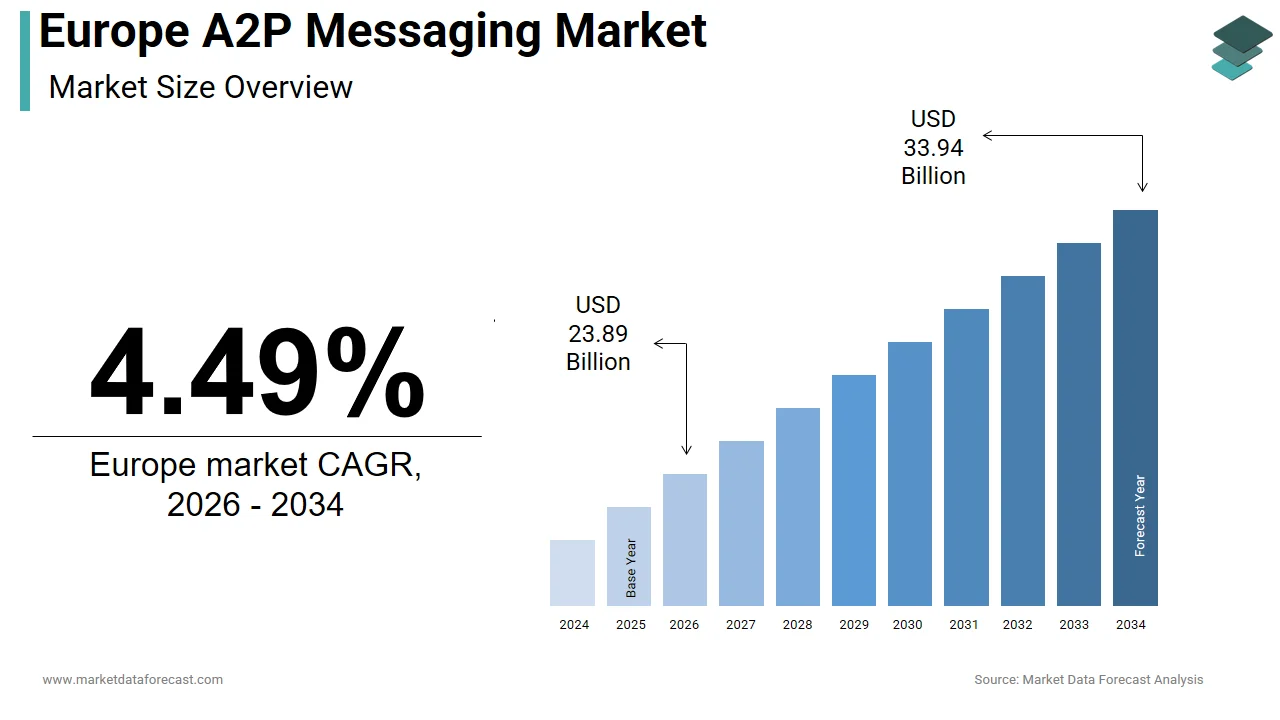
The Europe A2P messaging market was valued at USD 22.86 billion in 2025, is anticipated to reach USD 23.89 billion in 2026, and is projected to grow to USD 33.94 billion by 2034, registering a CAGR of 4.49% from 2026 to 2034. Market growth is underpinned by regulatory mandates for strong customer authentication, widespread digitization of public services, and the continued reliance on SMS as a universal, low-friction communication channel. A2P messaging has evolved into a core digital infrastructure layer across banking, government, healthcare, and e-commerce ecosystems in Europe.
Key Market Trends
- Sustained dominance of authentication and transactional messaging driven by PSD2 compliance.
- Rising institutional usage from public sector digitalization and national e-government platforms.
- Gradual transition toward RCS-enabled interactive A2P messaging with SMS fallback.
- Increasing focus on fraud prevention, sender ID registration, and message authentication.
- Growing enterprise demand for data residency and GDPR-aligned delivery frameworks.
Segmental Insights
-
Based on component:
-
The A2P service segment dominated the market in 2025 due to regulatory complexity, carrier fragmentation, and enterprises’ preference for managed, compliant messaging delivery.
-
-
Based on application:
-
The authentication services segment led the market by capturing 57.8% share, driven by mandatory two-factor authentication requirements across BFSI and public services.
-
-
Based on vertical:
-
The BFSI segment held the largest share at 38.2%, supported by continuous demand for transaction alerts, login verification, and fraud prevention messaging
-
Regional Insights
The Europe A2P messaging market is witnessing stable growth across major economies, supported by regulatory enforcement, high mobile penetration, and strong institutional usage.
- Germany led the market with 23.1% share, driven by its advanced digital economy, strong financial sector, and government-backed digital identity programs.
- The United Kingdom ranked second, supported by mature fintech adoption, NHS-driven institutional messaging, and transparent sender ID regulations.
- France maintains a strong position due to centralized public services, mobile banking growth, and carrier-supported interactive messaging.
- Spain and Italy are expanding steadily, driven by digital banking adoption, tourism-related notifications, and rollout of RCS by national operators.
Competitive Landscape
The Europe A2P messaging market is highly competitive and shaped more by regulatory compliance, delivery reliability, and carrier integration depth than by pricing alone. Global CPaaS providers, regional aggregators, and telecom-owned platforms compete on data sovereignty, fraud mitigation, and PSD2-aligned authentication capabilities. Market consolidation favors players with direct operator interconnects, localized infrastructure, and strong compliance tooling. The gradual rise of enterprise-controlled platforms is reshaping vendor strategies toward hybrid service-plus-platform models.
Prominent companies operating in the Europe A2P messaging market include AT&T, Sinch, Infobip Ltd., Orange, Route Mobile, Tata Communications, Twilio Inc., Monty Mobile, Global Message Services, Clear Sky Technologies, Sify Technologies, Genesys, Syniverse, and Vonage.
Europe A2P Messaging Market Size
The Europe A2P messaging market size was USD 22.86 billion in 2025, is anticipated to be USD 23.89 billion in 2026, and is projected to reach USD 33.94 billion by 2034, registering a CAGR of 4.49% from 2026 to 2034.
Application to Person (A2P) messaging refers to automated text communications sent from software applications to mobile users, widely used for authentication, transaction alerts, marketing, and service notifications. In Europe, A2P messaging has become a critical infrastructure layer for digital services across banking, e-commerce, logistics, and public administration. A2P messaging is widely used in Europe and is a deep part of daily digital life. Businesses and institutions send a large volume of these automated messages for things like secure customer authentication and general communication. The proliferation of two-factor authentication, driven by the Revised Payment Services Directive, has made SMS based verification a regulatory standard for financial institutions. Additionally, national digital identity frameworks such as France’s FranceConnect and Germany’s BundID rely heavily on A2P for one-time password delivery. This structural shift anchors A2P messaging as an essential utility in Europe’s digital economy.
MARKET DRIVERS
Regulatory Mandates for Strong Customer Authentication Under PSD2
The regulatory requirement for strong customer authentication imposed by the Revised Payment Services Directive propels the growth of the Europe A2P messaging market. Under PSD2, financial institutions must verify user identity using at least two independent factors, with SMS based one time passwords serving as the most widely adopted out-of-band verification method across the EU. According to sources, several payment service providers in the European Economic Area used SMS for transaction authentication due to its universal reach and low friction. This regulatory framework has generated immense baseline demand. Even as newer authentication methods emerge, SMS remains the fallback for customers without smartphones or biometric capabilities, representing nearly a share of adults aged 65 and above. Furthermore, the directive’s applicability extends beyond banking to insurance, investment platforms, and fintech wallets, broadening the A2P footprint. Consequently, compliance necessity rather than commercial choice sustains high volume A2P traffic, making financial services the single largest and most stable demand segment in the European market.
Digital Transformation of Public Sector and Civic Services
The modernization of government services across Europe has significantly fuelled the expansion of the Europe A2P messaging market. National and municipal administrations increasingly use SMS to deliver appointment confirmations, tax notices, health alerts, and emergency notifications to citizens. According to the European Commission’s Digital Economy and Society Index (DESI), 69% of EU citizens aged 16-74 interacted with public authorities online in 2023. The General Data Protection Regulation enables such communications when based on legitimate interest or legal obligation, providing a compliance pathway absent in commercial marketing. Moreover, countries integrate A2P into national digital ID ecosystems, using it for secure credential delivery. A2P messaging is becoming an indispensable bridge for reaching populations that are offline or have low digital literacy, a necessity underscored by the EU's push for 100% digital public services by 2030 under the Digital Decade Policy Programme. This civic digitization wave ensures sustained institutional demand independent of consumer marketing cycles.
MARKET RESTRAINTS
Stringent Data Privacy Regulations Limiting Message Content and Consent Mechanisms
The region’s robust data protection and electronic communications laws, which restrict message content, sender identification, and user consent, thereby restrict the growth of the Europe A2P messaging market. The General Data Protection Regulation requires explicit opt-in for promotional A2P messages, while the ePrivacy Directive mandates stringent rules for storing or accessing information on end-user devices, including SIM-based identifiers used for routing. These enforcement actions have made enterprises cautious about bulk marketing campaigns, particularly in sectors like retail and entertainment. Apart from these, the EU’s upcoming ePrivacy Regulation will further tighten rules on metadata processing, potentially affecting message delivery analytics and routing optimization. Unlike in other regions where promotional SMS thrives, Europe’s regulatory environment confines high-volume A2P traffic largely to transactional and authentication use cases. Even service messages require granular consent layers; for instance, a delivery notification may be permitted, but cross-selling within the same message is prohibited. This legal complexity increases compliance costs and deters innovation in conversational A2P applications, constraining market expansion beyond regulated utilities.
Interoperability Gaps and Fragmented Mobile Network Operator Policies
The lack of standardized technical and commercial frameworks across the region’s mobile network operators hampers the expansion of the Europe A2P messaging market. Unlike unified markets such as the United States or India, European carriers maintain divergent routing policies, pricing structures, and anti-spam filtering mechanisms for A2P traffic. For example, a bank in Italy sending fraud alerts to customers in Sweden may face blocking if its alphanumeric sender ID is not pre-registered with local operators, a process that varies by country and lacks central coordination. Furthermore, the absence of a pan-European A2P registry akin to India’s Distributed Ledger-based TCCC system leaves enterprises dependent on third-party aggregators, increasing latency and cost. This fragmentation not only undermines reliability but also discourages SMEs from adopting A2P at scale, limiting market depth despite high mobile penetration.
MARKET OPPORTUNITIES
Integration of A2P Messaging with RCS for Rich Interactive Experiences
The gradual adoption of Rich Communication Services as a next-generation channel that retains SMS compatibility while enabling interactive, media-rich conversations, provides new opportunities for the growth of the Europe A2P messaging market. Unlike traditional SMS, RCS supports branding, quick reply buttons, payment integration, and read receipts, features that enhance customer engagement without requiring app downloads. The European Commission’s Digital Markets Act indirectly supports RCS by mandating interoperability for large messaging platforms, creating regulatory tailwinds for carrier-led alternatives. The technical base for RCS adoption is mature in Western Europe because smartphone penetration has reached a significant level, as confirmed by data from the International Telecommunication Union (ITU). Enterprises can deploy RCS while falling back to SMS for feature phone users, ensuring universal reach. This hybrid model positions RCS-enabled A2P as a premium yet inclusive upgrade path.
Expansion of A2P Messaging in Healthcare Appointment and Medication Adherence Systems
The digitization of European healthcare systems offers a potential opportunity for the expansion of the Europe A2P messaging market. This is particularly in improving patient attendance and treatment compliance. Chronic disease management programs across the EU increasingly rely on automated SMS to remind patients of appointments, medication schedules, and lab tests. According to research, non-adherence to prescribed therapies costs European health systems a substantial share annually. A2P interventions have proven effective in reducing this gap. Healthcare systems in Europe are increasingly using A2P (Application-to-Person) messaging to improve patient adherence to therapies and reduce the financial burden of missed appointments. Furthermore, the EU’s cross-border health data exchange framework allows A2P notifications to follow patients traveling within the bloc, such as vaccination reminders or prescription refills. The need for scalable efficiency gains is increasing due to tightening healthcare budgets, and low-cost, high-reach SMS interventions are meeting this need, which creates a growth vector outside of commercial sectors.
MARKET CHALLENGES
Rising Threat of A2P Traffic Spoofing and Phishing Attacks
The escalating sophistication of fraud schemes that impersonate legitimate service messages to steal credentials or install malware remains a major impediment to the growth of the Europe A2P messaging market. Cybercriminals exploit the inherent trust users place in branded SMS by spoofing sender IDs to mimic banks, delivery firms, or government agencies. Traditional A2P infrastructure lacks end-to-end authentication, making it difficult for recipients to distinguish genuine messages from fraudulent ones. Adoption of verification standards among European operators remains incomplete, a problem that persists despite ongoing standardization initiatives. This trust erosion forces enterprises to invest in additional security layers such as branded short codes or domain-based signing, increasing operational complexity. Worse, false positives from aggressive spam filters sometimes block legitimate alerts. Fraud vulnerability will continue to constrain user confidence and limit A2P’s expansion into sensitive domains such as digital identity and payments, unless universal message authentication is implemented.
Dependence on Legacy SS7 Signaling Infrastructure with Limited Modernization
Heavy reliance on the decades-old Signaling System No. 7 for message routing creates technical vulnerabilities and scalability bottlenecks that hinder the expansion of the Europe A2P messaging market. SS7 was designed for circuit-switched voice networks and lacks native support for encryption, end-to-end authentication, or real-time delivery guarantees, features essential for modern digital services. The slow migration to alternatives and 5G messaging can be attributed to high capital costs and worries about interoperability with 2G and 3G networks that continue to operate in rural areas. This legacy dependency not only increases exposure to cyber threats but also limits support for advanced features like message threading or rich media. Carriers are reluctant to sunset SS7 without regulatory mandates, creating a technological inertia that delays the adoption of next-generation A2P capabilities. Europe’s A2P ecosystem will continue to be limited by a pre-Internet era protocol until its signaling infrastructure is modernized.
REPORT COVERAGE
| REPORT METRIC | DETAILS |
| Market Size Available | 2025 to 2034 |
| Base Year | 2025 |
| Forecast Period | 2026 to 2034 |
| Segments Covered | By Component, Application, Vertical, SMS Traffic, Deployment Mode, Enterprise Size, and Country. |
| Various Analyses Covered | Global, Regional, and Country-Level Analysis, Segment-Level Analysis, Drivers, Restraints, Opportunities, Challenges; PESTLE Analysis; Porter’s Five Forces Analysis, Competitive Landscape, Analyst Overview of Investment Opportunities |
| Countries Covered | UK, France, Spain, Germany, Italy, Russia, Sweden, Denmark, Switzerland, Netherlands, Turkey, Czech Republic, and the Rest of Europe. |
| Market Leaders Profiled | AT&T, Sinch, Infobip Ltd., Orange, Route Mobile, Tata Communications, Twilio Inc., Monty Mobile, Global Message Services, Clear Sky Technologies, Sify Technologies, Genesys, Syniverse, VONAGE, and others. |
SEGMENTAL ANALYSIS
By Component Insights
The A2P Service segment dominated the Europe A2P messaging market by capturing a substantial share in 2025. The supremacy of the A2P Service segment is attributed to the region’s reliance on managed messaging traffic rather than self-hosted platforms. This dominance arises from the operational complexity of direct carrier integration and the regulatory burden of compliance, which pushes enterprises toward third-party service providers. European data protection and electronic communications laws require stringent sender registration, consent verification, and message auditing, tasks most enterprises outsource to specialized A2P service providers. Major banks and e-commerce firms prefer turnkey A2P services that pre-certify sender IDs across all EU mobile operators, a process that would otherwise require navigating national telecom regulators. The Revised Payment Services Directive further mandates secure delivery logs for authentication messages, a capability embedded in commercial A2P services but costly to replicate in-house. This regulatory entanglement makes A2P services not just convenient but essential for legal operation. Reliable message delivery demands deep carrier relationships and adaptive routing logic because several mobile network operators across Europe employ divergent routing and filtering rules. A2P service providers maintain direct interconnects with Tier 1 carriers and use real-time analytics to reroute traffic during outages or congestion. The technical expertise and infrastructure required to maintain such performance at scale are prohibitively expensive for individual businesses, cementing the A2P service segment’s dominance.

The Platform segment is predicted to witness the highest CAGR of 12.3% between 2026 and 2034 due to large enterprises seeking greater control, customization, and integration with internal systems. Financial institutions and healthcare providers increasingly deploy on-premises or private cloud A2P platforms to maintain full auditability and data sovereignty over customer communications. These platforms enable real-time logging, dynamic template approval workflows, and integration with customer data platforms, all critical for compliance with PSD2 and GDPR. This shift reflects a strategic move toward digital sovereignty. Enterprises are embedding A2P capabilities into broader customer experience platforms that unify SMS with email chatbots and social messaging. These platforms allow contextual messaging, such as triggering a delivery SMS only if a customer opens a shipping email, enhancing relevance and reducing opt-outs. Salesforce and Adobe have added certified A2P modules compliant with EU consent laws, accelerating adoption. The flexibility offered by self-managed platforms, which off-the-shelf services cannot match, is becoming a priority for businesses that are moving from batch blasts to personalized journeys.
By Application Insights
The authentication services segment led the Europe A2P messaging market by accounting for a 57.8% share in 2024. The prominence of the authentication services segment is propelled by regulatory mandates and digital security needs across finance and public services. The Revised Payment Services Directive requires two-factor authentication for nearly all electronic transactions, with SMS based one time passwords serving as the default method for most of the EU payment service providers as per the European Banking Authority. This has generated massive baseline volume. Even neobanks like Revolut and N26, despite promoting app-based authentication, retain SMS as a fallback for users without smartphones. The directive’s scope extends to account logins, payment confirmations, and high-value transfers, ensuring consistent demand regardless of economic cycles. European governments increasingly use A2P SMS as the secure delivery channel for digital identity credentials and civic service access. This civic digitization ensures authentication remains the bedrock of A2P traffic.
The interactive messages segment is estimated to register the fastest CAGR of 18.6% over the forecast period, owing to the rollout of Rich Communication Services and demand for conversational engagement. Rich Communication Services enable branded, interactive A2P messages with buttons, quick replies, and media, features driving rapid adoption in customer service. The fallback to SMS ensures universal reach while premium features engage smartphone users. This hybrid model accelerates enterprise adoption without excluding legacy device holders. European consumers increasingly reject one-way promotional blasts in favor of responsive dialogues. Retailers use interactive A2P to confirm sizes, offer alternative products, or collect post-purchase feedback, all within the native messaging thread. The General Data Protection Regulation supports such interactions when based on legitimate interest, provided users can opt out instantly. This compliance-aligned interactivity makes interactive messages not just engaging but legally sustainable, driving double-digit growth.
By Vertical Insights
The BFSI segment held the leading share of 38.2% of the Europe A2P messaging market in 2024. The growth of the BFSI segment is fuelled by regulatory and security imperatives. Every financial institution operating in the European Economic Area must implement strong customer authentication under PSD2, with SMS serving as the most accessible out-of-band channel. According to sources, most payment service providers rely on A2P SMS for at least one authentication step. This mandate applies not only to payments but also to account access, beneficiary changes, and high-risk operations. The rise of neobanks and digital wallets has exponentially expanded the user base, requiring real-time notifications. Traditional banks have also digitized most of their customer interactions, which shifts from paper to A2P alerts. This structural migration from analog to digital banking guarantees sustained high-volume traffic from the BFSI sector.
The healthcare & life sciences segment is anticipated to witness the fastest CAGR of 21.4% during the forecast period. The rapid expansion of the healthcare & life sciences segment is driven by digital health transformation and chronic disease management needs. European governments are embedding A2P messaging into national digital health infrastructures to improve care coordination. The programs are mandated under the EU’s Digital Health and Care Strategy, which requires member states to implement digital outreach by 2025. Hence, A2P becomes the critical last-mile communication layer. Europe’s aging demographic intensifies demand for remote patient monitoring and medication adherence support. A2P messaging provides a low-tech, high-reach solution for daily treatment prompts. Pharmaceutical companies include A2P support programs with prescription launches, sending dose reminders, and side effect check-ins. These cost-effective interventions provide scalable efficiency gains, accelerating vertical growth as healthcare budgets tighten.
COUNTRY LEVEL ANALYSIS
Germany A2P Messaging Market Analysis
Germany was the top performer in the Europe A2P messaging market by occupying a 23.1% share in 2024, which was driven by its advanced digital economy, stringent financial regulations, and large population. The country serves as a hub for both financial institutions and industrial enterprises that rely heavily on secure A2P channels. Moreover, the federal government’s digital identity initiative BundID uses A2P SMS for initial user verification, with millions of citizens enrolled by year's end. Germany’s industrial base also contributes, as logistics firms send real-time delivery notifications. The Federal Network Agency actively enforces sender ID registration, creating a compliant yet high-volume environment. So, Germany’s A2P ecosystem remains deeply embedded in both private and public sector workflows, ensuring sustained leadership.
The United Kingdom A2P Messaging Market Analysis
The United Kingdom followed closely in the Europe A2P messaging market by capturing a 19.4% share in 2024 and maintained strong demand despite its post-Brexit status due to mature digital infrastructure and regulatory continuity with EU standards. The UK’s financial sector alone generates immense traffic. The National Health Service remains a major institutional user, delivering millions of appointments and prescription alerts annually. Apart from these, the UK’s e-commerce penetration fuels promotional and transactional messaging from retailers. Ofcom mandates strict SMS sender transparency, which has encouraged enterprise adoption of registered short codes and branded messaging. So, the UK’s A2P market combines regulatory rigor with consumer readiness, which supports its position as Europe’s second-largest and most sophisticated messaging economy.
France A2P Messaging Market Analysis
France is another noteworthy player in the Europe A2P messaging market because of its centralized digital public services and strong mobile banking adoption. The country’s e-commerce sector also contributes significantly, with online retail sales surging, triggering high volumes of order and delivery notifications. Orange, France’s dominant carrier, enabling interactive messaging for brands like La Poste and Carrefour. Hence, France balances innovation with compliance, sustaining robust A2P growth across both civic and commercial domains.
Spain A2P Messaging Market Analysis
Spain experienced steady growth in the Europe A2P messaging market owing to high mobile penetration, digital banking expansion, and tourism-driven service notifications. Also, Spain exhibits near-universal mobile access. Banks sent millions of authentication messages, complying with PSD2 while serving millions of residents and tourists who require real-time transaction alerts. The tourism sector further amplifies demand, as hotels, airlines, and tour operators use A2P for booking confirmations and check-in reminders. Telefónica’s nationwide RCS rollout has enabled interactive messaging for Iberia and El Corte Inglés, improving customer engagement. Additionally, Spain’s national digital ID system Cl@ve uses SMS for initial access. This blend of financial, tourism, and public sector usage creates a diversified A2P ecosystem resilient to sector-specific downturns.
Italy A2P Messaging Market Analysis
Italy is anticipated to grow in the Europe A2P messaging market from 2026 and 2034 owing to its large population of 59 million, growing fintech adoption, and government digitization efforts. The Italian banking system, comprising Intesa Sanpaolo UniCredit and digital challengers like N26 Italy, sent millions of authentication messages. E-commerce is accelerating rapidly, with online sales growing, generating high volumes of orders and shipping notifications. Telecom Italia has deployed RCS across its network, enabling brands like Poste Italiane to offer interactive parcel tracking. So, Italy’s market is poised for deeper integration across financial and civic domains.
COMPETITIVE LANDSCAPE
The Europe A2P messaging market features intense competition among global cloud communications providers, regional aggregators, and telecom operator-owned platforms. Unlike other regions where price dominates competition, Europe’s landscape is defined by compliance reliability, and integration depth. Major players differentiate through data residency certifications, direct carrier relationships, and PSD2-aligned authentication frameworks. The absence of a unified regulatory or technical standard across 30-plus countries creates opportunities for agile providers who can navigate national telecom rules and privacy interpretations. New entrants face significant barriers, including the cost of carrier interconnects and the complexity of consent auditing. At the same time, large enterprises increasingly demand end-to-end control, pushing providers to offer both managed services and self-hosted platform options. Fraud prevention has become a key battleground, with machine learning based smishing detection now a standard feature. This environment fosters continuous innovation in security interoperability and user experience while consolidating the market around players with proven European operational maturity.
KEY MARKET PLAYERS
Some of the companies that are playing a dominating role in the Europe A2P messaging market include
- AT&T
- Sinch
- Infobip Ltd.
- Orange
- Route Mobile
- Tata Communications
- Twilio Inc.
- Monty Mobile
- Global Message Services
- Clear Sky Technologies
- Sify Technologies
- Genesys
- Syniverse
- VONAGE
TOP PLAYERS IN THE MARKET
- Sinch is a Swedish-headquartered cloud communications platform with extensive A2P messaging infrastructure across Europe. The company provides omnichannel engagement solutions to global enterprises, including banks, retailers, and digital service providers operating in the European Union. Sinch maintains direct interconnects with over 95 mobile operators in Europe, enabling high deliverability and compliance with regional regulations. The company also strengthened its RCS capabilities through partnerships with Deutsche Telekom and Orange, allowing brands to deploy rich interactive messages across Western Europe. These initiatives reinforce Sinch’s role as a trusted enabler of secure, compliant A2P communication in a highly regulated market.
- Twilio is a US-based communications platform as a service provider with significant A2P messaging operations in Europe serving multinational enterprises and fast-growing digital natives. The company offers programmable SMS APIs that support dynamic sender ID registration, consent management, and delivery reporting in line with GDPR and ePrivacy rules. Twilio operates local data centers in Ireland and Germany to ensure data residency and low-latency message delivery. The company also expanded its Trust Hub to include EU-specific compliance templates for financial and healthcare use cases. These enhancements position Twilio as a developer-friendly yet regulation-aware A2P provider catering to Europe’s tech-forward enterprises.
- Infobip is a Croatian global cloud communications provider with deep roots in the European A2P messaging ecosystem. The company serves clients across banking, e-commerce, and public services with a focus on omnichannel orchestration and regulatory compliance. Infobip operates its own SS7 and SMPP infrastructure with direct connections to all major European mobile networks, ensuring high throughput and delivery reliability. The company also integrated advanced number lookup and fraud scoring tools powered by machine learning to reduce smishing risks. Additionally, Infobip established a European data residency framework with nodes in Frankfurt and Amsterdam to meet strict data sovereignty requirements. These strategic moves solidify Infobip’s position as a secure and scalable A2P partner for regulated industries across the continent.
TOP STRATEGIES USED BY THE KEY MARKET PARTICIPANTS
Key players in the Europe A2P messaging market prioritize regulatory compliance through built-in consent management and sender ID verification systems aligned with GDPR and ePrivacy rules. They invest in direct carrier interconnects to ensure high deliverability and reduce reliance on third-party aggregators. Companies are rapidly adopting Rich Communication Services to offer branded interactive messaging while maintaining SMS fallback for universal reach. Data residency is enforced via localized cloud infrastructure in EU jurisdictions such as Germany, Ireland, and the Netherlands. Strategic partnerships with national banks, telecom operators, and government agencies further embed A2P providers into critical digital workflows. These strategies collectively address Europe’s unique blend of technical fragmentation, legal stringency, and demand for secure, trusted communication channels.
MARKET SEGMENTATION
This research report on the Europe A2P messaging market has been segmented and sub-segmented into the following categories.
By Component
- Platform
- A2P Service
By Application
- Authentication Services
- Promotional and Marketing Services
- Customer Relationship Management Services
- Interactive Messages
- Pushed Content Services
- Others
By Vertical
- BFSI
- Retail & E-commerce
- Hyperlocal Business
- Healthcare & life sciences
- Travel & Hospitality
- Others
By SMS Traffic
- National
- Cross-border
By Deployment Mode
- On-premise
- Cloud
By Enterprise Size
- Large Enterprises
- Small & Medium Enterprises
By Country
- United Kingdom
- France
- Spain
- Germany
- Italy
- Russia
- Sweden
- Denmark
- Switzerland
- Netherlands
- Rest of Europe
Frequently Asked Questions
1. What is driving growth in the europe a2p messaging market?
Growth in the europe a2p messaging market is fueled by digital transformation, increased demand for secure communication, and widespread adoption in banking and retail sectors
2. Which industries use a2p messaging in europe?
The europe a2p messaging market serves banking, healthcare, retail, e-commerce, media, and travel sectors, supporting consumer alerts, promotions, authentication, and notifications
3. How does GDPR impact the europe a2p messaging market?
GDPR drives demand for compliant, secure solutions in the europe a2p messaging market, increasing adoption of platforms that protect consumer data in communication
4. What role does two-factor authentication play in the europe a2p messaging market?
Two-factor authentication is a major use case in the europe a2p messaging market, helping banks and businesses boost security with SMS-based verification
5. How is rcs technology affecting the europe a2p messaging market?
RCS enables rich, interactive messaging in the europe a2p messaging market, attracting businesses who want multimedia engagement and personalized campaigns
6. Who are the top players in the europe a2p messaging market?
Leading companies in the europe a2p messaging market include Twilio, Sinch, and Infobip, who focus on innovation and omnichannel business communication
7. Which countries dominate the europe a2p messaging market?
Germany, the UK, France, and Italy are key contributors in the europe a2p messaging market, driven by high mobile adoption and strong digital infrastructure
8. What are the main applications in the europe a2p messaging market?
The europe a2p messaging market is used for alerts, two-factor authentication, promotions, CRM, delivery notifications, and transactional updates
9. How is AI changing the europe a2p messaging market?
AI helps automate and personalize communication in the europe a2p messaging market, improving customer engagement and marketing ROI for businesses
10. What challenges face the europe a2p messaging market?
Challenges in the europe a2p messaging market include privacy regulations, competition, and evolving consumer preferences for secure communication options
Related Reports
Access the study in MULTIPLE FORMATS
Purchase options starting from
$ 2000
Didn’t find what you’re looking for?
TALK TO OUR ANALYST TEAM
Need something within your budget?
NO WORRIES! WE GOT YOU COVERED!
Call us on: +1 888 702 9696 (U.S Toll Free)
Write to us: sales@marketdataforecast.com