- Product Description Description
- Table of Contents TOC
- List of Table & Figure LOT
- Get Free Sample PDF Sample PDF
Market Size, 2025
$364.47 MnMarket Estimate, 2026
$402.80 MnMarket Forecast, 2034
$829.03 MnCAGR, 2026–2034
10.50%Europe ACSS Market Report Summary
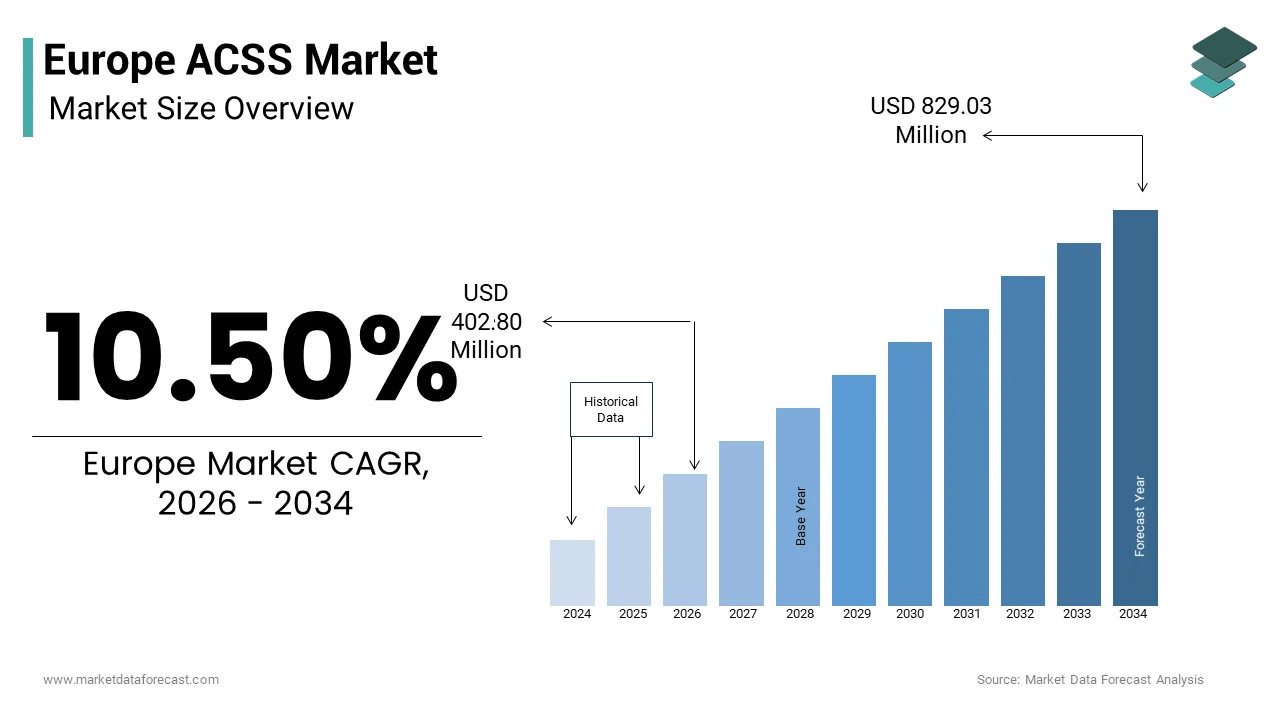
The Europe ACSS (Aluminum Conductor Steel Supported) market was valued at USD 364.47 million in 2025 and is estimated to reach USD 402.80 million in 2026, eventually expanding to USD 829.03 million by 2034, growing at a CAGR of 10.50% during the forecast period from 2026 to 2034.
The growth of the European ACSS market is primarily driven by the rapid modernization of power transmission infrastructure, increasing renewable energy integration, and rising demand for high-capacity conductors capable of operating at elevated temperatures. Utilities across Europe are increasingly adopting ACSS conductors to upgrade aging transmission lines while minimizing the need for building new corridors. Additionally, expanding cross-border electricity trade, grid resilience initiatives, and large-scale renewable energy projects are accelerating the adoption of advanced conductor technologies such as ACSS across the region.
Key Market Trends
- Growing grid modernization initiatives across Europe to support renewable energy integration and enhance transmission capacity.
- Rising adoption of high-temperature low-sag conductors, such as ACSS, to upgrade existing power lines without constructing new transmission infrastructure.
- Increasing cross-border electricity transmission projects to strengthen energy security and regional power connectivity.
- Strong investments in renewable energy projects, particularly wind and solar, requiring efficient long-distance transmission solutions.
- Technological advancements in conductor materials and manufacturing, improving efficiency, durability, and operational reliability.
Segmental Insights
By Type of ACSS Conductor
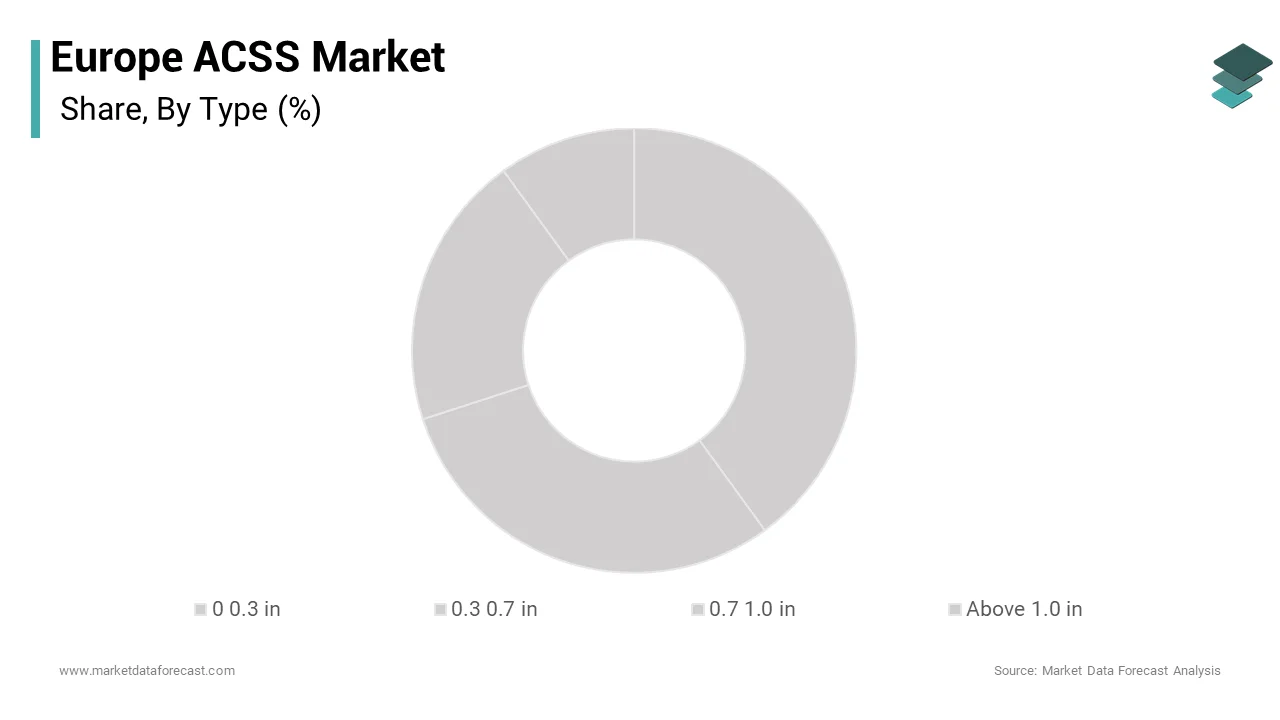
The 0.7 to 1.0 inch segment held the largest share of the Europe ACSS market, accounting for 42.3% of the market share in 2024. The dominance of this segment is attributed to its optimal balance between conductivity, mechanical strength, and cost efficiency, making it suitable for a wide range of transmission upgrades and grid expansion projects across Europe.
By Application
The bare overhead transmission conductor segment dominated the Europe ACSS market in 2024. This segment’s leading position is driven by the widespread use of overhead transmission systems in power grids, where ACSS conductors are preferred for their ability to operate at higher temperatures with minimal sag, enabling utilities to increase line capacity while maintaining structural reliability.
Regional Insights
The Europe ACSS market is experiencing steady growth across key countries as governments and utilities invest in grid modernization and renewable energy transmission infrastructure.
- Germany was the largest contributor, accounting for 22.3% of the Europe ACSS market share in 2024, supported by extensive renewable energy expansion and transmission upgrades under the country’s energy transition initiatives.
- France held the second-largest position with 18.3% market share in 2024, driven by a centralized grid modernization strategy led by RTE, focusing on enhancing transmission efficiency and supporting low-carbon electricity generation.
- The United Kingdom is witnessing significant growth due to legally binding net-zero targets and large-scale grid decarbonization programs, which require high-capacity transmission infrastructure.
- Spain is emerging as an important market as it strengthens its position as a renewable energy exporter to Central Europe, necessitating robust transmission networks.
- Italy is expanding ACSS adoption as part of efforts to stabilize its historically weaker southern grid and integrate renewable energy projects across the Mediterranean region.
Competitive Landscape
The Europe ACSS market is characterized by strong competition among global cable and conductor manufacturers, focusing on expanding production capacity, technological innovation, and strategic partnerships with utility companies. Companies are investing in advanced conductor technologies and grid solutions to support Europe’s transition toward a more resilient and renewable-focused energy system.
Prominent players in the Europe ACSS market include General Cable, Prysmian Group, Southwire Company, Nexans, Apar Industries, Hengtong Group, Sumitomo Electric Industries, LS Cable, Tongda Cable, Hanhe Cable, Saudi Cable Company, and K M Cables & Conductors.
Europe ACSS Market Size
The Europe ACSS market size was valued at USD 364.47 million in 2025 and is anticipated to reach USD 402.80 million in 2026 to reach from USD 829.03 million by 2034, growing at a CAGR of 10.50% during the forecast period from 2026 to 2034.
Current Introduction and Market Definition
The ACSS (Aluminum Conductor Steel Supported cable) is a specialized overhead power transmission conductor engineered for high-capacity and high-temperature operation. This thermal resilience makes it a critical enabler for grid modernization in scenarios demanding increased power flow over existing rights-of-way. Annual spending on grids across the European Union is projected to exceed 70 billion US dollars in 2025 with a figure that doubles the investment from a decade prior, according to the International Energy Agency. Consequently, the ACSS serves as a pivotal technological conduit, facilitating the physical integration of new energy sources into an aging and increasingly stressed continental network.
MARKET DRIVERS
Accelerated Grid Modernization to Accommodate Renewable Energy Integration
The legally binding mandate to achieve a minimum 42.5% share of renewable energy in its final consumption by 2030, as established by the revised Renewable Energy Directive. The growing gris modernization to accommodate renewable energy integration is propelling the growth of Europe ACSS market. This ambitious target necessitates a fundamental transformation of the continent’s power infrastructure. The European Commission estimates that a staggering 584 billion euros in grid investment will be required by the end of the decade to manage the influx of variable wind and solar power, which is often generated in remote locations far from major demand centers. Conventional conductors lack the thermal capacity to handle the fluctuating and often higher power flows from these new sources without excessive sag, which can compromise safety and reliability. ACSS conductors, with their high-temperature low-sag properties, offer a direct solution by allowing utilities to significantly increase the ampacity of existing transmission corridors without the need for costly and time-consuming new right-of-way acquisitions.
Replacement of Aging and Inadequate Legacy Transmission Infrastructure
A substantial portion of the continent’s power network was constructed in the mid-to-late 20th century and is now operating well beyond its intended service life. The replacement of aging and inadequate legacy transmission infrastructure is additionally fuelling the growth of Europe ACSS market. This aging infrastructure is ill-equipped to handle the demands of a modern, digital, and electrified economy, leading to increased vulnerability to outages and inefficiencies. The European Parliament’s own-initiative report on electricity grids, adopted in May 2025, explicitly promotes that these ageing distribution grids will face immense pressure from rising electricity demand. Rebuilding these corridors from scratch is often impractical due to urban density and environmental regulations. ACSS provides a highly effective retrofit solution.
MARKET RESTRAINTS
Volatility in Key Raw Material Prices Impacting Project Economics
The inherent volatility in the prices of its two primary raw materials, aluminum and steel is solely degrading the growth of Europe ACSS market. The cost structure of ACSS is heavily dependent on these commodities, whose prices are subject to global supply chain dynamics, geopolitical tensions, and macroeconomic fluctuations. Such price swings introduce considerable uncertainty into the budgeting and financial planning of large-scale grid projects, which often have multi-year timelines. A sudden spike in aluminum prices can erode the profit margins of cable manufacturers and force transmission system operators to delay or scale back infrastructure upgrades. While, aluminum is generally less expensive than copper, its price per metric ton can experience sharp movements that directly impact the final cost of ACSS cable.
Complex and Lengthy Regulatory Permitting Processes for New Corridors
While ACSS is often used to upgrade existing lines, many strategic grid enhancements require entirely new transmission corridors, which are ensnared in a web of complex and protracted regulatory permitting processes. The complex and lengthy regulatory permitting processes for new corridors Securing the necessary approvals for new rights-of-way involves navigating a labyrinth of national, regional, and local regulations, environmental impact assessments, and public consultations. This bureaucratic inertia is a well-documented bottleneck. A 2026 analysis by Cognitive Market Research identifies lengthy permitting and regulatory approval processes as a key restraint for the ACSR, ACSS, and HTLS conductor market in Europe. The challenge is compounded by the fact that seventy% of new renewable capacity is expected to connect to the distribution grid by 2030 by placing immense pressure on local permitting authorities who are already overwhelmed. These delays can stretch project timelines by several years, increasing overall costs and creating a misalignment between the urgent need for grid capacity and the slow pace of its physical realization.
MARKET OPPORTUNITIES
Strategic Deployment in Cross-Border Interconnection Projects
The application within the European Union’s ambitious cross-border interconnection initiatives, which is setting up new opportunities for the growth of Europe ACSS market. The EU has set a firm target for all member states to achieve an electricity interconnection level of at least 15% by 2030, a goal designed to enhance energy security, facilitate the sharing of renewable resources, and create a truly integrated single market for electricity. These projects represent a massive pipeline of high-voltage transmission work that demands conductors capable of handling long-distance, high-capacity power flows efficiently and reliably. ACSS, with its superior thermal performance and lower line losses compared to traditional conductors is ideally suited for these interconnectors. Its ability to maximize power transfer over existing or newly permitted corridors aligns perfectly with the project goals of optimizing investment and accelerating commissioning. This focused program of pan-European infrastructure development provides a clear, funded, and high-value avenue for ACSS adoption, moving beyond national grid upgrades to a continental-scale deployment.
Integration into Circular Economy Frameworks through Enhanced Recycling
The growing emphasis on sustainability and the circular economy is substantially to set up new opportunities for the growth of Europe ACSS market. Aluminum is one of the most recyclable industrial materials, with recycling requiring only about 5% of the energy needed for primary production. Europe, already boasts a robust aluminum recycling ecosystem, with an end-of-life recycling rate for the metal of approximately 69%, according to a study. This presents a strategic opening for ACSS manufacturers and grid operators to develop closed-loop systems. For example, a new industrial initiative launched in France by RTE and Nexans in 2025 is specifically designed to recycle aluminum from decommissioned high-voltage cables, with a capacity to process six hundred metric tons of aluminum annually. This not only enhances the environmental credentials of grid investments but also offers potential long-term cost stability by reducing reliance on virgin raw materials by creating a compelling value proposition beyond pure technical performance.
MARKET CHALLENGES
Acute Shortage of Skilled Workforce for Specialized Installation and Maintenance
The severe shortage of a skilled workforce capable of handling its specialized installation, stringing, and maintenance protocols is a quiet challenge for the growth of Europe ACSS market. While ACSS offers superior performance, its fully annealed aluminum strands are softer and more susceptible to damage during handling than those in traditional ACSR conductors by requiring trained crews who understand the precise tensioning and sagging procedures. The European power industry is projected to need around 250,000 additional workers by 2030 just to meet expected demand, according to Goldman Sachs analysts. The lack of qualified personnel can lead to project delays, increased risk of installation errors that compromise conductor performance, and higher labor costs, all of which act as a significant barrier to the widespread and efficient deployment of ACSS technology across the continent.
Intensifying Competition from Alternative High-Performance Conductor Technologies
The persistent and evolving challenge from competing high-temperature low-sag conductor technologies, each vying for a share of the same grid modernization budget. The intensifying competition from alternative high-performance conductor technologies is also to hinder the growth of Europe ACSS market. While ACSS is a proven and cost-effective solution, it competes directly with other advanced conductors such as High-Temperature Low-Sag (HTLS) composite-core cables and Aluminum Conductor Composite Reinforced (ACCR). This competitive landscape forces ACSS suppliers to continuously demonstrate a superior total cost of ownership, balancing upfront price against lifecycle benefits like durability and ease of installation. Transmission system operators, under intense budget scrutiny, must make complex trade-offs between the immediate affordability of ACSS and the potentially higher long-term performance of its rivals by creating a constant pressure on market share and pricing strategy that defines a key strategic challenge for the ACSS segment.
REPORT COVERAGE
| REPORT METRIC | DETAILS |
| Market Size Available | 2025 to 2034 |
| Base Year | 2025 |
| Forecast Period | 2026 to 2034 |
| CAGR | 10.50% |
| Segments Covered | By Type, Application, and Country |
| Various Analyses Covered | Global, Regional, and Country Level Analysis, Segment-Level Analysis; DROC, PESTLE Analysis; Porter’s Five Forces Analysis; Competitive Landscape; Analyst Overview of Investment Opportunities |
| Regions Covered | UK, France, Spain, Germany, Italy, Russia, Sweden, Denmark, Switzerland, Netherlands, Turkey, the Czech Republic, and the Rest of Europe |
| Market Leaders Profiled | General Cable, General Cable (Prysmian acquired but operates legacy brands), Prysmian Group, Southwire Company, Nexans, Apar Industries, Hengtong Group, Sumitomo Electric Industries, LS Cable, Tongda Cable, Hanhe Cable, Saudi Cable Company, K M Cables & Conductors |
SEGMENTAL ANALYSIS
By Type of ACSS Conductor Insights
The 0.7 to 1.0 inch segment was accounted in holding 42.3% of the Europe ACSS market share in 2024 owing to the conductor volume installed across high-voltage transmission networks in the region. Its optimal balance between current-carrying capacity, mechanical strength, and compatibility with existing lattice tower infrastructure. Most legacy transmission corridors across Western and Central Europe were engineered for conductors within this diameter range by making the 0.7 to 1.0 inch ACSS the natural choice for ampacity upgrades without structural reinforcement.
The vast majority of Europe’s 220 kV and 380 kV transmission lines utilize suspension insulators and hardware designed for conductors between 0.7 and 1.0 inches in diameter. Retrofitting these corridors with larger-diameter cables would require costly tower modifications or complete rebuilds. It can carry up to 1,800 amperes continuously at 200 degrees Celsius, sufficient to meet most reinforcement needs without the diminishing returns seen in larger diameters.
The above 1.0 inch ACSS segment is expected to expand at a CAGR of 11.4% from 2025 to 2033. Europe’s offshore wind capacity is expected to surge from 35 gigawatts in 2024 to over 120 gigawatts by 2035, according to the survey. These projects require robust onshore export corridors capable of handling 2 to 4 gigawatts per circuit. Conductors above 1.0 inch in diameter, often used in twin or quad bundle configurations can transmit over 3,000 amperes by making them indispensable for landing points in Germany, the Netherlands, and the UK. These long-distance, high-power links demand conductors with minimal losses and maximum thermal headroom. As per the Ten-Year Network Development Plan 2024 published by ENTSO-E, 18 of the 235 Projects of Common Interest involve circuits exceeding 1 gigawatt, almost all specifying conductors above 1.0 inch.
By Application Insights
The bare overhead transmission conductor segment was the largest by holding a prominent share of the Europe ACSS market in 2024. The growth of the segment is driven by the executing large-scale conductor replacement programs to address thermal bottlenecks. In France alone, RTE plans to replace over 8,000 kilometers of aging conductors by 2030, with ACSS specified for more than 60% of high-temperature upgrade projects. Similarly, Germany’s Federal Network Agency has mandated thermal uprates on 12 key north-south corridors to alleviate congestion from northern wind power. These initiatives rely almost exclusively on bare ACSS due to its proven reliability and standardized installation protocols. Transmission regulators across Europe exhibit a strong preference for mature, field-tested technologies in infrastructure. ACSS has been deployed commercially, since the early 2000s and boasts a global track record exceeding 200,000 circuit kilometers. This operational history provides confidence in long-term performance under extreme weather and load conditions. This regulatory endorsement channels the majority of public and private grid investment toward the bare overhead transmission segment.
The Primary and Secondary Distribution Conductor application segment is esteemed to register a fastest CAGR of 9.8% throughout the forecast period. The proliferation of electric vehicles is placing unprecedented stress on urban distribution feeders. A single fast-charging hub can draw up to 2 megawatts, equivalent to the peak demand of 200 households. In cities like Amsterdam and Oslo, distribution utilities have recorded summer peak loads on suburban feeders increasing by 25 to 40% between 2020 and 2024, as documented by Eurelectric. Rooftop solar and small-scale wind installations are transforming distribution networks from passive to active systems. In Germany, over 2.5 million photovoltaic systems are connected to low and medium-voltage grids that often causing reverse power flows and voltage instability during midday peaks. ACSS’s high-temperature tolerance allows feeders to safely export excess solar power back to substations without thermal overload.
COUNTRY ANALYSIS
Germany ACSS Market Analysis
Germany was the top performer of the Europe ACSS market by capturing 22.3% of share in 2024 driven by its central role in the continent’s energy transition and extensive high-voltage grid. The country’s Energiewende policy has created a unique challenge, where a massive wind generation in the north must be transmitted to industrial load centers in the south, but the required SuedLink and SuedOstLink corridors face persistent delays. The transmission operator 50Hertz has prioritized thermal uprates on existing north-south routes using ACSS. According to the Federal Network Agency, over 1,200 kilometers of ACSS are scheduled for installation by 2027 to mitigate congestion until new HVDC lines come online. Germany’s rigorous technical standards and high labor costs also favor durable, low-maintenance solutions like ACSS.
France ACSS Market Analysis
France ACSS market held second position by holding 18.3% of share in 2024 with a centralized and state-directed grid modernization strategy led by RTE. Unlike its neighbors, France’s grid remains heavily nuclear-dependent, but the government’s push for 40 gigawatts of additional solar and 35 gigawatts of offshore wind by 2050 necessitates significant reinforcement. A 2025 RTE technical bulletin confirms that 70% of its high-temperature conductor procurements since 2022 have been ACSS, primarily in the 0.85 to 0.95 inch range. The country’s stable regulatory environment and long-term planning horizon provide predictable demand, while its focus on minimizing visual impact in rural areas favors overhead upgrades over new corridors, further boosting ACSS adoption.
United Kingdom ACSS Market Analysis
The United Kingdom ACSS market growth is expected to grow with the legally binding net zero targets and urgent grid decarbonization mandates. National Grid Electricity Transmission faces immense pressure to connect 50 gigawatts of offshore wind by 2030, requiring massive onshore reinforcement. Notably, the 1.4 gigawatt Viking Link interconnector to Denmark uses 1.06 inch ACSS for its UK onshore section by showcasing the technology’s role in international energy security. The UK’s streamlined permitting for grid enhancements under the Energy Act 2023, further accelerates project timelines by sustaining strong ACSS demand.
Spain ACSS Market Analysis
Spain ACSS market growth is propelled with the renewable energy exporter to Central Europe. The country’s abundant solar and wind resources, where over 60 gigawatts of combined capacity as of 2025, must be transmitted northward via the Pyrenees, a requiring high-capacity conductors. Red Eléctrica de Espana has prioritized ACSS for its 400 kV backbone on the Madrid–Barcelona and Barcelona–French border corridors. According to survey, grid investments will reach 28 billion euros by 2030, with over half allocated to transmission. The country’s arid climate and high ambient temperatures make ACSS’s thermal stability especially valuable, as conventional conductors suffer significant derating during summer peaks, where a factor confirmed by Iberian grid reliability studies published in 2025.
Italy ACSS Market Analysis
Italy ACSS market growth is driven by the efforts to stabilize its historically weak southern grid and integrate Mediterranean renewable projects. Terna is the national transmission operator that has identified chronic congestion between Sicily and the mainland, exacerbated by new solar farms in Puglia and Calabria. A flagship project involves replacing 300 kilometers of aging conductor on the Foggia, Naples corridor with 0.92 inch ACSS, expected to raise capacity from 1,100 to 1,900 amperes. Italy’s susceptibility to heatwaves, where temperatures exceeded 45 degrees Celsius in Sicily in 2024 that further underscores the need for conductors that maintain performance under extreme conditions.
COMPETITIVE LANDSCAPE
Competition in the Europe ACSS market is characterized by a concentrated yet dynamic landscape dominated by a few technically proficient manufacturers. The barrier to entry remains high due to stringent EN and IEC standards rigorous type testing requirements and the need for proven field performance across diverse climatic conditions. Incumbents compete not on price alone but on total lifecycle value offering engineering support installation expertise and sustainability credentials. While global players like Nexans and Prysmian lead the market niche European fabricators maintain regional relevance through localized service and rapid delivery. The competitive intensity is further shaped by the growing demand for customized conductor solutions that balance ampacity mechanical strength and environmental impact.
KEY MARKET PLAYERS
A few of the market players in the Europe ACSS market are
- General Cable
- General Cable (Prysmian acquired but operates legacy brands)
- Prysmian Group
- Southwire Company
- Nexans
- Apar Industries
- Hengtong Group
- Sumitomo Electric Industries
- LS Cable
- Tongda Cable
- Hanhe Cable
- Saudi Cable Company
- K M Cables & Conductors
Top Players In The Market
- Nexans is a leading global cable manufacturer with deep involvement in the European ACSS market through its high-voltage overhead conductor solutions. The company supplies annealed aluminum conductors to major transmission system operators across France Germany and Spain. In recent years Nexans has reinforced its position by investing in sustainable conductor production including a dedicated recycling line for aluminum from decommissioned cables launched in 2025 at its Halden plant. This initiative aligns with EU circular economy mandates and enhances the environmental profile of its ACSS offerings. Nexans, also collaborates closely with grid operators on pilot projects testing next generation thermal performance standards ensuring its products meet evolving regulatory and technical demands across the continent.
- Prysmian Group plays a pivotal role in the Europe ACSS market through its extensive portfolio of overhead transmission conductors and strong relationships with national utilities. The company leverages its R&D center in Italy to develop advanced annealed aluminum solutions tailored for high-temperature applications in congested corridors. Recently Prysmian strengthened its market presence by expanding its manufacturing capacity for ACSS at its Arco Felice facility to support Italy’s southern grid reinforcement program. The company also actively participates in CIGRE working groups shaping international standards for high-capacity conductors. Its integrated approach combining product innovation project execution and sustainability reporting positions it as a strategic partner for Europe’s grid modernization agenda.
- General Cable though now integrated into Prysmian continues to influence the Europe ACSS market through its established brand reputation and technical legacy in overhead conductors. Its historical projects across the UK and Iberia remain operational benchmarks for long term ACSS performance. The company’s contribution persists via ongoing technical support and specification guidance for legacy installations now maintained under Prysmian’s service umbrella. Recent actions include digitizing its conductor performance database to provide predictive analytics for asset life extension, where a service offered to European transmission operators managing aging infrastructure. This knowledge transfer ensures that General Cable’s decades of field experience continue to inform current ACSS deployment strategies across the region.
MARKET SEGMENTATION
This research report on the Europe ACSS market is segmented and sub-segmented into the following categories.
By Type
- 0 0.3 in
- 0.3 0.7 in
- 0.7 1.0 in
- Above 1.0 in
By Application
- Bare Overhead Transmission Conductor
- Primary and Secondary Distribution Conductor
- Messenger Support
- Others
By Country
- UK
- France
- Spain
- Germany
- Italy
- Russia
- Sweden
- Denmark
- Switzerland
- Netherlands
- Turkey
- Czech Republic
- Rest of Europe