- Product Description Description
- Table of Contents TOC
- List of Table & Figure LOT
- Get Free Sample PDF Sample PDF
Market Size, 2025
$458 MnMarket Estimate, 2026
$495 MnMarket Forecast, 2034
$929 MnCAGR, 2026–2034
8.17%Europe Aerogel Market Size
The Europe aerogel market size was valued at USD 458.26 million in 2025 and is projected to reach USD 929.12 million by 2034 from USD 495.70 million in 2026, growing at a CAGR of 8.17%.
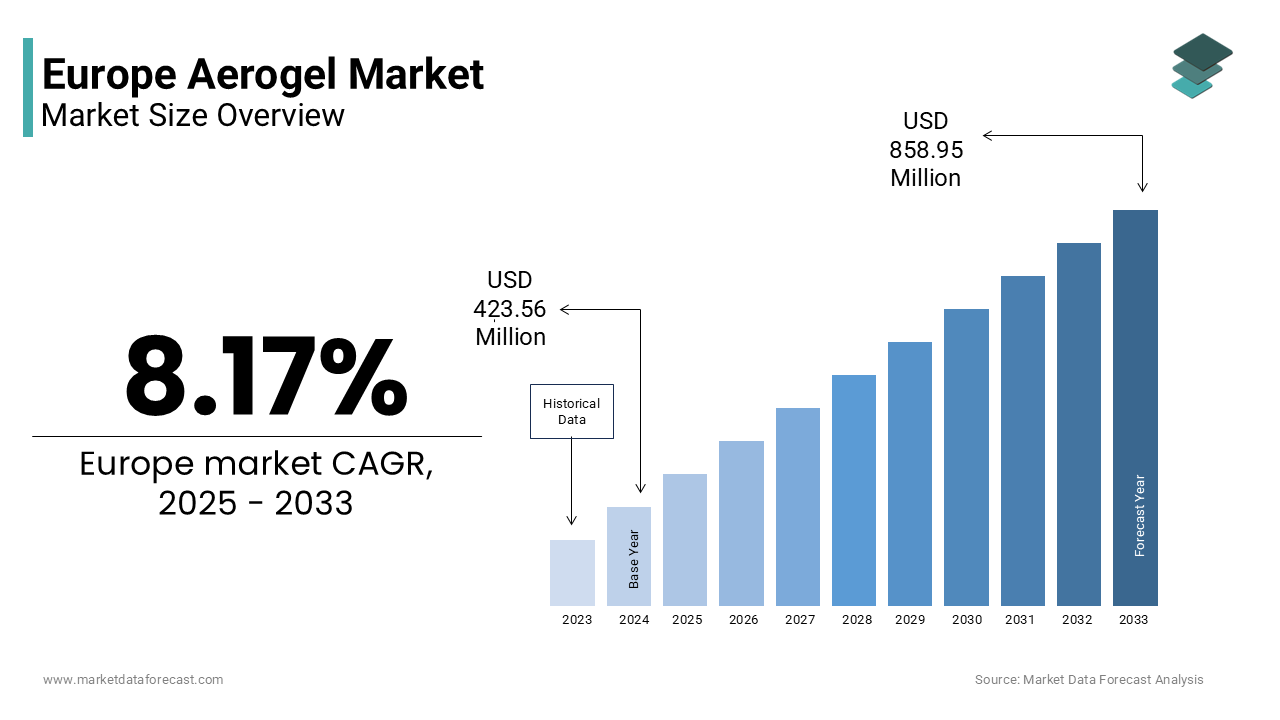
Aerogels are ultra-lightweight porous materials derived from gels in which the liquid component is replaced with gas, resulting in exceptional thermal insulation properties, low density and high surface area. In the European context, these materials are increasingly deployed in energy efficiency applications spanning building envelopes, industrial pipework and advanced mobility systems. Their relevance has intensified under the European Union’s decarbonization mandate, which prioritises high-performance insulation to reduce heating demand and embodied carbon. According to Eurostat, the building sector accounted for more than one-third of final energy consumption in the European Union in 2023, with space heating representing the largest share of that usage. As per the European Environment Agency, approximately 220 million buildings across the EU were constructed before 2000, many of which lack modern insulation standards. The European Commission’s Renovation Wave Strategy aims to retrofit 35 million buildings by 2030, which is creating structural demand for next-generation insulants. Aerogels, though niche, offer a compelling solution where space constraints or performance thresholds limit conventional materials and are making them a strategic enabler of Europe’s energy transition.
MARKET DRIVERS
Stringent Building Energy Performance Regulations Under the EU Green Deal
The European Union’s binding energy efficiency directives have become a primary catalyst for aerogel adoption in construction and retrofit projects, which is majorly driving the European aerogel market. According to the European Commission, all member states must implement nearly zero energy building standards for new public structures since 2019 and for all new buildings by 2021, with progressively tighter requirements under the revised Energy Performance of Buildings Directive effective from 2023. As per the European Environment Agency, over three-quarters of the EU’s existing building stock exhibits poor energy performance,ce, necessitating deep retrofits that often lack cavity space for bulky insulation. Aerogels with thermal conductivity as low as 0.013 W/mK enable compliance in constrained geometries such as historic façades, window perimeters, and flat roofs where mineral wool or polystyrene cannot be installed effectively. Germany’s Energy Saving Ordinance and France’s RE2020 thermal regulation explicitly recognise high-performance insulants in calculation methodologies, providing regulatory tailwinds. According to the European Committee Standardisation, EN 17658, published in 2023, established test protocols for aerogel-based insulation panels, which further legitimise their use in certified projects across the bloc.
Expansion of Offshore Wind and Renewable Energy Infrastructure
Europe’s accelerated deployment of offshore wind farms has created a specialised demand for aerogel-based thermal and acoustic insulation in subsea and nacelle applications, which is further boosting the aerogel market expansion in Europe. According to the European Wind Energy Association, the EU installed 4.3 gigawatts of offshore wind capacity in 2023, bringing the cumulative total to over 33 gigawatts with a target of 300 gigawatts by 2050. As per the European Commission’s Net Zero Industry Act, critical clean tech components, including wind turbine systems, must achieve high durability and minimal maintenance in harsh marine environments. Aerogels are increasingly specified for insulating electrical cabling, power converters, and hydraulic lines within nacelles due to their hydrophobicity, compressive strength, and resistance to salt corrosion. In 2023, Denmark’s Ørsted and Germany’s RWE began trialling aerogel-wrapped subsea cables on North Sea projects to prevent condensation-induced failures during temperature cycling. According to the European Defence Agency, aerogel composites were being evaluated in 2025 for thermal protection in floating offshore platforms where weight and space are at a premium. This convergence of energy policy, operational necessity, and material performance positions aerogels as a niche but growing enabler of Europe’s renewable infrastructure resilience.
MARKET RESTRAINTS
High Production Costs and Limited Economies of Scale
The commercial scalability of aerogels in Europe remains constrained by prohibitively high manufacturing costs stemming from energy-intensive supercritical drying processes and low production yields, which is one of the notable restraints to the European aerogel market. According to the European Materials Research Society, the average production cost of silica aerogel blankets in 2023 ranged between €80 and €120 per square meter, significantly exceeding the €10 to €20 range for conventional mineral wool or rigid foam boards. As per the German Aerospace Centre (DLR), only a handful of industrial-scale aerogel production facilities operated in the EU as of 2025, with combined annual capacity below 500,000 square meters, insufficient to meet pilot demand from large infrastructure projects. According to the European Chemicals Agency, solvent recovery inefficiencies in legacy production methods lead to elevated environmental compliance costs. Although ambient pressure drying techniques have emerged, they often compromise mechanical integrity or thermal performance, reducing suitability for critical applications. Until continuous flow manufacturing or bio-based precursors achieve technical maturity, aerogels will remain confined to high-value niches rather than mainstream adoption across construction or industrial sectors.
Lack of Standardized Installation Protocols and Skilled Labor
Despite regulatory recognition, aerogel integration into European construction and industrial workflows is hindered by the absence of harmonised installation guidelines and a shortage of trained applicators, which is further hampering the European market growth. According to the European Construction Institute, fewer than 15% of certified insulation contractors across the EU had received formal training in handling aerogel blankets or granules as of 2025. As per the European Federation of Building and Woodworkers, inconsistent cutting techniques, moisture sealing practices, and joint detailing often compromise aerogel performance in real-world conditions, leading to thermal bridging or material degradation. According to France’s Céquami certification body, over 40% of aerogel retrofits in social housing failed post-installation audits in 2023 due to improper vapour barrier integration. Similarly, industrial sectors such as oil and gas report reluctance to specify aerogels because maintenance crews lack protocols for inspection or replacement in pipework systems. This implementation gap undermines the material’s theoretical advantages and slows diffusion even where policy and performance align.
MARKET OPPORTUNITIES
Integration into Electric Vehicle Battery Thermal Management Systems
The rapid electrification of Europe’s automotive sector presents a high growth opportunity for the European aerogel market. According to the European Automobile Manufacturers Association, over 2.6 million battery electric vehicles were registered in the EU in 2023, which represents 21% of new car sales. As per the European Battery Alliance, stringent safety regulations under the EU Battery Regulation require electric vehicles to prevent thermal runaway propagation between cells for at least five minutes during crash or fire events. Aerogels with their low thermal conductivity and non-combustibility are uniquely suited to serve as inter-cell spacers and module wraps. In 2025, BMW and Volvo began incorporating silica aerogel sheets in next-generation platforms to meet these standards without adding excessive weight. According to the European Commission’s Important Project of Common European Interest on Batteries, over €6 billion was allocated to support advanced material supply chains, including thermal management components. This regulatory and industrial alignment positions aerogels as a mission-critical material in Europe’s EV value chain.
Retrofitting Historic Buildings Under Cultural Heritage Preservation Laws
Europe’s vast inventory of protected historic structures offers a specialised but growing opportunity for aerogel insulation due to its ultra-thin profile and vapour permeability, which is another potential opportunity in the European aerogel market. According to Europa Nostra, over 1.2 million buildings in the EU are listed as cultural heritage sites, many of which are exempt from standard energy renovation mandates but still subject to voluntary efficiency upgrades. As per the European Commission’s Cultural Heritage in Energy Transition initiative, thin insulation solutions that preserve architectural integrity arerprioritisedin conservation guidelines. Aerogel renders and blankets as thin as 10 millimetres can deliver thermal performance equivalent to 60 millimetres of mineral wool, enabling compliance without altering window reveals, cornices, or façade dimensions. In 2023, Italy’s Ministry of Cultural Heritage approved aerogel-based plaster for use in Renaissance villas in Tuscany, while Germany’s Denkmalpflege authorities endorsed its use in half-timbered houses. These endorsements create a replicable pathway for heritage-sensitive energy retrofits across the continent where conventional insulation is legally or aesthetically prohibited.
MARKET CHALLENGES
Fragility and Handling Sensitivity During on-Site Installation
Despite their performance benefits, aerogels remain mechanically delicate materials prone to cracking, powdering, or compression damage during transport and on-site handling that compromises insulation efficacy, which is a key challenge to the European aerogel market. According to the European Insulation Manufacturers Association, over 30% of aerogel blanket shipments in 2023 required repackaging due to edge chipping or surface abrasion during logistics. As per technical audits conducted by the French CSTB research centre, improper stacking or exposure to wind during rooftop installation led to irreversible density changes in 22% of monitored projects, reducing thermal resistance by up to 18%. Unlike rigid foams or fibrous mats, aerogels cannot be stapled, nailed, or compressed without structural degradation, necessitating specialised fastening systems and protective cladding. These constraints increase labour time and material waste, particularly in adverse weather conditions common across Northern and Central Europe. Until reinforced composite formats or flexible aerogel textiles achieve cost parity, the material’s physical vulnerability will limit its deployment to controlled environments with expert oversight.
Regulatory Uncertainty Around Nano Material Classification
Aerogels composed of silica nanoparticles face evolving regulatory scrutiny in Europe under the Registration Evaluation Authorisation and Restriction of Chemicals framework that may impact long-term market viability, which is further challenging the expansion of this regional market. According to the European Chemicals Agency, certain amorphous silica particles below 100 nanometers are under evaluation for potential reclassification as substances of very great concern, though no final determination has been made as of 2025. As per the European Centre for Ecotoxicology and Toxicology of Chemicals, inhalation exposure during cutting or demolition remains a concern for occupational safety authorities in Germany and the Netherlands. In 2023, Sweden’s Work Environment Authority issued precautionary handling guidelines recommending N95 respirators and wet cutting methods for all aerogel installation activities. These advisories increase compliance burdens and deter contractors unfamiliar with nanomaterial protocols. Although manufacturers assert that bound aerogel structures pose minimal risk, the absence of definitive EU-wide classification creates procurement hesitation among public agencies and large developers awaiting regulatory clarity before committing to large-scale adoption.
REPORT COVERAGE
| REPORT METRIC | DETAILS |
| Market Size Available | 2025 to 2034 |
| Base Year | 2025 |
| Forecast Period | 2026 to 2034 |
| CAGR | 8.17% |
| Segments Covered | By Type, Form, End User Industries, and Region |
| Various Analyses Covered | Global, Regional, & Country Level Analysis; Segment-Level Analysis; DROC, PESTLE Analysis; Porter’s Five Forces Analysis; Competitive Landscape; Analyst Overview of Investment Opportunities |
| Regions Covered | UK, France, Spain, Germany, Italy, Russia, Sweden, Denmark, Switzerland, Netherlands, Turkey, and the Czech Republic |
| Market Leaders Profiled | Aerogel UK Ltd, Aerogel-it GmbH, BASF SE, Cabot Corporation, Earth Green Aerogels, ENERSENS, KEEY Aerogel, and SVENSKA AEROGEL AB |
SEGMENTAL ANALYSIS
By Type Insights
The silica aerogel segment accounted for 71.4% of the European aerogel market share in 2025. The dominance of the silica aerogel segment in this regional market is driven by its optimal balance of ultralow thermal conductivity, mechanical stability, and commercial maturity compared to alternative compositions. Silica aerogels exhibit thermal conductivity as low as 0.013 W/mK according to FEPA technical data, making them ideal for applications where space constraints preclude bulkier insulants. The material’s hydrophobic variants are especially valued in offshore oil and gas pipeline insulation and building retrofits in humid climates. As per the European Commission’s Renovation Wave Strategy, over 35 million buildings require deep energy upgrades by 2030, many of which feature narrow wall cavities where silica aerogel blankets deliver performance unattainable by mineral wool or polystyrene. Additionally, silica’s noncombustibility and transparency to water vapour align with stringent EU construction product regulations under EN 13501 fire safety classifications and EN 16097 vapour permeability standards. These technical and regulatory compatibilities secure silica aerogel’s position as the default choice across industrial, construction, and mobility sectors.
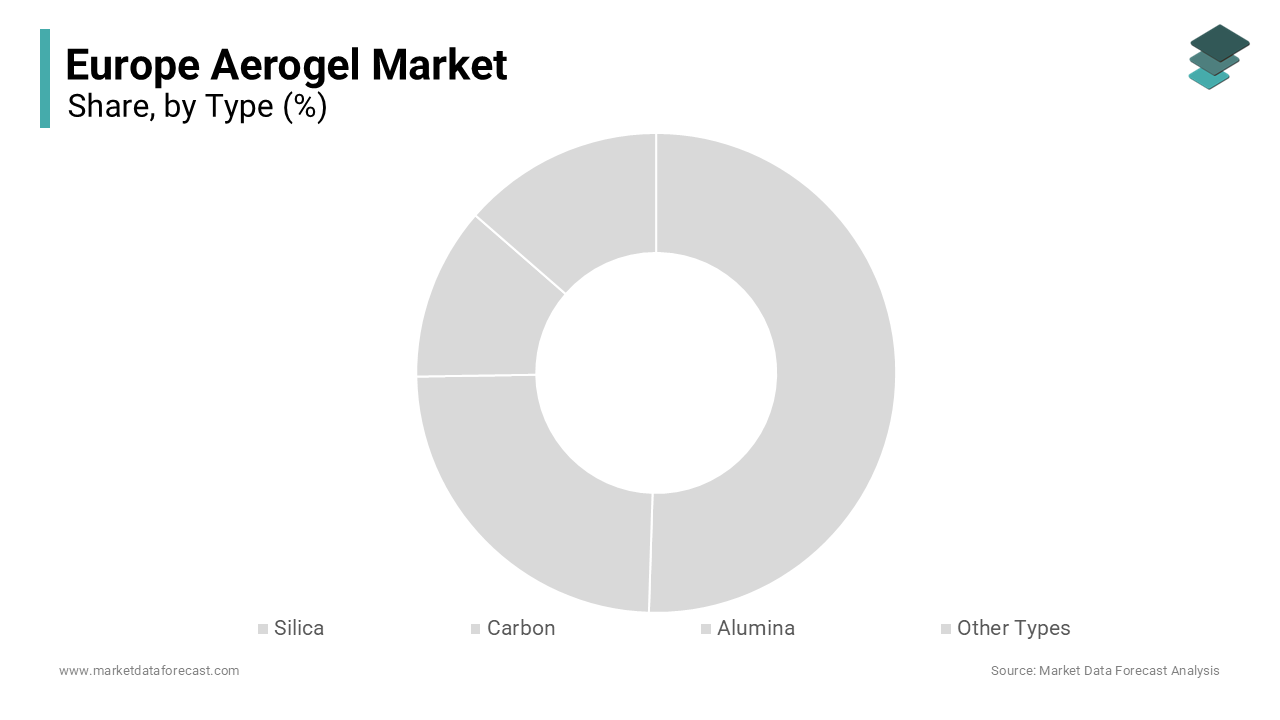
The carbon aerogel segment is the fastest-growing type segment in the European aerogel market and is predicted to witness a CAGR of 21.2% over the forecast period, owing to its unique electrochemical properties,s, including high surface area, electrical conductivity, and thermal stability, which are critical for next-generation energy storage systems. As per the European Battery Alliance, carbon aerogels are increasingly integrated into supercapacitor electrodes for electric vehicles. In 2025, according to the German Aerospace Centre, carbon aerogel-based supercapacitors achieved 35% higher energy density than conventional activated carbon systems, making them viable for regenerative braking and auxiliary power in premium EV platforms. Furthermore, the European Space Agency has funded pilot projects using carbon aerogels in satellite thermal regulation and radiation shielding due to their resilience in n vacuum and extreme thermal gradients. These high-value applications in clean mobility and aerospace position carbon aerogel as a strategic advanced material with accelerating adoption despite current niche volumes.
By Form Insights
The blanket segment had the largest share of the European aerogel market in 2025. The leading position of the blanket segment in this European market is attributed to the ease of handling, compatibility with curved surfaces, and seamless integration into existing construction and maintenance workflows. Aerogel blankets typically consist of silica particles embedded in fibrous reinforcement, enabling flexibility without compromising thermal performance. As per the UK Oil and Gas Authority, over 80% of new North Sea subsea pipeline projects in 2022 specified aerogel blankets for thermal insulation due to their resistance to hydrostatic pressure and long-term stability in seawater. Similarly, in the building sector, the French Ministry of Ecological Transition approved aerogel blanket systems for heritage retrofits under the RE2025 thermal regulation, which is citing their minimal thickness and vapour permeability. As per the European Committee for Standardisation, the EN 17658 test method, published in 2023, standardised blanket performance validation, boosting contractor confidence. These practical and regulatory advantages make blankets the preferred format for both new builds and complex retrofits across Europe.
The particles segment is the fastest-growing form segment in the European aerogel market due to their versatility as an additive in coatings, plasters, and composite materials where uniform thermal resistance is required without altering structural form. As per the German Federal Institute for Materials Research and Testing (BAM), aerogel particles blended into render systems reduce thermal transmittance of historic masonry walls by up to 45% using only 15 millimetres of thickness. In the industrial sector, particles are increasingly used to fill double-walled tanks and valves in chemical plants where blanket installation is impractical. According to the European Construction Institute, over 30 pilot projects across Italy and Spain in 2025 incorporated aerogel particle-infused plasters in social housing upgrades under the EU’s Social Climate Fund. Additionally, advancements in hydrophobic surface treatment have reduced moisture uptake during mixing, improving onsite workability. These application diversifications position particles as an enabler of aerogel diffusion beyond traditional insulation into mainstream building materials.
By End User Industries Insights
The oil and gas industry segment was the largest end-user segment of the European gel market. The dominance of the oil and gas segment in this regional market is driven by stringent thermal efficiency requirements in offshore and subsea infrastructure. Aerogel blankets are extensively used to insulate deepwater pipelines, risers, and processing equipment where space limitations, corrosion resistance, and performance under high pressure are nonnegotiable. According to the UK Oil and Gas Authority, the North Sea alone features over 22,000 kilometres of subsea pipelines requiring continuous thermal protection to prevent hydrate formation and maintain flow assurance. In 2022, the sector rebounded to prepandemic production levels with new licensing rounds accelerating insulation demand. France and Spain announced in October 2022 a joint initiative to construct 226 kilometres of underwater gas interconnectors, according to the European Commission, enhancing energy security following disruptions from the Ukraine conflict. Such strategic infrastructure investments directly translate into sustained aerogel procurement. Moreover, European regulations such as the Offshore Safety Directive mandate rigorous thermal integrity monitoring, making aerogel’s long-term stability a compliance advantage over degradable foams.
The industrial segment is the fastest-growing end-user category in the European aerogel market. The expanding applications beyond traditional oil and gas into chemical processing, power generation, and cryogenic storage, ultra-efficient insulation reduces energy losses and operational emissiowhichhiare re majorly propelling the industrial segment in this regional market. As per the European Environment Agency, industrial facilities account for 25% of the EU’s final energy consumption, with thermal systems representing over 70% of that usage. Aerogels are increasingly specified for insulating high-temperature reactors, steam lines, and LNG storage tanks where conventional materials fail above 650 degrees Celsius. In 2025, BASF implemented silica aerogel wraps in its Antwerp chemical plant, reducing heat loss by 38% and cutting annual CO₂ emissions by 12,000 metric tons according to company sustainability disclosures. Additionally, the EU’s Industrial Emissions Directive requires best available techniques for energy efficiency, creating regulatory pressure to adopt advanced insulation. These economic and compliance drivers position the industrial sector as a high-growth frontier for aerogel deployment.
REGIONAL ANALYSIS
United Kingdom Aerogel Market Analysis
The United Kingdom held the largest market share in the European aerogel market at 22.4% in 2025. The dominating position of the UK in the European market is attributed to its robust offshore oil and gas operations, aerospace manufacturing base, and aggressive decarbonization agenda. According to the UK Oil and Gas Authority, new North Sea licensing rounds were issued in 2022, directly stimulating demand for subsea pipeline insulation. As per the International Trade Administration, the UK civil aerospace industry generated USD 32 billion in turnover in 2021, creating demand for lightweight thermal protection in aircraft components. The government’s Future Homes Standard mandates near-zero carbon emissions for new dwellings from 2026, accelerating the adoption of high-performance insulants like aerogels in residential construction. These intersecting industrial and policy vectors establish the UK as Europe’s most dynamic aerogel market.
Germany Aerogel Market Analysis
Germany accounted for a substantial share of the European aerogel market in 2025. The country’s chemical, automotive, and machinery sectors require advanced thermal management for high-temperature processes and electric vehicle battery systems. In 2025, BASF and Siemens jointly piloted aerogel-insulated reactor jackets at industrial sites as per company press releases, aligning with the EU Energy Efficiency Directive mandating a 13% reduction in industrial energy use by 2030. Germany’s National Building Code also incentivises ultralow energy retrofits, particularly in public and social housing. Space-constrained façades benefit from aerogel’s thin profile. According to Frankfurt city planning documents, the Digital Park Fechenheim project specified aerogel blankets for HVAC ducting and roof systems. This alignment of industrial policy, building regulation, and large-scale infrastructure sustains Germany’s high aerogel uptake.
France Aerogel Market Analysis
France commanded a promising share of the European market in 2025. The government allocated billions for the Hermitage Plaza towers in Paris to support the 2025 Olympic Games, with aerogel insulation selected for façades and mechanical systems to meet RE2025 thermal targets. As per the French Ministry of Energy Transition, France’s hydrogen strategy targets 6.5 GW of electrolyser capacity by 2030, requiring advanced insulation materials. Additionally, France’s post-Ukraine energy security strategy includes expanding domestic gas interconnectors such as the 2022 joint pipeline initiative with Spain, which requires aerogel blankets for underwater thermal stability. According to ADEME, all public buildings must achieve a 40% reduction in energy consumption by 2030, accelerating retrofits in schools, hospitals, and administrative facilities. These state-led projects combi, ned with regulatory stringency create consistent demand for high-performance insulation solutions across multiple sectors.
Italy Aerogel Market Analysis
Italy is predicted to witness a prominent CAGR in the European aerogel market over the forecast period. Over 60% of Italy’s building stock predates 1970 and lacks adequate insulation, yet cannot undergo invasive renovations due to cultural preservation laws. Aerogel plasters and thin blankets offer a compliant solution preserving architectural integrity while improving energy performance. As per the Italian Ministry of Ecological Transition, the Superbonus 110% tax incentive subsidised deep energy retrofits for more than 2 million buildings. Additionally, Italy’s industrial north hosts chemical and petrochemical clusters in Lombardy and Emilia Romagna, where aerogels insulate high-temperature process lines. This dual demand from culturally sensitive construction and heavy industry positions Italy as a steady and expanding market.
COMPETITIVE LANDSCAPE
The European aerogel market features moderate consolidation with a mix of specialised material innovators and diversified chemical giants competing on technical differentiation rather than price. Leading companies such as Aspen Aerogels, BAS, F and Cabot leverage proprietary formulations, manufacturing scale and deep industry relationships to secure high-value contracts in oil and gas construction and clean energy. The market remains niche due to high material costs, yet competition is intensifying as new entrants like Svenska Aerogel and Green Earth Aerogel Technologies introduce ambient-pressure-dried products to improve affordability. Regulatory tailwinds from the EU’s Renovation Wave and Net Zero Industry Act create shared growth opportunities but also raise performance and sustainability benchmarks. Success hinges on balancing innovation with practical installability and compliance across fragmented national building codes and industrial standards.
KEY MARKET PLAYERS
Some of the notable key players in the European aerogel market are
- Aerogel UK Ltd
- Aerogel-it GmbH
- BASF SE
- Cabot Corporation
- Earth Green Aerogels
- ENERSENS
- KEEY Aerogel
- SVENSKA AEROGEL AB
Top Players in the Market
- Aspen Aerogels Inc. is a leading innovator in the European aerogel market, specialising in Pyrogel and Cryogel branded insulation solutions widely used in oil and gas, industrial and energy applications. The company supplies high-performance aerogel blankets that meet stringent European safety and thermal standards for offshore pipelines and process facilities. In 2022, Aspen expanded its European logistics footprint with a dedicated warehouse in the Netherlands to accelerate delivery to North Sea projects. The firm also collaborates with European energy majors on cryogenic insulation for hydrogen ininfrastructurealigning with the EU’s Green Deal objectives. These strategic moves reinforce Aspen’s role as a global technology provider while deepening its integration into the decarbonising industrial landscape.
- BASF SE contributes significantly to the European aerogel market through its advanced materials division, which develops tailored silica aerogel composites for construction and mobility applications. The company leverages its extensive R&D network in Germany to enhance aerogel durability, moisture resistance, and integration into building renders and EV battery systems. In 20,2,4, BASF implemented aerogel-insulated reactor jackets at its Antwerp chemical site, reducing heat loss and CO2 emissions. It also partners with European construction material manufacturers to co-develop thin insulation plasters compliant with heritage retrofit regulations. These initiatives position BASF as a sustainability-drivenenablerr f aaeroerogel adoption across high-value industrial and building sectors in Europe and globally.
- Cabot Corporation is a key participant in the European aerogel market through its Nanogel aerogel particles, which are engineered for integration into translucent insulating panels and speciality coatings. The company’s European operations focus on supplying building material producers and industrial clients requiring lightweight high performance thermal barriers. In recent years, Cabot has enhanced its particle surface treatment technologies to improve compatibility with polymer matrices and plaster systems. It also supports EU-funded projects on energy-efficient glazing and façade systems using aerogel-filled panels. Cabot’s global particle expertise and localised technical service capabilities strengthen its influence in both European and international markets where material versatility and optical properties are critical.
Top Strategies Used by the Key Market Participants
Key players in the European aerogel market focus on vertical integration by developing application-specific formulations for construction, industrial, and mobility sectors. They investlocalisedized production and logistics to reduce lead times and comply with regional environmental standards. Companies actively collaborate with energy and infrastructure projects funded under the EU Green Deal to demonstrate aerogel’s role in decarbonization. Strategic partnerships with building material manufacturers enable the co-development of composite products such as aerogel-infused plasters and translucent panels. Additionally, firms prioritise regulatory alignment by ensuring their products meet EN fire safety, vapour permeability recyclability criteria, which builds trust among architects, engineers and public sector procurers across Europe.
MARKET SEGMENTATION
This research report on the European aerogel market has been segmented and sub-segmented based on categories.
By Type
- Silica
- Carbon
- Alumina
- Other Types
By Form
- Blanket
- Particles
- Blocks
- Panels
By End User Industries
- Industrial
- Marine
- Oil and Gas
- Other End-User Industries
By Country
- UK
- France
- Spain
- Germany
- Italy
- Russia
- Sweden
- Denmark
- Switzerland
- Netherlands
- Turkey
- Czech Republic
- Rest of Europe