- Product Description Description
- Table of Contents TOC
- List of Table & Figure LOT
- Get Free Sample PDF Sample PDF
Market Size, 2025
$2.64 BnMarket Estimate, 2026
$2.74 BnMarket Forecast, 2034
$3.71 BnCAGR, 2026–2034
3.87%Executive Summary: Europe Aerospace Fasteners Market
- Market Scope: European aerospace fastening technology market analysis covering product categories, material segments, platform types, regional leadership frameworks, and adoption metrics.
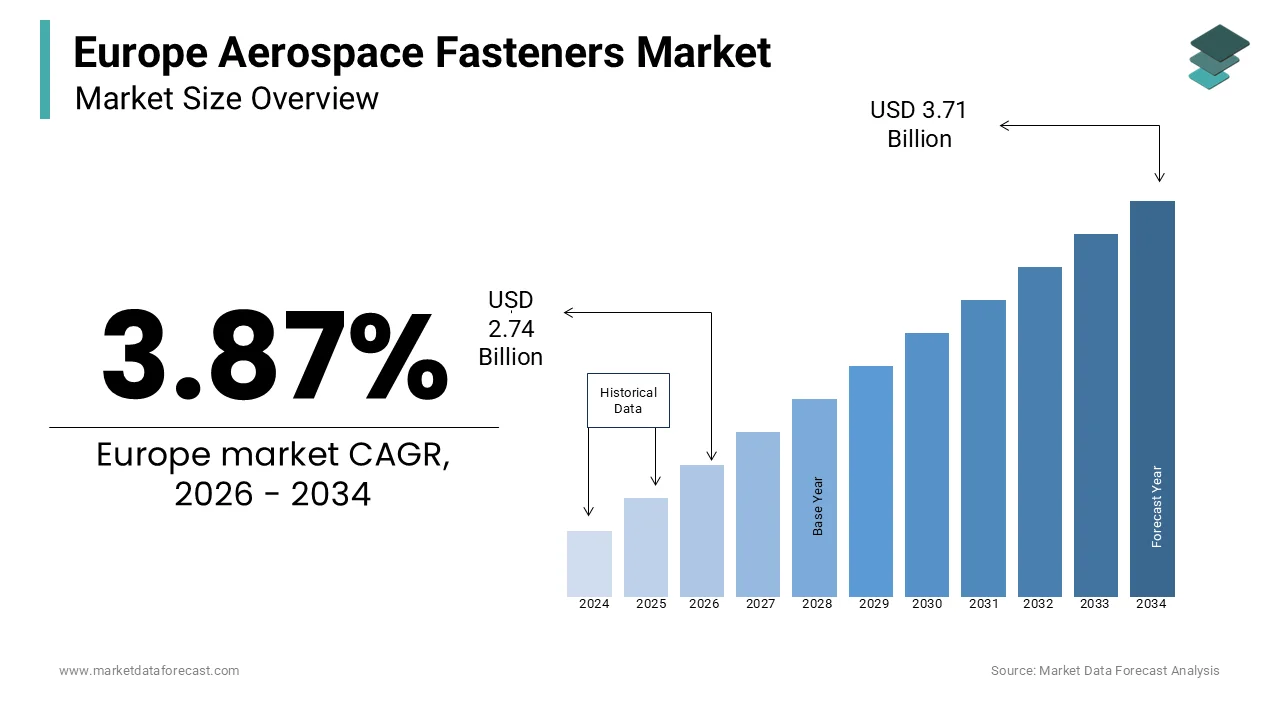
- Market Valuation: Valued at USD 2.64 billion (2025), estimated at USD 2.74 billion (2026), and projected to reach USD 3.71 billion by 2034, growing at a robust CAGR of 3.87% (2026–2034).
- Primary Growth Drivers: Rising commercial aircraft production and European defence modernization (Airbus delivering 766 aircraft, including 602 A320-family, 32 A330-family, and 57 A350-family units). Key operational metrics include Airbus producing ~60 A320-family aircraft per month with a target of 75 per month by 2027, Germany acquiring 35 F-35As and 20 additional Eurofighters, Spain ordering 45 Eurofighters, and new aviation-fastener qualifications and certifications taking approximately 1.5 to 2 years.
Key Market Segment Metrics (2026–2034)
| Category | Leading Segment (2025 Position) | Fastest-Growing Segment |
|---|---|---|
| By Product | Rivets (dominated the product segment with 42.6% market share in 2025) | Screws (projected to register the fastest 9.8% CAGR from 2026 to 2034) |
| By Material | Aluminum (led the material segment with 38.7% share) | Titanium (forecast to grow at an 11.3% CAGR) |
| By Platform | Commercial aircraft (dominated the platform segment with 54.2% share) | Military aircraft (projected to expand at a 10.7% CAGR) |
| By Region | Germany (led the European market with 26.3% share in 2025), followed by France with 21.6% (France's aerospace industry includes over 420 member companies represented by GIFAS) | — |
Major Market Players & Market Structure
Market Structure: Highly competitive European aerospace fasteners landscape featuring 10 key market leaders competing on lightweight materials, precision manufacturing, strict certification requirements, digital traceability, and OEM integration.
Key Companies: LISI Aerospace, TriMas Corporation, Cherry Aerospace (PCC), SFS Group AG, Howmet Aerospace, Precision Castparts Corp., and Stanley Black & Decker.
Europe Aerospace Fasteners Market Size
The Europe aerospace fasteners market size was valued at USD 2.64 billion in 2025 and is projected to reach USD 3.71 billion by 2034 from USD 2.74 billion in 2026, growing at a CAGR of 3.87%.
Aerospace fasteners are highly engineered components, including bolts, rivets, pins, nuts, and speciality inserts, designed to meet stringent performance, safety, and fatigue resistance requirements in commercial, military, and business aviation platforms. These fasteners are critical to airframe integrity, enabling secure assembly of primary and secondary structures under extreme thermal, mechanical and vibrational loads. Europe’s position as a global aerospace manufacturing hub with Airbus, Leonard,o and Dassault Aviation headquartered on the continent ensures consistent demand for advanced fastening systems. As per research, a large number of civil aircraft are registered in EASA member states, with Airbus alone delivering 766 commercial jets globally in 2025 (a slight increase from the 735 delivered in 2023). Each large commercial aircraft requires hundreds of thousands of fasteners. Moreover, European NATO members operate a combined military fleet of several thousand fixed-wing aircraft and helicopters, far exceeding 1,800 units. These military platforms demand high-strength corrosion-resistant fasteners compliant with rigorous standards, such as NATO STANAG requirements. Apart from these, the European Space Agency’s Ariane 6 and Vega C launch vehicles are highly complex systems that are widely reported to utilise thousands of aerospace-grade fasteners per mission. Airframes are increasingly incorporating composite materials. So, fastener designs are evolving to prevent delamination and galvanic corrosion. This technical complexity, ty coupled with rigorous traceability mandates under EN 9100 quality standards, rds defines the specialised nature of Europe’s aerospace fasteners ecosystem.
MARKET DRIVERS
Rising Commercial Aircraft Production Rates Are Driving Sustained Fastener Procurement
The acceleration of commercial aircraft manufacturing in the region, led by Airbus, is among the key drivers of the European aerospace fasteners market. As per Airbus’s 2025 delivery report, the company handed over 766 aircraft to global customers, including 602 A320 family narrow-bodies, 32 A330 family units, and 57 A350 family units. The A320 aircraft uses hundreds of thousands of fasteners, while the larger A350, which is largely made of carbon-fibre-reinforced polymers, uses millions of specialised fasteners. Airbus is currently producing approximately 60 A320 family aircraft per month and now plans to reach a production rate of 75 aircraft per month in 2027, a target that was previously expected sooner but was delayed due to persistent supply chain issues. This ramp-up directly translates to billions of fastener units annually sourced through tier one integrators like Premium Aerotec and Spirit AeroSystems. European manufacturers are signing long-term fastener supply agreements to ensure production continuity and manage supply chain volatility, as the global commercial fleet is predicted to double by 2040 in Airbus's Global Market Forecast.
Modernisation of European Military and Defence Fleets Is Fueling Demand for High-Integrity Fasteners
The region’s ongoing military aviation modernisation programs are greatly boosting demand for aerospace fasteners that meet NATO and national defence specifications, which in turn accelerates the expansion of the European aerospace fasteners market. As per sources, European NATO member nations are expanding their air force capabilities and replacing ageing fleets, with countries like Germany and Spain recently ordering significant numbers of new Eurofighter Typhoons and F-35As. For instance, Germany is acquiring 35 F-35As and 20 additional Eurofighters to replace its Tornado fleet, and Spain ordered 45 Eurofighters. The German Luftwaffe is undergoing significant fleet renewal, with plans to acquire 35 F-35s for its nuclear sharing role and signals-intelligence aircraft like the Airbus Pegasus to replace its ageing Tornado fleet. Similarly, France is upgrading its Rafale F4 standard fleet with structural reinforcements requiring requalification of thousands of fastener joints. The European Defence Fund (EDF) contributes significantly to collaborative defence research and development projects, including major initiatives such as the Future Combat Air System (FCAS), which aims to develop a next-generation combat aircraft by 2040. These programs ensure long-term demand for fasteners that comply with STANAG 4673 and national military standards, guaranteeing traceability, ty performa, and survivability.
MARKET RESTRAINTS
Stringent Certification and Qualification Protocols Increase Time to Market
The rigorous regulatory and quality assurance frameworks governing aerospace fasteners in the region significantly extend development and approval timelines, acting as a restraint to the European aerospace fasteners market. Aviation fasteners are subject to rigorous and mandatory quality and certification standards imposed by regulatory bodies such as the European Union Aviation Safety Agency (EASA) and national authorities. As per studies, the qualification and certification process for new aviation fasteners is extensive and time-consuming, often taking a year and a half to two years, due to stringent testing requirements for material properties and performance. Fasteners used in critical (primary) aircraft structures face enhanced regulatory scrutiny and are subject to additional, comprehensive testing requirements, including full-scale airframe validationDefencese applications also involve strict, mandatory standards, such as NATO requirements for rigorous testing and full batch traceability. These requirements deter smaller suppliers from entering the market and force even established manufacturers to maintain extensive documentation and testing infrastructure. Delays in certification directly impact aircraft production schedules. The supply chain for these highly regulated components can be vulnerable to disruptions, with shortages having the potential to cause significant issues like temporary production line stoppages. The compliance burden will remain a structural bottleneck until digital twin and predictive qualification methods are widely accepted.
Dependence on Critical Raw Materials Creates Supply Chain Vulnerability
Continuing supply chain risks due to heavy reliance on imported critical raw materials, including titanium, nickel, um nickel speciality all,oys furrestrainraint the expansion of the European aerospace fasteners market. Geopolitical tensions continue despite increased sourcing from Canada and Japan, which was driven by post-2022 diversification efforts. The European Defence Agency warns that fastener production could face disruption if supply chains for these materials are interrupted by trade restrictions or logistics bottlenecks. Domestic refining capacity remains negligible. The EU's Raw Materials Initiative encourages recycling and substitution research, but aerospace fasteners still demand virgin material with certified purity levels. Europe needs to establish reliable, independent sources for critical inputs to shield its fastener market from unpredictable global commodity price swings and geopolitical risks.
MARKET OPPORTUNITIES
Expansion of MRO Activities Across Europe Is Creating Aftermarket Opportunities
The growth of maintenance, repair and overhaul services in the region is opening a growth opportunity for the European aerospace fasteners market. This provides a robust aftermarket for aerospace fasteners driven by ageing fleets and regulatory airworthiness mandates. European MROs are a major global hub for aircraft maintenance. Aircraft maintenance requires a high volume of fasteners, particularly during heavy checks and military depot visits. There is a significant and growing investment in the MRO sector in Europe. The region is a major hub for aircraft maintenance, with numerous facilities handling a large volume of heavy maintenance checks. The European Aviation Safety Agency mandates that replaced fasteners must match original equipment manufacturer specifications, including material lot traceability and surface treatment. This creates consistent demand for certified fasteners independent of new production cycles. This segment offers stable, high-margin revenue for fastener manufacturers.
Adoption of Additive Manufacturing Is Enabling Next-Generation Fastener Designs
The integration of additive manufacturing into aerospace fastener production is creating fresh prospects for foperformance-optimiseded,, weight-reduced components, which is expected to propel the growth of the European aerospace fasteners market. As per sources, researchers are successfully using additive manufacturing to produce lightweight titanium alloy fasteners with complex internal structures, while maintaining necessary mechanical properties. A major aerospace manufacturer has begun qualifying additively manufactured fasteners for specific uses on test aircraft, with plans for broader future application in non-primary structures. A prominent space agency is currently integrating 3D-printed metal alloy fasteners into critical components of launch vehicle engine mounts, demonstrating growing confidence in the technology for space applications. Unlike traditional machining, which wastes up to 9 per cent of expensive raw material l additive methods use only the required powder, reducing material costs. This shift enables customisation on material efficiency and design-free, dom positioning Europe at the forefront of next-generation fastening technology.
MARKET CHALLENGES
Counterfeit and Non-Conforming Fasteners Pose Safety and Compliance Risks
The infiltration of counterfeit or substandard fasteners into the European aerospace supply chain remains a persistent challenge threatening airworthiness and regulatory compliance, which in turn challenges the growth of the European aerospace fasteners market. These components often originate from unapproved distributors and mimic genuine part numbers but fail to meet the required tensile or fatigue specifications. Major OEMs have secured their operations with strict controls and the Supply Chain Assurance Standard, but the vulnerability persists within the uncoordinated MRO and secondary supply chains. Detection requires costly spectrographic and ultrasonic testing, and once installed, removal disrupts operations. The risk of counterfeit fasteners will continue to undermine safety and increase compliance costs until blockchain-based digital passports and AI-powered anomaly detection are universally adopted.
Workforce Shortages in Precision Manufacturing Threaten Production Scalability
The shortage of skilled technicians and engineers in precision fastener manufacturing limits its ability to scale production in line with aerospace demand, which holds back the expansion of the European aerospace fasteners market. The aerospace fastener industry requires workers with specialised training in manufacturing techniques, measurement sciences, and material quality assurance. This shortage is evident in key manufacturing nations, with current projections indicating a substantial deficit of skilled machinists within the regional supply chain. Furthermore, a considerable portion of suppliers identify attracting new talent as their primary operational challenge. The problem is exacerbated by the high barrier to entry—producing a certified aerospace fastener requires adherence to AS 9100 EN 4400 and Nadcap standards, demanding meticulous documentation and process control. Compounding the issue is the extended timeframe needed to develop a qualified workforce, as comprehensive training and certification for new technicians span nearly two years. This persistent deficit is unfolding against a backdrop of anticipated robust job growth, with projections pointing to hundreds of thousands of new positions emerging across the broader European aerospace sector in the coming years.
REPORT COVERAGE
| REPORT METRIC | DETAILS |
| Market Size Available | 2025 to 2034 |
| Base Year | 2025 |
| Forecast Period | 2026 to 2034 |
| CAGR | 3.87% |
| Segments Covered | By Product, Material, Platform, and Region |
| Various Analyses Covered | Global, Regional, & Country Level Analysis; Segment-Level Analysis; DROC, PESTLE Analysis; Porter’s Five Forces Analysis; Competitive Landscape; Analyst Overview of Investment Opportunities |
| Regions Covered | UK, France, Spain, Germany, Italy, Russia, Sweden, Denmark, Switzerland, Netherlands, Turkey, and the Czech Republic |
| Market Leaders Profiled | LISI Aerospace, TriMas Corporation, Cherry Aerospace (PCC), Leeart Industry Co., Ltd., Superbti Co., Ltd., XOT Metals, SFS Group AG, Howmet Aerospace Inc., Precision Castparts Corp., and Stanley Black & Decker, Inc. |
SEGMENTAL ANALYSIS
By Product Insights
The rivets segment held the largest share of 42.6% of the European aerospace fasteners market in 2025. Its irreplaceable role in airframe assembly, particularly in joint aluminium and composite panels across commercial and military aircraft, has mainly contributed to the growth of the rivets segment. The prevalence of rivets is further reinforced by decades of validated performance. Regulatory standards define strict dimensional and mechanical tolerances ensuring interchangeability across European supply chains. Major manufacturers produce millions of titanium and aluminium rivets annually for final assembly lines. Apart from these, riveting remains the preferred method for composite-to-metal bonding, where bolted joints risk delamination. Rivets will continue to serve as the primary method of fastening in the European aerospace industry as new aircraft programs rely on hybrid metallic composite structures.
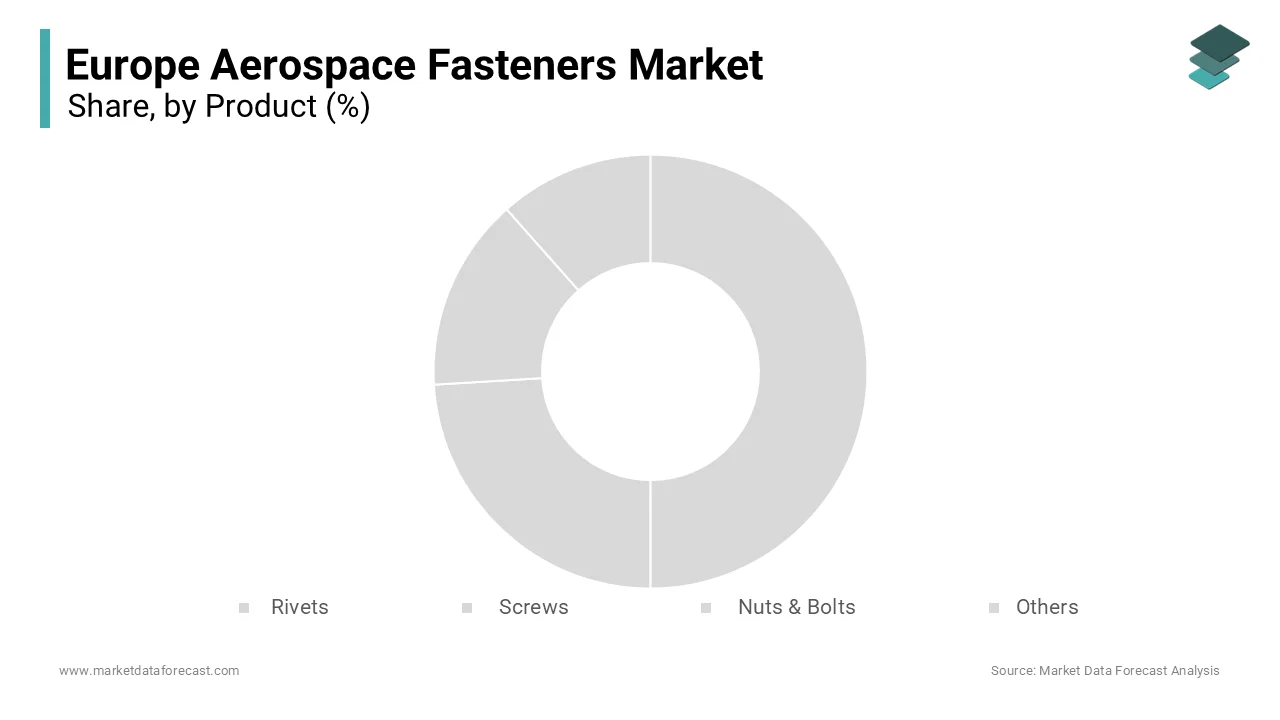
The screws segment is predicted to witness the highest CAGR of 9.8% from 2026 to 2034 due to increasing demand for removable and serviceable joints in avionics interiors and engine nacelles. Unlike permanent rivets, screws enable frequent access fomaintenancence upgrades and inspections—vital in modern aircraft with high electronic content. As per research, the production scale of modern commercial aircraft, such as the A320neo family, necessitates the integration of tens of thousands of individual, precision-engineered aerospace screws throughout their internal systems, from flight deck controls to passenger cabin infrastructure. The shift toward modular avionics architectures under Industry-wide initiatives focused on efficiency and modularity, like the EU's Clean Sky 2 program, is promoting increased use of standardised fastening solutions to enable quick and efficient replacement of line-replaceable units during maintenance. Leading aerospace suppliers are developing advanced self-locking and vibration-resistant screws that adhere strictly to stringent regulatory requirements, such as those established by EASA for aircraft structural integrityDefencese applications also contribute. The increasing pace of digital cabin retrofit programs across European commercial and military aircraft is driving a sharp rise in demand for certified removable fasteners, which are quickly superseding traditional permanent joining methods.
By Material Insights
The aluminium segment led the European aerospace fasteners market and accounted for a 38.7% share in 2025. The prominence of the aluminium segment is attributed to its optimal balance of light weight, corrosion resis, tan, and cost efficiency for non-critical structural applications. As per studies, aluminium-based fasteners are widely utilised in constructing the non-primary structural elements of aircraft, which often employ strong, established alloys like the 2025 and 7075 series. In addition, aircraft manufacturers, such as Airbus, consistently select lightweight aluminium fasteners for key structural joints, a practice that improves fuel efficiency and reduces environmental impact by decreasing overall aircraft weight. The material’s compatibility with aluminium airframes also prevents galvanic corrosion when proper sealing is applied. Industry-wide adoption of common standards for aerospace fasteners ensures that products from various European manufacturers meet consistent requirements for mechanical properties. Apart from these, aluminium mum fasteners dominate general aviation and business jet segments, where performance demands are lower but cost sensitivity is high. Hence, the material remains foundational to fastener selection despite advances in composite high-temperature alloys.
The titanium segment is estimated to register the fastest CAGR of 11.3% from 2026 to 2034, owing to its use in primary structures under high stresses of modern aircraft. According to sources, the space industry widely uses titanium fasteners in next-generation rockets, indicating their essential role in modern space exploration. Also, major commercial aircraft manufacturers rely heavily on titanium fasteners for building new passengeraeroplaness. As per sources, military aviation employs titanium fasteners in vital areas like engine mounts and weapon systems because the material can handle extreme temperatures and stress. Airframers accept the premium for weight-critical applications, even though titanium fasteners are significantly more expensive than aluminium. The premium price of titanium is a necessary investment in performance and reliability for demanding environments, where aluminium is less suitable. So, demand is set to rise as composite airframes become standard across next-generation platforms.
By Platform Insights
The commercial aircraft segment dominated the European aerospace fasteners market by occupying a 54.2% share in 2025. The dominance of the commercial aircraft segment is propelled by Europe’s position as the home of Airbus and a major hub for global aviation manufacturing. Airbus is delivering many aircraft, with an emphasis on its A320 family compared to wide-body models. These aircraft require a significant number of fasteners, particularly for the high-production A320 lines. Further, Airbus is raising the production rate for the A320 model to keep up with demand. Many commercial aircraft in Europe undergo maintenance and repair each year. European regulations mandate strict standards for the quality and tracking of components like fasteners. Airbus has a substantial number of pending orders, suggesting strong future demand for its aircraft. The commercial segment will remain the primary demand driver for aerospace fasteners in Europe.
The military aircraft segment is anticipated to witness the fastest CAGR of 10.7% during the forecast period. The rapid growth of the military aircraft segment is fueled by European defence modernisation and NATO capability commitments. As per research, European Union member states are collectively planning to acquire many new combat and support aircraft over the coming years. The production of each Eurofighter aircraft demands a substantial number of high-strength, specialised metal fasteners. In addition, individual countries, such as Germany, are committing significant funds specifically to update their air force with advanced aircraft models. Also, France is investing in extensive upgrades for its existing fleet, which involves the re-certification of many structural connections. The European Defence Fund is financially supporting the creation of next-generation aerial defence systems through a collaborative development program. These programs ensure long-term demand for fasteners compliant with NATO STANAG 4673 and national military specifications.
REGIONAL ANALYSIS
Germany Market Analysis
Germany was the top performer in the European aerospace fasteners market and accounted for a 26.3% share in 2025. The domination of the German market is primarily driven by its dense industrial base, advanced manufacturing capabilities, and central role in European defence and commercial aviation. As per sources, the industry has a deep supply chain, with hundreds of domestic companies producing specialised, certified aerospace fasteners. The country hosts major final assembly and MRO facilities for Airbus, Eurofighter and A400M in Bremen, Manching and Hamb, consuming millions of fasteners annually. Also, as per research, German-made fasteners are a significant export product, with the majority of sales directed towards other European Union countries, which indicates strong regional trade ties. Increased government spending on defence, recently surpassing two per cent of GDP, shows growing federal support for related industries. Furthermore, Germany leads in precision machining and surface treatment technology, with A strong focus on quality and safety is evident, as many local suppliers hold key international accreditations to meet stringent EASA and NATO requirements. This combination of scale innovation and strategic alignment solidifies Germany’s leadership in the regional fasteners ecosystem.
France Market Analysis
France was the second-largest country in the European aerospace fasteners market and held a 21.6% share in 2025. The growth of these fasteners in the French market is due to their dual strength in commercial and military aviation through Airbus Dassault Aviation and Safran. As per GIFAS (French Aerospace Industries Association), there are over 420 member companies in the French aerospace industry, which includes numerous fastener manufacturers and suppliers. A fighter jet like the Dassault Rafale uses hundreds of thousands of fasteners in its construction, with a significant portion made from advanced and lightweight materials like titanium and various alloys to meet stringent strength and weight requirements. Airbus's operations in France involve a vast network of thousands of subcontracting companies, many of which are certified under standards like EN 9100 and supply components, including fasteners, to its assembly lines. France also leads in fastener innovation. France's strong state support, integrated supply chains, and deep OEM relationships establish it as a vital hub for Europe’s aerospace fastening infrastructure.
United Kingdom Market Analysis
The United Kingdom continues to be a major player in the European aerospace fasteners market due to its heritage in precision engineering and strategic role in global aerospace supply chains. As per sources, a significant number of UK-based companies are actively involved in the manufacturing of aerospace fasteners by indicating a large domestic industry base. The UK's aerospace fastener production is a major export industry, supplying international markets with a wide range of components. According to studies, the domestic production of military aircraft, such as the Eurofighter, drives a substantial demand for a high volume of fasteners for each aircraft built. Major aerospace companies in the UK, such as Spirit AeroSystems in Belfast, are key suppliers of fastening systems for large commercial aircraft programs, including the A220 and A320. In addition, there is a strong financial commitment from the government toward maintaining and upgrading the national fleet of fast jets, which helps ensure ongoing demand for related parts and services. A formal agreement between the UK and the European Union Aviation Safety Agency (EASA) ensures that aerospace standards are mutually accepted, which helps maintain smooth trade and regulatory compliance after Brexit. The UK continues to shape the European market significantly through its leading metrology capabilities and focus on high-value speciality fasteners.
Italy Market Analysis
Italy grew steadily in the European aerospace fasteners market and was driven by its prowess in military aviation and composite airframe manufacturing through Leonardo and Avio Aero. As per studies, many Italian companies create aerospace fasteners that have received official approval. Further, Italian-made military training jets rely heavily on these specialised joining parts, with a significant portion made from durable and rust-resistant material. Italy is also a key partner in the A350 program,,m supplying wing trailing edge assemblies that require specialised blind fasteners to join carbon fibre panels. Italy's defence department is investing heavily in 2025 to upgrade its military aircraft, which drives demand for advanced components like these fasteners. The country’s expertise in composite fastening and NATO interoperability ensures continued relevance in both European and transatlantic supply chains.
Spain Market Analysis
Spain is predicted to notably grow the European aerospace fasteners market between 2026 and 203,3, owing to its integration into Airbus’s industrial ecosystem and growing MRO sector. According to research, Spain has a robust domestic aerospace manufacturing sector, with more than a hundred companies actively producing aerospace fasteners. Major aircraft assembly plants in Getafe and Illescas operated by Airbus are significant consumers of these fasteners, which use tens of millions annually for building aircraft structures. Spain also hosts major MRO hubs, including ITP Aero and E, ANA serving Iberia Air Europa and NATO allies with fastener replacement during heavy checks. Apart from these, Spain participates in the European Defence Fund’s Future Combat Air System, contributing fastener R&D for next-generation platforms. The Nation's significant ties to Airbus, growing defence maintenance activities, firmly position it as a key and developing player in the European aerospace fastening sector.
COMPETITIVE LANDSCAPE
KEY MARKET PLAYERS
Some of the notable key players in the European aerospace fasteners market are
- LISI Aerospace
- TriMas Corporation
- Cherry Aerospace (PCC)
- Leeart Industry Co., Ltd.
- Superbti Co., Ltd.
- XOT Metals
- SFS Group AG
- Howmet Aerospace Inc.
- Precision Castparts Corp.
- Stanley Black & Decker, Inc.
TOP STRATEGIES USED BY THE KEY MARKET PLAYERS
Key players in the European aerospace fasteners market are investing in digital traceability systems to ensure full material lot compliance with EN 9100 and EASA mandates. They are expanding cold forming and precision machining capacity to meet rising demand from Airbus and defence programs. Strategic alignment with Clean Sky and European Defence Fund initiatives drives innovation in lightweight and corrosion-resistant fasteners. Companies are also establishing aerospace centres of excellence with Nadcap-accredited processes to consolidate production and quality control. Furthermore, they are developing hybrid joining technologies for composite metallic interfaces to support next-generation airframes. These strategies enhance reliability, scalability and technological leadership in a highly regulated and performance-driven market.
COMPETITION OVERVIEW
The European aerospace fasteners market is characterised by a concentrated yet highly specialised competitive landscape where technological excellence, regulatory compliance and OEM integration determine success. Competition is not primarily price-based but centred on material science, precision manufacturing and certification pedigree. A handful of large players like Howmet Aerospac,e Bollh, ff and SFS dominate through decades-long relationships with Airbus, Leonardo and Safran while hundreds of small and medium enterprises serve niche applications such as MRO or interior fittings. Barriers to entry are formidable due to EN 9100 quality requirements, Nadcap audit, ts and EASA Part 21G certification, which demand significant capital and expertiGerman Ge, man, Fre, , ch UK-based firms lead high-integrity fasteners ens while Southern European suppliers focus on cost-efficient secondary structure components. Collaboration is common through EU-funded consortia, yet supply chain security concerns are driving vertical integration and nearshoring. The market remains resilient due to inelastic demand from aircraft production and defence modernisation, but is vulnerable to raw material volatility and skilled labour or shortages.
TOP PLAYERS IN THE MARKET
- Alcoa Fastening Systems, now operating under Howmet Aerospa,,ce is a cornerstone of Europe’s aerospace fasteners landscape with deep integration into Airbus defence supply chains. The company supplies high-integrity rivets, ts bboltslts nutsts blind fasteners for commercial, al military, and space platforms across the continent. Its facility in Ranshofen, Austria, produces titanium aluminiumum fasteners certified to EN and Nadcap standards, serving final assembly lines in Toulo, se Hamburg and Seville. Through its global footprint and decades of aerospace heritage, Howmet ensures Europe’s access to mission-critical fastening solutions while exporting European-manufactured components to Boei, Lockheed Martin and other international OEMs.
- Bollhoff Group is a German-based global leader in engineered fastening technologies with extensive aerospace operations across Europe. The company specialises in riveting systems, blind bo speciality inserts used in primary airframe and engine structures. Bollhoff supplies Airbus Leonardo and Safran with certified fasteners compliant with EASA and NATO specifications. Its innovations support both European sovereignty and global aerospace sustainability goals through advanced joining solutions exported worldwide.
- SFS Group is a Swiss multinational with a significant presence in the European aerospace fasteners market, offering high precision scre,ws n, and speciality fasteners for avionics interiors and engine systems. The company’s aerospace division supplies Airbus, Dassault, ult Rolls-Royce EN 4400 certified components manufactured in its ISO 9100 facilities in Switzerland and Germany. The company also enhanced its digital supply chain platform, enabling just-in-time delivery to MRO facilities across Europe. SFS’s commitment to Swiss precision surface engineering and traceability has made it a trusted partner for high-reliability removable fastening systems. Its products are also integrated into Boeing and Gulfstream platforms, reinforcing its dual role in European and global aerospace ecosystems.
MARKET SEGMENTATION
This research report on the European Aerospace fasteners market has been segmented and sub-segmented based on categories.
By Product
- Rivets
- Screws
- Nuts & Bolts
- Others
By Material
- Aluminum
- Steel
- Superalloys
- Titanium
By Platform
- Fixed-wing Aircraft
- Commercial Aircraft
- Business Aircraft
- General Aviation Aircraft
- Military Aircraft
- Rotary-wing Aircraft
- Military Helicopters
- Civil Helicopters
By Country
- UK
- France
- Spain
- Germany
- Italy
- Russia
- Sweden
- Denmark
- Switzerland
- Netherlands
- Turkey
- Czech Republic
- Rest of Europe