- Product Description Description
- Table of Contents TOC
- List of Table & Figure LOT
- Get Free Sample PDF Sample PDF
Market Size, 2025
$187.23 BnMarket Estimate, 2026
$198.27 BnMarket Forecast, 2034
$313.24 BnCAGR, 2026–2034
5.90%Europe Aggregates Market Report Summary
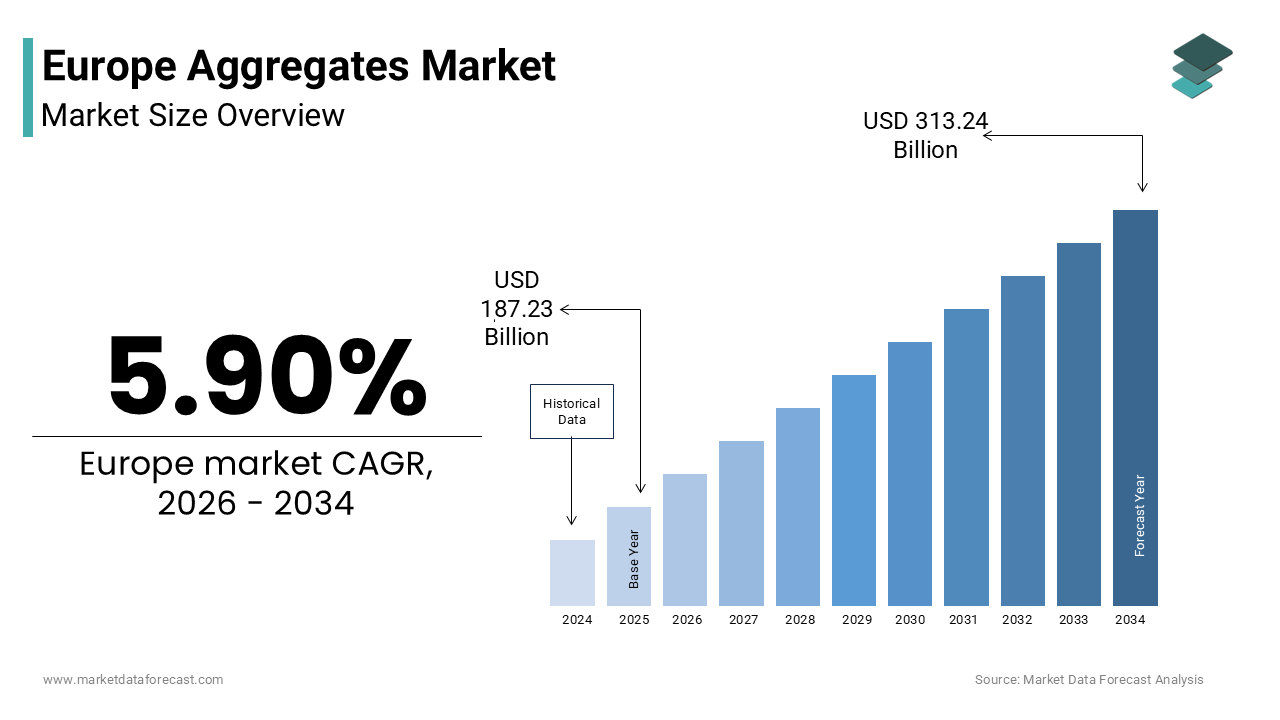
The Europe aggregates market was valued at USD 187.23 billion in 2025, is anticipated to reach USD 198.27 billion in 2026, and is projected to reach USD 313.24 billion by 2034, growing at a CAGR of 5.90% during the forecast period from 2026 to 2034. The growth of the Europe aggregates market is driven by large-scale public infrastructure investments, urban regeneration and housing supply mandates, and rising construction activity across major European economies. Increasing focus on transport modernization, renewable energy infrastructure, and grid expansion projects is further supporting demand for aggregates. Moreover, the growing adoption of recycled construction and demolition waste, along with circular economy policies and green procurement standards, is reshaping supply dynamics and strengthening long-term market growth.
Key Market Trends
- Rising use of recycled aggregates supported by EU circular economy regulations and sustainability targets.
- Increasing demand for specialized aggregates in renewable energy, grid infrastructure, and offshore wind projects.
- Growing integration of digital quarry management, automation, and environmental monitoring systems.
- Strong emphasis on low-carbon construction materials in public procurement frameworks.
- Expanding investment in local sourcing and logistics optimization to reduce transport emissions and costs.
Segmental Insights
- Based on aggregate type, the crushed stone segment dominated the market, driven by high mechanical strength, durability, and widespread use in infrastructure, concrete, and transportation projects.
- The recycled aggregates segment is expected to grow at the fastest pace, supported by EU recycling mandates, improved processing technologies, and government incentives promoting circular construction materials.
- Based on application, the construction segment held the largest share, owing to continued investment in residential, commercial, transportation, and civil infrastructure development across Europe.
- The insulation application segment is projected to witness the highest growth, fueled by stringent building energy efficiency regulations and rising adoption of lightweight insulating aggregates in green buildings.
Regional Insights
The Europe aggregates market is experiencing steady demand across major economies, supported by public infrastructure funding, housing policies, and sustainability-driven construction practices.
- Germany remains one of the leading markets, driven by large-scale transportation projects, industrial development, and strong construction activity.
- France continues to perform strongly, supported by urban renewal programs, public works investment, and infrastructure modernization initiatives.
- The United Kingdom shows consistent growth due to road, rail, and housing projects combined with strong demand for recycled aggregates.
- Italy is emerging as a high-growth market due to urban redevelopment projects, residential construction demand, and growing circular material adoption.
- The Netherlands and Nordic countries are witnessing increased demand driven by climate-resilient infrastructure, flood protection projects, and sustainable construction practices.
Competitive Landscape
The Europe aggregates market is characterized by the presence of large multinational building material groups and strong regional quarry operators. Leading companies compete through vertical integration, control over quarry resources, and advanced processing capabilities, while differentiation is increasingly driven by sustainability credentials, recycled content offerings, and environmental compliance. Market leaders are investing in digital quarrying technologies, circular material solutions, and biodiversity restoration initiatives to strengthen regulatory alignment and long-term competitiveness. Prominent players in the Europe aggregates market include Holcim, Heidelberg Materials, CRH plc, CEMEX, Aggregate Industrie, Tarmac, Vicat, Colas Group, Buzzi Unicem, LSR Group, Eurovia, Breedon Group, Carmeuse, Hanson UK, and CEMEX UK.
Europe Aggregates Market Size
The europe aggregates market size was valued at USD 187.23 billion in 2025 and is anticipated to reach USD 198.27 billion in 2026 from USD 313.24 billion by 2034, growing at a CAGR of 5.90% during the forecast period from 2026 to 2034.
Aggregates refers to the extraction processing and distribution of granular mineral materials, including crushed stone sand and gravel, used as essential raw inputs in construction infrastructure and industrial applications. These materials form the foundational layer of virtually all built environments from road bases and concrete mixes to railway ballast and drainage systems. Unlike commoditized bulk goods aggregates are inherently local due to high transport costs relative to value and stringent zoning constraints on extraction sites. According to Eurostat, non-metallic minerals constitute the largest share of material consumption in the European Union, driven heavily by construction-related demand in major economies including Germany, France, and Poland. The European Environment Agency indicates that the vast majority of Europe's aggregates are sourced from natural quarrying, while recycled demolition waste and marine dredging constitute a smaller, but significant, alternative supply. The sector operates under rigorous environmental permitting frameworks including the EU Habitats Directive and national mining codes that regulate land use water consumption and biodiversity impact. This localized yet highly regulated nature positions aggregates as a critical yet often overlooked enabler of Europe’s physical resilience and decarbonization infrastructure.
MARKET DRIVERS
Large Scale Public Infrastructure Investment Programs
The region’s sustained commitment to modernizing transportation and energy infrastructure is a primary driver of the Europe aggregates. Significant public funding is being directed toward major transnational, regional, and national infrastructure initiatives focused on transportation and utility networks. The modernization and expansion of transportation infrastructure, including rail, road, port, and airport projects, continue to rely on high volumes of construction materials. National infrastructure planning and cohesion policies are actively supporting the rehabilitation and expansion of transportation networks, which drives ongoing demand for earthworks and foundational materials. State-led investments are facilitating large-scale construction activities, contributing to a sustained requirement for raw materials such as aggregates and crushed stone in infrastructure development. Such long term visibility ensures consistent quarry utilization and justifies capital reinvestment in extraction and processing equipment despite cyclical private construction fluctuations.
Urban Regeneration and Housing Supply Mandates
Accelerated urban densification policies across the region are fueling demand for aggregates in residential and mixed-use developments, which boosts the growth of the Europe aggregates market. This is particularly evident in high-growth metropolitan corridors. A significant portion of the European population is concentrated in urban areas, with the expansion of built-up land outpacing the rate of population growth. In response to urban expansion, certain European nations are implementing mandated housing targets for municipalities to increase annual unit approvals, with municipal initiatives in cities setting specific yearly goals for new housing production. The construction of mid-rise residential buildings requires substantial amounts of aggregate materials for foundations and site preparation. Moreover, urban renewal projects such as Barcelona’s Superilles and Berlin’s Tempelhofer Feld redevelopment integrate permeable pavements and green infrastructure that require specialized lightweight and recycled aggregates. These policy driven construction waves create stable localized demand that offsets declines in rural or speculative building sectors reinforcing aggregates as indispensable to Europe’s spatial planning ambitions.
MARKET RESTRAINTS
Stringent Environmental Regulations on Quarrying Activities
The expansion and operation of aggregate extraction sites in the region face mounting constraints from biodiversity protection laws and landscape conservation mandates, which hampers the growth of the Europe aggregates market. A significant portion of active extraction sites within the European Union are located in areas designated for nature protection, which initiates complex regulatory procedures for biodiversity mitigation. National courts have paused expansions of extraction operations due to inadequacies in plans for mitigating impact on protected species. Environmental permitting authorities have rejected new extraction projects to avoid disrupting traditional land uses and local wildlife migration patterns. Stringent environmental compliance requirements are resulting in substantial delays for project timelines. Adhering to environmental standards is increasing the overall cost of compliance for extractive industries. New regulatory frameworks focusing on nature restoration and ecosystem integrity are placing constraints on the development of new greenfield extraction sites near sensitive environmental locations. Recycled materials offer only partial relief and fall short of the technical properties required for structural applications, leaving supply vulnerable to regulatory hurdles that threaten to delay critical infrastructure projects.
Community Opposition and Social License Challenges
Local resistance to new or expanded quarries significantly impedes aggregate supply security across the region due to concerns over noise dust traffic and landscape degradation, which hinders the expansion of the Europe aggregates market. Public consultation processes for proposed extraction sites in Western Europe frequently encounter formal opposition from community groups and environmental organizations. Regional support for mining projects does not guarantee timely implementation, as local protests can lead to significant operational delays. Proposed extraction sites often face rejection by regulatory bodies due to concerns regarding impacts on landscape aesthetics and local water resources. Substantial community opposition is a recurring factor in the planning phase for material extraction projects. These conflicts reflect a broader societal shift where communities demand greater voice in land use decisions even when projects serve national interests. The absence of standardized benefit sharing mechanisms, such as community royalties or infrastructure offsets, further erodes social license making permitting increasingly unpredictable and politically fraught regardless of technical or economic justification.
MARKET OPPORTUNITIES
Integration of Recycled Construction and Demolition Waste
The systematic incorporation of recycled aggregates from construction and demolition waste provides a major opportunity to enhance resource efficiency and reduce primary extraction pressure, which is anticipated to fuel the growth of the Europe aggregates market. A significant portion of construction and demolition material generated across the European Union is not currently processed back into usable aggregates. New regulatory frameworks are pushing for higher recycling rates, which is driving investment into technology that can better sort and crush materials. Certain regions are demonstrating high utilization rates of recycled concrete for infrastructure, particularly in road foundations, by adopting specific construction standards. Public sector procurement is increasingly incorporating mandates that require a minimum amount of recycled content in infrastructure projects to promote a circular economy. Innovations such as AI powered optical sorters and microwave treatment for contaminant removal are improving quality consistency enabling use in higher grade applications like structural concrete. This circular transition not only conserves natural resources but also aligns with corporate sustainability reporting requirements under the EU’s CSRD enhancing procurement eligibility for green infrastructure tenders.
Deployment in Renewable Energy and Grid Infrastructure
The rapid rollout of renewable energy and grid modernization projects is opening new potential applications for specialized aggregates across the region. This deployment is expected to boost the expansion of the Europe aggregates market. The expansion of renewable energy capacity within the European grid is necessitating significant infrastructure development, including the construction of foundations, cable systems, and access roads. Offshore wind projects require substantial amounts of marine materials for cable protection and foundation stability. The expansion of hydrogen infrastructure, including pipeline development, relies on specialized materials for thermal stability and vibration mitigation. Grid reinforcement initiatives and substation construction often incorporate specialized materials to manage electromagnetic properties. These emerging sectors demand technically certified materials with specific gradation and durability profiles commanding premium pricing and long term off take agreements. Aggregates producers can pivot from conventional construction to vital clean energy supply chains by aligning with European energy sovereignty goals.
MARKET CHALLENGES
Geographic Mismatch Between Supply and Demand Centers
A persistent spatial imbalance exists between aggregate reserves and major consumption zones across the region, which exacerbates logistics costs and carbon footprints, and thereby impedes the growth of the Europe aggregates market. Accessible hard rock resources are significantly located in remote geographic areas rather than near population centers. Demand for construction materials is concentrated in densely populated urban corridors. The economic feasibility of transporting heavy construction materials diminishes rapidly as distance increases, often rendering long-distance hauling impractical. High transport costs can exceed the initial value of the raw material, creating localized supply chain limitations and necessitating careful logistical planning for material supply. This mismatch forces reliance on lower quality local sands or imported alternatives increasing project costs and compromising engineering performance. In the Netherlands for instance shortages of high strength gravel have led to imports from Norway despite abundant domestic sand reserves unsuitable for structural use. Continued fragmentation of supply chains and rising infrastructure costs are inevitable without regional, multi-modal logistics planning (rail/barge), particularly as urban density increases.
Workforce Shortages and Aging Extraction Labor
A serious shortage of skilled personnel in quarry operations processing plant management and geological surveying threatens the operational continuity and safety standards, which constrains the expansion of the Europe aggregates market. The extraction workforce in Europe shows an aging demographic with a small proportion of younger individuals joining the field. Retirement and fewer opportunities for vocational training appear to be factors in the observed reduction of qualified engineers in certain regional quarrying areas. This trend suggests a potential challenge in passing on knowledge and skills between experienced workers and newer entrants. This gap is compounded by declining interest in extractive careers among younger generations who perceive the industry as environmentally damaging and technologically outdated. Consequently, companies struggle to implement digital monitoring systems automated drilling and precision blasting techniques that require hybrid technical expertise. Automation can provide some assistance, but it cannot currently substitute for human expertise in complex geological or emergency situations. The sector must adopt targeted recruitment, curriculum integration, and green branding, or face operational degradation, increased accidents, and the erosion of its social and economic legitimacy.
REPORT COVERAGE
| REPORT METRIC | DETAILS |
| Market Size Available | 2025 to 2034 |
| Base Year | 2025 |
| Forecast Period | 2026 to 2034 |
| CAGR | 4.90% |
| Segments Covered | By Aggregate Type, Application and Country |
| Various Analyses Covered | Regional & Country Level Analysis, Segment-Level Analysis, DROC, PESTLE Analysis, Porter’s Five Forces Analysis, Competitive Landscape, Analyst Overview on Investment Opportunities |
| Countries Covered | UK, France, Spain, Germany, Italy, Russia, Sweden, Denmark, Switzerland, the Netherlands, Turkey, the Czech Republic, and the Rest of Europe. |
| Market Leaders Profiled | Holcim, Heidelberg Materials, CRH plc, CEMEX, Aggregate Industries, Tarmac, Vicat, Colas Group, Buzzi Unicem, LSR Group, Eurovia, Breedon Group, Carmeuse, Hanson UK, and CEMEX UK |
SEGMENTAL ANALYSIS
By Aggregate Type Insights
The crushed stone segment held the largest share of 48.6% of the Europe aggregates market in 2025. The dominance of the crushed stone segment is driven by its superior mechanical properties, high compressive strength angular particle shape and durability, making it indispensable for structural applications such as road bases railway ballast and concrete production. Infrastructure maintenance and expansion projects, particularly in major European economies, generate a substantial demand for construction materials. The prioritization of high-speed transit networks significantly impacts the volume of crushed stone utilized within the European Union. Standardized quality regulations for construction aggregates create a preference for manufactured, crushed stone materials over naturally occurring alternatives in large-scale infrastructure projects. Strategic national resource planning in Europe often favors the extraction of hard rock from specific geological regions to ensure long-term material availability. Unlike sand or gravel which face marine extraction bans in sensitive coastal zones crushed stone benefits from inland quarrying that aligns with biodiversity offsetting schemes under the EU Habitats Directive. This combination of engineering necessity regulatory preference and strategic resource planning solidifies crushed stone as the backbone of Europe’s built environment.
The recycled aggregates segment is anticipated to witness the fastest CAGR of 9.4% between 2026 and 2034 due to binding EU circular economy mandates and evolving technical standards that validate secondary materials for structural use. The European Union is managing a large volume of construction and demolition waste while implementing directives that set high recycling targets for these materials. Certain European countries are integrating policies that mandate minimum percentages of recycled concrete aggregates in new road construction. Advancements in processing, including optical sorting and alternative, methods have enhanced the ability to remove contaminants from waste streams. Improved processing capabilities are facilitating compliance with standards for using recycled materials in new concrete production. Governmental initiatives, such as tax incentives for utilizing certified recycled aggregates in public works, are accelerating demand for these materials in certain regions. These regulatory financial and technological enablers are transforming recycled aggregates from a niche alternative into a mainstream solution aligned with Europe’s decarbonization and resource sovereignty goals.
By Application Insights
The construction segment was the largest segment in the Europe aggregates market by captured a significant share in 2025. The prominence of the construction segment is attributed to the foundational role of aggregates in residential commercial and civil engineering projects across the continent. The volume of new construction projects across Europe creates a substantial requirement for raw construction materials, specifically for building foundations and site preparation. Large-scale transportation and housing initiatives contribute to consistent, high-level demand for these materials within specific national programs. The expansion of infrastructure networks, such as highways, necessitates significant material input for each unit of construction. Municipal building standards in certain European nations influence material demand by regulating the technical specifications for structural concrete. Additionally urban regeneration projects in cities like Milan and Warsaw integrate permeable pavements and green roofs that rely on specialized lightweight aggregates. Unlike ancillary uses construction remains the primary economic engine for the sector with demand tightly coupled to public investment cycles and demographic pressures making it the undisputed core of Europe’s aggregates ecosystem.
The insulation application segment is likely to experience the fastest CAGR of 7.85 from 2026 to 2034 owing to Europe’s stringent building energy performance directives and the rising adoption of lightweight expanded clay and shale aggregates in thermal insulation systems. Building regulations are increasingly emphasizing the need for new constructions to meet very low energy consumption standards, which is boosting interest in insulation materials that have a low carbon footprint from production. Lightweight materials like expanded clay aggregates are being utilized more often in the creation of concrete blocks and for green roof applications due to their thermal properties. Energy-focused retrofitting programs in various regions are encouraging the use of insulating aggregates in renovation projects, which helps to lower heating requirements. Specific types of expanded aggregate materials are being selected for high-efficiency, passive-standard building designs, particularly where moisture resistance and fire safety are required. Hence, insulating aggregates are transitioning from specialty products to essential components of Europe’s decarbonized built environment.
COMPETITIVE LANDSCAPE
Competition in the Europe aggregates market is characterized by a dual structure comprising large multinational groups and regional independent operators. The majors such as Heidelberg Materials CRH and Holcim leverage scale technological investment and sustainability credentials to dominate public infrastructure tenders and cross border projects. In contrast smaller local quarriers compete on proximity service agility and community integration often supplying niche or rural markets where transport economics favor hyperlocal sourcing. Regulatory complexity particularly around environmental permits and land use planning creates high barriers to entry yet also fragments supply encouraging consolidation among mid tier players. Differentiation increasingly hinges on circularity certifications digital traceability and carbon footprint declarations as public procurement shifts toward green criteria. While price remains important technical reliability regulatory compliance and environmental stewardship now define competitive advantage in a market pivotal to Europe’s physical and ecological resilience.
KEY MARKET PLAYERS
Some of the companies that are playing a dominating role in the Europe Aggregates Market include
- Holcim
- Heidelberg Materials
- CRH plc
- CEMEX
- Aggregate Industrie
- Tarmac
- Vicat
- Colas Group
- Buzzi Unicem
- LSR Group
- Eurovia
- Breedon Group
- Carmeuse
- Hanson UK
- CEMEX UK
Top Players in the Europe Aggregates Market
Heidelberg Materials
Heidelberg Materials is a German multinational and one of Europe’s largest producers of aggregates cement and ready mix concrete with operations spanning numerous European countries. The company supplies critical raw materials for major infrastructure projects including Germany’s high speed rail corridors and the UK’s HS2 railway. It also invested in digital twin technology to optimize blast patterns and reduce energy consumption in crushing operations. These actions reinforce its leadership in sustainable extraction while ensuring long term supply security for Europe’s decarbonization and construction agendas.
CRH plc
CRH plc is an Irish based global building materials group with extensive aggregates operations across Western and Central Europe including France Germany and Poland. The company integrates quarried and recycled aggregates into circular supply chains serving both public infrastructure and private development sectors. It also partnered with ENVEA to deploy real time dust and noise monitoring systems at its quarries enhancing community relations. These initiatives position CRH as a pioneer in resource efficiency and environmental transparency within Europe’s extractive industry.
Holcim Ltd
Holcim Ltd is a Swiss headquartered leader in sustainable construction solutions with significant aggregates production across Southern and Eastern Europe. The company emphasizes low impact extraction and circular material flows aligning with EU Green Deal objectives. It also collaborated with ETH Zurich to develop AI driven resource mapping that minimizes land disturbance during exploration. These innovations strengthen Holcim’s role in advancing the technical and environmental performance of aggregates while supporting Europe’s transition to a circular built environment.
Top Strategies Used by the Key Market Participants
Key players in the Europe aggregates market prioritize vertical integration by controlling quarrying processing and logistics to ensure supply chain resilience and cost efficiency. They invest heavily in digital technologies such as drone surveying automated fleet management and real time environmental monitoring to enhance operational precision and community compliance. Strategic expansion of recycling capabilities enables them to meet EU mandated circular economy targets and access green public procurement contracts. Companies actively engage in biodiversity offsetting and landscape restoration programs to secure social license and expedite permitting. Additionally they collaborate with research institutions and standardization bodies to certify recycled and alternative aggregates for high grade applications thereby broadening market acceptance and reducing reliance on virgin extraction.
MARKET SEGMENTATION
This europe aggregates market research report is segmented and sub-segmented into the following categories.
By Aggregate Type
- Sand
- Gravel
- Crushed Stone
- Slag
- Other Aggregate Types (Recycled, Manufactured, etc.)
By Application
- Construction
- Buildings
- Railways
- Roadways
- Others
- Insulation
- Other Applications
By Country
- UK
- France
- Spain
- Germany
- Italy
- Russia
- Sweden
- Denmark
- Switzerland
- Netherlands
- Turkey
- Czech Republic
- Rest of Europe