- Product Description Description
- Table of Contents TOC
- List of Table & Figure LOT
- Get Free Sample PDF Sample PDF
Market Size, 2025
$2.71 BnMarket Estimate, 2026
$2.91 BnMarket Forecast, 2034
$4.56 BnCAGR, 2026–2034
5.77%Europe Agricultural Films Market Size, Share, Trends & Forecast (2026–2034)
- Market Scope: Regional analysis of Europe’s agricultural films sector, evaluating polymer film types (LLDPE, LDPE, EVA, HDPE, Reclaim), core applications (greenhouse films, mulch films, silage wraps), and key country markets across the UK, France, Spain, Germany, Italy, Netherlands, and wider Europe.
- Market Valuation: Valued at USD 2.75 billion in 2025, estimated at USD 2.91 billion in 2026, and projected to reach USD 4.56 billion by 2034, expanding at a compound annual growth rate (CAGR) of 5.77% during the forecast period from 2026 to 2034.
- Primary Growth Drivers: Intensifying climate variability, drought stress driving protected horticulture demand, and the European Union’s Farm to Fork Strategy emphasizing input efficiency and sustainable intensification.
Europe Agricultural Films Market Segment Metrics (2026–2034)
| Category | Leading Segment / Baseline Position | Fastest-Growing Segment |
|---|---|---|
| By Type / Material | Linear Low-Density Polyethylene (LLDPE) (held a 38.3% share in 2024, valued for mechanical strength, puncture resistance, and recycling compatibility) | Ethylene Vinyl Acetate (EVA) (projected at a 9.1% CAGR from 2025 to 2033 due to superior optical, anti-condensation, and thermal infrared properties) |
| By Application | Greenhouse Films (captured a 45.7% share in 2024, anchored by Europe’s leadership in high-tech protected horticulture and year-round vegetable yields) | Mulch Films (estimated at an 8.7% CAGR, accelerated by EU pesticide reduction mandates and certified biodegradable standards) |
| By Country | Spain (led the regional market with a 22.8% share in 2024, driven by extensive greenhouse and tunnel clusters in Andalusia and Murcia) | Italy & France (exhibiting strong momentum fueled by water scarcity mitigation, organic farming directives, and certified compostable mulch mandates) |
Major Industry Players & Market Structure
Market Structure: Highly regulated and competitive landscape characterized by major chemical converters offering commodity films, alongside specialized biopolymer pioneers focusing on circular economy compliance and certified compostable solutions.
Key Companies: The Dow Chemical Company, BASF SE, Novamont S.p.A., ExxonMobil Corporation, RKW SE, Berry Global, Inc., Grupo Armando Alvarez, British Polythene Industries Plc., and Barbier Group.
Europe Agricultural Films Market Size
Europe's agricultural films market size was valued at USD 2.75 billion in 2025 and is anticipated to reach USD 2.91 billion in 2026 to reach USD 4.56 billion by 2034, growing at a CAGR of 5.77% during the forecast period from 2026 to 2034.
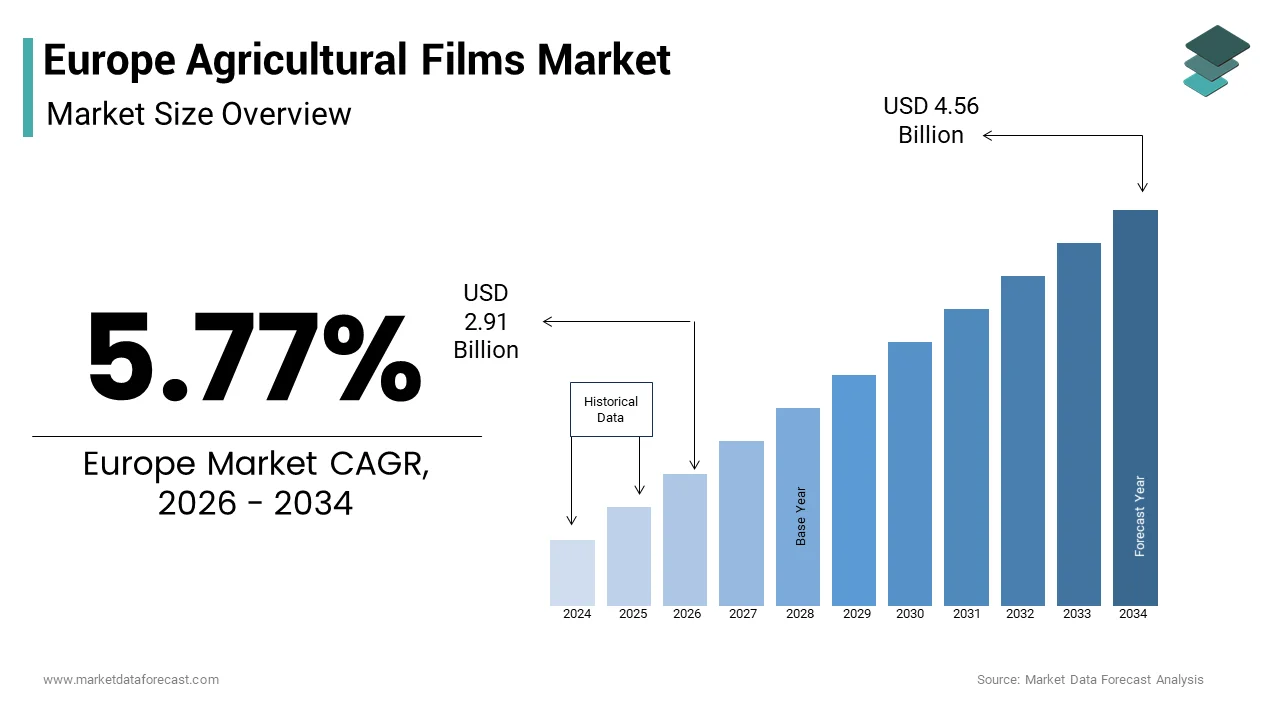
Agricultural films refer to polymeric sheets, primarily made from polyethylene, polypropylene, and biodegradable polymers, deployed across crop production systems to modify microclimate, enhance soil conditions, and improve yield efficiency. These include mulch films, greenhouse films, silage wrap, ps, and tunnel covers engineered to regulate temperature, moisture, and light while suppressing weeds and conserving water. According to sources, Europe's ecosystems and agriculture continued to be threatened by escalating drought conditions and high temperatures in 2024, which led to low cereal production in some regions. Simultaneously, the European Union’s Farm to Fork Strategy establishes a goal of a 50 percent reduction in pesticide use and associated risks by 2030. The European Environment Agency (EEA) points out an increasing trend in the annual extent of intense drought impacts on croplands within the EU. Regulatory frameworks and national extended producer responsibility schemes further influence material selection, driving innovation in recyclable and biobased alternatives. These intersecting environmental, agronomic, and policy forces define the contemporary contours of the Europe agricultural films market.
MARKET DRIVERS
Escalating Climate Variability Intensifies Demand for Protected Cultivation
The region’s increasing exposure to erratic weather patterns has accelerated its adoption as a risk mitigation tool, which drives the growth of the Europe agricultural films market. According to research, Southern Europe is experiencing significantly hotter summers and extended heatwaves, which is a key trend in a warming climate, leading to challenges for traditional open-field farming. In response, farmers are expanding protected agriculture. There is a clear increase in the use of protective farming environments, such as greenhouses and tunnels, across the European Union. Films with advanced thermo-optical properties, such as infrared reflective or diffuse light transmitting variants, are now standard in Dutch and Belgian greenhouse clusters to optimize photosynthesis under variable light conditions. Apart from these, specialized materials with advanced coatings are being developed to help these protective structures last longer and let in enough light for healthy plant growth. National subsidies under the Common Agricultural Policy further support investments. This convergence of climatic stress, policy support, and technological adaptation sustains robust film utilization across European farming systems.
Policy Driven Shift Toward Sustainable Intensification and Input Efficiency
The European Union’s Farm to Fork Strategy is a principal driver for the Europe agricultural films market. This helps in the adoption of agricultural films by promoting resource-efficient farming practices. Mulch films, for instance, reduce herbicide dependency by suppressing weed growth mechanically while minimizing nitrogen leaching through controlled soil moisture. These efficiency gains not only reduce input costs but also contribute to tfarm-levelel carbon accounting required under the EU’s Carbon Farming Initiative. The integration of films into certified sustainable farming protocols, such as GLOBALG.A.P. and Organic EU, further incentivizes adoption among export-oriented producers seeking market access.
MARKET RESTRAINTS
Stringent Waste Management Regulations Increase Compliance Burden
The European Union’s evolving regulatory landscape on plastic waste imposes operational and financial constraints on the growth of the Europe agricultural films market. Countries like Germany and Austria now enforce mandatory take-back schemes requiring farmers to return used films to certified collection points with non-compliance penalties per ton. These logistics add to total film costs. Moreover, the Single Use Plastics Directive restricts biodegradable additives, effectively banning conventional polyethylene mulch in several regions. This regulatory fragmentation forces manufacturers to maintain multiple product lines, recyclable, biodegradable, and compostable, each requiring separate certification under EN standards. The resulting complexity deters small-scale farmers from adopting films despite agronomic benefits.
High Initial Investment and Limited Access to Financing for Smallholders
These films require substantial upfront capital that many regional small and medium farms cannot afford, even after long-term savings, which further restrains the expansion of the Europe agricultural films market. A typical greenhouse installation utilizing modern multi-layer film technology generally involves a significant initial investment. This investment can fall within a broad financial range for a standard one-hectare setup. The final cost is subject to several factors, reflecting the various options available in advanced agricultural infrastructure. Uptake of rural development funds provided by the Common Agricultural Policy remains low because of complex and bureaucratic application processes. In addition, only a portion of eligible Italian smallholders accessed film-related subsidies. Apart from these, leasing models for film infrastructure are underdeveloped outside the Netherlands and Denmark. Consequently, many farmers revert to open field cultivation despite higher yield volatility. The economic barrier will continue to restrict film adoption among the producers most vulnerable to climate shocks until tailored financing mechanisms or cooperative procurement models are scaled.
MARKET OPPORTUNITIES
Rise of Bio-Based and Certified Compostable Films Under Circular Economy Mandates
The transition toward circular agriculture is opening commercial potential for next-generation agricultural films derived from polylactic acid, polyhydroxyalkanoate,,s and starch blends. This is setting up new opportunities for the growth of the Europe agricultural films market. As per research, the capacity to produce certified compostable mulch films within Europe has experienced significant growth over the past couple of years. This growth is propelled by national bans on conventional polyethylene mulch in organic farming. Key countries like France and Spain have adopted regulations mandating that all agricultural films used on organic land must meet a specific certification standard. Apart from these, A new set of guidelines for agricultural plastics was introduced as part of the EU Ecolabel program in 2023. Major retailers prefer produce grown with such films as part of their green sourcing commitments. These regulatory, commercial a,, nd environmental tailwinds are transforming compostable films from niche to mainstream.
Integration of Smart Films with Precision Agriculture Systems
Innovation in functional films embedded with sensors or responsive polymers is creating synergies with the region’s digital farming transformation, which offers major opportunities for the expansion of the Europe agricultural films market. Smart agricultural films, equipped with moisture or temperature-responsive layers, can automatically adjust microclimate conditions without external energy input. For instance, thermo-chromic greenhouse films developed by research consortia in Germany modulate light transmission based on ambient temperature, reducing overheating risk during heatwaves. Similarly, anti-fog films with hydrophilic coatings maintain optical clarity crucial for AI-powered crop monitoring drones. These intelligent films not only enhance agronomic performance but also generate data for carbon footprint verification under the EU’s Digital Product Passport framework. This convergence of material science and digital agriculture opens high-value niches beyond traditional commodity films.
MARKET CHALLENGES
Fragmented Collection and Recycling Infrastructure Hinders Circular Transition
The lack of a cohesive system for recovering and processing used agricultural films, despite policy ambitions, degrades the growth of the Europe agricultural films market. According to sources, most countries within the European Union have not yet established specific programs for collecting plastics used in farming. In Southern and Eastern Europe, many farmers often dispose of used plastic films by burying or burning them on their land because local collection points are unavailable, as per studies. Even where collection exists, contamination from soil and crop residues reduces recyclability. The material used to make new plastic films contains very little recycled content, as increasing this amount is expensive due to the advanced cleaning and processing needed. The economic model is further strained by low oil prices, which make virgin polymer cheaper than recycled granulate. The circularity promise of agricultural plastics will not be fulfilled until extended producer responsibility schemes fund reverse logistics and standardize film compositions across the continent.
Technical Limitations of Biodegradable Films in Diverse European Climates
Compostable films have environmental appeal, but their performance varies significantly across Europe's diverse agro-climatic zones, which in turn weakens farmer confidence and expansion of the Europe agricultural films market. Mechanical strength is another concern. The tensile resistance of many bio-based films is lower than conventional polyethylene. This limits their use in mechanized operations involving transplanters or harvesters. Furthermore, cost premiums persist due to low production scale. The widespread adoption of these materials is constrained by technical gaps, which will persist until regionalized formulations are developed and durability standards are harmonized with actual use conditions.
REPORT COVERAGE
| REPORT METRIC | DETAILS |
| Market Size Available | 2025 to 2034 |
| Base Year | 2025 |
| Forecast Period | 2026 to 2034 |
| CAGR | 5.77% |
| Segments Covered | By Type, Application, By Country |
| Various Analyses Covered | Global, Regional & Country Level Analysis; Segment-Level Analysis, DROC, PESTLE Analysis, Porter’s Five Forces Analysis, Competitive Landscape, Analyst Overview of Investment Opportunities |
| Regions Covered | UK, France, Spain, Germany, Italy, Russia, Sweden, Denmark, Switzerland, Netherlands, Turkey, Czech Republic & Rest of Europe |
| Market Leaders Profiled | Dow Chemical Company, BASF SE, ExxonMobil Corporation, RKW SE, Berry Plastic Group, Inc., Grupo Armando Alvarez, British Polythene Industries Plc., and Barbier Group. |
SEGMENT ANALYSIS
By Type Insights
In 2024, the Linear Low Density Polyethylene (LLDPE) segment held the leading share of 38.3% in the Europe agricultural films market due to its superior mechanical strength, puncture resistance, and flexibility under varying climatic conditions. Moreover, its widespread use in mulch and silage applications, where durability during handling and long field life are critical, further drives the growth of this segment. A further major factor driving the growth of this segment is compatibility with recycling infrastructure. LLDPE’s homopolymer structure allows easier reprocessing compared to multi-layer alternatives and aligns. Apart from these, major film producers in the Netherlands and Belgium have optimized metallocene catalysis to produce thinner yet stronger LLDPE film, reducing material use without compromising performance. These technical and circular economy advantages sustain LLDPE’s dominance.
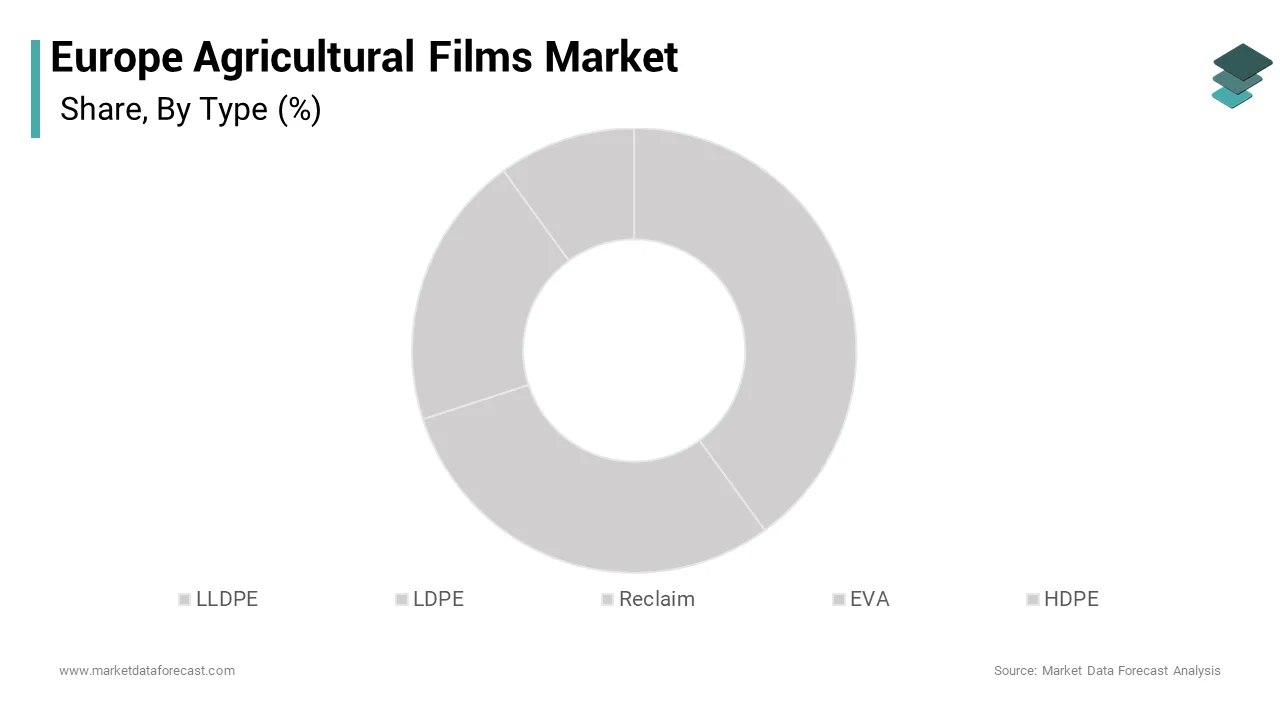
The Ethylene Vinyl Acetate (EVA) segment is predicted to witness the highest CAGR of 9.1% from 2025 to 2033. The rapid growth of the EVA segment is driven by its exceptional optical and thermal properties, making it ideal for advanced greenhouse applications. A different growth driver is the demand for light diffusion and anti-condensation peperformance in gh-value horticulture. This directly enhances yield uniformity in tomato and cucumber cultivation, which dominates ddominatesthe Dutch and Belgian greenhouse sectors. Policy alignment with energy efficiency mandates further propels the growth of this segment. The EU’s Energy Related Products Directive includes greenhouse cladding in its scope, requiring minimum thermal insulation values. EVA films with infrared blocking additives reduce nighttime heat loss, which enables compliance without structural retrofits. Investment in high-performance EVA films is accelerating across Northern and Central Europe as growers in the region face increasing energy costs.
By Application Insights
The greenhouse film segment was the largest in the Europe agricultural films market by capturing a share of 45.7% in 2024. The prominence of the greenhouse film segment is propelled by the continent’s leadership in protected horticulture and year-round vegetable production. An additional driver of this segment is the scale of greenhouse farming. These systems rely on advanced multi-layer films with UV stabilization anti anti-fog, and thermal retention properties to extend growing seasons and optimize light use efficiency. A different growth factor is policy support under the Common Agricultural Policy, which allocated funds for climate-resilient infrastructure, including energy-saving greenhouse covers. Countries have mandated the use of thermal screens in new greenhouses to reduce natural gas consumption, a measure directly enabled by specialized EVA and LLDPE films. Apart from these, the shift toward vertical farming and semi-closed greenhouse systems in urban peripheries of Germany and France further amplifies demand for high-durability optical-grade films. This structural and regulatory foundation ensures greenhouse films remain the core of the market.
The mulch film segment is estimated to register the fastest CAGR of 8.7% over the forecast period, owing to the EU mandates to reduce chemical inputs and enhance soil health. A different major accelerator of this segment is the Farm to Fork Strategy’s requirement to cut pesticide use by 50 percent by 2030, which has elevated physical weed suppression through mulching as a key agronomic tool. The transition to compostable variants also propels the expansion of this segment. France and Spain banned conventional polyethylene mulch in organic farming, requi17033-certifiedertified biodegradable films. Apart from these, innovations in black on white mulch designs improve soil temperature regulation for early season planting, vital in Scandinavia and the Baltic, where growing windows are narrow. These regulatory, agronomic, and climatic factors are converging to drive rapid mulch film expansion.
COUNTRY ANALYSIS
Spain Agricultural Films Market Analysis
Spain led the Europe agricultural films market and accounted for a 22.8% share in 2024, with its extensive horticultural sector and arid climate conditions. The country accounts for substantial hectares of greenhouse and tunnel cultivation, primarily in Andalusia and Murcia. Intense solar radiation and water scarcity make films essential for moisture retention, temperature control, and UV protection. An additional enabler is the national irrigation modernization program,which integrates mulchh film use to achieve water savings in vegetable production. Apart from these, Spain leads in compostable mulch adoption following the 2023 Royal Decree mandating biodegradable films in all organic farming operations. These regulatory and environmental pressures, combined with export-oriented agriculture, solidify Spain’s leadership in film consumption.
Italy Agricultural Films Market Analysis
Italy was the second-largest country in the Europe agricultural films market and captured an 18.4% share in 2024. The growth of the Italian market is due to its diverse crop portfolio and strong Southern horticulture. A different driver is water stress. A different factor is policy alignment with the National Recovery and Resilience Plan, which allocated funds for sustainable plastic alternatives in agriculture. This funding accelerated the adoption of recyclable and biodegradable mulch films among smallholders in Puglia and Sicily. Furthermore, Italy hosts leading film producers in the Emilia Romagna region who export advanced EVA greenhouse films across Europe. These industrial agronomic and policy synergies sustain Italy’s strategic market role.
Netherlands Agricultural Films Market Analysis
The Netherlands maintains a noteworthy position in the Europe agricultural films market due to technologically advanced greenhouse systems and export-driven horticulture. The country maintains a large number of ihigh-techgreenhouses, primarily cultivating tomatoes, peppers, and cut flowers for European markets. These installations require premium multi-layer films with light diffusion anti anti-condensation, and thermal properties to maximize energy efficiency and yield. A distinguishing factor is strict compliance. This has driven he adoption of infrared reflective EVA films that cut heating demand. Apart from these, the Netherlands operates one of Europe’s most efficient agricultural plastic collection systems. These technological and circular economy leadership traits ensure the Netherlands remains a high-value market despite its limited land area.
France Agricultural Films Market Analysis
France is moving ahead steadily in the European agricultural films market, with growth driven by organic farming expansion and regulatory innovation. The country mandates EN 17033 certification for all agricultural mulch used on organic land, accelerating the adoption of starch and PLA-based alternatives. An additional driver is the national drought resilience strategies. Additionally, France hosts key R and D centers such as the French National Institute for Agricultural Research, which pioneers weed-light-selective films that suppress weed growth without herbicides. These policies, scientific and environmental initiatives position France as a leader in sustainable film innovation.
Germany Agricultural Films Market Analysis
Germany is likely to grow in the Europe agricultural films market between 2025 and 2033, owing to its advanced recycling infrastructure and precision farming adoption. Protected cultivation is expanding in the vegetable and nursery sectors, particularly in North Rhine-Westphalia and Lower Saxony, even though open field agriculture remains dominant. A different enabler is Germany’s agricultural plastic take-back system, operated. , government further incentivizes circularity through the Circular Economy Act, which requires producers to fund end-of-life management. Aparthesethesethes,e German machinery manufacturers integrate film laying and recovery into automated sysystemsenhancing efficiency for large-scale farms. These systemic approaches to sustainability and mechanization establish Germany as a model for responsible film use in temperate climates.
COMPETITIVE LANDSCAPE
The Europe agricultural films market features dynamic competition shaped by sustainability mandates, technological differentiation,n and regional policy fragmentation. Large multinational converters dominate the commodity segment with economies of scale in LLDPE and LDPE production, while specialized biopolymer firms compete on environmental credentials and certification compliance. Regulatory pressure under the EU’s circular economy action plan has raised entry barriers, favoring companies with in-house R and D and recycling partnerships. Competition is increasingly centered on film functionality—such as light diffusion, thermal retention, and controlled degradation—rather than price alone. National bans on conventional plastics in organic farming have created niche high-growth segments where innovation in starch and PHA-based films is accelerating. The market also reflects a north-south divide, with Northern Europe prioritizing recyclability and Southern Europe focusing on biodegradability due to differing collection infrastructures and crop systems. Collaboration across the value chain—from resin producers to farmer cooperatives—is emerging as a critical competitive lever to navigate complex regulatory and environmental expectations.
KEY MARKET PLAYERS
Some of the major players in the Europe agricultural market include
- The Dow Chemical Company
- BASF SE
- Novamont S.p. A
- ExxonMobil Corporation
- RKW SE
- Berry Plastic Group, Inc.
- Grupo Armando Alvarez
- British Polythene Industries Plc.
- Barbier Group.
Top Players In The Market
- RKW Group is a leading European manufacturer of agricultural films with a strong portfolio of LLDPE and biodegradable solutions tailored for mulch and silage applications across diverse climatic zones. The company supplies high-performance films to farmers and cooperatives in Germany, France, and Southern Europe while also serving global markets through its production facilities in Asia and North America. In recent years, RKW has intensified its focus on circularity by launching a fully recyclable mono-material mulch film compatible with existing collection schemes. The company also partnered with agricultural machinery manufacturers in the Netherlands to develop integrated film laying and recovery systems that minimize soil contamination and enhance recyclability under the EU’s extended producer responsibility framework.
- Berry GGlobalc.plays a significant role in the European agricultural films sector through its extensive production network and innovation in sustainable film technologies. The company offers advanced greenhouse and silage films engineered for energy efficiency and durability under extreme weather conditions. In 204 Berry Global expanded its EVA-based greenhouse film line in Italy, featuring infrared blocking and anti-condensation additives to support energy reduction targets in protected horticulture. The firm also launched a certified compostable mulch film compliant with EN 17033 standards for organic farms in France and Spain. These initiatives align with EU Farm to Fork objectives and reinforce Berry’s commitment to agronomic and environmental performance.
- Novamont S.p.A. is a pioneer in bio-based and biodegradable agricultural films in Europe, specializing in Mater Bi formulations derived from starch and biopolyesters. The company’s compostable mulch films are widely adopted in organic vineyards, strawberry fields, and vegetable farms across Italy, France, and Germany. The company also collaborated with the European Bioplastics Association to establish field degradation monitoring protocols, ensuring compliance with soil health regulations. Through science-based innovation and policy engagement, Novamont continues to shape the transition toward circular agriculture in Europe and beyond.
Top Strategies Used By The Key Market Participants
Key players in the Europe agricultural films market prioritize regulatory alignment by developing products that comply with the EU’s Single Use Plastics Directive, Farm to Fork Strategy, and national extended producer responsibility schemes. They invest in mono-material and bio-based formulations to enhance recyclability and biodegradability while maintaining agronomic performance. Companies collaborate with agricultural machinery manufacturers to integrate film application and recovery into precision farming workflows. Strategic partnerships with national collection systems and recyclers ensure end-of-life management and support circular economy claims. Additionally, firms engage in field trials and certification processes to validate compostability under real-world European climatic conditions, thereby building farmer and policymaker trust.
MARKET SEGMENTATION
This research report on the Europe agricultural market is segmented and sub-segmented into the following categories.
By Type
- LLDPE
- LDPE
- Reclaim
- EVA
- HDPE
By Application
- Greenhouse Film
- Mulch Film
- Silage Film
By Country
- UK
- France
- Spain
- Germany
- Italy
- Russia
- Sweden
- Denmark
- Switzerland
- Netherlands
- Turkey
- Czech Republic
- Rest of Europe