- Product Description Description
- Table of Contents TOC
- List of Table & Figure LOT
- Get Free Sample PDF Sample PDF
Market Size, 2025
$0.50 BnMarket Estimate, 2026
$0.53 BnMarket Forecast, 2034
$0.81 BnCAGR, 2026–2034
5.57%Europe Agricultural Miticide Market Size, Share, Trends & Forecast (2026–2034)
- Market Scope: Comprehensive market analysis of the European agricultural miticide market covering active ingredients, application areas, crop types, country-level regulatory frameworks under EU standards, and sustainable IPM drivers.
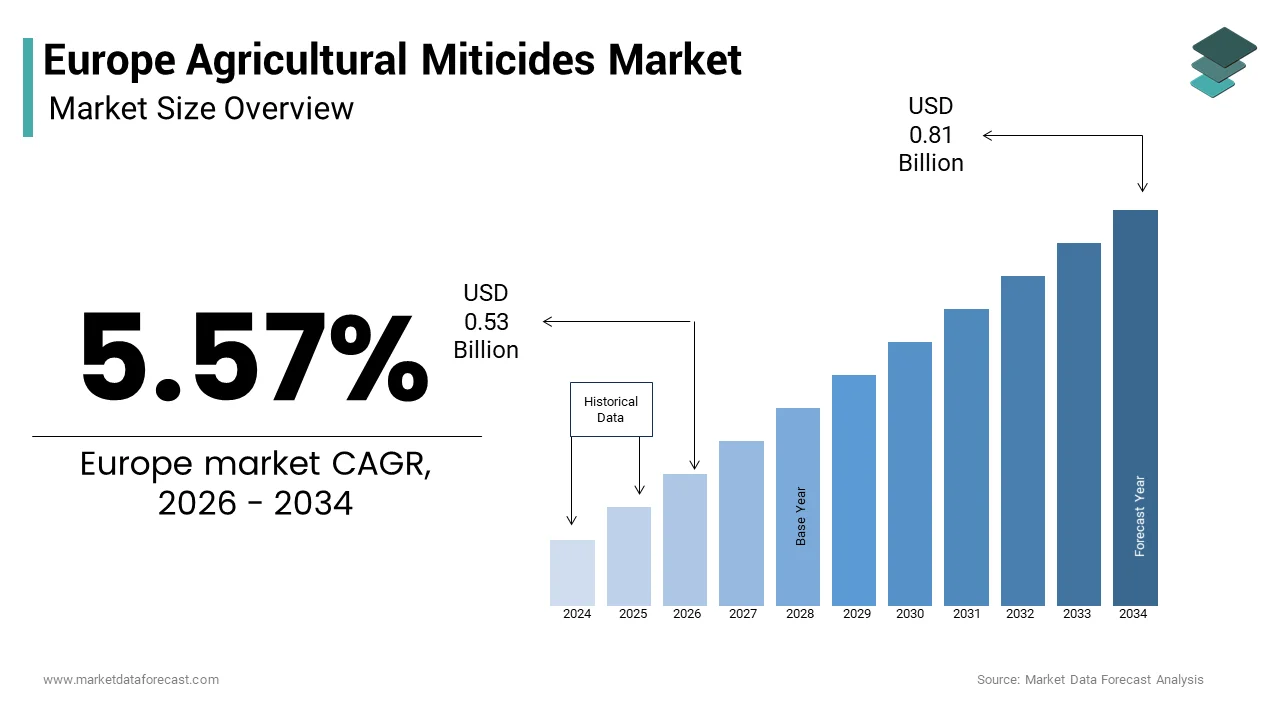
- Market Valuation: Valued at USD 0.50 billion (2025), estimated at USD 0.53 billion (2026), and projected to reach USD 0.81 billion by 2034, growing at a compound annual growth rate (CAGR) of 5.57% (2026–2034).
- Primary Growth Drivers: Escalating mite resistance to conventional acaricides under integrated pest management (IPM) pressure, rapid expansion of protected cultivation and high-value horticulture (especially in Southern and Central Europe), and the rise of precision digital agriculture platforms.
Europe Agricultural Miticide Market Segment Metrics (2026–2034)
| Category | Leading Segment (2025 Position) | Fastest-Growing Segment |
|---|---|---|
| By Product Type (Active Ingredient) | Abamectin (holding 28.3% market share in 2025 due to broad-spectrum efficacy) | Bifenazate (growing at an anticipated CAGR of 9.7% via low-risk profiles) |
| By Application Area | Greenhouses (capturing 36.2% market share due to controlled environment pressures) | Orchards (growing at an 8.3% CAGR across Mediterranean and Central Europe) |
| By Crop Type | Fruits & Vegetables (high-value horticultural adoption) | Ornamentals & Specialty Crops |
| By Country / Region | Spain (holding 22.3% market share via extensive protected tunnel and citrus farming) | France & Italy (driven by viticulture and strict IPM compliance frameworks) |
Major Industry Players & Market Structure
Market Structure: Highly regulated and competitive European crop protection market balancing stringent EU pesticide directives (Regulation EC 1107/2009) with the demand for selective, low-impact botanical and chemical acaricides.
Key Companies: BASF SE, Syngenta AG, UPL Ltd, Bayer Crop Science, FMC Corporation, Adama Agricultural Solutions, Gowan Company, Valent Biosciences, Sumitomo Chemical, OHP, Inc., Rotam Europe, Certis USA, Osho Chemical Industries, and Meerut Agro Chemical Industries.
Europe Agricultural Miticide Market Size
The European agricultural miticide market was valued at USD 0.50 billion in 2025 and is anticipated to reach USD 0.53 billion in 2026 from USD 0.81 billion by 2034, growing at a CAGR of 5.57% from 2026 to 2034.
Current Introduction and Definition of the Europe Agricultural Miticide Market
The agricultural miticide is the chemical and biological agents specifically formulated to control mite infestations, including spider mites rust mites and gall mites in crop production systems, across the European Union. These products are applied in high value horticulture viticulture fruit orchards and protected cultivation, where mite damage can cause significant yield loss and quality degradation. Unlike broad spectrum insecticides miticides in Europe are subject to stringent regulatory scrutiny under Regulation EC 1107/2009, which mandates rigorous environmental and toxicological assessments before authorization. According to the European Food Safety Authority over 85 active substances previously used in miticides have been withdrawn since 2010 due to concerns about aquatic toxicity pollinator safety or endocrine disruption. As per the European Commission’s Sustainable Use of Pesticides Directive, member states must reduce high risk pesticide use by 50% by 2030 accelerating demand for selective low impact alternatives. National action plans such as France’s Ecophyto III and Germany’s National Action Plan on Plant Protection further restrict application windows and require integrated pest management documentation.
MARKET DRIVERS
Escalating Mite Resistance to Conventional Acaricides Under Integrated Pest Management Pressure
Intensive use of limited chemical classes has accelerated mite resistance, across key European crops creating urgent demand for novel mode of action miticides. The escalating mite resistance to conventional acaricides under integrated pest management pressure is impacting positively on the growth of Europe agriculture miticide market. According to the European and Mediterranean Plant Protection Organization, over 40 mite species in the EU now exhibit resistance to at least two major acaricide groups including organotin compounds and pyrethroids. In Spain, the Ministry of Agriculture reported that Tetranychus urticae populations in strawberry greenhouses showed 92% resistance to bifenthrin by 2024 forcing growers to rotate chemistries more frequently. Similarly, in Italy the Council for Agricultural Research confirmed that vineyard rust mites developed cross resistance to abamectin and fenpyroximate in 68% of monitored sites between 2022 and 2024. As per the European Food Safety Authority, EFSA now requires resistance management plans as part of all new miticide dossiers with a rule that incentivizes innovation in novel biochemicals like tetronic acid derivatives and METI inhibitors. This biological arms race compels continuous product renewal ensuring sustained demand for next generation miticides even amid overall pesticide reduction targets.
Expansion of Protected Cultivation and High Value Horticulture Across Southern and Central Europe
The rapid growth of greenhouse and tunnel farming for vegetables berries and ornamentals has intensified mite pressure due to stable warm environments ideal for mite proliferation, which is additionally escalating the growth of Europe agricultural miticide market. According to Eurostat, the area under protected cultivation in the EU expanded by 18% between 2021 and 2024 reaching over 420,000 hectares with Spain Italy and the Netherlands leading adoption. As per France’s Agreste statistical, service protected strawberry farms in Brittany recorded average mite related yield losses of 22% without intervention by making targeted miticide use economically non optional. The high-tech horticulture infrastructure further concentrating production in mite prone environments. This structural shift toward intensive high value systems ensures consistent demand for precise effective miticides despite broader pesticide reduction policies.
MARKET RESTRAINTS
Stringent Regulatory Withdrawals and Data Requirements Under EU Pesticide Legislation
The European Union’s precautionary regulatory approach has led to the systematic withdrawal of effective miticide active ingredients creating formulation gaps and limiting grower options. The stringent regulatory withdrawals and data requirements under EU pesticide legislation is restricting the growth of Europe agricultural miticide market. According to the European Commission’s Pesticide Residues in Food report some miticide substances were not renewed between 2020 and 2024 due to concerns about groundwater contamination or non-target organism toxicity. In 2024, the European Food Safety Authority refused approval for flufenoxuron citing unacceptable risks to aquatic invertebrates, a decision that eliminated a key rotational chemistry for apple and grape growers. As per the European Crop Protection Association, only 12 new miticide active ingredients received EU authorization between 2015 and 2024 compared to 38 in the preceding decade reflecting rising data requirements and cost barriers. This regulatory attrition forces reliance on fewer chemistries accelerating resistance and reducing integrated pest management flexibility particularly in organic and low input systems.
Limited Efficacy and Registration of Biological Miticides in Diverse Climatic Conditions
While biocontrol agents offer a sustainable alternative their inconsistent performance, across Europe’s varied agroclimatic zones restricts widespread adoption. The limited efficacy and registration of biological miticides in diverse climatic conditions is also impeding the growth of Europe agricultural miticide market. According to the International Organisation for Biological Control, trials in Northern Europe show that predatory mites like Phytoseiulus persimilis achieve only 45 to 60% control of spider mites below 18 degrees Celsius temperatures common in spring and autumn. In Germany, the Julius Kuhn Institute reported that microbial miticides based on Beauveria bassiana failed to establish in field conditions with relative humidity below 70% limiting use in continental climates. As per the European Biocontrol Manufacturers Association, only 9 biological miticide products hold full EU authorization compared to 42 chemical options due to complex efficacy demonstration requirements under Regulation EC 1107/2009. Furthermore, national approvals vary, which a product authorized in Spain may lack validation data for Polish conditions delaying pan European rollout.
MARKET OPPORTUNITIES
Development of RNA Interference Based and Species Specific Miticides Under EU Innovation Frameworks
Emerging biotechnological approaches offer highly targeted mite control with minimal ecological impact aligning with Europe’s sustainability mandates. The development of RNA interference-based species specific miticies with the increasing support from EU innovation frameworks is certainly to create new opportunities for the growth of Europe agricultural miticide market. According to the European Commission’s Horizon Europe program 14 projects received funding in 2024 to develop RNA interference RNAi sprays that silence essential genes in specific mite pests without affecting beneficial arthropods. In the Netherlands, Wageningen University demonstrated that dsRNA targeting V-ATPase in Tetranychus urticae reduced populations by 89% in greenhouse trials with no off target effects on predatory mites. As per the European Food Safety Authority, EFSA issued a scientific opinion in 2024 confirming that topically applied RNAi molecules degrade rapidly in soil and water posing negligible environmental risk with a step toward regulatory acceptance. Companies like Bayer and BASF are piloting RNAi formulations under the EU’s Important Project of Common European Interest on Sustainable Agriculture. These precision tools could bypass traditional toxicity hurdles and gain faster approval as non-persistent biopesticides opening a new frontier in selective mite management.
Integration of Miticide Use into Digital Farming and Precision Application Platforms
The rise of digital agriculture enables targeted miticide deployment that minimizes volume while maximizing efficacy, directly supporting EU pesticide reduction goals. The integration of miticide use into digital farming and precision application platforms is According to the European Space Agency satellite and drone based multispectral imaging can now detect early mite stress symptoms through changes in leaf reflectance allowing treatment only in affected zones. In France the National Federation of Agricultural Holders reported that 63% of vineyards using precision sprayers reduced miticide use by 35% in 2024 while maintaining control efficacy. As per the European Committee for Standardization CEN is finalizing ISO protocols for AI driven pest scouting systems that integrate mite identification with automated spray recommendations. Companies like John Deere and Bosch have launched smart sprayers that adjust dosage in real time based on canopy density and infestation levels. This data driven approach transforms miticides from blanket inputs into surgical interventions by enhancing sustainability compliance while preserving economic viability for growers under tightening regulatory constraints.
MARKET CHALLENGES
Fragmented National Authorization Processes Delaying Access to New Solutions
The national divergences in zonal evaluation create significant delays in miticide availability across member states, which is posing a challenge for the growth of Europe agricultural miticide market. According to the European Commission’s Standing Committee on Plants Animals Food and Feed, a miticide approved in the Southern zone Spain, Italy, Portugal may take up to 18 months to gain authorization in the Northern zone Germany, Sweden, Denmark due to differing residue or ecotoxicity interpretations. A Czech grower association reported that a novel tetronic acid miticide registered in Hungary remained unavailable in the Czech Republic for 14 months due to additional local bee toxicity studies. As per the European Crop Protection Association these delays force farmers to use older less effective chemistries increasing resistance risk and yield loss. The lack of mutual recognition undermines the single market principle and discourages investment in minor crop uses where registration costs cannot be amortized across all countries.
Shortageof Trained Agronomic Advisors for Miticide Resistance and Rotation Planning
Effective miticide stewardship requires expert guidance on mode of action rotation and resistance monitoring with a service increasingly scarce, which is additionally degrading the growth of Europe agricultural miticide market. According to the European Network for Rural Development only 28% of EU farms with mite prone crops have regular access to certified crop protection advisors. In Romania, the National Phytosanitary Authority noted that 61% of fruit growers applied the same miticide class for three consecutive seasons in 2024 due to lack of technical advice accelerating local resistance development. As per the European Institute for Vocational Training, fewer than 500 new agronomy graduates specializing in acarology enter the workforce annually against demand for over 2 000 across the EU. Digital tools exist but most are in English or German limiting accessibility for Southern and Eastern European farmers. This knowledge gap results in suboptimal product use eroding efficacy and undermining the sustainability goals that new miticides are designed to support. Bridging this advisory deficit is critical to ensuring that regulatory and technological advances translate into real world mite management outcomes.
REPORT COVERAGE
| REPORT METRIC | DETAILS |
| Market Size Available | 2025 to 2034 |
| Base Year | 2025 |
| Forecast Period | 2026 to 2033 |
| CAGR | 5.57% |
| Segments Covered | By Product Type, Application Area , Crop Type, and By Country |
| Various Analyses Covered | Global, Regional & Country Level Analysis, Segment-Level Analysis, DROC, PESTLE Analysis, Porter’s Five Forces Analysis, Competitive Landscape, Analyst Overview on Investment Opportunities |
| Regions Covered | UK, France, Spain, Germany, Italy, Russia, Sweden, Denmark, Switzerland, Netherlands, Turkey, the Czech Republic, and the Rest of Europe |
| Market Leaders Profiled | BASF Ornamentals, FMC Corporation, Adama Agricultural Solutions, Dow, Bayer Crop Science, Gowan Company, Syngenta AG, Valent Biosciences, Sumitomo Chemical, OHP, Inc, Rotam Europe, Certis USA, Osho Chemical Industries, Meerut Agro Chemical Industries. |
SEGMENTAL ANALYSIS
By Product Type
The abamectin segment was accounted in holding 28.3% of the Europe agricultural miticide market share in 2025 due to its broad spectrum efficacy against spider mites and established registration across diverse crops. According to the European Food Safety Authority, abamectin remains authorized in 24 EU member states for use in vineyards orchards and protected vegetables despite regulatory scrutiny owing to its rapid degradation in sunlight and soil. The French Ministry of Agriculture reported that many apple and pear growers used abamectin as a rotational chemistry in 2024 to manage resistance to newer chemistries. In Spain, the Ministry of Agriculture confirmed that abamectin was the most applied miticide in strawberry greenhouses covering over 18,000 hectares due to its compatibility with biological control agents like Phytoseiulus persimilis. As per the European Crop Protection Association, abamectin formulations have undergone extensive re evaluation under Regulation EC 1107/2009 and received renewed approval with updated risk mitigation measures including buffer zones and restricted application windows. Its cost effectiveness residual activity and integration into resistance management programs ensure continued dominance despite pressure from newer selective molecules.
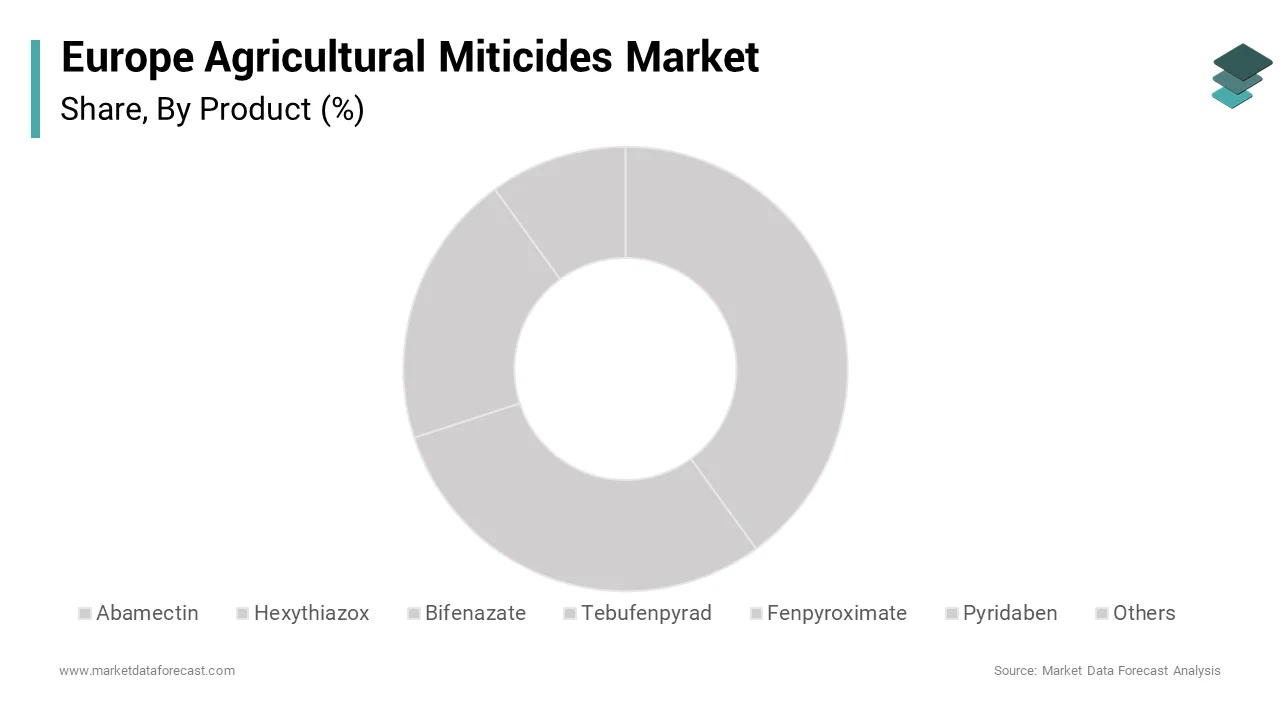
The bifenazate segment is anticipated to grow at an anticipated CAGR of 9.7% throughout he forecast period owing to its unique mode of action favorable ecotoxicological profile and compatibility with integrated pest management. According to the European Food Safety Authority, bifenazate exhibits negligible toxicity to bees predatory mites and aquatic organisms making it eligible for use in sensitive ecosystems and organic transition systems. In the Netherlands, the Product Board for Horticulture reported that 71% of tomato and cucumber greenhouse operators adopted bifenazate in 2024 as a cornerstone of resistance management due to its selective action on Tetranychus species without disrupting beneficial arthropods. As per the German Federal Office of Consumer Protection and Food Safety, bifenazate received full authorization in 2023 under reduced data requirements for low risk substances with a regulatory pathway that accelerates market access. Companies like Sipcam Oxon and UPL launched new formulations with enhanced rainfastness and systemic movement in 2024 further expanding its use in open field vineyards and berry farms. This combination of environmental safety agronomic performance and regulatory tailwinds positions bifenazate as the leading next generation miticide in Europe’s sustainability focused landscape.
By Application Insights
The greenhouses segment was the largest by capturing 36.2% of the Europe agricultural miticide market share in 2024 owing to the mite-pressure in controlled environments and high crop value justifying targeted interventions. According to Eurostat, the EU’s protected cultivation area reached 420 000 hectares in 2024 with tomatoes cucumbers strawberries and ornamentals accounting for 78% of production. The Dutch Product Board for Horticulture reported that greenhouse vegetable growers apply miticides an average of 4.2 times per cycle with spider mites causing yield losses up to 30% if uncontrolled. In Spain, the Ministry of Agriculture confirmed that over 12,000 hectares of strawberry tunnels rely on scheduled miticide rotations to maintain fruit quality for export. The economic imperative to protect high value crops in enclosed environments ensures consistent demand for effective reliable miticides despite overall pesticide reduction targets.
The orchards segment is likely to witness a fastest CAGR of 8.3% from 2025 to 2033 owing to the expanding fruit production and rising mite pressure in Mediterranean and Central European regions. According to Eurostat, the EU’s apple and pear orchard area grew by 9% between 2021 and 2024 reaching over 2.1 million hectares with Spain Italy and Poland leading expansion. In France, Agreste reported that rust mite infestations in vineyards increased by 18% in 2024 due to warmer winters enabling earlier population buildups, prompting more frequent miticide applications. As per the Italian Council for Agricultural Research gall mites in olive groves caused cosmetic damage affecting premium oil certification driving adoption of targeted treatments. The European Commission’s Fruit and Vegetables Promotion Scheme allocated 180 million euros in 2024 to support high density orchard systems which are more susceptible to mite outbreaks due to canopy density. With the EU targeting 25% organic fruit production by 2030 even conventional orchards must adopt selective low impact miticides by creating sustained demand for precision acaricides in this high value perennial crop segment.
COUNTRY ANALYSIS
Spain Agricultural Miticide Market Analysis
Spain was the top performer by occupying 22.3% of the Europe agricultural miticide market share in 2024 with its vast horticultural and fruit production under both open field and protected cultivation. According to the Spanish Ministry of Agriculture, the country manages over 35,000 hectares of strawberry tunnels and 280 000 hectares of citrus orchards both highly susceptible to spider and rust mites. As per the National Institute for Agricultural and Food Research and Technology, INIA trials in 2024 showed that uncontrolled mite populations reduced tomato yields in Almería greenhouses by up to 35%. Spain’s warm climate enables year-round mite reproduction creating continuous demand for rotational miticide programs. National policies under the Ecophyto Plan support integrated approaches but recognize that chemical intervention remains essential in high intensity systems—securing Spain’s position as Europe’s miticide consumption leader.
Italy Agricultural Miticide Market Analysis
Italy agricultural miticide market was the largest by holding 17.3% of share in 2024, across vineyards olive groves and fruit orchards. In Emilia, Romagna and Veneto apple and pear growers combat spider mites that compromise fruit finish required for premium markets. The Ministry of Agricultural Policies reported that 58% of protected vegetable farms in Puglia applied miticides at least three times per cycle in 2024. As per the National Association of Organic Producers, FederBio even certified organic farms use approved natural miticides like neem extracts due to zero tolerance for cosmetic damage in export chains. Italy’s combination of high value Mediterranean crops climatic suitability for mites and stringent quality standards for fresh produce ensures robust and diversified miticide demand across conventional and transitioning systems.
France Agricultural Miticide Market Analysis
France agricultural miticides market growth is likely to grow with prominent growth opportunities in coming years owing to the strict regulatory oversight and strong emphasis on resistance management in viticulture and fruit production. According to FranceAgriMer, the national agricultural board over 750 000 hectares of vineyards and 210 000 hectares of apple orchards require regular mite monitoring and intervention. The French Agency for Food Environmental and Occupational Health & Safety ANSES confirmed that all miticide authorizations now mandate resistance management plans under the Ecophyto III strategy. In 2024, the National Federation of Fruit Producers reported that 64% of growers used abamectin and bifenazate in rotation to delay resistance development. As per the French Technical Institute for Vine and Wine, IFV trials demonstrated that untreated mite infestations reduced grape sugar accumulation by 12% affecting wine quality.
Netherlands Agricultural Miticide Market Analysis
The Netherlands agricultural miticide market growth is to be driven by the intensive greenhouse horticulture and leadership in integrated pest management. According to the Dutch Central Bureau of Statistics the country’s 4,500 hectares of tomato and 3200 hectares of cucumber greenhouses operate under year-round mite pressure requiring precise acaricide deployment. The Product Board for Horticulture reported that 89% of growers use miticides in strict rotation with biological controls to prevent resistance while maintaining export quality. As per Wageningen University research in 2024, bifenazate and fenpyroximate achieved over 90% control of Tetranychus urticae without harming predatory mites making them preferred choices. The Netherlands Enterprise Agency supports digital scouting tools that trigger miticide applications only when thresholds are exceeded reducing overall volume.
Germany Agricultural Miticide Market Analysis
Germany agricultural miticide market growth is eventually growing with the focus on apple orchards vineyards and emerging berry production under temperate conditions. According to the German Federal Statistical Office, the country cultivates over 35,000 hectares of apples primarily in Saxony and Rhineland Palatinate where spider mites threaten fruit finish required for domestic and EU markets. The Julius Kuhn Institute reported that mite damage in vineyards along the Mosel River increased by 15% in 2024 due to drier summers accelerating population cycles. As per the Federal Office of Consumer Protection and Food Safety, BVL only miticides with low-risk profiles like bifenazate receive expedited authorization under Germany’s strict implementation of EU pesticide regulations. The German Farmers’ Association noted that even organic apple growers use sulfur based miticides during critical periods to meet retailer cosmetic standards.
COMPETITIVE LANDSCAPE
Competition in the Europe agricultural miticide market is defined by a delicate balance between regulatory compliance agronomic necessity and environmental responsibility. Unlike global markets where volume dominates European players compete on scientific validation stewardship and integration into legally mandated sustainable farming systems. The landscape features a mix of multinational innovators like BASF and Syngenta alongside agile generics specialists such as UPL each navigating the EU’s precautionary regulatory framework. National differences in zonal evaluations create fragmentation favoring companies with strong regulatory affairs capabilities. At the same time the rise of digital farming and biological alternatives pressures chemical providers to demonstrate added value through precision efficacy and compatibility with beneficial organisms. As a result, the market rewards firms that combine regulatory foresight agronomic relevance and environmental credibility transforming miticide supply from a commodity transaction into a trusted partnership in sustainable crop protection.
KEY MARKET PLAYERS
These are the market players that are dominating the Europe agriculture miticides market.
- BASF Ornamentals
- FMC Corporation
- Adama Agricultural Solutions
- Dow
- UPL Ltd
- Bayer Crop Science
- Gowan Company
- Syngenta AG
- Valent Biosciences
- Sumitomo Chemical
- OHP, Inc
- Rotam Europe
- Certis USA,
- Osho Chemical Industries
- Meerut Agro Chemical Industries
Top Players In The Market
- BASF SE is a key innovator in the Europe agricultural miticide market offering a portfolio of selective acaricides including bifenazate and fenpyroximate tailored for high value horticulture and viticulture. The company emphasizes resistance management and environmental safety through formulations that minimize impact on beneficial arthropods. BASF launched a next generation bifenazate formulation with enhanced rainfastness and systemic movement approved under the EU’s low risk pesticide pathway. It also partnered with Wageningen University to develop digital decision support tools that integrate mite scouting data with precise application recommendations.
- Syngenta Group maintains a strong presence in the European miticide segment through its abamectin and pyridaben based solutions widely used in greenhouse vegetables and orchards. The company leverages its global R&D network to develop resistance-breaking chemistries while ensuring compliance with stringent EU regulatory standards. Syngenta introduced a new abamectin formulation with reduced application rates and extended residual control authorized in 22 EU member states under updated ecotoxicological dossiers. It also expanded its agronomic advisory services across Southern Europe to train growers on miticide rotation and threshold-based spraying. Through regulatory excellence and field level stewardship Syngenta strengthens trust among professional fruit and vegetable producers navigating pesticide reduction targets.
- UPL Ltd has emerged as a dynamic player in the Europe agricultural miticide market by offering cost effective yet compliant alternatives to legacy chemistries. The company’s portfolio includes bifenazate and hexythiazox formulations registered across major EU growing regions with a focus on greenhouse and berry crops. UPL secured EU authorization for a novel co formulation combining bifenazate with a natural synergist to enhance efficacy at lower doses. It also established a dedicated regulatory affairs hub in Brussels to accelerate zonal approvals and ensure alignment with national action plans.
MARKET SEGMENTATION
This research report on the Europe agricultural miticide market is segmented and sub-segmented into following categories.
By Product Type (Active Ingredient)
- Abamectin
- Bifenazate
- Hexythiazox
- Fenpyroximate
- Spiromesifen
- Milbemectin
- Other Active Ingredients
By Application Area
- Farmland
- Orchard
- Greenhouses
- Nurseries
- Others
By Crop Type
- Fruits & Vegetables
- Cereals & Grains
- Oilseeds & Pulses
- Ornamentals & Others
By Country
- UK
- France
- Spain
- Germany
- Italy
- Russia
- Sweden
- Denmark
- Switzerland
- Netherlands
- Turkey
- Czech Republic
- Rest of Europe