- Product Description Description
- Table of Contents TOC
- List of Table & Figure LOT
- Get Free Sample PDF Sample PDF
Market Size, 2025
$113.5 MnMarket Estimate, 2026
$117.7 MnMarket Forecast, 2034
$157.4 MnCAGR, 2026–2034
3.70%Executive Summary: Europe Agriculture Anti-Transpirant Market
- Market Scope: Comprehensive European market analysis of agricultural anti-transpirants covering types, application segments, regional leadership frameworks, and adoption metrics.
- Market Valuation: Valued at USD 113.50 million (2025), estimated at USD 117.70 million (2026), and projected to reach USD 157.40 million by 2034, growing at a CAGR of 3.70% (2026–2034).
- Primary Growth Drivers: Escalating frequency and intensity of drought episodes across European croplands and the strategic integration of physiological water-saving agents into climate-smart agricultural policy frameworks (such as the EU Farm to Fork Strategy and Common Agricultural Policy).
Key Market Segment Metrics (2026–2034)
| Category | Leading Segment Focus | Fastest-Growing Segment Focus |
|---|---|---|
| By Type | Film Forming Type (held 41.9% of the European market share in 2025 due to broad crop compatibility and immediate physiological effects) | Reflectance Type (projected to register a CAGR of 10.6% driven by residue-free, organic-compliant standards) |
| By Application | Crops Segment (dominated with 71.6% of the market share in 2025 across staple and high-value field crops) | Turf and Ornamental (anticipated to record a CAGR of 12.6% due to urban heat island effects and municipal water restrictions) |
| By Country / Region | Spain (led the market in 2025 with 25.7% regional share due to arid climate and extensive perennial crops) | Turkey & France (witnessing strong CAGRs driven by expanding climate adaptation initiatives and modernizing agricultural practices) |
Major Market Players & Market Structure
Market Structure: Moderately consolidated competitive landscape where multinational agrochemical firms coexist with specialized biostimulant developers, competing on digital platform integration, regulatory compliance (EU safety and residue standards), and field validation.
Key Companies: BASF SE, Bayer AG, Nufarm Limited, Miller Chemical & Fertilizer, Beijing Shenlanlin, Coastal AgroBusiness, Wilt-Pruf Products, Sumi Agro, PBI-Gordon Corporation, Bonide, Aquatrols, and Shanghai Zhilv.
Europe Agriculture Anti-Transpirant Market Size
The Europe agriculture anti-transpirant market size was valued at USD 113.50 million in 2025 and is anticipated to reach USD 117.70 million in 2026 from USD 157.40 million by 2034, growing at a CAGR of 3.70% from 2026 to 2034.
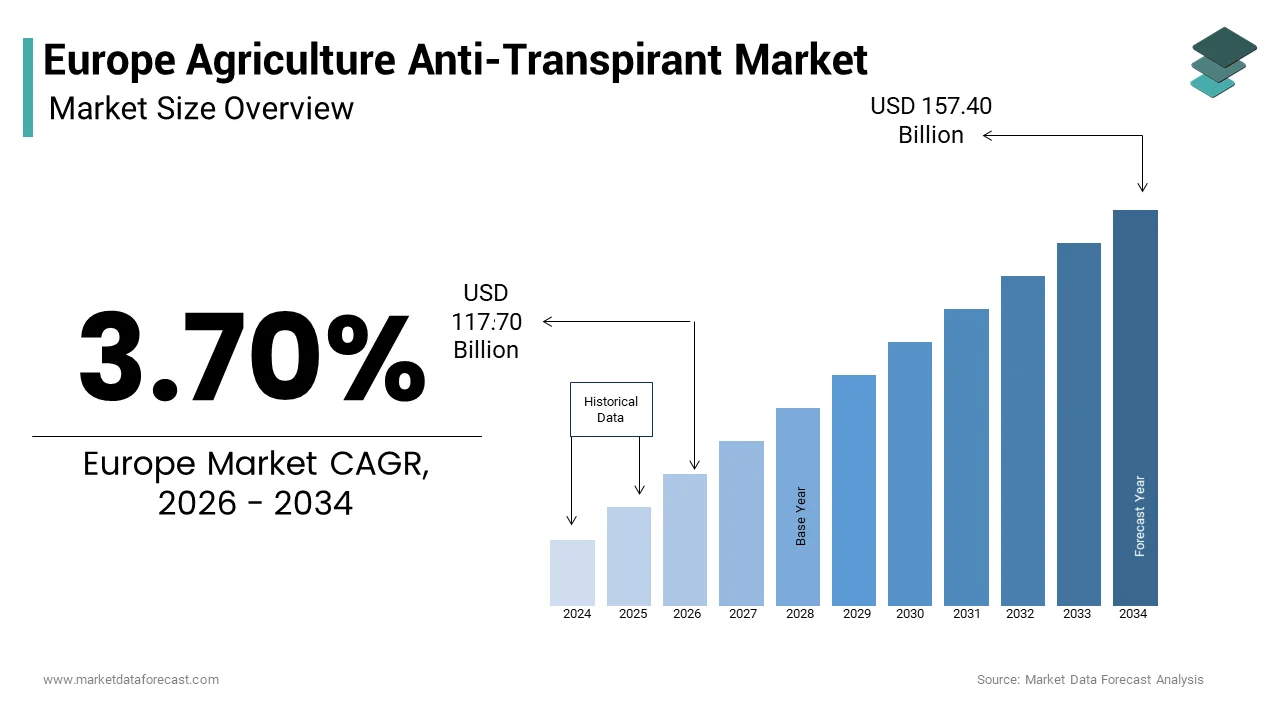
Agricultural anti-transpirants represent a specialized class of agrochemical formulations designed to mitigate non-stomatal and stomatal water loss from plant surfaces during periods of environmental stress. These compounds function by forming semi-permeable or reflective barriers on foliage, thereby enhancing crop resilience against heat waves and moisture deficits without interfering with essential physiological processes like photosynthesis. As climate volatility intensifies across the continent, the strategic deployment of anti-transpirants has transitioned from niche practice to integral agronomic protocol. According to the European Environment Agency, extreme heat days have been increasing since 2000, highlighting the growing need for adaptive crop management. As per Eurostat agricultural indicators, prolonged droughts have been reducing soil moisture levels in Mediterranean regions over the past decade. Unlike generic irrigation solutions, anti-transpirants offer targeted water conservation aligned with the European Union’s Farm to Fork Strategy objectives for sustainable input reduction. Their adoption is increasingly embedded within integrated crop management systems that prioritize resource efficiency and yield stability under unpredictable weather patterns.
MARKET DRIVERS
Escalating Frequency and Intensity of Drought Episodes Across European Croplands
Europe has witnessed a marked acceleration in hydroclimatic extremes, which is directly amplifying the necessity for physiological drought mitigation tools such as anti-transpirants and is majorly propelling the growth of the European agriculture anti-transpirant market. According to the Copernicus Climate Change Service, recent summers have been among the hottest on record for Europe, with soil moisture deficits reaching critical levels across large portions of arable land in southern and central regions. As per the European Drought Observatory, the duration of severe agricultural droughts has been increasing in recent decades. As documented by the Joint Research Centre of the European Commission, cereals have experienced notable reductions in productivity during peak stress periods. Anti-transpirants counteract this by reducing transpirational water loss, thereby preserving turgor pressure and extending the grain-filling period. In Spain, trials conducted by the Spanish National Research Council demonstrated that kaolin-based anti-transpirants improved fruit set during drought conditions. This validation, coupled with recurring climatic disruptions, positions anti-transpirants as a non-negotiable component of modern European agronomy focused on climate adaptation rather than mere reaction.
Integration into Climate-Smart Agricultural Policy Frameworks
The European Union’s policy architecture increasingly incentivizes technologies that enhance water-use efficiency and reduce climate vulnerability, which is also contributing to the growth of the European agriculture anti-transpirant market. According to the Common Agricultural Policy 2023–2027, member states are required to allocate a significant portion of their rural development budgets to climate and environmental objectives. Anti-transpirants align directly with these mandates by enabling yield stabilization without expanding irrigation infrastructure, which is often restricted in water-stressed zones. For example, France’s Ecophyto II+ plan explicitly lists film-forming anti-transpirants as eligible inputs for its low-input cropping systems certification. Similarly, Germany’s National Water Strategy identifies physiological water-saving agents as key enablers for maintaining agricultural output amid declining groundwater recharge rates, as per the Federal Environment Agency. These policy tailwinds create both regulatory legitimacy and financial support mechanisms, including subsidies for demonstration farms using anti-transpirants in high-risk zones. As national adaptation plans under the EU Climate Law mature, anti-transpirants are being codified not as optional supplements but as core components of drought-resilient farming portfolios, accelerating institutional adoption beyond individual grower discretion.
MARKET RESTRAINTS
Stringent Regulatory Frameworks Governing Agrochemical Formulations Under EU Legislation
The commercialization and field application of agricultural anti-transpirants in Europe are profoundly constrained by the European Union’s rigorous regulatory apparatus, particularly Regulation EC No 1107/2009 concerning the approval of plant protection products, which is a significant impediment to the regional market growth. Although many anti-transpirants are classified as biostimulants or adjuvants rather than active pesticidal substances, they often fall into a regulatory grey area that necessitates extensive safety dossiers. The European Food Safety Authority mandates comprehensive ecotoxicological assessments, including data on effects on non-target organisms such as pollinators and aquatic invertebrates. Furthermore, the inclusion of certain film-forming polymers or silicon-based compounds may trigger classification under the REACH regulation, requiring additional registration and risk management measures. This complex compliance landscape disproportionately affects small and medium-sized enterprises, which constitute a significant portion of the European agri-innovation sector. As a result, market entry timelines for novel anti-transpirant formulations can extend beyond five years, stifling innovation despite clear agronomic demand. The regulatory burden is further compounded by divergent national interpretations of biostimulant definitions under the Fertilising Products Regulation EU 2019/1009, creating market fragmentation that impedes economies of scale and consistent product availability across member states.
High-Cost Relative to Traditional Water Management Practices
Despite their agronomic benefits, anti-transpirants remain economically inaccessible for many European farmers when compared to conventional water conservation methods, which is further hampering the expansion of the European agriculture anti-transpirant market. As per the European Agrochemical Cost Observatory, the application cost per hectare per season is significantly higher than optimizing irrigation scheduling through soil moisture probes, which incur lower recurring costs. This cost disparity is particularly acute in Eastern and Southern Europe, where farm incomes are lower than the EU average according to Eurostat. Moreover, the absence of dedicated subsidy lines for anti-transpirants in most national rural development programs means growers must absorb full costs without offsetting support. As per the European Farmers Coordination, many cereal and oilseed producers deemed anti-transpirants financially unjustifiable unless yields increased substantially, a threshold rarely achieved consistently across variable seasons. Until pricing structures become more competitive or public funding mechanisms explicitly recognize anti-transpirants as climate adaptation investments, their adoption will remain confined to high-value horticulture and premium viticulture sectors.
MARKET OPPORTUNITIES
Integration of Anti-Transpirants into Precision Agriculture and Digital Farming Platforms
The convergence of digital agronomy and physiological crop protection presents a transformative opportunity for the European agriculture anti-transpirant market. Advanced farm management software now incorporates real-time microclimate data from satellite imagery and IoT soil moisture sensors to generate hyperlocal irrigation and stress mitigation advisories. Companies like Bayer and BASF have begun embedding anti-transpirant recommendations into their digital platforms, enabling growers to apply these inputs only when predictive models indicate imminent water stress. This precision approach minimizes input waste and maximizes return on investment, addressing a key barrier to adoption. As per the European Commission’s Digital Agriculture Report, large-scale farms in Germany, France, and the Netherlands are increasingly utilizing variable-rate application technologies, creating a ready-made infrastructure for targeted anti-transpirant use. According to Wageningen University, field trials demonstrated that integrating kaolin-based anti-transpirants with drone-based thermal imaging reduced water consumption in orchards while maintaining yield parity. With the EU allocating funding under the Common Agricultural Policy for digital farming adoption, the pathway for scaling anti-transpirant use through tech-enabled decision support systems becomes increasingly viable and economically rational for European producers.
Expansion of Anti-Transpirant Use in High-Value Horticultural and Viticultural Sectors
Europe’s premium horticulture and wine industries offer fertile ground for anti-transpirant market expansion due to their high economic stakes and sensitivity to climate-induced quality degradation, which is another prominent opportunity in the regional market. According to the International Organisation of Vine and Wine, the European Union accounts for a major share of global wine production, with vineyards spanning millions of hectares. Heat stress during veraison can cause berry shrivel and sugar accumulation imbalances, directly compromising enological quality and market value. Similarly, protected horticulture, which includes greenhouse tomato and pepper production, faces escalating cooling costs and humidity-related disease pressures. Anti-transpirants provide a dual benefit in these contexts by reducing evaporative demand and lowering canopy temperatures, as validated in trials by the French National Institute for Agricultural Research. In Italy, reflective particle films have become standard practice in Puglia to prevent sunburn and maintain export-grade appearance in table grapes. The willingness of these high-margin sectors to invest in quality-preserving technologies, coupled with established distribution networks for specialty inputs, creates a scalable model for anti-transpirant penetration that can later cascade into broader field crop applications as costs decrease and regulatory pathways clarify.
MARKET CHALLENGES
Inconsistent Field Performance and Efficacy Variability Across Crop Species and Environmental Conditions
The practical effectiveness of agricultural anti-transpirants in Europe remains hampered by significant variability in performance, which undermines grower confidence and retards widespread adoption and challenging the growth of the European agriculture anti-transpirant market. Efficacy is highly contingent on a complex interplay of factors including crop morphology, application technique, ambient humidity, and wind speed, leading to inconsistent results even within the same region. According to the Julius Kühn Institute in Germany, pinene-based anti-transpirants reduced water loss under controlled conditions, but the same formulation yielded much lower reductions in open-field trials during windy seasons. Similarly, film-forming polymers may crack or degrade prematurely under intense UV exposure common in southern Europe, negating their protective effect earlier than intended. This unpredictability is particularly problematic for risk-averse farmers who operate on thin margins and cannot afford trial and error with input expenditures. As per the European Farmers Coordination, many respondents cited inconsistent results as the primary reason for not reapplying anti-transpirants after an initial trial. Without standardized performance benchmarks and region-specific application protocols validated through multi-year, multi-location trials, the technology struggles to transition from experimental curiosity to reliable agronomic tool, especially when competing against more predictable interventions like supplemental irrigation.
Limited Awareness and Technical Knowledge Among End Users Regarding Application Protocols
Despite growing climatic pressures, a substantial knowledge gap persists among European farmers concerning the correct selection, timing and application methodology for agricultural anti-transpirants, which is further challenging the growth of the regional market. Many growers perceive these products as simple foliar sprays akin to fertilizers, overlooking the critical importance of phenological stage, droplet size, and coverage density for optimal efficacy. Extension services across the EU have been slow to integrate anti-transpirant training into their curricula, partly due to the novelty of the technology and the absence of harmonized best practice guidelines. As per the European Biostimulants Industry Council, only a minority of surveyed agronomists in key agricultural member states felt adequately equipped to advise on anti-transpirant use, while many farmers relied on distributor recommendations that may prioritize sales over agronomic suitability. This lack of technical literacy leads to suboptimal outcomes, such as applying reflective films too early in the season or using excessive concentrations that cause phytotoxicity. According to the Food and Agriculture Organization’s regional office, misapplication rates are estimated to be high in Eastern Europe where access to specialized agronomic advice is more limited. Bridging this educational deficit through targeted demonstration programs, digital advisory tools, and certified training modules is essential to unlock the latent demand for anti-transpirants and ensure their contribution to sustainable water management in European agriculture.
REPORT COVERAGE
| REPORT METRIC | DETAILS |
| Market Size Available | 2025 to 2034 |
| Base Year | 2025 |
| Forecast Period | 2026 to 2034 |
| CAGR | 3.70% |
| Segments Covered | By Type, Application, and By Country |
| Various Analyses Covered | Global, Regional & Country Level Analysis, Segment-Level Analysis, DROC, PESTLE Analysis, Porter’s Five Forces Analysis, Competitive Landscape, Analyst Overview on Investment Opportunities |
| Regions Covered | UK, France, Spain, Germany, Italy, Russia, Sweden, Denmark, Switzerland, Netherlands, Turkey, the Czech Republic, and the Rest of Europe |
| Market Leaders Profiled | Miller Chemical & Fertilizer, Beijing Shenlanlin, Coastal AgroBusiness, Wilt-Pruf Products, Sumi Agro, PBI-Gordon Corporation, Bonide, Aquatrols, and Shanghai Zhilv. |
SEGMENTAL ANALYSIS
By Type Insights
The film forming segment led the market by commanding for 41.9% of the European market share in 2025. The dominance of film forming segment in the European market can be credited to its broad compatibility across crop systems, mechanical simplicity, and immediate physiological effect. Film forming anti-transpirants create a semi-permeable polymer layer on leaf surfaces that physically restricts water vapor diffusion without disrupting gas exchange entirely. Their adoption is particularly pronounced in Mediterranean horticulture where water scarcity is acute. As per the European Crop Protection Association, many registered anti-transpirant products in the EU utilize film-forming chemistries, primarily based on polyethylenes or acrylics. According to the French National Institute for Agricultural Research, film-forming agents have demonstrated reductions in transpiration rates in tomato crops under heat stress, correlating with improved marketable yield. These performance metrics, combined with regulatory acceptance under the EU Fertilising Products Regulation for certain biodegradable formulations, solidify its position as the cornerstone of anti-transpirant deployment in European agriculture.
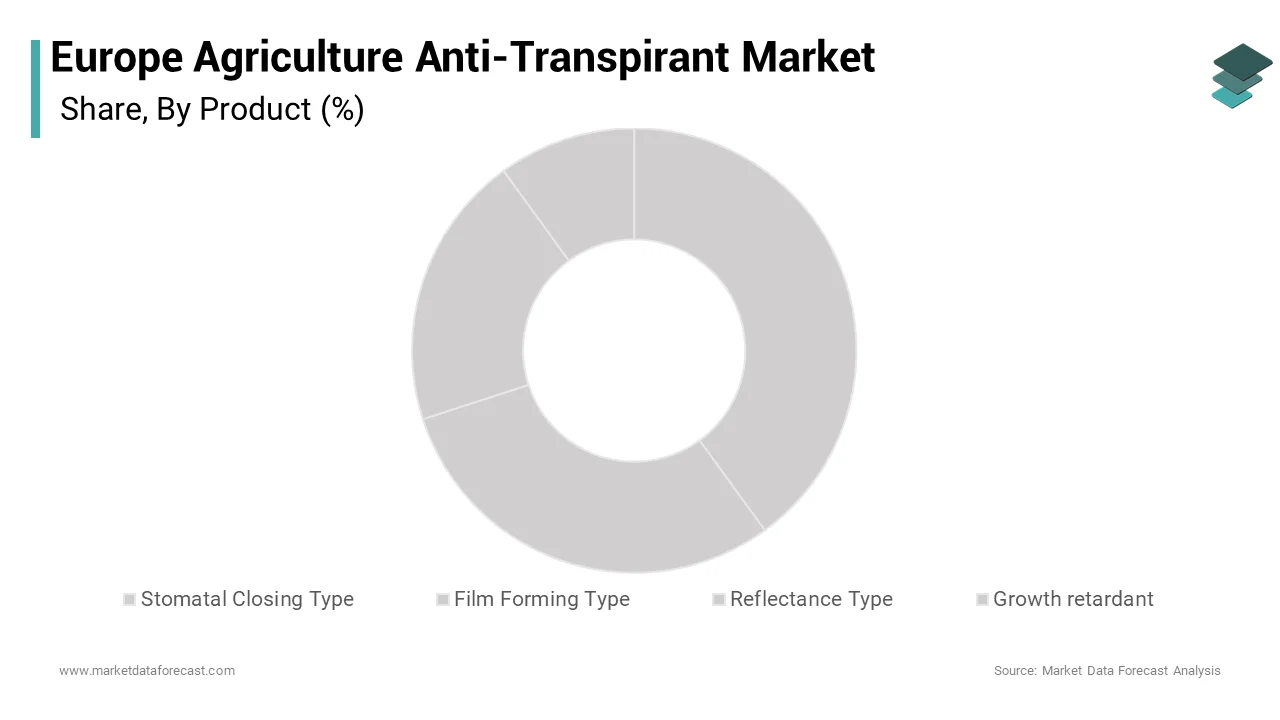
The reflectance type segment is a promising segment and is estimated to register a CAGR of 10.6% over the forecast period owing to the rising demand for non-chemical, residue-free solutions that align with organic farming standards and consumer preferences for clean-label produce. Reflectance anti-transpirants, primarily composed of kaolin or calcium carbonate particles, function by reflecting solar radiation to lower leaf temperature and reduce evaporative demand. Unlike synthetic polymers, these mineral-based formulations leave no persistent residues and are approved for use in certified organic systems under EU Regulation 2018/848. As per the Spanish Meteorological Agency, kaolin-based sprays are widely used in olive and almond orchards to combat summer heatwaves. According to Coldiretti, reflectance products account for a significant share of anti-transpirant use in table grape production, where sunburn damage can cause substantial economic losses. The segment’s growth is further amplified by innovations in particle dispersion technology that enhance adhesion and rainfastness, reducing reapplication frequency and improving cost efficiency for growers.
By Application Insights
The crops segment dominated the market by capturing 71.6% of the European market share in 2025. The growth of the crops segment in the European market is attributed to the economic scale and climate vulnerability of Europe’s staple and high-value field crops, including cereals, olives, grapes, and tomatoes. With extensive agricultural area across the EU, even marginal improvements in water-use efficiency translate into significant yield protection. As per the European Commission’s Joint Research Centre, drought-related crop losses have been significant in recent years, creating urgent demand for physiological mitigation tools. According to the European Environment Agency, groundwater abstraction exceeds renewable supply in regions like Murcia and Andalusia. Furthermore, the inclusion of anti-transpirants in EU guidance documents as non-chemical alternatives for stress management has legitimized their use in mainstream farming. Large cooperative networks in France and Germany now routinely bundle anti-transpirant applications with fungicide sprays, minimizing operational costs and enhancing adoption among conventional growers who prioritize input synergy and logistical efficiency.
The turf and ornamental segment is anticipated to record a CAGR of 12.6% over the forecast period owing to the intensifying urban heat island effects and municipal water restrictions across major European cities. Public green spaces, golf courses, and premium landscaping projects face mounting pressure to maintain aesthetic quality while complying with strict irrigation limits. Anti-transpirants offer a viable solution by reducing evapotranspiration in ornamental plants and turfgrass without altering visual appearance. As per the Royal Horticultural Society, many professional landscapers in the UK now incorporate anti-transpirants into establishment protocols for new plantings, citing improved survival rates during dry spells. In Germany, the number of golf courses using anti-transpirants has risen significantly, driven by the German Golf Association’s sustainability certification program that awards points for water conservation technologies. As urban greening initiatives gain momentum under the EU Green Cities Framework, this segment is poised for accelerated commercialization beyond niche horticultural circles.
COUNTRY-LEVEL ANALYSIS
Spain Agriculture Anti-Transpirant Market Analysis
Spain led the agriculture anti-transpirant market in Europe in 2025 by holding 25.7% of the regional market share. The dominance of Spain in the European market is driven by the country’s arid climate and extensive reliance on high-value perennial crops vulnerable to heat and water stress. Over millions of hectares of olive groves and vineyards located in regions like Andalusia and Castilla-La Mancha create a structural demand for water conservation technologies. As per the Spanish Ministry of Agriculture, much of the nation’s agricultural land is classified as being under high drought risk, a condition exacerbated by declining reservoir capacity according to the Center for Hydrographic Studies. Government-backed pilot programs in Murcia and Valencia have actively promoted anti-transpirants as part of integrated water-saving strategies, with subsidies covering a portion of input costs for certified sustainable farms. Research institutions such as the Instituto de Agricultura Sostenible in Córdoba have validated yield gains in almond orchards using film-forming and reflectance products during peak summer stress. This confluence of climatic necessity, policy support, and scientific validation cements Spain’s position as the epicenter of anti-transpirant adoption in Europe.
Italy Agriculture Anti-Transpirant Market Analysis
Italy accounted for a promising share of the European agriculture anti-transpirant market in 2025. The growth of Italy in the European market is driven by its vast viticulture and horticultural sectors, which are acutely sensitive to thermal stress and quality degradation. Italy produces large volumes of wine annually, representing a significant share of global output according to the International Organisation of Vine and Wine, and its table grape exports generate billions of euros per year as per ISTAT. Heatwaves during critical phenological stages can trigger sunburn, sugar imbalances, and aroma loss, directly impacting market value. In response, regions like Puglia and Sicily have institutionalized the use of kaolin-based reflectance sprays. The Italian National Research Council documented that these applications reduced berry surface temperatures, preserving anthocyanin content and acidity profiles essential for premium wine production. Additionally, the National Rural Development Program allocates specific funding for climate-resilient viticulture, enabling cooperatives to access anti-transpirants at reduced costs. This synergy between economic stakes, climatic exposure, and targeted policy mechanisms drives Italy’s sustained prominence in the market.
France Agriculture Anti-Transpirant Market Analysis
France is expected to exhibit a healthy CAGR in the European agriculture anti-transpirant market during the forecast period. The diversified agricultural landscape and progressive agroecological policies are propelling the French market expansion. While less arid than southern neighbors, France faces increasing summer droughts, particularly in the southwest and Provence. The French Biodiversity Office recorded a rise in agricultural drought declarations in recent years, prompting urgent adaptation measures. Anti-transpirants have gained traction within the framework of the Ecophyto II+ plan, which incentivizes input reduction and resilience building. The French National Federation of Fruit Producers reports that a significant share of apple and cherry orchards in the Rhône Valley now integrate anti-transpirants into bloom-to-harvest protocols. Field trials by Arvalis Institut du Végétal confirmed that stomatal-closing types reduced water use in maize without compromising grain weight under controlled deficit irrigation. Furthermore, France’s robust network of Chambers of Agriculture provides technical training on anti-transpirant use, ensuring knowledge transfer to hundreds of thousands of farms. This blend of climatic pressure, policy alignment, and extension infrastructure sustains France’s strong market presence.
Germany Agriculture Anti-Transpirant Market Analysis
Germany is anticipated to account for a notable share of the European agriculture anti-transpirant market during the forecast period. The focus of Germany on precision agriculture and high-value protected cultivation is driving the German market expansion. Although Germany enjoys relatively abundant rainfall, rising temperatures and erratic precipitation patterns have heightened crop stress in key regions. The anti-transpirant market here is driven less by open-field staples and more by greenhouse horticulture, which spans thousands of hectares of tomato, cucumber, and pepper production according to the Federal Statistical Office. In controlled environments, anti-transpirants help stabilize humidity and reduce energy-intensive cooling demands. BASF and Bayer have partnered with German greenhouse cooperatives to embed anti-transpirant recommendations into digital farm platforms, enabling real-time application based on vapor pressure deficit thresholds. A study by the University of Hohenheim showed that film-forming agents lowered transpiration rates in greenhouse tomatoes during heat spikes, improving fruit firmness and shelf life. Additionally, Germany’s stringent fertilizer ordinance limits nitrogen leaching, indirectly promoting physiological water management over excessive irrigation. This technologically mediated, quality-driven adoption model defines Germany’s unique market trajectory.
Turkey Agriculture Anti-Transpirant Market Analysis
Turkey is estimated to witness a healthy CAGR in the European agriculture anti-transpirant market during the forecast period due to its strategic position as a bridge between Mediterranean and continental climates and its rapidly modernizing agricultural sector. The country cultivates extensive areas of hazelnuts, olives, and grapes, crops highly susceptible to summer desiccation, particularly in the Aegean and Southeastern Anatolia regions. As per the Turkish Statistical Institute, agricultural drought frequency has been increasing, with irrigation water availability declining due to upstream dam construction and aquifer depletion. In response, the Ministry of Agriculture and Forestry launched the Climate-Smart Agriculture Initiative, which includes anti-transpirants in its recommended toolkit for drought-prone provinces. Pilot projects in Izmir demonstrated that reflectance-type products improved fig yield during heatwaves, a finding widely disseminated through Turkey’s agricultural extension service reaching millions of farmers. Moreover, proximity to EU supply chains enables Turkish growers to access advanced formulations at competitive prices. This combination of climatic urgency, policy mobilization, and market access positions Turkey as a dynamic and growing node in the European anti-transpirant landscape.
COMPETITIVE LANDSCAPE
The Europe agriculture anti-transpirant market features a moderately consolidated competitive landscape where multinational agrochemical firms coexist with specialized biostimulant developers. Competition centers less on price and more on product reliability technical support and compatibility with sustainable farming mandates. Leading players differentiate through digital integration offering anti-transpirant recommendations via farm management software that syncs with weather and soil moisture data. Regulatory compliance is a critical battleground with companies racing to reformulate products to meet evolving EU standards on environmental safety and residue limits. Innovation focuses on enhancing rainfastness biodegradability and crop specificity to address performance variability concerns. Smaller firms compete by targeting niche crops or regional climates with tailored solutions while larger corporations leverage distribution scale and agronomic networks. The absence of standardized efficacy metrics creates both opportunity and challenge as brands must independently prove value through extensive field validation and extension partnerships to gain grower trust.
KEY MARKET PLAYERS
Some of the major players in the Agriculture Anti Transpirant market are
- Miller Chemical & Fertilizer
- Beijing Shenlanlin
- BASF SE
- Bayer AG
- Nufarm Limited
- Coastal AgroBusiness
- Wilt-Pruf Products
- Sumi Agro
- PBI-Gordon Corporation
- Bonide
- Aquatrols
- Shanghai Zhilv.
Top Players In The Market
- BASF SE is a pivotal contributor to the Europe agriculture anti-transpirant market through its advanced crop protection and biostimulant portfolio. The company integrates anti-transpirant technologies into its digital farming platform MagIC to enable precision application based on real time field data. In recent years BASF has expanded its R and D collaborations with Mediterranean research institutes to develop climate resilient formulations tailored for olive and grape production. It also launched a new film forming anti-transpirant line in 2024 that degrades fully within 21 days aligning with EU sustainability standards. These initiatives reinforce its commitment to water efficient agriculture while supporting growers in drought prone regions across southern Europe.
- Bayer AG actively shapes the European anti-transpirant landscape through its Climate Smart Agriculture strategy and xarvio digital advisory tools. The company embeds anti-transpirant recommendations into its field zone management system allowing farmers to apply inputs only during high stress windows. Bayer has intensified partnerships with viticulture cooperatives in France and Italy to validate product efficacy under real world heatwave conditions. In 2025 it introduced a reflectance based kaolin formulation certified for organic use which broadened its accessibility to premium horticultural segments. These actions demonstrate Bayer’s focus on integrating physiological protection with data driven agronomy to enhance resilience.
- Nufarm Limited has established a strong presence in the European anti-transpirant market by targeting high value horticultural niches in Spain and Turkey. The company leverages its global supply chain to deliver cost effective reflectance and film forming products adapted to local cropping systems. Nufarm recently enhanced its technical support network by training over 200 agronomists across southern Europe on optimal anti-transpirant application timing and dosage. It also co funded multi location trials with universities in Murcia and Izmir to generate region specific performance data. These efforts strengthen grower trust and position Nufarm as a responsive partner in climate adaptation rather than just an input supplier.
Top Strategies Used by the Key Market Participants
Key players in the Europe agriculture anti-transpirant market prioritize strategic integration of their products into digital farming ecosystems to enable precise and timely applications. They invest heavily in region specific field trials to generate credible agronomic data that validates performance under local climatic stresses. Collaborations with national agricultural research institutions and grower cooperatives are common to accelerate adoption and build technical credibility. Companies also focus on aligning formulations with EU regulatory frameworks particularly around biodegradability and organic certification to ensure market access. Additionally they expand technical service teams to provide hands on training and support thereby reducing misapplication risks and enhancing user confidence across diverse farming contexts.
MARKET SEGMENTATION
This research report on the Europe agriculture anti-transpirant market is segmented and sub-segmented into the following categories.
By Type
- Stomatal Closing Type
- Film Forming Type
- Reflectance Type
- Growth retardant
By Application
- Crops
- Garden
- Turf and Ornamental
By Country
- UK
- France
- Spain
- Germany
- Italy
- Russia
- Sweden
- Denmark
- Switzerland
- Netherlands
- Turkey
- Czech Republic
- Rest of Europe