- Product Description Description
- Table of Contents TOC
- List of Table & Figure LOT
- Get Free Sample PDF Sample PDF
Market Size, 2025
$8.19 BnMarket Estimate, 2026
$8.98 BnMarket Forecast, 2034
$17.47 BnCAGR, 2026–2034
9.61%Executive Summary: Europe Agriculture Market
- Market Scope: Comprehensive regional European agriculture and smart farming industry analysis covering precision farming hardware/software, guidance technologies, crop monitoring applications, regional leadership frameworks, strategic corporate developments, and competitive landscapes.
- Market Valuation: Valued at USD 8.19 billion (2025), estimated at USD 8.98 billion (2026), and projected to reach USD 17.47 billion by 2034, registering a robust CAGR of 9.61% (2026–2034).
- Primary Growth Drivers: High-quality food demand, precision farming tech adoption, EU Common Agricultural Policy (CAP) support emphasizing sustainability/digitalization, AI-powered farm management, drone-based crop monitoring, and regenerative agriculture methods. Restraints include severe labor shortages, aging farmer demographics, and climate change yield impacts.
Key Market Segment Metrics (2026–2034)
| Category | Leading Segment / Region (Position) | Fastest-Growing Segment |
|---|---|---|
| By Technology & Component | Guidance systems (held 54.2% technology share) & Hardware component segment (56.2% share in 2025 via sensors, drones, tractors) | Remote sensing and imaging (projected at an anticipated CAGR of 14.8%) |
| By Application & Use Case | Crop monitoring applications (led due to direct impact on yield optimization and resource efficiency) | AI-powered precision application systems and automated farm management software |
| By Region / Country | Germany (captured 48.2% market share in 2025 with high mechanization) & France (second at 18.5% share) | Emerging tech-integrated agricultural corridors across Southern and Eastern Europe |
Major Market Players & Market Structure
Market Structure: Highly competitive European agricultural technology ecosystem driven by machinery-software partnerships, sustainable electric machinery investments, precision spraying innovations (such as John Deere's See and Spray Ultimate), and strict EU directive compliance.
Key Companies: Deere & Company, KUBOTA Corporation, Topcon Corporation, SZ DJI Technology Co. Ltd., Planet Labs PBC, Farmers Edge Inc., AeroVironment Inc., and Traction Ag.
Europe Agriculture Market Size
The Europe agriculture market size was valued at USD 8.19 billion in 2025 and is anticipated to reach a valuation of USD 8.98 billion in 2026 and USD 17.47 billion by 2034, growing at a CAGR of 9.61% from 2026 to 2034.
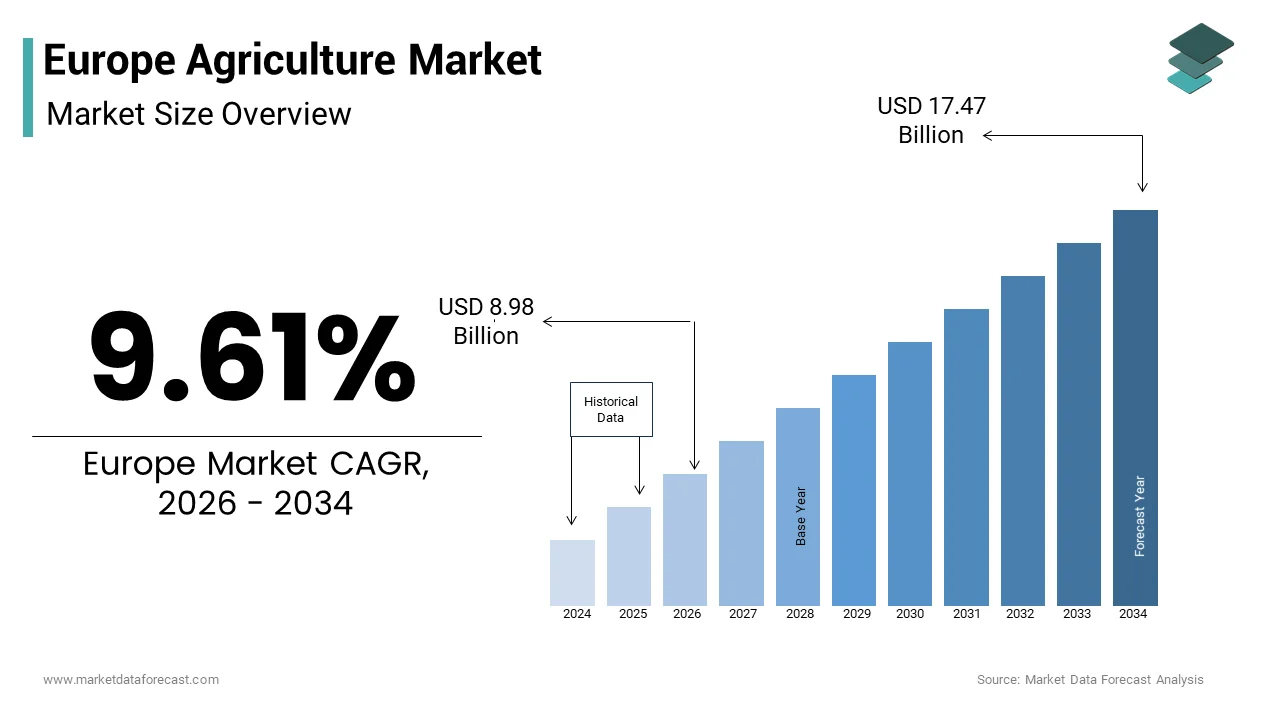
The agriculture is foundational pillar for food security and rural economic stability. As per Eurostat, the European Union utilized approximately 157 million hectares for agricultural purposes in 2023, which represents nearly 40% of the total land area of the EU. According to the European Environment Agency, the agricultural sector contributes roughly 10% of the total greenhouse gas emissions in the EU necessitating a shift towards low carbon farming practices. The Common Agricultural Policy provides substantial financial support aimed at modernizing infrastructure and promoting ecological resilience. Climate variability poses significant risks with extreme weather events increasingly affecting yield stability, across major producing nations. The integration of digital technologies and precision farming tools is becoming essential to optimize resource use efficiency. Consumer demand for organic and locally sourced products is reshaping supply chains and influencing production methods. This complex landscape requires adaptive strategies to balance economic viability with ecological stewardship ensuring long term sustainability of the European food system.
MARKET DRIVERS
Policy Support Through Common Agricultural Policy Reforms
The common agricultural policy is driving modernization and sustainability are majorly fuelling the growth of the Europe agriculture market. This framework allocates billions of euros annually to support farmer incomes rural development and environmental protection measures. The recent reforms emphasize eco-schemes that reward farmers for adopting practices beneficial to climate and biodiversity such as crop rotation and organic farming. These financial incentives lower the risk associated with transitioning to sustainable methods encouraging widespread adoption across member states. According to the study, direct payments constitute a significant portion of farm income in many countries ensuring economic viability despite market volatility. The policy also supports young farmers through specific grants and preferential access to funds addressing the demographic challenge of an aging workforce. By linking subsidies to compliance with environmental standards, the policy effectively steers the market towards greener production models. This structured support system enables farmers to invest in advanced machinery and digital tools that enhance productivity. The alignment of national strategic plans with EU wide objectives ensures coordinated progress towards sustainability goals.
Rising Consumer Demand for Organic and Sustainable Products
The shifting consumer preferences towards healthy and environmentally friendly food products are significantly influencing production patterns, which is also promoting the growth of the Europe agriculture market. European consumers are increasingly willing to pay premium prices for organic produce driven by heightened awareness of health benefits and environmental impact. This growth reflects a robust demand side pull that encourages farmers to convert conventional lands to organic certification. The European Green Deal targets increasing the share of organic farming to 25% by 2030, which aligns with consumer trends and policy ambitions. Supermarkets and food retailers are expanding their organic offerings creating reliable distribution channels for producers. This demand drives innovation in natural pest management and soil health practices reducing reliance on synthetic inputs. The traceability requirements associated with organic certification also promote transparency and trust in the food supply chain. The cultural shift towards conscious consumption thus acts as a powerful market force compelling the agricultural sector to prioritize sustainability and quality over mere volume.
MARKET RESTRAINTS
Severe Labor Shortages and Aging Workforce
The persistent labor shortages and an increasingly aging farmer population, which threatens operational continuity is hindering the growth of the Europe agriculture market. The physical demands of farming combined with relatively low wages make the sector less attractive to younger generations leading to a structural deficit in available workforce. This demographic trend limits the capacity of farms to expand operations or adopt labor intensive sustainable practices. Seasonal labor shortages are particularly acute during harvest periods causing delays and potential crop losses. The reliance on migrant workers has become essential in many countries but regulatory changes and geopolitical factors create uncertainty in labor supply. The lack of social protection and poor working conditions exacerbate recruitment difficulties. The shortage impedes the adoption of certain agroecological methods that require more manual intervention than conventional industrial farming.
Impact of Climate Change and Extreme Weather Events
The climate change is increasing the frequency and intensity of extreme weather events that disrupt production cycles, which is additionally hampering the growth of the Europe agriculture market. Rising temperatures prolonged droughts and unpredictable rainfall patterns challenge the resilience of traditional cropping systems and threaten yield stability. As per the European Environment Agency heatwaves and water scarcity have become more common in Southern and Central Europe affecting key crops such as wheat maize and olives. As per the Joint Research Centre of the European Commission, climate change could reduce crop yields by up to 10% by 2050, if no adaptation measures are implemented. Drought conditions in recent years have severely impacted pasture availability for livestock leading to increased feed costs and reduced meat and dairy production. Flooding events in Northern and Western Europe damage infrastructure and cause soil erosion, further complicating farming operations. Europe experienced its warmest year on record recently, which accelerates pest proliferation and disease spread. These climatic shifts require significant investment in irrigation systems drought resistant varieties and insurance mechanisms which many smallholders cannot afford. The unpredictability of weather patterns makes long term planning difficult increasing financial risk for farmers. Insurance premiums are rising reflecting the heightened risk profile making it harder for farmers to manage volatility.
MARKET OPPORTUNITIES
Expansion of Precision Agriculture Technologies
The integration of precision agriculture technologies to enhance efficiency and sustainability simultaneously is accelerating the growth of the Europe agriculture market. Advanced tools such as drones satellite imagery and Internet of Things sensors enable farmers to monitor crop health and soil conditions with unprecedented accuracy. As per the European Innovation Partnership for Agricultural Productivity and Sustainability, the adoption of digital tools can increase resource use efficiency by up to 20% reducing waste and environmental impact. Precision farming allows for variable rate application of fertilizers and pesticides ensuring that inputs are used only where needed which lowers costs and complies with environmental regulations. The European Commission supports this transition through funding programs that promote digital skills and infrastructure development in rural areas. The agricultural software and data services is growing rapidly, as farmers seek actionable insights to optimize decision making. Automation technologies, including autonomous tractors and robotic harvesters address labor shortages, while improving operational consistency. The collection of big data facilitates predictive analytics helping farmers anticipate weather risks and market trends. This technological evolution creates new business models such as farming as a service where providers offer specialized equipment and expertise to smallholders. The synergy between hardware and software solutions enables a holistic approach to farm management.
Growth in Vertical Farming and Controlled Environment Agriculture
The vertical farming and controlled environment agriculture by enabling year round production in urban and peri urban areas is additionally to promote new opportunities for the expansion of the Europe agriculture market. These systems use stacked layers and artificial lighting to grow crops in enclosed spaces, significantly reducing land and water usage. Europe hosts numerous innovative facilities that produce leafy greens herbs and strawberries with minimal environmental footprint. This method eliminates the need for pesticides and reduces transportation emissions by locating production closer to consumers. The technology appeals to retailers and consumers seeking fresh locally grown produce with consistent quality and safety standards. Energy efficiency improvements in LED lighting and renewable energy integration are making these systems more economically viable. Urban planning policies increasingly incorporate agricultural spaces to enhance food security and green infrastructure. The scalability of modular units allows for flexible deployment in warehouses rooftops or repurposed industrial buildings.
MARKET CHALLENGES
Regulatory Complexity and Compliance Burdens
The complex web of regulations that impose significant compliance burdens on farmers and agribusinesses is quite challenge for the growth of the Europe agriculture market. Navigating the intricate requirements of the Common Agricultural Policy environmental directives and food safety standards requires substantial administrative effort and expertise. The introduction of the Farm to Fork Strategy and Biodiversity Strategy adds new layers of regulation targeting pesticide reduction and habitat preservation. The administrative workload has increased considerably with many small farms lacking the resources to hire specialized consultants. Frequent updates to regulations create uncertainty making long term investment planning difficult. The variation in implementation across member states leads to uneven playing fields and competitive distortions. Data privacy concerns related to digital farming tools add another layer of regulatory complexity under the General Data Protection Regulation. Compliance costs divert resources from productive activities reducing overall profitability. The fear of penalties for unintentional non-compliance discourages innovation and risk taking.
Volatility in Input Costs and Supply Chain Disruptions
The fluctuating prices for essential inputs such as energy fertilizers and feed is certainly a major challenge for the growth of the Europe agriculture market. Geopolitical tensions and global supply chain disruptions have led to sharp increases in production costs squeezing farmer margins. The price index for agricultural inputs in the European Union rose significantly in recent years driven primarily by higher energy and fertilizer costs. The dependence on imported raw materials for fertilizer production makes the sector vulnerable to external shocks and trade restrictions. The natural gas prices, which are important for nitrogen fertilizer production have experienced extreme volatility affecting availability and affordability. Feed costs for livestock farmers have also surged due to global grain market fluctuations impacting meat and dairy profitability. Supply chain bottlenecks delay the delivery of machinery parts and seeds disrupting planting and harvesting schedules. The lack of pricing power for many farmers means they cannot fully pass these increased costs onto consumers. Financial stress leads to reduced investment in maintenance and innovation threatening long term productivity. Diversifying supply sources and enhancing local production of inputs are potential mitigation strategies but require time and capital.
REPORT COVERAGE
| REPORT METRIC | DETAILS |
| Market Size Available | 2025 to 2034 |
| Base Year | 2025 |
| Forecast Period | 2026 to 2034 |
| CAGR | 9.61% |
| Segments Covered | By Technology, Component, Application, By Country |
| Various Analyses Covered | Global, Regional & Country Level Analysis; Segment-Level Analysis, DROC, PESTLE Analysis, Porter’s Five Forces Analysis, Competitive Landscape, Analyst Overview of Investment Opportunities |
| Regions Covered | UK, France, Spain, Germany, Italy, Russia, Sweden, Denmark, Switzerland, Netherlands, Turkey, Czech Republic,c & Rest of Europe |
| Market Leaders Profiled | Deere & Company, CNH Industrial N.V., Bayer AG, AGCO Corporation, Syngenta Group, International Business Machines Corporation, Microsoft Corporation, Hexagon AB, KUBOTA Corporation, Topcon Corporation, SZ DJI Technology Co., Ltd., Planet Labs PBC, Farmers Edge Inc., AeroVironment Inc., Traction Ag. |
SEGMENTAL ANALYSIS
By Technology Insights
The guidance systems segment was the largest by holding 54.2% of the Europe agriculture market share in 2025 due to their foundational role in enabling precision farming and reducing operational inefficiencies. These systems utilize Global Navigation Satellite System signals to steer tractors and implements with centimeter level accuracy minimizing overlap and ensuring uniform field coverage. The substantial reduction in fuel consumption and input waste, which directly improves farm profitability. This efficiency is given the high energy costs and strict environmental regulations in the European Union. Furthermore, guidance systems alleviate operator fatigue allowing for longer working hours during important planting and harvesting windows, which addresses labor shortage issues. The compatibility of these systems with various machinery brands ensures broad accessibility for farmers regardless of their equipment portfolio. The maturity of the technology and proven return on investment make it the entry point for most farmers beginning their digital transformation journey. Regulatory support for precision agriculture under the Common Agricultural Policy further incentivizes investment in these tools.
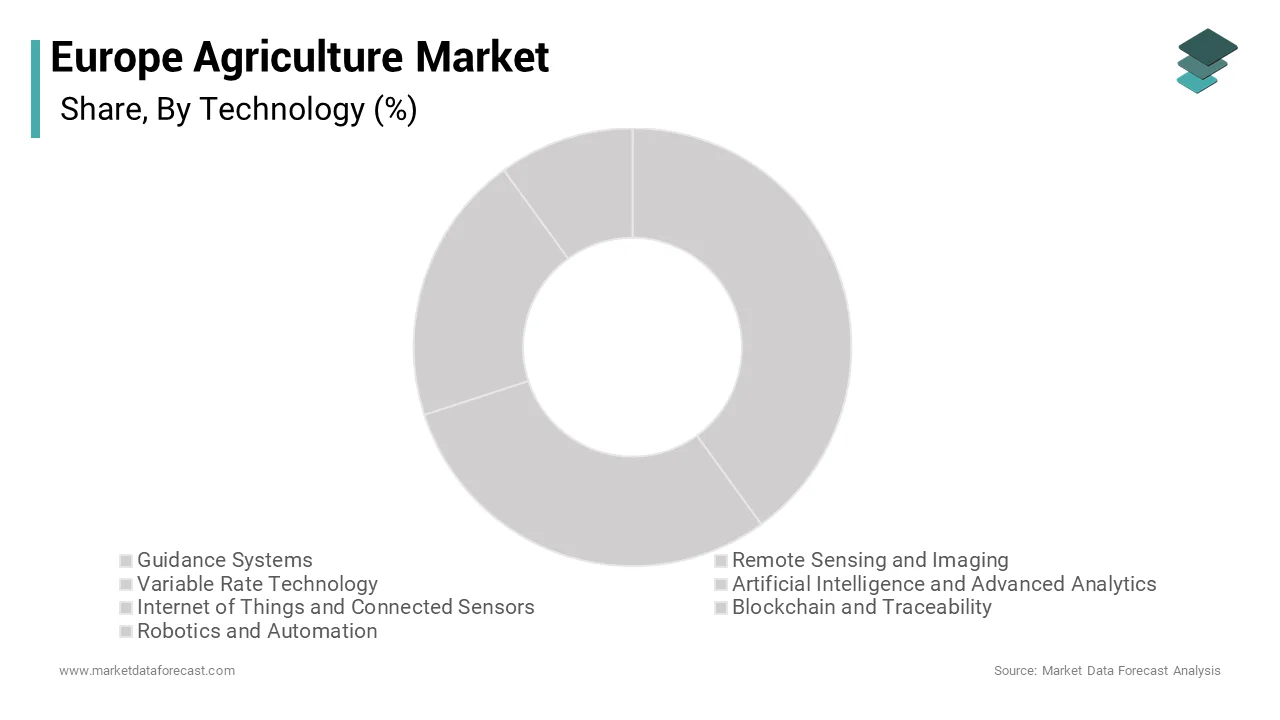
The remote sensing and imaging technology segment is projected to grow at an anticipated CAGR of 14.8% during the forecast period with the increasing availability of high resolution satellite and drone data. This technology enables the detection of crop stress disease and nutrient deficiencies before they are visible to the naked eye facilitating proactive management decisions. The Copernicus program provides free and open access to satellite data, which has democratized remote sensing for agricultural applications across the continent. The integration of multispectral and hyperspectral sensors allows for detailed analysis of plant health indicators such as chlorophyll content and water status. The declining cost of drone hardware and advanced imaging software has made this technology accessible to small and medium sized farms. Farmers increasingly rely on these insights to comply with the Farm to Fork Strategy requirements for reduced pesticide use by targeting treatments only where necessary. The ability to monitor large areas frequently and non-invasively offers significant advantages over traditional ground scouting methods. Cloud based platforms now automate the processing of vast amounts of imagery delivering actionable insights directly to farmers smartphones.
By Component Insights
The hardware segment was the largest by holding 56.2% of the Europe agriculture market share in 2025, as physical assets such as sensors, drones, tractors, and irrigation controllers form the backbone of precision farming infrastructure. The initial capital investment in hardware is substantial but necessary to capture data and execute automated tasks in the field. The durability and tangible nature of hardware make it a preferred investment for farmers seeking long term assets that depreciate predictably. The sales of precision farming hardware have grown steadily as farmers replace aging equipment with digitally enabled alternatives. The widespread availability of financing options and leasing models reduces the upfront financial burden encouraging adoption among smaller enterprises. Hardware manufacturers continuously innovate to improve sensor accuracy battery life and connectivity ensuring that devices remain relevant in rapidly evolving technological landscapes. The regulatory requirement for certified equipment under European Union standards ensures quality and safety reinforcing consumer confidence in established brands. The integration of hardware with existing farm machinery allows for incremental upgrades rather than complete system overhauls. This flexibility supports gradual digital transformation aligning with the risk aversion typical of the agricultural sector.
The software solutions segment is swiftly emerging at a fastest CAGR of 16.2% from 2026 to 2034, as farmers increasingly prioritize data analytics and decision support tools over mere data collection. The proliferation of hardware has generated vast amounts of agricultural data that require sophisticated software to interpret and translate into actionable insights. The demand for farm management information systems is surging as operators seek to consolidate data from multiple sources into unified dashboards. Cloud based software platforms offer scalability and accessibility allowing farmers to monitor operations remotely via mobile devices. The integration of artificial intelligence and machine learning in agricultural software enhances predictive capabilities for weather pests and yields. Subscription based pricing models lower the barrier to entry enabling smallholders to access premium analytics without significant upfront costs. The software segment benefits from continuous updates and improvements delivered over the air ensuring that users always have access to the latest features and algorithms. Interoperability standards are improving allowing different software platforms to exchange data seamlessly, which increases their utility and stickiness. The ability to generate compliance reports for environmental regulations automatically saves time and reduces administrative burdens.
By Application Insights
The crop monitoring segment held a dominant share of the Europe agriculture market in 2025 due to its direct impact on yield optimization and resource efficiency. This application involves the regular assessment of crop health growth stages and stress factors using various digital tools. The ability to detect issues early prevents minor problems from escalating into major losses safeguarding farmer income. The real time monitoring data allows for precise irrigation scheduling, which is crucial in regions facing water scarcity such as Southern Europe. The frequency and accuracy of digital monitoring surpass traditional manual scouting providing a comprehensive view of field conditions. Farmers use this information to adjust fertilization plans ensuring that nutrients are applied when crops need them most. The integration of monitoring data with weather forecasts enhances decision making regarding planting and harvesting times. Regulatory pressure to demonstrate sustainable practices drives the adoption of monitoring tools that provide auditable records of field activities. The versatility of crop monitoring applies to a wide range of crops from cereals to vineyards making it universally relevant. The continuous feedback loop provided by monitoring systems supports iterative improvement in farming practices.
The yield mapping and forecasting segment is likely to exhibit a fastest CAGR of 15.5% from 2026 to 2034 with the need for accurate production planning and market positioning. This application uses historical data current crop conditions and weather models to predict harvest volumes with high precision. Farmers benefit from better logistics planning ensuring that storage and transportation resources are allocated efficiently. This precision enables farmers to negotiate better contracts and secure favorable prices for their produce. The integration of satellite imagery and ground truth data enhances the reliability of these predictions. Insurance companies increasingly use yield forecasting data to assess risk and set premiums offering financial products tailored to actual production potential. The ability to identify low yielding zones within fields allows for targeted investigations and corrective actions for future seasons. This analytical capability transforms farming from a reactive to a proactive enterprise.
COUNTRY LEVEL ANALYSIS
Germany Agriculture Market Analysis
Germany agriculture market was the outperformer by capturing 48.2% of share in 2025 with the high levels of mechanization and strong adoption of digital technologies. The country boasts a robust agricultural sector with a focus on efficiency and sustainability driven by stringent environmental regulations. As per the Federal Ministry of Food and Agriculture, Germany has approximately 260000 farms with an average size of 60 hectares which supports the economic viability of precision farming investments. The government actively promotes digitalization through initiatives like the Digital Strategy for Rural Areas providing funding for smart farming projects. According to Destatis the agricultural sector contributes significantly to the national economy with a strong emphasis on quality and innovation. The presence of major agricultural machinery manufacturers fosters a culture of technological advancement and local expertise. High labor costs incentivize automation making guidance systems and robotics essential for maintaining competitiveness. The well developed infrastructure including rural broadband connectivity facilitates the use of cloud based agricultural software. German farmers are increasingly adopting organic practices in response to consumer demand supported by government subsidies.
France Agriculture Market Analysis
France agriculture market was positioned next by holding 18.5% of share in 2025. The country manages approximately 27 million hectares of agricultural land producing a wide range of crops, including cereals, wine, and dairy products. The cooperative structure of French agriculture facilitates collective investment in advanced technologies by allowing smallholders to access precision farming tools. France is a leading exporter of agricultural goods driving the need for efficient production methods. The wine industry extensively uses remote sensing and drones for precision viticulture to maintain quality standards. Government policies encourage agroecological transitions providing financial incentives for sustainable practices. The diverse geography requires adaptable technologies that can handle varying soil and climate conditions. French farmers are increasingly focused on reducing chemical inputs in line with the Ecophyto plan. The strong tradition of gastronomy and quality food production aligns with precision agriculture goals of enhancing product consistency. Research institutions collaborate with industry to develop innovative solutions tailored to local needs.
United Kingdom Agriculture Market Analysis
The United Kingdom agriculture market growth is likely to grow with the post Brexit policy reforms and a focus on technological innovation. The departure from the European Union has led to the introduction of the Environmental Land Management scheme which rewards farmers for public goods including environmental protection. The humid climate necessitates efficient machinery operation making guidance systems valuable for minimizing soil compaction. The government provides grants through the Farming Investment Fund to support the purchase of robotic and automated equipment. The strong agritech sector in the UK develops innovative software and hardware solutions for global countries. Farmers face pressure to increase self-sufficiency and reduce reliance on imports driving efficiency improvements. The focus on net zero emissions encourages the adoption of low carbon farming practices supported by digital monitoring. The robust insurance and financial services sector offers specialized products for agricultural risk management.
Italy Agriculture Market Analysis
Italy agriculture market growth is likely to grow with the high value specialty crops and extensive olive oil and wine production. The country utilizes approximately 12 million hectares for agriculture with a significant portion dedicated to perennial crops that benefit from precision monitoring. As per the Italian National Institute of Statistics the fragmented land structure with many small family farms presents challenges for technology adoption but also opportunities for shared services. The Ministry of Agricultural Food and Forestry Policies supports digital innovation through the National Strategic Plan for the Common Agricultural Policy. According to Coldiretti there is increasing interest among young farmers in using drones and sensors to manage complex terrains. The tourism linked food sector demands high quality and traceability, which digital tools facilitate. Water scarcity in southern regions drives the adoption of smart irrigation systems to optimize water use. The government provides subsidies for modernizing irrigation infrastructure and adopting sustainable practices. Italian researchers collaborate with European partners to develop technologies suited for Mediterranean crops. The cultural emphasis on food heritage aligns with precision agricultures ability to enhance quality and consistency.
Spain Agriculture Market Analysis
Spain agriculture market growth is likely to grow with the fruits vegetables and olive oil relying heavily on irrigation. The National Plan for Precision Agriculture promotes the use of digital tools to improve resource efficiency and sustainability. The large scale horticultural producers are leading the adoption of drones and sensors for crop monitoring. The favorable climate allows for year-round production by increasing the importance of efficient logistics and yield forecasting. Government funds from the Next Generation EU support the digital transformation of rural areas. The export-oriented nature of Spanish agriculture requires strict compliance with international quality standards facilitated by digital traceability. Energy costs for pumping water drive the need for efficient irrigation systems controlled by software.
COMPETITIVE LANDSCAPE
The competitive landscape of the Europe agriculture market is characterized by intense rivalry among global machinery manufacturers and specialized technology providers vying for leadership in precision farming and sustainable solutions. Established players leverage their extensive distribution networks and brand recognition to maintain strong relationships with farmers, while innovating continuously to meet evolving regulatory and environmental standards. New entrants focusing on digital services and robotic solutions challenge traditional models by offering flexible-subscription based options that lower entry barriers for smallholders. Competition extends beyond hardware specifications to encompass data interoperability customer support and ecosystem integration, which are important for long term user adoption. Strategic alliances between machinery makers and software developers create comprehensive solutions that address the full spectrum of farm management needs. Price competition is moderated by the high value placed on reliability and compliance with European Union directives.
KEY MARKET PLAYERS
A few of the dominating market players that are in the Europe agriculture market are
- Deere & Company
- CNH Industrial N.V.
- Bayer AG
- AGCO Corporation
- Syngenta Group
- International Business Machines Corporation
- Microsoft Corporation
- Hexagon AB
- KUBOTA Corporation
- Topcon Corporation
- SZ DJI Technology Co., Ltd.
- Planet Labs PBC
- Farmers Edge Inc.
- AeroVironment Inc.
- Traction Ag
Top Players In The Market
- Deere and Company maintains a dominant position in the Europe agriculture market through its extensive portfolio of intelligent machinery and precision farming solutions. The company actively integrates advanced technologies such as artificial intelligence and computer vision into its tractors and harvesters to enhance operational efficiency for European farmers. Recently, Deere expanded its See and Spray technology across key areas, including Germany and France, allowing for precise herbicide application that aligns with strict environmental regulations. The establishment of digital innovation hubs in Munich facilitates collaboration with local agritech startups and research institutions. This holistic approach strengthens customer loyalty and ensures compliance with evolving European Union agricultural policies promoting sustainability and productivity.
- CNH Industrial serves as a crucial player in the Europe agriculture market by delivering innovative equipment and digital solutions tailored to diverse farming needs across the continent. The company leverages its strong brand presence through Case IH and New Holland to provide specialized machinery for both arable and specialty crop production. CNH recently launched autonomous concept vehicles in Italy and the Netherlands demonstrating its commitment to future ready farming technologies that address labor shortages. The integration of telematics and data analytics platforms enables farmers to monitor fleet performance and optimize field operations in real time. Strategic partnerships with European technology firms enhance the connectivity and interoperability of their machines within broader farm management ecosystems.
- Kubota Corporation has significantly strengthened its footprint in the Europe agriculture market by focusing on compact and versatile machinery suitable for smaller farms and specialized applications. The company emphasizes sustainability through the development of electric and hybrid powertrains that reduce emissions and noise pollution in rural areas. Kubota recently expanded its manufacturing and distribution capabilities in France and Germany to better serve local customers with timely support and customized solutions. The introduction of smart farming tools including automated steering systems and remote monitoring applications enhances the usability of their equipment for modern farmers. Collaborations with European research centers drive innovation in robotics and precision agriculture tailored to regional crop requirements.
Top Strategies Used By Key Market Participants
Key players in the Europe agriculture market prioritize strategic partnerships with local distributors and agritech startups to enhance market penetration and customize solutions for regional needs. Companies increasingly invest in research and development to create sustainable technologies such as electric machinery and precision application systems that comply with stringent European Union environmental regulations. Digital transformation remains a central strategy with firms developing integrated software platforms that offer data analytics and farm management tools to improve decision making for farmers. Service oriented business models are gaining traction as providers offer maintenance packages and training programs to ensure optimal equipment performance and customer retention. Expansion into niche segments such as vertical farming and organic agriculture allows companies to diversify their portfolios and capture emerging opportunities. Regulatory compliance is managed proactively through active engagement with policymakers and participation in industry standards bodies.
RECENT MARKET NEWS
In March 2024, Deere and Company launched its See and Spray Ultimate technology in Germany enabling precise herbicide application to reduce chemical usage and strengthen the Europe agriculture market.
MARKET SEGMENTATION
This research report on the Europe agriculture market is segmented and sub-segmented into the following categories.
By Technology
- Guidance Systems
- Remote Sensing and Imaging
- Variable Rate Technology
- Artificial Intelligence and Advanced Analytics
- Internet of Things and Connected Sensors
- Blockchain and Traceability
- Robotics and Automation
By Component
- Hardware
- Software
- Services
By Application
- Crop Monitoring
- Yield Mapping and Forecasting
- Soil Monitoring and Soil Health Analytics
- Weather Tracking and Forecasting
- Precision Spraying and Input Optimization
- Drone Analytics
- Livestock Health Tracking
By Farm Size
- Small-Scale Farms (Less Than 100 ha)
- Medium-Scale Farms (100 - 500 ha)
- Large-Scale Farms (More Than 500 ha)
By Country
- UK
- France
- Spain
- Germany
- Italy
- Russia
- Sweden
- Denmark
- Switzerland
- Netherlands
- Turkey
- Czech Republic
- Rest of Europe