- Product Description Description
- Table of Contents TOC
- List of Table & Figure LOT
- Get Free Sample PDF Sample PDF
Market Size, 2025
$48.34 BnMarket Estimate, 2026
$50.97 BnMarket Forecast, 2034
$77.83 BnCAGR, 2026–2034
5.43%Europe Air Freight Market Report Summary
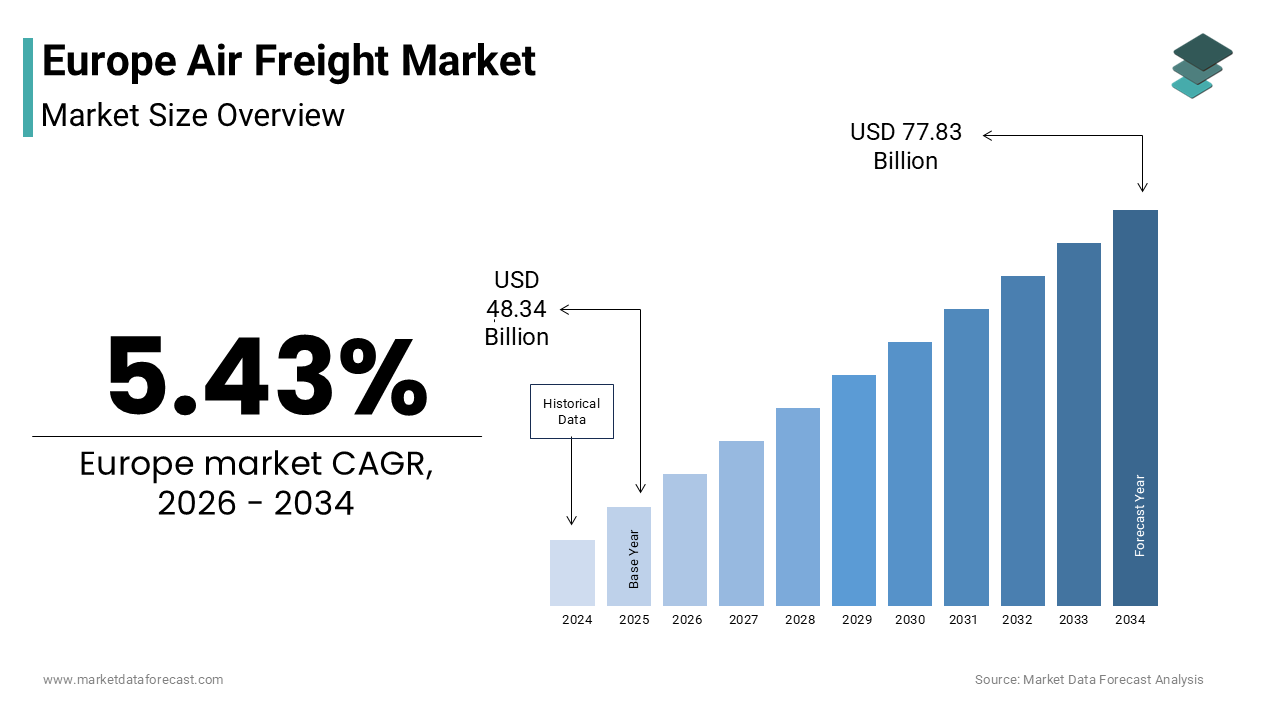
The Europe air freight market was valued at USD 48.34 billion in 2025, is expected to reach USD 50.97 billion in 2026, and is projected to grow to USD 77.83 billion by 2034, registering a CAGR of 5.43% during the forecast period from 2026 to 2034. The growth of the Europe air freight market is primarily driven by the rising demand for temperature-sensitive pharmaceutical logistics, expanding cross-border e-commerce fulfillment, and the increasing need for fast, secure, and reliable supply chains. The integration of digital freight platforms, cold-chain infrastructure expansion, and multimodal logistics networks is transforming the role of air cargo from a premium niche service into a strategic backbone of high-value European trade flows.
Key Market Trends
-
Increasing adoption of CEIV-certified pharmaceutical logistics and temperature-controlled cargo solutions.
-
Expansion of digital booking platforms and API-based air cargo marketplaces enabling real-time pricing and tracking.
-
Growth in express intra-European e-commerce shipments is driving demand for time-definite air freight services.
-
Rising investments in dedicated cargo hubs and automated logistics infrastructure at major European airports.
-
Strong focus on sustainable aviation fuel (SAF) adoption and emissions reduction initiatives across the aviation sector.
Segmental Insights
- Based on Service, the freight forwarding segment dominated the Europe air freight market in 2025 owing to its role in managing complex cross-border logistics, customs compliance, and multimodal shipment coordination. Meanwhile, the freight transport segment is projected to witness steady growth due to fleet modernization, expansion of dedicated cargo aircraft, and recovery of passenger belly-hold capacity.
- Based on destination, international shipments accounted for the largest share driven by Europe’s global trade connectivity and reliance on transatlantic and Asia-Europe air corridors. The domestic air freight segment is expected to grow at a faster pace supported by expanding medical logistics networks and regional e-commerce distribution models.
- Based on end-user industry, the healthcare and pharmaceuticals segment led the market in 2025 due to strict cold-chain requirements and high cargo value, while the e-commerce and retail segment is anticipated to record the fastest growth rate driven by rapid cross-border online shopping and demand for express delivery services.
Regional Insights
- Germany dominated the Europe air freight market in 2025, supported by Frankfurt Airport’s position as the region’s largest cargo hub and strong demand from the automotive and pharmaceutical industries.
- The United Kingdom held a significant market share due to the presence of major logistics hubs such as Heathrow and East Midlands, along with strong life sciences exports and express parcel networks.
- France remains a key market led by Paris Charles de Gaulle Airport, benefiting from luxury fashion exports, aerospace manufacturing, and growing African trade corridors.
- The Netherlands continues to expand steadily with Amsterdam Schiphol serving as a major logistics gateway integrating sea-air transport via Rotterdam.
- Turkey is emerging as one of the fastest-growing markets, leveraging its strategic geographic location and expanding cargo infrastructure at Istanbul Airport to connect Europe with Asia and the Middle East.
Competitive Landscape
The Europe air freight market is highly competitive, featuring integrated carriers, dedicated cargo airlines, and global logistics providers focused on service reliability, digital transparency, sustainability initiatives, and specialized cargo capabilities. Leading companies operating in the Europe air freight market include Deutsche Post DHL Group, FedEx Corporation, United Parcel Service, Inc. (UPS), DB Schenker, DSV A/S, Kuehne + Nagel International AG, CEVA Logistics, Expeditors International, Nippon Express Co., Ltd., Bolloré Logistics, and Lufthansa Cargo AG. These companies are investing heavily in digital booking platforms, automated cargo hubs, cold-chain logistics, and sustainable aviation fuel adoption to strengthen their competitive positioning and support the evolving demands of Europe’s fast-moving global trade ecosystem.
Europe Air Freight Market Size
The Europe air freight market size was valued at USD 48.34 billion in 2025 and is anticipated to reach USD 50.97 billion in 2026 from USD 77.83 billion by 2034, growing at a CAGR of 5.43% during the forecast period from 2026 to 2034.
Air freight refers to the commercial transportation of goods by aircraft. Unlike surface logistics, air freight prioritizes speed, security, and reliability over cost efficiency, serving as a critical enabler for just in time supply chains and emergency logistics. European airports experienced a recovery in air cargo volumes following pandemic disruptions, but total tonnage remained below pre-pandemic levels due to macroeconomic headwinds. Commercial cargo flights in European airspace returned to pre-pandemic levels, with major hubs including Frankfurt and Paris Charles de Gaulle handling a significant portion of the total air cargo tonnage. The sector is deeply integrated with global trade flows, particularly transatlantic and Asia Europe corridors, and operates under stringent regulatory frameworks governing security, customs, and environmental performance. Crucially, air freight in Europe functions not as a standalone service but as a strategic node within multimodal logistics networks, where its role is defined by urgency rather than volume.
MARKET DRIVERS
Growth in Temperature Sensitive Pharmaceutical Shipments Drives Premium Cargo Demand
The expansion of biopharmaceutical manufacturing and vaccine distribution has spread across the region, which is among the key drivers of the Europe air freight market. This growth has significantly increased the reliance on air freight for temperature-controlled logistics. Unlike standard cargo, pharmaceuticals require strict adherence to cold chain protocols often within 2 to 8 degrees Celsius or even cryogenic conditions for mRNA therapies. Driven by the rise of complex, individualized ATMPs entering clinical development in the EU, the pharmaceutical logistics sector is increasingly relying on specialized, rapid air transportation to maintain strict temperature and time constraints for these high-value treatments. Supported by extensive, certified cold-chain facilities and numerous specialized handling partners, Frankfurt Airport maintains its position as a primary European gateway for temperature-sensitive pharmaceutical shipments, experiencing high volume demand for cold-chain logistics. The rollout of personalized medicine further intensifies this trend. The high-value, patient-specific, and time-critical nature of CAR T-cell therapies necessitates specialized, rapid, and often dedicated logistical support to deliver the treatment to patients immediately upon manufacture. Major European air carriers are strengthening their specialized pharmaceutical shipping capabilities, expanding CEIV-certified networks to meet the rising demand for sophisticated, temperature-controlled, and high-value drug logistics. This high value low volume segment commands premium rates and ensures consistent demand irrespective of broader economic cycles.
E Commerce Fulfillment for Cross Border Luxury and Electronics Fuels Express Air Volumes
The rise of pan European e commerce, particularly in luxury fashion, consumer electronics, and high end cosmetics, has created sustained demand for express air freight services that guarantee next day or same day delivery, and therefore contributes to the expansion of the Europe air freight market. Unlike domestic parcel networks, cross border e commerce between non contiguous markets, such as Italy to Sweden or Portugal to Finland, relies heavily on air connectivity due to fragmented ground infrastructure and customs complexities. Cross-border online purchases within the European Union have grown to constitute a substantial share of total e-commerce transactions, demonstrating a significant increase in international online shopping activity compared to the early 2020s. Companies like Zalando and ASOS utilize air freight for rapid restocking between regional fulfillment centers. Leading fashion e-commerce platforms are increasingly utilizing air logistics to expedite the movement of high-value goods between centralized logistics hubs and regional warehouses to meet fast delivery demands. Similarly, Major electronics manufacturers leverage rapid air cargo solutions to facilitate simultaneous product launches across diverse European markets, ensuring maximum availability shortly after release. Express logistics providers are experiencing increased intra-European e-commerce volume, driven by high demand for faster delivery, which is shifting consumer behavior toward fewer returns and higher expectations for speed. This segment thrives on consumer expectations for immediacy, transforming air freight from a contingency option into a core retail enabler.
MARKET RESTRAINTS
Stringent Environmental Regulations Increase Operational Costs and Limit Capacity
The European Union’s aggressive decarbonization agenda imposes significant constraints on air freight operations through emissions pricing and operational restrictions, which in turn hampers the growth of the Europe airfreight market. The expanding EU Emissions Trading System requires aircraft operators to pay for their emissions, leading to a substantial increase in operating costs, which are passed on as surcharges to air cargo customers. Regulations within the EU's "Fit for 55" package, specifically ReFuelEU Aviation, compel a significant, long-term increase in Sustainable Aviation Fuel adoption, which currently faces severe supply shortages and costs much higher than traditional fuel. Environmental regulations and legal rulings are tightening operational limits at major European hubs, resulting in stricter night curfews and reduced flight slots that hinder time-sensitive air cargo logistics. These measures collectively reduce available capacity while increasing expenses, forcing shippers to seek alternatives or absorb higher costs. The lack of scalable green fuel infrastructure, coupled with heavy regulation, will continue to limit growth and erode the competitiveness of European air freight compared to other regions.
Chronic Air Traffic Control Inefficiencies Cause Delays and Reduce Network Reliability
The region’s fragmented air navigation system, managed by over 30 national air traffic control providers, results in persistent inefficiencies that hinder the expansion of the Europe air freight market. These inefficiencies degrade air freight performance. In 2023, European aviation experienced high, yet generally manageable average en-route air traffic flow management delays, which spiked significantly during summer months due to convective weather and high traffic volume. Airspace congestion caused significant, costly ripple effects for cargo integrators, causing critical shipments to miss connections at major European hubs. Furthermore, the Single European Sky initiative remains largely unimplemented due to national sovereignty concerns, forcing aircraft to fly suboptimal routes with higher fuel consumption. For time definite freight, such unpredictability undermines the core value proposition of air transport. Europe’s air cargo network will fail to reach its full potential for efficiency and reliability until the airspace is fully integrated.
MARKET OPPORTUNITIES
Expansion of Dedicated Cargo Hub Infrastructure Enhances Throughput Efficiency
The regional airports are investing heavily in specialized cargo terminals to accommodate rising demand for high value and time sensitive shipments, which shows strong potential for the Europe air freight market. Frankfurt Airport continues to strengthen its specialized pharmaceutical handling capabilities by expanding its temperature-controlled infrastructure to support growing air-side perishable logistics. Similarly, Paris Charles de Gaulle is increasing its cargo handling capacity through new, modernized cargo facilities at Cargo City, utilizing improved technology to optimize ground transportation turnover. These upgrades are not merely about scale but precision. Amsterdam Schiphol’s Pharma Gateway utilizes advanced digital logging technology to provide shippers with real-time temperature visibility, enhancing reliability. Such infrastructure reduces handling errors, accelerates customs processing, and minimizes dwell time, directly enhancing service quality for premium segments. The European Investment Bank is financing the modernization of logistics facilities at various European airports, supporting a shift toward a tiered cargo network that reduces congestion at major hubs. This strategic build out transforms airports from passive transit points into active logistics orchestrators, strengthening Europe’s position in global high value supply chains.
Integration of Digital Freight Platforms Streamlines Booking and Tracking Processes
The adoption of digital freight marketplaces and API based booking systems is revolutionizing how shippers access and manage air cargo capacity across the region, which provides a lucrative area for the Europe air freight market. Platforms like CargoAi and WebCargo enable real time rate comparison, instant booking, and dynamic rerouting across multiple carriers without manual quotation requests. European freight forwarders are rapidly accelerating their adoption of digital booking platforms, showing a strong increase in utilization compared to previous years, according to industry data and IATA. Airlines benefit from improved load factor optimization. Following the integration of digital tools like WebCargo's algorithmic matching, Lufthansa Cargo has improved capacity utilization and enhanced financial performance. Additionally, blockchain pilots led by the Air Cargo Blockchain Consortium, comprising Brussels Airport and Swissport, provide immutable records of handling events from origin to final delivery, reducing disputes and insurance claims. This digitization compresses transaction cycles from days to minutes, enhances transparency, and unlocks data driven forecasting. Predictive analytics-driven platforms will enable proactive capacity allocation and dynamic pricing, transforming air freight into a more agile and resilient industry in unstable trade environments.
MARKET CHALLENGES
Volatility in Jet Fuel Prices Erodes Margin Stability for Carriers and Forwarders
Jet fuel comprises a significant portion of an airline's operating budget (20-30%), with its price instability having a direct effect on both profitability and air freight pricing, which challenges the growth of the Europe air freight market. European jet fuel prices remained elevated and volatile throughout 2023, fueled by regional refining constraints and geopolitical tensions that impacted supply availability. Unlike ocean freight, where bunker adjustment factors are standardized, air cargo fuel surcharges are negotiated individually, creating pricing uncertainty for both carriers and shippers. Amid fluctuating operating costs, major air cargo carriers faced pressure in early 2023 to manage service guarantees on standard routes to ensure profitability. Small and medium forwarders, lacking hedging capabilities, face acute margin pressure. UK-based small and medium-sized freight forwarders reported significant pressure on profit margins for standard, lower-cost air shipments due to high operational costs, including elevated fuel prices. Despite its promise of long-term stability, SAF's current limited supply hinders significant risk mitigation. Air freight earnings will remain vulnerable to energy market volatility until fuel cost mechanisms are better aligned with market realities.
Labor Shortages Across Ground Handling and Piloting Roles Disrupt Operational Continuity
A systemic shortage of skilled aviation personnel is constraining air freight capacity and reliability across the region, and limiting the expansion of the Europe air freight market. The European aviation sector faces a significant imbalance between the supply of qualified flight crews and increasing operational demands, driving intense competition for personnel. Simultaneously, substantial workforce gaps for critical airside roles are hindering ground operations, resulting in slower aircraft processing. Furthermore, personnel shortages at major UK hubs have caused delays that disrupt logistics. The problem is exacerbated by aging workforces. the German air freight industry faces a looming crisis due to an aging workforce and insufficient younger talent. Training bottlenecks persist, deterring new entrants. These human capital gaps create a ceiling on network expansion regardless of aircraft availability, turning labor, not metal, into the scarcest resource in Europe’s air freight ecosystem.
REPORT COVERAGE
| REPORT METRIC | DETAILS |
| Market Size Available | 2025 to 2034 |
| Base Year | 2025 |
| Forecast Period | 2026 to 2034 |
| CAGR | 5.43% |
| Segments Covered | By Service, Destination, End-user Industry and Region |
| Various Analyses Covered | Regional & Country Level Analysis, Segment-Level Analysis, DROC, PESTLE Analysis, Porter’s Five Forces Analysis, Competitive Landscape, Analyst Overview on Investment Opportunities |
| Countries Covered | UK, France, Spain, Germany, Italy, Russia, Sweden, Denmark, Switzerland, the Netherlands, Turkey, the Czech Republic, and the Rest of Europe. |
| Market Leaders Profiled | Deutsche Post DHL Group, FedEx Corporation, United Parcel Service, Inc. (UPS), DB Schenker, DSV A/S, Kuehne + Nagel International AG, CEVA Logistics, Expeditors International, Nippon Express Co., Ltd., Bolloré Logistics, and Lufthansa Cargo AG. |
SEGMENTAL ANALYSIS
By Service Insights
The freight forwarding segment dominated the Europe air freight market by accounting for a substantial share in 2025. The dominance of the freight forwarding segment is driven by its role as the orchestrator of complex cross-border shipments. Air freight within and through Europe involves navigating 27 distinct national customs regimes, EU import controls, and security protocols like the Known Consignor program. The European Union’s implementation of stricter security measures requires advanced, detailed data for almost all air shipments, forcing shippers to rely heavily on specialized logistics partners to handle the complex regulatory process. Freight forwarders provide essential compliance expertise. Major global logistics firms are processing an extensive volume of European customs documentation, highlighting their role in managing trade, particularly as new regulatory requirements are introduced. Additionally, the EU’s Union Customs Code mandates electronic tracking of high risk goods such as lithium batteries and pharmaceuticals, further increasing reliance on forwarders with certified systems. Due to the rising burden of complex regulatory requirements, smaller exporters are increasingly outsourcing their air logistics management to specialized, third-party logistics providers. This dependency ensures that forwarding, not just flying, captures the majority of value in the air cargo chain. Modern freight forwarders offer seamless orchestration across air, road, and rail, providing shippers with single-window visibility from factory to final delivery. Leading logistics providers are deploying advanced, integrated platforms to ensure real-time tracking of environmental conditions for sensitive pharmaceutical shipments, using specialized networks of airports and transport vehicles. European air cargo is increasingly handled via multimodal contracts, with air transport forming a part of a broader, integrated logistics chain rather than a stand-alone service. Forwarders leverage digital tools like blockchain and API integrations to offer predictive delay alerts and dynamic rerouting, services airlines alone cannot provide. Logistics providers are reporting that customers who adopt integrated, comprehensive air transport solutions experience significantly fewer, or less impactful, interruptions to their supply chains compared to traditional, fragmented methods. This holistic control transforms forwarders from transactional agents into strategic partners, locking in long term contracts and justifying premium margins over pure capacity providers.
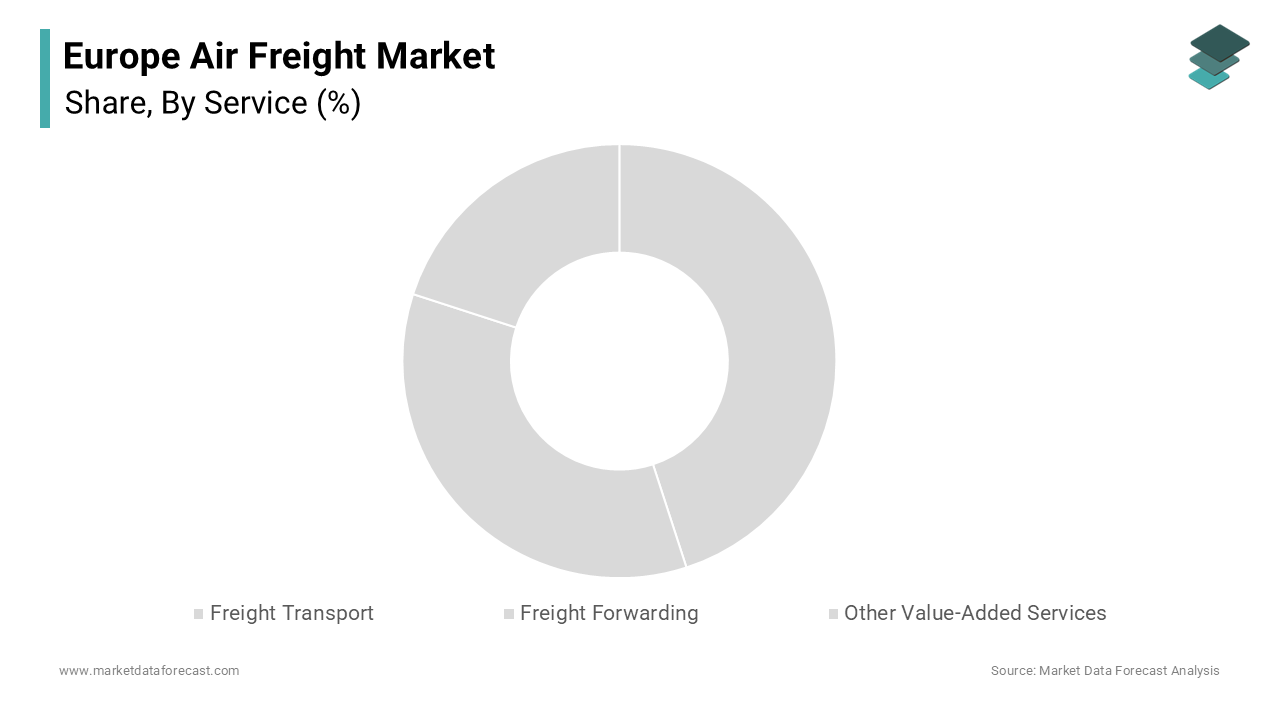
The freight transport segment is predicted to witness the highest CAGR of 5.8% between 2026 and 2034 due to dedicated cargo fleet expansion and belly capacity recovery. Airlines and integrators are aggressively replacing older freighters with fuel efficient models to meet both demand and environmental mandates. European cargo operators are actively modernizing their fleets by adopting new-generation, high-capacity twin-engine freighters to expand total cargo tonnage. Lufthansa Cargo is operating a modern, environmentally efficient freighter fleet, having replaced older, less efficient aircraft with newer models to significantly reduce emissions per payload. Similarly, Turkish Cargo is rapidly expanding its freighter fleet and increasing direct cargo flights to European cities, leveraging its Istanbul hub to bolster capacity. These modern planes feature larger doors, higher payloads, and advanced avionics that reduce turnaround time. Driven by the adoption of new, dedicated freighters and reduced reliance on older, converted passenger planes, the average age of cargo aircraft operating in Europe is decreasing, contributing to improved operational reliability. This physical capacity growth directly translates into more frequent and higher volume air transport services. The rebound of international passenger flights has restored significant belly hold space previously lost during pandemic travel bans. Passenger flight volumes within Europe and across the Atlantic have almost fully recovered to pre-pandemic levels, demonstrating a significant rebound in air travel demand. Wide-body passenger aircraft continue to provide significant belly cargo capacity for general freight, maximizing the utilization of available space during passenger operations. The return of long-haul passenger flights has driven a surge in IAG Cargo's belly hold usage, especially across major European routes. This low cost capacity is ideal for non urgent high density goods like automotive parts and textiles, complementing dedicated freighters used for time sensitive items. The dual stream, dedicated plus belly, creates a more resilient and tiered air network, allowing shippers to optimize cost versus speed. Stable tourism recovery will drive freight growth organically, removing the need for new capital investment.
By Destination Insights
The international shipments segment led the Europe air freight market by capturing a significant share in 2025. The leading position of the international shipments segment is attributed to Europe’s deeply integrated yet nationally fragmented trade landscape. Despite the EU single market, manufacturing remains distributed across specialized clusters, German automotive parts, Italian fashion, Dutch horticulture, requiring rapid cross border movement. A substantial portion of the materials used in European manufacturing consists of intermediate goods that pass through integrated, multinational production chains before reaching final assembly. Air freight enables just in time delivery for these networks. To maintain minimal inventory at its primary assembly facilities, BMW coordinates a vast network of time-sensitive deliveries from regional suppliers, occasionally utilizing air transport for critical components. The absence of harmonized ground transport regulations, such as driver hour limits and toll systems, makes road transit unpredictable for time critical cargo. Logistics research indicates that air transport offers superior speed and reliability for cross-border shipments compared to road freight, which is often hindered by congestion and unpredictable waiting times. This operational certainty makes international air indispensable despite higher costs. Europe’s extensive network of free trade agreements and booming cross border online retail amplify extra EU air flows. The European Union continues to rely heavily on Asian markets for advanced electronics and telecommunications equipment, with these high-value goods frequently arriving through air cargo networks. Simultaneously, e commerce platforms like Temu and Shein ship millions of small parcels weekly from China to European fulfillment centers via air. Major European aviation hubs like Amsterdam Schiphol are increasingly pivoting toward e-commerce and specialized parcel handling to offset fluctuations in traditional industrial air freight. The EU’s Digital Services Act also requires faster returns processing, pushing retailers to use air for reverse logistics. These dynamics ensure that international air freight remains the dominant flow, connecting Europe to global innovation and consumption hubs in ways surface transport cannot match.
The domestic air freight segment is estimated to register the fastest CAGR of 7.2% during the forecast period owing to the expansion of national medical emergency networks that rely on domestic air links, and the fact that e-commerce regional fulfillment models increase intra-country air movements. Hospitals and blood banks increasingly use domestic air corridors for time critical health logistics. France is increasingly utilizing specialized aerial courier services, including drones and light aircraft, for the rapid transport of time-sensitive organ, blood, and medical shipments, resulting in a growing volume of air-assisted medical deliveries between healthcare facilities. Large German university hospitals are integrating specialized, rapid logistics, including drone courier projects for critical samples, to bypass road traffic and improve speed for urgent laboratory analysis. Following the COVID-19 pandemic, numerous EU nations have expanded the use of aerial transport to ensure vaccine security, particularly when reaching remote or geographically isolated communities. These missions often use small turboprops or helicopters operating from secondary airports, creating new domestic lanes unrelated to commercial passenger traffic. The urgency and regulatory backing of healthcare logistics insulate this segment from economic downturns, ensuring consistent growth. Major retailers are shifting from centralized to regional distribution, using domestic air to restock local warehouses rapidly. Zalando operates many fulfillment centers across Germany and flies inventory between them daily to balance stock levels. Amazon’s use of small cargo aircraft between Leipzig and Cologne enables next day replenishment without congested Autobahn routes. These micro networks treat countries as archipelagos of demand, where air becomes the fastest connector between islands of inventory. Domestic air cargo is bridging the gap between road transport constraints and complex international logistics to meet rising consumer demands for immediacy.
By End-User Industry Insights
The pharmaceuticals segment held the majority share of 34.1% of the Europe air freight market in 2025. The supremacy of the pharmaceuticals segment is credited to high cargo value and strict handling requirements. Pharmaceutical shipments must comply with GDP (Good Distribution Practice) guidelines requiring continuous temperature monitoring, tamper proof seals, and rapid transit. High-value pharmaceutical trial materials in Europe are predominantly transported by air to meet strict, short-turnaround time windows required for maintaining product integrity. Frankfurt Airport acts as a major European hub for temperature-controlled pharmaceutical freight, employing numerous certified handlers to ensure strict adherence to EU, IATA, and GMP traceability standards. Unlike other sectors, pharma shippers prioritize reliability over cost. A single delay in the transport of personalized CAR T cell therapies can result in significant financial loss and poses substantial risks to patient safety due to the high cost and perishable nature of the therapy. This necessity locks in premium air freight contracts regardless of fuel price fluctuations, making pharmaceuticals the highest value and most stable segment in the market. Advanced therapies like mRNA vaccines and gene editing treatments have ultra short shelf lives and require cryogenic shipping. The increasing approval of new cell and gene therapies in the EU necessitates a robust, specialized air logistics chain to move highly sensitive products from manufacturing sites to treatment centers. Novartis ships its Zolgensma gene therapy from Switzerland to numerous European hospitals via dedicated charters with real time temperature logging. These products cannot be stockpiled or shipped by sea, creating irreversible air dependency. The rising share of biologics in development pipelines is set to strengthen, making pharmaceutical products the foundation of Europe’s specialized air freight industry.
The e-commerce & retail segment is anticipated to witness the fastest CAGR of 9.1% between 2026 and 2034. The rapid expansion of the e-commerce & retail segment is fuelled by cross border shopping and returns logistics. Consumers now routinely shop across EU borders, expecting delivery speeds comparable to domestic purchases. According to Eurostat and European e-commerce reports, online shopping in the EU continues to expand, with a steady increase in the trend of consumers purchasing goods from other European countries compared to previous years. To meet this, retailers use air to move inventory between regional fulfillment centers. ASOS flies stock from its UK warehouse to Milan weekly to serve Southern Europe. During peak seasons like Black Friday, air volumes spike. DHL Express reported a significant surge in intra-EU e-parcel volumes during the peak November shopping season, driven by high demand for fast delivery during holiday shopping periods. The EU’s ban on hidden cross border fees under the Geo Blocking Regulation has further stimulated this behavior. Unlike traditional retail, e commerce treats geography as fluid, making air the only viable option for fast, reliable cross national delivery. European consumers are less likely to return items if they receive them quickly, prompting retailers to invest in air for outbound shipments. Academic research from the University of St Gallen suggests that optimizing delivery speed for fashion items can be an effective strategy to lower the rate of returns in e-commerce. Zalando and Otto offer premium air delivery options that guarantee 24 hour arrival, knowing it increases net sales despite higher shipping costs. Additionally, the EU’s upcoming Right to Repair laws encourage faster replacement part delivery via air to avoid lengthy repair waits. This behavioral insight transforms air freight from a cost center into a revenue protection tool, driving sustained investment in e commerce air logistics networks across Europe.
REGIONAL ANALYSIS
Germany Air Freight Market Analysis
Germany was the top performer in the Europe air freight market by accounting for a 28.6% share in 2025. The country serves as Europe’s primary air cargo gateway through Frankfurt Airport, the continent’s busiest cargo hub, and a manufacturing epicenter demanding just in time component delivery. BMW and Siemens rely on daily air shipments for high value electronics from Eastern Europe, while pharmaceutical giants like Bayer use dedicated cold chain lanes to global markets. The government’s National Logistics Strategy 2030 prioritizes air cargo infrastructure, including automated customs clearance and Sustainable Aviation Fuel blending mandates. Germany’s central location, industrial density, and multimodal connectivity make it the indispensable core of Europe’s air freight network.
United Kingdom Air Freight Market Analysis
The United Kingdom was the second largest country in the Europe air freight market by capturing a 19.4% share in 2025. The growth of the UK market is propelled by Heathrow and East Midlands airports. Despite Brexit, the UK remains a critical transshipment point for US and Asian cargo entering Europe. UK airports continue to manage a significant amount of air cargo, with the majority being handled through international connections. International cargo dominates the overall freight volume at major UK airports. East Midlands Airport has established itself as the leading specialized express freight airport in the UK. The airport functions as a critical, high-frequency European logistics node for major express delivery companies. The UK’s life sciences sector drives premium demand, AstraZeneca ships vaccines to numerous countries via air from its Cambridge facility. Post Brexit, the UK has signed bilateral air service agreements with several nations, bypassing EU restrictions to secure direct cargo routes. This strategic autonomy, combined with world class logistics infrastructure, sustains the UK’s outsized influence despite no longer being an EU member.
France Air Freight Market Analysis
France is another key player in the Europe air freight market, which is led by Paris Charles de Gaulle, the second busiest cargo airport in Europe. The country’s strength lies in high value exports: luxury fashion, cosmetics, and aerospace components. Paris-Charles de Gaulle continues to strengthen its position as a premier European air cargo hub, capitalizing on its dedicated infrastructure to handle substantial volumes of global freight. Air logistics providers are expanding their focus on high-value cargo, with luxury fashion brands driving the demand for specialized, high-speed freight services through Paris. Airbus maintains a unique, in-house, large-scale air transport network to connect specialized production sites across Europe, facilitating the assembly of its commercial aircraft. France acts as a vital logistics hub for trade with West Africa, with specialized providers facilitating high-frequency cargo movements to major African destinations. The French government is heavily investing in the modernization of aviation infrastructure and the development of sustainable aviation technologies to meet future environmental goals. This blend of premium exports, aerospace integration, and African connectivity positions France as a diversified and resilient air freight leader.
Netherlands Air Freight Market Analysis
The Netherlands grew steadily in the European air freight market, centered on Amsterdam Schiphol. In 2023, Amsterdam Airport Schiphol processed significant metric tonnes of cargo, with a decline in overall volume compared to the previous year, while maintaining a strong reliance on e-commerce and pharmaceutical shipments within its top commodity categories. The airport’s Pharma Gateway is the most advanced in Europe, featuring blockchain enabled temperature tracking and 24/7 customs. The Netherlands’ flat geography and dense road network enable rapid last mile distribution. Major retailers like Bol.com and Coolblue use domestic air to balance inventory between fulfillment centers in Eindhoven and Groningen. Additionally, the Port of Rotterdam’s integration with Schiphol creates a seamless sea air corridor for high value Asian imports. This synergy between air, sea, and land logistics makes the Netherlands a uniquely efficient transshipment engine.
Turkey Air Freight Market Analysis
Turkey is the fastest growing major player in the Europe air freight market due to its strategic position between Europe and Asia. According to the General Directorate of State Airports Authority, Istanbul Airport has established itself as a leading international hub, maintaining high freight volumes that dominate the national air cargo industry despite minor annual fluctuations in total tonnage. Turkish Airlines' cargo division has significantly expanded its dedicated freighter fleet and global reach, positioning it as one of the world's largest air freight carriers with a route network that connects more countries than any other airline. The country benefits from free trade agreements with both the EU and Eurasian Economic Union, enabling it to act as a consolidation point for Central Asian and Middle Eastern goods entering Europe. While the European Union, specifically Germany and Italy, remains a primary destination for Turkish textile exports, the industry is navigating a period of shifting demand and market consolidation in its traditional trade corridors. Under a long-term strategic vision coinciding with the carrier's centenary, Turkey is investing heavily in massive cargo infrastructure at its primary hub to create a technologically advanced "cargo city" featuring automated logistics and specialized handling for temperature-sensitive goods. This geopolitical advantage, coupled with aggressive investment, positions Turkey as Europe’s rising air freight gateway to the East
COMPETITIVE LANDSCAPE
The Europe air freight market features intense competition among integrated carriers pure freight airlines and global logistics providers each leveraging distinct strengths. Integrated players like DHL and UPS dominate express parcel flows through proprietary networks and hub control while passenger airline cargo divisions such as Lufthansa and Air France KLM capitalize on extensive route coverage and belly capacity. Competition is increasingly defined by service quality rather than price with differentiation centered on reliability digital transparency sustainability credentials and vertical expertise in sectors like pharma and e commerce. New entrants face high barriers due to airport slot constraints regulatory compliance costs and capital intensity. At the same time digital freight forwarders are disrupting traditional brokerage by offering instant pricing and seamless multimodal coordination. This multifaceted rivalry drives continuous innovation in automation sustainability and customer centric solutions making Europe one of the most sophisticated and dynamic air cargo markets globally.
KEY MARKET PLAYERS
Some of the companies that are playing a dominating role in the Europe Air Freight Market include
- Deutsche Post DHL Group
- FedEx Corporation
- United Parcel Service, Inc. (UPS)
- DB Schenker
- DSV A/S
- Kuehne + Nagel International AG
- CEVA Logistics
- Expeditors International
- Nippon Express Co., Ltd.
- Bolloré Logistics
- Lufthansa Cargo AG
Top Players in the Europe Air Freight Market
Lufthansa Cargo AG
Lufthansa Cargo AG is a leading air freight carrier headquartered in Frankfurt Germany with an extensive network connecting Europe to major global trade lanes. The company operates a fleet of modern Boeing 777F freighters and leverages passenger belly capacity across the Lufthansa Group to offer comprehensive coverage. It plays a pivotal role in transporting high value pharmaceuticals automotive parts and e commerce goods throughout Europe. In recent years Lufthansa Cargo has strengthened its position by expanding its digital booking platform Lufthansa Cargo Digital and enhancing its CEIV Pharma certified cold chain capabilities.
DHL Express (Deutsche Post DHL Group)
DHL Express is a dominant integrated logistics provider with a vast air freight infrastructure across Europe including its global hub at Leipzig Halle Airport. The company operates numerous dedicated aircraft and offers time definite international and domestic delivery services for e commerce parcels documents and urgent freight. DHL serves as a critical enabler for cross border online retail and healthcare logistics throughout the region. To reinforce its leadership DHL has invested heavily in automation at its European hubs deployed electric ground vehicles and expanded its GoGreen Plus sustainability program which includes verified carbon neutral shipping options.
Air France KLM Martinair Cargo
Air France KLM Martinair Cargo is a major European air cargo alliance combining the freighter operations and belly capacity of Air France and KLM Royal Dutch Airlines. Headquartered in Paris and Amsterdam it connects Europe to Africa Asia and the Americas with strong specialization in perishables pharmaceuticals and live animals. The joint cargo division benefits from dual hub access at Charles de Gaulle and Schiphol airports enabling flexible routing and redundancy. Recent initiatives include the launch of a blockchain based tracking system for temperature sensitive shipments and the integration of sustainable aviation fuel into regular operations on transatlantic routes. The group also enhanced its digital customer portal to provide real time shipment visibility and dynamic rerouting capabilities for European shippers.
Top Strategies Used by the Key Market Participants
Key players in the Europe air freight market are investing in digital transformation through advanced booking platforms real time tracking and AI powered predictive analytics to enhance customer experience and operational efficiency. They are expanding cold chain and CEIV certified facilities to capture high margin pharmaceutical and biotech cargo. Companies are increasingly offering sustainable aviation fuel options and carbon offset programs to comply with EU environmental regulations and meet corporate ESG demands. Strategic hub consolidation and automation at major airports like Leipzig and Frankfurt improve throughput and reduce handling times. Additionally they are forming long term partnerships with e commerce retailers and healthcare providers to secure recurring high frequency shipments and reduce reliance on volatile spot market demand
MARKET SEGMENTATION
This research report on the Europe Air Freight Market has been segmented and sub-segmented based on the following categories.
By Service
- Freight Transport
- Freight Forwarding
- Other Value-Added Services
By Destination
- Domestic
- International
By End-User Industry
- E-commerce & Retail
- Manufacturing & Automotive
- Healthcare & Pharmaceuticals
- Perishables & Fresh Produce
- High-Tech & Electronics
- Others
By Country
- UK
- France
- Spain
- Germany
- Italy
- Russia
- Sweden
- Denmark
- Switzerland
- Netherlands
- Turkey
- Czech Republic
- Rest of Europe