Europe Aircraft MRO Market Size, Share, Trends, & Growth Forecast Report By MRO Type (Airframe Maintenance, Engine Overhaul, Component Repair and Overhaul, Line Maintenance), Air Craft Type, End-use, Service Provider Type and Country (UK, France, Spain, Germany, Italy, Russia, Sweden, Denmark, Switzerland, Netherlands, Turkey, Czech Republic and Rest of Europe), Industry Analysis From 2025 to 2033
Europe Aircraft MRO Market Report Summary
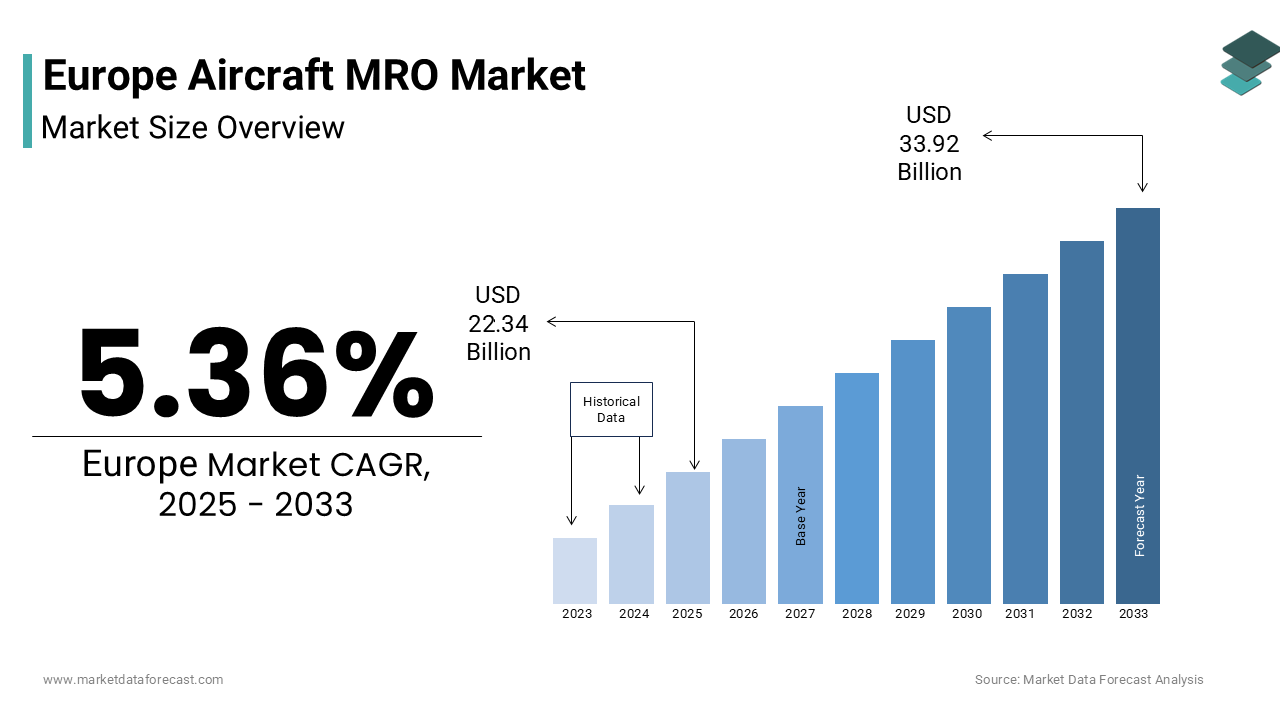
The Europe aircraft MRO market was valued at USD 21.29 billion in 2024, is estimated to reach USD 22.34 billion in 2025, and is projected to reach USD 33.92 billion by 2033, growing at a CAGR of 5.36% during the forecast period from 2025 to 2033. The growth of the Europe aircraft MRO market is driven by the aging commercial aircraft fleet, rising regulatory requirements from the European Union Aviation Safety Agency (EASA), and increasing demand for avionics upgrades, engine overhauls, and structural inspections. Aircraft MRO plays a critical role in ensuring airworthiness, operational reliability, and regulatory compliance across commercial, business, and military aviation fleets. The expansion of low-cost carriers, growth in cargo aviation, and increasing adoption of digital and predictive maintenance technologies are further strengthening MRO demand across the region.
Key Market Trends
- Rising demand for engine overhauls due to aging narrow-body and wide-body fleets.
- Increasing avionics retrofits driven by navigation, safety, and emissions regulations.
- Growing adoption of predictive maintenance, digital twins, and aircraft health monitoring platforms.
- Expansion of cargo aircraft conversions and freighter fleet maintenance activities.
- Rising focus on Sustainable Aviation Fuel (SAF) compatibility testing and related engine inspections.
Segmental Insights
- Based on MRO type, the engine overhaul segment held the largest share of the Europe aircraft MRO market in 2024. This dominance is attributed to the high cost, technical complexity, and regulatory rigor associated with turbine engine maintenance, particularly for aging Airbus A320 and Boeing 737 fleets.
- Based on aircraft type, the commercial aviation segment accounted for the leading share of the Europe aircraft MRO market in 2024. High aircraft utilization rates, dense intra-European route networks, and strict maintenance schedules continue to drive consistent MRO demand from commercial airlines.
- Based on end user, the commercial passenger airlines segment dominated the Europe aircraft MRO market in 2024 due to large fleet sizes, post-pandemic aircraft reactivation programs, and ongoing compliance with EASA-mandated inspection cycles.
Regional Insights
- The Europe aircraft MRO market shows strong concentration in countries with advanced aerospace infrastructure and high fleet density.
- Germany led the Europe aircraft MRO market in 2024, supported by strong OEM presence, a large commercial airline base, and extensive defense aviation maintenance activities.
- France remains a key market due to vertically integrated aerospace capabilities, strong engine MRO operations, and long-term military aircraft sustainment programs.
- The United Kingdom continues to be a major MRO hub, driven by engine overhaul expertise, extensive line maintenance networks, and specialization in high-value aircraft services.
- Spain and Italy are emerging growth markets, benefiting from low-cost carrier operations, favorable aircraft storage conditions, cargo aircraft conversions, and rising defense investments.
Competitive Landscape
The Europe aircraft MRO market is moderately consolidated, with competition shaped by OEM-affiliated providers and independent third-party MRO specialists. Market leaders differentiate through proprietary technical expertise, digital maintenance platforms, and long-term power-by-the-hour contracts. Increasing regulatory scrutiny, technician shortages, and cybersecurity risks are prompting MRO providers to invest in workforce development, automation, and data security. Sustainability initiatives, including SAF compatibility and emissions compliance, are becoming key competitive differentiators. Major companies operating in the Europe aircraft MRO market include Lufthansa Technik, Safran Aircraft Engines, Airbus Services, AFI KLM Engineering & Maintenance, SR Technics, MTU Maintenance, Rolls-Royce plc, Sabena Technics, SIA Engineering Company, and Turkish Technic.
Europe Aircraft MRO Market Size
The europe aircraft MRO market size was valued at USD 21.29 billion in 2024 and is anticipated to reach USD 22.34 billion in 2025 from USD 33.92 billion by 2033, growing at a CAGR of 5.36% during the forecast period from 2025 to 2033.
Aircraft maintenance, repair and overhaul (MRO) is a critical backbone of the continent’s aviation ecosystem ensuring airworthiness operational continuity and regulatory compliance across commercial business and defense fleets. Unlike transactional service sectors aircraft MRO is governed by stringent oversight from the European Union Aviation Safety Agency which mandates recurring inspections component replacements and airframe checks based on flight hours and calendar intervals. According to Eurocontrol, European airlines operated a combined fleet exceeding 3,200 commercial aircraft in 2024, which is reflecting a 12% increase from pre‑pandemic levels and amplifying scheduled maintenance demand. Furthermore, the International Air Transport Association (IATA) reports that the average age of narrow‑body aircraft in Western Europe reached 11.4 years in 2024, elevating the need for structural inspections and system retrofits. The region hosts over 180 EASA Part 145 certified MRO facilities, with major hubs in Germany, France, the United Kingdom, and Spain, leveraging engineering expertise and OEM partnerships. Beyond commercial aviation, Europe’s defense sector maintains over 1,600 fixed‑wing military aircraft, as documented by the European Defence Agency (EDA), necessitating specialized depot‑level maintenance. This intricate interplay of regulatory rigor, fleet dynamics, and technological evolution defines the contemporary European aircraft MRO landscape, as it adapts to sustainability mandates and digital transformation.
MARKET DRIVERS
Aging Commercial Fleet Intensifies Structural and System Overhaul Requirements
The progressive aging of Europe’s commercial aircraft fleet has emerged as a primary driver of MRO demand due to mandatory airframe inspections component fatigue assessments and avionics modernization cycles, which is majorly driving the European aircraft MRO market growth. As per IATA (2024), the average age of narrow body aircraft operated by European carriers reached 11.4 years while wide body fleets averaged 13.7 years, which is signalling entry into high maintenance phases. Aircraft exceeding 10 years require comprehensive D checks every 6–10 years involving complete disassembly corrosion treatment and structural reinforcement. Lufthansa Technik reported conducting 42 heavy maintenance checks in 2023 alone on Airbus A320ceo and Boeing 737 Classic variants all exceeding 12 years of service. According to EASA, repetitive eddy current inspections on wing spars and fuselage lap joints are mandated after 30,000 flight cycles, a threshold increasingly met by legacy fleets. Replacement of obsolete components such as hydraulic actuators and analogue flight displays further compounds workload. As per Cirium (2024), 68% of European narrow bodies are projected to surpass the 12-year mark by 2027. This demographic pressure ensures sustained demand for deep maintenance regardless of short-term traffic fluctuations.
Regulatory Mandates for Avionics Modernization and Emissions Compliance Accelerate Retrofit Demand
European aviation authorities have enacted progressive regulatory frameworks compelling airlines to upgrade aircraft systems for safety communication and environmental performance, thereby fuelling MRO activity and the regional market expansion. According to the European Commission, all aircraft operating in EU airspace must be equipped with Performance Based Navigation and Controller Pilot Data Link Communication capabilities by 2026. This mandate has triggered a wave of avionics retrofits with over 1,400 European registered aircraft undergoing cockpit upgrades in 2023 as per Eurocontrol. Simultaneously the EU Emissions Trading System now fully integrates aviation requiring precise fuel monitoring and data reporting which necessitates installation of advanced fuel flow sensors and flight data recorders. Airbus estimates that 75% of its in service A320 fleet in Europe requires supplemental data acquisition units to comply. Additionally, noise abatement regulations around major airports such as Heathrow and Frankfurt enforce Stage IV noise compliance pushing operators to retrofit hush kits or replace engines. Rolls Royce reported servicing 210 Trent 700 engines in 2024 for noise and emissions enhancements under these rules. These overlapping regulatory imperatives transform MRO from reactive upkeep into a strategic compliance function.
MARKET RESTRAINTS
Persistent Shortage of Certified Aviation Technicians Constrains Capacity Utilization
The Europe aircraft MRO market faces a critical workforce bottleneck due to an acute shortage of licensed aviation maintenance engineers which directly limits shop capacity and turnaround efficiency. According to EASA, over 12,000 new technician certifications are needed annually across the EU to meet current demand yet training institutions produce fewer than 8,000 qualified graduates each year. This gap has widened since 2022 as experienced personnel retired in record numbers with the German Aerospace Industries Association estimating that 35% of its maintenance workforce is over 55 years old. Airlines such as Air France and easyJet have reported MRO slot delays of up to 21 days in 2024 due to staffing shortages at third party facilities. The issue is exacerbated by uneven geographic distribution with Eastern European MRO centers lacking sufficient certified personnel despite available infrastructure. EASA’s strict certification requirements under Part 66 prohibit task delegation to non-licensed personnel for critical inspections further tightening bottlenecks. While virtual reality training and modular certification programs are emerging, the pipeline remains insufficient to support projected fleet growth. This human capital deficit represents a structural ceiling on MRO throughput regardless of capital investment.
Volatility in Aircraft on Ground Periods Disrupts Maintenance Scheduling and Resource Allocation
Unpredictable aircraft utilization patterns driven by operational disruptions and ad hoc route changes have significantly destabilized MRO planning across Europe, which is further impeding the regional market growth. According to the European Cockpit Association (2024), over 28% of short haul flights experienced last minute cancellations or aircraft swaps due to crew shortages and air traffic control constraints. Such volatility forces airlines to defer scheduled maintenance leading to compressed heavy check windows and cascading delays. Lufthansa Technik disclosed that 17% of its planned C checks in Q1 2024 were rescheduled due to unplanned aircraft grounding from technical faults or crew unavailability. This unpredictability complicates inventory management for rotable components and reduces workforce productivity as technicians shift between tasks. Moreover, MRO contracts increasingly include strict turnaround time penalties with non-compliance fees averaging €45,000 per delayed day as per Oliver Wyman industry benchmarks. Facilities operating at 90% capacity cannot absorb these shocks without overtime or subcontracting both of which inflate costs. Until airlines achieve stable flying schedules through improved crew planning and airspace modernization MRO providers will contend with inefficient resource deployment.
MARKET OPPORTUNITIES
Expansion of Digital Twin and Predictive Maintenance Platforms Creates High Value Service Offerings
The integration of digital twin technology and data driven predictive maintenance is unlocking new revenue streams and operational efficiencies for European aircraft MRO market. By creating virtual replicas of aircraft systems fed by real time sensor data from engines APUs and landing gear MRO firms can forecast component failures before they occur. As per Airbus (2024), nearly 900 of its aircraft in European service now transmit live health data through the Skywise platform enabling predictive interventions. Lufthansa Technik’s AVIATAR system processed over 2.3 billion data points in 2024 to optimize component life and reduce unscheduled removals by 18%. This shift from fixed interval to condition-based maintenance extends asset life and minimizes aircraft on ground time. European regulators including EASA have endorsed these models by updating maintenance approval procedures to accept data driven deferrals. Furthermore, digital twins facilitate virtual troubleshooting allowing engineers to simulate repairs before physical work begins cutting workshop time by up to 30% as demonstrated in trials by Satair. Airlines such as Finnair have signed multi-year digital MRO contracts valuing data analytics on par with traditional labor. This transformation positions MRO providers as integrated data partners rather than reactive service vendors.
Growth in Sustainable Aviation Fuel Compatibility Testing Drives Specialized Engine MRO Demand
The accelerating adoption of Sustainable Aviation Fuel across Europe is generating novel MRO requirements centred on engine compatibility certification and material degradation analysis, which is another promising opportunity for the European aircraft MRO market. The European Commission mandates that 6% of all aviation fuel supplied in the EU must be sustainable by 2030 under the ReFuelEU Aviation initiative. Airlines are blending up to 50% SAF in current operations. However, prolonged exposure to certain bio derived fuel components can accelerate seal wear and deposit formation in high pressure turbine sections. Rolls Royce has conducted over 200 engine teardowns since 2022 specifically to assess SAF induced wear with findings integrated into revised maintenance protocols. In 2024 Safran and Air France launched a joint program to monitor CFM56 engines on SAF rich routes with enhanced borescope inspections every 500 flight hours. EASA has issued new service bulletins requiring fuel system material verification for aircraft operating above 30% SAF blends. This regulatory and operational shift compels MRO providers to develop specialized inspection checklists trained personnel and material compatibility databases. As SAF usage expands from niche demonstrations to mainstream operations these tailored engine MRO services will become standard across European maintenance networks.
MARKET CHALLENGES
Fragmented Regulatory Oversight Across Non-EU European States Complicates Cross Border MRO Certification
The absence of harmonized aviation maintenance regulations in non-EU European countries creates significant compliance complexity for pan regional MRO providers, which is a major challenge to the European market growth. While EASA Part 145 certification is recognized across the European Union nations such as Serbia Ukraine and Moldova maintain independent airworthiness authorities with divergent approval processes. According to the European Business Aviation Association, operators in the Western Balkans face an average of 45 additional days to validate MRO work performed in EU facilities due to bilateral agreement delays. This fragmentation forces MRO companies to maintain duplicate documentation systems and pursue country specific approvals inflating administrative costs by an estimated 12% as reported by the European Regions Airline Association. Moreover, components repaired in an EASA certified shop may require re inspection before installation on aircraft registered in non-aligned states disrupting just in time logistics. During the 2024 Balkan airspace recovery following regional disruptions several carriers reported aircraft grounded for over 3 weeks awaiting paperwork validation. Until the European Common Aviation Area fully integrates oversight standards this jurisdictional patchwork will impede seamless MRO service delivery across the continent.
Rising Cybersecurity Vulnerabilities in Connected MRO Ecosystems Threaten Operational Integrity
The digitalization of aircraft maintenance systems has introduced significant cybersecurity risks that threaten data integrity workshop safety and regulatory compliance across Europe, which is further challenging the aircraft MRO market growth in Europe. Modern MRO operations rely on interconnected platforms for technical logbooks component tracking and remote diagnostics yet 63% of European MRO providers reported at least one cyber incident in 2024 according to ENISA. Attack vectors include compromised electronic flight bags falsified service records and malware injected through third party software updates. In one 2023 case a major European MRO facility had to suspend all work for 72 hours after ransomware encrypted its component traceability database delaying over 30 aircraft releases. EASA has since issued cybersecurity guidelines for maintenance organizations but implementation remains voluntary and uneven. The integration of OEM proprietary systems such as Boeing’s AnalytX and Airbus’s Airspace further fragments security protocols. Without standardized encryption access controls and incident response frameworks the industry remains exposed to disruptions that could cascade through the aviation supply chain. This emerging threat dimension necessitates dedicated cyber resilience investments beyond traditional workshop safety paradigms.
REPORT COVERAGE
| REPORT METRIC | DETAILS |
| Market Size Available | 2024 to 2033 |
| Base Year | 2024 |
| Forecast Period | 2025 to 2033 |
| Segments Analysed | By MRO Type, Aircraft Type, End-use, Service Provider Type and region |
| Various Analyses Covered | Global, Regional & Country Level Analysis, Segment-Level Analysis, Drivers, Restraints, Opportunities, Challenges; PESTLE Analysis; Porter's Five Forces Analysis, Competitive Landscape, Analyst Overview of Investment Opportunities |
| Regions Analysed | United Kingdom, France, Spain, Germany, Italy, Russia, Sweden, Denmark, Switzerland, the Netherlands, Turkey, and the Czech Republic. |
| Key Market Players | Lufthansa Technik, Safran Aircraft Engines, Airbus Services, AFI KLM Engineering & Maintenance, SR Technics, MTU Maintenance, Rolls-Royce plc, Sabena technics, SIA Engineering Company, and Turkish Technic. |
SEGMENTAL ANALYSIS
By MRO Type Insights
The engine overhaul segment accounted for 37.7% of the European aircraft MRO market share in 2024 and emerged as the most dominating segment in this regional market. The dominance of engine overhaul segment in this regional market is attributed to the high cost, complexity, and regulatory stringency associated with turbine engine maintenance. Aircraft engines account for over 30% of total airframe value and are subject to the most rigorous inspection protocols under EASA Part 21 and OEM service bulletins. Each high‑bypass turbofan requires a full overhaul every 15,000–25,000 flight hours involving disassembly, non‑destructive testing, blade replacement, and performance restoration. In 2023 Rolls‑Royce performed 410 engine shop visits in Europe for its Trent family, according to its annual operations review. Similarly, Safran’s MRO network in France handled over 500 CFM56 and LEAP engine overhauls driven by the aging narrow‑body fleet. The cost of a single wide‑body engine overhaul ranges from €2.5–4 million, which is making it the single largest MRO line item.
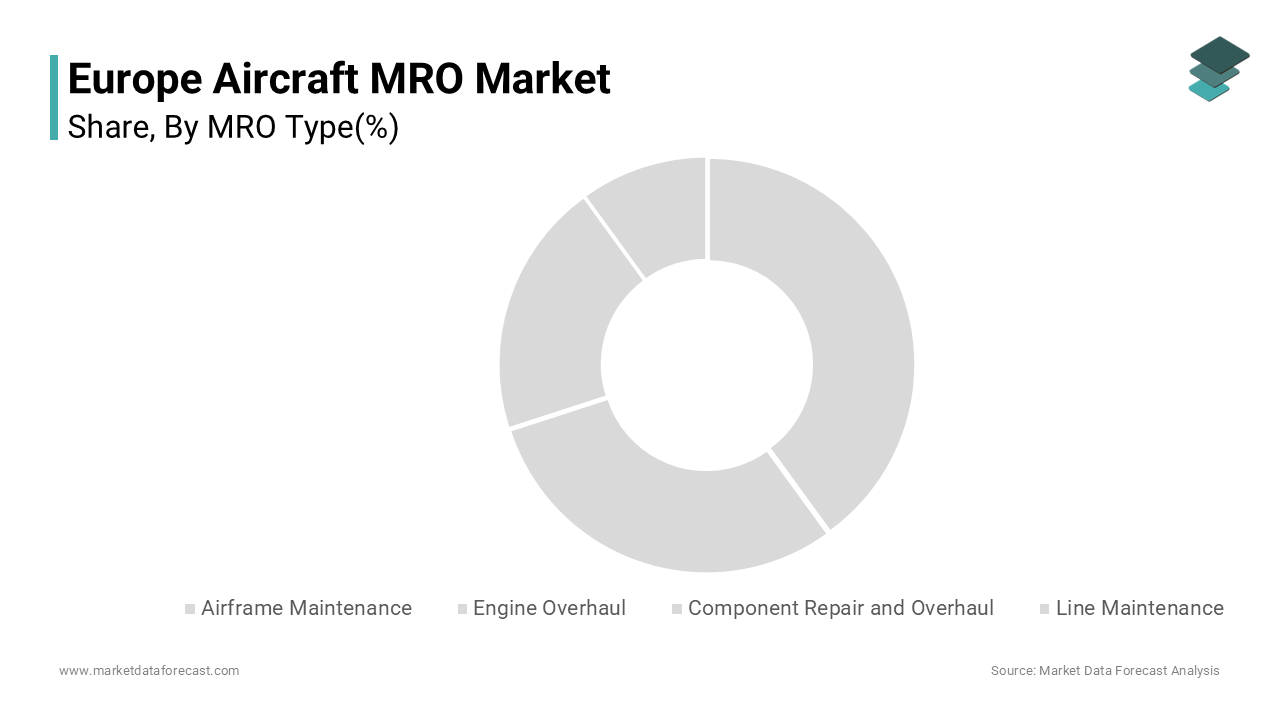
The component repair and overhaul segment is the fastest expanding MRO segment in Europe and is expected to grow at a CAGR of 4.4% over the forecast period owing to the proliferation of avionics and electrical systems in modern aircraft. Next‑generation aircraft such as the Airbus A350 and Boeing 787 integrate over 500 line‑replaceable units per airframe ranging from flight control computers to environmental sensors. In 2024 European MRO facilities processed over 1.2 million avionics units, as per the European Organisation for Civil Aviation Equipment. The shift toward fly‑by‑wire architectures has increased dependency on servo actuators and data concentrators, which exhibit higher failure rates in humid or high‑vibration environments. With the average cost of a single flight display repair exceeding €18,000, component MRO has become a high‑margin revenue stream fuelled by system complexity rather than airframe age.
By Aircraft Type Insights
The commercial aviation segment commanded for the largest share of the European aircraft MRO market in 2024. The growth of commercial aviation segment in this regional market is driven by the continent’s dense network of passenger and cargo carriers operating under strict airworthiness regimes. European commercial airlines operate intensive flight schedules, with Ryanair averaging 9.4 block hours per aircraft daily in 2024 according to OAG Aviation Worldwide. This utilization triggers frequent line maintenance checks every 300–500 flight hours and heavy checks every 18–24 months. In 2023 European carriers conducted over 9.8 million commercial flights, generating over 45,000 scheduled heavy maintenance events as documented by IATA.
The military aircraft MRO segment is predicted to experience a CAGR of 4.12% over the forecast period in this regional market owing to the European defense investment surge. European NATO members increased defense spending by 11.3% in 2024, which is totalling €380 billion, as reported by the European Defence Agency. Germany allocated €2.1 billion in 2024 to extend its Tornado fleet until 2030, while Sweden’s Gripen C upgrades included new radar cooling systems and composite skin repairs.
By End User Insights
The commercial passenger airlines segment led the market by accounting for the major share of the European aircraft MRO market in 2024 owing to their role as the primary demand engine. Following pandemic‑induced storage, over 1,200 aircraft were reactivated in Europe between 2022 and 2024, requiring extensive corrosion treatment, system recalibration, and airworthiness validation. As per EASA, each reactivated aircraft incurred an average of €320,000 in MRO costs, with heavy checks comprising 60% of expenses. This catch‑up cycle generated €2.1 billion in incremental MRO revenue in 2023 alone, as estimated by Oliver Wyman.
The cargo operators segment is anticipated to grow at a CAGR of 5.5% over the forecast period in this regional market due to the accelerated freighter conversion programs. The demand for rapid parcel delivery has spurred conversion of retired passenger aircraft into freighters, with over 85 Boeing 737‑800 and Airbus A321P2F conversions delivered to European cargo operators in 2023 as per IBA Insight. Companies like Elbe Flugzeugwerke in Germany performed 22 A321 conversions in 2024 alone for DHL and UPS. The European parcel market grew by 9.4% in 2024 according to PostEurop, ensuring sustained conversion and maintenance demand.
REGIONAL ANALYSIS
Germany Aircraft MRO Market Analysis
Germany held the leading position in the European aircraft MRO market by accounting for 22.8% of regional activity in 2024. The growth of Germany in the European market is driven by its integrated OEM capabilities, dense airline networks, and defense industrial strength. According to Lufthansa Technik, its Hamburg facility performs more than 300 heavy maintenance checks annually, servicing Lufthansa Group aircraft and third‑party carriers from over 40 countries. As per Airbus Defence, the Manching military MRO center maintains more than 200 Eurofighter and Tornado aircraft for the Luftwaffe and allied air forces. According to Germany’s Federal Ministry of Defence, €1.8 billion was allocated in 2024 to extend the Tornado fleet requiring structural and avionics overhauls. As per MTU Aero Engines, the company operates 5 shop visit lines for Pratt & Whitney, GE, and Rolls‑Royce engines. Germany’s dual commercial‑defense footprint, supported by a highly skilled engineering workforce and EASA Part 145 density, ensures unrivaled MRO depth. Additionally, the nation’s central location enables rapid ferry flights from across Europe, further consolidating its hub status.
France Aircraft MRO Market Analysis
France captured a promising share of the European aircraft MRO market in 2024. The OEM integration, national carrier demand, and defense modernization are driving the French market growth. France’s MRO ecosystem is uniquely shaped by its vertically integrated aerospace champions. According to Safran, its Villaroche facility near Paris performs more than 600 engine overhauls annually. As per Dassault Aviation, its Bordeaux Falcon MRO center services about 150 aircraft yearly. According to Air France Industries KLM Engineering & Maintenance, its Paris Charles de Gaulle hangars conducted 180 heavy checks in 2024. As outlined by the Direction Générale de l’Armement, France’s military modernization program includes life extension for 117 Rafale fighters, each requiring 12‑week depot‑level overhauls every 7 years. In 2024, Dassault Aviation signed a 10‑year MRO contract with the French Air Force valued at €900 million. France’s regulatory rigor, high technical standards, and OEM ownership of MRO workflows create a self‑sustaining industrial loop that attracts international operators seeking OEM‑certified work.
United Kingdom Aircraft MRO Market Analysis
The United Kingdom is anticipated to command a prominent share of the European aircraft MRO market over the forecast period due to its legacy infrastructure, post‑Brexit specialization, and global MRO exports. Despite Brexit, the UK remains a premier MRO destination due to its concentration of EASA and UK CAA dual‑approved facilities. According to British Airways Engineering, its Heathrow base performed 140 heavy maintenance checks in 2024. As per STS Aviation Services, its line maintenance network expanded to 32 European airports. According to Rolls‑Royce, the Derby engine overhaul center completed more than 500 Trent engine shop visits in 2024. As per AJW Group, the company manages component inventory for about 150 airlines worldwide. In 2024, the UK Department for Transport launched the Future Flight Challenge, allocating £125 million to develop MRO protocols for hybrid‑electric aircraft. The UK’s strategic pivot toward high‑value niche services, including aircraft storage, reactivation, and engine leasing, ensures continued relevance despite regulatory divergence. Its time zone advantage also facilitates coordination with North American and Middle Eastern operators.
Spain Aircraft MRO Market Analysis
Spain is expected to exhibit a prominent CAGR in the European aircraft MRO market during the forecast period due to the low‑cost carrier concentration, sunny climate for aircraft storage, and emerging defense partnerships. Spain’s MRO growth is fueled by its role as the operational base for Europe’s largest low‑cost carriers. According to Ryanair, the airline operates more than 450 aircraft from Spanish bases requiring extensive line maintenance. As per Iberia Maintenance, its Madrid Barajas facility conducted 110 heavy checks in 2024, primarily for A320 and A350 fleets. According to Teruel Airport, more than 220 aircraft were stored at its facility in 2024 due to favorable climate conditions. Companies like TAP MRO Atlantic use this infrastructure for cost‑effective reactivation programs. As per Airbus and Indra, a joint maintenance simulation center was established in Getafe under the FCAS fighter program. In 2024, the Spanish Air Force extended the C‑295 transport fleet life by 15 years requiring structural and avionics overhauls. This blend of commercial cost advantage and strategic defense investment secures Spain’s rising MRO profile.
Italy Aircraft MRO Market Analysis
Italy is predicted to witness a notable CAGR in the European aircraft MRO market during the forecast period owing to the business aviation leadership, military fleet sustainment, and Mediterranean logistics positioning. Italy is Europe’s foremost business jet MRO hub, with facilities in Milan, Rome, and Olbia servicing more than 500 private and corporate aircraft annually. According to Leonardo, its Pisa component repair center supports AW139 and AW189 helicopter fleets used by 30 countries. As per the Italian Air Force, the service maintains about 180 fixed‑wing aircraft, including F‑35s and Tornados, requiring specialized depot‑level maintenance at Cameri Air Base in partnership with Lockheed Martin. In 2024, Leonardo signed a 15‑year MRO agreement with the Italian Ministry of Defence covering 90 aircraft and valued at €1.2 billion. Italy’s geographic position also makes it a preferred maintenance stop for Middle Eastern and African operators transiting Europe. Post‑pandemic Mediterranean tourism recovery has further increased ad hoc MRO demand at secondary airports. With strong OEM capabilities and strategic location, Italy sustains a high‑value niche MRO presence distinct from mass commercial models.
COMPETITIVE LANDSCAPE
Competition in the Europe aircraft MRO market is defined by a dual structure comprising OEM affiliated providers and independent third party specialists each vying for dominance through technological differentiation and service integration. OEM linked entities such as Lufthansa Technik Safran and Airbus Defence leverage design authority access proprietary tooling and factory trained engineers to maintain exclusivity on complex heavy maintenance and engine overhauls. In contrast independent players compete on turnaround speed cost efficiency and geographic proximity particularly in line maintenance and component repair. The market is further segmented by aircraft type with commercial MRO dominated by scale players handling narrow body fleets while military MRO is concentrated among defense integrators with sovereign security clearances. Regulatory oversight from EASA creates high entry barriers ensuring quality but also limiting new entrants. Intensifying pressure from airlines for cost transparency has spurred bundled service contracts and digital performance guarantees. Meanwhile the rise of predictive maintenance platforms is redefining value from labor execution to data insight. This dynamic fosters a competitive landscape where innovation sustainability and operational agility outweigh traditional capacity metrics.
KEY MARKET PLAYERS
Some of the companies that are playing a dominating role in the Europe Aircraft MRO Market include
- Lufthansa Technik
- Safran Aircraft Engines
- Airbus Services
- AFI KLM Engineering & Maintenanc
- SR Technics
- MTU Maintenance
- Rolls-Royce plc
- Sabena technics
- SIA Engineering Company
- Turkish Technic
Top Players in the Market
Lufthansa Technik
Lufthansa Technik is a globally recognized leader in aircraft maintenance repair and overhaul headquartered in Germany with operations spanning four continents. The company provides comprehensive MRO services for commercial regional and VIP aircraft including airframe heavy maintenance engine shop visits and digital fleet management solutions. Lufthansa Technik contributes significantly to the global MRO ecosystem through its proprietary AVIATAR platform which enables predictive maintenance using real time aircraft data. In 2024 the company expanded its engine services portfolio by launching a dedicated facility in Budapest for LEAP and PW1000G engine overhauls. It also deepened partnerships with European low cost carriers through power by the hour agreements enhancing its integrated service offerings and reinforcing its position as a technology driven MRO provider.
Safran Aircraft Engines
Safran Aircraft Engines is a French multinational and a cornerstone of Europe’s aerospace maintenance infrastructure specializing in turbine engine overhaul and support. As part of the Safran Group it delivers MRO services for CFM International LEAP and M88 military engines to operators worldwide. The company plays a pivotal role in global engine sustainment through its global support network and OEM authorized repair capabilities. In recent developments Safran inaugurated a digital twin enabled maintenance center near Paris in early 2024 focused on AI driven diagnostics for LEAP engines. It also extended its long term service agreements with major European airlines incorporating sustainable aviation fuel compatibility checks into routine overhaul protocols thereby aligning MRO processes with decarbonization mandates.
Airbus Defence and Space Maintenance Services
Airbus Defence and Space Maintenance Services represents the military and government segment of Airbus’s broader MRO strategy with major facilities in Germany Spain and France. The organization provides depot level maintenance for Eurofighter Typhoon A400M C295 and NH90 platforms serving over 25 national air forces. Its global contribution lies in enabling sovereign maintenance capabilities through technology transfer and training programs in partner nations. In 2024 Airbus Defence activated a new structural repair line in Manching Germany dedicated to extending the service life of Tornado and Eurofighter fleets under European defense modernization initiatives. The company also integrated blockchain based traceability for spare parts to comply with NATO supply chain security standards strengthening its position in high security military MRO.
Top Strategies Used by the Key Market Participants
Key players in the Europe aircraft MRO market pursue vertical integration by combining OEM design authority with certified maintenance execution to ensure technical exclusivity and customer lock in. They invest heavily in digital transformation deploying predictive analytics digital twins and AI driven diagnostics to shift from time based to condition based maintenance models. Strategic expansion of engine and component repair capabilities for next generation platforms such as LEAP and PW1000G secures long term revenue streams. Companies establish power by the hour and total care contracts bundling labor parts and logistics into fixed cost agreements enhancing customer retention. Geographic diversification through service center networks in Eastern Europe and the Mediterranean improves turnaround efficiency for low cost carriers. Partnerships with sustainable aviation fuel producers enable MRO providers to offer compatibility testing and material degradation monitoring as value added services. Workforce development via certified training academies addresses technician shortages while ensuring regulatory compliance. These strategies collectively reinforce competitiveness in a capital intensive and regulation heavy environment.
MARKET SEGMENTATION
This research report on the europe aircraft MRO market has been segmented and sub–segmented into the following categories.
By MRO Type
- Airframe Maintenance
- Engine Overhaul
- Component Repair and Overhaul
- Line Maintenance
By Aircraft Type
- Commercial
- Military
- General Aviation
By End User
- Commercial Passenger Airlines
- Cargo Operators
- Leasing Companies
- Charter Operators
- Military Operators
By Service Provider Type
- Airline-Affiliated MROs
- Independent Third-Party MROs
- OEM-Affiliated MROs
By Country
- UK
- France
- Spain
- Germany
- Italy
- Russia
- Sweden
- Denmark
- Switzerland
- Netherlands
- Turkey
- Czech Republic
- Rest of Europe
Frequently Asked Questions
What is the Europe aircraft MRO market?
The Europe aircraft MRO market includes services related to the maintenance, repair, and overhaul of aircraft to ensure airworthiness, safety, and regulatory compliance.
What does MRO stand for in aviation?
MRO stands for Maintenance, Repair, and Overhaul, covering routine inspections, component repairs, engine servicing, and complete aircraft overhauls.
What factors are driving the Europe aircraft MRO market?
Key drivers include increasing air passenger traffic, aging aircraft fleets, strict aviation safety regulations, and rising demand for fleet life extension.
Which aircraft types are covered in the market?
The market covers narrow-body aircraft, wide-body aircraft, regional jets, turboprops, business jets, helicopters, and military aircraft.
Which countries dominate the Europe aircraft MRO market?
Germany, France, the United Kingdom, Spain, and Italy are key contributors due to strong aviation infrastructure and airline presence.
What role do regulations play in the market?
Strict regulations from EASA mandate regular maintenance and safety checks, ensuring consistent demand for certified MRO services.
What challenges does the Europe aircraft MRO market face?
Challenges include skilled labor shortages, high operational costs, supply chain disruptions, and compliance with evolving regulatory standards.
What are the key end users of aircraft MRO services?
Airlines, aircraft leasing companies, military organizations, business jet operators, and helicopter service providers are major end users.
Who are the major players in the Europe aircraft MRO market?
Major players include Lufthansa Technik, Safran Aircraft Engines, Airbus Services, SR Technics, and AFI KLM Engineering & Maintenance.
What is the future outlook of the Europe aircraft MRO market?
The market is expected to grow steadily, supported by fleet expansion, technological advancements, and strong regulatory enforcement.
Access the study in MULTIPLE FORMATS
Purchase options starting from
$ 2000
Didn’t find what you’re looking for?
TALK TO OUR ANALYST TEAM
Need something within your budget?
NO WORRIES! WE GOT YOU COVERED!
Call us on: +1 888 702 9696 (U.S Toll Free)
Write to us: sales@marketdataforecast.com