- Product Description Description
- Table of Contents TOC
- List of Table & Figure LOT
- Get Free Sample PDF Sample PDF
Market Size, 2025
$25.41 BnMarket Estimate, 2026
$26.75 BnMarket Forecast, 2034
$40.41 BnCAGR, 2026–2034
5.29%Executive Summary: Europe Alfalfa Hay Market Analysis & Forecast (2026–2034)
- Market Scope: Comprehensive regional agricultural sector report analyzing product classifications (bales, pellets, cubes), animal feed application sectors, country-level adoption dynamics, EU regulatory compliance standards, and sustainable legume forage trends across Europe.
- Market Valuation: Valued at USD 25.41 billion (2025), estimated at USD 26.75 billion (2026), and projected to reach USD 40.41 billion by 2034, registering a compound annual growth rate (CAGR) of 5.29% from 2026 to 2034.
- Primary Growth Drivers: Intensification of high-yielding dairy herds in Northwestern Europe requiring high-protein forage, growth of the equestrian and sport horse industry demanding dust-free nutrition, and support for legume forage crops under the EU Common Agricultural Policy (CAP) eco-schemes.
Key Market Segment Metrics (2026–2034)
| Category | Leading Segment (2025 Position) | Fastest-Growing Segment |
|---|---|---|
| By Type | Bales (dominant share due to traditional feeding practices, long-stem rumen function, and cost efficiency) | Pellets (projected at a 10.12% CAGR via logistical optimization and pet/livestock demand) |
| By Application | Meat and Dairy Animal Feed (captured 56.5% share in 2025 to support high milk yields and protein targets) | Horse Feed (forecasted at a 10.7% CAGR via expansion of sport/leisure equine populations) |
| By Country | France (held 20.8% share in 2025 via large dairy/equine sectors and CAP protein autonomy plans) | The Netherlands & Southern European import/export hubs |
Major Market Players & Competitive Landscape
Market Structure: Dual competitive landscape featuring large-scale domestic Southern European producers and multinational import suppliers competing on protein consistency, harvest hygiene, phytosanitary compliance, and traceability.
Key Companies: Sodrugestvo Group, Tassili Agricultural Development Company, Lidea SAS, Alfalfa Monegros S.L., Coaba, Los Venteros S.C., Grupo Osés, Haykingdom Inc., Standlee Hay Company, Green Prairie International, Cubeit Hay Company, Anderson Hay & Grain Inc., and Gruppo Carli.
 Download Free Sample Report
Europe Alfalfa Hay Market Size
The market size of the Europe alfalfa hay market was valued at USD 25.41 billion in 2025 and is anticipated to reach USD 26.75 billion in 2026 to reach USD 40.41 billion by 2034, growing at a CAGR of 5.29% during the forecast period from 2026 to 2034.
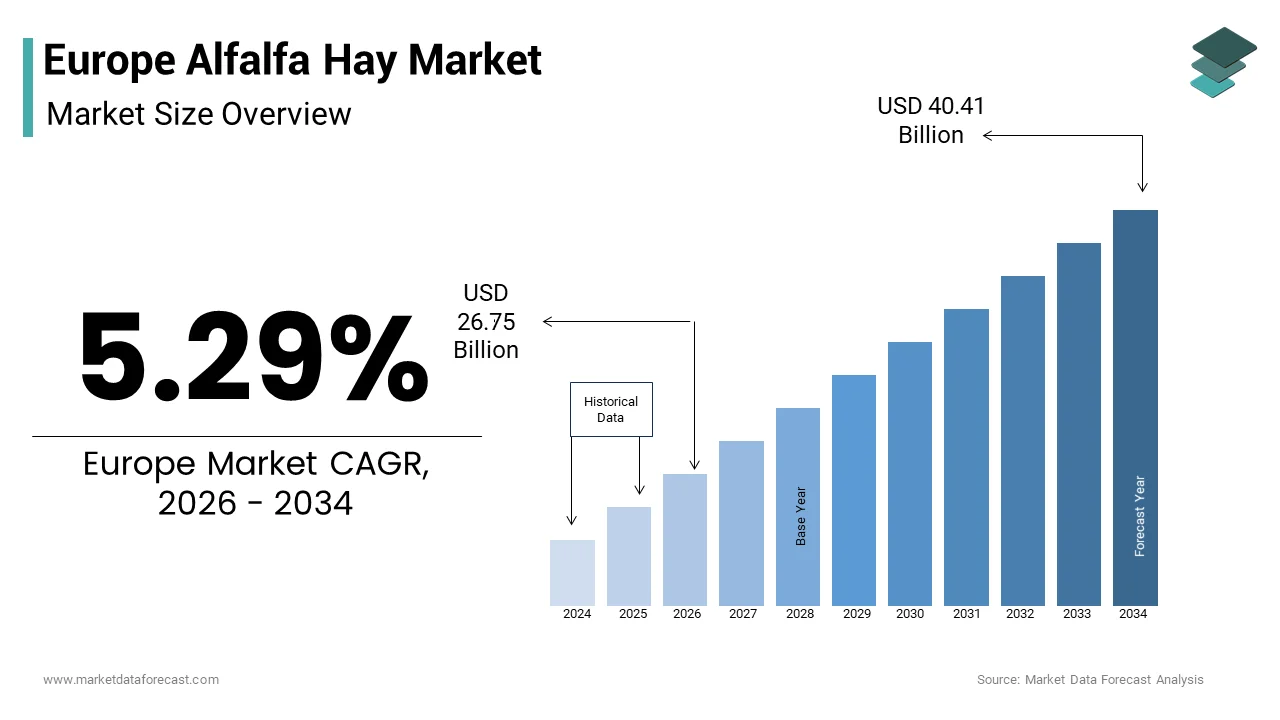
Alfalfa hay encompasses the production processing, and distribution of dehydrated or sun-dried alfalfa, primarily used as high protein forage for dairy cattle, equine,,s and specialty livestock across the continent. Alfalfa hay is valued for its digestible fiber protein content exceeding 18% and balanced calcium to phosphorus ratio, making it indispensable in premium animal nutrition. Unlike cereal straws or grass hays, alfalfa is typically baled in controlled moisture conditions and often pelletized or cubed for export and intensive feeding systems. The demand for alfalfa hay in Europe is driven by its large dairy sector, stringent animal welfare standards, and growing equestrian industry. According to Eurostat, around 19.2 million dairy cows are maintained in the European Union,n with high-yielding herds in Germany, France, and the Netherlands requiring protein-rich forage to sustain milk production. Under the European Commission’s Common Agricultural Policy 2023–2027, legume forage crops, including alfalfa, are supported under eco scheme payments for nitrogen fixation and soil health. Additionally, the European Horse Network estimates that about 7 million equines in Europe rely on quality hay as a dietary staple, which is further anchoring structural demand for consistent and contaminant-free alfalfa supplies.
MARKET DRIVERS
Expansion of High-Yielding Dairy Herds Drives Premium Forage Demand
The intensification of dairy farming in Northwestern Europe continues to fuel consistent demand for high-protein alfalfa hay as a critical feed component, which is one of the key factors propelling the growth of the alfalfa hay market in Europe. According to Eurostat, the average milk yield per cow in the European Union reached about 7,800 kilograms in 2023, up from around 7,400 kilograms in 2018, which reflects genetic and nutritional advancements. High-producing herds in Germany, the Netherlands, and Denmark routinely exceed 10,000 kilograms annually, which requires higher‑protein diets that are levels unattainable with grass hay alone. Many intensive dairy farms now include alfalfa hay or pellets in total mixed rations to support rumen health and milk solids. The EU’s nutrient management tools promote precise protein balancing to reduce nitrogen excretion, which makes high-digestibility forages like alfalfa environmentally advantageous. According to reports, partially replacing grass silage with alfalfa hay can reduce ammonia emissions while maintaining milk output. This dual benefit of productivity and compliance ensures sustained procurement of quality alfalfa from both domestic and imported sources.
Growth of the Equestrian and Sport Horse Industry Elevates Quality Hay Standards
The robust equestrian sector of Europe significantly influences alfalfa hay consumption due to the nutritional and digestive needs of performance and leisure horses, which is further boosting the alfalfa hay market growth in Europe. According to the European Horse Network, about 7 million equines are kept across Europe, with many engaged in competitive disciplines including dressage, show jumping, and racing. These animals require dust-free, mold-free forage with consistent nutrient profiles to prevent respiratory and colic issues. Alfalfa hay meets these criteria with its low non-structural carbohydrate content and high calcium levels essential for bone development in young and working horses. In countries like France, the U.S., K, and Italy, where equestrian tourism and breeding are economically significant, many boarding stables specify alfalfa inclusion in feed rations to support performance and recovery. Additionally, the European Horse Welfare Code, updated in 20,23, recommends a minimum of 1.5 kilograms of high-quality legume hay per 100 kilograms of body weight for sport horses, further institutionalizing demand. This specialized requirement creates a premium segment less sensitive to price fluctuations and more focused on traceability and hygienic processing.
MARKET RESTRAINTS
Limited Domestic Production Capacity Constrains Supply Security
Europe faces a structural deficit in alfalfa hay production due to climatic limitations, agronomic priorities, and land use competition, which restricts self-sufficiency and hinders the expansion of this market. According to the European Commission, alfalfa and other legume forages were cultivated on several million hectares in the EU in 2024, below the area needed to meet domestic livestock demand. Southern regions like Spain and Italy produce high-quality hay, but face recurring droughts that are prolonged in 2023, reducing yields substantially. Meanwhile, Northern Europe’s co,ol humid climate favors grass over legumes, leading to protein gaps filled by imports. The EU imports substantial volumes of alfalfa pellets and hay, which is primarily from the United States and the United Arab Emirates. This reliance on external sources exposes the market to shipping disruptions, trade policies, and foreign exchange volatility. Without expanded irrigation infrastructure and CAP incentives for legume rotation adoption, Europe’s alfalfa hay supply will remain vulnerable to global market fluctuations.
Stringent Phytosanitary and Contaminant Regulations Increase Import Complexity
The Europe Alfalfa Hay Market is significantly constrained by rigorous EU regulations governing pesticide residues, mycotoxins, and foreign matter in imported forage. As per the European Food Safety Authority, all consignments of alfalfa hay must comply with maximum residue levels and undergo aflatoxin B1 testing in line with EU limits. In 2023, the European Commission rejected multiple shipments due to violations, including the presence of prohibited weeds like Palmer amaranth or excessive dust content. These rejections cause costly delays and force buyers to seek alternative suppliers, often at premium prices. Additionally, the EU’s updated feed hygiene regulation 2023/1283 requires full traceability from field to bale, including harvest dates and drying methods, which is a challenge for exporters with fragmented supply chains. Compliance documentation must be validated by EU-approved third parties, further increasing the administrative burden. While these rules protect animal health and ecosystem integrity, they create high barriers for new exporters and reduce supply elasticity during domestic shortfalls.
MARKET OPPORTUNITIES
Integration of Alfalfa into EU Agroecological Transition Plans Creates Policy Tailwinds
The strategic shift of the European Union toward sustainable agriculture presents a significant opportunity for the European alfalfa hay market. Under the Common Agricultural Policy 2023–2027, eco-schemes must account for at least 25% of direct payments, which is rewarding legume integration for nitrogen fixation, soil carbon sequestration, and biodiversity enhancement. As per the European Commission, farmers who include alfalfa in crop rotations can receive per-hectare eco-scheme payments through their national CAP plans. Furthermore, the EU Soil Strategy for 2030 identifies deep-rooted legumes like alfalfa as key to reversing soil degradation, with pilot programs in France and Germany demonstrating improvements in soil organic matter after alfalfa inclusion. National initiatives amplify this trend as Spain’s Strategic Plan for Agriculture promotes alfalfa in irrigated zones of Castilla-La Mancha to reduce synthetic fertilizer use. These policy instruments not only boost domestic production but also enhance the environmental credentials of European livestock farming, aligning with consumer demand for low-footprint dairy and meat products and creating a virtuous cycle of supply and sustainability.
Development Value-Added Alfalfa Products Expands Market Applications.
Innovation in processing technologies is unlocking new revenue streams for alfalfa beyond traditional hay bales through high-value derivatives tailored to niche animal and industrial uses, which is another significant opportunity for the European market. Companies across the Netherlands and Denmark are producing alfalfa protein concentrate with high crude protein for use in calf milk replacers and aquaculture feeds, which is a segment that is growing. Additionally, pelleted and cubed alfalfa with added vitamins or probiotics caters to premium pet food manufacturers targeting Europe’s large cat and dog population. In Germany, researchers at leading institutes have developed enzymatically treated alfalfa fiber for use in biodegradable packaging trials funded under Horizon Europe. These value-added formats command premium prices and reduce transport costs through densification. As consumer and regulatory pressure mounts for circular bioeconomy solutions, alfalfa’s versatility as a renewable protein and fiber source positions it for diversified growth beyond conventional forage markets.
MARKET CHALLENGES
Climate-Induced Weather Volatility Disrupts Harvest Cycles and Quality
The climate change that is due to weather extremes that compromise yield consistency and forage quality is a major challenge to the regional market growth. According to the European Environment Agency, compound drought‑heatwave events have increased in Southern and Central Europe, and 2023 was among the hottest years on record. Alfalfa requires three to four cuttings annually, but prolonged heat above 35°C stunts regrowth while sudden rainfall during harvest causes leaf shatter and mold development. For instance, protein content ithe n the second and third cuttings declines during heat stress periods. In Eastern Europe, spring floods delayed the first cutting and reduced annual tonnage. These disruptions not only lower farm income but also force dairy and equine operations to source expensive imports or substitute with inferior forages, which is impacting animal health and productivity. Without adaptive agronomic practices and weather‑indexed insurance, the sector remains exposed to escalating climatic risk.
Fragmented EU Import Policies Create Market Access Inequities
The inconsistent phytosanitary protocols and tariff classifications applied by individual member states, despite a common external trade framework, are further challenging the alfalfa hay market growth in Europe. According to the European Court of Auditors, while the EU mandates uniform feed safety standards, national border inspection posts exhibit significant variation in sampling frequency and rejection criteria. For instance, in 2023, Spanish ports cleared US alfalfa pellet shipments while Italian ports rejected identical consignments, citing differing interpretations of dust content limits. This unpredictability increases compliance costs for exporters and discourages long-term supply contracts. Furthermore, the EU’s Harmonized System code 1214 90 for alfalfa hay is sometimes misapplied as “other forage,” triggering higher tariffs or additional documentation. According to the European Feed Manufacturers Federation, such discrepancies caused shipment delays in 2023, adding to landed costs. Until the European Commission enforces standardized import procedures through centralized digital clearance platforms, market fragmentation will persist, undermining supply reliability and pricing transparency across the bloc.
REPORT COVERAGE
| REPORT METRIC | DETAILS |
| Market Size Available | 2025 to 2034 |
| Base Year | 2025 |
| Forecast Period | 2026 to 2034 |
| CAGR | 5.29% |
| Segments Covered | By Type, Application, And Region |
| Various Analyses Covered | Global, Regional, and Country-Level Analysis; Segment-Level Analysis; DROC; PESTLE Analysis; Porter’s Five Forces Analysis; Competitive Landscape; Analyst Overview of Investment Opportunities |
| Regions Covered | UK, France, Spain, Germany, Italy, Russia, Sweden, Denmark, Switzerland, the Netherlands, the Czech Republic, and the Rest of Europe |
| Market Leaders Profiled | Alfalfa Monegros, S.L., Coaba, Los Venteros S.C., Grupo Osés, Haykingdom Inc., STANDLEE HAY COMPANY, Green Prairie International, Cubeit Hay Company, M&C Hay, Glenvar Hay, McCracken HAY COMPANY, SL Follen Company, Anderson Hay & Grain Inc., Border Valley, Knight Ag Sourcing, Hay USA, Bailey Farms, Riverina Pty Ltd, and Gruppo Carli. |
SEGMENTAL ANALYSIS
By Type Insights
The bales segment occupied the most significant share of the European alfalfa hay market in 2025. The dominance of the bales segment in the European market is primarily driven by traditional feeding practices in the dairy and equine sectors, where long-stem fiber is essential for rumen function and dental health. Many high-yielding dairy farms in Germany, the Netherlands, and France prefer large square or round bales for inclusion in total mixed rations due to better digestibility and reduced sorting behavior in cattle. The second factor is cost efficiency. Baling requires less energy and capital investment compared to pelleting or cubing. Additionally, bales retain more leaf material when harvested and stored under optimal moisture conditions. National equine welfare guidelines in the UK and Sweden also mandate long forage as the foundation of the horse diet, reinforcing demand for baled hay over processed forms. This agronomic and physiological alignment ensures bales remain the default choice for large-scale livestock operations across Europe.
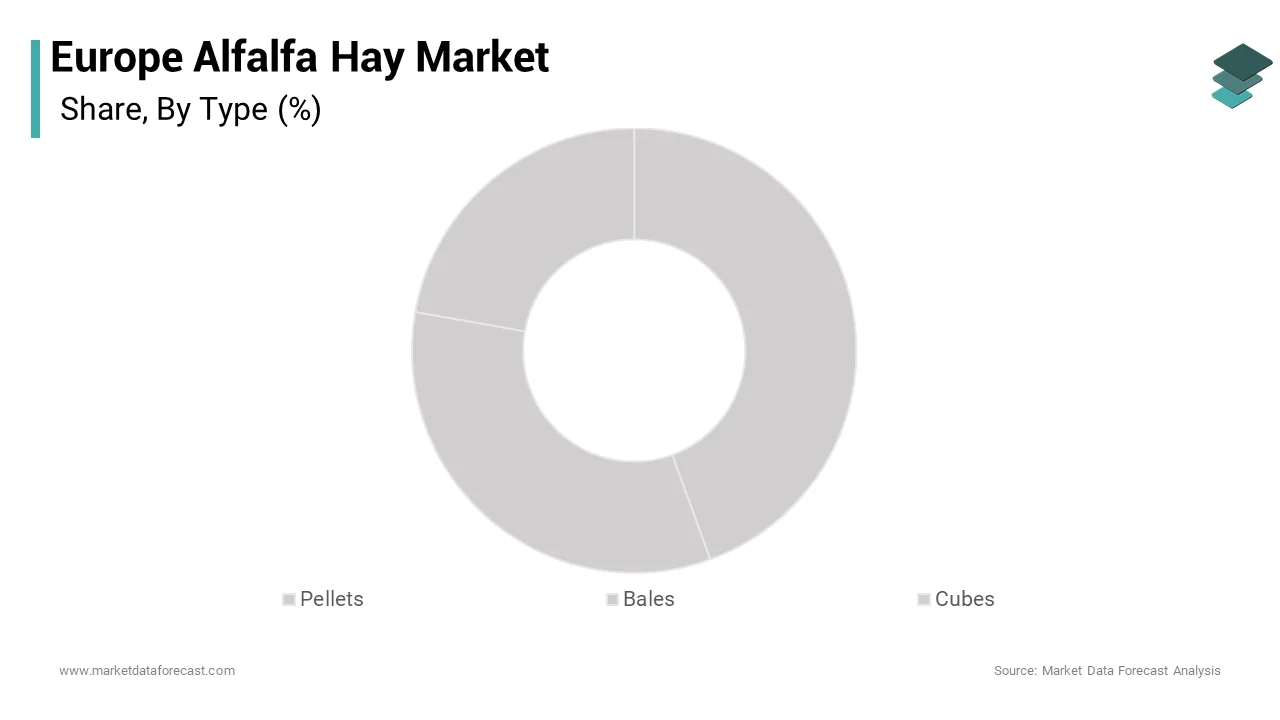
The pellets segment is another major segment and is estimated to register the fastest CAGR of 10.12% over the forecast period, owing to the rising demand for pace-efficient, uniform, and dust-free forage in intensive livestock and pet nutrition systems. As per the European Pet Food Industry Federation, many European households now keep small herbivores such as rabbits and guinea pigs, and pelleted alfalfa is commonly used as a dietary component. The second driver is logistical optimization. Pellets increase bulk density to 600–700 kg/m3 compared to loose biomass at 80–200 kg/m3, which reduces transport volume and enables cost-effective long-distance distribution from Southern production zones to Northern consumption centers. In 2023, the Netherlands imported 19.2 million kilograms of lucerne (alfalfa) meal and pellets from France, with additional volumes from Italy and Germany, for use in calf starter rations and organic poultry feed. Additionally, pelleting allows for precise nutrient fortification with vitamins, minerals, or probiotics, aligning with the EU’s Farm to Fork Strategy for targeted animal nutrition. These functional and economic advantages position pellets as the growth engine of the processed forage segment.
By Application Insights
The meat and dairy animal feed segment captured 56.5% of the European market share in 2025. The dominance of the meat and dairy segment in the European market is driven by the critical role of high-protein forage in supporting milk yield and meat quality across the continent’s intensive livestock systems. According to Eurostat, the EU maintains about 19.2 million dairy cows and around 72 million bovine animals with high-yielding herds in Germany, France, and the Netherlands, requiring rations containing 16 to 19% crude protein, and these levels are consistently delivered by alfalfa hay. The second factor is regulatory alignment. The EU’s Integrated Pollution Prevention and Control Directive mandates reduced nitrogen excretion from livestock operations, which is making highly digestible protein sources like alfalfa environmentally preferable to synthetic supplements. For instance, substituting higher-digestibility forages for imported protein meals can lower ammonia emissions without compromising milk output. With the Common Agricultural Policy increasingly linking subsidies to sustainable feed practices, alfalfa’s dual benefit of productivity and environmental stewardship secures its centrality in ruminant nutrition.
The horse feed segment is predicted to grow at a CAGR of 10.7% over the forecast period in this regional market, owing to the expansion of the sport and leisure horse population and heightened awareness of digestive health requirements. According to the European Commission, the EU is home to around 6 million horses, and performance and high‑intensity training disciplines require consistent high‑quality forage to help prevent colic and respiratory issues. Alfalfa hay’s low dust and mold content, combined with its calcium‑rich profile that make it suitable for performance horses, particularly in disciplines like dressage and endurance racing. The second catalyst is the professionalization of horse care. Many boarding stables in France, the UK, and Italy specify alfalfa inclusion in feed protocols. Additionally, EU animal welfare initiatives emphasize forage‑first feeding practices for working and sport horses, which supports demand for high‑quality legume hay. This convergence of welfare standards and performance nutrition ensures sustained growth in the equine forage segment.
COUNTRY ANALYSIS
France Alfalfa Hay Market Analysis
France dominated the alfalfa hay market in Europe by holding 20.8% of the regional market share in 2025. The dominance of France in the European market is attributed to the large dairy sector, extensive equine industry, and favorable agro-climatic conditions in regions like Centre Val de Loire and Auvergne-Rhône-Alpes. France maintains about 3.08 million dairy cows as per official statistics, with intensive farms relying on alfalfa hay to meet protein targets in high-yielding herds. France also hosts one of Europe’s largest populations of sport and leisure horses. Under the Common Agricultural Policy, France allocates support measures for legume forage cultivation. Additionally, the national “Proteins Plan” aims to reduce reliance on soybean imports by 2030, which is promoting domestic alfalfa as a sustainable alternative. With strong domestic production and strategic use in both livestock and equine sectors, France remains the anchor market for alfalfa hay in Western Europe.
Spain Alfalfa Hay Market Analysis
Spain had the second leading share of the European alfalfa hay market in 2025. Spain is the EU’s largest producer of alfalfa hay, with cultivation concentrated in Castilla-La Mancha, Andalusia, and Murcia under irrigation. Despite recurring droughts, Spain exported significant volumes of alfalfa pellets and bales in 2024, mainly to the Netherlands, Germany, and Italy. The second driver is policy support. Spain’s Strategic Plan for the Common Agricultural Policy includes specific eco-scheme payments for water-efficient alfalfa varieties and deficit irrigation techniques that reduce water use. Additionally, the expansion of organic dairy farms creates demand for certified organic alfalfa hay. Although climate vulnerability remains a concern, Spain’s production scale, infrastructure, and export orientation solidify its role as Europe’s primary alfalfa supplier.
Germany Alfalfa Hay Market Analysis
Germany held the third position in the European alfalfa hay market in 2025. The country is the EU’s largest producer of alfalfa hay, with cultivation concentrated in Castilla-La Manc, Andalusia, and Andalucía under irrigation. Despite recurring droughts, Spain exported significant volumes of alfalfa pellets and bales in 2024, mainly to the Netherlands, Germany, and Italy. The second driver is policy support. Spain’s Strategic Plan for the Common Agricultural Policy includes specific eco-scheme payments for water-efficient alfalfa varieties and deficit irrigation techniques that reduce water use. Additionally, the expansion of organic dairy farms creates demand for certified organic alfalfa hay. Although climate vulnerability remains a concern, Spain’s production scale, infrastructure, and export orientation solidify its role as Europe’s primary alfalfa supplier.
Italy Alfalfa Hay Market Analysis
Italy is anticipated to hold a notable share of the European alfalfa hay market over the forecast period, owing to a dual structure of intensive Po Valley dairy farms and extensive Southern sheep and goat operations, both reliant on alfalfa for protein supplementation. Italy maintains a large dairy herd, with Lombardy and Emilia Romagna leading in milk production and alfalfa hay usage. The second driver is equestrian demand. Italy hosts substantial numbers of sport horses concentrated near Milan, Rome, and Florence, where premium stables routinely include alfalfa in feeding programs. Additionally, Italy’s strategic location enables it to serve as a distribution hub for Mediterranean imports of alfalfa pellets, with flows entering through Genoa and Trieste ports in 2024 destined for Central Europe. Despite water scarcity challenges in key growing areas, national irrigation modernization programs and CAP eco incentives support continued alfalfa cultivation and stable demand across livestock sectors.
Netherlands Alfalfa Hay Market Analysis
The Netherlands is expected to showcase a healthy CAGR in the European market during the forecast period, owing to the ultra-intensive livestock systems' extreme reliance on imported forage and advanced feed formulation practices. The Netherlands maintains a highly efficient dairy sector, producing large volumes of milk that require highly efficient rations where alfalfa pellets provide consistent protein with low variability. Industry associations report substantial alfalfa pellet imports, primarily from Spain and the United States, to meet demand from dairy, veal, and rabbit farms. The second factor is logistical integration. The Port of Rotterdam serves as a major entry point for bulk forage with specialized terminals for handling and redistribution across the Rhine corridor. Additionally, Dutch feed compounders lead in precision nutrition, incorporating alfalfa protein concentrate into starter feeds for calves and piglets. This blend of import dependencytechnicalal sophistication,n and value‑added processing ensures the Netherlands remains a pivotal and high‑velocity market despite limited domestic production.
COMPETITIVE LANDSCAPE
The Europe Alfalfa Hay Market features a dual competitive structure with domestic producers in Southern Europe competing against imported supply primarily from the United States and the Middle East. Competition is not solely price-based but centers on protein consistency, dust content, harvest time, and regulatory compliance. Large agro-industrial firms dominate volume supply through integrated operations, while smaller cooperatives and organic producers cater to niche premium segments, particularly in equine and organic dairy. The market is highly fragmented, with over 15,000 alfalfa growers in Spain alone, yet consolidated at the processing and export level, where scale ensures compliance with EU feed safety standards. Differentiation increasingly hinges on sustainability credentials, with buyers favoring suppliers that demonstrate water stewardship, carbon footprint reduction, and traceability. Climate vulnerability remains a systemic risk, leveling the playing field between domestic and imported hay. As the EU tightens environmental regulations and promotes protein autonomy, competition will intensify around agronomic innovation, logistics efficiency, and value-added processing rather than raw tonnage alone.
KEY MARKET PLAYERS
Some of the key players dominating the Europe alfalfa hay market are
- Alfalfa Monegros, S.L.
- Coaba
- Los Venteros S.C.
- Sodrugestvo Group
- Tassili Agricultural Development Company (Tassili)
- Grupo Osés
- Lidea SAS
- Haykingdom Inc.
- STANDLEE HAY COMPANY
- Green Prairie International
- Cubeit Hay Company
- M&C Hay
- Glenvar Hay
- McCracken HAY COMPANY
- SL Follen Company
- Anderson Hay & Grain Inc.
- Border Valley
- Knight Ag Sourcing
- Hay USA
- Bailey Farms, Riverina Pty Ltd
- Gruppo Carli.
Top Players In The Market
- Sodrugestvo Group is a leading European agro-industrial company with significant operations in forage production and distribution across Eastern and Central Europe. The company integrates alfalfa cultivation, processing,,g and logistics through its vertically aligned supply chain serving dairy and equine sectors in Germany, PoPolanddand the Baltics. Sodrugestvo leverages its extensive farmland portfolio in Ukraine and Romania to produce high-protein alfalfa hay under controlled irrigation and harvest protocols. In 2024, the company expanded its dehydration facilities in Romania to produce dust-free alfalfa pellets compliant with EU feed hygiene regulations. It also implemented blockchain traceability from field to bale, enabling real-time verification of protein content and harvest dates for premium buyers. These initiatives reinforce its role as a reliable supplier of consistent and certified forage supporting Europe’s shift toward sustainable and transparent animal nutrition.
- Tassili Agricultural Development Company is a major forage producer based in Spain with a strong footprint in the European alfalfa hay market. Operating over 35,000 hectares of irrigated alfalfa in Castilla La Mancha, the company specializes in large square bales and premium pellets for export to Germany, the Netherlands, and France. Tassili adheres to GLOBALG.A.P. and organic certification standards,s, ensuring compliance with stringent EU phytosanitary requirements. In early 2024, it launched a water efficiency program using soil moisture sensors and deficit irrigation techniques, reducing water consumption by 22% without compromising yield. The company also partnered with Dutch feed compounders to develop fortified alfalfa pellets enriched with rumen-protected amino acids. These actions position Tassili at the intersection of sustainability innovation and market responsiveness in Europe’s premium forage segment.
- Lidea SAS is a French agricultural cooperative and seed technology company that plays a pivotal role in the Europe alfalfa hay market through the development and distribution of high-yielding disease disease-resistant alfalfa varieties. While not a direct hay producer, Lidea’s genetics underpin much of Western Europe’s domestic production. The company’s Stamina and Team series varieties dominate in France, Germany, and Belgium due to their winter hardiness and multi-cut potential. In 2023, LL introduced aaa new drought-tolerant alfalfa line validated across 12 trial sites in Southern Europe, showing 18% higher dry matter yield under water stress. It also collaborates with national agricultural institutes to promote legume integration in crop rotations under CAP eco schemes. By enhancing agronomic performance and climate resilience, Lidea strengthens the foundation of Europe’s alfalfa supply chain from the ground up.
Top Strategies Used By The Key Market Participants
Key players in the Europe Alfalfa Hay Market focus on vertical integration by controlling cultivation, harvesting, and processing to ensure quality consistency and traceability. Companies invest in water-efficient irrigation and precision agronomy to mitigate climate risks and comply with EU sustainability mandates. Strategic partnerships with feed compounders, dairy cocooperativesquestrian associations secure long-term offtake agreements and align product specifications with end-user needs. Export-oriented producers prioritize compliance with EU phytosanitary and feed hygiene regulations through third-party certifications and digital dodocumentationirms develop value-added formats such as fortified pellets or organic bales to capture premium segments and reduce transport costs. Seed developers concentrate on breeding high-yielding drought-tolerant and multi-cut varieties adapted to regional European condconditionsnhancing domestic production resilience and reducing import dependency.
MARKET SEGMENTATION
This research report on the europe alfalfa hay market is segmented and sub-segmented into the following categories.
By Type
- Pellets
- Bales
- Cubes
By Application
- Meat/Dairy Animal Feed
- Poultry Feed
- Horse Feed
- Other
By Country
- UK
- France
- Spain
- Germany
- Italy
- Russia
- Sweden
- Denmark
- Switzerland
- Netherlands
- Turkey
- Czech Republic
- Rest of Europe