- Product Description Description
- Table of Contents TOC
- List of Table & Figure LOT
- Get Free Sample PDF Sample PDF
Market Size, 2025
$16.02 BnMarket Estimate, 2026
$16.81 BnMarket Forecast, 2034
$24.66 BnCAGR, 2026–2034
4.91%Europe Alumina Market Report Summary
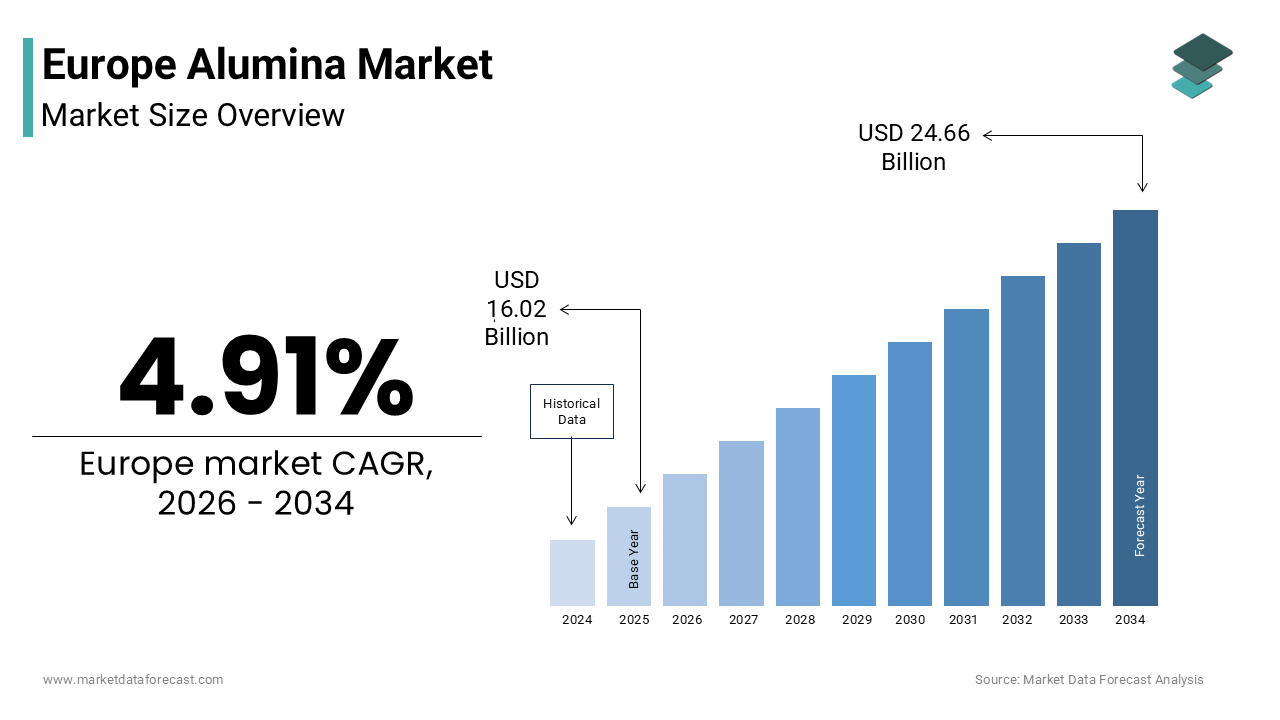
The Europe alumina market was valued at USD 16.02 billion in 2025, is estimated to reach USD 16.81 billion in 2026, and is projected to reach USD 24.66 billion by 2034, growing at a CAGR of 4.91% during the forecast period from 2026 to 2034. The growth of the Europe alumina market is driven by increasing demand for aluminum in transportation, renewable energy, and advanced industrial applications. Alumina (aluminum oxide – Al₂O₃) is the primary raw material used for aluminum production and also finds extensive applications in ceramics, refractories, abrasives, catalysts, and specialty chemicals. Europe operates within a regulated industrial framework where decarbonization policies, raw material import dependencies, and circular economy initiatives influence the alumina supply chain. The increasing focus on sustainable materials and energy-efficient technologies is further shaping the regional alumina market.
Key Market Trends
-
Rising demand for lightweight aluminum alloys in electric vehicles to improve vehicle efficiency and reduce emissions.
-
Increasing adoption of high-purity and specialty alumina in renewable energy technologies such as solar photovoltaic cells and battery storage systems.
-
Growing focus on circular economy initiatives, including recycling and recovery of alumina from industrial waste streams.
-
Expansion of semiconductor and electronics manufacturing that requires ultra-high purity alumina materials.
-
Increasing emphasis on low-carbon aluminum supply chains to comply with European environmental regulations.
Segmental Insights
- Based on grade, the smelter grade alumina segment held a prominent share of the Europe alumina market due to its critical role as the primary feedstock for aluminum smelting. The demand is supported by ongoing aluminum production used in automotive, aerospace, and packaging industries.
- The chemical grade alumina segment is expected to register the fastest growth during the forecast period. The growth is driven by increasing applications in lithium-ion batteries, electronics manufacturing, catalysts, ceramics, and advanced materials used in high-tech industries.
- Based on application, the aluminum production segment accounted for the largest share of the Europe alumina market as alumina is the key raw material required for primary aluminum manufacturing.
- The calcined alumina and alumina hydrate segments are also witnessing steady growth due to their use in ceramics, refractories, abrasives, and chemical processing industries.
Regional Insights
The Europe alumina market is experiencing steady demand across major industrial economies supported by manufacturing activity, automotive production, and advanced materials industries.
-
Germany accounted for 24.3% of the Europe alumina market share in 2024, driven by its strong automotive manufacturing sector, advanced chemical industry, and high demand for aluminum components.
-
France holds a significant market share due to the presence of specialty alumina production facilities and strong demand from aerospace and defense industries.
-
Norway plays a major role in aluminum production and imports large volumes of alumina to support its hydro-powered smelting operations.
-
Italy contributes significantly through its ceramics and foundry industries that require alumina-based materials.
-
Turkey is witnessing increasing demand due to rapid industrialization and expanding automotive and manufacturing sectors.
Competitive Landscape
The Europe alumina market is highly competitive and dominated by global mining and metal companies that supply alumina for aluminum production as well as specialty industrial applications. Market participants focus on securing raw material supply, investing in low-carbon aluminum production technologies, and expanding specialty alumina product portfolios. Companies are increasingly adopting sustainability strategies, including recycling initiatives and carbon reduction technologies, to comply with European environmental regulations. Strategic partnerships with automotive manufacturers, electronics companies, and renewable energy developers are also shaping the competitive dynamics of the market. Prominent players in the Europe alumina market include Rio Tinto, Alcoa Corporation, RUSAL, Norsk Hydro ASA, Alumina Limited, South32 Limited, Hindalco Industries Limited, Emirates Global Aluminium, NALCO (National Aluminium Company Limited), and China Hongqiao Group Limited.
 Download Free Sample Report
Europe Alumina Market Size
The Europe Alumina Market size was valued at USD 16.02 billion in 2025 and is anticipated to reach USD 16.81 billion in 2026 from USD 24.66 billion by 2034, growing at a CAGR of 4.91% during the forecast period from 2026 to 2034.
Alumina is chemically known as aluminum oxide (Al₂O₃), which serves as the foundational precursor in primary aluminum production and finds extensive application in refractories, ceramics, abrasives, and specialty chemicals. In Europe, the alumina operates within a tightly regulated industrial ecosystem shaped by decarbonization mandates, circular economy directives, and strategic raw material dependencies. Unlike regions endowed with bauxite reserves, Europe relies almost entirely on imported alumina, primarily sourced from Guinea, Brazil, and Australia, to feed its limited but technologically advanced smelting infrastructure. The European Commission’s Raw Materials Act identifies alumina as a material of strategic importance due to its role in clean energy technologies and defense applications. Furthermore, as per the International Aluminium Institute, Europe accounts for less than 5% of global primary aluminum output, underscoring its constrained upstream capacity. This structural dependency, coupled with tightening environmental legislation under the EU Green Deal, positions the Europe alumina market at the intersection of industrial resilience and sustainability transformation, where supply security and emission reduction compete as dual imperatives.
MARKET DRIVERS
Electrification of Transport Systems Fuels Demand for Lightweight Aluminum Alloys
The accelerating electrification of Europe’s transport sector has emerged as a pivotal driver for alumina demand through its downstream linkage to aluminum production. The electrification of transport systems is solely prompting the growth of Europe alumina market. Electric vehicles require lightweight materials to offset battery weight and extend driving range by making aluminum alloys indispensable. As per the European Automobile Manufacturers Association, electric car registrations in the EU surpassed 2.7 million units in 2025, representing a 21% year-on-year increase and accounting for nearly one in four new passenger vehicles sold. Each electric vehicle uses an average of 180 kilograms of aluminum, significantly more than internal combustion engine counterparts, according to data published by Ducker Worldwide. This surge translates into heightened demand for primary aluminum, which in turn escalates the need for metallurgical-grade alumina. The European Battery Alliance further reinforces this trend by promoting localized battery and vehicle production, indirectly stimulating regional aluminum consumption. Additionally, the EU’s Fit for 55 package mandates a 55% reduction in CO₂ emissions from new cars by 2030, compelling automakers to adopt lightweighting strategies. This structural shift not only anchors long-term alumina consumption but also reshapes procurement strategies among European metal producers seeking secure and low-carbon feedstock.
Expansion of Renewable Energy Infrastructure Drives Specialty Alumina Applications
The deployment of renewable energy systems for high-purity and specialty alumina in components such as photovoltaic cells, wind turbine gearboxes, and grid-scale battery storage is propelling the growth of Europe alumina market. Solar photovoltaic installations alone reached 65 gigawatts of new capacity in the EU in 2025 by marking a record annual addition driven by REPowerEU targets. High-purity alumina is essential in the passivation layers of PERC and TOPCon solar cells by enhancing efficiency and durability. Similarly, in lithium-ion battery manufacturing, alumina-coated separators improve thermal stability and cycle life features vital for stationary storage linked to intermittent renewables. Moreover, the European Chemicals Agency notes that specialty alumina consumption in electronics and energy applications grew by 7.3% annually between 2021 and 2025. This niche yet high-value segment offers resilient demand insulated from fluctuations in primary aluminum markets. As Europe advances its energy sovereignty agenda, the integration of advanced ceramics and functional oxides derived from alumina becomes increasingly embedded in clean tech value chains, creating a diversified and technologically sophisticated demand base that extends far beyond traditional smelting.
MARKET RESTRAINTS
Geopolitical Volatility Disrupts Secure Alumina Supply Chains
The near-total dependence on imported alumina exposes to acute supply chain vulnerabilities exacerbated by geopolitical instability in key sourcing regions, which is hampering the growth of Europe alumina market. Over 85% of the EU’s alumina imports originate from countries facing political uncertainty or trade restrictions, including Guinea, where the world’s largest bauxite exporter and Russia, which supplied refined alumina to several Central European smelters prior to sanctions. Furthermore, the imposition of EU sanctions on Russian metals, following the Ukraine conflict severed access to approximately 1.1 million metric tons of annual alumina supply, as documented by the International Energy Agency. This shortfall forced European smelters like Aluminij in Bosnia and Alcoa’s operations in Spain to seek alternative suppliers at premium prices, compressing margins. The absence of domestic refining infrastructure means Europe lacks strategic buffers against export controls or maritime chokepoint risks. Consequently, supply insecurity not only inflates input costs but also undermines the EU’s ambition for resilient industrial value chains, particularly in defense and aerospace sectors where assured material provenance is non-negotiable.
Stringent Environmental Regulations Increase Production Compliance Costs
The growing pressure from evolving environmental legislation that imposes significant operational and financial burdens on both importers and end-users is also impeding the growth of Europe alumina market. The EU Emissions Trading System, now includes indirect emissions from electricity-intensive industries, directly affecting aluminum smelters that consume vast quantities of power derived from alumina. Moreover, the Industrial Emissions Directive mandates Best Available Techniques for all large combustion plants, requiring costly retrofits for facilities handling alumina-derived processes. Additionally, the upcoming Carbon Border Adjustment Mechanism will levy tariffs on imported aluminum based on embedded carbon intensity, indirectly penalizing alumina sourced from high-emission jurisdictions like China and the Middle East. Data from the European Commission indicates that alumina produced via the Bayer process in coal-dependent regions emits up to 1.8 tons of CO₂ per ton of alumina, compared to 0.6 tons in hydro-powered refineries. This disparity forces European buyers to either absorb higher costs for green-certified alumina or face CBAM liabilities. Moreover, waste management regulations governing red mud, where the caustic byproduct of alumina refining have tightened, with the EU classifying it as hazardous under certain pH thresholds.
MARKET OPPORTUNITIES
Circular Economy Initiatives Unlock Secondary Alumina Recovery Potential
The EU’s aggressive push toward a circular economy for alumina recovery from post-consumer and industrial waste streams is greatly influencing the growth of Europe alumina market. Unlike primary production, which relies on bauxite mining, secondary alumina can be extracted from aluminum dross, spent catalysts, and incineration residues by offering a lower-carbon alternative aligned with the European Green Deal. Recent advances in hydrometallurgical leaching and plasma arc processing have improved alumina extraction yields from these wastes to above 85% purity, as demonstrated in pilot projects funded by Horizon Europe. Companies like Hydro and Umicore are already scaling closed-loop systems that reintegrate recovered alumina into specialty applications, thereby reducing reliance on virgin material. Furthermore, the revised Waste Framework Directive mandates that member states achieve a 65% municipal waste recycling rate by 2035, indirectly boosting feedstock availability for urban mining ventures. This emerging circular pathway not only enhances resource sovereignty but also creates new industrial synergies between waste management, metallurgy, and advanced materials sectors, positioning Europe at the forefront of sustainable alumina innovation.
Strategic Stockpiling Mandates Create Institutional Procurement Channels
The new EU-level policies mandating strategic reserves of raw materials offer a structured demand channel for alumina, insulating it from short-term market volatility. This factor is also to escalate the growth of the Europe alumina market in foreseen years. Under the Raw Materials Act adopted in 2023, member states are required to maintain minimum stockpiles equivalent to 90 days of net imports for materials deemed essential to defense, digital infrastructure, and energy security. Alumina qualifies under this framework due to its irreplaceable role in semiconductor substrates, radar-absorbing ceramics, and high-voltage transmission systems. As per the European Defence Agency, military-grade aluminum alloys used in armored vehicles and naval vessels depend exclusively on high-purity alumina with trace element controls unattainable through recycled sources. This institutional demand guarantees baseline offtake regardless of cyclical industrial activity. Data from the Directorate-General for Internal Market indicates that initial stockpiling contracts signed in 2025 covered 320,000 metric tons of alumina, with annual replenishment obligations thereafter. Such mechanisms not only stabilize pricing expectations but also incentivize long-term supply agreements with certified low-carbon producers.
MARKET CHALLENGES
Energy Intensity Constraints Limit Domestic Refining Viability
The inability to establish competitive domestic alumina refining stems fundamentally from the extreme energy intensity of the Bayer process, which requires sustained high-temperature steam and substantial electrical input conditions increasingly incompatible with the region’s decarbonized energy matrix. This is solely one of the major challenges for the growth of the Europe alumina market. Producing one ton of alumina consumes approximately 15 gigajoules of thermal energy and 150 kilowatt-hours of electricity, figures that render European operations economically unviable under current energy pricing structures. According to the European Network of Transmission System Operators for Electricity, the average wholesale electricity price in the EU exceeded 110 euros per megawatt-hour in 2025, more than double the global average for industrial consumers. Furthermore, the EU’s phaseout of coal and nuclear restrictions in several member states constrain access to stable baseload power essential for continuous refining operations. As a result, no new alumina refinery has been commissioned in Europe since the 1970s, and existing conversion facilities remain limited to niche chemical grades.
Technological Fragmentation Hinders Standardization in Specialty Alumina Grades
The proliferation of high-performance applications for alumina from solid-state batteries to quantum computing substrates has led to a fragmented material specifications that complicates scalable production and certification within Europe. The technological fragmentation is substantially to degrade the growth of the Europe alumina market. Unlike metallurgical-grade alumina, which adheres to globally recognized purity benchmarks (typically 99.5% Al₂O₃), specialty grades require precise control over particle size distribution, dopant concentrations, and crystal morphology, often tailored to individual OEM requirements. According to the study, over 200 distinct alumina formulations are currently in use across European advanced manufacturing sectors, with minimal interoperability between them. This lack of standardization inflates R&D costs for producers and delays qualification cycles for end-users in aerospace and medical device industries governed by stringent regulatory protocols. For instance, the European Aviation Safety Agency mandates batch-specific validation for every alumina-based ceramic component, a process that can take up to 18 months per variant. Consequently, European specialty alumina suppliers operate at suboptimal scale, unable to achieve economies of scope across diverse product lines. Meanwhile, Asian competitors like Sumitomo Chemical and Baikowski benefit from vertically integrated ecosystems that co-develop materials with downstream fabricators, accelerating time-to-market.
REPORT COVERAGE
| REPORT METRIC | DETAILS |
| Market Size Available | 2025 to 2034 |
| Base Year | 2025 |
| Forecast Period | 2026 to 2034 |
| CAGR | 4.91% |
| Segments Covered | By Grade, Application and Region. |
| Various Analyses Covered | Global, Regional & Country Level Analysis, Segment-Level Analysis, DROC, PESTLE Analysis, Porter’s Five Forces Analysis, Competitive Landscape, Analyst Overview of Investment Opportunities |
| Country Covered | UK, France, Spain, Germany, Italy, Russia, Sweden, Denmark, Switzerland, the Netherlands, Turkey, the Czech Republic, and the Rest of Europe. |
| Market Leaders Profiled | Rio Tinto, Alcoa Corporation, RUSAL, Norsk Hydro ASA, Alumina Limited, South32 Limited, Hindalco Industries Limited, Emirates Global Aluminium, NALCO (National Aluminium Company Limited), and China Hongqiao Group Limited. |
SEGMENTAL ANALYSIS
By Grade and Application Insights
The smelter grade alumina segment was accounted in holding a prominent share of the Europe alumina market in 2024, which is directly tied to its exclusive role as the feedstock for primary aluminum smelting, a process with no viable large-scale substitute. Europe’s limited but strategically vital smelting capacity concentrated in Norway, Germany, and Bosnia relies entirely on imported smelter grade alumina from Guinea and Brazil. According to the International Aluminium Institute, European primary aluminum output stood at 3.1 million metric tons in 2025, requiring roughly 6.2 million tons of smelter grade alumina based on the standard 2-to-1 input ratio. The persistence of this segment is further reinforced by the EU’s push for localized battery and electric vehicle manufacturing under the Net Zero Industry Act, which indirectly sustains demand for primary aluminum despite recycling efforts. Although, secondary aluminum use is growing, high-performance applications in aerospace and defense still mandate virgin metal derived from smelter grade alumina, cementing its market preeminence through at least 2035.
The chemical grade alumina segment is projected to register a fastest CAGR of 6.8% during the forecast period with its role in next-generation technologies that align with EU industrial and climate priorities. The deployment of gigafactories has created unprecedented demand for alumina-based battery components. Alumina-coated separators enhance thermal stability in lithium-ion cells, a necessity for electric vehicles operating under EU safety standards. As per the European Battery Alliance, the continent will host 35 active gigafactories by 2030 by producing over 1.2 terawatt-hours of battery capacity annually. Companies like Umicore and BASF are scaling domestic production of battery-grade alumina to meet this demand. Concurrently, the European Chips Act has allocated 43 billion euros to rebuild semiconductor sovereignty, with facilities like Intel’s Magdeburg plant requiring sapphire-grade alumina for wafer carriers and chamber linings. The European Semiconductor Equipment Suppliers Association estimates that semiconductor-related alumina demand will triple by 2030.
REGIONAL ANALYSIS
Germany Alumina Market Analysis
Germany was the top performer of the Europe alumina market by occupying 24.3% of share in 2024 with its dense concentration of automotive, chemical, and engineering industries. As Europe’s manufacturing powerhouse, Germany consumes alumina both as a metallurgical input for aluminum casting and as a functional additive in specialty applications. The country hosts major chemical producers like Alteo and Evonik, which supply high-purity alumina for catalysts and abrasives. The automotive industry, which accounts for nearly 28% of EU vehicle production, relies heavily on aluminum castings for engine blocks and transmission housings, sustaining steady demand for smelter grade derivatives. Moreover, Germany’s National Hydrogen Strategy includes funding for low-carbon aluminum production, indirectly supporting secure alumina sourcing.
France Alumina Market Analysis
France was accounted in holding 16.3% of the Europe alumina market share in 2024 with its historical refining infrastructure and strong defense-industrial complex. The country is home to the last operational alumina refinery in Western Europe, Alteo’s facility in Gardanne which, though scaled down, continues to produce chemical grade alumina for aerospace and nuclear applications. The French Ministry of Armed Forces allocated 6.2 billion euros in 2025 to modernize land systems, much of which flows into advanced materials procurement. Additionally, France’s commitment to nuclear energy providing over 65% of its electricity that enables relatively low-carbon aluminum recycling, reducing pressure on primary alumina but increasing demand for specialty grades in reactor components.
Norway Alumina Market Analysis
Norway alumina market growth is expected to drive with the domestic consumption but via its role as Europe’s primary aluminum producer, which dictates substantial alumina imports. According to Statistics Norway, the country imported 2.58 million metric tons of alumina in 2025, mostly from Brazil and Australia by making it the largest single-point importer in Europe. This green premium allows Norwegian metal to access EU, under the Carbon Border Adjustment Mechanism without tariffs by creating a virtuous cycle of demand. Furthermore, Hydro’s investment in the Karmoy technology pilot plant demonstrates integration of alumina-derived alloys into circular supply chains for automotive clients like BMW.
Italy Alumina Market Analysis
Italy alumina market growth is expected to grow with the world-leading ceramics industry and robust foundry sector. Italy is the largest producer of ceramic tiles in Europe, and increasingly uses alumina to enhance product durability for commercial applications. Simultaneously, the automotive foundry cluster around Turin and Brescia utilizes aluminum alloys derived from smelter grade alumina for engine components supplied to Stellantis and Ferrari. Additionally, Italy’s focus on luxury goods extends to high-end abrasives and refractories, where chemical grade alumina finds niche but high-margin applications.
Turkey Alumina Market Analysis
Turkey alumina market growth is expected to grow with its rapid industrialization and strategic location bridging Europe and Asia. According to the Turkish Statistical Institute, Turkey produced 320,000 metric tons of primary aluminum in 2025 by requiring nearly 640,000 tons of smelter grade alumina partly sourced domestically from Seydişehir mines and partly imported. Moreover, Turkey’s automotive exports surged to 1.8 million vehicles in 2025 by making it Europe’s third largest car exporter after Germany and Spain, thereby amplifying aluminum alloy consumption.
COMPETITIVE LANDSCAPE
Competition in the Europe alumina market is characterized by a dichotomy between global commodity suppliers and niche European specialty producers. The absence of large scale domestic refining confines most participants to either importing smelter grade material or focusing on high purity chemical derivatives. This structural gap fosters intense rivalry among specialty players like Alteo Solvay and Baikowski who compete on purity consistency and application specific formulations. Meanwhile global giants such as Rio Tinto and Rusal vie for long term offtake agreements with European smelters emphasizing carbon footprint transparency. New entrants face high barriers due to stringent environmental permitting and capital intensity yet innovation in circular recovery offers disruptive potential. Competitive advantage increasingly hinges on alignment with EU regulatory frameworks including CBAM compliance material traceability and waste valorization capabilities rather than price alone.
KEY MARKET PLAYERS
Some of the companies that are playing a dominating role in the Europe Alumina Market include
- Rio Tinto
- Alcoa Corporation
- RUSAL
- Norsk Hydro ASA
- Alumina Limite
- South32 Limited
- Hindalco Industries Limited
- Emirates Global Aluminium
- NALCO (National Aluminium Company Limited)
- China Hongqiao Group Limited
Top Players in the Europe Alumina Market
Norsk Hydro ASA
Norsk Hydro ASA is a Norwegian multinational that plays a pivotal role in the European alumina and aluminum value chain through its integrated operations spanning renewable energy powered smelting and low carbon metal production. The company sources alumina primarily from external suppliers but maintains strategic partnerships to ensure traceability and sustainability. Hydro also collaborates with automotive OEMs to develop closed loop systems that recover aluminum from end of life vehicles reinforcing its leadership in sustainable metal solutions across Europe.
Alteo S
Alteo SA is a France based specialty alumina producer and the last remaining alumina refiner in Western Europe operating its facility in Gardanne. The company focuses exclusively on chemical grade alumina serving high value sectors including refractories catalysts ceramics and flame retardants. Alteo has strategically pivoted toward green chemistry by investing in red mud valorization technologies to extract iron titanium and rare earth elements from refining waste. It partnered with Solvay and the French Alternative Energies and Atomic Energy Commission to scale a pilot plant converting bauxite residue into construction materials. This initiative aligns with EU circular economy mandates and strengthens Alteo’s position as a critical supplier of non-metallurgical alumina to European advanced manufacturing industries.
Rusal (UC RUSAL International Public Joint Stock Company)
Rusal is a Russia headquartered global aluminum and alumina giant with significant historical ties to European markets through long term supply contracts and downstream assets. Despite geopolitical disruptions following 2022 the company maintained limited operational presence in Central Europe particularly in Bosnia where it supplies alumina to Aluminij Industries. Rusal has emphasized its low carbon ALLOW brand which leverages hydropower-based production and carries a verified footprint below 4 tons of CO2 per ton of aluminum.
Top Strategies Used by the Key Market Participants
Key players in the Europe alumina market prioritize vertical integration through partnerships with bauxite suppliers and logistics providers to secure feedstock. They invest heavily in decarbonization technologies including inert anode smelting and red mud recycling to comply with EU environmental regulations. Companies are shifting toward specialty alumina production to capture higher margins in battery and semiconductor applications. Strategic collaborations with automotive and electronics OEMs enable co-development of tailored alumina grades. Additionally, firms pursue certification under the Aluminium Stewardship Initiative to enhance ESG credibility and meet procurement standards of major European buyers.
MARKET SEGMENTATION
This research report on the Europe Alumina Market has been segmented and sub-segmented based on the following categories.
By Grade
- Smelter Grade
- Chemical Grade
By Application
- Aluminum Production
- Alumina Hydrate
- Calcined Alumina
By Country
- UK
- France
- Spain
- Germany
- Italy
- Russia
- Sweden
- Denmark
- Switzerland
- Netherlands
- Turkey
- Czech Republic
- Rest of Europe