Europe Aluminium Foil Market Size, Share, Trends & Growth Forecast Report, Segmented By Application, And By Country (UK, France, Spain, Germany, Italy, Russia, Sweden, Denmark, Switzerland, Netherlands, Turkey, Czech Republic and Rest of Europe), Industry Analysis From 2026 to 2034
Market Size, 2025
$2191 MnMarket Estimate, 2026
$2277 MnMarket Forecast, 2034
$3095 MnCAGR, 2026–2034
3.91%Executive Summary: Europe Aluminium Foil Market
- Market Scope: Comprehensive European aluminium foil industry analysis covering application segments, industrial technical sectors, regional leadership shares, recycling efficiency metrics, and renewable-energy policy frameworks.
- Market Valuation: Valued at USD 2,109.07 million (2024), estimated at USD 2,191.81 million (2025), and projected to reach USD 2,932.61 million by 2033, registering a steady CAGR of 3.91% (2025–2033).
- Primary Growth Drivers: High demand across food, beverage, and pharmaceutical packaging, coupled with expanding clean-energy and electric vehicle infrastructure. Key structural and environmental benchmarks include EU aluminium foil consumption reaching ~1.3 million tons in 2024, an aluminium recycling efficiency rate of ~76%, 67% of consumers across six major European markets utilizing aluminium foil for food wrapping, and targeted solar photovoltaic growth under the EU’s REPowerEU plan aiming for nearly 600 GW of installed capacity by 2030 (building on 56 GW added in 2023).
Key Market Segment Metrics (2025–2033)
| Category | Leading Segment (2025 Position) | Fastest-Growing Segment |
|---|---|---|
| By Application | Packaging (dominated with a 59.4% market share in 2025 across food, beverage, and pharmaceutical uses) | Technical applications (projected to grow at an 8.04% CAGR, driven by lithium-ion batteries, capacitors, and renewable energy infrastructure) |
| By Product Type / Thickness | Household and standard gauge container foils | Lightweight high-barrier foils and battery-grade aluminum foils |
| By End-Use Industry | Food, household, and pharmaceutical packaging sectors | Electric vehicles, electronics, and renewable energy sectors |
| By Country / Region | Germany (led the European market with a 23.4% share in 2025, with Italy holding the second-largest share) | Major European industrial manufacturing hubs expanding technical foil applications |
Major Market Players & Market Structure
Market Structure: Highly competitive European aluminium foil industry featuring major international rolling mills and flexible packaging converters competing intensively on advanced recycling infrastructure, low-carbon production methods, lightweight high-barrier foil solutions, specialized pharmaceutical packaging, technical foil production capacity, and vertical integration strategies to secure raw materials and manage operating costs.
Key Companies: Hydro Aluminum, Novelis, Constantia Flexibles, Amcor, Hindalco Industries, Aluflexpack, Reynolds Group Holdings, Aleris Corporation, Plus Pack, and Laminazione Sottile.
Europe Aluminium Foil Market Size
The Europe aluminium foil market size was valued at USD 2191.81 million in 2025 and is anticipated to reach a valuation of USD 2277.51 million in 2026 and USD 3095.42 million by 2034, growing at a CAGR of 3.91% from 2026 to 2034.
Aluminum foil remains a cornerstone material in Europe’s packaging and industrial sectors due to its excellent barrier properties, malleability, and recyclability. Aluminum foil is defined as a thin-gauge sheet of aluminum typically less than 0.2millimeterss in thickness, and it serves critical roles in food preservation, pharmaceutical packaging, and thermal insulation applications across the region. As Europe intensifies its commitment to circular economy principles, aluminum foil benefits from its inherently infinite recyclability without loss of quality. According to the International Aluminium Institute, aluminium’s recycling efficiency rate is about 76%, which indicates regional infrastructure maturity. In 2025, a Censuswide survey across six major European markets found that 67% of respondents mainly use aluminium foil to wrap or cover food and leftovers, which reflects deep consumer integration. EU aluminium foil consumption was about 1.3 million tons in 2025. This material’s strategic importance is further amplified by stringent EU regulations on food safety and shelf-life extension, which favour inert and impermeable packaging solutions. Unlike generic packaging films, aluminum foil provides a complete barrier against light, oxygen, and moisture, which is making it indispensable in sensitive applications ranging from ready meals to sterile medical supplies.
MARKET DRIVERS
Rising Demand for Sustainable and Recyclable Packaging Solutions
The decisive regulatory and consumer shift of Europe toward sustainable packaging has significantly accelerated aluminum foil adoption, which is primarily driving the European aluminum foil market growth. The European Green Deal and the Circular Economy Action Plan have prioritized packaging materials that support closed-loop systems, and aluminum foil aligns precisely with these objectives. EU packaging waste reached 186.5 kilograms per capita in 2022, which is prompting urgent calls for materials with proven recycling infrastructure. Aluminum foil is fully recyclable and retains its properties indefinitely through repeated recycling cycles, which is a trait verified by the International Aluminium Institute. According to the European Aluminium Association, recycling aluminum requires only 5% of the energy needed for primary production, which translates into substantial carbon savings. Germany’s dual system, which is managed by organizations like Der Grüne Punkt, reported increased packaging recycling in 2023 with large quantities collected and processed from private householdsUmweltbundesamt. Additionally, leading FMCG brands such as Nestlé and Unilever have incorporated aluminum foil into their sustainable packaging roadmaps, which is leveraging its compatibility with existing European recycling streams. This regulatory and corporate alignment creates a powerful tailwind for foil demand, especially as single-use plastic restrictions expand under EU Directive 2019 904. Consumers are also increasingly aware. For instance, a strong preference for packaging that can be recycled efficiently across Europe, which is further reinforcing foil’s market position.
Growth in Processed and Convenience Food Consumption
The sustained rise in demand for ready-to-eat and convenience foods across Europe has directly fueled aluminum foil consumption, particularly in foodservice and retail packaging, which is further boosting the aluminum foil market expansion in Europe. Changing urban lifestyles, shrinking household sizes, and an aging population have collectively driven the preference for portion-controlled, shelf-stable, and easily reheatable meals. Ready meals are widely consumed across Europe, with particularly strong penetration in Nordic and Western European countries. Aluminum foil is uniquely suited for such applications due to its heat resistance, grease barrier performance, and oven safety, attributes that synthetic laminates often lack. The European Commission’s Farm to Fork Strategy acknowledges that modern food distribution systems rely on high-integrity packaging to minimize spoilage, and aluminum foil contributes to reducing food waste, which the EU estimates at 59.2 million tons annually. Major food producers such as Kraft Heinz and McCain Foods utilize aluminum trays and wraps for frozen and chilled segments, which is citing superior product protection during transport and storage. Furthermore, the European foodservice sector depends heavily on aluminum foil for catering, baking, and takeout solutions. The material’s ability to maintain freshness while enabling direct heating adds functional value unmatched by alternatives, solidifying its role in Europe’s evolving food landscape.
MARKET RESTRAINTS
Stringent Environmental Regulations on Primary Aluminum Production
While aluminum foil itself is recyclable, its upstream production faces mounting regulatory and environmental constraints that challenge market scalability, which is majorly impeding the aluminum foil market growth in Europe. Primary aluminum smelting is energy-intensive and carbon-heavy, drawing scrutiny under the EU’s Industrial Emissions Directive and the Carbon Border Adjustment Mechanism. According to the European Environment Agency, primary aluminum production in the EU is a significant source of CO2 emissions, with electricity consumption for smelting typically around 15,000 kilowatt hours per metric ton of aluminum. The European Commission’s 2023 review of the EU Emissions Trading System explicitly identified nonferrous metals, including aluminum, as sectors requiring accelerated decarbonization. Although Europe imports a majority of its primary aluminum from external partners, domestic foil converters remain exposed to regulatory risk and carbon pricing pressures. Norway’s production is hydro-powered and low-carbon, but geopolitical tensions and supply chain volatility have increased input cost uncertainty, especially after the 2022 energy crisis. Moreover, the European Chemicals Agency has flagged perfluorinated compounds sometimes used in foil surface treatments for potential restriction under REACH, which is adding compliance complexity. These factors elevate production costs and limit the ability of manufacturers to expand capacity without substantial capital investment in green smelting technologies or certified low-carbon feedstock, thereby acting as a structural restraint on market growth despite strong end-user demand.
Competition from Alternative Flexible Packaging Materials
Aluminum foil faces intensifying competition from multilayer polymer films and bio-based laminates that offer comparable barrier performance at lower weight and cost, which is further hindering the growth of the European aluminum foil market. Innovations in metallized plastic films have narrowed the functional gap with traditional foil while providing better flexibility and reduced material usage. For instance, flexible plastic packaging represents about 42.5% of Europe’s plastic packaging production and is driven by advances in co-extrusion and nano-coating technologies. These materials are especially attractive to brands targeting lightweighting and e-commerce, where shipping cost sensitivity favors lower-density packaging. The EU’s Packaging and Packaging Waste Regulation proposal, expected to take effect in 2026 this emphasizes design for recyclability, and current multilayer plastics often fail this criterion,n yet emerging mono material structures are gaining traction. Companies like Amcor and Constantia Flexibles have introduced recyclable polyethylene-based barrier films that mimic foil’s oxygen transmission resistance but are fully compatible with existing plastic recycling streams. Additionally, Fraunhofer-led programs highlight progress in sustainable biobased materials, and industry sources report that metallized PEF films can provide superior oxygen barrier performance compared to conventional substrate films. Such developments pressure aluminum foil suppliers to justify premiums through superior performance or sustainability credentials, particularly in mid-tier food and pharmaceutical segments where cost efficiency is paramount.
MARKET OPPORTUNITIES
Expansion of Lightweight and High Barrier Aluminum Alloys
Innovation in aluminum alloy composition and rolling technology presents a significant opportunity to the European aluminum foil market. Recent developments in ultra-thin yet robust foils enable weight reduction without compromising barrier integrity, which aligns with both sustainability and cost efficiency goals. According to the European Aluminium Association, foil gauge reduction initiatives have reduced average thickness across key packaging segments, which is translating into substantial raw material savings. Novel alloys incorporating trace elements such as manganese and magnesium improve tensile strength and puncture resistance, which is making them suitable for high-speed form fill seal operations in pharmaceutical blister packs and aseptic food containers. For instance, Hydro’s development of low-iron high-purity foil grades has achieved very low oxygen transmission rates, which meet stringent requirements for probiotic and oxygen-sensitive food products. Furthermore, the European Commission’s Horizon Europe program has allocated funding to projects focused on advanced metallic packaging, including nanostructured aluminum surfaces that enhance antimicrobial properties. These technical enhancements allow foil to penetrate premium segments previously dominated by rigid containers or complex laminates. As consumer brands seek to meet EU mandatory recycled content targets under the PPWR, these high-performance alloys also facilitate higher incorporation of post-consumer scrap without quality loss, which reinforces oil’s circular economy credentials.
Integration of Aluminum Foil in Pharmaceutical and Medical Packaging
The pharmaceutical sector’s stringent requirements for sterility, shelf life, and regulatory compliance create a high-value growth corridor for the European aluminum foil market. The robust pharmaceutical manufacturing base of Europe, which accounts for a significant share of global medicine exports, relies heavily on cold-form foil for blister packaging of tablets and capsules. Cold-form aluminum foil combines layers of aluminum, nylon, and polyvinyl chloride to deliver absolute moisture and oxygen barriers, critical for maintaining drug efficacy over extended periods. The European Medicines Agency mandates that primary packaging must ensure product stability throughout shelf life, and aluminum-based systems consistently meet these standards. Billions of pharmaceutical blister packs were produced in the EU in 2,0,23 wcold-formform foil widely used for high-barrier applications. Additionally, the rise in biologic drugs and personalized medicine demands packaging with enhanced barrier and tamper-evident features, areas where aluminum excels. Companies like Amcor and Constantia Flexibles have invested in clean-room certified foil converting lines to serve this segment. As Europe’s population ages, chronic disease management will drive sustained demand for unit-dose medications, which further anchors aluminum foil in the healthcare supply chain.
MARKET CHALLENGES
Volatility in Primary Aluminum and Energy Input Costs
The Europe aluminum foil market remains highly sensitive to fluctuations in primary aluminum prices and electricity costs, both of which are subject to geopolitical and macroeconomic shocks. Aluminum is traded on the London Metal Exchange, and its price surged to record highs in March 2022 following Russia’s invasion of Ukraine, before stabilizing in the mid‑$2,000s range in 2025. Since foil production requires a consistent supply of high-purity aluminum, converters face margin pressure when spot prices diverge from long-term contracts. Compounding this, the smelting and rolling processes are electricity-intensive; industrial electricity prices in Germany spiked sharply during the 2022 energy crisis, with peaks exceeding 400 euros per megawatt hour. Although prices have moderated, structural vulnerabilities persist due to Europe’s reliance on imported energy and intermittent renewable supply. Unlike integrated producers in North America or the Middle East with access to low-cost hydro or gas, most European foil converters operate as tollers or semi-independents, lacking upstream hedging capabilities. This cost pass-through lag often compresses profitability during volatile periods, discouraging capacity expansion. Moreover, the EU’s Carbon Border Adjustment Mechanism, fully phased in by 2026, will impose tariffs on imports based on embedded carbon, potentially increasing feedstock costs if suppliers fail to decarbonize. These interlinked input risks complicate long-term planning and pricing strategies for foil manufacturers.
Limited Consumer Awareness of Foil Recyclability in Mixed Waste Streams
Despite aluminum foil’s intrinsic recyclability, contamination and improper disposal severely undermine actual recovery rates in many European regions, which further challenges the growth of the European aluminum foil market. Unlike beverage cans, which enjoy high collection rates, used aluminum foil is frequently rejected by municipal sorting facilities. For instance, a significant share of post-consumer aluminum foil ends up in residual waste due to consumer confusion or a lack of clear labeling. EU rules emphasize improved separate collection of packaging, but implementation varies widely; in Southern and Eastern Europe, these separate metal bins are still uncommon, which is leading to foil being landfilled or incinerated. Even in countries with advanced systems like Sweden or the Netherlands, food-contaminated foil is often diverted from recycling streams because standard eddy current separators cannot distinguish between clean and soiled metal fractions. In Europe, the average recycling rate of aluminum in packaging is about 55%. However, public education campaigns remain fragmented, and Extended Producer Responsibility schemes have yet to uniformly address foil-specific collection protocols. This gap between technical recyclability and real-world recovery not only represents a material loss but also weakens foil’s environmental value proposition against competing materials with simpler end-of-life pathways, such as mono-material plastics in controlled streams.
REPORT COVERAGE
| REPORT METRIC | DETAILS |
| Market Size Available | 2025 to 2034 |
| Base Year | 2025 |
| Forecast Period | 2026 to 2034 |
| CAGR | 3.91% |
| Segments Covered | By Application, and By Country |
| Various Analyses Covered | Global, Regional & Country Level Analysis, Segment-Level Analysis, DROC, PESTLE Analysis, Porter’s Five Forces Analysis, Competitive Landscape, Analyst Overview on Investment Opportunities |
| Regions Covered | UK, France, Spain, Germany, Italy, Russia, Sweden, Denmark, Switzerland, Netherlands, Turkey, the Czech Republic, and the Rest of Europe |
| Market Leaders Profiled | Zhangjiagang Fineness Aluminum Foil Co., Ltd., Zhengzhou Keyuan Non-ferrous Metal Materials Co., Ltd., VWR International LLC, All-foils, Inc., Aleris Corporation, Reynolds Group Holdings Limited, Carcano Antonio S.p.A., Hindalco Industries Ltd., Amcor plc, Plus Pack AS, Laminazione Sottile S.p.A., Loften Foil Co., Aluflexpack AG, Constantia Flexibles, Icont, Aleuro Converting SP. Z.O.O., Grupo Cuatrogasa, Alufi, Cofresco and Sphere |
SEGMENTAL ANALYSIS
By Application Insights
The packaging segment dominated the Europe aluminum foil market by accounting for 59.4% of the European market share in 2025. The dominance of the packaging segment in the European market is driven by Europe’s high reliance on ready meals, baked goods, and dairy products that require superior moisture and light barriers. The pharmaceutical packaginsub-segmentnt is also growing steadily, supported by stringent EU regulations on drug stability and shelf life. A key driver of packaging dominance is the EU’s aggressive push toward recyclable and food-safe materials under the Farm to Fork Strategy and the Packaging and Packaging Waste Directive. According to a 2025 Censuswide survey published by the European Aluminium Foil Association, 67% of respondents across six major European markets mainly use aluminum foil to wrap or cover food and leftovers, reinforcing its embedded role in daily consumption patterns. Additionally, the European Commission mandates that all food contact materials must prevent contamination and preserve nutritional quality, criteria that aluminum foil meets inherently due to its impermeability. The rise of e‑grocery and meal kit services further amplifies demand for vacuum‑sealed or oven‑ready foil trays. Unlike plastic films, aluminum foil does not leach chemicals when heated, which makes it the preferred choice for premium and organic food brands across Germany, France, and the Nordic countries.
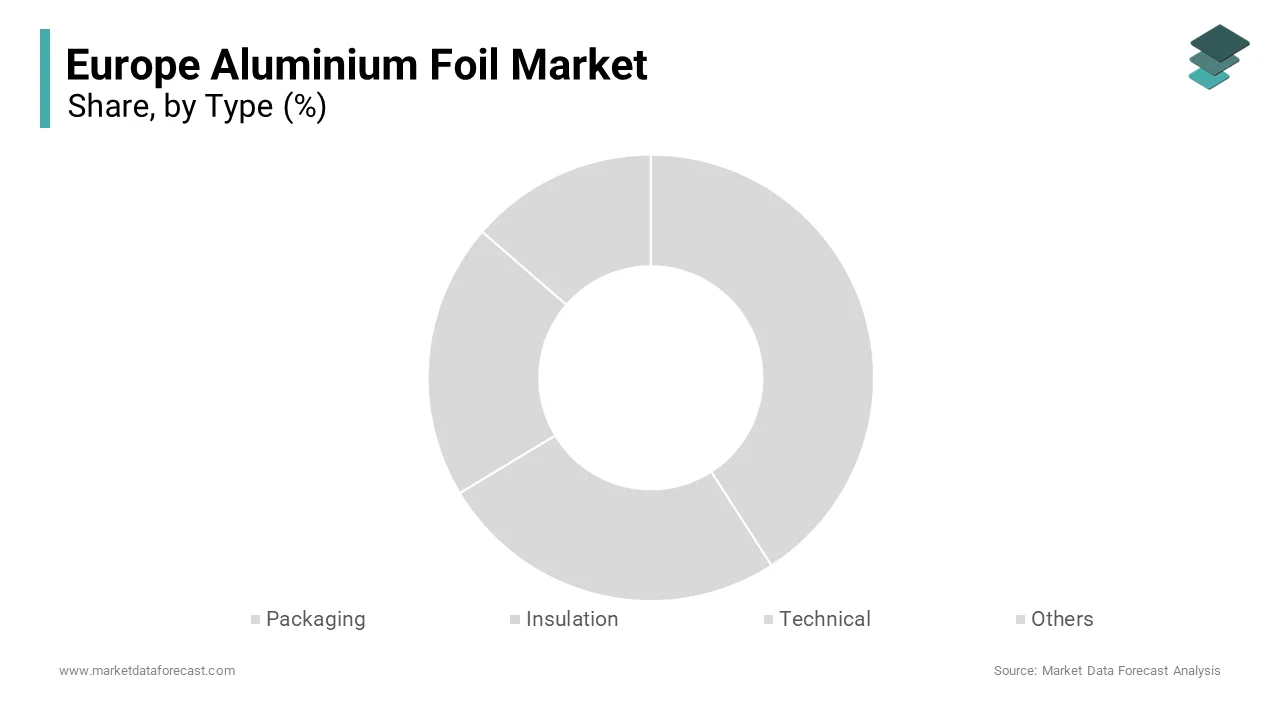
The technical applications segment is anticipated to grow at a CAGR of 8.04% over the forecast period in the European aluminum foil market due to Europe’s strategic shift toward electrification and renewable energy infrastructure. Aluminum foil is a critical component in lithium-ion battery anodes and electrolytic capacitors used in electric vehicles and grid-scale energy storage systems. Europe is expected to host numerous large-scale battery gigafactories by 2030, which requires significant volumes of high-purity aluminum foil annually. Additionally, the EU’s REPowerEU plan targets almost 600 gigawatts of installed solar photovoltaic capacity by 2030, and aluminum foil is increasingly used in backsheet layers of solar modules for its thermal reflectivity and corrosion resistance. According to SolarPower Europe, the continent added 56 gigawatts of solar capacity in 2023 alone, which is creating sustained demand for advanced metallic films. Furthermore, the expansion of data centers relies on aluminum foil-based capacitors for power conditioning. These high-value, performance-driven applications command premium pricing and are less susceptible to commodity volatility, which is enabling sustained investment in specialized foil production across Germany and Sweden.
COUNTRY LEVEL ANALYSIS
Germany Aluminium Foil Market Analysis
Germany dominated the aluminum foil market in Europe in 2025 with a share of 23.4% of the regional market. The growth of Germany in the European market is attributed to its dual strength in advanced manufacturing and stringent sustainability enforcement. Germany is home to Europe’s largest food processing and pharmaceutical industries, both of which rely heavily on high-quality foil for compliance with EU food safety and medicinal product regulations. The German Packaging Act mandates that all packaging placed on the market must be recyclable by design, and aluminum foil meets this standard through established dual collection systems like Der Grüne Punkt, which report high recovery rates for metal packaging. Additionally, Germany’s Energiewende policy has accelerated investments in battery and renewable technology, creating new demand in technical segments. Companies such as Hydro and Novelis operate high-precision foil rolling mills in Bavaria and North Rhine-Westphalia, which supply both the automotive and electronics sectors. As per the German Electrical and Electronic Manufacturers’ Association, capacitor production rose in 2023, which is directly boosting foil demand in Germany. With significant volumes of foil consumed annually for packaging alone, Germany’s market remains deeply integrated into both consumer and industrial supply chains.
Italy Aluminium Foil Market Analysis
Italy held the second-largest share of the European aluminum foil market in 2025. The promising position of Italy in this regional market is mainly due to its globally recognized food culture and extensive agro-processing sector, particularly in cheese, cured meats, and ready meals. Italy is the largest producer of Parmigiano Reggiano and prosciutto in Europe, both of which require vacuum-sealed aluminum packaging to preserve aroma and prevent oxidation during export. According to Coldiretti’s analysis of Istat data, Italy’s agri‑food exports reached roughly €62–64 billion in 2023, and much of iwas t was wrapped in foil to meet European and international phytosanitary standards. The Italian pharmaceutical industry, which is centered in Lombardy and Lazio, also contributes significantly with foil‑based blister packs widely used for solid dose formats. Moreover, Italy’s strong artisanal bakery network relies on disposable foil trays for retail and catering, which is a trend reinforced by hygiene regulations post‑pandemic. Urbanization and the rise of single‑person households have further increased demand for portion‑controlled foil packaging.
France Aluminium Foil Market Analysis
France is estimated to command a prominent share of the Europe aluminum foil market during the forecast period, owing to its robust retail food sector and progressive circular economy policies. France implemented the Anti-Waste Law for a Circular Economy in 2020, which restricts single-use plastics and incentivizes reusable or infinitely recyclable alternatives like aluminum foil. As a result, major retailers such as Carrefour and Auchan have increased the use of foil for fresh produce and bakery items nationwide. According to a 2025 European Aluminium Foil Association survey, 67% of respondents across six major European markets mainly use aluminum foil to wrap or cover food and leftovers. The French dairy industry depends on foil for aging and packaging, which supports a strong export performance. Additionally, the country’s growing pharmaceutical output, particularly vaccine and biologic production in the Lyon biocluster, drives demand for cold form foil, and aluminum blisters are widely used for solid dose medicines to ensure compliance with EU stability requirements. France’s commitment to decarbonization also supports technical foil applications in electric mobility with ongoing EV battery investments.
United Kingdom Aluminium Foil Market Analysis
The United Kingdom is expected to exhibit a healthy CAGR in the European aluminum foil market during the forecast period. Despite Brexit-related supply chain adjustments, the UK maintains strong food consumption due to its mature foodservice and healthcare sectors. Many supermarkets ' own-brand ready meals use aluminum trays, which are citing superior oven performance and recyclability. The UK’s National Health Service relies on foil sealed unit dose packaging, a practice consistent with Medicines and Healthcare products Regulatory Agency guidance on ensuring medicine stability and safety. The country’s shift toward net zero has spurred investment in energy storage. The strategy of the UK government indicates domestic battery production capacity is projected to grow substantially by 2030, which requires high-purity foil for anode current collectors. Waste management infrastructure also supports foil recovery, with many local authorities providing separate metal collection. Urban meal delivery services continue to grow, further boosting demand for disposable foil containers. Though energy costs remain elevated, integrated players ensure a stable supply through closed-loop recycling partnerships with major brands.
Turkey Aluminium Foil Market Analysis
Turkey is a notable market for aluminum foil in Europe and is likely to hold a considerable share of the regional market over the forecast period. The country’s strategic position as a bridge between Europe and Asia enables it to serve both domestic and export-oriented production. Turkey is the largest producer of figs, hazelnuts, and dried fruits in Europe, all of which require vacuum-sealed aluminum packaging to maintain quality during long-distance shipping. As per the Ministry of Trade, agricultural exports exceeded $35 billion in 2023, and many packaged goods use foil to meet European and international phytosanitary standards. Turkey’s pharmaceutical sector has expanded rapidly, with local companies like Deva Holding and Abdi Ibrahim using cold-form foil for blister packs to meet EU Good Manufacturing Practice standards for export markets. Industrial growth is further supported by government incentives under the National Technology Move program, which prioritizes advanced materials manufacturing. Energy costs remain a challenge, but recycling aluminum saves about 95% of the energy required for primary production, which is helping mitigate primary metal dependency. Urbanization and rising middle-class consumption continue to drive household foil demand.
COMPETITIVE LANDSCAPE
The Europe aluminum foil market features intense competition among integrated producers, converters, and specialty packaging firms. Established players leverage technological expertise and recycling ecosystems to differentiate offerings while newer entrants focus on niche applications such as medical obattery-gradede foils. Price sensitivity in commodity packaging segments drives consolidation,, high-value technical applications foster innovation-based rivalry. Regulatory compliance, particularly under the EU sustainability directive, acts as both a barrier and a catalyst, shaping strategic direction. Companies compete on purity gauge consistency and surface quality, especially for pharmaceutical and electronics uses. Access to low-carbon primary aluminum and post-consumer scrap determines cost efficiency and environmental credentials. Brand partnerships and long-term supply agreements are critical for market stability. The competitive landscape is further influenced by energy costs, logistics, resilience, and regional policy support for advanced manufacturing. As demand diversifies c,, competition increasingly hinges on sustainability performance and application-specific customization rather than volume alone.
KEY MARKET PLAYERS
A few of the market players in the Europe aluminium foil market include
- Zhangjiagang Fineness Aluminum Foil Co.,
- Zhengzhou Keyuan Non-ferrous Metal Materials Co...,
- VWR International LLC,
- Hydro Aluminum
- Novelis Inc
- All-foils, Inc.
- Aleris Corporation
- Reynolds Group Holdings Limited
- Carcano Antonio S.p.A.
- Hindalco Industries Ltd.
- Constantia Flexibles Group
- Amcor plc
- Plus Pack AS
- Laminazione Sottile S.p.A.
- Loften Foil Co.
- Aluflexpack AG
- Constantia Flexibles
- Icont, Aleuro Converting SP. Z.O.O.
- Grupo Cuatrogasa
- Alufi
- Cofresco and
- Sphere
Top Players in the Market
- Hydro Aluminum is a leading integrated producer of aluminum products with a strong presence in the European foil market. The company operates advanced rolling mills in Germany and Norway, specializing in high-purity and ultra-thin foil grades for food packaging and technical applications. Hydro has invested significantly in low-carbon aluminum production using hydropower and recycling technologies. In 2023, the company launched its Hydro CIRCAL certified recycled aluminum foil series, which meets stringent EU circular economy standards. Hydro also collaborates with major food and pharmaceutical brands to develop lightweight, ht sustainable packaging solutions that reduce material use without compromising barrier performance.
- NoveInc. Inc is a global leader in aluminum rolling and recycling with substantial operations across EuEuroEuropeuding facilities in the United Kingdom, GermGermanyd Italy. The company supplies high-quality aluminum foil to the food, beverage, and pharmaceutical sectors, emphasizingemphasiziclosed-loopoop recycling and carbon reduction. Novelis has pioneered the use of post-consumer recycled content in foil production, achieving over 80% recycled input in several product lines. In 202,4, the company expanded its Latchford UK plant to increase capacity for sustainable packaging foil, driven by rising demand from European FMCG companies. Novelis actively partners with brands to meet EU Packaging and Packaging Waste Regulation targets through certified recyclable solutions.
- Constantia Flexibles Group is a major European manufacturer of flexible packaging, including high-barrier aluminum foil laminates for pharmaceutical and premium food applications. Headquartered in Austria, the company operates foil converting and printing facilities across Germany, France, and Italy. Constantia is renowned for its cold-form foil used in blister packaging, which meets global pharmaceutical regulatory standards. The company has intensified its focus on sustainability, launching mono-material recyclable alternatives that retain foil-like barrier properties. In 2023, Constantia invested in digital printing capabilities at its Weide, n Germ, site to support personalized short-run pharmaceutical packaging, thereby strengthening its position in high-value medical foil segments across Europe.
Top Strategies Used by the Key Market Participants
Key players in the Europe aluminum foil market primarily pursue vertical integration to secure raw material supply and stabilize costs. They invest heavily in recycling infrastructure to align with EU circular economy mandates and reduce carbon footprints. Companies are developing lightweight and high-barrier foil alloys to meet demand for sustainable yet functional packaging. Strategic partnerships with FMCG and pharmaceutical firms enable co-innovation in application-specific solutions. Expansion of technical foil production supports growth in electric vehicles and renewable energy sectors. Digitalization of manufacturing enhances precision in ultra-thin foil rolling. Geographic diversification within Europe ensures proximity to key end-user clusters. Continuous R&D focuses on surface treatments that improve recyclability and compatibility with automated packaging lines. These strategies collectively reinforce competitive advantage while addressing regulatory and environmental imperatives across the region.
MARKET SEGMENTATION
This research report on the Europe aluminium foil market is segmented and sub-segmented into the following categories.
By Application
- Packaging
- Food & Beverages
- Pharmaceuticals
- Others
- Insulation
- Technical
- Others
By Country
- UK
- France
- Spain
- Germany
- Italy
- Russia
- Sweden
- Denmark
- Switzerland
- Netherlands
- Turkey
- Czech Republic
- Rest of Europe
Frequently Asked Questions
What are the primary uses of aluminium foil in Europe?
Packaging dominates—especially for food (wraps, trays, lidding), pharmaceutical blister packs, and household use—while industrial applications include insulation (HVAC, construction), capacitors, and battery components in the growing EV sector.
Why is demand for aluminium foil resilient despite sustainability pressures?
Its 100% recyclability, barrier properties (light, moisture, oxygen), and lightweight nature align with circular economy goals—EU recycling rates exceed 75%, and foil is increasingly used in reusable and recyclable packaging formats.
Which countries lead production and consumption?
Germany, Italy, France, and the Netherlands are top producers and users, supported by strong food processing, pharma, and manufacturing industries—while Eastern Europe shows rising demand due to packaging modernization.
How is the EU’s Packaging and Packaging Waste Directive (PPWR) impacting the market?
Stricter recyclability and recycled content targets (e.g., 30% by 2030 for packaging) are driving investment in closed-loop recycling and lightweighting—without compromising barrier performance.
Are lightweighting and downgauging trends affecting foil usage?
Yes—advances in rolling technology enable thinner gauges (as low as 4–6 µm for lidding) while maintaining integrity, reducing material use and costs—especially in high-volume food and pharma applications.
Who are the major European foil producers?
Leading players include AMAG Austria Metall, Hydro (Norway), Constellium (France/Netherlands), Novelis (UK/Germany), and Aleris (now part of Novelis)—offering certified, food-safe, and specialty foils with integrated recycling services.
How is the rise of e-commerce influencing foil demand?
Growth in meal-kit delivery and ready-to-eat meals has boosted demand for thermoformed trays, lidding foils, and barrier layers in multi-material flexible packaging—requiring high-seal integrity and printability.
What challenges does the market face?
Energy-intensive production, volatile LME aluminium prices, and competition from mono-material plastic alternatives (where recyclability improves) pressure margins—though foil’s superior barrier and recycling profile often prevail.
Is aluminium foil used in emerging green technologies?
Increasingly—yes. It serves as current collectors and packaging in lithium-ion batteries, and as reflective insulation in heat pumps and building retrofits, supporting EU decarbonization goals.
What’s the market outlook for 2025–2030?
The Europe aluminium foil market is projected to grow modestly but steadily, underpinned by food safety needs, pharmaceutical expansion, battery demand, and its irreplaceable role in high-performance, recyclable packaging systems.
Access the study in MULTIPLE FORMATS
Purchase options starting from
$ 2000
Didn’t find what you’re looking for?
TALK TO OUR ANALYST TEAM
Need something within your budget?
NO WORRIES! WE GOT YOU COVERED!
Call us on: +1 888 702 9696 (U.S Toll Free)
Write to us: sales@marketdataforecast.com