Europe Ammonium Sulfate Market Size, Share, Trends, & Growth Forecast Report By Application (Fertilizers, Industrial) and Country (UK, France, Spain, Germany, Italy, Russia, Sweden, Denmark, Switzerland, Netherlands, Turkey, Czech Republic and Rest of Europe), Industry Analysis From 2025 to 2033
Market Size, 2025
$2.63 BnMarket Estimate, 2026
$2.76 BnMarket Forecast, 2034
$4.05 BnCAGR, 2026–2034
4.91%Europe Ammonium Sulfate Market Report Summary
The Europe ammonium sulfate market was valued at USD 2.63 billion in 2024, is estimated to reach USD 2.76 billion in 2025, and is projected to reach USD 4.05 billion by 2034, growing at a CAGR of 4.91% during the forecast period from 2026 to 2034. The growth of the market is primarily driven by increasing sulfur deficiency in European agricultural soils, rising demand for balanced fertilization, and the compound’s dual nutrient profile of nitrogen and sulfur. The decline in atmospheric sulfur deposition due to strict environmental regulations has intensified reliance on sulfur-containing fertilizers such as ammonium sulfate. Additionally, growing utilization in industrial applications including water treatment, caprolactam (nylon 6) production, and flame-retardant materials is further supporting market expansion. The shift toward circular economy practices, including recovery of ammonium sulfate from industrial processes, is also strengthening long-term demand across Europe.
Key Market Trends
- Rising demand for sulfur-enriched fertilizers due to widespread soil sulfur deficiency across Europe.
- Growing recovery of ammonium sulfate from industrial byproducts such as flue gas desulfurization and caprolactam production.
- Increasing adoption in precision agriculture and controlled-release fertilizer blends.
- Expanding use in industrial applications such as wastewater treatment, food processing, and flame-retardant materials.
- Strong alignment with EU sustainability policies promoting circular nutrient recovery and fertilizer sovereignty.
Segmental Insights
- Based on application, the fertilizers segment dominated the Europe ammonium sulfate market in 2024. The dominance of this segment is attributed to declining natural sulfur availability in soils and the growing need for efficient nitrogen utilization in crops such as wheat, oilseed rape, and cereals across major agricultural economies including Germany, France, and Poland.
- The industrial segment is expected to witness the fastest growth during the forecast period. This growth is supported by rising use in municipal water treatment, expanding demand for flame retardants in construction materials, and consistent usage in food processing and brewing industries.
Regional Insights
The Europe ammonium sulfate market demonstrates steady growth across major agricultural and industrial economies.
- Germany was the largest contributor, accounting for 22.6% of the European market share in 2024, supported by strong domestic chemical production, large caprolactam facilities, and intensive agricultural activity requiring sulfur supplementation.
- France holds a significant share driven by high sulfur deficiency in cereal-growing regions and strong demand from agricultural cooperatives.
- Poland is emerging as a fast-growing market due to its large agricultural base, nutrient-deficient soils, and increasing adoption of cost-effective sulfur fertilizers.
- The United Kingdom remains an important market supported by sulfur-deficient farmland and growing usage in wastewater treatment applications.
- The Netherlands is gaining importance as a circular economy and logistics hub, with increasing production of recovered ammonium sulfate and high adoption of precision farming practices.
Competitive Landscape
The Europe ammonium sulfate market is characterized by a mix of integrated chemical producers and fertilizer-focused manufacturers. Market competition is shaped by regulatory compliance, product quality, circular production capabilities, and the ability to supply granular and precision-compatible formulations. Leading players are focusing on recovering ammonium sulfate from industrial processes, investing in granulation infrastructure, and aligning product portfolios with EU sustainability frameworks such as the Farm to Fork Strategy. Strategic collaborations with agricultural cooperatives, investments in processing facilities, and digital agronomy support tools are strengthening competitive positioning. Prominent players in the Europe ammonium sulfate market include Yara International ASA, CF Industries Holdings, Inc., Nutrien Ltd., EuroChem Group AG, Uralchem JSC, BASF SE, K+S AG, Coromandel International Ltd., Gujarat State Fertilizers & Chemicals Ltd., and Deepak Fertilisers and Petrochemicals Corporation Ltd.
Europe Ammonium Sulfate Market Size
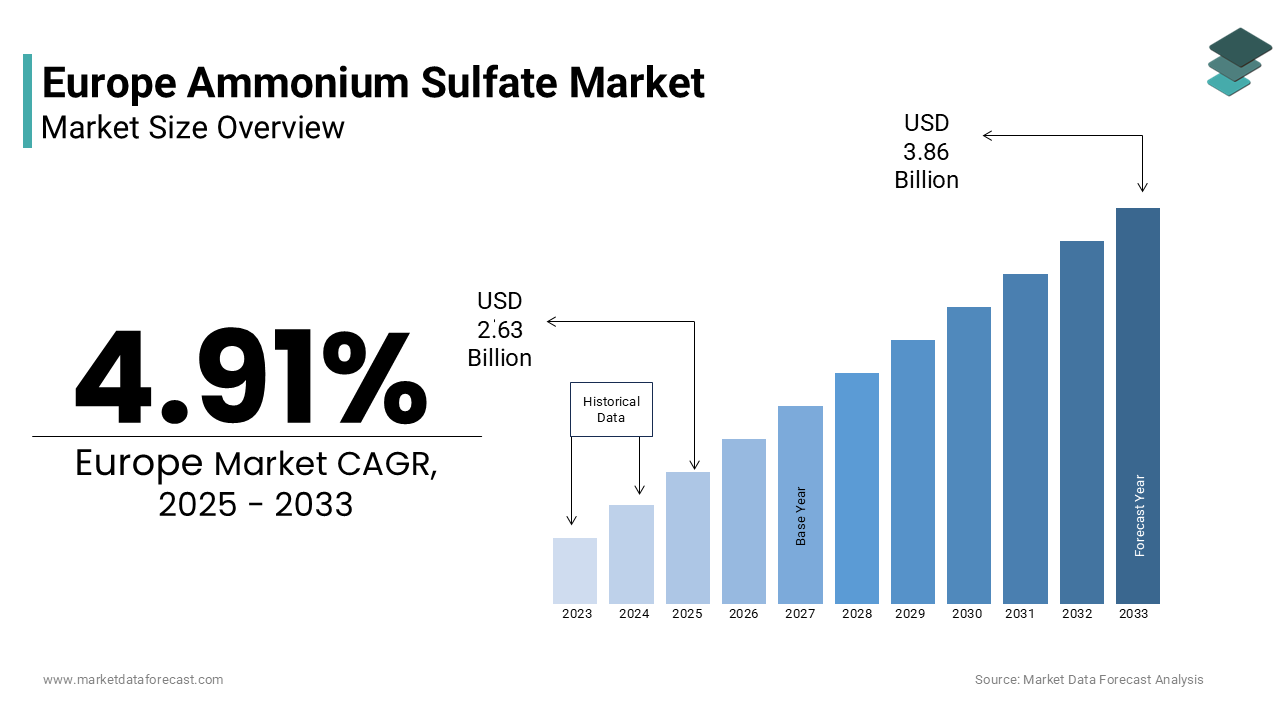
The europe ammonium sulfate market size was valued at USD 2.51 billion in 2024 and is anticipated to reach USD 2.63 billion in 2025 from USD 3.86 billion by 2033, growing at a CAGR of 4.91% during the forecast period from 2025 to 2033.
Ammonium sulfate is an inorganic salt primarily used as a nitrogen and sulfur fertilizer in agriculture and as a coagulant or flame retardant in industrial applications. Its dual nutrient profile makes it especially valuable in regions with sulfur-deficient soils, a condition increasingly prevalent due to decades of low sulfur deposition following clean air policies. European environmental agencies confirm that atmospheric sulfur levels across the EU have seen a very significant and ongoing reduction since 1990, a trend largely driven by successful emissions controls and international agreements like the Gothenburg Protocol. Simultaneously, the European Commission's Farm to Fork Strategy aims for a substantial decrease in the use and risk of chemical pesticides by 2030, encouraging a significant shift toward more sustainable agricultural practices. Beyond agriculture, ammonium sulfate is integral to water treatment processes and caprolactam production for nylon 6, with the European Chemical Industry Council provides comprehensive data on various chemical consumption patterns in Europe across many different industrial applications. Ammonium sulfate plays a crucial, though frequently ignored, role in Europe's industrial and agricultural systems as the continent balances decarbonization goals with the need for food security and circular resource use
MARKET DRIVERS
Declining Atmospheric Sulfur Deposition Creating Soil Nutrient Gaps
The sharp reduction in industrial sulfur emissions across the region has inadvertently triggered widespread sulfur deficiency in agricultural soils, which contributes to the growth of the Europe ammonium sulfate market. This directly fuels the demand for ammonium sulfate as a corrective fertilizer. According to the European Environment Agency (EEA), the amount of sulfur falling from the atmosphere across Europe has substantially decreased over several decades due to successful air quality policies. The decline has been significant and widespread across the continent. This environmental achievement, while beneficial for air quality and ecosystem health, has depleted a once-reliable natural sulfur source for crops. Research has consistently shown that a large majority of agricultural land in Northern and Central Europe now has low levels of plant-available sulfur, often below critical thresholds needed for optimal crop nutrition. This environmental success (less acid rain) has led to an agricultural challenge (sulfur deficiency in crops). Sulfur is essential for protein synthesis and nitrogen utilization. Its absence reduces nitrogen use efficiency. Ammonium sulfate, containing nitrogen and sulfur in a readily absorbable sulfate form, offers a precise solution. In response, countries like France and Poland have updated their national fertilizer recommendations to explicitly include sulfur supplementation, with ammonium sulfate being the most cost effective source for broadacre crops such as oilseed rape and wheat.
Integration into Caprolactam Production for Sustainable Nylon Manufacturing
Ammonium sulfate is a major co-product in the industrial synthesis of caprolactam, the precursor to nylon 6, and its demand is tightly linked to Europe’s synthetic fiber and engineering plastics sector. This further propels the expansion of the Europe ammonium sulfate market. The industrial sector is transitioning from considering ammonium sulfate a waste product to utilizing it as a valuable resource. A significant volume of ammonium sulfate is consistently produced as a co-product of caprolactam production. Recent operational requirements necessitate a high percentage of utilization for the ammonium sulfate co-product, effectively prohibiting landfill disposal. Manufacturers are upgrading processing units, like crystallization and granulation units, to create market-ready fertilizer-grade material. Regulatory changes are enabling the integration of this recovered material into the commercial fertilizer market. The EU's Strategy for Sustainable and Circular Textiles promotes domestic nylon recycling and production, which in turn ensures a steady supply of caprolactam and ammonium sulfate. This effectively converts a previous waste problem into a valuable nutrient source.
MARKET RESTRAINTS
Stringent EU Fertilizer Regulations Limiting Application Flexibility
The European Fertilizing Products Regulation imposes strict compositional and labeling requirements that complicate its use in blended fertilizers, and thereby constrains the growth of the Europe ammonium sulfate market. Regulatory frameworks classify specific ammonium-based compounds as single-nutrient inputs, requiring detailed declarations of chemical composition. Standardizing nutrient blends involves assessment procedures that may impact the timelines and expenditures associated with product certification. The distinction between synthetic and naturally occurring substances affects how certain inputs are categorized, potentially restricting their use in specific agricultural segments. Regional directives may limit the application of certain compounds in specialized cultivation areas to address long-term soil health considerations. Variations in regional and international guidelines contribute to a fragmented landscape for the distribution and use of agricultural inputs. These regulatory hurdles reduce formulation agility for fertilizer blenders and discourage innovation in multi nutrient products, which constrains ammonium sulfate’s potential despite its agronomic benefits.
Perception as an Acidifying Agent Deterring Long Term Adoption
Ammonium sulfate is often perceived by European farmers and agronomists as a soil acidifying fertilizer, which limits its adoption despite its nutrient efficiency, and consequently hinders the expansion of the Europe ammonium sulfate market. When applied, the ammonium ion undergoes nitrification, releasing hydrogen ions that lower soil pH, a concern in regions already prone to acidity such as Scandinavia and parts of Central Europe. A significant amount of cultivated ground across Europe exhibits a soil pH level that is low enough for aluminum compounds to become toxic, which may hinder crop root development. The continued application of a specific nitrogen-based fertilizer over several growing seasons is associated with a measurable decrease in soil pH compared to using a different, less acidifying nitrogen-based fertilizer. A pattern is evident where the type of fertilizer used in agricultural practices directly influences the long-term acidity of the soil. The high cost and intensive labor associated with liming hinder its widespread adoption among small and medium-sized agricultural operations, even though it provides a viable solution. Furthermore, the EU’s Common Agricultural Policy eco schemes incentivize maintaining or improving soil pH, implicitly discouraging acidifying inputs. This perception persists despite evidence that ammonium sulfate’s acidification is localized and manageable, and that its sulfur contribution can actually improve crop resilience in neutral to alkaline soils. A lack of effective communication regarding context-specific benefits means that this misconception will persist, suppressing demand in essential agricultural regions.
MARKET OPPORTUNITIES
Recovery from Flue Gas Desulfurization in Waste-to-Resource Systems
Ammonium sulfate recovery from flue gas desulfurization (FGD) in coal and biomass power plants offers a significant circular economy opportunity in the region, which is expected to boost the growth of the Europe ammonium sulfate market. Numerous operational waste-to-energy facilities across the EU employ ammonia-based FGD systems to manage emissions, resulting in the production of high purity ammonium sulfate as a secondary product. There is an upward trend in the overall volume of this compound generated as operators seek revenue streams from emissions control, and the recovered salt meets quality standards and is gaining acceptance in agricultural supply chains, particularly in areas with advanced circular nutrient policies. The EU’s Industrial Emissions Directive encourages such valorization by requiring “best available techniques” for byproduct management. Europe is seeking to secure its nutrient supply and lessen dependence on imported fertilizers; FGD-derived ammonium sulfate provides an effective, homegrown alternative with a small carbon footprint, effectively repurposing pollution control by-products into a fertilizer source.
Expansion into Precision and Controlled-Release Fertilizer Blends
The development of ammonium sulfate-based precision and controlled release fertilizers exhibits a major opportunity aligned with the region’s digital agriculture transition, which is anticipated to fuel the expansion of the Europe ammonium sulfate market. Modern agricultural practices are increasingly adopting precision technologies that necessitate fertilizers with consistent physical properties for accurate distribution. Ammonium sulfate is being utilized as a foundational component in multi-nutrient products to provide essential nitrogen and sulfur. Advancements in coating technologies, such as biodegradable matrices, allow for a more controlled release of nutrients to better match the growth cycles of specific crops. The use of enhanced efficiency fertilizers is observed as a method to mitigate nutrient runoff and improve overall environmental performance in farming. These technological shifts in fertilizer composition are aligning with broader initiatives focused on increasing agricultural productivity while reducing resource waste. Ammonium sulfate is poised to become a key component in advanced nutrient delivery systems for data-driven agronomy, driven by substantial EU Horizon Europe research and development funding for smart fertilizers.
MARKET CHALLENGES
Vulnerability to Volatility in Caprolactam Production Cycles
Its heavy dependence on caprolactam manufacturing, a sector subject to global petrochemical cycles and textile demand fluctuations, challenges the growth of the Europe ammonium sulfate market. The availability of ammonium sulfate in Europe is linked to the synthesis of caprolactam, as it is a co-product of this process. Changes in the global demand for nylon affect the production volume of caprolactam, which in turn influences the amount of ammonium sulfate available. When demand weakens in sectors such as automotive manufacturing and apparel production, it can lead to a decline in chemical synthesis activities. A reduction in the output of primary chemicals can tighten the supply of co-products, and limited availability often results in higher spot prices for these materials. Unlike dedicated fertilizer producers who can adjust output, caprolactam-based suppliers cannot independently scale ammonium sulfate volumes, creating supply-demand mismatches. Additionally, the EU’s Carbon Border Adjustment Mechanism increases production costs for energy-intensive caprolactam plants, potentially accelerating closures. Europe's ammonium sulfate supply is vulnerable because it depends solely on a single, unrelated industry's economic stability, hindering reliable long-term strategies for farmers and blenders.
Limited Infrastructure for Granulation and Specialty Formulation
The region faces a major obstacle in ammonium sulfate valorization due to insufficient infrastructure for converting crystalline co-product into high value granular or coated fertilizers, which poses a serious obstacle to the Europe ammonium sulfate market. The majority of ammonium sulfate produced within the region consists of fine crystals, which are typically restricted to industrial applications or bulk blending rather than advanced farming techniques. Modern precision agricultural machinery generally requires fertilizer in the form of hard, spherical granules within a specific size range to ensure accurate distribution. Dedicated facilities capable of processing this material into high-quality granules are relatively scarce and tend to be concentrated in specific geographic hubs. Many regional distributors avoid using crystalline formats due to challenges such as dust generation, material separation, and general handling difficulties. The significant financial investment required to install specialized processing equipment serves as a primary deterrent for smaller and mid-sized manufacturers. Consequently, much of the co-product is exported in raw form or sold at a discount, forfeiting value and limiting adoption in advanced farming systems. Europe will underutilize a key domestic nutrient source and fail to achieve fertilizer sovereignty goals until public or private investment addresses the current processing gap.
REPORT COVERAGE
| REPORT METRIC | DETAILS |
| Market Size Available | 2024 to 2033 |
| Base Year | 2024 |
| Forecast Period | 2025 to 2033 |
| CAGR | 4.91% |
| Segments Covered | By Application and Region |
| Various Analyses Covered | Global, Regional & Country Level Analysis; Segment-Level Analysis; DROC, PESTLE Analysis; Porter’s Five Forces Analysis; Competitive Landscape; Analyst Overview of Investment Opportunities |
| Regions Covered | United Kingdom, France, Spain, Germany, Italy, Russia, Sweden, Denmark, Switzerland, the Netherlands, Turkey, and the Czech Republic |
| Market Leaders Profiled | Yara International ASA, CF Industries Holdings, Inc., Nutrien Ltd., EuroChem Group AG, Uralchem JSC, BASF SE, K+S AG, Coromandel International Ltd., Gujarat State Fertilizers & Chemicals Ltd., and Deepak Fertilisers and Petrochemicals Corporation Ltd. |
SEGMENTAL ANALYSIS
By Application Insights
The fertilizers dominated the Europe ammonium sulfate market by accounting for a substantial share in 2024. The dominance of the fertilizers segment is driven by the continent’s widespread soil sulfur deficiency, a direct consequence of decades of successful air pollution control. Atmospheric sulfur deposition has significantly decreased following the introduction of environmental policies. This reduction has diminished a natural sulfur source for agricultural land. Consequently, a substantial area of farmland in central and northern regions now exhibits sulfur levels below agronomic standards. This nutrient gap requires specialized fertilizers to support crop health and yield. Compounds providing nitrogen and sulfur can address these dual deficiencies and improve nitrogen utilization by crops. Furthermore, the European Commission’s Farm to Fork Strategy incentivizes balanced fertilization to reduce overall synthetic input, making high efficiency compounds like ammonium sulfate strategically valuable. National agricultural extensions in Poland, France, and Germany have updated crop guidelines to mandate sulfur supplementation for oilseed rape wheat and legumes, directly anchoring demand in the fertilizer segment.
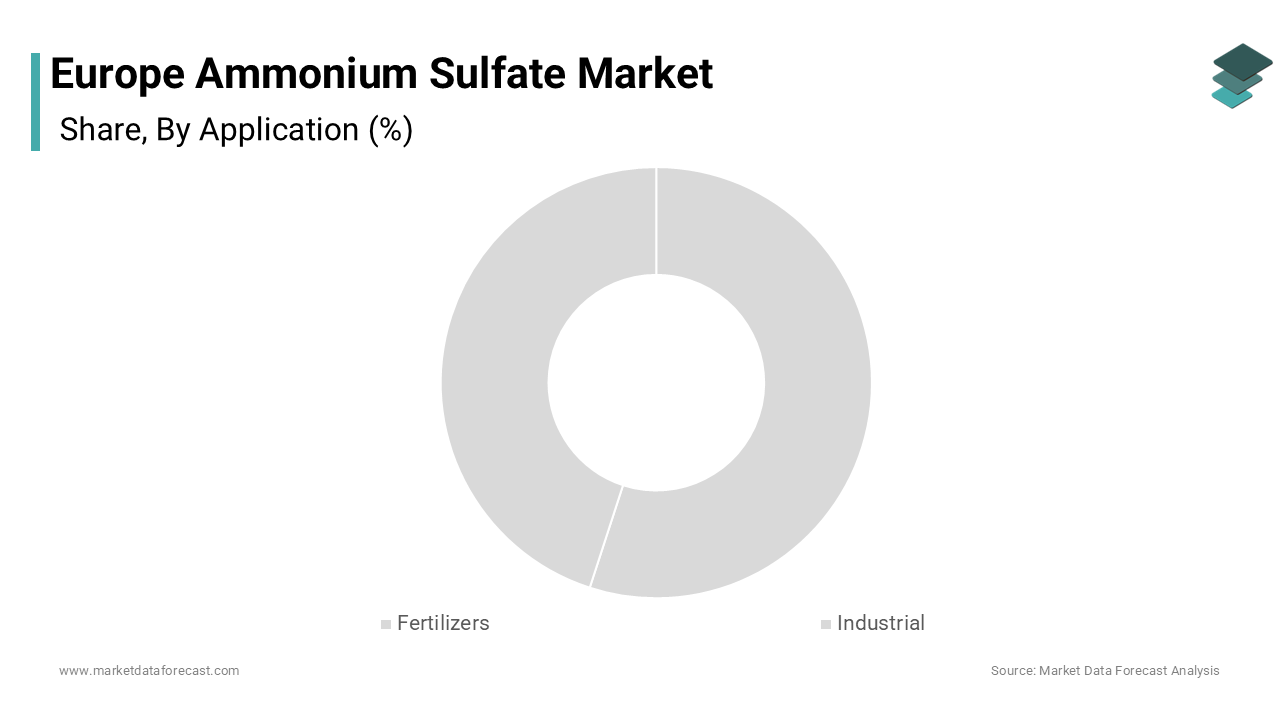
The industrial application segment is likely to experience the fastest CAGR of 5.9% between 2025 and 2033 owing to expanding use in water treatment, flame retardancy, and food processing sectors experiencing regulatory and technological tailwinds. In municipal water treatment, ammonium sulfate serves as a coagulant aid and pH buffer in sludge dewatering processes. The European Union has adopted a significant revision to the Urban Wastewater Treatment Directive, which mandates extensive future upgrades to wastewater and sludge management systems across a broader range of facilities, with implementation ongoing over many years. Changes in wastewater treatment regulations and practices are driving a growing interest in the circular economy, including the potential recovery of valuable nutrients for agriculture and other sectors. Simultaneously, the EU’s Construction Products Regulation now mandates reduced smoke toxicity in insulation materials, driving adoption of ammonium sulfate as a flame retardant synergist in wood fiber boards and textiles. Ammonium sulfate remains an approved and widely used food additive (E517) for bakery and brewing applications within the EU, used as a safe dough conditioner and yeast nutrient. The food and beverage industry, particularly the baking and brewing sectors, continues a general trend of utilizing approved additives like ammonium sulfate to ensure consistent product quality and support efficient production processes. Unlike the fertilizer segment, industrial demand is less cyclical and more aligned with regulatory compliance and public health infrastructure, offering stable growth amid agricultural policy volatility.
REGIONAL ANALYSIS
Germany Europe Ammonium Sulfate Market Analysis
Germany led the Europe ammonium sulfate market by capturing a 22.6% share in 2024. The supremacy of the German market is propelled by its dual role as Europe’s top chemical producer and a major agricultural economy with extensive sulfur deficient arable land. BASF and Evonik operate large caprolactam plants that generate high purity ammonium sulfate as a co product, while agricultural demand is driven by intensive cultivation of oilseed rape and winter wheat in regions like Lower Saxony and Bavaria. Additionally, Germany’s strict enforcement of the Fertilizer Ordinance mandates documented nutrient balancing, reinforcing ammonium sulfate’s role in compliant farm nutrient plans. The federal government’s Agricultural Soil Strategy further promotes sulfur supplementation to maintain yield stability under climate stress. This combination of industrial integration, agronomic necessity, and regulatory rigor ensures Germany’s continued leadership in both production and consumption.
France Europe Ammonium Sulfate Market Analysis
France followed closely in the Europe ammonium sulfate market by holding a 17.5% share in 2024. The nation’s market is primarily agriculture driven, with vast cereal and oilseed regions in the Paris Basin and Normandy exhibiting acute sulfur deficits. A majority of agricultural land used for growing a key cereal crop was observed to have a lower than desired concentration of a specific essential nutrient. Updated advice for managing crop nutrition suggests applying a certain range of a specific element per unit of land. A key location within the nation is a source for a compound that is used both in industry and for crop nutrition. Policies are in place that encourage more effective use of another major crop nutrient, which can lead to greater use of products like ammonium sulfate. Funding has been directed toward upgrading facilities for holding and mixing crop nutrition products, improving their accessibility to farmer cooperatives. France's significant demand for ammonium sulfate, sustained by robust farmer organizations, advanced agronomy, and supportive policies, positions it as a key market in Western Europe.
Poland Europe Ammonium Sulfate Market Analysis
Poland is growing steadily in the Europe ammonium sulfate market due to its large agricultural sector, ranking first in the EU for rye cultivation and second for potatoes, coupled with highly sulfur deficient soils across its central and eastern plains. Agricultural land in the region exhibits a notable deficit in essential nutrients, particularly sulfur. Ammonium sulfate has emerged as a preferred solution due to its economic viability and ease of integration into existing farming methods. Local manufacturing capabilities provide a strategic advantage by ensuring a steady supply of both industrial and agricultural grade products. A significant amount of this material is being circulated through organized distribution efforts aimed at supporting smaller agricultural operations. Public initiatives continue to encourage the adoption of specific fertilization practices to improve overall soil health and crop productivity. Additionally, Poland’s strategic location makes it a key distribution hub for Eastern European markets, amplifying its influence beyond national borders. This blend of agronomic need, domestic production, and policy support solidifies Poland’s role as a Central European powerhouse in ammonium sulfate utilization.
United Kingdom Europe Ammonium Sulfate Market Analysis
The United Kingdom holds a noteworthy position in the Europe ammonium sulfate market. Despite Brexit, the UK remains a significant consumer due to its intensive arable farming systems and advanced water treatment infrastructure. A substantial majority of UK farmland, including both arable land and grassland, is widely considered to be sulfur deficient due to continuously decreasing atmospheric sulfur deposition. The Environment Agency mandates stringent sludge management in wastewater treatment, driving industrial demand as ammonium sulfate improves dewatering efficiency in facilities operated by Thames Water and Severn Trent. The official Nutrient Management Guide (RB209) for the UK, supported by the Department for Environment, Food and Rural Affairs and industry partners, continues to highlight the critical role of sulfur in supporting efficient nitrogen use and maintaining crop quality. Moreover, the UK also supports innovation through the Agri Tech Centre’s nutrient use efficiency trials, which validated ammonium sulfate’s yield benefits in variable rate application systems. The UK leverages its robust scientific advisory networks and infrastructure to maintain its position as a key market for both agricultural and industrial grades.
Netherlands Europe Ammonium Sulfate Market Analysis
The Netherlands is anticipated to expand in the Europe ammonium sulfate market from 2025 to 2033 due to its role as a logistics, innovation, and circular economy hub. The Port of Rotterdam serves as Europe’s primary entry point for imported ammonium sulfate, while domestic producers like OCI Nitrogen integrate co product streams from caprolactam and flue gas desulfurization into certified fertilizer blends. The nation demonstrates a leading position in the practice of circular nutrient recovery. A specific waste-to-energy facility effectively captures a substantial volume of ammonium sulfate from its industrial process. The recovered product is processed to meet established quality standards and is subsequently introduced into the commercial market under a proprietary name. The country's agricultural sector exhibits a high degree of precision farming adoption, which is notably advanced within the region. A significant majority of arable farms within the area utilize technologies that favor a granulated form of ammonium sulfate for consistent application. Additionally, Wageningen University conducts cutting edge research on sulfur cycling in low input systems, informing EU policy. The Netherlands serves as a vital testbed and distribution nexus for innovative ammonium sulfate applications across Northwest Europe, driven by its compact geography, advanced high-tech agriculture, and strong commitment to resource recovery.
COMPETITIVE LANDSCAPE
Competition in the Europe ammonium sulfate market is shaped by a dual supply structure comprising integrated chemical producers and dedicated fertilizer companies. Incumbents like Grupa Azoty and OCI Nitrogen compete on production scale feedstock integration and circular innovation while global chemical giants like BASF participate indirectly through byproduct valorization. The market is not driven by price alone but by regulatory compliance product form and agronomic support. Certification under EN 17012 and CE marking are critical differentiators as they determine eligibility for Farm to Fork aligned farming systems. Competition is further intensified by the need to address sulfur deficiency without exacerbating soil acidification prompting innovation in blended and coated formulations. Smaller blenders face challenges in sourcing consistent granular grades due to limited processing infrastructure creating opportunities for vertically integrated players. Overall the market rewards those who combine industrial efficiency with agronomic expertise and regulatory foresight in a landscape increasingly defined by sustainability and nutrient sovereignty.
KEY MARKET PLAYERS
Some of the companies that are playing a dominating role in the europe ammonium sulfate market include
- Yara International ASA
- CF Industries Holdings, Inc.
- Nutrien Ltd.
- EuroChem Group AG
- Uralchem JSC
- BASF SE
- K+S AG
- Coromandel International Ltd.
- Gujarat State Fertilizers & Chemicals Ltd. (GSFC)
- Deepak Fertilisers and Petrochemicals Corporation Ltd.
Top Players in the Market
Grupa Azoty S.A.
Grupa Azoty S.A. is Poland’s largest chemical group and a key European producer of ammonium sulfate, operating integrated facilities in Tarnów and Kędzierzyn that supply both agricultural and industrial grades. The company contributes to the global market by exporting high purity ammonium sulfate to Central and Eastern Europe, the Middle East, and North Africa, serving as a regional alternative to Asian suppliers. Grupa Azoty leverages its captive ammonia and sulfuric acid production to ensure feedstock security and cost stability. It also launched a digital nutrient advisory platform for farmers to optimize sulfur application based on soil testing. These initiatives reinforce its position as a vertically integrated and agronomically engaged supplier in Europe’s evolving fertilizer landscape.
BASF SE
BASF SE is a German multinational that produces ammonium sulfate as a co product of its caprolactam operations in Ludwigshafen. BASF plays a strategic role by transforming an industrial byproduct into a CE marked fertilizer compliant with the EU Fertilizing Products Regulation. The company supplies high purity ammonium sulfate to European blenders and distributors, contributing to circular nutrient flows within the chemical value chain. It also partnered with agricultural cooperatives in Germany and France to integrate ammonium sulfate into low emission fertilizer blends aligned with the Farm to Fork Strategy. Through these actions BASF demonstrates how industrial chemistry can support sustainable agriculture without expanding primary production.
OCI Nitrogen
OCI Nitrogen is a Netherlands based specialty fertilizer producer and a subsidiary of OCI Global, operating a major production complex in Geleen that utilizes recovered sulfur streams to manufacture ammonium sulfate. The company contributes to the global market by championing circular production models, including sourcing sulfur dioxide from flue gas desulfurization units at waste to energy plants. The product is distributed across Benelux and Germany for use in arable and horticultural systems. OCI also invested in a new granulation line to meet demand for uniform prills compatible with automated spreaders. By aligning industrial emissions control with nutrient recovery OCI Nitrogen positions ammonium sulfate as a cornerstone of Europe’s circular bioeconomy and sets a benchmark for sustainable production beyond traditional synthesis routes.
Top Strategies Used by the Key Market Participants
Key players in the Europe ammonium sulfate market are prioritizing circular production by recovering sulfur from flue gas desulfurization and caprolactam co product streams to create certified fertilizer grade material. Companies are investing in granulation and prilling technologies to produce dust-free uniform particles suitable for precision agriculture equipment. Strategic alignment with EU regulatory frameworks such as the Fertilizing Products Regulation and Farm to Fork Strategy is being leveraged to position ammonium sulfate as a high efficiency nutrient solution. Firms are also developing digital agronomic tools to guide sulfur application based on soil testing and crop requirements enhancing product value beyond commodity status. Additionally producers are strengthening logistics and blending partnerships to ensure consistent supply of both crystalline and granulated grades across diverse agricultural and industrial end uses.
MARKET SEGMENTATION
This europe ammonium sulfate market research report is segmented and sub-segmented into the following categories.
By Application
- Fertilizers
- Industrial
By Country
- UK
- France
- Spain
- Germany
- Italy
- Russia
- Sweden
- Denmark
- Switzerland
- Netherlands
- Turkey
- Czech Republic
- Rest of Europe
Frequently Asked Questions
What is ammonium sulfate used for?
Ammonium sulfate is mainly used as a nitrogen fertilizer in agriculture and also in chemical manufacturing, food additives, and water treatment.
What is driving the growth of the Europe ammonium sulfate market?
Growth is driven by rising demand for nitrogen-based fertilizers, increasing agricultural productivity needs, and growing use in industrial applications.
Which sector dominates the demand for ammonium sulfate in Europe?
The agriculture sector dominates due to its widespread use as a soil fertilizer, especially for alkaline soils.
What are the major applications of ammonium sulfate?
Key applications include fertilizers, food additives, pharmaceuticals, water treatment, and industrial chemicals.
Which countries are leading the ammonium sulfate market in Europe?
Major contributors include Germany, France, the UK, Italy, and Spain due to strong agricultural and industrial activity.
What are the key challenges in the Europe ammonium sulfate market?
Challenges include fluctuating raw material prices, environmental regulations, and competition from alternative fertilizers.
What is the difference between ammonium sulfate and other nitrogen fertilizers?
Ammonium sulfate provides both nitrogen and sulfur, whereas many other fertilizers provide only nitrogen.
How does ammonium sulfate benefit agriculture?
It improves soil fertility, provides nitrogen and sulfur nutrients, and enhances crop yield.
What is the future outlook for the Europe ammonium sulfate market?
The market is expected to grow steadily due to increasing focus on sustainable agriculture and efficient nutrient management.
Who are the key players in the Europe ammonium sulfate market?
Key players include Yara International, BASF SE, EuroChem Group, Nutrien Ltd., CF Industries, and K+S AG.
Access the study in MULTIPLE FORMATS
Purchase options starting from
$ 2000
Didn’t find what you’re looking for?
TALK TO OUR ANALYST TEAM
Need something within your budget?
NO WORRIES! WE GOT YOU COVERED!
Call us on: +1 888 702 9696 (U.S Toll Free)
Write to us: sales@marketdataforecast.com