- Product Description Description
- Table of Contents TOC
- List of Table & Figure LOT
- Get Free Sample PDF Sample PDF
Market Size, 2025
$1.86 BnMarket Estimate, 2026
$2.31 BnMarket Forecast, 2034
$13.01 BnCAGR, 2026–2034
24.12%Europe API Management Market Report Summary
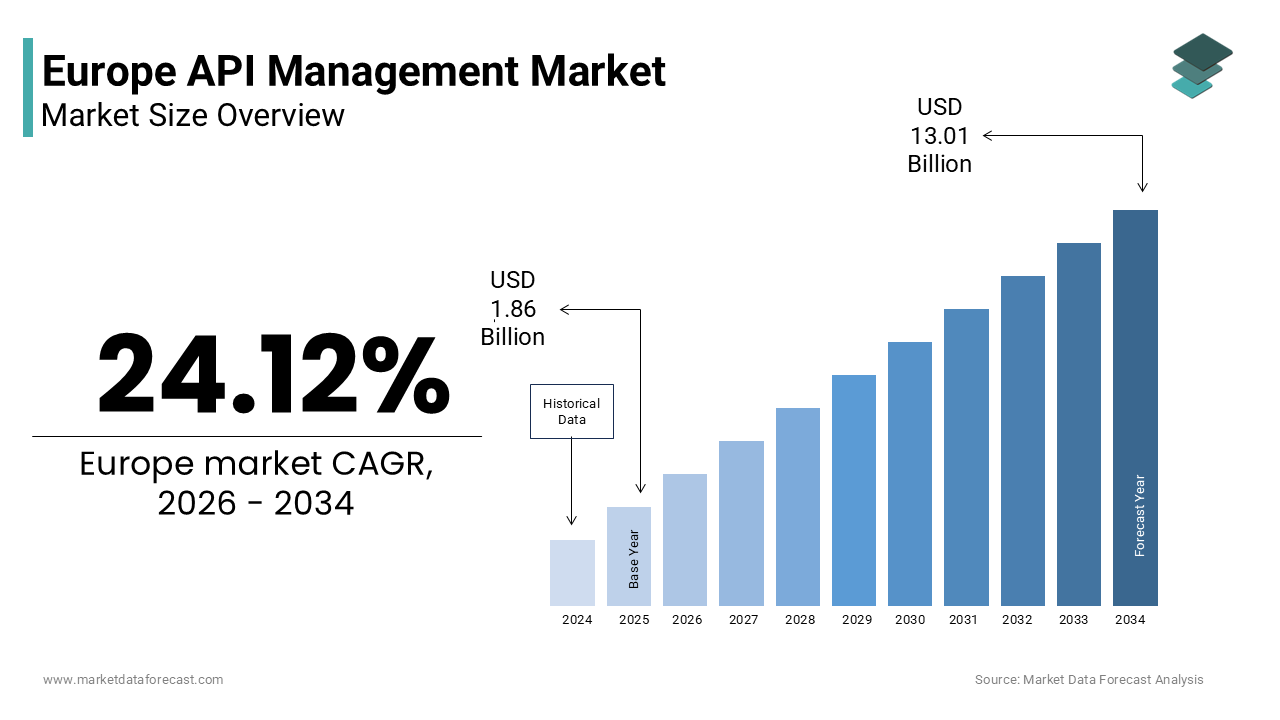
The Europe API management market was valued at USD 1.86 billion in 2025, is estimated to reach USD 2.31 billion in 2026, and is projected to reach USD 13.01 billion by 2034, growing at a CAGR of 24.12% during the forecast period from 2026 to 2034. The growth of the market is driven by the rapid shift toward microservices architecture, cloud-native environments, and digital transformation initiatives across European enterprises. Increasing reliance on secure data exchange, API governance, and regulatory compliance (such as GDPR) is further accelerating adoption. Additionally, the expansion of IoT ecosystems, open banking initiatives, and connected digital platforms is strengthening the demand for robust API management solutions across industries.
Key Market Trends
- Rising adoption of microservices architecture is driving demand for API orchestration
- Increasing focus on API security, governance, and compliance due to strict regulations
- Growth of cloud-based API management platforms for scalability and flexibility
- Expansion of open banking ecosystems enabling secure data sharing via APIs
- Rapid proliferation of IoT devices and connected systems is boosting API traffic
Segmental Insights
- By Enterprise Type: The large enterprises segment dominated the market in 2025 due to complex IT ecosystems, high API volumes, and strict compliance requirements.
- The small & medium enterprises (SMEs) segment is expected to witness fast growth, driven by affordable cloud-based API solutions and increasing digital adoption.
- By Deployment: The cloud segment held the largest share (64.8%) owing to its scalability, cost efficiency, and ease of integration with modern applications.
- By Application: The security segment accounted for the largest share, supported by rising cyber threats and strict regulatory frameworks like GDPR
- The performance analytics segment is projected to grow at the fastest rate due to the need for real-time monitoring, optimization, and improved user experience.
Regional Insights
The market is experiencing strong growth across Europe driven by digital transformation, regulatory compliance, and cloud adoption.
- Germany led the market with 23.1% share in 2025, supported by Industry 4.0 initiatives, a strong manufacturing base, and increasing API integration.
- The United Kingdom holds a significant share due to open banking adoption, fintech innovation, and strong digital infrastructure.
- France is growing steadily with government-backed digital initiatives and sovereign cloud development.
- Italy and Spain are emerging markets driven by SME digitalization, e-commerce growth, and public sector modernization
Competitive Landscape
The Europe API management market is highly competitive, with the presence of global technology giants, cloud providers, and specialized software vendors. Companies are focusing on innovation, security, compliance, and cloud integration to strengthen their market position. Prominent players in the Europe API management market include IBM Corporation, Microsoft Corporation, Google LLC, Amazon Web Services, Inc., Oracle Corporation, SAP SE, MuleSoft, Software AG, Broadcom Inc., TIBCO Software Inc., Red Hat, Axway Software, and WSO2 Inc.
 Download Free Sample Report
Europe API Management Market Size
The Europe API management market size was valued at USD 1.86 billion in 2025 and is anticipated to reach USD 2.31 billion in 2026 from USD 13.01 billion by 2034, growing at a CAGR of 24.12% during the forecast period from 2026 to 2034.
API Management is the process of designing, publishing, documenting, and overseeing application programming interfaces (APIs) in a secure, scalable, and controlled environment. These platforms serve as the critical infrastructure for digital transformation enabling seamless connectivity between disparate systems applications and data sources across the region. As European enterprises accelerate their transition toward microservices architectures and cloud native environments the need for robust API governance becomes paramount. The market is defined by its ability to facilitate secure data exchange while ensuring compliance with stringent regulatory frameworks such as the General Data Protection Regulation. According to Eurostat, 77.6 percent of large enterprises (250+ employees) in the European Union utilized cloud computing services in 2023, creating a foundational reliance on APIs for cross-platform integration and data flow. Furthermore the European Commission’s Digital Decade policy targets that 75 percent of EU companies should adopt cloud computing, big data, and artificial intelligence by 2030. However, as of 2024, only 8 percent of companies have adopted AI, highlighting an urgent need for API orchestration to bridge legacy systems with new technologies. The proliferation of connected devices continues to scale the API ecosystem, with IoT Analytics reporting over 18.8 billion active IoT connections globally at the start of 2025, a significant portion of which are concentrated in European industrial and smart city hubs. This interconnected ecosystem requires sophisticated management tools to handle traffic monitoring security enforcement and developer engagement. Consequently the market is not merely about technical connectivity but represents a foundational layer for business agility innovation and competitive advantage in the modern digital economy.
MARKET DRIVERS
Accelerated Adoption of Microservices Architecture Drives Demand for API Orchestration
The widespread transition from monolithic legacy systems to microservices architecture is one of the major drivers of the Europe API management market. Microservices break down complex applications into smaller independent services that communicate via APIs necessitating robust management platforms to handle the resulting complexity. This architectural shift allows organizations to deploy updates faster and scale specific components independently which is crucial for maintaining competitiveness in dynamic markets. According to the European Commission's Digital Decade reports, there is a significant and sustained increase in the adoption of cloud-native architectures among European firms, as organizations move away from monolithic systems toward more modular and scalable software structures. As the number of internal and external APIs grows exponentially organizations face challenges in tracking versioning security and performance without centralized management tools. API management solutions provide the necessary visibility and control to ensure that these distributed services operate cohesively. The European Institute of Innovation and Technology (EIT) emphasizes that the shift toward microservices enables enterprises to become more agile, allowing for more frequent software updates and a faster response to changing market demands compared to traditional development methods. This efficiency gain motivates businesses to invest heavily in API gateways and management consoles. Furthermore the decoupling of front end and back end systems enables omnichannel experiences which are increasingly expected by European consumers. By facilitating seamless integration across diverse platforms API management tools become indispensable for organizations seeking to leverage the full potential of microservices while maintaining operational stability and security standards.
Stringent Regulatory Compliance Requirements Mandate Enhanced API Security and Governance
Strict regulatory frameworks governing data privacy and security in the region are boosting the adoption of advanced API management solutions and are propelling the growth of the Europe API management market. The General Data Protection Regulation imposes rigorous obligations on how personal data is collected processed and shared requiring organizations to implement precise access controls and audit trails. APIs often serve as the entry points for data exchange making them critical vectors for potential breaches if not properly secured. The European Union Agency for Cybersecurity (ENISA) identifies the exploitation of software vulnerabilities and web-facing interfaces as a top tier threat, driving a critical need for organizations to implement specialized security protocols for their data-sharing layers. API management platforms offer features such as authentication authorization encryption and threat detection which are essential for complying with GDPR and other regional directives like the Digital Operational Resilience Act. The European Banking Authority emphasizes that financial institutions must ensure the resilience of their digital operations including API interfaces to prevent systemic risks. Non compliance can result in severe penalties with fines reaching up to 4 percent of global annual turnover. Consequently enterprises are prioritizing API management tools that provide comprehensive governance capabilities including policy enforcement and real time monitoring. These solutions enable organizations to demonstrate compliance through detailed logging and reporting mechanisms. As regulatory scrutiny intensifies across sectors such as healthcare and finance the demand for secure and compliant API management infrastructure continues to grow establishing it as a non negotiable component of enterprise IT strategy.
MARKET RESTRAINTS
Complexity of Integrating Legacy Systems with Modern API Platforms Hinders Deployment
The presence of extensive legacy infrastructure in many established industries in the region constrains the expansion of the Europe API management market. Numerous organizations particularly in the banking manufacturing and public sectors rely on outdated mainframe systems that were not designed for modern web based connectivity. Integrating these rigid systems with contemporary API management platforms requires complex middleware and custom development efforts which can be time consuming and costly. According to the European Investment Bank (EIB), many European firms continue to face significant barriers to digital innovation due to the complexity of modernizing their existing hardware and software foundations, which often stalls broader transformation goals. The lack of standardized protocols in older systems often leads to compatibility issues requiring specialized expertise to resolve. This integration challenge increases the total cost of ownership and extends implementation timelines discouraging some organizations from fully embracing API management strategies. Furthermore the risk of disrupting critical business operations during migration creates hesitation among IT leaders who prioritize stability over innovation. Various sources observe that the rapid adoption of digital interfaces is frequently hampered by the technical challenges of connecting new cloud-based tools with deeply rooted on-premise systems. The scarcity of skilled professionals who understand both legacy architectures and modern API technologies exacerbates this issue. Until more streamlined integration tools become available or legacy systems are systematically modernized the complexity of connecting old and new technologies will continue to impede the seamless expansion of the API management market in the region.
Shortage of Skilled Professionals with Expertise in API Development and Management
A critical shortage of qualified personnel possessing specialized skills in API design development and management is slowing down the growth of the Europe API management market. Effective API management requires a deep understanding of software architecture security protocols and data analytics which are not commonly found in traditional IT workforces. Data from Eurostat indicates that a majority of enterprises attempting to recruit technology specialists face extreme difficulties, particularly in finding candidates with the high-level qualifications required for advanced software engineering and systems analysis. Organizations struggle to find talent capable of designing scalable secure and user friendly APIs that align with business objectives. This skills gap leads to prolonged recruitment cycles and increased labor costs as companies compete for a limited pool of experts. Furthermore the rapid evolution of API technologies and standards means that existing staff require continuous training to remain competent. Research from Cedefop highlights that while technology professionals are increasingly required to adopt multi-disciplinary skillsets, the formal provision of regular training in emerging fields remains insufficient to meet the pace of industrial change. Without adequate human capital organizations may implement suboptimal API strategies leading to security vulnerabilities poor performance and limited innovation. The reliance on external consultants to fill these gaps further strains budgets and reduces internal knowledge retention. Addressing this workforce deficiency requires significant investment in education and training programs which many companies are slow to undertake. Consequently the lack of skilled professionals remains a persistent barrier to the widespread and effective adoption of API management solutions across the continent.
MARKET OPPORTUNITIES
Expansion of Open Banking Initiatives Creates New Revenue Streams for Financial Institutions
The implementation of Open Banking regulations across the region opens up big possibilities for the Europe API management market. This is supported by mandating banks to share customer data with third party providers through secure APIs. The Revised Payment Services Directive PSD2 requires financial institutions to open their payment infrastructure to authorized third parties fostering innovation and competition. Multiple studies note that the European open banking landscape is maturing, with a stabilized network of authorized third-party providers facilitating a vast array of secure financial data exchanges across the region. API management platforms are essential for banks to securely expose their data and services while maintaining control over access and usage. These solutions enable banks to monetize their APIs by offering premium services to fintech partners and other stakeholders. The ability to manage high volumes of API calls with low latency and high availability is crucial for maintaining customer trust and regulatory compliance. Open Banking Limited (formerly the OBIE) highlight a significant milestone in user activity and transaction frequency, proving that digital-first financial services have become a mainstream component of the UK economy. Beyond payments open finance initiatives are expanding this model to include savings investments and insurance data. API management providers can capitalize on this trend by offering specialized solutions tailored to the financial sector’s unique security and compliance needs. This regulatory driven openness transforms APIs from technical utilities into strategic business assets driving significant investment in management infrastructure.
Growth of Internet of Things Ecosystems Demands Scalable API Connectivity Solutions
The rapid proliferation of Internet of Things IoT devices across the regional industries unlocks potential for providers in this domain to deliver scalable connectivity solutions, which is predicted to accelerate the expansion of the Europe API management market. IoT deployments generate massive amounts of data from sensors and devices that must be integrated with enterprise applications and cloud platforms via APIs. Research confirms that the proliferation of connected devices across Western Europe is placing immense pressure on digital backbones, necessitating highly reliable and scalable interfaces to manage the increasing flow of industrial and consumer data. API management platforms enable organizations to securely connect manage and monitor these devices ensuring seamless data flow and real time analytics. In sectors such as smart manufacturing healthcare and logistics APIs facilitate the integration of IoT data with backend systems for predictive maintenance and operational optimization. The European Commission’s Smart Everything Everywhere initiative supports the development of interoperable IoT solutions which rely heavily on standardized API interfaces. API management solutions provide the necessary abstraction layer to handle device heterogeneity and protocol translation simplifying the integration process. Furthermore the ability to enforce security policies at the API gateway level protects IoT networks from cyber threats which are increasingly prevalent. As enterprises expand their IoT footprint the demand for API management tools that can scale efficiently and provide comprehensive visibility into device interactions will surge. This trend positions API management as a critical enabler of the industrial internet and smart city initiatives across Europe.
MARKET CHALLENGES
Increasing Sophistication of API Specific Cyber Threats Compromises Data Integrity
The rising sophistication of cyberattacks specifically targeting API vulnerabilities is hampering the growth of the Europe API management market. As APIs become the primary interface for data exchange they attract malicious actors seeking to exploit weaknesses in authentication logic or data validation processes. Reports from the European Union Agency for Cybersecurity (ENISA) emphasize that vulnerabilities in web applications and digital interfaces remain a primary vector for cyber threats, necessitating a greater focus on securing the communication layers between different software services. Traditional security measures such as firewalls are often insufficient to protect against complex API attacks like broken object level authorization or excessive data exposure. Organizations must continuously update their API management strategies to address these evolving threats which requires significant resources and expertise. The General Data Protection Regulation mandates strict protection of personal data meaning that any breach via an API can result in substantial financial and reputational damage. Furthermore the distributed nature of microservices architectures increases the attack surface making it difficult to maintain consistent security policies across all endpoints. As per the Open Web Application Security Project API security risks are now among the top ten critical web application security risks. Companies face the challenge of balancing accessibility with security ensuring that APIs remain open for innovation while being protected against unauthorized access. The need for advanced threat detection and automated response mechanisms adds complexity to API management implementations requiring ongoing vigilance and investment in security technologies.
Lack of Standardization Across API Protocols and Formats Impedes Interoperability
The absence of universal standards for API design protocols and data formats creates significant interoperability issues within the Europe API management market. Organizations often employ a mix of REST SOAP GraphQL and other API styles depending on legacy systems and specific use cases. This fragmentation complicates the integration process and increases the complexity of managing diverse API portfolios. Under the Interoperable Europe Act, the European Union is working to harmonize technical standards for data exchange across public and private sectors to reduce fragmentation and ensure consistent digital services across member states. The lack of standardization leads to siloed data and inefficient workflows as different systems struggle to communicate effectively. Developers face steep learning curves when working with multiple API types which slows down development cycles and increases the likelihood of errors. Furthermore the absence of common documentation standards makes it difficult for external partners to integrate with enterprise APIs seamlessly. As per the Linux Foundation’s OpenAPI Initiative while the OpenAPI Specification is widely adopted it is not universally implemented leading to variations in implementation quality. This inconsistency hinders the creation of a cohesive digital ecosystem where data can flow freely and securely between organizations. Companies must invest in additional translation layers and customization efforts to bridge these gaps which increases costs and reduces agility. Interoperability challenges must be resolved through strict industry-wide standards. Until this happens, the efficient scaling of API management solutions across the European market will continue to be hindered.
REPORT COVERAGE
| REPORT METRIC | DETAILS |
| Market Size Available | 2025 to 2034 |
| Base Year | 2025 |
| Forecast Period | 2026 to 2034 |
| CAGR | 24.12% |
| Segments Covered | By Enterprise Type, Deployment, Application, End User Industry and Region |
| Various Analyses Covered | Global, Regional, & Country Level Analysis; Segment-Level Analysis, Drivers, Restraints, Opportunities, Challenges, PESTLE Analysis, Porter’s Five Forces Analysis, Competitive Landscape, Analyst Overview of Investment Opportunities |
| Regions Covered | UK, France, Spain, Germany, Italy, Russia, Sweden, Denmark, Switzerland, the Netherlands, Turkey, the Czech Republic, and the Rest of Europe |
| Key Market Players | IBM Corporation, Microsoft Corporation, Google LLC, Amazon Web Services, Inc., Oracle Corporation, SAP SE, MuleSoft (a Salesforce company), Software AG, Broadcom Inc. (CA Technologies), TIBCO Software Inc., Red Hat, Inc., Axway Software, and WSO2 Inc. |
SEGMENTAL ANALYSIS
By Enterprise Type Insights
The large enterprises segment remained in the lead in the Europe API management market by capturing a substantial share in 2025. This leading position of the segment is mainly attributed to the complex IT infrastructures and extensive digital ecosystems inherent to large organizations which require robust governance and security for thousands of APIs. Large enterprises in sectors such as banking telecommunications and retail have undergone significant digital transformation initiatives that rely heavily on microservices and cloud native architectures. : Eurostat data indicates that a vast majority of large enterprises in the European Union have successfully transitioned to cloud-based environments, creating a critical requirement for specialized management solutions that can securely bridge these cloud services with existing internal systems. The scale of operations in large corporations necessitates advanced features such as rate limiting threat protection and detailed analytics which are critical for maintaining service level agreements. Furthermore regulatory compliance requirements such as the General Data Protection Regulation impose strict data handling obligations that large enterprises must meet through sophisticated API gateways. As per the European Banking Authority financial institutions which are predominantly large entities must ensure operational resilience through rigorous API monitoring and control. The ability of API management platforms to provide centralized visibility and control over distributed systems makes them indispensable for large organizations. These companies also possess the financial resources to invest in comprehensive enterprise grade solutions and dedicated support services. Consequently the combination of regulatory pressure technical complexity and financial capacity ensures that large enterprises remain the primary consumers of API management technologies in the European market. A key factor sustaining the dominance of the large enterprises segment is the necessity to manage complex digital ecosystems while adhering to stringent regulatory compliance standards. Large organizations operate numerous legacy and modern applications that must communicate seamlessly requiring a unified API management strategy. The integration of these disparate systems is critical for business continuity and innovation. API management platforms provide the necessary infrastructure to catalog secure and monitor these interfaces effectively. Additionally large enterprises are subject to rigorous audits and compliance checks particularly in regulated industries such as finance and healthcare. API gateways offer essential security features such as OAuth authentication and encryption which help mitigate risks and ensure data integrity. The cost of non compliance can be substantial with fines reaching millions of euros under GDPR. Therefore large enterprises invest heavily in API management solutions to automate compliance reporting and enforce security policies consistently. This strategic imperative to balance innovation with risk management drives continuous investment in advanced API management capabilities solidifying the segment's market leadership.
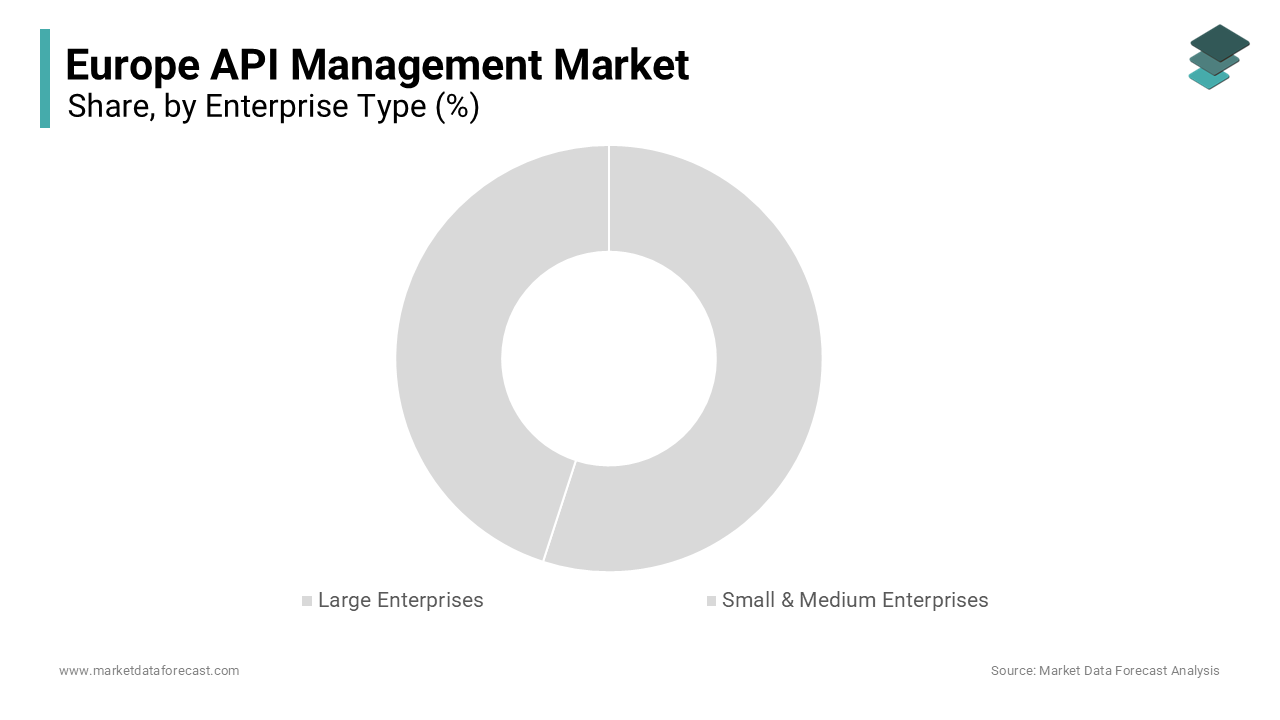
The small and medium enterprises segment is expected to exhibit a noteworthy CAGR of 19.2% from 2026 to 2034. This swift expansion of the segment is attributed to the increasing digitalization of SMEs and the availability of affordable cloud based API management solutions. Small and medium sized businesses are recognizing the value of APIs in connecting with partners customers and third party services to enhance their competitive edge. According to the European Commission SMEs account for 99 percent of all businesses in the EU and their adoption of digital technologies is accelerating rapidly. The rise of software as a service models has lowered the barrier to entry allowing SMEs to access enterprise grade API management tools without significant upfront investment. Eurostat confirm a steady upward trend in small and medium-sized businesses purchasing cloud services, reflecting a widespread move away from on-premise infrastructure in favor of more scalable, web-based operational models. API management enables SMEs to innovate faster by integrating external services such as payment gateways and logistics providers into their workflows. This agility allows smaller businesses to respond quickly to market changes and customer demands. Furthermore government initiatives aimed at supporting digital transformation in SMEs provide funding and resources for technology adoption. The ability to scale API usage as the business grows makes these solutions attractive to expanding companies. Consequently the combination of affordability accessibility and strategic value drives the rapid expansion of the SME segment in the API management market. The primary factor for the rapid growth of the small and medium enterprises segment is the widespread availability of cost effective cloud based API management solutions tailored to their needs. Traditional on premise API management systems were often prohibitively expensive and complex for smaller organizations. However the shift to subscription based cloud models has democratized access to these technologies. These solutions offer scalability allowing SMEs to pay only for the resources they use and adjust capacity as their business evolves. The ease of deployment and maintenance associated with cloud platforms reduces the need for specialized IT staff which is often a constraint for smaller businesses. Cloud providers also offer pre built connectors and templates that simplify the process of connecting to popular business applications. This user friendly approach lowers the technical barrier and encourages experimentation with new digital services. Furthermore the flexibility of cloud APIs supports remote work and collaboration which are increasingly important for modern SMEs. Small and medium enterprise adoption of API management is surging, driven by simplified interfaces and tiered pricing. Consequently, the market is experiencing substantial growth.
By Deployment Insights
The cloud deployment segment held the majority share of 64.8% of the Europe API management market in 2025 because of the widespread migration of European enterprises to cloud infrastructure and the inherent advantages of scalability and flexibility offered by cloud-based API management. Organizations are increasingly adopting hybrid and multi cloud strategies which require API management solutions that can operate seamlessly across different environments. Eurostat confirm that a substantial majority of large enterprises across the European Union have integrated cloud computing into their operations, providing a mature infrastructure for deploying advanced digital interfaces and connected services. Cloud deployment eliminates the need for substantial hardware investments and reduces maintenance overhead allowing companies to focus on core business activities. The ability to scale resources dynamically in response to fluctuating traffic demands is crucial for maintaining performance and user experience. Under the Digital Decade policy framework, the European Commission has established specific targets for the widespread uptake of advanced technologies, including cloud-edge solutions, to ensure the long-term digital sovereignty and competitiveness of the region's businesses. Cloud based API management also facilitates faster deployment of new services and updates enabling organizations to innovate more rapidly. The integration with other cloud native services such as serverless computing and container orchestration enhances the overall value proposition. Furthermore cloud providers offer robust security and compliance features that align with European regulations. This combination of operational efficiency scalability and regulatory alignment ensures that cloud deployment remains the dominant choice for API management in the region. A major factor driving the dominance of the cloud deployment segment is the superior scalability and operational efficiency it provides compared to on premise alternatives. Cloud based API management platforms allow organizations to handle sudden spikes in traffic without the need for proactive capacity planning or hardware procurement. This elasticity is essential for businesses experiencing variable demand patterns such as e commerce retailers during holiday seasons. The managed nature of cloud services means that providers handle software updates security patches and infrastructure monitoring freeing up internal IT resources for strategic initiatives. Cloud platforms also offer global reach enabling enterprises to deploy APIs closer to end users for reduced latency and improved performance. This geographic distribution is particularly beneficial for multinational companies operating across Europe. Furthermore the integration of artificial intelligence and machine learning capabilities in cloud API management tools enhances predictive analytics and automated threat detection. These advanced features are often more accessible and easier to implement in cloud environments. Consequently the operational advantages and cost savings associated with cloud deployment continue to drive its widespread adoption and market leadership.
The cloud deployment segment is predicted to witness the highest CAGR of 18.5% during the forecast period owing to the accelerating shift toward digital first business models and the increasing preference for flexible scalable IT infrastructure. Organizations are moving away from capital intensive on premise setups in favor of operational expenditure models that offer greater agility. Studies note a fundamental change in corporate IT procurement, as organizations increasingly prioritize cloud-native architectures for new software developments and reassess legacy systems for transformation into hybrid or multi-cloud environments. Cloud based API management enables faster time to market for new applications and services which is critical in competitive industries. The ability to integrate with emerging technologies such as Internet of Things and artificial intelligence is also easier in cloud environments. Research indicate that the expansion of the public cloud sector in Europe is fostering a diverse ecosystem of service providers, enabling more effective management and integration of cross-platform digital tools. The ongoing improvements in cloud security and compliance certifications further alleviate concerns about data sovereignty and privacy. Additionally the rise of remote work has increased the demand for cloud accessible APIs that support distributed teams. These factors combined create a powerful momentum for cloud deployment adoption. As more organizations recognize the strategic benefits of cloud based API management the segment will continue to outpace others in terms of growth rate. One of the major drivers for the rapid growth of the cloud deployment segment is its seamless integration with emerging technologies and support for remote work trends. Modern digital initiatives often involve Internet of Things devices artificial intelligence and big data analytics which generate vast amounts of data requiring efficient API connectivity. Cloud based API management platforms are designed to handle these high volume low latency interactions effectively. According to the International Data Corporation the number of connected IoT devices in Europe is projected to reach 2.5 billion by 2025 most of which will rely on cloud APIs for data transmission. The flexibility of cloud infrastructure allows organizations to experiment with new technologies without significant upfront investment. Furthermore the shift toward remote and hybrid work models has increased the reliance on cloud accessible applications and services. API management in the cloud ensures that employees can securely access corporate resources from anywhere enhancing productivity and collaboration. As per the European Foundation for the Improvement of Living and Working Conditions over 40 percent of the EU workforce engaged in remote work in 2023 driving demand for secure cloud based connectivity. Cloud providers also offer advanced identity and access management features that support secure remote access. This alignment with contemporary work practices and technological trends ensures that cloud deployment remains the preferred choice for organizations seeking agility and innovation. Consequently the segment continues to experience robust growth as businesses adapt to the evolving digital landscape.
By Application Insights
The security segment dominated the Europe API management market and accounted for a 35.5% share in 2025. This dominance of the segment is driven by the critical importance of protecting sensitive data and preventing unauthorized access in an increasingly interconnected digital environment. APIs are common targets for cyberattacks including data breaches and denial of service attacks making robust security measures essential. The European Union Agency for Cybersecurity (ENISA) highlight that threat actors are increasingly exploiting vulnerabilities in digital infrastructure and software supply chains, necessitating a shift toward advanced API security and automated protection layers. API management platforms provide comprehensive security features such as authentication authorization encryption and threat detection which are vital for safeguarding digital assets. The General Data Protection Regulation imposes strict requirements on data privacy requiring organizations to implement stringent access controls and audit trails. As per the European Banking Authority financial institutions must ensure the resilience of their API interfaces to prevent systemic risks. Non compliance with these regulations can result in severe penalties and reputational damage. Consequently enterprises prioritize security when selecting API management solutions. The ability to monitor and analyze API traffic in real time allows organizations to detect and respond to threats promptly. Furthermore the rise of open banking and open data initiatives has expanded the attack surface necessitating even stronger security protocols. This regulatory and operational imperative ensures that security remains the primary application area for API management investments in Europe. The main reason for the dominance of the security segment is the stringent regulatory compliance landscape and the evolving threat environment in Europe. Organizations must adhere to multiple regulations including GDPR and the Digital Operational Resilience Act which mandate robust security controls for digital services. API management solutions enable companies to enforce these controls consistently across all interfaces. The complexity of modern IT environments with multiple cloud providers and third party integrations increases the risk of vulnerabilities. API gateways serve as a central point for enforcing security policies such as rate limiting and input validation. Organizations are increasingly adopting zero trust architectures which rely on strict identity verification for every person and device trying to access resources. API management platforms facilitate this approach by providing detailed visibility into API usage and behavior. The ability to integrate with identity providers and security information and event management systems further enhances protection. As cyber threats become more sophisticated the demand for advanced API security capabilities will continue to grow solidifying the segment's market leadership.
The performance analytics segment is estimated to register the fastest CAGR of 20.1% between 2026 and 2034 due to the increasing need for organizations to monitor optimize and troubleshoot API performance to ensure optimal user experiences. APIs are the backbone of modern digital services. Any performance degradation directly impacts customer satisfaction and revenue. Research indicates that organizations leveraging advanced data and analytics platforms achieve higher service stability and faster troubleshooting capabilities by integrating real-time insights into their technical workflows. Performance analytics tools provide real time insights into latency throughput and error rates enabling proactive management of API health. The complexity of microservices architectures makes it difficult to identify bottlenecks without comprehensive monitoring capabilities. The European Institute of Innovation and Technology (EIT) emphasizes that digital transformation and human-centric industrial analytics are becoming central to European manufacturing, with a focus on using data-driven insights to optimize resource distribution and competitive positioning. The integration of artificial intelligence and machine learning into analytics platforms enhances predictive capabilities allowing organizations to anticipate and prevent performance issues before they occur. Furthermore the growing volume of API traffic requires automated analysis tools to handle the scale of data generated. These factors combined create a strong demand for sophisticated performance analytics solutions. Businesses are accelerating the adoption of these tools to achieve operational excellence and competitive advantage. Consequently, this is driving substantial market growth. The biggest push behind the quick surge of the performance analytics segment is the focus on proactive monitoring and user experience optimization. In today’s digital economy users expect instant and reliable responses from applications. Any delay or failure in API performance can lead to customer churn and lost revenue. Performance analytics tools enable organizations to track key performance indicators and identify trends that may indicate underlying issues. The ability to visualize API traffic and usage patterns helps IT teams make informed decisions about capacity planning and infrastructure upgrades. The integration of analytics with DevOps practices supports continuous improvement and faster release cycles. Automated alerts and dashboards provide immediate visibility into system health allowing for rapid response to incidents. Furthermore the use of historical data for trend analysis helps organizations predict future demand and optimize resources accordingly. This proactive approach minimizes downtime and ensures consistent service quality. As digital services become more complex the need for detailed performance insights will continue to grow. Consequently the performance analytics segment will experience sustained high growth as organizations prioritize reliability and user satisfaction.
REGIONAL ANALYSIS
Germany API Management Market Analysis
Germany outperformed other countries in the Europe API management market and secured a 23.1% share in 2025. The supremacy of the German market is supported a strong industrial base and a robust commitment to Industry 4.0 initiatives which rely heavily on API connectivity for smart manufacturing and supply chain optimization. German enterprises are increasingly adopting API management solutions to integrate legacy systems with modern cloud applications. According to the German Federal Ministry for Economic Affairs and Climate Action (BMWK), the digitalization of SMEs is a primary focus, supported by the Digital Now program and the €500 million "Support Center Germany" initiative launched in November 2025 to streamline innovation funding. The presence of major automotive and manufacturing companies drives demand for secure and scalable API infrastructure. Furthermore Germany’s strict data privacy laws encourage the use of compliant API management platforms. As per Eurostat, cloud computing adoption in German enterprises reached 47% in 2023, moving closer to the EU average of 53% in 2025, which supports the expanding ecosystem of cloud-based API services for industrial digitalization (e.g., Manufacturing-X). The country’s well developed IT infrastructure and skilled workforce support the implementation of advanced API strategies. Additionally the financial sector in Frankfurt is a major consumer of API technologies for open banking and fintech innovations. The combination of industrial digitalization regulatory compliance and financial innovation ensures that Germany remains the dominant force in the European API management market.
United Kingdom API Management Market Analysis
The United Kingdom was the next prominent country in the Europe API management market and occupied a 19.2% share in 2025. This position of the UK market is propelled by its leadership in the financial services sector and the widespread adoption of open banking regulations. The Revised Payment Services Directive has compelled banks to expose their data through APIs creating a vibrant ecosystem of fintech innovation. According to the Open Banking Implementation Entity transaction volumes via open banking APIs have grown exponentially driving demand for robust management solutions. London serves as a global hub for financial technology attracting significant investment in API infrastructure. The UK government’s digital strategy also promotes the use of APIs in public services enhancing efficiency and transparency. As per the UK Department for Science, Innovation and Technology (DSIT), the digital sector contributed approximately £160 billion in Gross Value Added (GVA) in 2023, representing 6.5% of the total UK economy and cementing the role of API management in financial and consultancy services. The presence of major technology companies and startups fosters a culture of innovation and rapid adoption of new technologies. Furthermore the UK’s departure from the European Union has led to a focus on digital sovereignty and independent regulatory frameworks which influence API governance practices. The strong emphasis on security and compliance in the financial sector ensures continued investment in advanced API management tools. This dynamic environment positions the UK as a key driver of market growth in the region.
France API Management Market Analysis
France maintains a noteworthy presence in the Europe API management market due to the government’s strong support for digital transformation and the development of a sovereign cloud infrastructure. The France 2030 investment plan includes significant funding for digital technologies including API management solutions. According to the French Ministry of Economy, the adoption of cloud services is accelerating under the Cloud de Confiance (Trusted Cloud) initiative, with the government allocating €667 million by 2025 to develop sovereign cloud infrastructure and API integration tools. The presence of major telecommunications and retail companies creates a diverse market for API applications. France is also a leader in the adoption of open data initiatives which require standardized and secure API interfaces. The country’s focus on data sovereignty and security aligns with the need for compliant API management platforms. Furthermore the vibrant startup ecosystem in Paris contributes to innovation in API technologies. The combination of government support industrial demand and regulatory focus ensures that France remains a significant player in the European API management market.
Italy API Management Market Analysis
Italy witnessed a consistent growth in the Europe API management market by positioning itself as a significant contributor to the region. The market status in Italy is characterized by a growing emphasis on digitalization in the public sector and small and medium sized enterprises. The National Recovery and Resilience Plan allocates substantial funds for digital infrastructure and innovation encouraging the adoption of API management solutions. According to sources, the percentage of Italian enterprises using cloud services has increased significantly in recent years. The tourism and retail sectors are key drivers of API adoption as businesses seek to enhance customer experiences through digital channels. Italy’s banking sector is also undergoing digital transformation with open banking initiatives driving demand for secure API interfaces. As per studies, the adoption of open banking standards is accelerating creating new opportunities for API management providers. The government’s efforts to improve digital skills and infrastructure support the widespread adoption of these technologies. Furthermore the presence of international technology companies in Milan fosters innovation and competition. As Italian businesses continue to modernize their IT systems the demand for API management solutions will grow ensuring Italy’s continued relevance in the European market.
Spain API Management Market Analysis
Spain is anticipated to expand notably in the Europe API management market over the forecast period due to a vibrant startup ecosystem and a strong focus on digital tourism and financial services. The Spanish government’s Digital Spain 2025 agenda aims to boost digital skills and infrastructure supporting the adoption of API technologies. The tourism industry relies heavily on APIs for booking systems and customer engagement driving demand for reliable management solutions. Spain’s financial sector is also embracing open banking with several major banks launching API platforms for third party developers. The country’s strategic location as a gateway to Latin America also attracts international companies seeking to expand their digital presence. Furthermore the growth of e commerce and digital media sectors contributes to the demand for API management tools. The combination of government support industrial digitalization and a dynamic startup scene ensures that Spain remains a key market for API management in Europe.
COMPETITIVE LANDSCAPE
The competition in the Europe API management market is characterized by intense rivalry among established technology giants specialized software vendors and emerging startups. Major multinational corporations leverage their extensive cloud infrastructure and broad product portfolios to offer integrated solutions that appeal to large enterprises. These incumbents benefit from strong brand recognition and existing customer relationships which facilitate cross selling opportunities. However specialized vendors challenge this dominance by providing niche features and superior customer support tailored to specific industry needs. The market sees frequent innovation as companies strive to differentiate themselves through advanced security capabilities artificial intelligence integration and ease of use. Regulatory compliance with the General Data Protection Regulation serves as a critical competitive factor requiring vendors to demonstrate robust data protection measures. Companies that successfully balance innovation with compliance gain a strategic advantage in attracting risk averse European clients. The rise of open source alternatives also pressures proprietary vendors to offer flexible pricing models and transparent operations. Strategic acquisitions and partnerships are common as firms seek to expand their technical expertise and geographic footprint. This dynamic environment fosters continuous improvement but also creates pressure on margins and customer retention. Agility and customer centricity remain essential for sustaining long term success in this rapidly evolving sector.
KEY MARKET PLAYERS
Some of the companies that are playing a dominating role in the Europe API management market include
- IBM Corporation
- Microsoft Corporation
- Google LLC
- Amazon Web Services, Inc.
- Oracle Corporation
- SAP SE
- MuleSoft (a Salesforce company)
- Software AG
- Broadcom Inc. (CA Technologies)
- TIBCO Software Inc.
- Red Hat, Inc.
- Axway Software
- WSO2 Inc.
Top Players in the Europe API Management Market
International Business Machines Corporation
International Business Machines Corporation maintains a strong presence in the Europe API management market through its comprehensive IBM API Connect platform. The company enables organizations to create secure and scalable APIs while ensuring compliance with strict European data regulations. IBM recently enhanced its platform with advanced artificial intelligence capabilities to automate API lifecycle management and improve security threat detection. These innovations help enterprises optimize their digital ecosystems and accelerate application development. The company actively collaborates with European financial institutions to support open banking initiatives by providing robust API governance tools. IBM’s focus on hybrid cloud integration allows clients to manage APIs across diverse environments seamlessly. By prioritizing security and automation IBM strengthens its position as a trusted partner for digital transformation. Its global expertise combined with local regulatory knowledge ensures that European customers receive tailored solutions that meet their specific operational needs and compliance requirements effectively.
Google LLC
Google LLC significantly influences the Europe API management market with its Apigee platform which is widely adopted for its scalability and developer friendly features. The company provides powerful analytics and security tools that help businesses monitor and protect their API ecosystems effectively. Google recently introduced enhanced machine learning models within Apigee to predict traffic patterns and detect anomalies in real time. This proactive approach minimizes downtime and enhances user experience for millions of consumers across Europe. Google also supports European startups and enterprises through its cloud infrastructure enabling rapid deployment of API driven services. The company’s commitment to open standards and interoperability fosters innovation and collaboration within the digital community. By integrating Apigee with other Google Cloud services the company offers a holistic solution for modern application development. These strategic enhancements reinforce Google’s leadership in delivering high performance and secure API management solutions to the European market.
Microsoft Corporation
Microsoft Corporation plays a pivotal role in the Europe API management market through its Azure API Management service which integrates seamlessly with the broader Microsoft cloud ecosystem. The company empowers organizations to publish secure and documented APIs at scale supporting both internal and external developers. Microsoft recently expanded its API management capabilities with improved support for Kubernetes and serverless architectures enhancing flexibility for cloud native applications. The company also emphasizes security by incorporating advanced identity management and threat protection features aligned with European regulatory standards. Microsoft actively partners with European governments and enterprises to facilitate digital transformation initiatives using robust API strategies. Its extensive network of data centers in Europe ensures low latency and data sovereignty for local clients. Microsoft continuously innovates its platform while focusing on customer success. In doing so, it solidifies its reputation as a key enabler of secure and efficient API connectivity in the region.
Top Strategies Used by the Key Market Participants
Key players in the Europe API management market primarily focus on strategic partnerships and collaborations to expand their technological capabilities and market reach. Companies frequently join forces with local system integrators and consulting firms to deliver tailored solutions that address specific regional regulatory requirements. Another prevalent strategy is the continuous enhancement of product portfolios through the integration of artificial intelligence and machine learning technologies. These advancements enable automated threat detection predictive analytics and intelligent traffic management which are critical for modern digital ecosystems. Market participants also invest heavily in research and development to ensure their platforms remain compatible with emerging cloud native architectures such as Kubernetes and serverless computing. Additionally companies emphasize compliance with European data protection laws by implementing robust security features and obtaining relevant certifications. This approach builds trust with enterprise clients who prioritize data sovereignty and regulatory adherence. Furthermore key players offer comprehensive training and support services to help organizations maximize the value of their API investments. These multifaceted strategies enable vendors to maintain competitive advantages and drive widespread adoption of API management solutions across diverse industries in Europe.
MARKET SEGMENTATION
This research report on the Europe API management market has been segmented and sub-segmented based on the following categories.
By Enterprise Type
- Large Enterprises
- Small & Medium Enterprises
By Deployment
- Cloud
- On-Premise
By Application
- Security
- Performance Analytics
- Gateway
- Governance
- Other Application
By End User Industry
- IT & Telecom
- BFSI
- Government
- Retail
- Healthcare
- Transport & Logistics
- Others
By Country
- UK
- France
- Spain
- Germany
- Italy
- Russia
- Sweden
- Denmark
- Switzerland
- Netherlands
- Turkey
- Czech Republic
- Rest of Europe