- Product Description Description
- Table of Contents TOC
- List of Table & Figure LOT
- Get Free Sample PDF Sample PDF
Europe Appliances Market Size
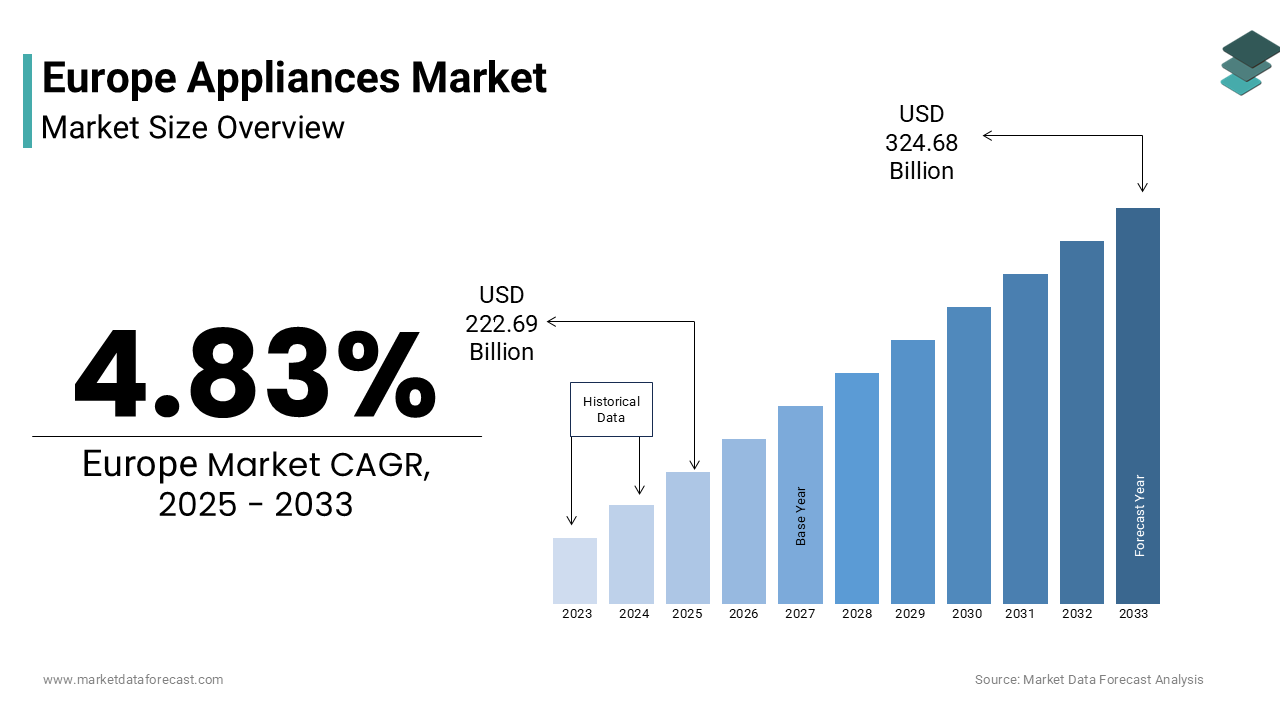
The europe appliances market size was valued at USD 212.42 billion in 2024 and is anticipated to reach USD 222.69 billion in 2025 from USD 324.68 billion by 2033, growing at a CAGR of 4.83% during the forecast period from 2025 to 2033.
The appliances are broad spectrum of household and commercial devices designed to enhance convenience, efficiency, and quality of life across residential and institutional settings. In 2025, this market is shaped by evolving consumer lifestyles, stringent energy regulations, and a growing emphasis on digital integration. Urbanization continues to influence consumption patterns, where 75.4% of the EU population resided in urban areas in 2024 as noted by the United Nations Department of Economic and Social Affairs. This density accelerates demand for space efficient and multifunctional appliances.
MARKET DRIVERS
Rising Energy Efficiency Regulations Are Accelerating Demand for Advanced Appliances
The European Union energy labeling reforms and Ecodesign Directive revisions have profoundly reshaped appliance consumption is propelling the growth of Europe appliances market. As a consequence, only 5% of refrigerators sold in 2023 achieved an A rating, while over 60% fell into the C to D range according to the European Commission’s Market Surveillance Report on Energy Labelling. This recalibration heightened consumer awareness and incentivized manufacturers to prioritize genuine energy performance over cosmetic efficiency claims. The EU’s ambition to reduce final energy consumption by 11.7% by 2030 under the Fit for 55 package further pressures appliance makers to innovate. For instance, new washing machines now consume an average of 30% less electricity and 20% less water compared to models from 2015 as documented by the European Environment Agency. The Ecodesign for Sustainable Products Regulation, effective from 2024, mandates reparability, durability, and energy performance disclosures, which is compelling brands to integrate longer lifespans and modular designs.
Digitalization and Smart Home Integration Are Reshaping Consumer Expectations
The proliferation of connected living environments has transformed appliances from standalone devices into integrated nodes within broader home ecosystems is accelerating the growth of Europe appliances market. As of 2024, approximately 45% of households in Western Europe owned at least one smart home device, with smart thermostats and connected white goods leading adoption as per the International Data Corporation’s Western Europe Smart Home Tracker. Consumer behavior reflects this shift, where a 2024 Kantar survey across five major EU markets revealed that 38% of appliance buyers considered smart functionality as a decisive purchase criterion, up from 22% in 2020. Furthermore, integration with national demand response programs, such as those in Italy and Spain that enables appliances to adjust operation based on grid load by aligning household consumption with renewable energy availability.
MARKET RESTRAINTS
Supply Chain Volatility and Geopolitical Tensions Constrain Production Scalability
The increasing pressure from persistent disruptions in global supply chains exacerbated by geopolitical instability is enhancing the growth of European appliances market. In 2023, the European Central Bank identified that 41% of EU manufacturing firms, including major appliance assemblers, reported significant delays in sourcing critical electronic components such as semiconductors and printed circuit boards. The conflict in Eastern Europe disrupted overland logistics corridors, while export controls on rare earth elements from China for motor and sensor production increased input costs by an estimated 12% to 15% in 2024, according to the source. Additionally, maritime freight rates from Asia to Northwest Europe surged by 78% in early 2024 compared to 2022 averages as noted by the United Nations Conference on Trade and Development. These pressures compress margins for mid-tier brands that lack the inventory buffers of conglomerates like Arcelik or Miele. Compounding the issue, the EU’s carbon border adjustment mechanism, phased in from 2023, imposes additional compliance costs on imported subassemblies, particularly from Turkey and Southeast Asia.
Stagnant Household Formation Rates Limit Volume Growth in Core Segments
The demographic shifts are tempering demand for large household appliances despite high replacement needs, which is additionally hampering the growth of Europe appliances market. In countries like Italy and Germany, the average household size has shrunk to 2.0 and 1.9 persons respectively, thereby reducing per capita demand for full sized refrigerators, cookers, and laundry units. Concurrently, urban housing constraints limit appliance footprints in Paris and Amsterdam, over 65% of new residential units are under 60 square meters as noted by the European Urban Knowledge Network. This spatial limitation favors compact or multifunctional appliances but depresses sales of premium large format units.
MARKET OPPORTUNITIES
Circular Economy Mandates Are Unlocking Remanufacturing and Refurbishment Pathways
The EU’s Circular Economy Action Plan is prompting structural innovation in appliance lifecycle management, which is creating new opportunities for the growth of Europe appliances market. Under the 2024 Ecodesign for Sustainable Products Regulation, manufacturers must ensure spare parts availability for up to 10 years and design for disassembly, which is directly enabling large scale refurbishment operations. Major retailers, such as MediaMarkt and Fnac now dedicate in store sections to certified pre owned appliances, with warranties matching new products. Simultaneously, startups like Back Market and Certideal have secured over €200 million in venture funding to scale appliance refurbishment platforms, across Western Europe. This regulatory driven ecosystem not only reduces electronic waste but also democratizes access to energy efficient models, particularly among lower income households.
Expansion of Energy Performance Contracting Is Driving B2B Appliance Upgrades
The institutional and commercial sectors through energy performance contracting frameworks is also enhancing the growth of Europe appliances market. Public buildings across the EU, including schools, hospitals, and municipal housing, are mandated under the Energy Efficiency Directive to renovate 3% of their floor area annually, that often requiring appliance modernization. In 2023, over 12000 public kitchens in Germany alone upgraded to A rated commercial dishwashers and combi ovens, under such programs, as per the sources. Similarly, social housing corporations in the Netherlands replaced more than 85000 aging refrigerators and cookers between 2022 and 2024 through efficiency performance agreements with utilities like Eneco and Vattenfall. These contracts guarantee energy savings, with repayments tied to utility bill reductions, effectively removing upfront cost barriers. This institutional channel provides stable, large volume demand insulated from consumer cyclicality and offers appliance manufacturers a route to deploy high efficiency commercial variants at scale.
MARKET CHALLENGES
Intensifying Competition from Private Labels Undermines Brand Premium Pricing
The increasing private label appliance offerings that challenge established brand economics is a challenge for the growth of Europe appliances market. Major retailers, such as Carrefour, Aldi, and Lidl now market their own lines of small and large appliances by capturing 22% of the EU small domestic appliances. These products, often manufactured by OEMs in Eastern Europe or Turkey, are priced 30% to 40% below branded equivalents, while offering comparable core functionality. This trend pressures mid-tier brands, like Candy or AEG to either discount aggressively or justify premiums through design, connectivity, or service. Furthermore, online marketplaces such as Amazon Basics and Cdiscount Essentials amplify price transparency by compressing margins across categories.
Skills Shortage in After Sales Service Networks Hampers Consumer Confidence
The acute shortage of qualified technicians capable of servicing modern, digitally integrated appliances is another factor degrading the growth of European appliances market. This gap from declining vocational training enrolment, in Germany, apprenticeship starts in electrical installation trades fell by 17% between 2018 and 2023, according to the sources. The average repair wait times have extended to 12 days in urban centers and over 21 days in rural areas, as per the sources. Delayed or inadequate service erodes trust in premium appliance investments for high end smart models requiring firmware updates or sensor recalibration. This service deficit also contradicts EU right to repair goals, as inaccessible or costly maintenance incentivizes premature replacement.
REPORT COVERAGE
| REPORT METRIC | DETAILS |
| Market Size Available | 2024 to 2033 |
| Base Year | 2024 |
| Forecast Period | 2025 to 2033 |
| Segments Covered | By Product, Type, End-User, Distribution Channel& Region |
| Various Analyses Covered | Global, Regional & Country Level Analysis, Segment-Level Analysis; DROC, PESTLE Analysis; Porter's Five Forces Analysis, Competitive Landscape, Analyst Overview of Investment Opportunities |
| Regions Covered | United Kingdom, France, Spain, Germany, Italy, Russia, Sweden, Denmark, Switzerland, the Netherlands, Turkey, and the Czech Republic. |
| Key Market Players | BSH Hausgeräte GmbH, Electrolux AB, Arçelik A.Ş., Whirlpool Corporation, LG Electronics, Samsung Electronics Co. Ltd., Miele & Cie KG, Haier Smart Home Co. Ltd., Panasonic Holdings Corporation, and Hisense Corporation. |
SEGMENTAL ANALYSIS
By Product Insights
The Major appliances segment was the largest by holding 64.3% of the Europe appliances market share in 2024 from their high unit value, long replacement cycles, and regulatory-driven upgrades. Refrigerators, washing machines, and cookers form the core of this segment, with strong integration into housing infrastructure. The EU’s Ecodesign for Sustainable Products Regulation enacted in 2024 requires all new major appliances sold to meet stringent energy efficiency, reparability, and durability standards. In Germany, 2.8 million refrigerators were replaced in 2024 under state backed scrappage incentives linked to energy efficiency upgrades as reported by the German Federal Ministry for Economic Affairs and Climate Action. New residential developments across the EU are legally required to include fully equipped kitchens, which is directly boosting built in major appliance demand. In France, the RE2020 thermal regulation mandates energy efficient kitchen equipment in all new builds from 2022 onward, translating to over 320000 major appliance installations annually as per the French Building Federation.
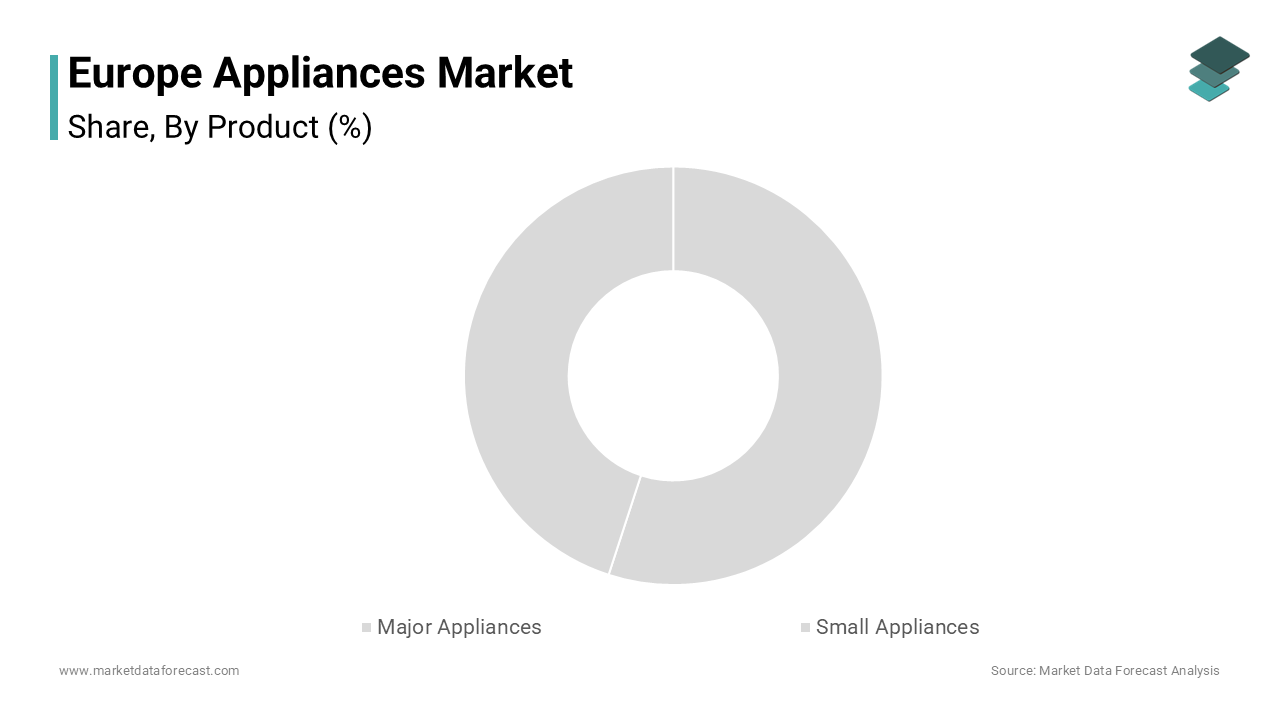
The small appliances segment is esteemed to register a fastest CAGR of 7.8% from 2025 to 2033. The proliferation of one and two person households is a defining demographic trend in Europe, directly benefiting small appliances. These smaller units prioritize compact, multifunctional, and portable devices over full sized kitchen suites. Air fryer ownership alone tripled between 2020 and 2024 by reaching 28% of EU households according to the European Consumer Organisation. Consumer interest in home based nutrition and wellness has dramatically elevated demand for specialized small appliances.
By Type Insights
The conventional appliances segment was the largest by holding a prominent share of the Europe appliances market in 2024. Amid persistent inflation and cost of living pressures, European consumers exhibit strong price consciousness in appliance purchases. In 2023, the average selling price of a smart refrigerator in the EU was €1280 compared to €820 for a non-smart A rated model. Furthermore, only 29% of consumers across the EU expressed confidence in the long term functionality of smart features beyond five years. This risk aversion, combined with minimal perceived utility in basic tasks like refrigeration or washing, sustains the dominance of mechanically operated, serviceable, and lower cost conventional units in replacement driven mature markets.
Smart appliance penetration remains heavily skewed toward affluent, digitally mature regions. Manufacturers maintain robust conventional product lines across value and mid tiers to serve these markets.
The smart appliances segment is lucratively growing at a fastest CAGR of 12.3% throughout the forecast period. Smart appliances are increasingly positioned as active participants in Europe’s energy transition. Similarly, Sweden’s Vattenfall launched a smart appliance orchestration pilot in 2024 covering 12000 households by reducing evening peak loads by 9%, according to the Swedish Energy Agency. The EU’s revised Electricity Market Design regulation encourages such integration by enabling appliance level participation in flexibility markets. Millennial and Gen Z consumers are redefining appliance expectations through their native fluency with digital ecosystems. This cohort values remote monitoring, predictive maintenance alerts, and usage analytics that features absent in conventional models.
REGIONAL ANALYSIS
Germany Appliances Market Analysis
Germany was the largest by capturing 22.3% of the Europe appliances market share in 2024 from high disposable income, strong manufacturing heritage, and progressive environmental policies. The government’s 2024 Energy Efficient Appliance Bonus by offering up to €200 for A rated replacements, spurred a 14% year on year increase in major appliance sales as per the survey. High urban renovation rates with 4.3% of housing stock upgraded annually, as per the German Institute for Economic Research, further sustain appliance turnover.
France Appliances Market Analysis
France appliances market growth is likely to grow with the strong regulatory influence and a growing emphasis on circularity. France’s Anti Waste Law mandates repairability scores on all appliances sold since 2021, leading to a 23% increase in repair related service calls between 2022 and 2024. Simultaneously, the government’s MaPrimeRénov scheme subsidized over 1.2 million energy efficient appliance upgrades in 2023 alone, as per the reports.
The United Kingdom Appliances Market Analysis
The United Kingdom appliances market growth is likely to register a significant CAGR during the forecast period. Post Brexit trade adjustments have reshaped supply chains, but domestic demand remains robust due to strong housing transactions and evolving lifestyle trends. Additionally, the UK’s Ecodesign and Energy Labelling Regulations 2023 mirror EU standards, maintaining pressure for efficient replacements.
Italy Appliances Market Analysis
Italy appliances market grpwtj os likely to grow with the extensive renovation activity and strong cultural emphasis on kitchen quality. Moreover, Italian households prioritize design and integration; 74% of new kitchens feature fully embedded major appliances, as per the report. Cultural factors also matter; the centrality of home cooking sustains demand for high performance ovens and hood systems. These intertwined economic, policy, and cultural dynamics make Italy a high value, design conscious appliance market.
Spain Appliances Market Analysis
Spain appliances market growth is fueled by tourism linked short term rental investments and green renovation incentives. Simultaneously, the Plan Renove Electrodomésticos allocated €150 million in 2023 to subsidize A rated appliance purchases, resulting in 840000 units replaced, as per the Ministry for Ecological Transition.
COMPETITIVE LANDSCAPE
The Europe appliances market features intense competition among multinational incumbents regional specialists and agile private label entrants. Established players like BSH Electrolux and Whirlpool dominate through brand equity technological innovation and vertically integrated manufacturing yet face mounting pressure from retailers launching competitively priced private label lines. Competition is increasingly defined not just by product performance but by sustainability credentials digital integration and post purchase service quality. Regulatory compliance particularly under the EU’s Ecodesign and Circular Economy Action Plan serves as both a barrier to entry and a strategic differentiator for incumbents with R&D capabilities. Eastern European manufacturers are gaining traction by offering cost effective alternatives compliant with EU standards while Chinese brands such as Midea and Haier expand through strategic acquisitions and localized smart appliance portfolios. The rise of energy performance contracting and public sector procurement creates new B2B battlegrounds where technical compliance and lifecycle cost matter more than brand alone. Simultaneously consumer demand for refurbished and modular appliances fragments the market encouraging niche players.
KEY MARKET PLAYERS
Some of the companies that are playing a dominating role in the Europe Appliances Market include
- BSH Hausgeräte GmbH
- Electrolux AB
- Arçelik A.Ş.
- Whirlpool Corporation
- LG Electronics
- Samsung Electronics Co. Ltd.
- Miele & Cie KG
- Haier Smart Home Co. Ltd.
- Panasonic Holdings Corporation
- Hisense Corporation
Top Players in the Market
Electrolux
Electrolux is a leading European appliance manufacturer with a significant global footprint spanning over 120 markets. The company is deeply embedded in the European market through its portfolio of premium kitchen and laundry solutions under brands such as AEG and Frigidaire. In recent years Electrolux has intensified its focus on sustainability and digital innovation launching smart appliances with AI driven features and expanding its circular business models.
BSH Hausgeräte
BSH Hausgeräte is a German based multinational renowned for its Bosch Siemens Gaggenau and Neff brands. It plays a pivotal role in shaping high end appliance trends across Europe and contributes substantially to global innovation in connected and energy efficient home solutions. BSH has recently invested in localized production and digital after sales ecosystems including AI powered diagnostics and remote repair services.
Whirlpool Corporation
Whirlpool Corporation maintains a strong presence in Europe through its integrated manufacturing network and diverse brand portfolio including Whirlpool Indesit and Hotpoint. The company actively contributes to global appliance standards with a focus on affordability and energy performance. To bolster its European position Whirlpool has advanced its sustainability roadmap by launching refrigerators using natural refrigerants and introducing modular designs for easier repair.
Top Strategies Used by the Key Market Participants
Key players in the Europe appliances market prioritize sustainability driven product innovation by embedding circular design principles and energy efficient technologies in response to stringent EU regulations. They invest heavily in smart appliance ecosystems that integrate with home energy management and digital platforms to enhance user experience and grid compatibility. Companies are localizing production and repair networks to mitigate supply chain risks and comply with right to repair laws. Strategic partnerships with utilities and public sector bodies enable participation in energy efficiency retrofit programs. Additionally, firms are expanding certified refurbished offerings and digital service channels to capture value beyond initial sales and address evolving consumer preferences for affordability and environmental responsibility.
MARKET SEGMENTATION
The research report on the Europe Appliances Market has been segmented and sub-segmented based on categories.
By Product
- Major Appliances
- Small Appliances
By Type
- Conventional Appliances
- Smart Appliances
By End Use
- Residential
- Commercial
By Distribution Channel
- Hypermarkets & Supermarkets
- Electronic Stores
- Exclusive Brand Outlets
- Online
- Others
By Country
- UK
- France
- Spain
- Germany
- Italy
- Russia
- Sweden
- Denmark
- Switzerland
- Netherlands
- Turkey
- Czech Republic
- Rest of Europe