- Product Description Description
- Table of Contents TOC
- List of Table & Figure LOT
- Get Free Sample PDF Sample PDF
Market Size, 2025
$5.57 BnMarket Estimate, 2026
$6.01 BnMarket Forecast, 2034
$11.02 BnCAGR, 2026–2034
7.87%Europe Applicant Tracking System Market Report Summary
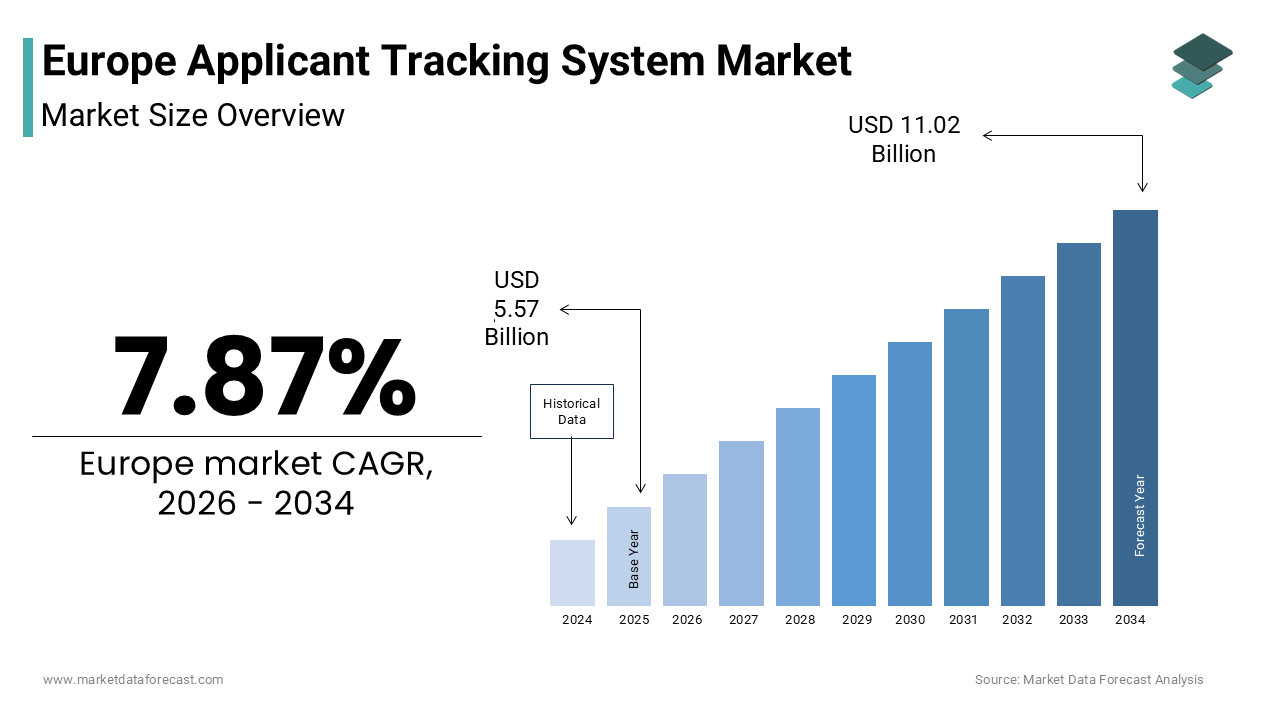
The Europe applicant tracking system market was valued at USD 5.57 billion in 2025, is expected to reach USD 6.01 billion in 2026, and is projected to grow to USD 11.02 billion by 2034, registering a CAGR of 7.87% during the forecast period from 2026 to 2034. The growth of the Europe applicant tracking system market is primarily driven by rising labor shortages across critical sectors, increasing digitalization of recruitment processes, and stringent regulatory requirements under GDPR and national labor laws. The adoption of AI-enabled candidate screening, multilingual recruitment platforms, and cloud-based HR solutions is transforming talent acquisition across Europe, while ethical automation, compliance transparency, and skills-based hiring frameworks continue to shape the evolution of ATS technologies.
Key Market Trends
- Rising implementation of ethical and explainable AI in recruitment to comply with the EU AI Act guidelines.
- Increasing integration of ESCO skills frameworks and qualification recognition systems for cross-border hiring.
- Growing adoption of cloud-based ATS platforms among SMEs due to scalability and cost efficiency.
- Expansion of public sector digital recruitment initiatives across European governments.
- Strong emphasis on data sovereignty, GDPR-compliant workflows, and automated consent management.
Segmental Insights
- Based on Deployment, the cloud-based ATS segment dominated the Europe applicant tracking system market in 2025 owing to its scalability, remote collaboration capabilities, and automatic regulatory updates aligned with evolving European labor laws. However, the on-premise deployment segment is projected to grow steadily as government agencies, financial institutions, and defense organizations prioritize data sovereignty and cybersecurity.
- Based on enterprise type, the large enterprises segment held the largest share due to complex cross-border hiring requirements and strict reporting obligations under EU directives. Meanwhile, the small and medium enterprises (SMEs) segment is expected to grow at the fastest pace, supported by affordable plug-and-play ATS platforms designed for organizations with limited HR resources.
- Based on end-user, the IT and telecom sector accounted for the major market share in 2025 driven by high recruitment volumes and persistent talent shortages, while the healthcare sector is projected to witness rapid growth due to workforce shortages and large-scale digital recruitment initiatives across public health systems.
Regional Insights
The United Kingdom led the Europe applicant tracking system market in 2025, supported by strong HR tech adoption, advanced digital infrastructure, and large public-sector ATS deployments such as the National Health Service recruitment platform.
- Germany remains a key contributor driven by strict data privacy requirements, works council approval mechanisms, and increasing adoption of explainable AI hiring tools among industrial enterprises.
- France continues to expand due to state-led digital labor reforms and centralized recruitment systems aligned with algorithmic transparency guidelines issued by CNIL.
- The Netherlands is emerging as a high-growth market supported by digital public services initiatives and strong adoption of inclusive, multilingual ATS platforms.
- Sweden demonstrates steady growth through ethical AI implementation and integration with EU mobility initiatives such as EURES, positioning the country as a leader in socially responsible recruitment technologies.
Competitive Landscape
The Europe applicant tracking system market is characterized by strong regulatory compliance requirements, emphasis on ethical AI adoption, and increasing integration with European labor mobility frameworks. Leading companies operating in the Europe applicant tracking system market include SAP SE, Oracle Corporation, Workday, Inc., iCIMS, Inc., Greenhouse Software, Inc., SmartRecruiters, Inc., Automatic Data Processing, Inc. (ADP), Bullhorn, Inc., Jobvite, Ceridian, IBM Corporation, and PeopleFluent. These companies focus on cloud deployment models, GDPR-compliant data governance, and AI-driven talent analytics to strengthen their competitive positioning while supporting evolving recruitment needs across Europe’s digitally transforming workforce ecosystem.
Europe Applicant Tracking System Market Size
The Europe applicant tracking system market size was valued at USD 5.57 billion in 2025 and is anticipated to reach USD 6.01 billion in 2026 from USD 11.02 billion by 2034, growing at a CAGR of 7.87% during the forecast period from 2026 to 2034
An applicant tracking system (ATS) is a software platform designed to automate and streamline recruitment processes by managing job postings, collecting and filtering candidate resumes, coordinating interviews, and ensuring compliance with labor regulations. In Europe, ATS adoption is shaped by a complex interplay of labor market dynamics, digital transformation in human resources, and stringent data protection laws. Unlike generic HR tools, modern European ATS solutions integrate artificial intelligence for skills matching, multilingual support for cross border hiring, and built in adherence to regional employment frameworks such as Germany’s Works Constitution Act or France’s labor code. According to Eurostat, the EU recorded a vacancy rate of 2.0% in Q3 2025, with industries such as IT, healthcare, and engineering continuing to face talent shortages. The European Commission’s Digital Europe Programme, with a total budget of €7.5 billion for 2021–2027, supports advanced digital skills development, which is indirectly driving demand for efficient talent acquisition infrastructure. As per the European Data Protection Supervisor, all applicant tracking system deployments must comply with GDPR’s strict requirements on candidate data retention, consent, and algorithmic transparency. This positions the Europe ATS market at the intersection of efficiency, compliance, and ethical automation in talent management.
MARKET DRIVERS
Rising Labor Shortages Across Critical Sectors
Persistent and deepening labor shortages in key European industries have intensified the need for efficient and scalable recruitment technologies, which is one of the major factors propelling the growth of the European applicant tracking system market. According to Eurostat, the EU recorded about 4.2 million unfilled vacancies in Q4 2024, with the information and communication sector facing a vacancy rate of 5.8% and human health and social work activities at 4.9%. These gaps are particularly severe in Germany, where the Federal Employment Agency reported shortages across more than 160 occupations, including engineering and IT. In response, companies are turning to applicant tracking systems (ATS) to reduce time to hire, improve candidate matching, and manage high application volumes without proportional increases in HR staffing. The German Chamber of Industry and Commerce notes that a majority of medium sized enterprises now use ATS to automate initial screening and interview scheduling. Similarly, France’s Ministry of Labour has reported that healthcare institutions in the public sector shortened hiring cycles after implementing AI enabled ATS solutions. As demographic aging and sectoral mismatches persist, ATS becomes not merely an efficiency tool but a strategic necessity for workforce continuity across Europe’s most vital economic pillars.
Mandatory Compliance with GDPR and National Labor Regulations
The stringent regulatory environment in Europe necessitates applicant tracking systems that go beyond recruitment automation to embed legal compliance into their core functionality, which is also supporting the European applicant tracking system market expansion. The General Data Protection Regulation requires that candidate data be collected with explicit consent, stored for limited durations, and made accessible for deletion upon request. According to the European Data Protection Board, more than 45 enforcement actions related to HR data processing were initiated in 2023, many involving improper retention of applicant information. Additionally, national laws impose further requirements: Germany’s Betriebsverfassungsgesetz mandates works council approval for any automated hiring tool that influences candidate evaluation, while France’s Loi pour le plein emploi requires transparency in algorithmic decision making. In response, European ATS vendors have integrated features such as automated data purging, configurable consent workflows, and audit trails that document every stage of the hiring process. The Dutch Data Protection Authority’s 2023 guidelines specifically recommend ATS with built in data minimization and purpose limitation controls. These legal imperatives transform ATS from optional software into compliance infrastructure, compelling even small and medium enterprises to adopt certified systems to avoid fines and reputational damage.
MARKET RESTRAINTS
High Implementation Costs and Integration Complexity
Despite clear benefits, the deployment of advanced applicant tracking systems in Europe is often hindered by substantial upfront investment and technical integration barriers, particularly for small and medium enterprises, which is impeding the European applicant tracking system market growth. According to a 2024 study by the European Federation of HR Directors, the average cost of implementing a cloud based ATS with AI features ranges from €15,000 to €50,000 annually, including licensing, customization, and training. For companies with fewer than 250 employees, these costs represent a significant operational burden. Moreover, integration with existing enterprise systems such as payroll software, ERP platforms, and national job portals (like Germany’s Arbeitsagentur or France’s Pôle Emploi) requires specialized IT resources often unavailable in smaller firms. As per the European Commission’s SME Strategy, only 28% of European SMEs have the internal capacity to manage complex SaaS integrations. Additionally, multilingual and multi country deployments demand configuration for local labor laws, languages, and tax codes, further escalating complexity. Without scalable, affordable entry level solutions or public sector support, many organizations delay or forgo ATS adoption, limiting market penetration despite strong functional demand.
Skepticism Toward AI Based Candidate Screening
Growing concerns about algorithmic bias and lack of transparency in AI driven hiring tools have generated resistance among European employers, candidates, and labor unions, which is acting as a significant restraint on advanced ATS adoption and hindering the regional market growth. The European Trade Union Confederation warns that automated screening systems may perpetuate gender or ethnic disparities if trained on historical hiring data that reflects past biases. In 2023, Germany’s Federal Anti-Discrimination Agency documented cases where AI tools downgraded applications containing non-traditional career paths or foreign sounding names. According to a Eurofound survey, 61% of European job seekers expressed discomfort with being evaluated by algorithms they could not interrogate. Regulatory scrutiny is intensifying, with the European Parliament’s AI Act classifying AI based recruitment systems as high risk, requiring rigorous bias testing, data governance, and human oversight. As a result, many companies opt for basic ATS without AI features to avoid compliance risks. France’s Ministry of Labour’s 2024 guidelines explicitly advise against fully automated hiring decisions. This climate of caution slows uptake of next generation ATS capabilities, tethering the market to rule based automation rather than predictive intelligence.
MARKET OPPORTUNITIES
Expansion of Public Sector Digital Recruitment Initiatives
European governments are increasingly investing in modernizing public sector hiring through centralized applicant tracking systems, which is creating a substantial new demand corridor for the European applicant tracking system market. According to the European Commission, many EU member states are investing in centralized applicant tracking systems to modernize civil service recruitment, reduce administrative delays, and improve workforce planning. In Spain, the Ministry of Inclusion launched the “Empleo Público Inteligente” initiative in 2023, deploying an AI assisted ATS across regional governments. Similarly, the Swedish Public Employment Service has integrated a multilingual ATS to manage applications from EU and third country nationals under the EU Blue Card scheme. The Netherlands’ Government ICT Service Agency mandated in 2024 that ministries use GDPR compliant ATS platforms with accessibility features for persons with disabilities. As per the European Commission, the Recovery and Resilience Facility dedicate 26% of its overall funding to digital objectives, with digital public services being the largest area of investment. By standardizing and scaling ATS use across public roles, these initiatives boost market volume and set benchmarks for security, interoperability, and ethical AI that influence private sector procurement.
Integration with European Skills and Qualifications Frameworks
The alignment of applicant tracking systems with pan European skills taxonomies and qualification recognition frameworks presents a strategic opportunity for the European applicant tracking system market. According to the European Commission, the ESCO classification system includes thousands of standardized occupation codes and skill descriptors designed to facilitate cross border labor mobility. As per the European Centre for the Development of Vocational Training, ESCO is widely adopted in public employment services across EU countries. Forward looking ATS providers embed ESCO mappings into their platforms so that equivalent roles across countries can be matched based on skill equivalence rather than job title alone. According to the European Labour Authority, such systems improve cross border job matching and support mobility within the single market. Additionally, the revised EU Directive on the Recognition of Professional Qualifications requires digital verification of credentials, a process streamlined through ATS integration with national qualification databases. This convergence of labor policy and technology enables ATS to function not just as a hiring tool but as a mobility enabler within the single market, unlocking new value for multinational employers and public employment services alike.
MARKET CHALLENGES
Fragmentation of National Labor Laws and Data Regimes
The Europe applicant tracking system market contends with profound legal and procedural fragmentation across member states, complicating the development of unified, scalable solutions. According to the International Labour Organization, probationary periods and candidate data retention rules vary significantly across European countries. While the General Data Protection Regulation provides a baseline, national interpretations differ, for instance Belgium requires separate consent for each stage of recruitment while Austria mandates that all automated decisions be appealable to a human reviewer. This obliges multinational employers to configure separate ATS workflows for each country, increasing cost and operational complexity. As per the surveys of European employers, many multinationals struggle to maintain compliance across their ATS deployments due to conflicting national requirements. Vendors must therefore invest heavily in localization, delaying feature rollouts and inflating pricing. Until greater harmonization occurs under initiatives like the European Labour Authority’s mutual recognition framework, this fragmentation will remain a structural impediment to seamless cross border recruitment technology adoption.
Lack of Standardized Metrics for Recruitment Performance
The absence of universally accepted benchmarks for measuring recruitment effectiveness undermines the perceived value proposition of applicant tracking systems across Europe, which is further challenging the expansion of the European applicant tracking system market. According to the Chartered Institute of Personnel and Development, HR departments across Europe inconsistently track recruitment metrics such as time to fill, cost per hire, and quality of hire. National differences exacerbate this, with German companies prioritizing candidate experience, UK firms focusing on diversity hiring, and French organizations emphasizing internal mobility. Without common metrics, it is difficult for vendors to demonstrate ROI or for procurement teams to compare solutions objectively. The European Social Survey collects data on employment attitudes, but there is limited evidence that recruitment technology is consistently perceived as a strategic asset. Furthermore, the European Federation of Psychologists’ Associations cautions that many ATS performance claims rely on proprietary algorithms not validated by independent occupational science. Until Europe adopts harmonized recruitment analytics standards, the market will struggle to mature beyond basic automation into data driven talent strategy.
REPORT COVERAGE
| REPORT METRIC | DETAILS |
| Market Size Available | 2025 to 2034 |
| Base Year | 2025 |
| Forecast Period | 2026 to 2034 |
| CAGR | 7.87% |
| Segments Covered | By Deployment, Enterprise Type, End-user and Region |
| Various Analyses Covered | Regional & Country Level Analysis, Segment-Level Analysis, DROC, PESTLE Analysis, Porter’s Five Forces Analysis, Competitive Landscape, Analyst Overview on Investment Opportunities |
| Countries Covered | UK, France, Spain, Germany, Italy, Russia, Sweden, Denmark, Switzerland, the Netherlands, Turkey, the Czech Republic, and the Rest of Europe. |
| Market Leaders Profiled | SAP SE, Oracle Corporation, Workday, Inc., iCIMS, Inc., Greenhouse Software, Inc., SmartRecruiters, Inc., Automatic Data Processing, Inc. (ADP), Bullhorn, Inc., Jobvite, Ceridian, IBM Corporation, and PeopleFluent. |
SEGMENTAL ANALYSIS
By Deployment Insights
The cloud-based deployment segment led the market by holding 71.8% of the regional market share in 2025. The dominance of cloud-based deployment segment in this regional market is driven by its scalability, cost efficiency, and seamless compliance with evolving data regulations. European organizations increasingly prefer cloud solutions because they eliminate the need for on site server maintenance and offer automatic updates that align with changes in labor laws such as the General Data Protection Regulation or national hiring codes. According to the European Commission’s 2024 Digital Economy and Society Index, 82% of EU enterprises now use cloud computing for at least one business function, with HR systems among the fastest migrating categories. Cloud based ATS platforms also enable remote hiring teams to collaborate in real time, which is a necessity in the post pandemic hybrid work environment. The European Data Protection Supervisor has issued guidance affirming that major cloud ATS providers with EU based data centers meet GDPR’s data localization requirements when configured properly. Furthermore, vendors like SAP SuccessFactors and Workable offer modular pricing starting at under 500 euros per month, making cloud ATS accessible even to mid-sized firms. This combination of regulatory alignment, operational flexibility, and financial accessibility solidifies cloud deployment as the dominant model across public and private sectors in Europe.
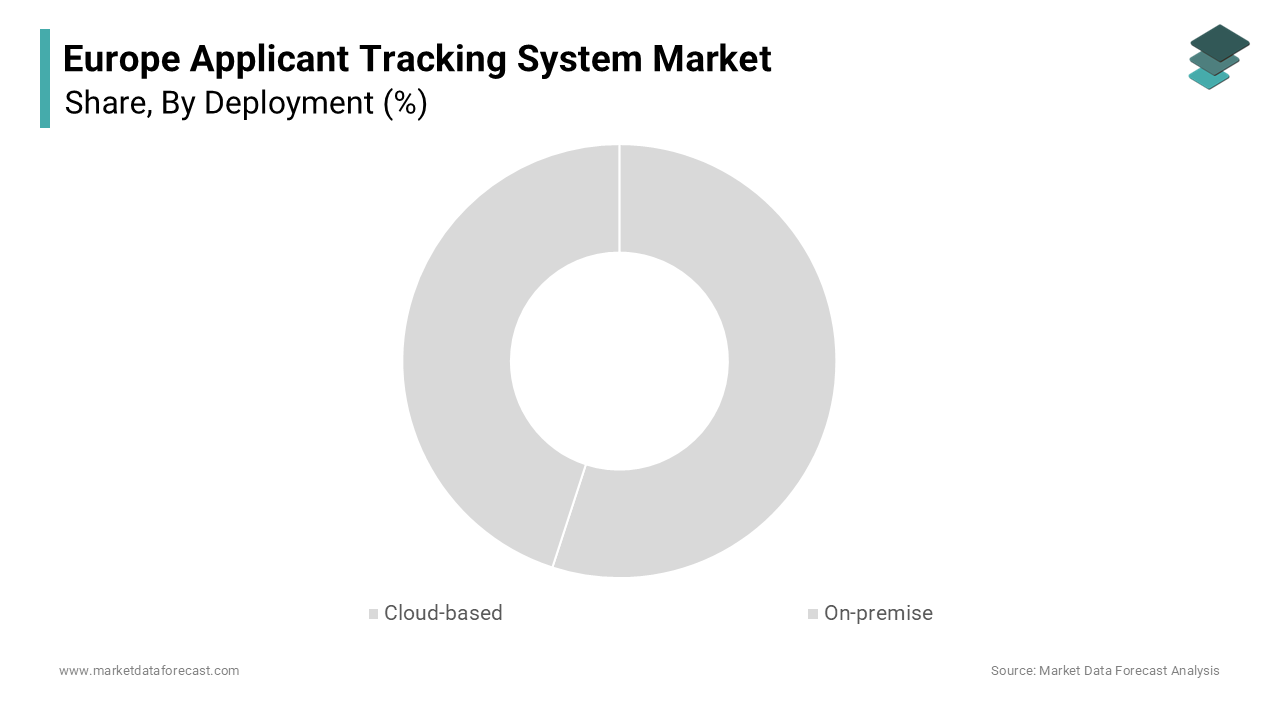
While smaller in share, the on-premise deployment segment is the fastest growing in the Europe applicant tracking system market and is expected to grow at a CAGR of 10.6% over the forecast period owing to the growing data sovereignty concerns among government agencies, financial institutions, and defense contractors that cannot risk storing sensitive candidate data on third party infrastructure. According to the European Banking Authority, many EU banks classify applicant data as high risk under their internal data governance policies, requiring on site storage and processing. In Germany, the Federal Office for Information Security mandates that public sector HR systems handling civil service applications must be hosted within national borders and under direct institutional control. Similarly, France’s ANSSI cybersecurity agency issued a directive requiring critical infrastructure employers to keep recruitment data on premise or in sovereign cloud environments. National defense ministries in Sweden and the Netherlands have also reverted to on premise ATS to comply with classified personnel protocols. As geopolitical tensions and cyber threats escalate, organizations with stringent security mandates are investing in modernized on premise ATS that integrate AI and workflow automation while retaining full data control, transforming this segment from legacy infrastructure into a niche but high value growth corridor.
By Enterprise Type Insights
The large enterprises segment commanded for the leading share of 66.9% of the European market in 2025. The dominance of large enterprises segment in the European market is attributed to their complex hiring needs and regulatory obligations. Organizations with more than 250 employees often manage hundreds of open positions across multiple countries, requiring centralized coordination, candidate relationship management, and compliance with diverse national labor laws. According to Eurostat, large enterprises in the EU account for only 0.2% of all businesses but generate 41% of total employment, making efficient talent acquisition critical to their operations. The European Federation of HR Directors reports that most large European firms use enterprise grade ATS to automate resume screening, interview scheduling, and onboarding workflows. These systems are also essential for meeting reporting requirements under the EU Pay Transparency Directive which mandates detailed documentation of hiring decisions. Multinationals like Siemens, Unilever, and AXA rely on integrated ATS modules within broader HR suites such as SAP SuccessFactors or Oracle HCM to ensure consistency across regions. The scale, complexity, and compliance burden inherent in large organizations create structural demand for sophisticated ATS solutions that justify significant investment and long-term vendor relationships.
The small and medium enterprises (SMEs) segment is the fastest growing enterprise segment in the Europe applicant tracking system market and is predicted to record a CAGR of 14.1% over the forecast period owing to the proliferation of affordable, user-friendly cloud based ATS platforms tailored to businesses with limited HR staff. According to the European Commission, SMEs constitute 99.8% of all EU businesses and employ 68% of the private sector workforce, yet historically relied on manual or spreadsheet-based hiring. The rise of plug and play solutions like Zoho Recruit, Breezy HR, and Teamtailor has lowered adoption barriers significantly. Surveys confirm that adoption among SMEs has grown rapidly in recent years. National digitalization grants further boost uptake, for example Germany’s “go digital” program reimburses up to 50% of HR software costs for firms with fewer than 100 employees. As talent competition intensifies and digital literacy improves among SME owners, lightweight ATS tools are transitioning from luxury to necessity, enabling smaller firms to compete for skilled workers with professionalized hiring processes.
By End-user Insights
The IT and Telecom segment led the market by holding 23.9% of the regional market share in 2025. The growth of the IT and telecom segment in the European market is driven by chronic talent shortages and high hiring velocity. According to Eurostat, the sector recorded one of the highest vacancy rates among all economic segments, with demand for software engineers, cybersecurity specialists, and data scientists far outpacing supply. Companies like SAP, Deutsche Telekom, and Ericsson routinely fill thousands of technical roles annually, requiring automated resume parsing, skills matching, and coding assessment integration. According to the European DIGITAL SME Alliance, most European tech firms use AI powered ATS to screen candidates based on GitHub profiles, coding test results, and certification databases. Furthermore, the sector’s global workforce strategy necessitates multilingual and cross border compliance features embedded in modern ATS platforms. The European Institute of Innovation and Technology notes that tech companies using advanced ATS reduced time to hire compared to manual processes. This operational imperative combined with high digital maturity makes IT and Telecom the most intensive and sophisticated adopter of applicant tracking technology in Europe.
The healthcare segment is the fastest growing end user segment in the Europe applicant tracking system market and is projected to register a CAGR of 16.6% over the forecast period. The severe workforce deficits and urgent recruitment needs across hospitals, clinics, and elderly care facilities are propelling the healthcare segment in the European market. According to the World Health Organization Regional Office for Europe, the EU faces a projected shortage of millions of healthcare workers by 2030, with nurses, physicians, and mental health professionals in highest demand. Public health systems are responding by digitizing recruitment, for example the UK’s National Health Service deployed a unified ATS across all trusts in 2023 to standardize hiring and reduce administrative delays. Similarly, France’s regional health agencies now mandate ATS use for all public hospital appointments under the “Ma Santé 2024” reform. These systems are tailored to verify professional licenses, manage shift preferences, and track credentialing, a critical need in a highly regulated environment. As demographic pressure mounts and digital health infrastructure expands, ATS adoption in healthcare transitions from administrative convenience to public health necessity.
REGIONAL ANALYSIS
United Kingdom Applicant Tracking System Market Analysis
The United Kingdom held the largest share of 20.2% of the European market in 2025. The UK is serving as a mature and innovation driven hub for HR technology adoption. Home to global corporations, financial institutions, and a dynamic startup ecosystem, the UK exhibits high digital maturity in talent acquisition. According to the Office for National Statistics, the UK recorded a job vacancy rate of 3.4% in 2024, with sectors like fintech and life sciences experiencing acute hiring pressure. The National Health Service’s enterprise wide ATS rollout covering over 1 million staff has become a benchmark for public sector digital recruitment. Post Brexit, the UK’s Department for Science Innovation and Technology has promoted sovereign HR tech solutions that comply with the UK GDPR while enabling global hiring. London hosts numerous ATS vendors and HR tech incubators supported by initiatives like Tech Nation’s Scale Up program. The Chartered Institute of Personnel and Development reports that most UK organizations with over 250 employees use integrated ATS platforms. This blend of regulatory clarity, tech infrastructure, and talent competition ensures the UK remains a leading and influential market for advanced applicant tracking solutions in Europe.
Germany Applicant Tracking System Market Analysis
Germany captured a promising share of the European applicant tracking system market in 2025. The growth of Germany in the European market is attributed to its engineering precision, strong works council influence, and emphasis on data privacy. The country faces one of Europe’s most severe skilled labor shortages, with the Federal Employment Agency estimating a deficit of hundreds of thousands of technical and healthcare workers in 2024. In response, large industrial firms like BMW, Siemens, and Bosch have deployed enterprise ATS with multilingual and GDPR compliant workflows. Critically, Germany’s Betriebsverfassungsgesetz requires works council approval for any automated hiring tool that influences candidate evaluation, a condition that has driven vendors to develop transparent explainable AI features. According to the German Federal Ministry for Economic Affairs and Climate Action, most DAX 30 companies now use certified ATS that document algorithmic decisions for audit purposes. Public sector adoption is also accelerating under the “Digital Administration Act” which mandates paperless recruitment by 2026. Germany’s unique balance of labor co determination, technical demand, and data ethics creates a high bar for ATS functionality that often sets standards for the broader European market.
France Applicant Tracking System Market Analysis
France is anticipated to command for a prominent share of the Europe applicant tracking system market during the forecast period due to the state led digital transformation and aggressive labor market reforms. The French government’s “France Travail” initiative launched in 2023 to replace Pôle Emploi relies on a centralized cloud based ATS to manage public employment services for millions of job seekers. According to France’s Ministry of Labour, a majority of private companies with more than 50 employees now use certified recruitment software to comply with the 2022 Loi pour le plein emploi which mandates transparent and non discriminatory hiring practices. The CNIL, France’s data protection authority, has published specific guidelines for ATS vendors requiring algorithmic impact assessments and candidate right to explanation. Major corporations like L’Oréal, TotalEnergies, and Airbus have integrated AI enabled ATS with bias detection modules to meet these standards. Additionally, France’s investment in AI through the “France 2030” plan includes funding for ethical HR tech startups developing European alternatives to US based platforms. This combination of regulatory rigor, public investment, and corporate adoption positions France as a strategic growth engine for compliant and socially responsible applicant tracking technology.
Netherlands Applicant Tracking System Market Analysis
The Netherlands is expected to record a healthy CAGR in the European applicant tracking system market over the forecast period. Netherlands is emerging as a model for agile and inclusive recruitment technology. The country’s high digital readiness, ranked first in the EU on the Digital Economy and Society Index, enables rapid ATS adoption across both public and private sectors. According to Statistics Netherlands, most Dutch enterprises with 10 or more employees use digital tools for hiring, with cloud based ATS dominant among SMEs. The Dutch government’s “Digital Public Services” program mandates that all civil service recruitment be managed through a unified ATS by 2025, ensuring efficiency and equal opportunity. The Netherlands Enterprise Agency actively supports HR tech startups through grants and innovation vouchers with a focus on accessibility for persons with disabilities and bias mitigation. Companies like Booking.com and ASML use advanced ATS with real time language translation to manage highly international workforces. Furthermore, Dutch data protection authority Autoriteit Persoonsgegevens has pioneered proportionate GDPR compliance frameworks for HR tech that balance innovation with candidate rights. This ecosystem of policy support, technical excellence, and social responsibility makes the Netherlands a scalable test market for next generation applicant tracking solutions.
Sweden Applicant Tracking System Market Analysis
Sweden is anticipated to showcase a steady CAGR in the European applicant tracking system market during the forecast period owing to the progressive labor policies and early adoption of ethical AI in hiring. The Swedish Public Employment Service uses a national ATS platform that integrates with EU job mobility schemes like EURES, enabling cross border candidate matching for critical roles. According to Sweden’s Official Statistics Agency, the country’s unemployment rate of 7.2% in 2024 masks severe shortages in engineering, healthcare, and green tech sectors where ATS adoption is widespread among employers. Swedish labor law emphasizes transparency and candidate dignity, requiring that automated hiring decisions be explainable and appealable. In response, vendors like Beamery and local developers have introduced ethical AI features such as gender-neutral language suggestions and skills-based anonymization. The Swedish Innovation Agency Vinnova has funded multiple projects to develop open source bias detection tools for recruitment platforms. Furthermore, Sweden’s strong works council tradition ensures that ATS implementations include employee representation in design and oversight. This forward looking regulatory and cultural environment positions Sweden as a leader in human centered and socially accountable applicant tracking technology in Europe.
COMPETITIVE LANDSCAPE
The Europe applicant tracking system market features a multi-tiered competitive landscape combining global enterprise vendors agile European startups and specialized compliance focused providers. Competition is defined less by price and more by regulatory alignment data governance and functional depth tailored to national contexts. Large players like SAP and Oracle dominate among multinational corporations and public institutions due to their integrated HR suites and legal robustness. Meanwhile homegrown vendors such as Workable Teamtailor and LocalTalent gain traction with SMEs through intuitive interfaces localized support and affordable pricing. Differentiation increasingly hinges on ethical AI features multilingual capabilities and integration with national employment ecosystems. The market is also shaped by public procurement policies that favor certified vendors with proven GDPR and bias mitigation credentials. Although entry barriers are moderate for basic ATS solutions the complexity of legal compliance and enterprise integration creates a high effective barrier for advanced deployments. As a result, the market rewards vendors who combine technical sophistication with deep understanding of European labor norms data rights and social values.
KEY MARKET PLAYERS
Some of the companies that are playing a dominating role in the Europe applicant tracking system market include
- SAP SE
- Oracle Corporation
- Workday, Inc.
- iCIMS, Inc.
- Greenhouse Software, Inc.
- SmartRecruiters, Inc.
- Automatic Data Processing, Inc. (ADP)
- Bullhorn, Inc.
- Jobvite
- Ceridian
- IBM Corporation
- PeopleFluent
Top Players in the Europe Applicant Tracking System Market
SAP SE
SAP SE is a global enterprise software leader with a significant footprint in the Europe applicant tracking system market through its SuccessFactors Recruiting module. The company integrates ATS functionality into its broader Human Experience Management suite enabling large organizations to manage end to end talent acquisition within a unified HR ecosystem. SAP’s solutions are widely adopted by multinational corporations public sector institutions and regulated industries across Germany France and the Nordics due to their robust compliance with GDPR national labor laws and works council requirements. In 2024 SAP enhanced its European ATS offering with explainable AI features that provide transparent reasoning for candidate recommendations and bias alerts aligned with the EU AI Act. The company also launched localized workflows for public sector hiring in collaboration with national employment agencies. These initiatives reinforce SAP’s position as a trusted infrastructure provider for complex compliant and scalable talent acquisition in Europe and globally.
Workable Software Ltd
Workable Software Ltd is a Europe born applicant tracking system provider headquartered in Greece with strong presence across the UK Germany and the Netherlands. The company specializes in user friendly cloud based ATS tailored for small and medium enterprises as well as high growth tech firms seeking efficient scalable hiring tools. Workable’s platform supports multilingual job postings GDPR compliant data handling and integrations with European job boards such as StepStone and Indeed EU. In 2023 the company introduced a “Fair Hiring” suite featuring anonymized resume review structured interview templates and diversity analytics to address rising regulatory and social expectations around equitable recruitment. Workable also expanded its data residency options with new EU based cloud infrastructure in Frankfurt and Amsterdam ensuring full compliance with data sovereignty requirements. By balancing ease of use with regulatory rigor Workable has become a preferred choice for agile European employers navigating talent shortages and digital transformation.
Cornerstone OnDemand Inc
Cornerstone OnDemand Inc offers an integrated talent experience platform that includes a sophisticated applicant tracking system widely used by large enterprises and public institutions across Western and Northern Europe. The company’s ATS emphasizes skills intelligence internal mobility and candidate relationship management enabling organizations to build talent pipelines beyond transactional hiring. Cornerstone’s European client base includes healthcare networks financial services firms and industrial conglomerates that require multilingual compliance and audit ready hiring workflows. In 2024 Cornerstone enhanced its platform with real time labor market insights powered by European job vacancy data and ESCO skill taxonomies to improve candidate matching accuracy. The company also deepened its integration with national qualification recognition systems to support cross border hiring under EU mobility directives. Through its focus on talent development compliance and data driven recruitment Cornerstone strengthens its role as a strategic partner for European organizations building future ready workforces.
Top Strategies Used by the Key Market Participants
Key players in the Europe applicant tracking system market pursue four core strategies to strengthen their foothold. First, they embed granular compliance features that address both the General Data Protection Regulation and country specific labor laws such as Germany’s works council mandates or France’s algorithmic transparency requirements. Second, they invest in ethical AI capabilities including bias detection anonymized screening and explainable decision logic to align with the EU AI Act and evolving social expectations. Third they offer EU based data residency through local cloud partnerships or sovereign infrastructure to meet data sovereignty demands from public sector and regulated industries. Fourth they integrate with European job boards public employment services and skill classification systems like ESCO to enhance candidate sourcing and cross border mobility. These strategies collectively ensure that ATS solutions are not only technically capable but also legally defensible and socially responsible in Europe’s unique regulatory and cultural context.
MARKET SEGMENTATION
This research report on the Europe applicant tracking system market has been segmented and sub-segmented based on the following categories.
By Deployment
- Cloud-based
- On-premise
By Enterprise Type
- Large Enterprises
- Small & Medium Enterprises
By End-user
- BFSI
- IT & Telecom
- Manufacturing
- Retail & Consumer Goods
- Healthcare
- Others (Government, etc.)
By Country
- UK
- France
- Spain
- Germany
- Italy
- Russia
- Sweden
- Denmark
- Switzerland
- Netherlands
- Turkey
- Czech Republic
- Rest of Europe