- Product Description Description
- Table of Contents TOC
- List of Table & Figure LOT
- Get Free Sample PDF Sample PDF
Market Size, 2025
$2.85 BnMarket Estimate, 2026
$3.13 BnMarket Forecast, 2034
$6.56 BnCAGR, 2026–2034
9.70%Executive Summary: Europe Application Performance Management Market
- Market Scope: Comprehensive European application performance management (APM) market analysis covering software platforms, deployment models, enterprise scales, national leadership shares, and regulatory compliance metrics.
- Market Valuation: Valued at USD 2.60 billion (2024), estimated at USD 2.85 billion (2025), and projected to reach USD 5.59 billion by 2033, registering a robust CAGR of 9.70% (2025–2033).
- Primary Growth Drivers: Shift toward cloud-native architectures, enterprise digital transformation, adoption of AI-powered observability, and stringent regulatory requirements for resilient digital services. Key enterprise and regulatory benchmarks include ~45% of EU enterprises using cloud computing services in 2023 (with high adoption in Finland at 78% and Sweden at 72%), alongside heavy regulatory frameworks such as non-compliance penalties under the Digital Services Act reaching up to 6% of global annual turnover.
Key Market Segment Metrics (2025–2033)
| Category | Leading Segment (2024 Position) | Fastest-Growing Segment |
|---|---|---|
| By Platform Type | Software solutions (dominated with a 63.8% market share in 2024) | Managed and professional services (projected to grow at a 15.5% CAGR) |
| By Deployment Model | Cloud deployment (held 47.7% of the market in 2024) | Hybrid deployment (forecast to expand at a rapid 16.6% CAGR) |
| By Enterprise Scale | Large enterprises (accounted for the most significant share in 2024) | Small and medium businesses / SMBs (expected to record the fastest CAGR of 18.8%) |
| By Country / Region | Germany (led the European market with a 25.5% share in 2024, supported by Industry 4.0 adoption, advanced manufacturing, data-governance rules, and enterprise IT investments; U.K. held the second-largest share) | High-growth European digital economies expanding enterprise cloud infrastructure |
Major Market Players & Market Structure
Market Structure: Highly competitive European application performance management ecosystem featuring global software giants, specialized observability leaders, and infrastructure tech providers competing intensely on AI-driven predictive analytics, automated root-cause identification, strict data-sovereignty compliance, OpenTelemetry integration, hybrid observability capabilities, localized cloud infrastructure, and sustainability-focused performance monitoring.
Key Companies: Akamai Technologies, AppDynamics (Cisco Systems), BMC Software, Broadcom, Datadog, Dynatrace, IBM, OpenText, Microsoft, New Relic, Oracle, Riverbed Technology, and Splunk.
 Download Free Sample Report
Europe Application Performance Management Market Size
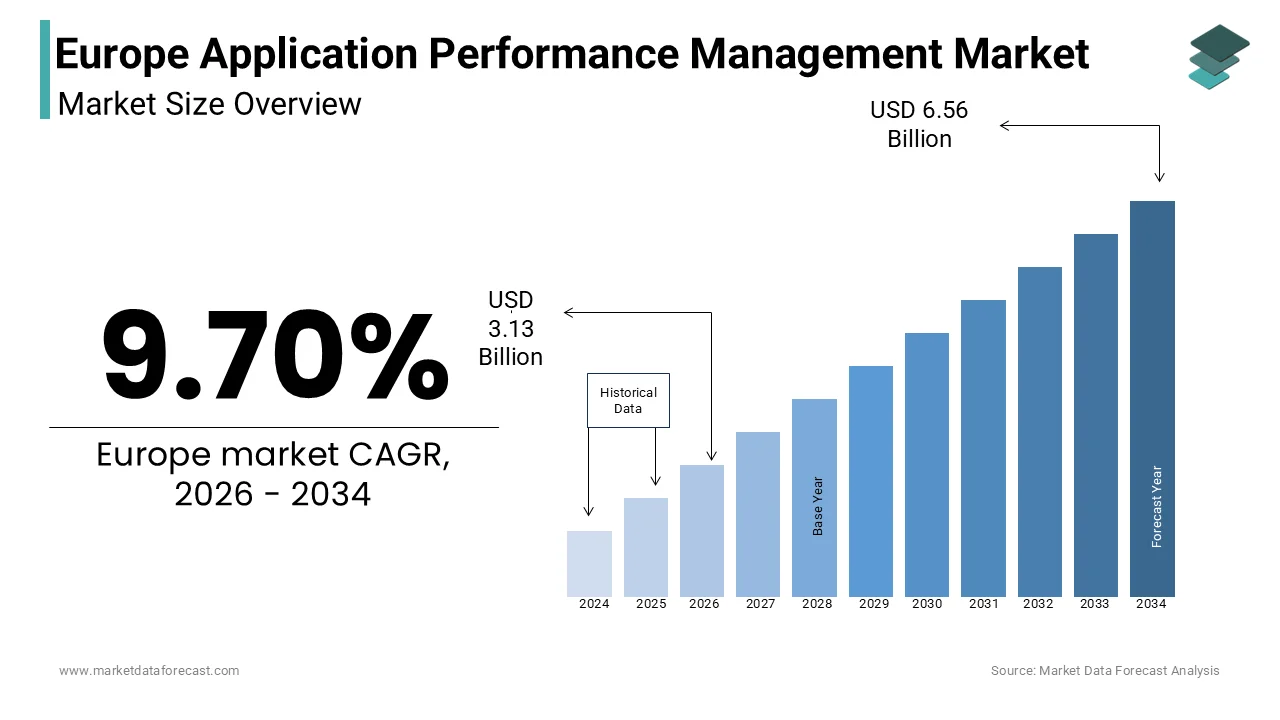
The Europe application performance management market size was valued at USD 2.85 billion in 2025 and is anticipated to reach a valuation of USD 3.13 billion in 2026 and USD 6.56 billion by 2034, growing at a CAGR of 9.70% during the forecast period from 2026 to 2034.
Application Performance Management (APM) is used to monitor, analyze, and optimize the performance, availability, and user experience of software applications across-premises, cl, and hybrid environments. In Europe, APM has evolved from basic infrastructure monitoring to a strategic discipline that integrates real-time telemetry, artificial intelligence, and regulatory compliance. The shift is driven by the region’s accelerated digital transformation and increasing dependence on always-on digital services. According to Eurostat, as of 2023, about 45% of enterprises in the European Union used cloud computing services, with adoption rates among large enterprises significantly higher. In digitally advanced nations such as Finland and Sweden, cloud usage reached around 78% and 72% respectively. At the same time, outages of major cloud providers like AWS and Microsoft Azure have caused substantial financial losses for European businesses, which is indicating the risks of downtime and reputational damage. This systemic reliance on uninterrupted digital operations has elevated APM from an IT function to a core component of business resilience, particularly in regulated sectors including finance, healthcare, and public services.
MARKET DRIVERS
Proliferation of Cloud Native Architectures Elevates Demand for Granular Performance Visibility
The widespread adoption of microservices, containers,s, and serverless computing across European enterprises has fundamentally transformed observability requirements, which is primarily driving the application performance management market in Europe. Traditional monitoring approaches that rely on static agents and siloed metrics are incapable of tracing dynamic, short-lived workloads or mapping complex service dependencies. For instance, a growing majority of new enterprise applications in Western Europe are being developed using cloud native design principles. Financial institutions are at the forefront of this transition, with several major EU banks migrating significant portions of their core transaction systems to cloud native platforms by 2025. These systems process millions of real-time interactions daily, where even minor latency spikes can trigger regulatory scrutiny under the Digital Operational Resilience Act. Consequently, organizations are compelled to adopt APM solutions offering distributed tracing, synthetic user monitoring, and AI-powered anomaly detection not as optional enhancements but as essential safeguards for compliance, customer retention, and operational continuity.
Escalating Stringency of Digital Service Regulations Drives Proactive Monitoring Adoption
The regulatory ecosystem of Europe increasingly treats application performance as a matter of public interest and legal obligation, which is further boosting the application performance management market growth in Europe. The Digital Services Act mandates that all designated very large online platforms ensure high service availability and implement robust incident response mechanisms with financial penalties for non-compliance reaching up to 6% of global annual turnover. As per the European Commission, 23 platforms and search engines fell under this designation as of August 2023. Parallel requirements exist in the financial sector under the Digital Operational Resilience Act, which obligates banks, insurers, and payment providers to deploy real-time monitoring capable of detecting performance degradation before it impacts end users. According to the European Central Bank, numerous critical incidents in 2025 were linked to application layer failures, which indicates the importance of proactive monitoring. In healthcare, the EU Health Data Space framework further ties system reliability to patient safety, which requires uninterrupted access to electronic health records. These converging regulatory pressures have repositioned APM from a technical utility to a mandatory governance layer, compelling enterprises to institutionalize observability as part of their risk management and compliance infrastructure.
MARKET RESTRAINTS
Persistent Integration Complexity Across Heterogeneous IT Environments Hinders Unified Monitoring
European enterprises frequently operate across fragmented technology stacks that blend legacy mainframes, private clouds, and multiple public cloud providers, which is impeding the regional market growth. This heterogeneity creates significant barriers to achieving end-to-end observability. For instance, many DAX 30 companies maintain multiple distinct runtime environments to support diverse workloads. Integrating performance data from systems such as SAP ECC on IBM Z mainframes with telemetry from AWS Lambda or Azure Functions demands extensive custom engineering, middleware adapters, and manual correlation logic. For instance, a significant share of IT leaders identify toolchain fragmentation as the primary obstacle to full-stack visibility. Compounding this challenge, data sovereignty mandates under the General Data Protection Regulation restrict the transfer of diagnostic data across borders, necessitating region-specific monitoring deployments. The resulting operational silos prevent the construction of a unified performance baseline, delay root cause analysis during outages, and increase mean time to resolution, which is undermining the very purpose of APM investments.
Talent Shortage in Observability Engineering Constrains Effective Tool Utilization
Despite substantial investments in advanced APM platforms, European organizations face a critical shortage of professionals skilled in observability, site reliability engineering, and telemetry analytics, which is further hindering the application performance management market growth in Europe. The European Union continues to face a significant shortage of cybersecurity and systems engineering professionals with observability roles among the most undersupplied. This gap is especially pronounced in Southern and Eastern Europe, where specialized training in cloud native operations remains limited. Industry research has found that many European enterprises operate their APM tools at less than half of their functional capacity due to insufficient expertise. Without engineers capable of interpreting distributed traces, building custom dashboards, or tuning AI-driven alerting models, organizations default to reactive, alert-fatigue-prone monitoring. This underutilization prevents the shift from failure detection to predictive performance optimization, which is a capability essential for meeting rising regulatory and customer expectations for digital service excellence.
MARKET OPPORTUNITIES
Expansion of Edge Computing Creates New Frontiers for Performance Monitoring Innovation
The rapid growth of edge computing in Europe is opening new avenues for APM innovation, particularly in industrial and smart infrastructure contexts, which is a significant opportunity for the European APM market. Edge computing deployments in Europe have grown rapidly, with thousands of industrial edge sites active across Germany, France, and the Nordic region. These environments host latency-critical applications such as autonomous logistics robots, real-time visual inspection in manufacturing, and border surveillance analytics. Traditional APM architectures that rely on constant cloud connectivity are ill-suited for such settings due to bandwidth limitations and intermittent network access. This gap creates an opportunity for lightweight, agentless monitoring solutions that perform on-device diagnostics and transmit only aggregated or anomaly-relevant data. The European Union’s Horizon Europe program has committed significant funding through 2027 to edge AI and distributed computing projects, which are accelerating public and private adoption. APM vendors capable of delivering low-footprint, offline-capable observability will be strategically positioned to capture this emerging segment.
Rise of Sustainable Software Engineering Practices Fuels Demand for Performance Efficiency Metrics
Sustainability is emerging as a core criterion in European software development and is creating demand for APM tools that measure computational efficiency and energy consumption, which is another potential opportunity for this regional market. The European Green Deal’s 2025 Code of Conduct for Energy Efficient Cloud Computing explicitly encourages monitoring of CPU idle time, memory allocation churn, and redundant processing as contributors to data center carbon emissions. Studies suggest that inefficient application code can account for a significant share of avoidable energy use in European data centers. Leading industrial firms such as Siemens and Schneider Electric have begun embedding efficiency KPIs into their DevOps workflows. The German Federal Office for Information Security has highlighted sustainability observability as an increasing requirement in public sector software audits. With the Corporate Sustainability Reporting Directive mandating environmental disclosures for digital operations starting in 2025, APM platforms that can translate performance data into carbon and energy metrics will gain strategic relevance across both private and public sectors.
MARKET CHALLENGES
Data Residency Cross-Border Observability Conflicts Undermine Monitoring Continuity
The fragmented interpretation of Europe's data localization laws creates significant operational barriers to unified APM, which is mainly challenging the growth of the APM market in Europe. While the General Data Protection Regulation does not categorically prohibit performance telemetry transfers, national data protection authorities in France, Germany, nd Austria have classified diagnostic logs containing IP addresses, session tokens, or device fingerprints as personal data. According to sources, a notable share of cross-border data investigations has involved SaaS based monitoring tools transmitting logs to non-EU jurisdictions. This regulatory uncertainty forces multinational enterprises to deploy separate, region-locked APM instances or implement complex data masking layers, both of which degrade observability fidelity. For example, a user journey spanning multiple EU countries may become untraceable if telemetry cannot legally cross-national boundaries, breaking end-to-end transaction visibility. Until the Digital Europe Programme issues harmonized guidance on telemetry classification, this jurisdictional fragmentation will persist as a structural impediment to seamless and enterprise-wide monitoring.
Over-reliance on Proprietary Monitoring Agents Increases Vendor Lock-In and Operational Rigidity
Many European organizations remain tethered to vendor-specific APM agents that embed deep but inflexible instrumentation into application code, which is creating long-term technical debt and strategic inflexibility and challenging the regional market growth. Many enterprises cite proprietary agent dependencies as a major barrier to APM platform migration. These agents often require code modifications, custom libraries, and runtime hooks that are difficult to remove without extensive refactoring. Thilock-in not only inflates switching costs but also impedes the adoption of open standards like OpenTelemetry, which is gaining momentum across cloud native ecosystems. For instance, a growing share of European organizations have adopted OpenTelemetry, yet legacy agent entanglement continues to slow full transition. Proprietary agents also struggle with modern runtimes such as WebAssembly and serverless functions, where execution is stateless and ephemeral. Until enterprises decouple instrumentation from proprietary logic through vendor-neutral, open standards, they will remain operationally constrained and economically vulnerable in an increasingly dynamic observability landscape.
REPORT COVERAGE
| REPORT METRIC | DETAILS |
| Market Size Available | 2025 to 2034 |
| Base Year | 2025 |
| Forecast Period | 2026 to 2034 |
| CAGR | 9.70% |
| Segments Covered | By Platform, Deployment Mode, Enterprise Size, Access, and By Country |
| Various Analyses Covered | Global, Regional & Country Level Analysis, Segment-Level Analysis, DROC, PESTLE Analysis, Porter’s Five Forces Analysis, Competitive Landscape, Analyst Overview on Investment Opportunities |
| Regions Covered | UK, France, Spain, Germany, Italy, Russia, Sweden, Denmark, Switzerland, Netherlands, Turkey, the Czech Republic, and the Rest of Europe |
| Market Leaders Profiled | Akamai Technologies Inc., AppDynamics (Cisco Systems Inc.), BMC Software Inc., Broadcom Inc., Datadog Inc., Dynatrace LLC, IBM Corporation, OpenText Corporation, Microsoft Corporation, New Relic Inc., Oracle Corporation, Riverbed Technology, Splunk Inc. |
SEGMENTAL ANALYSIS
By Platform Insights
The software segment dominated the leading share of 63.8% of the European application performance management market in 2025. The dominating position of the software segment in the European APM market is majorly driven by the enterprises’ preference for integrated, scalable, and customizable APM suites that support end-to-end observability within their existing technology stacks and the maturity of European software procurement practices, where large organizations prioritize ownership, data control, and long-term total cost of ownership over consumption-based models. According to Eurostat, a significant share of large enterprises in the European Union reported enterprise-grade monitoring software as part of their core IT operations in 2025, which reflects deep institutional reliance on licensed platforms.
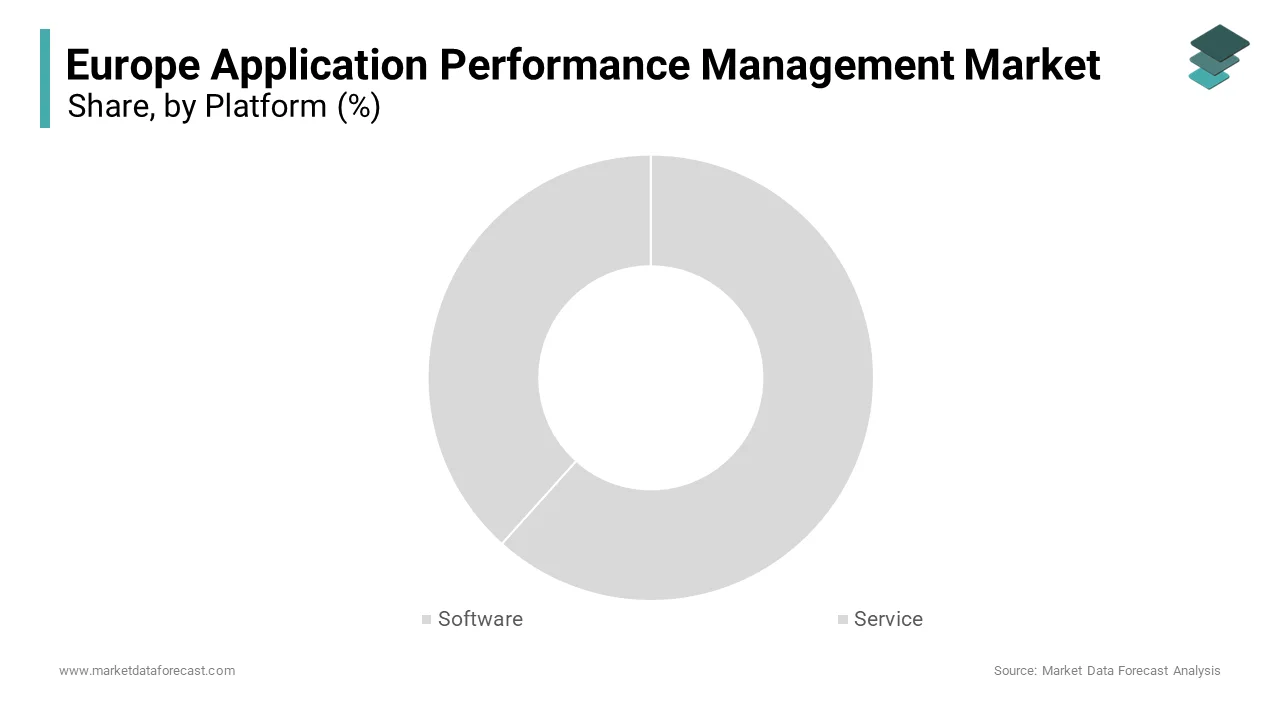
The service segment is another promising segment and is expected to witness a CAGR of 15.5% over the forecast period in the European APM market. Factors such as the rising adoption of managed observability services among small and mid-sized enterprises that lack in-house expertise are primarily driving the growth of the services segment in the European market. For instance, many European SMEs outsource at least one aspect of their application monitoring to third-party service providers, which is citing talent shortages and cost predictability as primary motivations.
By Deployment Mode Insights
The cloud segment dominated the Europe application performance management market by holding 47.7% of the regional market share in 2025. The leading position of the cloud segment in the European APM market is attributed to the region’s rapid migration to cloud infrastructure and the native compatibility of modern APM solutions with dynamic and containerized environments. According to Eurostat, cloud computing adoption among large enterprises in the EU was significantly high in 2025, with penetration rates in digitally advanced economies like the Netherlands and Finland exceeding the majority of enterprises.
The hybrid segment is the fastest-growing segment in the Europe APM market and is estimated to grow at a promising CAGR of 16.6% over the forecast period. This surge of the hybrid segment in the European market is driven by the pragmatic reality that most European enterprises operate in mixed environments where legacy on-premises systems coexist with modern cloud workloads. For instance, many DAX 30 and CAC 40 companies maintain multiple distinct runtime environments, which require unified monitoring that spans cloud and data center boundaries.
By Enterprise Size Insights
The large enterprises segment accounted for the most significant share of the European market in 2025. The growth of the large enterprises segment in the European market is driven by their complex application portfolios, stringent compliance obligations, and substantial digital service footprints. According to the European Central Bank, a large majority of systemically important financial institutions in the EU had implemented enterprise-grade APM platforms by the end of 2025 to comply with the Digital Operational Resilience Act’s requirements for real-time incident detection and reporting.
The small and medium businesses segment is anticipated to grow at the fastest CAGR of 18.8% over the forecast period, owing to the democratization of observability through cloud native, self-service platforms that require minimal setup and operational overhead. For instance, the adoption of entry-level APM tools among European SMEs has grown steadily in recent years, with customer experience protection and e-commerce reliability cited as top priorities.
COUNTRY-LEVEL ANALYSIS
Germany Application Performance Management Market Analysis
Germany was the top performer in the European application performance management market in 2025 and held 25.5% of the regional market share. The dominating position of Germany in the European market is driven by the continent’s industrial and digital backbone and its advanced manufacturing base, stringent data governance laws, and aggressive adoption of Industry 4.0 principles. Germany has emerged as a leader in the regional APM landscape with many DAX 30 companies implementing end-to-end observability frameworks to support smart factory operations and real-time supply chain orchestration. The national emphasis on data sovereignty has also driven demand for hybrid and on-premises APM deployments that keep telemetry within EU jurisdiction. Furthermore, the Federal Office for Information Security mandates rigorous application monitoring for critical infrastructure operators, which covers sectors from energy to transport. This regulatory rigor, combined with high enterprise IT spending and a mature cloud ecosystem, solidifies Germany’s strong position in the regional APM market.
United Kingdom Application Performance Management Market Analysis
The United Kingdom captured the second major share of the European APM market in 2025. The growth of the UK market is driven by its concentration of financial services, digital natives, and public sector digitization efforts. Despite Brexit, the UK remains a global hub for fintech and cloud innovation,n, with London hosting over two hundred regulated financial entities that require continuous application monitoring under the Financial Conduct Authority’s operational resilience guidelines. The UK’s National Cyber Security Centre has emphasized the growing use of AI-enhanced APM tools among critical national infrastructure operators to detect subtle performance anomalies indicative of cyber intrusions. The National Health Service’s digital transformation program, which is allocating billions of pounds to IT modernization, has further accelerated APM adoption in healthcare. Additionally, the UK’s early embrace of OpenTelemetry and DevOps culture has created fertile ground for next-generation observability platforms that prioritize developer experience and automation.
France Application Performance Management Market Analysis
France commanded a prominent share of the European application performance management market in 2025 owing to its robust public sector digitization agenda and strategic focus on technological sovereignty. The French government’s Cloud Souverain initiative has catalysed the deployment of hybrid observability stacks across ministries, utilities, and state-owned enterprises. France’s National Agency for the Security of Information Systems requires all operators of vital importance to implement real-time application monitoring capable of detecting service degradation within minutes. Concurrently, the country’s strong presence in aerospace, automotive, and luxury goods has driven private sector demand for APM in IoT e-commerce contexts. The French Data Protection Authority’s strict interpretation of GDPR as it pertains to diagnostic telemetry has also spurred localized APM deployments. With major vendors establishing sovereign cloud regions in partnership with Orange and Atos, France’s market is increasingly defined by compliance first, resilience-oriented monitoring strategies.
Netherlands Application Performance Management Market Analysis
The Netherlands is anticipated to account for a noteworthy share of the European application performance management market over the forecast period, owing to its role as a European data hub and leader in sustainable digital infrastructure. The Netherlands is home to the Amsterdam Internet Exchange, which is the largest in the world by peak traffic, and the country hosts thousands of multinational enterprises that rely on high-performance digital services. According to Statistics Netherlands, a significant share of large Dutch companies operated cloud-first application architectures in 2025, which requires sophisticated observability to manage latency across distributed workloads. The Dutch government’s Green ICT strategy has also elevated performance efficiency as a core metric, with APM tools now used to optimize energy consumption in data centers. Furthermore, the Netherlands’ progressive stance on open standards has accelerated OpenTelemetry adoption with many enterprises integrating it into their monitoring pipelines. This combination of technical maturity, sustainability mandate, and open ecosystem orientation positions the Netherlands as a high-growth, high-sophistication APM market.
Sweden Application Performance Management Market Analysis
Sweden is predicted to occupy a notable share of the Europe APM market over the forecast period, owing to its world-leading digital maturity and concentration of software engineering talent. Sweden consistently ranks among the top three in the European Commission’s Digital Economy and Society Index,, near-universal cloud adoption among enterprises. According to Vinnova, a large majority of listed companies had embedded observability into their continuous delivery pipelines by 2025, underscoring the priority placed on system reliability. The country’s vibrant startup ecosystem drives demand for lightweight, API first APM services that can scale with rapid product growth. At the same time, the Swedish Civil Contingencies Agency mandates resilience standards for digital public services, requiring real-time monitoring and automated failover. Combined with high per capita IT investment, a trust-based regulatory climate, and deep integration into Nordic and EU digital corridors, Sweden has become an early adopter of AI-driven predictive observability, positioning its market at the forefront of next-generation monitoring practices.
COMPETITIVE LANDSCAPE
The Europe application performance management market features intense competition among global technology vendors and niche observability specialists. Established players leverage artificial intelligence automation and cloud native architecture to differentiate their platforms while addressing region-specific demands for data sovereignty and regulatory compliance. The market is characterized by rapid product innovation, continuous integration with European digital ecosystems, and strategic investments in local infrastructure. New entrants face significant barriers due to the dominance of integrated platforms and the high cost of achieving compliance with frameworks like DORA and GDPR. At the same time, customer preference is shifting toward standards-based solutions that offer interoperability and avoid vendor dependency. Competitive dynamics are further shaped by the growing demand for sustainability-driven performance metrics and edge-aware monitoring capabilities. As digital service complexity increases across finance, healthcare, and industry sectors, the race to deliver predictive, purpose-built observability continues to define the competitive landscape in Europe.
KEY MARKET PLAYERS
A few of the market players in the Europe application performance management market include
- Akamai Technologies Inc.
- AppDynamics (Cisco Systems Inc.)
- BMC Software Inc.
- Broadcom Inc.
- Datadog Inc.
- Dynatrace LLC
- IBM Corporation
- OpenText Corporation
- Microsoft Corporation
- New Relic Inc.
- Oracle Corporation
- Riverbed Technology
- Splunk Inc.
Top Players in the Market
- Dynatrace is a global leader in observability and application performance management with deep penetration across European financial, manufacturing, and public sector markets. The company provides an AI-driven, fully automated observability platform that supports cloud native, hybrid, and legacy environments. In Europe, Dynatrace has strengthened its presence through strategic partnerships with major cloud providers and hyperscalers, enabling seamless integration with Azure, AAWSand Google Cloud. In 2,0,24, the company expanded its data residency capabilities by launching new tenant regions in Germany and France to comply with EU data sovereignty requirements. It also enhanced its Davis AI engine to deliver predictive performance analytics tailored to European regulatory frameworks such as DORA and GDPR, reinforcing its relevance in highly regulated industries across the region.
- Datadog has emerged as a preferred observability solution for European digital natives, fintech firms,, cloud-first enterprises. Its unified platform combines application performance monitoring, infrastructure telemetry, and log management within a developer-centric interface. The company has aggressively expanded its European footprint by opening new data centers in the Netherlands and Ireland to ensure low latency and GDPR compliant data handling. In 2025, Datadog launched industry-specific monitoring packs for European banking and e-commerce sectors, incorporating local compliance templates and synthetic user journey models. It also deepened integrations with European SaaS ecosystems, including SAP and Adyen, enabling real-time performance tracking across payment and ERP workflows. These initiatives have solidified its position as a go-to platform for agile and innovation-driven organizations across Western and Northern Europe.
- New Relic maintains a strong presence in the Europe application performance management market through its flexible, open architecture and commitment to developer experience. The company has repositioned its platform around an open telemetry foundation, allowing European enterprises to avoid vendor lock-in while maintaining high fidelity observability. In 2025, New Relic introduced a sovereign observability offering hosted on Deutsche Telekom’s cloud infrastructure, addressing stringent data residency demands in Germany and Austria. It also launched a sustainability insights module that correlates application performance with energy consumption metrics, aligning with the EU Green Deal’s digital sustainability goals. By embracing open standards, local partnerships, and purpose-built compliance features, New Relic has strengthened its appeal among mid-sized enterprises and public sector agencies seeking cost-effective yet future-ready monitoring solutions.
Top Strategies Used By The Key Market Participants
Key players in the Europe application performance management market prioritize data sovereignty compliance through localized cloud regions and sovereign infrastructure partnerships. They invest heavily in artificial intelligence to enable predictive analytics and automated root cause identification aligned with European regulatory expectations. Vendors adopt open telemetry standards to reduce customer lock-in and accelerate adoption across hybrid environments. Strategic alliances with European cloud providers, hyperscalers, and system integrators enhance solution embeddability and distribution reach. Product innovation focuses on industry-specific monitoring templates for finance, health, and the manufacturing sector, subject to strict EU operational resilience mandates. Companies also tailor sustainability features that link performance metrics to energy efficiency and carbon reporting requirements under the Corporate Sustainability Reporting Directive. These strategies collectively reinforce ttrustust agi and regulatory alignment in a complex, fragmented market landscape.
MARKET SEGMENTATION
This research report on the Europe application performance management market is segmented and sub-segmented into the following categories.
By Platform Type
- Software
- Service
- Deployment and Integration
- Training and Education
- Support and Maintenance
By Deployment Mode
- On-premises
- Cloud
- Hybrid
By Enterprise Size:
- Small and MBusinessessiness
- Large Enterprises
By Access Type:
- Web APM
- Mobile APM
By Country
- UK
- France
- Spain
- Germany
- Italy
- Russia
- Sweden
- Denmark
- Switzerland
- Netherlands
- Turkey
- Czech Republic
- Rest of Europe