- Product Description Description
- Table of Contents TOC
- List of Table & Figure LOT
- Get Free Sample PDF Sample PDF
Market Size, 2025
$10.80 BnMarket Estimate, 2026
$11.30 BnMarket Forecast, 2034
$16.26 BnCAGR, 2026–2034
4.65%Europe Armored Vehicle Market Report Summary
The Europe armored vehicle market was valued at USD 10.80 billion in 2025, is estimated to reach USD 11.30 billion in 2026, and is projected to reach USD 16.26 billion by 2034, expanding at a CAGR of 4.65% during the forecast period from 2026 to 2034.
Market growth is driven by the modernization of defense fleets, increased defense spending by European nations, and the growing need for advanced combat and tactical vehicles amid rising geopolitical tensions. Continuous investment in mobility, survivability, and digital integration is transforming Europe’s armored vehicle landscape, with military forces prioritizing next-generation platforms, modular systems, and hybrid propulsion technologies.
Key Market Trends
- Defense modernization programs: Ongoing procurement and upgrade projects such as Poland’s “Homar” and France’s “SCORPION” initiatives are fueling armored vehicle demand across Europe.
- Shift toward modular and hybrid designs: European OEMs are developing scalable, interoperable platforms with enhanced protection, mobility, and sustainability.
- Cross-border defense collaboration: Joint ventures and EU defense cooperation programs are accelerating the development of shared vehicle platforms.
- Technological integration: Increasing adoption of AI-enabled situational awareness, active protection systems (APS), and digital battle-management tools.
- Rising investment in homeland security: Governments are expanding law enforcement and peacekeeping fleets to handle internal security and disaster-response missions.
SEGMENTAL INSIGHTS
By Product: The combat vehicle segment dominated the Europe armored vehicle market in 2024, accounting for the largest revenue share. Its leadership is attributed to growing procurement of main battle tanks, infantry fighting vehicles, and reconnaissance systems supporting NATO and regional defense alliances.
By Mobility: The wheeled armored vehicle segment held a 57.3% share of the market in 2024. These vehicles are preferred for their superior maneuverability, lower maintenance costs, and versatility across both combat and non-combat applications, particularly in urban and peacekeeping operations.
Regional Insights
Poland emerged as the top performer in the European armored vehicle market, capturing a 21.5% share in 2024, supported by large-scale procurement programs and local production partnerships aimed at strengthening national defense.
Germany ranked second with an 18.8% share, driven by its industrial base, export capability, and continuous upgrades to the Leopard and Puma fleets.
France remains a key market participant due to its SCORPION modernization program and strategic focus on enhancing expeditionary defense capabilities, reinforcing its position in European and global defense initiatives.
COMPETITIVE LANDSCAPE
The European armored vehicle market is moderately consolidated, featuring both global defense giants and specialized OEMs. Companies focus on lightweight materials, hybrid propulsion, cyber-secure communications, and multi-mission modularity to meet evolving battlefield requirements.
Prominent players include BAE Systems, BMW AG, KNDS Group, BAE Systems Hägglunds, Daimler AG (Mercedes-Benz), Elbit Systems, Ford Motor Company, General Dynamics Corporation, INKAS Armored Vehicle OEM, International Armored Group, IVECO, Krauss-Maffei Wegmann GmbH & Co. (KMW), Lenco Industries Inc., Lockheed Martin Corporation, Navistar Inc., Oshkosh Defense LLC, Rheinmetall AG, STAT Inc., Textron Inc., and Thales Group.
Europe Armored Vehicle Market Size
The Europe armored vehicle market was valued at USD 10.80 billion in 2025 and is anticipated to reach a valuatio of USD 11.30 billion in 2026 and USD 16.26 billion by 2034, growing at a CAGR of 4.65% from 2026 to 2034.
Armored vehicle refers to the military and security platforms engineered to protect personnel and assets against ballistic threats, mines, and improvised explosive devices through integrated armor composites, mobility systems, and situational awareness technologies. These vehicles range from light tactical variants used by police and border forces to heavy infantry fighting vehicles and main battle tank derivatives deployed by national armies. The strategic landscape for armored mobility in Europe has undergone profound recalibration since 2022, following Russia’s invasion of Ukraine, which redefined continental defense postures and triggered unprecedented defense expenditure increases. As per sources, many European Union member states now allocate a portion of gross domestic product to defense-related activities, a threshold once considered exceptional. This geopolitical reorientation has shifted procurement priorities from expeditionary counterinsurgency platforms toward survivable multirole armored systems with network-centric warfare capabilities. The market thus reflects not merely a supply response but a structural realignment of European security doctrine in an era of renewed great power competition and hybrid threats.
MARKET DRIVERS
Heightened Geopolitical Tensions Drive Urgent Modernization of Land Forces
Heightened geopolitical tensions fuel the growth of the Europe armored vehicle market. Like, tangible deterioration of regional security following Russia’s full-scale invasion of Ukraine in February 2022, which shattered decades of post-Cold War strategic complacency. In response, European NATO members have committed to fielding combat-ready mechanized battalions along the eastern flank capable of withstanding high-intensity conflict. Since 2022, multiple European nations have initiated new or accelerated programs for acquiring armored vehicles. Several countries, including Germany and Poland, have updated their defense policies and engaged in contracts to acquire modern land combat systems. The European Defence Fund has also dedicated substantial resources to collaborative projects aimed at modernizing armored mobility capabilities, which emphasizes the institutional emphasis on strengthening land forces. This surge is not speculative but reactive to demonstrated battlefield realities where survivability, mobility, and firepower determine tactical outcomes.
Mandatory Force Readiness Requirements Under NATO’s New Force Model
NATO’s adoption of the NATO Force Model has institutionalized stringent readiness benchmarks, which drive the expansion of the Europe armored vehicle market. The doctrine requires that each contributing nation maintain a designated high-readiness brigade equipped with interoperable armored vehicles capable of deployment within days. This mandate has compelled countries like Romania and Bulgaria to replace Soviet era BMPs with modern NATO-compliant platforms such as the Piranha V and Marder derivatives. The standardization imperative also extends to logistics and training; vehicles must integrate. Moreover, the European Union’s Permanent Structured Cooperation framework now ties funding eligibility to interoperability metrics, further incentivizing procurement of vehicles meeting STANAG 4569 protection levels and digital architecture standards. These binding military requirements transform armored vehicle acquisition from discretionary budgeting into compulsory force structuring.
MARKET RESTRAINTS
Stringent Industrial Offset and Localization Mandates Increase Procurement Complexity
European defense procurement is increasingly conditioned on industrial participation clauses that require significant local content, technology transfer, or job creation, and thereby hinder the growth of the European armored vehicle market. As per sources, a portion of major armored vehicle contracts awarded by EU member states included offset obligations of contract value. The mandate,,s while politically popular, fragments the industrial base and inflates unit costs. The European Defence Agency has acknowledged that offset proliferation undermines economies of scale and interoperability, yet national governments prioritize industrial sovereignty over collective efficiency,y, creating a structural barrier to rapid fleet modernization.
Dual Use Export Control Regulations Constrain Technology Integration
Complex dual-use export control regimes restrict cross-border technology sharing, which in turn hinders the expansion of the Europe armored vehicle market. European export regulations governing dual-use items continue to necessitate individual licenses for sensitive components, even in transactions between allied countries, as per sources. Recent research points to frequent delays in joint armored vehicle projects due to licensing complexities, especially concerning advanced sensors and electronic warfare technologies. Clearly, the controls are counterproductive, suppressing innovation and increasing development expenses. Technological fragmentation will consistently hinder platform advancement until harmonization mechanisms, such as the EU's proposed Defense and Security Exports Coordination Framework, are fully put in place.
MARKET OPPORTUNITIES
Expansion of Hybrid Threat Response Missions for Law Enforcement Agencies
The growing deployment of light and medium armored vehicles by national police, gendarmerie, and border security forces responding to hybrid threats provides new opportunities for the growth of the Europe armored vehicle market. As per Europol's reports for 2025 (TE-SAT 2025 and the 2025 reports, which cover 2025 data), there is an indication of an increase in certain high-risk activities. There were 58 terrorist attacks in 2025, with a significant increase in jihadist attacks. France’s Gendarmerie Mobile operates approximately 70-90 older VBRG armored vehicles and is in the process of replacing them with 90 new Centaure armored vehicles for crowd control and urban intervention, while the German Bundeswehr has ordered 50 new Dingo 2 A4.1 MRAP (Mine-Resistant Ambush Protected) vehicles to replace those sent to Ukraine, with a framework agreement for up to 233 units. In addition, the European Union is increasingly directing its funding, including through the Internal Security Fund, toward the acquisition of dual-use platforms that combine both civilian safety and military protection standards. These vehicles emphasize rapid deployability, CBRN resistance, and non-lethal weapon integration, distinguishing them from combat-focused military designs. Manufacturers are developing modular platforms that can be reconfigured from patrol to riot control within hours, catering to this emerging security paradigm and diversifying their customer base beyond defense ministries.
Revitalization of Domestic Defense Industrial Capacity Through Strategic Autonomy
The European Union’s push for strategic autonomy in defense is setting fresh prospects for the expansion of the Europe armored vehicle market. This has caused unprecedented investment in indigenous armored vehicle development and production capabilities, which creates a fertile opportunity for local manufacturers. Moreover, there are explicit policy targets to increase a specific type of procurement from within the EU. This policy shift has unlocked funding for next-generation platforms. National governments are also reviving dormant production lines. Also, some European countries are restarting certain types of production after a hiatus to fulfil orders. Financial institutions are committing substantial investment to modernize and expand production facilities in multiple EU nations. These measures not only reduce foreign dependency but also create high-value engineering jobs and supply chain resilience. The shift in policy, which favours a more unified approach, is leading to the consolidation of Europe's fragmented national armored vehicle programs into a robust, continent-wide industrial base.
MARKET CHALLENGES
Obsolescence of Legacy Fleets and Limited Interoperability in Multinational Operations
The operational incompatibility and technological obsolescence of legacy armored vehicle fleets inherited from the Cold War era hindered the growth of the Europe armored vehicle market. According to studies, a notable share of Europe’s wheeled armored personnel carriers and tracked infantry fighting vehicles were designed before 1990 and lack digital communication suites, power management systems, and modular protection kits essential for modern networked warfare. Romania's inventory includes approximately 14MLI-8484 vehicles, with over 100 upgraded to the MLI-84M standard, based on the 1960s Soviet BMP-1 platform. Similarly, Bulgaria operates a mixed fleet of Soviet and Western vehicles requiring separate logistics trains and training pipelines. Interoperability challenges, including in vehicle data sharing and situational awareness, remain a key concern in multinational military exercises like Steadfast Defender, which emphasizes the need for common standards and integrated systems across European and NATO forces. Modernization is further hampered by budget inertia. The need for constant replacement and upgrade of numerous older armored assets in some EU and NATO member states, including Greece, is a direct consequence of historical economic limitations in defense spending. The ability of European land forces to participate fully in coalition operations hinges on comprehensive fleet rationalization and digital backbone integration.
Sustainability and Electrification Pressures Conflict with Combat Requirements
The European Union’s Green Deal and defense sector decarbonization targets are introducing an unprecedented tension between environmental mandates and the performance demands of armored mobility, which in turn hampers the expansion of the Europe armored vehicle market. European defense policy requires substantial reductions in military platform emissions, but current battery electric drivetrains generally fail to meet critical performance needs like power density and operational range for frontline vehicles. Hybrid electric prototypes offer significantly less operational range compared to conventional diesel vehicles, while the weight increase from battery packs negatively impacts transportability and survivability. Furthermore, efforts to develop fully electric armored vehicles have encountered significant technical issues, whichave h have led some programs to be stopped. Current research explores hydrogen fuel cells and synthetic fuels, but these options still face major challenges in achieving industrial-scale application. This regulatory operational dichotomy forces defense ministries to balance climate commitments against battlefield efficacy, which creates strategic ambiguity in next-generation vehicle design and delays procurement decisions across the continent.
REPORT COVERAGE
| REPORT METRIC | DETAILS |
| Market Size Available | 2025 to 2034 |
| Base Year | 2025 |
| Forecast Period | 2026 to 2034 |
| CAGR | 4.65% |
| Segments Covered | By Product, Type, Mobility, Mode of Operation, Point of Sale, System, and Region |
| Various Analyses Covered | Global, Regional, & Country Level Analysis; Segment-Level Analysis; DROC, PESTLE Analysis; Porter’s Five Forces Analysis; Competitive Landscape; Analyst Overview of Investment Opportunities |
| Regions Covered | UK, France, Spain, Germany, Italy, Russia, Sweden, Denmark, Switzerland, Netherlands, Turkey, and the Czech Republic |
| Market Leaders Profiled | AE Systems, BMW AG, Daimler AG (Mercedes Benz), Elbit Systems, Ford Motor Company, General Dynamics Corporation, INKAS Armored Vehicle OEM, International Armored Group, IVECO, Krauss-Maffei Wegmann GmbH & Co. (KMW), Lenco Industries, Inc., Lockheed Martin Corporation, Navistar, Inc., Oshkosh Defense, LLC, Rheinmetall AG, STAT, Inc., Textron, Inc., Thales Group. |
SEGMENTAL ANALYSIS
By Product Insights
The combat vehicles segment dominated the Europe armored vehicle market and accounted for a substantial share in 2025. Large-scale mechanized force modernization programs have mainly contributed to the dominance of the combat vehicles segment. The region’s urgent shift toward high-intensity warfare readiness necessitates the fielding of infantry fighting vehicles, main battle tanks, and reconnaissance platforms across mechanized brigades. This also drives the growth of this segment. These programs prioritize direct fire capability, survivability, and digital integration, core attributes of combat vehicles, over support roles. Moreover, the requirement for seamless integration into multinational task forces has institutionalized the procurement of standardized combat vehicles that comply with NATO’s STANAG protocols for armament communication and protection. This standardization ensures that vehicles can exchange targeting data and operate within joint fire support networks during coalition exercises such as Steadfast Defender. The European Union’s Permanent Structured Cooperation framework further incentivizes such alignment by linking funding to interoperability metrics. Consequently, defense ministries prioritize combat vehicles that offer plug-and-play compatibility with NATO architecture over bespoke or legacy support platforms, which lack digital integration pathways and hinder joint operational effectiveness.
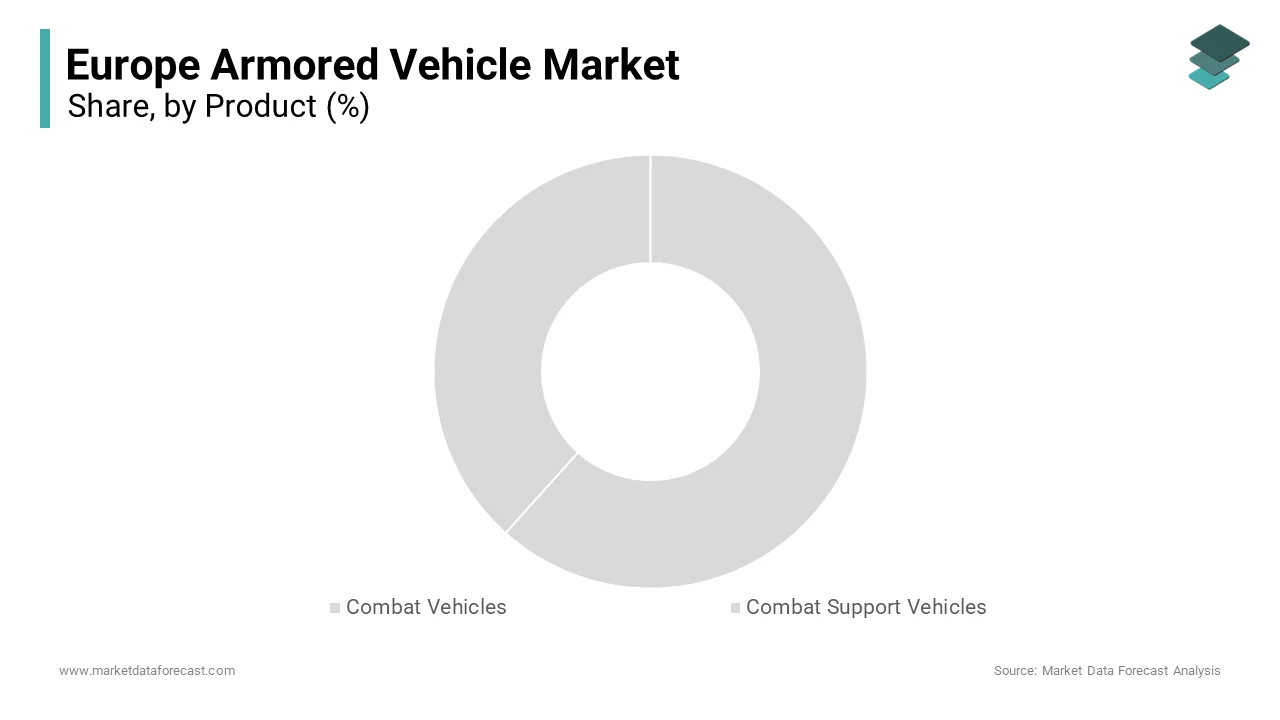
The combat support vehicles segment is predicted to witness the highest CAGR of 12.4% from 2025 to 2033 due to the expansion of logistics and medical evacuation requirements in high-intensity scenarios. The renewed focus on high-intensity conflict has exposed critical gaps in Europe’s battlefield sustainment capabilities, which drives demand for armored ambulances, recovery vehicles, and fuel resupply platforms. Moreover, the Geneva Conventions require medical vehicles to display clear markings yet remain survivable, a balance achieved through armored support platforms like the UK’s MIV Boxer ambulance variant. As European armies reconstitute divisional structures, these enablers transition from auxiliary assets to mission-critical components. Furthermore, combat support vehicles are increasingly essential for protecting specialized units such as engineers, explosive ordnance disposal teams, and CBRN reconnaissance squads operating close to the front line. Also, the adaptations reflect a doctrinal shift where support functions are no longer rear echelon activities but integral to maneuver warfare. The shift towards distributed operations within European armies is driving increased demand for survivable, multirole support platforms capable of engineering, medical, and logistics tasks under fire, and thus accelerating significant market growth.
By Mobility Insights
The wheeled segment held the majority share of 57.3% of the Europe armored vehicle market in 2025. The prominence of the wheeled segment is attributed to strategic deployability and lower lifecycle costs. Wheeled armored vehicles are preferred across Western and Southern Europe for their strategic mobility, operational flexibility, and reduced maintenance burden. Unlike tracked platforms, which require transporters for long-distance road movement, wheeled vehicles can self-deploy at highway speeds, reducing reliance on heavy equipment transporters, an important advantage given Europe’s limited military airlift capacity. Moreover, wheeled platforms cause less road damage,e, enabling unrestricted movement in civilian areas during hybrid or domestic security operations. In an era of constrained defense budgets and emphasis on rapid response, wheeled mobility offers the optimal balance of protection, speed, and economy for most European operational scenarios. The prevalence of urban counterterror, ISM, border patrol, and peacekeeping missions across Europe aligns closely with the maneuverability and quiet operation of wheeled vehicles. In dense city environments, tracked vehicles face challenges with turning radius noise and pavement damage, whereas 8x8 platforms offer agility and discreet operation. These operational realities, distinct from open terrain tank warfare, make wheeled vehicles the default choice for the majority of contemporary European security tasks, reinforcing their market dominance.
The tracked armored vehicles segment is estimated to register the fastest CAGR of 11.8% from 2025 to 2033. Eastern flank defense requires cross-country mobility in harsh terrain, which boosts the expansion of the tracked armored vehicles segment. The strategic imperative to defend NATO’s eastern borders, characterized by dense forests, marshland, and winter conditions, has reignited demand for tracked vehicles with superior off-road mobility and trench crossing capability. These platforms maintain mobility where wheeled systems bog down, ensuring continuous fire support and troop transport in high-threat environments. The renewed focus on territorial defense over a far-reaching expeditionary capability has led to a resurgence in the strategic value of tracked mobility. Modern armored doctrine requires infantry to keep pace with main battle tanks during offensive operations, a role only tracked infantry fighting vehicles can fulfill due to matching speed cross cross-country agility, and survivability. Wheeled IFVs typically achieve fewer kilometers per hour off-road compared to their tracked counterparts. Apart from these, tracked vehicles offer better hull-down positioning and lower ground pressure, reducing vulnerability to anti-tank mines. This symbiotic relationship between tanks and IFVs ensures sustained investment in tracked platforms despite higher costs, solidifying their accelerated growth trajectory.
COUNTRY ANALYSIS
Poland Armored Vehicle Market Analysis
Poland was the top performer in the Europe armored vehicle market and accounted for a 21.5% share in 2025. The domination of Poland is mainly driven by the most ambitious land force modernization program on the continent. Following Russia’s invasion of Ukraine, Poland launched its initiative, which includes contracts for armored vehicles. This covers main battle tanks, tracked IFVs, and wheeled APCs. The nation is transitioning from a Soviet era inventory to a fully NATO interoperable mechanized force with divisional structures capable of independent operations. Strategic partnerships with South Korea, the United States, and domestic firms have accelerated deliveries, with local assembly lines achieving full production capacity. Poland also hosts NATO’s Enhanced Forward Presence Battle Group and is establishing permanent US armored brigades on its soil, necessitating robust host-nation supporting infrastructurePoland’s procurement momentum is unmatched in Europe due to notable defense spending.
Germany Armored Vehicle Market Analysis
Germany was the second-largest region in the Europe armored vehicle market and captured an 18.8% share in 2025. Its central role in NATO’s defense architecture and renewed commitment to land power fuel the growth of the German market. Germany's policy represents a major change from a long-standing approach of military restraint to a focus on significant defense investment and modernization. A defense fund has been created to finance the procurement of new military equipment and address years of underinvestment in the armed forces. Also, a substantial portion of this special fund is being used to enhance the country's armored mobility capabilities. Germany also leads the multinational Main Ground Combat System initiative, with France developing next-generation tracked platforms for the 2035 horizon. Industrial policy further supports this. As the logistical and doctrinal backbone of NATO’s central front, Germany’s armored vehicle investments remain foundational to European security.
France Armored Vehicle Market Analysis
France is another major player in the Europe armored vehicle market because of its integrated SCORPION modernization program and global power projection ambitions. The SCORPION ecosystem includes Griffon wheeled multirole vehicles, Jaguar reconnaissance platforms, and Serval light armored vehicles, all linked via the SICS battlefield management system. France also exports its platforms extensively. Beyond procurement, France maintains a permanent armored presence in the Sahel and Eastern Europe under EU and NATO mandates requiring high-readiness platforms. The nation's defense industry is both revitalizing its domestic sector and exerting strategic influence, and thereby supporting its status as a European armored vehicle powerhouse.
Sweden Armored Vehicle Market Analysis
Sweden grew steadily in the European armored vehicle market due to its advanced indigenous development and Arctic warfare specialization. The nation’s primary platform, the CV90 infantry fighting vehicle, le has evolved through multiple generations with several units in service and ongoing upgrades featuring enhanced armor and digital architecture. The country also manufactures the BvS10 all-terrain armored vehicle used by the UK, Netherlands, and France for amphibious and mountain operations. BAE Systems Hägglunds has responded by doubling production capacity in Örnsköldsvik. Sweden's market reach in the armored vehicle industry extends well beyond its borders, a result of its homegrown design and significant export success, which emphasizes a strategic focus on maintaining defense independence and leading in specialized fields.
United Kingdom Armored Vehicle Market Analysis
The United Kingdom is likely to grow in the Europe armored vehicle market from 2025 to 2,033, owing to transformational programs and NATO interoperability focus. The centerpiece is the program under which the British Army is acquiring 8x8 vehicles for mechanized infantry battalions. The UK also operates the AJAX family of tracked reconnaissance vehicles, though program delays have prompted a 2025 review of requirements. The UK’s commitment to NATO’s Enhanced Forward Presence includes rotating armored battlegroups to Estonia equipped with these platforms. Post Brexit, the UK has deepened defense industrial ties with Germany and Italy to maintain supply chain resilience.
COMPETITIVE LANDSCAPE
Competition in the Europe armored vehicle market is highly dynamic, shaped by geopolitical urgency, technological differentiation,n and industrial policy alignment. While established players like Rheinmetall B, AE Systems Hägglunds, and KNDS dominate through mature platforms and deep integration with national armies, the landscape is increasingly influenced by cross-border joint ventures and emerging entrants from Eastern Europe. The shift from counterinsurgency to high-intensity warfare has intensified demand for survivable, digitally connected vehicles capable of operating in contested environments. This has elevated the importance of active protection systems, hybrid mobility, ty and network-centric architecture as key competitive differentiators. Simultaneously, national offset requirements and localization policies fragment procurement strategies, compelling manufacturers to establish regional production hubs. The European Defence Fund and Permanent Structured Cooperation initiatives encourage collaborative development, yet also heighten scrutiny over value for money and interoperability. As a result, competition extends beyond product specification to encompass supply chain in resiliency and support, and lifecycle cost management, making integrated service offerings as critical as hardware performance.
KEY MARKET PLAYERS
A few of the market players in the Europe armored vehicle market include
- AE Systems
- BMW AG
- KNDS Group
- BAE Systems Hägglunds
- Daimler AG (Mercedes-Benz)
- Elbit Systems
- Ford Motor Company
- General Dynamics Corporation
- INKAS Armored Vehicle OEM
- International Armored Group
- IVECO
- Krauss-Maffei Wegmann GmbH & Co. (KMW)
- Lenco Industries, Inc.
- Lockheed Martin Corporation
- Navistar, Inc.
- Oshkosh Defense, LLC
- Rheinmetall AG
- STAT, Inc.
- Textron, Inc.
- Thales Group.
Top Players In The Market
- Rheinmetall AG is a German defense technology leader with extensive involvement in the Europe armored vehicle market through platforms such as the Boxer wheeled armored vehicle and Lynx infantry fighting vehicle. The company plays a pivotal role in multinational programs, including the Main Ground Combat System, and supplies key subsystems like active protection systems and remote weapon stations globally. The company also deepened its strategic partnership with Poland to localize KF51 Panther main battle tank production. These actions reinforce its position as a cornerstone of Europe’s land mobility industrial base while advancing its global footprint through technology exports and co-production agreements.
- BAE Systems Hägglunds is a Swedish subsidiary of BAE Systems and a premier developer of tracked armored vehicles, most notably the CV90 infantry fighting vehicle platform. The company has delivered over 1400 CV90 variants to eight European nations and continues to modernize fleets with digital architecture, enhanced survivability, and hybrid propulsion. The firm also established a new sustainability center in Örnsköldsvik to develop low-emission drivetrains in alignment with EU defense green initiatives. By combining indigenous innovation with multinational collaboration, Hägglunds ensures its platforms remain central to European high-readiness forces while serving as a benchmark for global tracked vehicle design.
- KNDS Group is a Franco-German joint venture formed by Krauss Maffei Wegmann and Nexter Systems and serves as a strategic architect of Europe’s next-generation armored capabilities. It is the lead integrator for the Main Ground Combat System and produces the Leopard 2 and Leclerc main battle tanks, along with the VBCI wheeled infantry carrier. The company also finalized a cross-border production framework enabling dual sourcing of components between Germany and France to enhance supply chain resilience. Through deep integration, Ranco-German engineering a, nd advocacy for European strategic autonomy, KNDS not only shapes continental armored doctrine but also positions European technology as a competitive alternative in the global defense export market.
Top Strategies Used By The Key Market Participants
Key players in the Europe armored vehicle market prioritize multinational co-development programs to share R and D costs and ensure interoperability across NATO forces. They invest heavily in expanding domestic and regional production capacity to meet urgent delivery timelines and comply with localization mandates. Companies integrate digital backbone architectures and AI-enabled subsystems to future-proof platforms against evolving battlefield threats. Strategic partnerships with national governments facilitate technology transfer and offset compliance while enhancing political support. Additionally, they align vehicle design with EU sustainability directives by exploring hybrid and alternative fuel propulsion systems to meet emerging environmental regulations without compromising combat performance.
MARKET SEGMENTATION
This research report on the Europe armored vehicle market is segmented and sub-segmented into the following categories.
By Product
- Combat Vehicles
- Armored Personnel Carrier (APC)
- Infantry Fighting Vehicles (IFV)
- Light Protected Vehicles (LPV)
- Main Battle Tanks (MBT)
- Mine-resistant Ambush Protected (MRAP)
- Tactical Vehicle
- Others
- Combat Support Vehicles
- Armored Supply Trucks
- Armored Command & Control Vehicles
- Repair & Recovery Vehicles
- Unmanned Armored Ground Vehicles
By Type
- Electric Armored Vehicles
- Conventional Armored Vehicles
By Mobility
- Wheeled
- Tracked
By Mode of Operation
- Manned Armored Vehicles
- Unmanned Armored Vehicles
By Point of Sale
- OEM
- Retrofit
By System
- Engines
- Drive Systems
- Communication Systems
- Fire Control Systems (FCS)
- Navigation Systems
- Others
By Country
- UK
- France
- Spain
- Germany
- Italy
- Russia
- Sweden
- Denmark
- Switzerland
- Netherlands
- Turkey
- Czech Republic
- Rest of Europe