- Product Description Description
- Table of Contents TOC
- List of Table & Figure LOT
- Get Free Sample PDF Sample PDF
Market Size, 2025
$7.76 BnMarket Estimate, 2026
$91.17 BnMarket Forecast, 2034
$34.75 BnCAGR, 2026–2034
18.12%Europe Artificial Intelligence in Aviation Market Report Summary
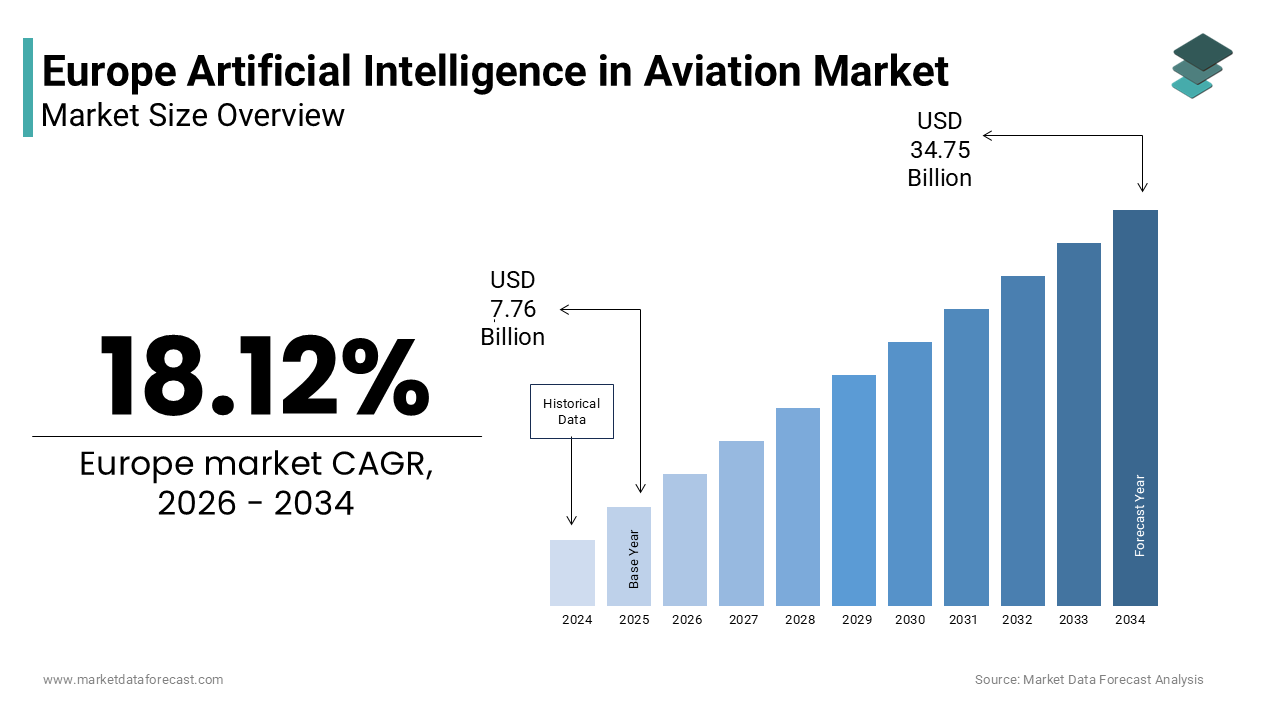
The Europe artificial intelligence in aviation market was valued at USD 7.76 billion in 2025, is estimated to reach USD 9.17 billion in 2026, and is projected to reach USD 34.75 billion by 2034, growing at a CAGR of 18.12% during the forecast period from 2026 to 2034. The growth of the market is driven by the increasing adoption of machine learning, automation, and data analytics to enhance operational efficiency, safety, and passenger experience. The rising pressure to meet European Green Deal carbon reduction targets, along with growing air traffic volumes, is further accelerating the adoption of AI technologies across airlines, airports, and air traffic management systems. Moreover, advancements in predictive maintenance, autonomous operations, and digital aviation ecosystems are strengthening market expansion across Europe.
Key Market Trends
- Increasing adoption of AI-driven predictive maintenance to reduce downtime and operational costs
- Growing use of AI for flight optimization and fuel efficiency to meet sustainability targets
- Rising implementation of biometric systems and AI-based passenger personalization
- Expansion of AI-powered air traffic management systems to handle increasing air traffic
- Integration of cloud-based AI platforms and real-time analytics across aviation operations
Segmental Insights
- By Application: The maintenance segment was the largest and held a significant share in 2025, driven by the adoption of predictive analytics to reduce aircraft downtime and improve operational reliability.
- The air traffic management segment is expected to witness the fastest growth, supported by the Single European Sky initiative and increasing demand for automated and optimized airspace operations.
- By Offering: The software segment dominated the market due to its critical role in data processing, analytics, and AI-driven decision-making systems
- The services segment is projected to grow rapidly due to increasing demand for AI integration, consulting, and regulatory compliance support
Regional Insights
The market is witnessing strong growth across major European countries due to digital transformation, sustainability goals, and increasing aviation demand.
- Germany accounted for 24.2% market share in 2025, driven by its strong aerospace industry, AI innovation ecosystem, and presence of major players like Airbus and Lufthansa
- The United Kingdom holds a significant position, supported by advanced AI research capabilities, a strong aerospace sector, and government-backed AI strategies.
- France is a key market due to Airbus headquarters, government investments in sustainable aviation, and digital transformation initiatives
- Spain and Italy are emerging markets, driven by tourism growth, airport modernization, and increasing adoption of AI-based aviation solutions.
Competitive Landscape
The Europe artificial intelligence in aviation market is highly competitive, with a mix of aerospace giants, global technology firms, and specialized AI companies. Market players are focusing on innovation, sustainability, and regulatory compliance to strengthen their market position. Prominent players in the Europe artificial intelligence in aviation market include Airbus SE, Thales Group, Leonardo S.p.A., Honeywell International Inc., IBM Corporation, Microsoft Corporation, Google LLC, Amazon Web Services, Inc., Intel Corporation, NVIDIA Corporation, and General Electric Company
Europe Artificial Intelligence in Aviation Market Size
The Europe artificial intelligence in aviation market size was valued at USD 7.76 billion in 2025 and is anticipated to reach USD 9.17 billion in 2026 from USD 34.75 billion by 2034, growing at a CAGR of 18.12% during the forecast period from 2026 to 2034.
Artificial Intelligence (AI) in aviation refers to using machine learning, data analytics, and automation to enhance safety, efficiency, and passenger experience across airlines, airports, and air traffic management. This technological convergence aims to enhance safety optimize fuel efficiency and streamline passenger experiences while addressing the stringent regulatory environment characteristic of European airspace. The sector is defined by its critical role in supporting the European Green Deal objectives which mandate a significant reduction in carbon emissions from transport. According to the European Aviation Environmental Report (EASA/Eurostat), aviation accounted for 12 percent of total greenhouse gas emissions from transport in the EU27+EFTA region in 2022, necessitating innovative solutions for sustainability. Furthermore, the European Union Aviation Safety Agency emphasizes that digital transformation is essential for maintaining the highest safety standards as air traffic volumes recover post pandemic. Estimates cited by IATA and partners indicate that airlines globally are increasingly adopting AI-driven predictive maintenance to reduce unscheduled downtime, which costs the global aviation sector approximately $33 billion annually. The market also involves the deployment of autonomous systems for ground handling and cargo processing enhancing operational throughput at major hubs such as Frankfurt Paris and London. As per Eurostat, 55 percent of large enterprises in the EU used AI technologies in 2025, reflecting a broader industrial shift toward advanced digital solutions. This landscape positions artificial intelligence not merely as an operational tool but as a foundational element for achieving regulatory compliance environmental sustainability and competitive advantage in the modern European aviation ecosystem.
MARKET DRIVERS
Stringent Environmental Regulations and Carbon Reduction Mandates Accelerate AI Adoption
The imperative to comply with rigorous environmental regulations is a key factor accelerating the growth of the Europe artificial intelligence in aviation market. The European Union remains committed to a 55% net reduction in emissions by 2030, though current national strategies are projected to reach only a 51-52% reduction without further policy intervention. Aviation being a hard to abate sector faces intense pressure to minimize its carbon footprint through operational efficiencies rather than solely relying on sustainable aviation fuels which remain scarce. Artificial intelligence algorithms optimize flight paths in real time accounting for weather conditions air traffic and aircraft performance to reduce fuel consumption. According to the European Environment Agency the aviation sector must significantly improve its energy efficiency to meet climate neutrality goals by 2050. AI driven systems can predict optimal ascent and descent profiles reducing fuel burn per flight which translates to substantial carbon savings across thousands of daily operations. Furthermore the International Civil Aviation Organization supports these regional efforts through global market based measures that incentivize efficiency. Airlines utilizing AI for weight and balance optimization also contribute to lower emissions by ensuring precise fuel loading. As per the European Aviation Environmental Report continuous improvements in operational efficiency are critical since technological advancements in aircraft design alone cannot meet the 2050 targets. Consequently regulatory pressure transforms AI from a competitive luxury into a compliance necessity driving widespread investment in intelligent flight operations software.
Increasing Air Traffic Volume and Need for Operational Efficiency Drive Demand
The steady recovery and projected growth of air passenger traffic in the region creates an urgent demand for AI solutions to manage operational complexity and capacity constraints, which is greatly boosting the expansion of the Europe artificial intelligence in aviation market. As travel restrictions ease passenger numbers are approaching pre pandemic levels placing immense strain on airport infrastructure and air traffic control systems. Artificial intelligence enables predictive analytics for airport resource allocation such as gate assignment baggage handling and staff scheduling ensuring smoother turnaround times. Machine learning models analyze historical data to forecast peak periods allowing airports to proactively adjust resources and minimize bottlenecks. The International Air Transport Association notes that operational inefficiencies cost the industry billions annually making AI driven optimization financially critical. Additionally AI enhances air traffic management by predicting conflict situations and suggesting optimal routing solutions thereby increasing airspace capacity without compromising safety. As per the Single European Sky ATM Research program digitalization and automation are key enablers for handling future traffic growth sustainably. The ability of AI to process vast amounts of data from multiple sources in real time allows stakeholders to make informed decisions rapidly. This operational necessity ensures that airlines and airport authorities continue to invest heavily in AI technologies to maintain service quality and profitability amidst rising demand.
MARKET RESTRAINTS
High Implementation Costs and Integration Complexity with Legacy Systems
The substantial financial burden associated with implementing AI solutions and the technical issues of integrating them with legacy aviation infrastructure are a major obstacle to the Europe artificial intelligence in aviation market. Many European airlines and airports operate on outdated IT systems that were not designed for seamless connectivity with modern AI platforms. Upgrading these legacy systems requires significant capital investment in hardware software and specialized personnel which can be prohibitive particularly for smaller regional carriers. According to the European Investment Bank the aviation sector requires hundreds of billions of euros in investment over the next decade to meet sustainability and digitalization goals yet funding remains constrained. The complexity of integrating AI with existing flight operation systems maintenance records and customer databases often leads to prolonged implementation timelines and operational disruptions. Furthermore the need for continuous data cleaning and standardization before AI models can be effectively trained adds to the overall cost. As per a study by the International Air Transport Association digital transformation initiatives often face budget overruns due to unforeseen technical hurdles. The return on investment for AI projects may also take several years to materialize creating hesitation among stakeholders focused on short term financial performance. Additionally the scarcity of skilled professionals who possess both aviation domain expertise and advanced data science capabilities further drives up labor costs. These financial and technical barriers slow the pace of adoption particularly among small and medium sized enterprises within the European aviation ecosystem.
Strict Regulatory Frameworks and Certification Hurdles for AI Technologies
The highly regulated nature of the aviation industry coupled with the lack of standardized certification frameworks for AI technologies further hinders the growth of the Europe artificial intelligence in aviation market. Safety is paramount in aviation and regulatory bodies such as the European Union Aviation Safety Agency require rigorous validation and verification processes for any new technology deployed in critical operations. However current certification standards were developed for deterministic systems and are ill suited for probabilistic AI algorithms whose decision making processes can be opaque. EASA's new regulatory framework, NPA 2025-07, explicitly addresses the "stochastic and non-deterministic nature" of machine learning. This framework is currently open for transition and will be fully deployed into specific aviation domains through a second amendment in 2026. The black box nature of many AI models makes it difficult for regulators to assess reliability and predictability under all possible scenarios. This uncertainty creates a cautious environment where manufacturers and operators hesitate to adopt AI for safety critical functions such as autonomous flight control or collision avoidance. Furthermore the General Data Protection Regulation imposes strict requirements on data handling which complicates the use of passenger data for AI driven personalization and security screening. As per the European Commission harmonizing AI regulations across member states is a priority but progress is gradual. The lack of clear guidelines increases compliance risks and legal liabilities for companies. Until robust and widely accepted certification frameworks are established the deployment of AI in critical aviation domains will remain limited and fragmented across the region.
MARKET OPPORTUNITIES
Expansion of Predictive Maintenance Solutions to Reduce Downtime and Costs
The adoption of AI-powered predictive maintenance offers a significant opportunity for the European aviation market. It enables the proactive identification of potential aircraft failures before they occur. Traditional maintenance schedules are often based on fixed intervals which can lead to unnecessary replacements or unexpected breakdowns. AI algorithms analyze real time data from sensors embedded in aircraft components such as engines landing gear and avionics to detect anomalies and predict remaining useful life. Implementation of AI-driven predictive maintenance allows airlines to reduce direct maintenance costs by 12–18%. By identifying component failures before they occur, these systems reduce Aircraft On Ground (AOG) incidents by roughly 20%, preventing cascading delays in tight flight schedules. This efficiency gain is crucial for airlines operating on thin margins and facing intense competition. European carriers are increasingly partnering with technology providers to develop customized AI models that integrate with their existing maintenance management systems. The European Aviation Safety Agency supports these initiatives as they enhance safety by preventing in flight failures. Furthermore the rise of Internet of Things devices in modern aircraft generates vast amounts of data that can be leveraged for deeper insights. As per Boeing the global demand for maintenance services is projected to grow significantly creating a lucrative market for AI driven solutions. By shifting from reactive to predictive strategies airlines can optimize inventory management reduce spare parts waste and improve fleet availability. This strategic shift offers a compelling value proposition that drives investment in AI technologies across the European aviation sector.
Enhancement of Passenger Experience Through Personalized Services and Biometrics
The opportunity to enhance passenger experience through AI driven personalization and biometric authentication is a major growth avenue for the European artificial intelligence in aviation market. Travelers increasingly expect seamless and personalized journeys from booking to arrival. AI algorithms analyze passenger preferences behavior and historical data to offer tailored recommendations for seats meals and ancillary services thereby increasing revenue per passenger. According to IATA, airlines transitioning to AI-based "Dynamic Offer Creation" can expect a 10–15% boost in conversion rates. This shift is part of the broader industry move to eliminate the 1970s-era "EDIFACT" standard in favor of modern retail APIs. Furthermore, the implementation of biometric systems using facial recognition technology streamlines check in security and boarding processes reducing wait times and improving satisfaction. Several major European airports including Amsterdam Schiphol and Paris Charles de Gaulle are piloting biometric corridors that allow passengers to move through terminals without showing documents repeatedly. As per the European Travel Commission digital facilitation of travel is a key priority for restoring consumer confidence and boosting tourism. AI also powers virtual assistants and chatbots that provide real time assistance for flight updates and baggage inquiries enhancing customer support efficiency. The integration of these technologies creates a frictionless travel experience that differentiates carriers in a competitive market. Compliant data handling practices are addressing privacy concerns, which is expected to accelerate the adoption of AI-driven passenger services. Thus, this trend will offer substantial opportunities for technology providers and airlines alike.
MARKET CHALLENGES
Data Privacy Concerns and Cybersecurity Vulnerabilities in Connected Systems
The increasing reliance on AI and connected systems in aviation raises significant concerns regarding data privacy and cybersecurity which pose major challenges to the Europe artificial intelligence in aviation market growth. AI systems require access to vast amounts of sensitive data including passenger information flight details and operational parameters making them attractive targets for cyberattacks. According to the European Union Agency for Cybersecurity the aviation sector has seen a rise in sophisticated cyber threats including ransomware and data breaches in recent years. A successful attack on AI driven systems could compromise safety disrupt operations and erode public trust. The General Data Protection Regulation imposes strict obligations on how personal data is collected processed and stored requiring robust security measures that can be complex and costly to implement. Furthermore the interconnected nature of modern aviation ecosystems means that a vulnerability in one part of the network can have cascading effects. As per the European Union Aviation Safety Agency ensuring the resilience of digital systems against cyber threats is a top priority but achieving this requires continuous monitoring and updates. The challenge is compounded by the use of third party vendors and cloud services which introduce additional risk vectors. Airlines and airports must invest heavily in cybersecurity infrastructure and staff training to protect their AI assets. Balancing the need for data accessibility for AI optimization with stringent privacy and security requirements remains a delicate and ongoing challenge for the industry.
Shortage of Skilled Workforce with Expertise in AI and Aviation Domain
A critical shortage of professionals possessing both advanced AI skills and deep domain knowledge in aviation acts as a serious impediment to the European artificial intelligence in aviation market. Developing deploying and maintaining AI solutions in aviation requires a unique combination of data science engineering and regulatory understanding which is rare in the current labor market. Eurostat highlight a widespread inability among European enterprises to recruit qualified information technology specialists, creating a competitive environment where critical infrastructure sectors must vie for a limited pool of advanced technical talent. The complexity of aviation systems means that generalist data scientists often struggle to understand the specific operational constraints and safety requirements necessary for effective AI implementation. As per the International Air Transport Association the industry faces a workforce crisis exacerbated by the pandemic which led to significant job losses and early retirements. Retraining existing employees takes time and resources while attracting new talent is difficult due to high competition and salary expectations. Furthermore the rapid evolution of AI technologies means that continuous upskilling is required to keep pace with advancements. This skills gap delays project timelines increases development costs and limits the scope of AI applications that can be safely deployed. Addressing this challenge requires collaborative efforts between industry academia and government to create specialized training programs and attract diverse talent to the aviation sector.
REPORT COVERAGE
| REPORT METRIC | DETAILS |
| Market Size Available | 2025 to 2034 |
| Base Year | 2025 |
| Forecast Period | 2026 to 2034 |
| CAGR | 18.12% |
| Segments Covered | By Application, Offering, Technology and Region |
| Various Analyses Covered | Global, Regional, & Country Level Analysis; Segment-Level Analysis, Drivers, Restraints, Opportunities, Challenges, PESTLE Analysis, Porter’s Five Forces Analysis, Competitive Landscape, Analyst Overview of Investment Opportunities |
| Regions Covered | UK, France, Spain, Germany, Italy, Russia, Sweden, Denmark, Switzerland, the Netherlands, Turkey, the Czech Republic, and the Rest of Europe |
| Key Market Players | Airbus SE, Thales Group, Leonardo S.p.A., Honeywell International Inc., IBM Corporation, Microsoft Corporation, Google LLC, Amazon Web Services, Inc., Intel Corporation, NVIDIA Corporation, and General Electric Company. |
SEGMENTAL ANALYSIS
By Application Insights
The maintenance segment dominated the Europe artificial intelligence in aviation market and accounted for a 34.8% share in 2025. This dominance of the segment is primarily driven by the critical need to reduce aircraft downtime and optimize maintenance schedules through predictive analytics. Airlines and maintenance repair and overhaul organizations are increasingly adopting AI driven solutions to transition from reactive or scheduled maintenance to condition based strategies. AI algorithms analyze real time data from aircraft sensors to predict component failures before they occur allowing for proactive repairs during scheduled ground times. This approach significantly enhances fleet availability and operational reliability. Furthermore the European Union Aviation Safety Agency emphasizes the importance of continuous airworthiness monitoring which is facilitated by advanced data analytics. The complexity of modern aircraft such as the Airbus A350 and Boeing 787 generates terabytes of data per flight that must be processed efficiently. These tangible financial and operational benefits drive widespread adoption among European carriers seeking to improve profitability and safety standards. The integration of digital twins also allows engineers to simulate wear and tear scenarios further refining maintenance protocols. Consequently the maintenance segment remains the primary beneficiary of AI investments in the European aviation sector. The biggest push for this segment is the substantial cost reduction achieved through predictive analytics and enhanced fleet availability. Traditional maintenance practices often result in unnecessary part replacements or unexpected failures that disrupt flight schedules. AI driven predictive maintenance models utilize machine learning to identify patterns in sensor data that indicate impending failures with high accuracy. By predicting failures weeks in advance airlines can order spare parts and schedule labor more efficiently reducing inventory holding costs and overtime expenses. The European Aviation Safety Agency supports these initiatives by promoting data driven safety management systems that enhance overall operational integrity. This reliability is crucial for maintaining customer satisfaction and avoiding compensation costs associated with delayed or cancelled flights. Furthermore the ability to extend the useful life of components through precise monitoring contributes to sustainability goals by reducing waste. The financial incentives combined with regulatory support create a compelling business case for AI adoption in maintenance. As European airlines face pressure to improve margins amidst rising fuel and labor costs the efficiency gains from AI driven maintenance become indispensable. This economic imperative ensures that the maintenance segment continues to lead the market in terms of revenue and adoption rates.
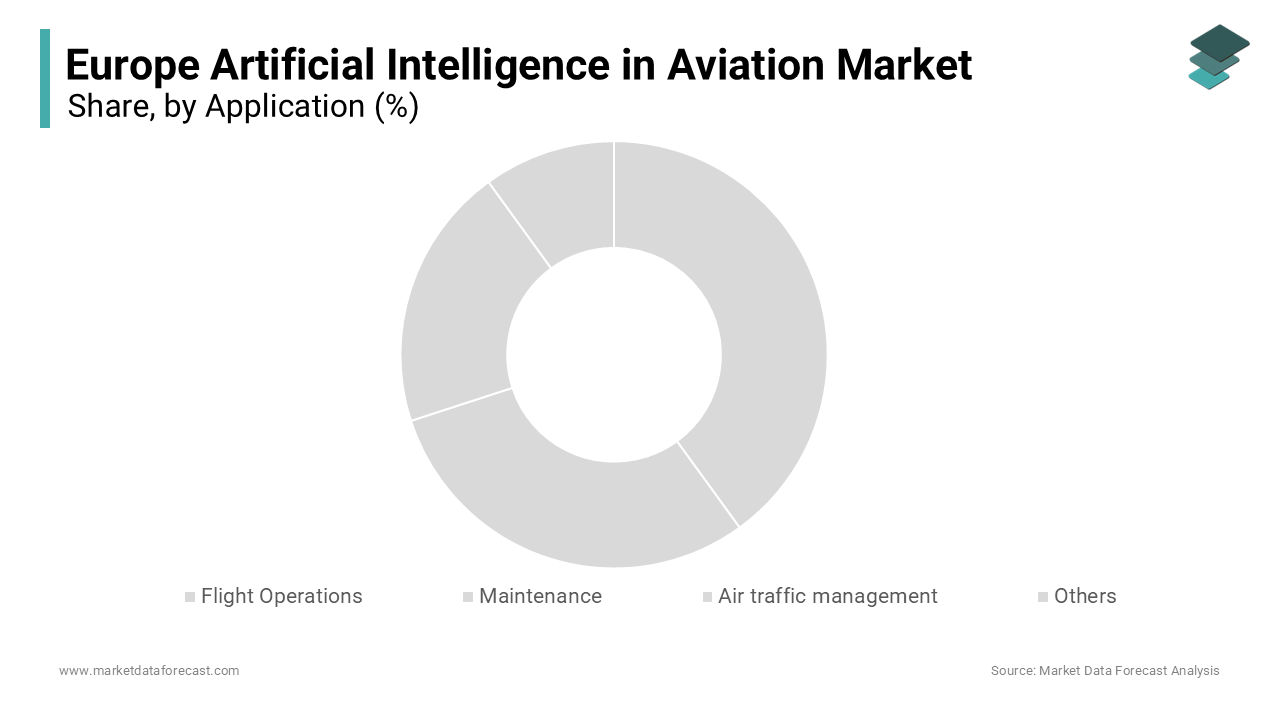
The air traffic management segment is on the rise and is expected to be the fastest growing segment in the market by witnessing a CAGR of 21.5% from 2026 to 2034. This accelerated growth of the segment is attributed to the urgent need to modernize airspace infrastructure and handle increasing traffic volumes efficiently. The Single European Sky initiative aims to reform the European air traffic management system to enhance capacity safety and environmental performance. Artificial intelligence plays a pivotal role in this transformation by enabling automated conflict detection trajectory optimization and dynamic airspace configuration. AI algorithms process real time data from radar satellites and weather stations to provide controllers with actionable insights that reduce congestion and delays. The International Civil Aviation Organization highlights that digitalization is essential for achieving sustainable growth in aviation. This capability is crucial for accommodating the growing demand for air travel while minimizing environmental impact. Furthermore AI enhances safety by predicting potential hazards and suggesting mitigation strategies proactively. The integration of remote tower services powered by AI also allows for more flexible and cost effective airport operations. These strategic advantages drive significant investment in AI technologies for air traffic management ensuring rapid market expansion. The primary factor for the rapid growth of the air traffic management segment is the implementation of the Single European Sky initiative and broader digitalization efforts across Europe. The fragmented nature of European airspace has long been a bottleneck for efficiency leading to excessive delays and fuel consumption. The Single European Sky ATM Research program focuses on deploying innovative technologies including artificial intelligence to create a seamless and interoperable air traffic management network. According to research, AI enabled systems can optimize flight trajectories in real time reducing average flight times by several minutes per journey. These savings translate into significant fuel reductions and lower carbon emissions aligning with European Green Deal objectives. AI facilitates this by enabling dynamic sectorization where airspace boundaries adjust automatically based on traffic demand. This flexibility improves controller workload management and enhances safety margins. Furthermore, the integration of unmanned aircraft systems into civilian airspace requires advanced AI capabilities for detect and avoid functions. The regulatory push towards automation and data sharing among stakeholders creates a fertile environment for AI adoption. Demand for AI solutions in air traffic management is surging as European nations collaborate to harmonize standards and deploy next-generation systems. This rapid adoption is driving robust market growth.
By Offering Insights
The software segment held the majority share 58.1% of the Europe artificial intelligence in aviation market in 2025. This supremacy of the segment is supported by the fundamental role of software algorithms in processing vast amounts of aviation data and delivering actionable insights. AI software platforms are essential for applications ranging from predictive maintenance and flight optimization to passenger personalization and security screening. The scalability and flexibility of software solutions allow airlines and airports to integrate AI capabilities without extensive hardware overhauls. AI software enables the extraction of value from this data by identifying patterns and anomalies that human analysts might miss. The European Union Aviation Safety Agency encourages the use of software based safety management systems to enhance regulatory compliance. Cloud based AI software solutions are particularly popular as they offer lower upfront costs and easier updates. Furthermore the development of specialized aviation AI platforms by major technology providers and startups has increased competition and innovation. These platforms offer modular features that can be customized to specific operational needs. The ability to continuously update algorithms with new data ensures that software solutions remain effective over time. Consequently the software segment dominates the market as the primary enabler of AI driven transformation in European aviation. A major factor driving the dominance of the software segment is the scalability and seamless integration capabilities of cloud based AI platforms. Traditional on premise software solutions often struggle to handle the volume and velocity of aviation data requiring significant hardware investments. Cloud based AI software offers elastic computing resources that can scale up or down based on demand making it ideal for fluctuating aviation operations. These platforms enable real time data processing from multiple sources including aircraft sensors airport systems and weather feeds. The integration of AI software with existing enterprise resource planning and flight operations systems is streamlined through application programming interfaces. This cost efficiency is attractive to airlines operating on tight margins. Furthermore cloud providers offer robust security and compliance features that meet stringent European data protection regulations. The ability to deploy updates and new features rapidly ensures that airlines can leverage the latest AI advancements without disruption. This agility is crucial in a dynamic industry where operational conditions change frequently. The combination of scalability cost effectiveness and ease of integration ensures that software remains the preferred offering for AI adoption in European aviation.
The services segment is expected to exhibit a noteworthy CAGR of 19.8% over the forecast period due to the increasing complexity of AI implementations which require specialized expertise for deployment integration and ongoing management. Aviation organizations often lack the internal technical capacity to develop and maintain sophisticated AI models leading to a surge in demand for consulting managed services and technical support. According to sources, the skills gap in digital technologies is a significant barrier for many aviation companies necessitating external assistance. Service providers offer end to end solutions including data preparation model training system integration and staff training. As per a study, collaborative partnerships with technology vendors are becoming common to accelerate digital transformation. The need for continuous monitoring and optimization of AI systems to ensure accuracy and compliance also drives recurring revenue for service providers. Furthermore the regulatory landscape in Europe is evolving requiring expert guidance to navigate certification and safety standards. Service firms assist airlines in demonstrating compliance with European Union Aviation Safety Agency requirements reducing legal risks. The customization of AI solutions to specific operational contexts requires deep domain knowledge which service providers possess. As AI becomes more integral to critical operations the reliance on professional services for risk mitigation and performance assurance grows. This trend indicates a maturing market where value creation shifts from product sales to long term operational partnerships driving sustained growth in the services segment. The core reason for the rapid growth of the services segment is the critical need for specialized expertise and regulatory compliance support in AI deployments. Implementing AI in aviation involves complex technical challenges including data integration algorithm selection and system validation. Most airlines and airports do not have sufficient in house data scientists and AI engineers to manage these tasks effectively. This skills gap forces organizations to rely on external service providers who possess the necessary technical and domain expertise. These providers offer tailored consulting services to help clients define AI strategies select appropriate technologies and implement solutions efficiently. They help organizations establish governance frameworks and ethical guidelines for AI usage ensuring alignment with regulatory expectations. The dynamic nature of AI models means that continuous monitoring and retraining are required to maintain performance. Managed service providers offer these ongoing support services ensuring that AI systems remain accurate and secure. Furthermore the need to integrate AI with legacy systems requires specialized integration services to avoid operational disruptions. The combination of technical complexity regulatory scrutiny and skills shortages creates a strong demand for professional services. European aviation entities are striving to leverage AI safely and effectively. As a result, the services segment will continue to experience robust growth.
By Technology Insights
The machine learning segment was the largest segment in the Europe artificial intelligence in aviation market and occupied a 42.4% share in 2025 because of the versatility of machine learning algorithms in solving diverse aviation challenges such as predictive maintenance demand forecasting and fuel optimization. Machine learning models can analyze historical and real time data to identify patterns and make predictions with high accuracy. According to research, machine learning applications can reduce fuel consumption through optimized flight paths and weight management. This efficiency gain is critical for airlines seeking to lower operational costs and meet environmental targets. The European Union Aviation Safety Agency recognizes the potential of machine learning to enhance safety by predicting equipment failures and identifying operational risks. Supervised and unsupervised learning techniques are used to classify data detect anomalies and optimize processes. The ability of machine learning models to improve over time with more data makes them particularly valuable for long term operational improvements. Furthermore the integration of machine learning with Internet of Things sensors enables real time monitoring of aircraft health. This technological synergy drives widespread adoption across various aviation applications. The proven return on investment and broad applicability of machine learning ensure its continued leadership in the European aviation AI market. A key factor sustaining the dominance of the machine learning segment is its versatility in enabling predictive maintenance and operational optimization. Machine learning algorithms can process vast amounts of structured and unstructured data from various sources including engine sensors flight records and weather reports. This capability allows airlines to predict component failures with high precision reducing unscheduled maintenance and improving fleet reliability. In addition to maintenance machine learning optimizes other operational aspects such as crew scheduling gate assignment and baggage handling. The ability to forecast passenger demand accurately also helps airlines adjust pricing and capacity dynamically maximizing revenue. Machine learning models analyze booking trends market conditions and external factors to provide accurate forecasts. This strategic advantage is crucial in a competitive industry with thin margins. Furthermore the European Commission supports the use of data driven technologies to enhance the efficiency and sustainability of the aviation sector. The broad range of applications and tangible benefits provided by machine learning make it the preferred technology for aviation stakeholders. Data availability is increasing while algorithms become more sophisticated. The machine learning segment's dominance is expected to continue.
The computer vision segment is predicted to witness the highest CAGR of 22.3% between 2026 and 2034 owing to the increasing adoption of visual recognition technologies for security surveillance autonomous ground operations and cabin monitoring. Computer vision systems use cameras and image processing algorithms to detect objects identify individuals and monitor activities in real time. Computer vision enables automated threat detection by identifying suspicious behaviors or prohibited items in baggage and cargo. These systems reduce wait times and improve the passenger experience by enabling touchless journeys. Furthermore computer vision is used for autonomous vehicle guidance on the tarmac enhancing safety and efficiency in ground handling operations. The technology also monitors cabin conditions ensuring passenger safety and comfort. The ability of computer vision to provide real time insights and automate manual tasks drives its rapid adoption. With advancements in camera resolution and processing power the applications of computer vision in aviation are expanding. This technological momentum ensures that the computer vision segment experiences sustained high growth rates. The top factor for this segment is the widespread adoption of biometric systems and autonomous ground handling solutions. Airports across Europe are investing in biometric technologies to create seamless and secure travel experiences. Facial recognition systems powered by computer vision allow passengers to check in drop baggage and board flights without presenting physical documents. This efficiency is crucial for handling increasing passenger volumes while maintaining high security standards. In addition to passenger processing computer vision is transforming ground operations. Autonomous vehicles equipped with visual sensors navigate the tarmac safely avoiding obstacles and coordinating with other assets. Computer vision systems monitor aircraft exterior conditions detecting damage or irregularities during inspections. This automated inspection process is faster and more accurate than manual checks. Furthermore the technology enhances security by monitoring restricted areas and detecting unauthorized access. The European Union Aviation Safety Agency supports the use of automated systems to enhance safety and efficiency. As airports strive to modernize infrastructure and improve service quality the demand for computer vision technologies will continue to rise. This strategic focus on automation and biometrics ensures robust growth for the computer vision segment.
REGIONAL ANALYSIS
Germany Artificial Intelligence in Aviation Market Analysis
Germany led the Europe artificial intelligence in aviation market and accounted for a 24.2% share in 2025. The dominance of the German market is fuelled a strong aerospace manufacturing base and a commitment to technological innovation. Home to major players like Airbus and Lufthansa Germany is at the forefront of adopting AI for aircraft production maintenance and operations. The German government’s High Tech Strategy promotes the development of artificial intelligence in key industries including aviation. According to the German Aerospace Center research and development initiatives focus on autonomous flight systems and digital twins. The presence of renowned technical universities and research institutes fosters a skilled workforce capable of developing advanced AI solutions. Furthermore the country’s robust industrial infrastructure supports the integration of AI into manufacturing processes. Eurostat indicate that German industrial enterprises are making significant strides in adopting advanced digital technologies, particularly within their engineering and manufacturing sectors. The aviation sector benefits from this ecosystem by leveraging AI for supply chain optimization and quality control. The strong regulatory framework ensures that AI applications meet high safety and privacy standards. Additionally the country’s central location in Europe makes it a hub for air traffic management innovations. The combination of industrial strength research capability and regulatory clarity ensures that Germany remains the dominant force in the European AI in aviation market.
United Kingdom Artificial Intelligence in Aviation Market Analysis
The United Kingdom followed closely behind in the Europe artificial intelligence in aviation market and captured a 18.1% share in 2025. This position of the UK market is attributed to its advanced aerospace sector and leadership in AI research. The country is home to major aerospace manufacturers and airlines that are actively integrating AI into their operations. The UK government’s National AI Strategy identifies aviation as a key sector for technological advancement. The National Cyber Security Centre (NCSC) and the Civil Aviation Authority (CAA) prioritize the resilience of aviation systems, ensuring that the integration of artificial intelligence does not compromise the security of national transport infrastructure. The presence of world class universities and tech hubs in London and Cambridge drives innovation in machine learning and computer vision. The Department for Business and Trade identifies the UK as a primary hub for specialized technology firms that focus on applying machine learning and data analytics to the aviation sector. Moreover, the country’s departure from the European Union has led to independent regulatory frameworks that encourage experimentation while maintaining safety standards. The Civil Aviation Authority supports the testing of autonomous aircraft and AI driven air traffic management systems. Furthermore the UK’s strong financial sector provides ample investment opportunities for aviation tech companies. The collaboration between industry academia and government fosters a vibrant ecosystem for AI development. As the UK seeks to maintain its global competitiveness in aerospace the adoption of AI technologies will continue to grow. This strategic focus ensures that the UK remains a key contributor to the European market.
France Artificial Intelligence in Aviation Market Analysis
France holds a promising share of the Europe artificial intelligence in aviation market due to the presence of Airbus headquarters and a strong state supported aerospace industry. The French government has launched the France 2030 investment plan which includes significant funding for green and digital aviation technologies. According to the French Civil Aviation Authority the adoption of AI for air traffic management and safety monitoring is accelerating. The country is a leader in developing sustainable aviation solutions where AI plays a crucial role in optimizing fuel efficiency and reducing emissions. As per the National Institute of Statistics and Economic Studies the French aerospace sector invests heavily in research and development. The presence of specialized engineering schools produces a steady stream of talent for the aviation industry. Furthermore France is active in European collaborative projects such as the Single European Sky initiative. The integration of AI into airport operations at major hubs like Paris Charles de Gaulle enhances passenger experience and operational efficiency. The country’s focus on sovereignty and technological independence drives the development of domestic AI capabilities. This strategic emphasis on innovation and sustainability ensures that France remains a pivotal player in the European AI in aviation market.
Spain Artificial Intelligence in Aviation Market Analysis
Spain is another key player in the Europe artificial intelligence in aviation market owing to a thriving tourism industry and a growing aerospace manufacturing sector. The country is a major hub for international travel requiring efficient airport operations and air traffic management. According to the Spanish State Aviation Safety Agency the adoption of digital technologies including AI is prioritized to handle increasing passenger volumes. Major airports such as Madrid Barajas and Barcelona El Prat are implementing AI driven solutions for baggage handling security and passenger flow management. As per the National Statistics Institute the tourism sector contributes significantly to the economy driving investment in aviation infrastructure. The presence of Airbus facilities in Spain supports the local supply chain and encourages technology transfer. Furthermore the Spanish government’s Digital Spain 2025 agenda promotes the use of AI in strategic sectors. The country’s favorable climate for testing autonomous drones and urban air mobility solutions attracts international investors. The collaboration between public and private sectors fosters innovation in aviation AI. As Spain continues to modernize its aviation infrastructure the demand for AI solutions will grow. This focus on efficiency and tourism support ensures Spain’s significant role in the European market.
Italy Artificial Intelligence in Aviation Market Analysis
Italy is predicted to expand significantly in the Europe artificial intelligence in aviation market from 2026 to 2034 due to a mix of aerospace manufacturing and a strong focus on regional connectivity. The country is home to Leonardo a major aerospace and defense company that is actively developing AI technologies for aviation. According to the Italian Civil Aviation Authority the modernization of air traffic management systems is a key priority. The adoption of AI for predictive maintenance and flight operations is gaining traction among Italian airlines. As per the National Institute of Statistics the digital transformation of Italian enterprises is accelerating supported by government incentives. The country’s strategic location in the Mediterranean makes it a crucial node for international air traffic. The integration of AI into airport security and passenger services enhances the travel experience. Furthermore Italy participates in European research programs focused on sustainable and digital aviation. The presence of skilled engineers and researchers supports the development of innovative AI solutions. The government’s National Recovery and Resilience Plan includes funding for digital infrastructure benefiting the aviation sector. As Italy seeks to enhance its competitiveness in the global aerospace industry the adoption of AI will continue to expand. This strategic focus ensures Italy’s continued relevance in the European AI in aviation market.
COMPETITIVE LANDSCAPE
The competition in the Europe artificial intelligence in aviation market is characterized by intense rivalry among established aerospace giants specialized technology firms and emerging startups. Major multinational corporations leverage their extensive domain expertise and broad product portfolios to offer integrated end to end solutions. These incumbents benefit from long standing relationships with airlines and regulatory bodies which facilitate smoother adoption of their technologies. However specialized AI startups challenge this dominance by introducing agile innovative solutions for niche problems such as predictive maintenance or passenger biometrics. The market sees frequent mergers and acquisitions as larger entities seek to absorb novel technologies and talent. Competitive differentiation increasingly relies on the ability to demonstrate tangible return on investment through improved safety efficiency and sustainability. Companies also compete on the basis of cybersecurity robustness and data privacy compliance which are critical concerns for European customers. The presence of strong government incentives for digitalization further intensifies competition as more players enter the market. This dynamic environment fosters continuous innovation but also creates pressure on pricing and profit margins. Strategic alliances become essential for sustaining competitive advantage in this rapidly evolving landscape where technological superiority and regulatory alignment are paramount for success.
KEY MARKET PLAYERS
Some of the companies that are playing a dominating role in the Europe Automotive E-Commerce Market include
- Airbus SE
- Thales Group
- Leonardo S.p.A.
- Honeywell International Inc.
- IBM Corporation
- Microsoft Corporation
- Google LLC
- Amazon Web Services, Inc.
- Intel Corporation
- NVIDIA Corporation
- General Electric Company
Top Players in the Europe Artificial Intelligence in Aviation Market
International Business Machines Corporation
International Business Machines Corporation significantly influences the Europe artificial intelligence in aviation market through its robust Watson AI platform and hybrid cloud infrastructure. The company collaborates with major European airlines and airports to optimize operations enhance passenger experiences and improve safety protocols. IBM recently strengthened its position by integrating advanced machine learning models into predictive maintenance systems allowing carriers to reduce downtime and lower costs. Their global contribution includes developing scalable AI solutions that handle vast amounts of flight data securely. By focusing on ethical AI and regulatory compliance IBM helps European entities navigate complex legal frameworks. The company’s recent partnerships with aerospace manufacturers facilitate the digital transformation of supply chains. These strategic initiatives enable IBM to maintain a competitive edge while supporting the industry’s sustainability goals. Their commitment to innovation ensures that aviation stakeholders can leverage cutting edge technology to achieve operational excellence and resilience in a dynamic market environment.
Airbus SE
Airbus SE stands as a pivotal force in the Europe artificial intelligence in aviation market by embedding AI technologies directly into aircraft design manufacturing and operational services. The company utilizes machine learning algorithms to enhance fuel efficiency optimize flight paths and automate production processes. Airbus has recently expanded its Skywise platform which aggregates data from thousands of aircraft to provide predictive insights for airlines globally. This initiative strengthens their market position by offering value added services beyond hardware sales. Their contribution to the global market includes setting standards for data sharing and interoperability in aviation. Airbus actively collaborates with European regulators to ensure AI applications meet stringent safety requirements. Recent investments in autonomous flight technologies and urban air mobility demonstrate their forward looking strategy. By prioritizing sustainability and digitalization Airbus reinforces its leadership role. These efforts enable the company to drive industry wide adoption of AI solutions while maintaining high safety and performance benchmarks for customers worldwide.
Thales Group
Thales Group plays a crucial role in the Europe artificial intelligence in aviation market by providing advanced avionics air traffic management and cybersecurity solutions. The company integrates AI into its flight control systems to enhance situational awareness and decision making for pilots. Thales has recently focused on developing AI driven tools for air traffic controllers to manage increasing airspace complexity efficiently. Their global contribution includes supplying secure and reliable communication networks for civil and military aviation. By leveraging deep learning techniques Thales improves the accuracy of weather forecasting and threat detection systems. Recent collaborations with European space agencies highlight their commitment to innovation in satellite based navigation. The company’s emphasis on sovereign technology aligns with European strategic interests. Thales continues to invest in research and development to stay ahead of emerging threats and technological trends. These actions solidify their reputation as a trusted partner for safe and efficient air travel solutions across the globe.
Top Strategies Used by the Key Market Participants
Key players in the Europe artificial intelligence in aviation market primarily employ strategic partnerships and collaborations to accelerate innovation and expand their technological capabilities. Companies frequently join forces with airlines airports and research institutions to co develop AI solutions tailored to specific operational needs. Another prevalent strategy is significant investment in research and development to enhance algorithm accuracy and processing speed. Market participants also focus on acquiring specialized tech startups to integrate niche AI functionalities into their existing portfolios rapidly. Additionally key players emphasize compliance with European regulatory standards to build trust and ensure seamless market entry. They prioritize cybersecurity measures to protect sensitive aviation data from emerging threats. Marketing efforts often highlight sustainability benefits such as fuel efficiency and emission reductions achieved through AI optimization. These multifaceted strategies enable companies to maintain competitive advantages and drive widespread adoption of artificial intelligence technologies across the diverse and highly regulated European aviation sector.
MARKET SEGMENTATION
This research report on the Europe Artificial Intelligence in Aviation Market has been segmented and sub-segmented based on the following categories.
By Application
- Flight Operations
- Maintenance
- Air traffic management
- Others
By Offering
- Software
- Hardware
- Service
By Technology
- Machine Learning
- Computer vision
- Data Analytics
- Others
By End User
- Airlines
- Airports
- OEMs
- MRO
By Country
- UK
- France
- Spain
- Germany
- Italy
- Russia
- Sweden
- Denmark
- Switzerland
- Netherlands
- Turkey
- Czech Republic
- Rest of Europe