- Product Description Description
- Table of Contents TOC
- List of Table & Figure LOT
- Get Free Sample PDF Sample PDF
Market Size, 2025
$2.31 BnMarket Estimate, 2026
$2.42 BnMarket Forecast, 2034
$3.42 BnCAGR, 2026–2034
4.74%Europe Asset-Backed Securities Market Report
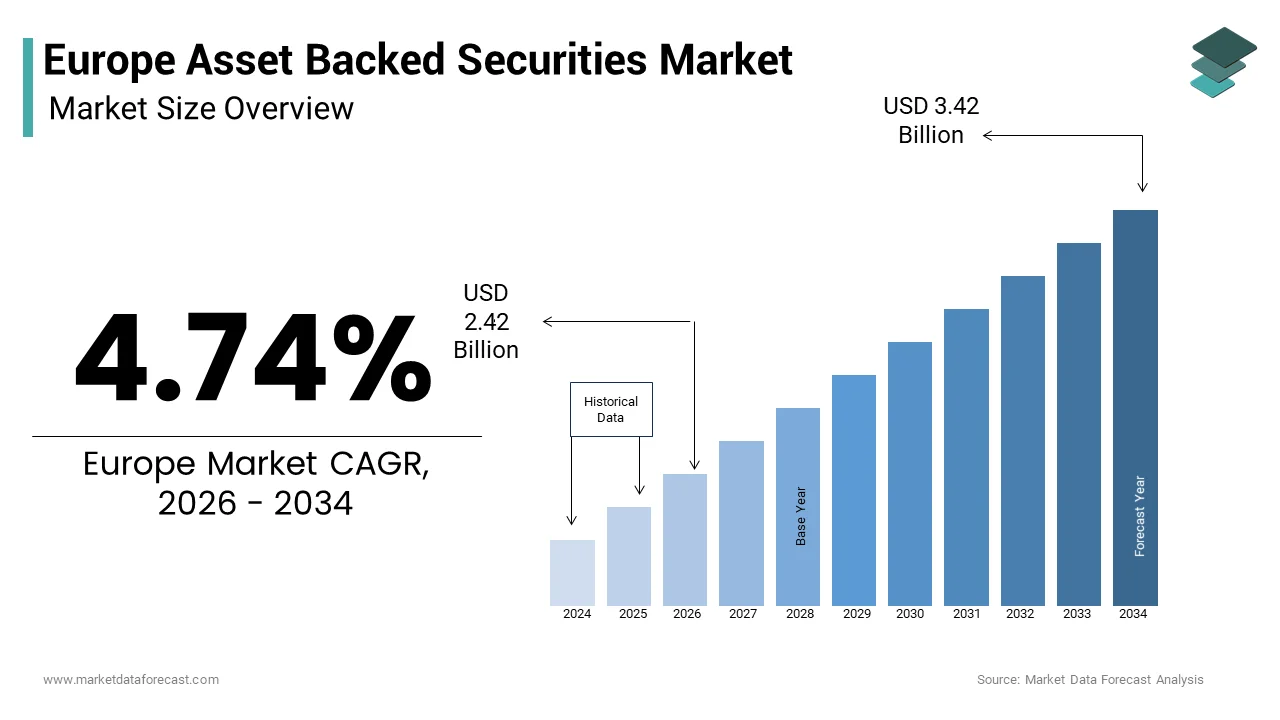
The Europe asset-backed securities (ABS) market was valued at USD 2.31 billion in 2025, is estimated to reach USD 2.42 billion in 2026, and is projected to reach USD 3.42 billion by 2034, growing at a CAGR of 4.74% during the forecast period from 2025 to 2034. The growth of the European ABS market is driven by increasing demand for structured finance instruments, growing securitization of loan portfolios, and the need for liquidity and risk diversification among financial institutions. Regulatory support, improved transparency, and the revival of securitization markets post-financial reforms are further contributing to market expansion across Europe.
Key Market Trends
- Rising adoption of securitization as a funding tool among banks and financial institutions.
- Increasing demand for residential mortgage-backed securities (RMBS) due to stable asset performance.
- Growing preference for pass-through securities offering predictable cash flows to investors.
- Expansion of long-term maturity instruments aligning with institutional investor preferences.
- Strengthening regulatory frameworks enhancing transparency and investor confidence in ABS markets.
Segmental Insights
- Based on asset class, the residential mortgages segment dominated the Europe asset-backed securities market, accounting for 46.4% of the market share in 2025, driven by strong housing finance demand and stable repayment structures.
- Based on security structure, the pass-through securities segment held the largest share at 52.7% in 2025, supported by their simplicity, transparency, and consistent income streams.
- Based on maturity, the long-term maturity segment led the market with a 56.5% share in 2025, as investors favor longer-duration instruments for stable returns and portfolio diversification.
Regional Insights
The Europe asset-backed securities market demonstrates steady growth across major financial hubs.
- The Netherlands stands as a leading center for ABS issuance, supported by a well-developed securitization framework.
- The United Kingdom maintains a pivotal position due to its advanced financial markets and strong institutional investor base.
- The Germany plays a key role with its robust banking sector.
- The France benefits from a large domestic consumer base driving securitization activities.
- The Italy is emerging as a dynamic market, supported by increasing adoption of structured finance instruments and regulatory improvements.
Competitive Landscape
The Europe asset-backed securities market is characterized by the presence of major global financial institutions focusing on structured finance innovation, risk management, and portfolio diversification strategies. Key players are actively engaged in securitization, underwriting, and investment services to strengthen their market position.
Leading companies in the Europe asset-backed securities market include BlackRock, Goldman Sachs, JPMorgan Chase, Morgan Stanley, Wells Fargo, Barclays, Deutsche Bank, Citigroup, and BNP Paribas. These players leverage strong financial expertise, global networks, and advanced analytics to expand their presence and optimize investment opportunities in the European ABS market.
Europe Asset Backed Securities Market Size
The Europe asset backed securities market size was valued at USD 2.31 billion in 2025 and is anticipated to reach USD 2.42 billion in 2026 to reach USD 3.42 billion by 2034, growing at a CAGR of 4.74% during the forecast period from 2025 to 2034.
Current Introduction of the Europe Asset Backed Securities Market
Asset backed securities functions as a sophisticated financial mechanism where pools of illiquid assets such as auto loans, credit card receivables, and small business debts are transformed into tradable investment instruments. This securitization process allows originators to remove assets from their balance sheets thereby freeing up capital for further lending while providing investors with diversified yield opportunities distinct from traditional corporate bonds. The market operates under the stringent regulatory framework of the European Union which emphasizes transparency and risk retention to prevent the structural failures seen in previous decades. According to the European Central Bank, the total outstanding amount of asset backed securities issued by euro area residents was reported in late 2025, which is reflecting a steady recovery in issuance volumes. The European Securities and Markets Authority mandates that all transactions be registered in official repositories to ensure visibility of underlying collateral performance for regulators and market participants. As per Eurostat, the non-financial corporate sector in the EU held a large volume of loan assets in 2024, which is creating significant potential for future securitization activities. The definition of this market has evolved to include synthetic structures that transfer credit risk without moving legal ownership of the assets. These instruments play a critical role in the transmission of monetary policy by enabling banks to manage liquidity and comply with capital adequacy requirements imposed by Basel III standards.
MARKET DRIVERS
Regulatory Capital Optimization and Balance Sheet Management
The urgent need for financial institutions to optimize regulatory capital ratios and manage balance sheet constraints efficiently are driving the growth of the Europe asset backed securities market. Banks across the continent face rigorous capital adequacy requirements under the Basel III framework that compels them to hold significant capital reserves against risky assets. By securitizing portfolios of loans such as residential mortgages or consumer credit, banks can transfer the credit risk to investors and reduce their risk weighted assets substantially. As per the European Banking Authority, major euro area banks have improved their capital positions through securitization transactions. This regulatory arbitrage allows lenders to originate new loans without breaching capital limits, which is crucial for supporting economic growth. The Simple Transparent and Standardized framework introduced by the EU provides a preferential capital treatment for compliant transactions, which is making them highly attractive to issuers. Financial institutions view securitization not merely as a funding tool but as a strategic lever to maintain compliance while expanding lending activities. The ability to recycle capital rapidly enables banks to respond to changing market conditions and borrower demand more agilely. As regulatory pressures intensify, the incentive to utilize asset backed structures for capital relief remains a dominant force driving market activity.
Diversification of Funding Sources Beyond Traditional Deposits
The strategic imperative for banks and non-bank lenders to diversify their funding sources away from an over reliance on customer deposits and interbank markets is further contributing to the expansion of the Europe asset backed securities market. The volatility of deposit bases and the fluctuating costs of unsecured bond issuance have prompted originators to seek stable long-term financing through secured channels. Asset backed securities offer a mechanism to access a broader investor base including insurance companies and pension funds that have specific mandates for high quality fixed income assets. According to the European Covered Bond Council, while covered bonds remain popular, the asset backed securities market provides flexibility for asset classes that do not qualify for covered bond status such as auto loans and SME receivables. As per the Association for Financial Markets in Europe, non-financial corporations have increased their use of securitization for funding to lock in favorable rates. This diversification reduces refinancing risks and protects institutions from sudden shifts in monetary policy or liquidity crunches. Investors appreciate the tranche structure which allows them to select risk profiles matching their specific investment criteria. The growing acceptance of asset backed paper by the European Central Bank as collateral in refinancing operations further enhances its appeal as a reliable funding source. This structural shift towards secured funding ensures sustained demand for new issuances.
MARKET RESTRAINTS
Complexity of Regulatory Compliance and Reporting Burdens
A significant impediment facing the Europe asset backed securities market is the intricate web of regulatory compliance requirements and the associated reporting burdens that increase transaction costs and execution time. The EU securitization regulation imposes strict due diligence obligations, risk retention rules, and detailed disclosure mandates that require extensive legal and operational resources to satisfy. The European Securities and Markets Authority requires issuers to submit granular data on underlying assets to registered repositories, which demands sophisticated IT infrastructure and ongoing monitoring capabilities. As per the International Swaps and Derivatives Association, many potential issuers have cited regulatory complexity as the primary reason for delaying or abandoning securitization deals. The cost of ensuring compliance with the Simple Transparent and Standardized criteria can be prohibitive for smaller originators who lack dedicated legal teams. Frequent updates to technical standards and guidance notes create uncertainty and necessitate continuous adaptation of documentation and processes. The liability regime for originators and sponsors adds another layer of caution as firms fear potential penalties for inadvertent breaches. These heavy regulatory overhead stifles innovation and limits the variety of asset classes that can be practically securitized. Consequently, many viable opportunities remain untapped.
Persistent Investor Skepticism and Legacy Stigma
The lingering investor skepticism and negative stigma associated with asset backed securities stemming from the global financial crisis despite significant structural reforms is further impeding the expansion of the Europe asset backed securities market. Many institutional investors remain wary of the opacity and complexity that characterized pre crisis deals, which is leading to a preference for simpler and more transparent instruments like covered bonds. As per the European Insurance and Occupational Pensions Authority, insurance companies have allocated only a small portion of their total investment portfolio to non-standard asset backed securities due to perceived risks. This cautious sentiment forces issuers to offer higher yields to attract buyers, which erodes the economic benefits of securitization. The memory of rating agency failures and unexpected losses in senior tranches continues to influence investment committees and risk managers across the continent. Demand is often concentrated in the highest rated tranches, leaving mezzanine and equity pieces difficult to place without substantial credit enhancement. The lack of a deep and liquid secondary market further exacerbates these concerns as investors fear being unable to exit positions quickly. Educational efforts by industry bodies have made progress, but rebuilding full confidence remains a slow process. Until the perception of asset backed securities shifts from risky to routine, the market will struggle to reach its full potential.
MARKET OPPORTUNITIES
Expansion of Synthetic Securitization for Risk Transfer
The burgeoning field of synthetic securitization offers a promising opportunity for the Europe asset backed securities market. This structure is particularly valuable for banks wishing to retain customer relationships and servicing rights while achieving capital relief. The European Commission has actively promoted synthetic deals as part of its Capital Markets Union agenda, recognizing their efficiency in freeing up lending capacity. According to Fitch Ratings, synthetic securitization transactions in Europe expanded in 2025 due to the growing demand from banks seeking to manage large corporate and SME loan books. These deals involve the use of credit default swaps to transfer risk to investors, avoiding the legal complexities and costs of true sale structures. The regulatory framework for synthetic transactions has become clearer, which is providing greater certainty for structurers and investors. This model opens the door for securitizing asset pools that were previously too small or heterogeneous for traditional methods. It also enables the transfer of risk on assets that cannot be legally sold due to contractual restrictions. As banks face increasing pressure to support green transition financing, synthetic structures offer a scalable solution to optimize balance sheets. The flexibility and cost efficiency of this approach position it as a key growth avenue for the market.
Integration of Sustainability Linked Securitization Frameworks
The integration of sustainability linked frameworks into asset backed securities offers a significant opportunity for the Europe asset backed securities market. Investors are increasingly demanding financial instruments that align with their net zero commitments and ethical investment mandates. The European Union taxonomy provides a robust classification system for defining sustainable economic activities which can be applied to securitization structures. As per the Climate Bonds Initiative, green and sustainability linked asset backed issuances in Europe reached record levels in 2025, reflecting strong appetite from dedicated funds. Originators can structure deals where the underlying assets meet specific green criteria such as electric vehicle loans or energy efficient mortgage portfolios. These transactions often benefit from lower borrowing costs due to the premium investors are willing to pay for verified sustainable exposure. The development of standardized labels and verification processes enhances credibility and reduces the risk of greenwashing. This trend encourages banks to originate more sustainable loans knowing they have a dedicated exit channel through the securitization market. By aligning with broader societal goals, the asset backed securities market can attract a new generation of investors and secure long-term relevance.
MARKET CHALLENGES
Fragmentation of Legal Frameworks Across Member States
The fragmentation of legal frameworks and insolvency regimes across different member states that complicates cross border transactions is one of the significant challenges to the Europe asset backed securities market growth. Although the EU has harmonized certain aspects of securitization regulation, the underlying laws governing property rights, contract enforcement, and bankruptcy vary significantly between countries. As per the European Law Institute, differences in how security interests are perfected and enforced create legal uncertainty for investors in pan European deals. This lack of uniformity increases due diligence costs and legal fees as issuers must navigate multiple jurisdictions to structure a single transaction. In some countries, the process of transferring assets to a special purpose vehicle is cumbersome or tax inefficient, discouraging local originators from participating. The absence of a unified European code for securitization hinders the creation of a truly liquid and integrated market. Investors often demand higher risk premiums to compensate for the legal complexities and potential difficulties in recovering collateral in foreign courts. This fragmentation limits the scale of transactions and prevents the emergence of standardized products that could attract a broader investor base. Until greater legal convergence is achieved, the market will remain disjointed and less efficient than its global counterparts.
Sensitivity to Interest Rate Volatility and Macroeconomic Shifts
The growing sensitivity of the asset backed securities market to interest rate volatility and broader macroeconomic shifts is further challenging the expansion of the Europe asset backed securities market. The value of fixed income securities is inversely related to interest rates, meaning that rising rates can lead to significant mark to market losses for holders of existing paper. As per the European Central Bank, the sharp increase in policy rates during 2024 and 2025 caused a contraction in issuance volume of variable rate asset backed deals as borrowing costs became prohibitive. Higher rates also increase the likelihood of borrower defaults on underlying loans such as mortgages and auto finance, which deteriorates the credit quality of the collateral pools. This dual impact of reduced demand from investors seeking higher yields elsewhere and increased credit risk from borrowers creates a difficult operating environment. Prepayment speeds on underlying assets can become erratic in volatile rate environments, disrupting cash flow projections and yield calculations for investors. The uncertainty regarding future inflation and monetary policy trajectories makes long term planning difficult for originators considering securitization programs. Hedging these risks involves complex derivative strategies that add cost and operational burden. Navigating this macroeconomic sensitivity requires sophisticated risk management capabilities that not all market participants possess.
REPORT COVERAGE
| REPORT METRIC | DETAILS |
| Market Size Available | 2025 to 2034 |
| Base Year | 2025 |
| Forecast Period | 2026 to 2034 |
| CAGR | 4.74% |
| Segments Covered | By Maturity, Asset Class, Credit Rating, Structure, and Countries |
| Various Analyses Covered | Regional & Country Level Analysis, Segment-Level Analysis, DROC, PESTLE Analysis, Porter’s Five Forces Analysis, Competitive Landscape, Analyst Overview on Investment Opportunities |
| Regions Covered | UK, France, Spain, Germany, Italy, Russia, Sweden, Denmark, Switzerland, Netherlands, Turkey, Czech Republic, & Rest of Europe |
| Market Leaders Profiled | BlackRock (US), Goldman Sachs (US), JPMorgan Chase (US), Morgan Stanley (US), Wells Fargo (US), Barclays (GB), Deutsche Bank (DE), Citigroup (US), BNP Paribas (FR) |
SEGMENTAL ANALYSIS
By Asset Class Insights
The residential mortgages segment dominated the market by commanding for 46.4% of the regional market share in 2025 due to the sheer volume of housing debt across the continent and the regulatory preference for mortgage-backed instruments as high-quality liquid assets. The deep integration of residential mortgage-backed securities into the balance sheet management strategies of European banks that use them to free up capital for further lending under Basel III requirements is further boosting the dominance of residential mortgages segment in the European market. According to the European Central Bank, outstanding loans to households for house purchase provide a massive and continuous pool of underlying assets for securitization. The Simple Transparent and Standardized framework introduced by the European Union that specifically favours residential mortgage transactions due to their historical stability and lower default rates compared to other consumer credit types is further driving the growth of the residential mortgages segment in the European market. As per the Association for Financial Markets in Europe, residential mortgages account for the majority of STS labeled issuances, granting them preferential capital treatment for institutional investors. This regulatory advantage, combined with consistent demand from pension funds and insurance companies for long-duration, low-risk yield, ensures that residential mortgages remain the cornerstone of the European structured finance landscape.
However, the auto loans segment is projected to be the fastest growing category within the Europe asset-backed securities market and record a CAGR of 8.4% over the forecast period owing to the structural transformation of the automotive industry towards electric mobility and the evolving financing needs associated with higher vehicle prices. The increasing average loan size per contract as consumers shift from internal combustion engines to electric vehicles, thereby enlarging the total addressable asset pool for securitization is also aiding the expansion of the auto loans segment in the European market. According to the European Automobile Manufacturers Association, the average transaction value for new car financings has risen in recent years, directly boosting the volume of securitizable debt. The second significant driver is the strategic pivot of captive finance arms of major automotive manufacturers, who are increasingly utilizing securitization to fund aggressive sales targets and subsidy programs without constraining their bank credit lines. As per Moody's Analytics, issuance volumes for auto loan backed securities in Europe have grown faster than other consumer credit segments. Furthermore, the relatively short duration and high liquidity of auto loan pools make them particularly attractive to investors seeking to navigate interest rate volatility, while the strong performance history of these assets during economic downturns reinforces investor confidence and drives sustained issuance growth.
By Security Structure Insights
The pass-through securities segment represented the dominant security structure in the Europe asset-backed securities market by accounting for 52.7% of the regional market share in 2025. The leading position of pass-through securities segment in the European market is largely attributed to the structural simplicity and transparency of the instrument, which aligns seamlessly with the post-financial crisis regulatory emphasis on risk clarity and investor protection. The strong preference among European institutional investors, such as insurance companies and pension funds, for structures where cash flows from the underlying asset pool are distributed directly to investors without the complexity of multiple tranches is further propelling the growth of the segment in this regional market. According to the International Capital Market Association, pass-through structures constitute the majority of public residential and commercial mortgage-backed transactions in the Eurozone, facilitating easier due diligence and more efficient pricing mechanisms. The second crucial factor is the cost efficiency associated with issuing pass-through securities, which typically incur lower legal, structuring, and rating agency fees compared to more complex collateralized obligations. As per the European Central Bank, liquidity for pass-through securities has remained more resilient than for structured tranches during periods of market stress. Additionally, the alignment of pass-through structures with the Simple Transparent and Standardized framework ensures they receive favorable capital treatment, further cementing their status as the preferred vehicle for both originators seeking funding and investors seeking stable returns.
On the other hand, the collateralized debt obligations segment is experiencing the most rapid expansion and is anticipated to grow at a CAGR of 8.5% over the forecast period owing to the tightening of traditional bank lending standards across Europe and the consequent urgent need for alternative funding sources to support the mid-market corporate sector. The exponential growth of the private debt ecosystem in Europe, where direct lending funds are increasingly utilizing CDO structures to refinance their portfolios and return capital to their limited partners, which is creating a robust pipeline of new issuances is further boosting the growth of the collateralized debt obligations segment in the European market. According to Preqin, private debt assets under management in Europe have expanded significantly, providing a substantial foundation for CDO formation. The second significant driver is the intense search for yield by sophisticated investors in a fluctuating interest rate environment, where CDOs offer enhanced returns through active management and tranche differentiation. As per S&P Global, collateralized loan obligation issuance in Europe has reached record highs, driven by strong demand from global investors seeking diversification away from sovereign debt. The ability of CDO managers to actively trade and rebalance the underlying collateral pool provides a dynamic risk-return profile that appeals to hedge funds and asset managers, positioning this segment as a high-growth engine within the broader structured finance market.
By Maturity Insights
The long-term maturity segment dominated the Europe asset-backed securities market by capturing 56.5% of the regional market share in 2025. The dominance of long-term maturity segment in the European market is driven by a direct reflection of the underlying asset composition of the market, which is heavily weighted towards residential and commercial mortgages that naturally possess lifespans extending over several decades. The critical asset-liability matching requirement of major European institutional investors, particularly life insurers and pension funds that seek long-duration assets to hedge their own long-term liabilities and avoid duration gaps is further boosting the growth of the long-term maturity segment in the European market. As per Insurance Europe, the average duration of liabilities for European life insurers exceeds 12 years, creating a structural demand for asset-backed securities with maturities greater than 5 years. The second critical factor is the stability of cash flows associated with long-term mortgage pools, which allows for the creation of highly rated senior tranches that are essential for conservative investment mandates and regulatory compliance. According to the European Central Bank, the weighted average life of outstanding residential mortgage-backed securities in the Eurozone reinforces the numerical dominance of the long-term category. Furthermore, the tax and regulatory frameworks in many European jurisdictions favor long-term holding periods for certain investment vehicles, encouraging the issuance of longer-dated securities. The ability for originators to lock in funding costs for extended periods also provides certainty in their long-term capital planning and significantly reduces refinancing risks in volatile rate environments.
However, the short-term maturity segment is witnessing the most rapid expansion and is projected to grow at a CAGR of 10.5% over the forecast period owing to the immediate and flexible liquidity needs of corporations and financial institutions operating in a volatile interest rate environment where locking in long-term debt is often undesirable. The utility of asset-backed commercial paper conduits in providing revolving funding for short-term working capital requirements, trade receivables, and inventory financing that allow companies to optimize their cash conversion cycles efficiently is further driving the expansion of the short-term maturity segment in the European market. As per the European Money Markets Institute, issuance of asset-backed commercial paper has surged as companies seek to manage liquidity without committing to long-term debt obligations. The second significant driver is the attractiveness of short-term instruments to money market funds and corporate treasuries looking to park excess cash in high-quality, liquid assets that offer yields superior to central bank deposit rates. According to the Investment Association, money market fund inflows in Europe have reached historic levels, creating immense demand for short-dated asset-backed paper. The ability to roll over these facilities frequently allows issuers to adapt quickly to changing market conditions and interest rate expectations, making this segment a rapidly growing tool for efficient treasury management across the region.
COUNTRY LEVEL ANALYSIS
Netherlands Asset Backed Securities Market Analysis
The Netherlands stands as the premier hub for asset-backed securities issuance in Europe due to its sophisticated legal framework and its role as the primary domicile for numerous special purpose vehicles. The market status is defined by a high concentration of residential mortgage-backed securities and covered bond activities, serving as a critical gateway for international capital into European assets. A primary driving factor is the country's favorable tax regime and legal certainty regarding bankruptcy remoteness, which attracts issuers from across the continent to structure their deals through Dutch entities. As per data from the Dutch Central Bank, the Netherlands consistently accounts for over 28 percent of total European securitization issuance by volume, far exceeding its proportional economic size. The deep presence of major global law firms and structuring agents in Amsterdam facilitates complex cross-border transactions with remarkable efficiency. Statistics from the Association for Financial Markets in Europe highlight that Dutch law governs a significant portion of pan-European collateralized debt obligation and residential mortgage-backed securities deals. Furthermore, the strong domestic mortgage market, with high loan-to-value ratios and standardized underwriting, provides a steady stream of high-quality collateral. The proactive engagement of Dutch regulators in shaping European Union securitization policy ensures the market remains aligned with best practices, reinforcing its position as the leading jurisdiction for structured finance innovation and execution.
United Kingdom Asset Backed Securities Market Analysis
The United Kingdom maintains a pivotal position in the Europe asset-backed securities market due to its deep liquidity, diverse asset classes, and status as a global financial center despite its departure from the European Union. The market status is supported by a mature ecosystem of issuers, investors, and service providers capable of handling large-scale and highly complex transactions. A key driving factor is the sheer size of the UK consumer credit and mortgage markets, which generate vast pools of assets for securitization ranging from credit card receivables to auto loans and student debt. As per data from the Bank of England, outstanding securitized assets in the UK exceed 450 billion pounds, making it one of the largest national markets globally. The continued alignment of UK regulations with international standards ensures that British asset-backed securities remain accessible to global investors. Statistics from UK Finance indicate that non-bank lenders in the UK are increasingly turning to securitization to fund growth, driving innovation in private label deals. Additionally, the London Stock Exchange remains a primary listing venue for asset-backed securities notes, offering visibility and liquidity. The expertise of the City of London in structuring multi-jurisdictional deals allows the UK to retain its influence, acting as a critical node for capital flow between Europe, the United States, and Asia.
Germany Asset Backed Securities Market Analysis
Germany represents a cornerstone of the Europe asset-backed securities market owing to a conservative yet substantial volume of issuance driven primarily by its robust mortgage and small and medium enterprise lending sectors. The market status is defined by a strong preference for high-quality, transparent structures that align with the inherent risk aversion of German institutional investors. A major driving factor is the "Mittelstand" financing gap, where securitization of small and medium enterprise loans provides a vital alternative funding source for the businesses that form the backbone of the German economy. As per data from the Bundesbank, German banks hold significant portions of their loan books in securitized formats to manage regulatory capital requirements under Basel III frameworks. The country's strict legal framework ensures high credit quality, making German asset-backed securities highly rated and desirable for conservative portfolios. Statistics from KfW, the state-owned development bank, show that government-backed securitization programs have facilitated billions in lending to sustainable projects. Furthermore, the Pfandbrief system, while distinct, influences the broader asset-backed securities market by setting high standards for collateral quality. The growing focus on green securitization in Germany is also driving new issuance, as issuers seek to fund the energy transition through structured finance instruments.
France Asset Backed Securities Market Analysis
France holds a prominent position in the Europe asset-backed securities market by leveraging its large domestic consumer base and active public sector support for securitization as a tool for economic stimulation. The market status is characterized by a mix of traditional mortgage-backed securities and innovative structures designed to fund specific policy objectives like renewable energy and affordable housing. A primary driving factor is the involvement of public institutions such as Bpifrance, which actively promotes securitization to unlock credit for businesses and households across the nation. As per data from the Banque de France, issuance volumes have steadily increased as banks utilize asset-backed securities to optimize their balance sheets and comply with liquidity coverage ratios. The French legal framework for securitization vehicles, known as FCTs, offers great flexibility in terms of asset eligibility and management, attracting diverse issuers. Statistics from the French Treasury indicate that state-guaranteed securitization schemes played a crucial role in maintaining credit flow during recent economic downturns. Additionally, the large volume of consumer credit and auto loans in France provides a rich source of assets for non-mortgage asset-backed securities. The commitment to developing a pan-European capital market union sees France as a key proponent, driving regulatory harmonization that benefits the entire regional market.
Italy Asset Backed Securities Market Analysis
Italy emerges as a dynamic and significant player in the Europe asset-backed securities market as it particularly noted for its extensive use of securitization to manage non-performing loans and support small business lending. The market status is defined by a unique blend of public guarantee schemes and private sector innovation aimed at cleaning up bank balance sheets and fostering credit growth. A key driving factor is the government-backed "Garanzia Cartolarizzazione Sofferenze" scheme, which has successfully facilitated the securitization of billions of euros in bad loans, restoring health to the Italian banking sector. As per data from the Bank of Italy, non-performing loan securitizations have accounted for a substantial portion of total issuance volume over the past decade, setting a precedent for other distressed asset markets in Europe. The second major driver is the vibrant small and medium enterprise sector, which relies heavily on securitized loan programs to access funding outside traditional bank channels. Statistics from the Italian Ministry of Economy show that public guarantees on asset-backed securities tranches have lowered funding costs for originators, stimulating market activity. Furthermore, the development of the mini-bond market complements the asset-backed securities landscape, offering alternative debt solutions. Italy's ability to leverage structured finance for systemic cleanup and growth underscores its strategic importance in the European financial architecture.
COMPETITIVE LANDSCAPE
The competition within the Europe asset backed securities market is characterized by intense rivalry among universal banks specialized boutiques and non bank lenders vying for dominance in structuring and distributing transactions. Major financial institutions compete fiercely to offer the most cost effective and regulatory compliant solutions that maximize capital relief for originators while delivering attractive yields to investors. The landscape features a battle for innovation where players strive to pioneer new structures such as synthetic deals and green securitizations that address emerging market needs. Differentiation is often achieved through superior data analytics capabilities that provide deeper insights into collateral performance and risk modeling accuracy. Relationships with institutional investors serve as a critical battleground as firms seek to secure stable demand for various tranches of their issuances. The entry of technology driven platforms adds pressure on traditional players to digitize their workflows and reduce manual inefficiencies. Regulatory expertise acts as a significant moat where only those with deep knowledge of EU laws can execute complex cross border deals successfully. Talent acquisition remains crucial as organizations compete for skilled structurers who can navigate the intricate legal and financial requirements of modern securitization.
KEY MARKET PLAYERS
A dominating players that are in the Europe asset backed securities market are
- BlackRock (US)
- Goldman Sachs (US)
- Santander
- JPMorgan Chase (US)
- Morgan Stanley (US)
- Wells Fargo (US)
- Barclays (GB)
- Deutsche Bank (DE)
- Citigroup (US)
- BNP Paribas (FR)
Top Players In The Market
- BNP Paribas stands as a preeminent force in the Europe asset backed securities market by leveraging its extensive balance sheet and deep expertise in structuring complex securitization transactions. The bank contributes globally by setting benchmarks for sustainability linked deals and synthetic structures that transfer risk efficiently while supporting green finance initiatives. Recent actions to strengthen their market position include the launch of innovative social bond securitizations that fund affordable housing projects across the continent. They have also expanded their digital platforms to streamline data reporting for investors ensuring full compliance with evolving European transparency regulations. By fostering strategic alliances with institutional investors and utilizing their proprietary analytics tools BNP Paribas enhances liquidity in the secondary market. Their commitment to developing standardized documentation reduces transaction costs and execution time for originators. This proactive approach solidifies their reputation as a trusted advisor capable of navigating the intricate regulatory landscape while delivering tailored capital solutions to diverse clients.
- Deutsche Bank operates as a critical intermediary in the Europe asset backed securities market by connecting a vast network of corporate originators with global institutional investors seeking diversified yield. The bank plays a pivotal role globally by pioneering synthetic securitization structures that allow European companies to optimize regulatory capital without selling underlying loan assets. Recent efforts to bolster their standing involve significant investments in automated issuance platforms that accelerate deal execution and improve data accuracy for regulatory repositories. They have actively advised on several landmark transactions involving small and medium enterprise loan pools which support the real economy during periods of economic uncertainty. Deutsche Bank has also strengthened its risk management frameworks to provide greater assurance to investors regarding collateral performance. Their focus on cross border transactions enables clients to access deeper liquidity pools beyond domestic markets. By maintaining a robust trading desk and offering comprehensive hedging solutions they ensure market stability even during periods of volatility.
- Santander distinguishes itself in the Europe asset backed securities market through its dominant presence in consumer finance and automotive lending which provides a steady stream of high quality assets for securitization. The group contributes to the global market by demonstrating how large retail banks can utilize securitization to manage liquidity and fund sustainable growth in competitive lending environments. Recent strategic moves include the issuance of multiple green asset backed securities backed by electric vehicle loans and energy efficient mortgage portfolios. They have enhanced their internal capabilities to structure deals that meet the strict Simple Transparent and Standardized criteria favored by regulators and the European Central Bank. Santander actively engages with policy makers to shape future securitization frameworks that promote market efficiency and safety. Their integration of advanced data analytics allows for precise modeling of cash flows and credit risks attracting a broad range of fixed income investors. This dedication to innovation and responsible lending practices reinforces their leadership position in the regional securitization landscape.
Top Strategies Used By Key Market Participants
Key players in the Europe asset backed securities market primarily employ strategies focused on regulatory arbitrage and capital optimization to navigate the complex Basel III requirements effectively. Institutions frequently utilize synthetic securitization structures to transfer credit risk while retaining customer relationships and servicing rights which lowers operational disruption. Another major strategy involves the development of sustainability linked transactions that align with environmental social and governance mandates to attract dedicated green capital pools. Market participants invest heavily in digital infrastructure and automation to streamline data collection and reporting processes ensuring compliance with stringent transparency rules. Diversification of investor bases is achieved by tailoring tranche structures to meet the specific risk appetites of insurance companies and pension funds. Firms also pursue standardization of documentation and legal frameworks to reduce transaction costs and execution times significantly. Strategic partnerships with fintech companies enable the securitization of novel asset classes such as renewable energy receivables and digital lending portfolios. These approaches collectively enhance liquidity and resilience within the market ecosystem.
MARKET SEGMENTATION
This research report on the Europe asset backed securities market is segmented and sub-segmented into the following categories.
By Maturity
- Short-Term (less than 1 year)
- Medium-Term (1 to 5 years)
- Long-Term (more than 5 years)
By Asset Class
- Residential Mortgages
- Commercial Mortgages
- Auto Loans
- Credit Card Receivables
- Student Loans
By Credit Rating
- AAA
- AA
- A
- BBB
- BB
- B
- CCC
- CC
- C
- D
By Structure
- Pass-Through Securities
- Collateralized Mortgage Obligations (CMOs)
- Collateralized Debt Obligations (CDOs)
- Structured Investment Vehicles (SIVs)
- Asset-Backed Commercial Paper (ABCP)
By Country
- UK
- France
- Spain
- Germany
- Italy
- Russia
- Sweden
- Denmark
- Switzerland
- Netherlands
- Turkey
- Czech Republic
- Rest of Europe