- Product Description Description
- Table of Contents TOC
- List of Table & Figure LOT
- Get Free Sample PDF Sample PDF
Market Size, 2025
$330.91 BnMarket Estimate, 2026
$363.82 BnMarket Forecast, 2034
$776.51 BnCAGR, 2026–2034
9.94%Europe Auto Insurance Market Report Summary
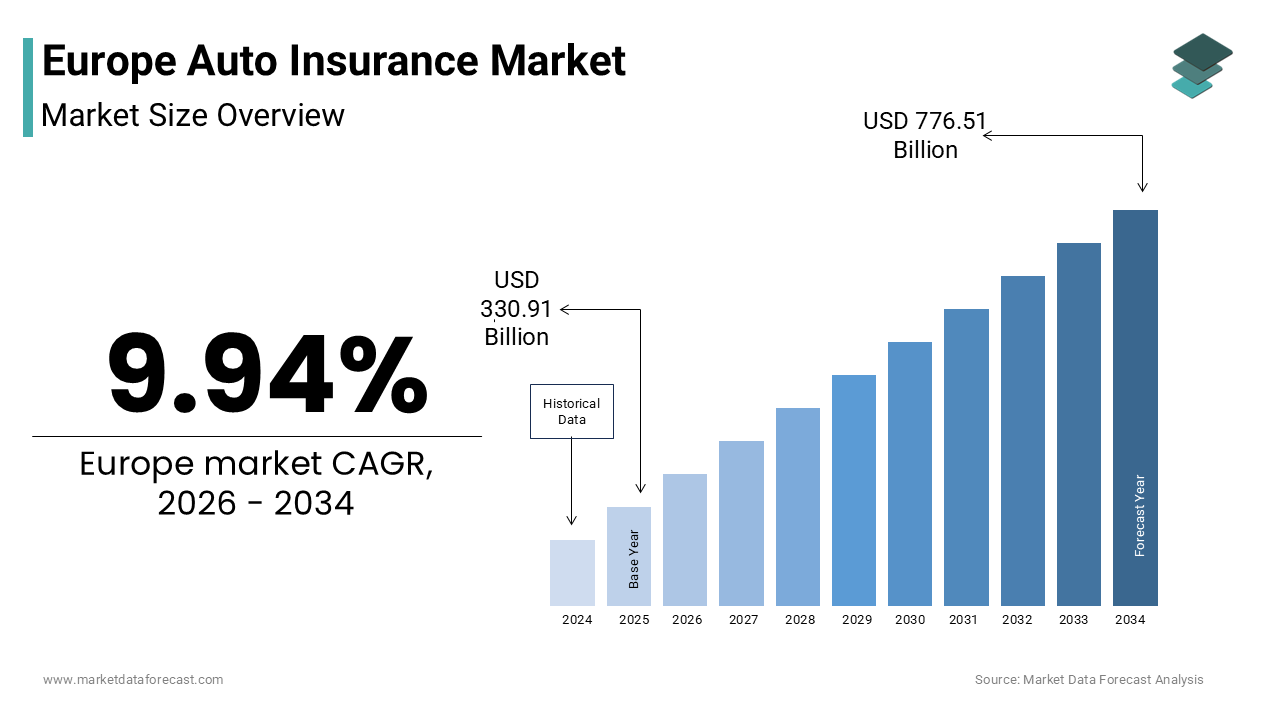
The Europe auto insurance market was valued at USD 330.91 billion in 2025, is estimated to reach USD 363.82 billion in 2026, and is projected to reach USD 776.51 billion by 2034, growing at a CAGR of 9.94% during the forecast period from 2026 to 2034. The growth of the Europe auto insurance market is driven by mandatory third-party liability regulations, rising vehicle ownership, and increasing claim costs associated with advanced driver assistance systems and electric vehicles. The evolving mobility ecosystem, characterized by electrification, telematics adoption, and digital insurance platforms, is reshaping traditional underwriting models. Additionally, insurers are leveraging data-driven risk assessment, embedded insurance offerings, and usage-based policies to address shifting consumer expectations and regulatory requirements across Europe.
Key Market Trends
-
Increasing adoption of usage-based insurance models enabled by telematics and real-time driving data.
-
Growing demand for comprehensive coverage due to rising repair costs of technologically advanced vehicles.
-
Expansion of embedded insurance solutions within electric vehicle ecosystems and OEM partnerships.
-
Rapid digitalization of insurance distribution through online platforms and direct-response channels.
-
Rising impact of climate-related vehicle damage is influencing underwriting strategies and premium structures.
Segmental Insights
-
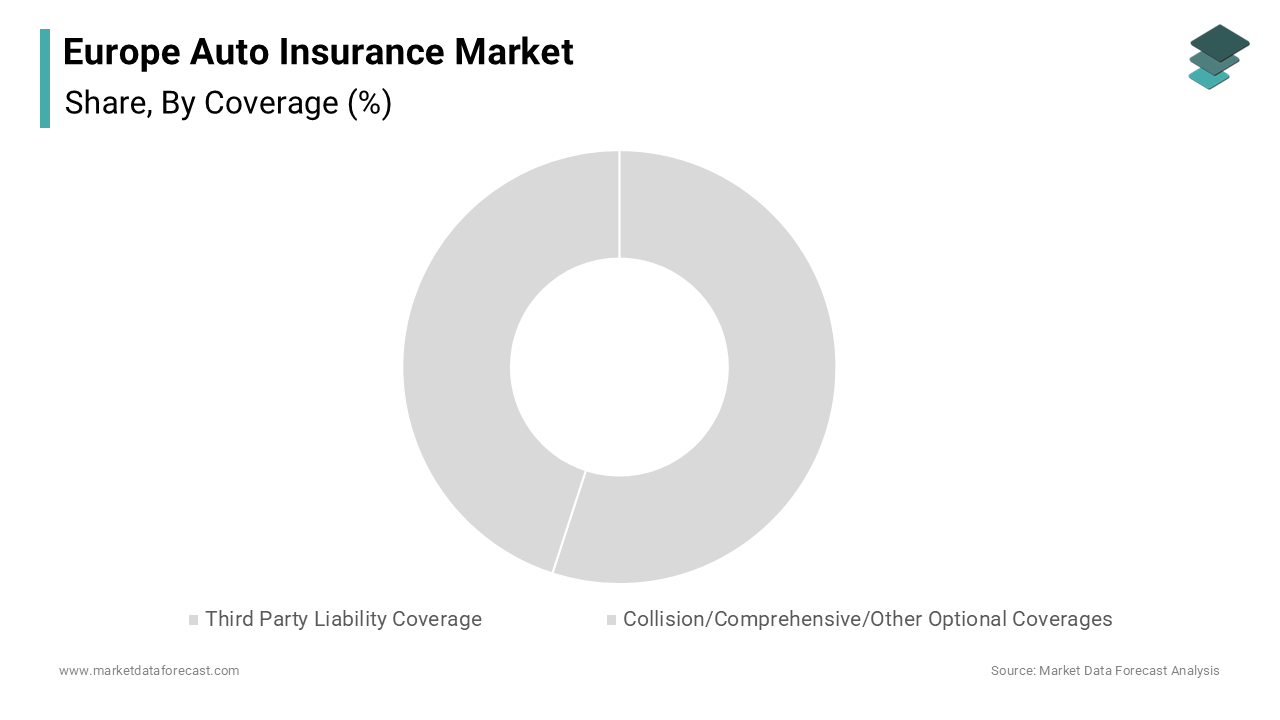
Based on coverage, the third-party liability coverage segment held the largest share of 59.3% of the Europe auto insurance market in 2025, driven by its legal mandate under the EU Motor Insurance Directive.
-
Based on distribution channel, the direct response segment accounted for 48.6% of the Europe auto insurance market share in 2025, supported by strong digital adoption and widespread use of online comparison platforms.
-
Based on vehicle age, the used vehicle segment captured 64.4% of the Europe auto insurance market in 2025, reflecting the aging vehicle fleet and high demand for affordable insurance solutions for pre-owned cars.
Regional Insights
The Europe auto insurance market demonstrates steady growth across major economies, supported by regulatory frameworks, evolving mobility trends, and increasing vehicle ownership.
-
Germany was the largest contributor, accounting for 19.8% of the Europe auto insurance market share in 2025, driven by its large vehicle base, premium automobile ownership, and advanced insurance infrastructure.
-
France continues to perform strongly, supported by regulatory frameworks such as the bonus-malus system and rising demand for comprehensive coverage amid increasing repair costs.
-
The United Kingdom remains a key market due to its digital insurance ecosystem, strong adoption of telematics-based policies, and highly competitive pricing landscape.
-
Italy and Spain are witnessing steady expansion supported by aging vehicle fleets, high policy volumes, and growing awareness of climate-related risks influencing insurance demand.
Competitive Landscape
The Europe auto insurance market is highly competitive and characterized by the presence of large multinational insurers alongside regional players and emerging insurtech firms. Leading companies are investing in artificial intelligence, telematics-driven underwriting, and embedded insurance solutions to enhance customer experience and improve operational efficiency. Prominent players operating in the Europe auto insurance market include Allianz SE, AXA SA, Assicurazioni Generali, Zurich Insurance Group, Aviva plc, MAPFRE S.A., Admiral Group plc, Direct Line Insurance Group, Ageas, RSA Insurance Group, ERGO Group, and Covea Group. Strategic collaborations with automotive manufacturers, digital transformation initiatives, and expansion of personalized insurance models continue to shape the competitive landscape across Europe.
Europe Auto Insurance Market Size
The Europe auto insurance market size was valued at USD 330.91 billion in 2025 and is anticipated to reach USD 363.82 billion in 2026 from USD 776.51 billion by 2034, growing at a CAGR of 9.94% during the forecast period from 2026 to 2034.
Auto insurance is a legal contract between a vehicle owner and an insurance provider that provides financial protection against physical damage, bodily injury, or legal liabilities resulting from traffic collisions and other incidents involving a vehicle. It is a mandatory requirement for all motor vehicles across the European Union, underpinned by the Motor Insurance Directive which enforces minimum third party liability coverage. The market’s current dynamics are being reshaped by the continent’s rapid transition toward electrification and advanced driver assistance systems. The European Environment Agency notes that increasing EV adoption across Europe is bringing to light, complex issues surrounding post-accident battery management and a shortage of specialized maintenance expertise. Simultaneously, with the average age of European cars steadily rising, a dual-risk landscape has emerged where older, less-advanced vehicles share the road with modern, software-driven, and heavier electric vehicles, challenging road safety and repair infrastructure. This complex interplay between legacy and innovation defines the modern European auto insurance market, which must continuously adapt its risk models to an evolving mobility ecosystem.
MARKET DRIVERS
Universal Legal Mandate for Third Party Liability Coverage
The legal obligation for every vehicle owner to hold at least third party liability insurance accelerates the growth of the Europe auto insurance market. This mandate, harmonized across all twenty seven EU member states under the Motor Insurance Directive, creates a universal, non discretionary demand base that is directly tied to vehicle registration figures. As long as an individual operates a motor vehicle on public roads, they are legally required to be insured, making this a captive market of immense scale. According to the European Commission, a rising number of passenger cars are registered in the European Union, with almost every registered vehicle serving as a guaranteed policyholder for the mandatory minimum liability coverage. This regulatory framework provides the market with exceptional stability and predictability, insulating it from economic cycles that affect discretionary spending. The directive’s robust enforcement mechanisms, including cross border cooperation to identify uninsured drivers and severe penalties for non compliance, ensure near universal adherence, making this legal requirement the bedrock upon which the entire industry is built.
Escalating Costs of Vehicle Repairs Due to Advanced Technology
The relentless increase in vehicle repair costs, driven by the integration of sophisticated technology into modern automobiles, also contributes to the expansion of the Europe auto insurance market. Today’s vehicles are equipped with a dense network of sensors, cameras, and control units that form advanced driver assistance systems. A minor collision that once required a simple bumper replacement now often necessitates the recalibration or replacement of multiple radar and camera modules, a process that is both time consuming and expensive. According to the European Association of Automotive Suppliers, vehicles equipped with Level 2 autonomous features often incur significantly higher repair costs compared to conventional vehicles, driven by the increased complexity of electronic components and specialized sensors. This inflation in claim severity directly translates into higher insurance premiums and increased demand for comprehensive coverage, as policyholders seek protection against these substantial out of pocket expenses. The trend is accelerating with electric vehicles, whose battery packs and specialized components can make even moderate damage economically unviable to repair, further driving up the average cost per claim and reinforcing the necessity of robust insurance.
MARKET RESTRAINTS
Intense Price Competition and Consumer Price Sensitivity
Extreme price sensitivity among consumers, particularly in its mature economies like Germany, France, and the UK, inhibits the growth of the Europe auto insurance market. Decades of market saturation and the proliferation of online comparison platforms have conditioned policyholders to shop for the lowest possible premium, often on an annual basis. This behavior has fostered an intensely competitive environment where insurers are locked in a race to the bottom on pricing, severely compressing profit margins. According to European insurance regulators and market observers, inflationary pressure and rising vehicle repair costs have compressed underwriting margins, forcing insurers in many Western European markets to raise motor insurance premiums to keep pace with soaring claims expenses over the past five years. This paradox is unsustainable; insurers are forced to either absorb losses or find ways to reduce coverage, which can erode customer trust. The commoditization of basic policies makes it difficult for companies to differentiate on anything other than price, stifling innovation in core product design and creating a fragile market dynamic where profitability is perpetually under threat from aggressive competitors.
Regulatory Caps on Premiums for High Risk Segments
The imposition of regulatory caps on insurance premiums for specific high-risk segments, particularly young and novice drivers, is a significant structural restraint on the market’s ability to manage risk. This in turn hinders the expansion of the Europe auto insurance market. In an effort to protect these groups from prohibitively high costs, several European countries have introduced measures to limit how much more they can be charged compared to experienced drivers. For example, France has implemented a system that restricts the maximum premium differential between a new driver and an experienced one. As per sources, such regulations, while well intentioned, create a challenging operating environment. Insurers are unable to fully price the actual risk, leading to cross subsidization from lower risk policyholders. This distorts the risk pool, can lead to adverse selection, and ultimately constrains the market’s ability to accurately reflect true risk in its pricing, posing a long term challenge to its financial sustainability and fairness.
MARKET OPPORTUNITIES
Expansion of Usage Based Insurance Through Telematics Integration
The widespread adoption of usage-based insurance (UBI) models is a transformative opportunity for the Europe auto insurance market. These models leverage telematics data to price policies based on actual driving behavior rather than broad demographic proxies. This shift from a static to a dynamic risk assessment model allows for unprecedented personalization and fairness. Safe drivers who drive fewer miles or avoid high risk behaviors like harsh braking can be rewarded with significantly lower premiums. The technology is now mature and affordable, with smartphone apps and plug in devices capable of accurately capturing a wide range of driving metrics. As per research, a large scale pilot program in Sweden demonstrated that UBI policies led to reduction in at fault accidents among participants, as the feedback loop encouraged safer driving habits. This win win scenario, lower costs for good drivers and reduced claims frequency for insurers, positions UBI as a powerful tool for growth, customer retention, and loss prevention.
Integration of Insurance into Electric Vehicle Ecosystems
The rise of electric vehicles offers a major strategic opportunity to embed auto insurance into new and seamless customer journeys, which is likely to promote the expansion of the Europe auto insurance market. As European consumers increasingly adopt EVs, they interact with a new ecosystem of manufacturers, charging networks, and service providers. This creates a natural point of sale for tailored insurance products. For instance, an EV manufacturer could offer a bundled package that includes a comprehensive insurance policy specifically designed for the vehicle’s unique risk profile, covering battery degradation, specialized repairs, and even charging equipment. According to various sources, total electric vehicle registrations in the European Union continued to represent a significant portion of the new car market in 2024, though the rapid growth of all-electric models experienced a slowdown compared to previous years due to the reduction of consumer incentives in major markets. OEM partnerships allow insurers to shift from a 'back office' function to a visible, integral part of the EV ownership journey, tapping into new income streams and securing loyalty from a tech-savvy demographic.
MARKET CHALLENGES
Data Privacy Regulations Limiting Personalized Risk Assessment
Balancing the need for granular data to accurately price risk with the continent’s world leading data privacy regulations, primarily the General Data Protection Regulation, remains an impediment to the Europe auto insurance market. Telematics data enables personalized insurance, but GDPR strictly regulates the collection and processing of this sensitive personal information. Insurers must navigate a complex consent framework, and consumers are often wary of sharing their driving data due to privacy concerns. As per a study, any use of personal data for automated decision making, such as setting an insurance premium, requires explicit, informed consent and the right to human intervention. This regulatory environment creates a significant barrier to the full exploitation of big data analytics, forcing insurers to rely on less precise risk factors and slowing down the development of next generation, behavior based insurance products.
Increasing Frequency of Climate Related Vehicle Damage Claims
The escalating frequency and severity of weather related vehicle damage caused by climate change hold back the expansion of the Europe auto insurance market. Europe is experiencing a marked increase in extreme weather events, including flash floods, hailstorms, and wildfires, all of which cause significant damage to parked and moving vehicles. According to the German Insurance Association, severe natural hazards in 2024 resulted in a high number of insurance claims across Germany, with flooding in the southern region serving as a primary driver of damage in the first half of the year. These events are not isolated; they represent a new normal that is not fully captured by historical actuarial models. The financial impact is twofold: it increases the volume of claims (frequency) and the cost to repair or replace vehicles damaged by water immersion or large hail (severity). This emerging risk category is difficult to predict and price, leading to unexpected losses that can destabilize an insurer’s portfolio. Increasingly volatile climate patterns demand the adoption of advanced risk assessment tools, creating a substantial, enduring challenge for market stability
REPORT COVERAGE
| REPORT METRIC | DETAILS |
| Market Size Available | 2025 to 2034 |
| Base Year | 2025 |
| Forecast Period | 2026 to 2034 |
| CAGR | 9.94% |
| Segments Covered | By Coverage, Distribution Channel, Vehicle Age and Region |
| Various Analyses Covered | Regional & Country Level Analysis, Segment-Level Analysis, DROC, PESTLE Analysis, Porter’s Five Forces Analysis, Competitive Landscape, Analyst Overview on Investment Opportunities |
| Countries Covered | UK, France, Spain, Germany, Italy, Russia, Sweden, Denmark, Switzerland, the Netherlands, Turkey, the Czech Republic, and the Rest of Europe. |
| Market Leaders Profiled | Allianz SE, AXA SA, Assicurazioni Generali, Zurich Insurance Group, Aviva plc, MAPFRE S.A., Admiral Group plc, Direct Line Insurance Group, Ageas, RSA Insurance Group, ERGO Group, and Covea Group. |
SEGMENTAL ANALYSIS
By Coverage Insights
In 2025, the third party liability coverage segment was the largest segment of the Europe auto insurance market by accounting for a 59.3% share. The dominance of the third party liability coverage segment is driven by a direct and unavoidable consequence of its legal status as a mandatory requirement for all vehicle owners across every European Union member state, as mandated by the EU Motor Insurance Directive. The primary driver of this segment’s size is the sheer universality of the obligation. It is not a product choice but a legal prerequisite for vehicle registration and operation on public roads. Eurostat data indicates that the total number of registered passenger cars in the European Union has continued to rise, with a growing number of vehicles subject to mandatory minimum insurance requirements. This creates a vast, captive, and non-discretionary customer base that is entirely insulated from economic cycles or consumer sentiment. The European Commission is strengthening cross-border enforcement mechanisms to improve the identification of uninsured drivers and enhance adherence to mandatory motor insurance directives across member states. This foundational legal framework makes third party liability the bedrock of the entire market, providing a stable and predictable revenue stream that underpins the industry’s existence.
The comprehensive and optional coverages segment is expected to exhibit a noteworthy CAGR of 6.7% from 2026 to 2034 due to a confluence of rising financial risk and increasing consumer awareness of the limitations of basic third party cover. One more reason for growth here is the dramatic increase in vehicle repair costs due to the integration of advanced technology. Modern vehicles are equipped with a complex array of sensors, cameras, and control units for advanced driver assistance systems, making even minor collisions extremely expensive to fix. Vehicles equipped with automated driver-assistance features, such as those in Level 2, significantly increase average repair bills compared to conventional, non-automated vehicles due to the high cost of sensor calibration and specialized, skilled labor. This inflation in potential out of pocket expenses has made comprehensive coverage, which protects the policyholder’s own vehicle, a necessity rather than a luxury for a growing segment of the population. Furthermore, the increasing average age of the European vehicle fleet is driving higher consumer demand for protective maintenance and repair services, as owners seek to maximize the lifespan of their older, already paid-off vehicles.
By Distribution Channel Insights
The direct response channel segment led the Europe auto insurance market by holding a 48.6% share in 2025. The leading position of the direct response channel segment is attributed to the continent’s highly digitized consumer landscape and the success of online price comparison platforms. Also helping this segment is the extreme price sensitivity of European consumers, who have been conditioned by decades of market saturation to shop for the lowest possible premium. Direct insurers, operating without the overhead of a physical agent network, can offer competitive rates and leverage sophisticated digital marketing to reach customers directly through websites and mobile apps. As per the European Insurance and Occupational Pensions Authority, the digitalization of the insurance sector is advancing, resulting in a growing proportion of European consumers utilizing online channels to find, compare, and purchase motor insurance products. This channel thrives on speed, convenience, and transparency, allowing consumers to compare multiple quotes in minutes. The efficiency and cost advantage of the direct model have made it the preferred choice for a vast majority of policyholders seeking a straightforward, transactional insurance purchase.
The banks distribution channel segment is predicted to witness the highest CAGR of 9.3% during the forecast period owing to the strategic expansion of bancassurance, where banks leverage their existing customer relationships to cross sell insurance products. A further key accelerator is the natural synergy between auto loans and auto insurance. When a customer finances a vehicle through a bank, it is a logical and convenient point to also purchase an insurance policy. According to research, a substantial portion of new vehicle acquisitions in the European Union were facilitated through financial products such as bank loans and leasing in 2024, supported by both OEM captive finance and banking institutions, despite higher borrowing costs. Banks are increasingly integrating insurance offerings into their digital lending platforms, creating a seamless, one stop shop experience. This embedded finance model allows banks to deepen customer relationships, increase their fee based income, and capture a high value customer at a moment of significant financial decision making, making it a powerful and rapidly expanding channel.
By Vehicle Age Insights
The used vehicle segment captured the majority share of 64.4% of the Europe auto insurance market in 2025. The supremacy of the used vehicle segment is credited to the composition of the continent’s vehicle fleet, which is characterized by a high proportion of older, second hand cars. In addition, this segment is helped by the economic reality for a large portion of the European population, for whom purchasing a new vehicle is a significant financial burden. Instead, consumers opt for reliable, pre owned models, creating a massive and sustained demand for insurance for these assets. According to data from the European Automobile Manufacturers' Association (ACEA), the average age of the passenger car fleet in the European Union has continued to increase, reflecting a maturing market with an growing reliance on older, used vehicles. This aging fleet is not just a collection of old cars; it includes a growing number of well maintained, late model vehicles that are being kept in service longer due to their quality and the high cost of new alternatives. Insuring these vehicles, which often have considerable residual value to their owners, forms the core of the market’s volume, as millions of Europeans seek to protect their primary mode of personal transport.
The new vehicle insurance segment is estimated to register the fastest CAGR of 7.4% from 2026 to 2034. The swift expansion of this segment is fuelled by the continent’s aggressive push toward electrification and the resulting boom in new electric vehicle (EV) sales. Unlike traditional internal combustion engine cars, new EVs come with a unique and complex set of insurance requirements driven by their high purchase price, specialized repair needs, and distinct risk profiles. A new EV often requires a comprehensive policy from day one due to its significant value and the high cost of its battery pack, which can account for a significant share of the vehicle’s total price. According to sources, total new electric car registrations in the EU remained high in 2024, but the rapid growth experienced in previous years subsided, with certain sectors experiencing a decline in annual sales due to reduced purchasing incentives. This influx of high value, technologically advanced new vehicles is creating a powerful, high premium demand stream that is growing much faster than the overall market, as every new car sale directly translates into a new, full coverage insurance policy.
REGIONAL ANALYSIS
Germany Auto Insurance Market Analysis
Germany was the top performer in the Europe auto insurance market by holding a share of 19.8% in 2025. The prominence of the German market is driven by its status as Europe’s largest economy and its dense network of millions of registered passenger vehicles. The German market is characterized by a highly sophisticated and competitive insurance landscape where consumers are known for their meticulous comparison shopping. A key driver of market activity is the nation’s strong culture of vehicle ownership and maintenance, with a significant portion of the population owning high value, premium brand automobiles that require comprehensive coverage. According to the German Federal Motor Transport Authority, the average age of the passenger car fleet in Germany has reached a record high, reflecting a mature market that demands a diverse mix of insurance products covering both new and older vehicles. This combination of a large vehicle base, high consumer expectations, and a focus on quality ensures Germany remains the single most important market for insurers seeking scale and profitability in Europe.
France Auto Insurance Market Analysis
France was the second largest country in the European auto insurance market by occupying a 15.5% share in 2025. The growth of the French market is propelled by a unique regulatory environment that actively intervenes to control costs and protect consumers. A major factor shaping the market is the government’s “bonus malus” system, which directly links a driver’s insurance premium to their claims history, creating a powerful incentive for safe driving. Furthermore, France has implemented strict regulations on premium differentials for young drivers, capping how much more they can be charged compared to experienced drivers. According to research, these measures have led to a more stable but highly competitive pricing environment. The market is also seeing a surge in demand for comprehensive coverage, driven by the rising cost of repairing modern vehicles equipped with advanced safety systems. This blend of regulatory oversight and evolving consumer needs defines France’s dynamic and closely watched insurance landscape.
United Kingdom Auto Insurance Market Analysis
The United Kingdom maintains a significant position in the European auto insurance market due to its maturity and its pioneering role in the development of online insurance distribution and price comparison websites. This has created a hyper competitive environment where price sensitivity is extreme, and customer loyalty is low. A critical driver of current market dynamics is the persistent issue of whiplash claims, which, despite recent legal reforms, continue to influence premium structures. According to official UK Department for Transport data, the number of licensed cars in the United Kingdom continues to rise, with a significant proportion of the total fleet consisting of older, previously used vehicles. The market is also at the forefront of adopting telematics based insurance, with a growing number of young drivers opting for black box policies to prove their safe driving habits and reduce their premiums. This focus on data driven pricing and a highly digitized customer journey makes the UK a key testing ground for new insurance models.
Italy Auto Insurance Market Analysis
Italy witnessed a consistent growth in the European auto insurance market owing to its regional disparities in risk and cost, with insurance premiums in southern regions like Campania and Sicily being significantly higher than in the north due to factors such as higher accident rates and fraud. This geographical fragmentation creates a complex operating environment for insurers. A major driver of market activity is the country’s high rate of vehicle ownership combined with a very old car fleet. The average age of passenger cars operating on Italian roads continues to increase, with the national vehicle fleet becoming progressively more mature and exceeding previous age milestones as of 2024. This aging fleet, coupled with a strong cultural preference for personal vehicle use over public transport, sustains a massive volume of policies, primarily for used vehicles. The market is also seeing a gradual shift toward more comprehensive coverage as consumers become more aware of the risks associated with driving older, less safe vehicles.
Spain Auto Insurance Market Analysis
Spain is predicted to expand in the Europe auto insurance market from 2026 to 2034. The Spanish market has been on a strong recovery trajectory following the economic challenges of the past decade, driven by a resurgence in new car sales and a growing middle class. A key factor influencing the market is the country’s high exposure to climate related risks, particularly hailstorms and flash floods, which have led to a significant increase in comprehensive insurance claims in recent years. According to research, the frequency of insurance claims arising from weather-related events has shown a marked increase following 2020, driven by more frequent and intense atmospheric phenomena. This has heightened consumer awareness of the need for broader coverage beyond the mandatory third party liability. Furthermore, the Spanish government’s incentives for electric vehicle purchases have begun to stimulate the new vehicle insurance segment, adding a new layer of growth to a market that is increasingly focused on protecting against both accident and environmental damage
COMPETITIVE LANDSCAPE
The competitive landscape of the Europe auto insurance market is characterized by a powerful oligopoly of large, multinational insurers competing against a backdrop of intense price pressure and technological disruption. At the top, global giants like Allianz, AXA, and Generali leverage their scale, brand strength, and extensive distribution networks to dominate national markets. They compete fiercely on innovation, particularly in digital services and personalized pricing models. Below this tier, a mix of strong regional insurers and agile insurtech startups challenge the incumbents by focusing on niche segments or offering superior digital experiences. The market is highly mature and saturated, leading to extreme customer price sensitivity and low loyalty, which is amplified by ubiquitous online comparison sites. This environment forces all participants to continuously innovate in product design and operational efficiency to maintain profitability, while simultaneously navigating a complex and evolving regulatory framework that prioritizes consumer protection, creating a dynamic and challenging competitive arena.
KEY MARKET PLAYERS
Some of the companies that are playing a dominating role in the Europe Auto insurance market include
- Allianz SE
- AXA SA
- Assicurazioni Generali S.p.A.
- Zurich Insurance Group Ltd.
- Aviva plc
- MAPFRE S.A.
- Admiral Group plc
- Direct Line Insurance Group plc
- Ageas SA/NV
- RSA Insurance Group Limited
- ERGO Group AG
- Covea Group
Top Players in the Market
Allianz SE
Allianz SE is a global insurance leader with a deeply entrenched presence across the European auto insurance market. The company offers a full spectrum of motor insurance products, from mandatory third party liability to comprehensive and telematics based policies. To reinforce its leadership, Allianz has been at the forefront of digital transformation, investing heavily in AI driven claims processing and customer service platforms.
AXA SA
AXA SA is a dominant force in the European auto insurance sector, known for its innovative product design and strong brand recognition in key markets like France, Germany, and the UK. The company has strategically positioned itself as a pioneer in usage based insurance, leveraging data analytics to offer highly personalized premiums. In a significant move to strengthen its market position, AXA partnered with a major European electric vehicle manufacturer to offer integrated, on demand insurance for new EV buyers. This embedded insurance model streamlines the purchase process and captures a high value customer segment at the point of sale, showcasing AXA’s commitment to adapting to the future of mobility.
Generali Group
Generali Group holds a powerful position in the European auto insurance landscape, with a particularly strong footprint in Southern and Central Europe. The company’s strategy focuses on combining traditional insurance expertise with cutting edge digital services to create a seamless customer journey. To enhance its competitive edge, Generali launched its “MyDrive” ecosystem, which goes beyond simple telematics by integrating roadside assistance, maintenance scheduling, and fuel price comparison into a single platform. This holistic approach to car ownership services deepens customer relationships and creates a sticky, value added proposition that differentiates Generali in an increasingly commoditized market.
Top Strategies Used by the Key Market Participants
Key players in the Europe auto insurance market are primarily deploying three core strategies to maintain their competitive advantage. First, they are aggressively investing in digitalization and artificial intelligence to automate claims processing, enhance fraud detection, and deliver a superior customer experience through mobile apps and online portals. Second, they are developing and expanding usage based and telematics driven insurance products to personalize pricing and incentivize safe driving, thereby improving loss ratios. Third, they are forging strategic partnerships with automotive manufacturers, mobility service providers, and technology firms to embed insurance into new customer journeys and capture emerging segments such as electric vehicle owners and users of shared mobility services.
MARKET SEGMENTATION
This research report on the Europe Auto Insurance Market has been segmented and sub-segmented based on the following categories.
By Coverage
- Third Party Liability Coverage
- Collision/Comprehensive/Other Optional Coverages
By Distribution Channel
- Insurance Agents/Brokers
- Direct Response
- Banks
- Others
By Vehicle Age
- New Vehicles
- Used Vehicles
- By Application
- Personal
- Commerical
By Country
- UK
- France
- Spain
- Germany
- Italy
- Russia
- Sweden
- Denmark
- Switzerland
- Netherlands
- Turkey
- Czech Republic
- Rest of Europe