Europe Automated Storage and Retrieval System Market Size, Share, Trends, & Growth Forecast Report By Function, Type, Industry, and Country (UK, France, Spain, Germany, Italy, Russia, Sweden, Denmark, Switzerland, Netherlands, Turkey, Czech Republic, and Rest of Europe), Industry Analysis From 2026 to 2034
Market Size, 2025
$32.70 BnMarket Estimate, 2026
$34.75 BnMarket Forecast, 2034
$56.57 BnCAGR, 2026–2034
6.28%Europe Automated Storage and Retrieval System Market Size
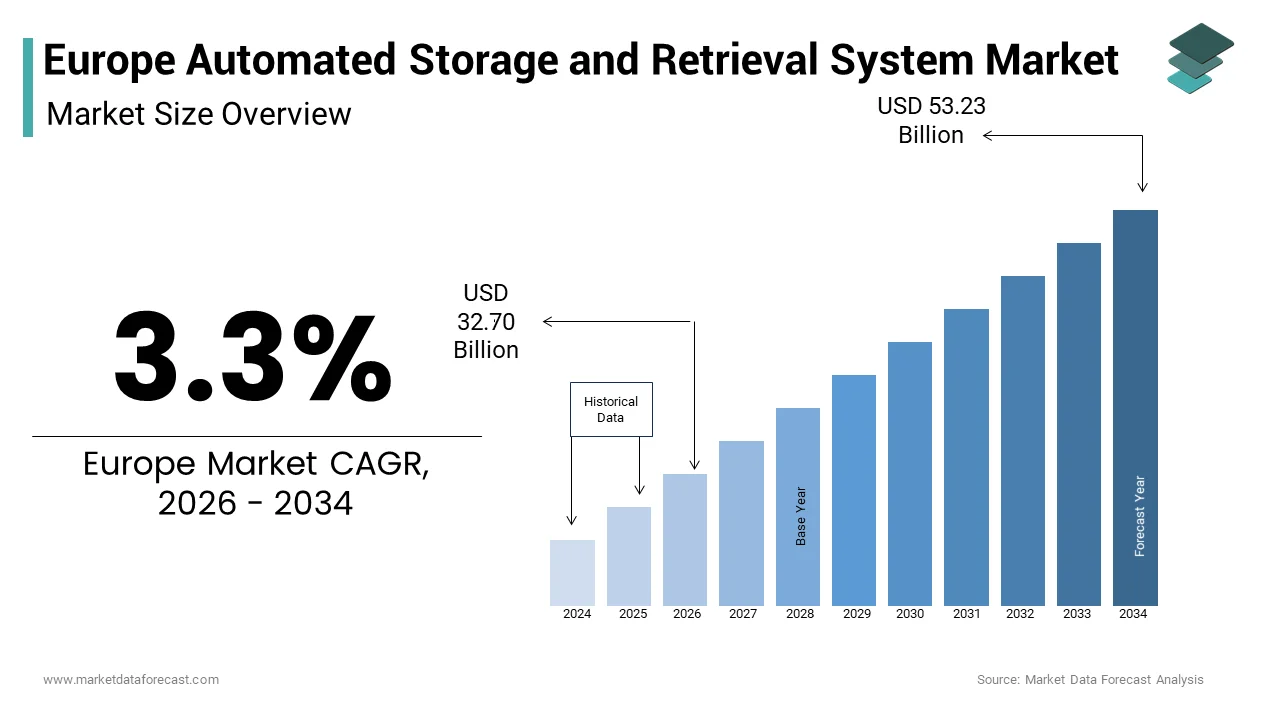
The Europe automated storage and retrieval system market size will reach USD 32.70 billion in 2025 and is anticipated to reach USD 34.75 billion in 2026 to reach USD 56.57 billion by 2034, growing at a CAGR of 6.28% during the forecast period from 2026 to 2034.
An Automated Storage and Retrieval System (ASRS) refers to a combination of computer-controlled systems that automatically place and retrieve items from defined storage locations. These systems are widely used in manufacturing, warehousing, logistics, and distribution centers to enhance operational efficiency, reduce labour costs, and optimize space utilization.
Moreover, the adoption of ASRS in Europe has been driven by the increasing need for smart logistics solutions amid rapid e-commerce expansion and growing demand for just-in-time inventory management.
Like, as per the European Logistics Association (ELA), warehouse automation investments across Western Europe increased by nearly 14% annually between 2020 and 2023. This trend shows the region’s focus on Industry 4.0 technologies, including robotics, AI-driven inventory management, and real-time data analytics—key components of modern ASRS installations.
Apart from these, Germany leads in deployment due to its strong industrial base and early adoption of automated material handling systems. The UK and France have also seen rising integration of ASRS in the pharmaceutical, automotive, and retail sectors. Urbanization is intensifying and labour shortages are persisting, particularly in Northern Europe, so companies are increasingly turning to ASRS to maintain productivity while reducing dependency on manual operations.
Therefore, sustainability is becoming a core business objective as ASRS supports energy-efficient warehouse operations by optimizing lighting, climate control, and reducing human error.
MARKET DRIVERS
Growth of E-Commerce and Demand for Faster Order Fulfillment
The exponential growth of e-commerce and the corresponding need for faster, more accurate order fulfillment are one of the primary drivers of the Europe Automated Storage and Retrieval System (ASRS) Market. Online retail sales in the area are increasing, so retailers and logistics providers are under immense pressure to streamline their operations and reduce delivery times.
Like leading e-commerce players in Germany, the UK, and France, have experienced an annual increase in order volumes since 2021, necessitating the implementation of advanced warehouse automation technologies like ASRS. These systems enable high-speed picking, sorting, and restocking, significantly improving throughput and accuracy.
Moreover, market leaders such as Amazon and Zalando have invested heavily in fully automated fulfillment centers across Europe. In fact, as per McKinsey & Company, a significant portion of new large-scale warehouse projects launched in the region between 2021 and 2023 incorporated ASRS technology to support same-day delivery commitments.
The rise of omnichannel retailing further amplifies this trend, as businesses must manage complex inventory flows across physical stores, online platforms, and distribution hubs. ASRS provides the agility needed to handle these multi-channel demands efficiently, making it an essential component of modern logistics strategies in Europe.
Labour Shortages and Rising Operational Costs in the Logistics Sector
Persistent labour shortage and rising operational costs within the logistics and warehousing industry are another critical driver of the Europe Automated Storage and Retrieval System (ASRS) Market.
Like, as per the International Transport Forum (ITF), the European logistics sector faced a 12% labour deficit in 2023, particularly in countries like the UK, Germany, and the Netherlands, where skilled warehouse worker availability has declined sharply.
This workforce challenge has been compounded by increasing wage pressures. According to the European Foundation for the Improvement of Living and Working Conditions (Eurofound), average hourly wages in the logistics sector rose by nearly 7% year-over-year in 2023, prompting companies to seek cost-effective alternatives to manual labour.
ASRS offers a compelling solution by reducing dependency on human workers for repetitive and physically demanding tasks such as palletizing, picking, and inventory tracking. Companies like Swisslog and Dematic have reported a surge in demand for goods-to-person systems, which minimize walking time and improve worker productivity.
Besides, as per the 2023 digital transformation report by the European Commission, automation technologies like ASRS not only lower labour-related expenses but also enhance workplace safety and reduce error rates in inventory handling.
Given these benefits, businesses across industries—from pharmaceuticals to automotive—are increasingly adopting ASRS to maintain operational efficiency and mitigate the impact of labour constraints in Europe’s evolving supply chain landscape.
MARKET RESTRAINTS
High Initial Investment and Implementation Costs
A major restraint affecting the Europe Automated Storage and Retrieval System (ASRS) Market is the high initial investment required for system acquisition, installation, and integration with existing warehouse infrastructure.
These costs include not only the machinery and software but also extensive modifications to building layouts, integration with enterprise resource planning (ERP) systems, and employee training programs. Small and medium-sized enterprises (SMEs), which constitute a significant portion of the European logistics sector, often find these expenditures prohibitive.
In addition, return on investment (ROI) timelines can extend beyond five years, discouraging immediate adoption despite long-term benefits.
Furthermore, fluctuations in raw material prices—particularly steel and electronic components—have added financial uncertainty for companies considering automation upgrades. So, without government subsidies or financing support, many potential adopters remain hesitant to make the necessary capital outlay, limiting the widespread implementation of ASRS in certain segments of the market.
Complexity in Integration with Legacy Systems and IT Infrastructure
A further significant restraint influencing the Europe Automated Storage and Retrieval System (ASRS) Market is the complexity involved in integrating these systems with legacy warehouse management systems (WMS) and existing IT infrastructure. Many European warehouses operate on older software platforms that were not designed to interface seamlessly with modern automation technologies.
Also, nearly 40% of European logistics firms using ASRS encountered delays during implementation due to compatibility issues between new hardware and outdated software environments, according to a report. This led to extended downtime and additional costs associated with system upgrades or middleware development.
Moreover, the scarcity of skilled personnel capable of managing the convergence of mechanical automation and digital logistics systems poses another challenge. Unless addressed through better standardization, training initiatives, and vendor collaboration, these integration complexities will continue to hinder broader adoption of ASRS in Europe’s logistics landscape.
MARKET OPPORTUNITY
Expansion of Cold Chain Logistics and Temperature-Controlled Warehousing
A prominent opportunity shaping the Europe Automated Storage and Retrieval System (ASRS) Market is the expanding cold chain logistics sector, driven by increasing demand for temperature-sensitive products such as pharmaceuticals, perishable foods, and biologics.
According to the European Cold Chain Federation (ECCF), refrigerated warehouse capacity in the EU grew by 9% annually between 2020 and 2023, reflecting heightened investment in controlled-environment storage facilities.
Cold storage environments pose unique challenges for manual handling, including reduced worker efficiency, higher energy consumption, and stringent hygiene requirements. ASRS presents an ideal solution by minimizing human exposure to extreme temperatures while ensuring precise inventory control and traceability.
For instance, in the pharmaceutical sector, the implementation of ASRS in cold chain warehouses has enabled compliance with Good Distribution Practice (GDP) standards, particularly in vaccine and biopharmaceutical storage. As per the European Medicines Agency (EMA), a significant majority of new biologic drugs approved between 2020 and 2023 require cold or ultra-cold storage, reinforcing the need for automated solutions.
Further, food and beverage companies are adopting ASRS to optimize frozen product storage and reduce spoilage. Companies like KUKA and SSI Schaefer have introduced specialized robotic storage systems designed for low-temperature environments, enhancing reliability and energy efficiency.
Regulatory mandates are tightening around food safety and drug integrity, so the integration of ASRS into cold chain logistics is expected to accelerate, offering substantial growth potential for the market.
Adoption of Green and Energy-Efficient Warehouse Technologies
Another key opportunity driving the Europe Automated Storage and Retrieval System (ASRS) Market is the increasing emphasis on sustainability and energy-efficient warehouse operations. As part of the European Union’s Green Deal initiative, logistics companies are under pressure to reduce carbon emissions and align with circular economy principles.
Traditional warehouses with manual handling systems tend to be less efficient in terms of space utilization, lighting, and climate control, contributing to higher energy use.
ASRS addresses these inefficiencies by optimizing storage density, reducing travel distances for retrieval mechanisms, and enabling intelligent energy management. For example, goods-to-person systems eliminate unnecessary movement, lowering power consumption by up to 30%, as per the Fraunhofer Institute for Material Flow and Logistics (IML) in 2023.
Furthermore, several European governments offer incentives for adopting green logistics technologies. The German Federal Ministry for Economic Affairs and Climate Action (BMWK) has funded multiple pilot projects integrating renewable energy sources with ASRS operations, promoting sustainable automation practices.
With increasing corporate environmental responsibility (CER) goals and consumer demand for eco-conscious supply chains, the push toward energy-efficient ASRS solutions is expected to drive sustained market expansion in Europe.
MARKET CHALLENGES
Cybersecurity Risks in Highly Digitized ASRS Environments
A serious challenge facing the Europe Automated Storage and Retrieval System (ASRS) Market is the growing concern over cybersecurity risks associated with highly digitized and interconnected warehouse environments. As ASRS systems become increasingly reliant on IoT-enabled sensors, cloud-based control systems, and real-time data analytics, they also become more vulnerable to cyber threats.
According to the European Union Agency for Cybersecurity (ENISA), the number of ransomware attacks targeting industrial control systems in logistics and manufacturing increased by 45% between 2021 and 2023. These attacks often disrupt warehouse operations, leading to costly downtimes and inventory losses.
ASRS implementations typically integrate with enterprise resource planning (ERP) and warehouse management systems (WMS), creating multiple entry points for potential breaches. As per a study by Deloitte, nearly 30% of European logistics firms using ASRS had experienced at least one cyber incident in the past two years, underscoring the need for robust security measures.
Besides, according to the European Network and Information Security Directive (NIS2), organizations operating critical logistics infrastructure are now subject to stricter cybersecurity compliance requirements. Meeting these standards requires additional investments in secure communication protocols, encryption technologies, and employee cybersecurity training.
Without adequate safeguards, cyber vulnerabilities could undermine confidence in ASRS adoption, especially among larger enterprises handling sensitive supply chain operations.
Scalability and Flexibility Limitations in Existing ASRS Configurations
Another critical challenge influencing the Europe Automated Storage and Retrieval System (ASRS) Market is the limited scalability and flexibility of current system configurations. While ASRS offers high-efficiency gains in structured environments, adapting these systems to changing operational needs—such as fluctuating inventory types, seasonal demand variations, and evolving product dimensions—remains a complex endeavor.
Traditional ASRS designs often rely on fixed shelving units and rigid robotic pathways, making them less adaptable to dynamic storage requirements.
Furthermore, the rise of micro-fulfillment centers and decentralized warehousing models in response to urban e-commerce trends has created demand for modular and mobile ASRS solutions. However, current offerings in this segment remain limited compared to traditional centralized systems.
Unless manufacturers develop more flexible and scalable ASRS architectures, the market may struggle to meet the evolving needs of diverse industries across Europe.
REPORT COVERAGE
| REPORT METRIC | DETAILS |
| Market Size Available | 2025 to 2034 |
| Base Year | 2025 |
| Forecast Period | 2026 to 2034 |
| CAGR | 6.28% |
| Segments Covered | By Type, Function, Industry Vertical, and Country |
| Various Analyses Covered | Regional & Country Level Analysis, Segment-Level Analysis, DROC, PESTLE Analysis, Porter’s Five Forces Analysis, Competitive Landscape, Analyst Overview on Investment Opportunities |
| Countries Covered | UK, France, Spain, Germany, Italy, Russia, Sweden, Denmark, Switzerland, Netherlands, Turkey, the Czech Republic, and the Rest of Europe |
| Market Leaders Profiled | Siemens AG (Germany), Nestlé S.A. (Switzerland), Volkswagen AG (Germany), Royal Dutch Shell plc (Netherlands/United Kingdom), LVMH Moët Hennessy Louis Vuitton SE (France), Unilever PLC (Netherlands/United Kingdom), TotalEnergies SE (France), SAP SE (Germany), AstraZeneca PLC (United Kingdom/Sweden), and Daimler AG (Germany) |
SEGMENTAL ANALYSIS
By Type Insights
Unit Load ASRS
Unit Load Automated Storage and Retrieval Systems (ASRS) spearheaded with a 31.5% share of the European market in 2025. This dominance is attributed to its widespread use in large-scale warehouses and distribution centers that handle high-volume palletized goods.
The system’s compatibility with high-bay racking structures makes it ideal for industries such as automotive, food & beverage, and pharmaceuticals, where bulk storage is essential. As per the German Logistics Association (DBV), Unit Load ASRS installations contributed to a 25% reduction in warehouse footprint while improving inventory accuracy by nearly 98%.
Apart from these, companies like SSI Schaefer and Swisslog have reported increased demand for automated pallet handling solutions, particularly from third-party logistics (3PL) providers aiming to improve throughput and reduce labour dependency.
With rising investments in smart logistics infrastructure and e-commerce fulfillment hubs across Europe, Unit Load ASRS continues to be the most widely adopted ASRS type in the region.
AutoStore ASRS
AutoStore Automated Storage and Retrieval Systems are emerging as the fastest-growing segment in the European market, projected to expand at a CAGR of 14.7% from 2025 to 2033. This rapid growth is driven by the system’s compact design, scalability, and suitability for small- to medium-sized item storage and retrieval operations. In the UK and the Netherlands, major online retailers have increasingly adopted AutoStore technology to support same-day delivery services.
Furthermore, AutoStore’s modular architecture allows seamless expansion without requiring extensive facility modifications, making it highly attractive to SMEs and startups seeking cost-effective automation solutions. As urban logistics hubs prioritize space optimization and sustainability, AutoStore ASRS is expected to see continued adoption across diverse industry verticals in Europe.
By Function Insights
Order Picking
Order picking represented the largest functional application of Automated Storage and Retrieval Systems (ASRS) in Europe, capturing 34.3% of total market volume in 2024. This superiority is mainly supported by the growing complexity and speed requirements in e-commerce and omnichannel retail fulfillment.
According to the European Logistics Innovation Network (ELIN), order picking accounts for nearly 55% of total warehouse operating costs, making automation a strategic imperative for reducing errors and increasing throughput.
Goods-to-person (GTP) picking systems powered by ASRS have become a standard in modern distribution centers. As per a study by the Technical University of Munich, GTP systems integrated with mini-load ASRS can reduce picking time by up to 45%, significantly enhancing productivity.
Major players such as Dematic and Honeywell Intelligrated have reported strong demand for robotic picking cells and voice-directed picking integrations linked to ASRS. Moreover, the rise of micro-fulfillment centers near urban hubs has further intensified the need for fast, accurate order processing, reinforcing the critical role of ASRS in optimizing picking workflows across the region.
Kitting
Kitting is a rapidly expanding functional application within the Europe Automated Storage and Retrieval System (ASRS) Market, rising at an estimated CAGR of 13.9% during the forecast period. This growth is fueled by the increasing demand for customized product bundles in sectors such as automotive, electronics, and industrial manufacturing.
According to the European Manufacturing Association (EMA), kitting processes have become integral to just-in-time (JIT) production models, where precise component sequencing is essential to avoid assembly line disruptions.
Automated kitting leverages ASRS to retrieve multiple SKUs simultaneously, enabling efficient pre-packaging of parts for downstream operations. Also, the healthcare sector is adopting automated kitting for surgical kits and medical device packaging, where traceability and sterility are crucial. With advancements in robotics and AI-driven sorting algorithms, kitting applications are expected to drive substantial growth in the ASRS market across Europe.
By Industry Vertical
Retail & E-Commerce
Retail and e-commerce led industry vertical in the Europe Automated Storage and Retrieval System (ASRS) Market, accounting for 28.5% of total consumption in 2024. This is driven by the exponential growth of online shopping and the corresponding need for high-speed, scalable fulfillment infrastructure. Moreover, to meet rising customer expectations for faster delivery, major retailers and logistics providers have invested heavily in automated warehousing technologies.
Apart from these, the shift toward micro-fulfillment centers located closer to urban centers has accelerated the deployment of compact ASRS solutions tailored for high-density storage and rapid order processing. Leading e-commerce platforms such as Amazon, Zalando, and Otto Group have expanded their automated warehouse networks across Europe, directly boosting demand for ASRS systems. Given ongoing digital transformation and consumer preference for next-day delivery, the retail and e-commerce sector remains the dominant driver of ASRS adoption in the region.
Healthcare & Pharmaceuticals
The healthcare and pharmaceuticals sector is a booming industry vertical in the Europe Automated Storage and Retrieval System (ASRS) Market, projected to grow at a CAGR of 12.4% in the future. This rapid expansion is driven by stringent regulatory requirements, rising demand for precision medicine, and the need for secure, temperature-controlled storage solutions.
According to the European Medicines Agency (EMA), over 70% of newly approved biologic drugs between 2020 and 2023 required cold or ultra-cold storage conditions, necessitating automated systems that ensure both compliance and inventory accuracy.
ASRS plays a crucial role in hospital pharmacies, drug distribution centers, and vaccine storage facilities by minimizing human error, enhancing traceability, and optimizing space utilization. Moreover, the implementation of serialization and track-and-trace regulations under the Falsified Medicines Directive (FMD) has prompted pharmaceutical manufacturers to integrate ASRS with RFID and barcode tracking capabilities.
With increasing investments in digital health infrastructure and personalized medicine, the healthcare sector is poised to drive sustained growth in the European ASRS market.
COUNTRY-LEVEL ANALYSIS
Germany Automated Storage and Retrieval System Market Analysis
Germany led the Europe Automated Storage and Retrieval System (ASRS) Market with a market share of 22.4%, driven by its strong industrial base, early adoption of automation technologies, and robust logistics infrastructure. The presence of leading ASRS providers such as SSI Schaefer, Jungheinrich, and Kardex Remstar has also facilitated domestic innovation and global export opportunities. Additionally, the rise of e-commerce fulfillment centers operated by Amazon and local logistics firms has spurred demand for high-speed picking and storage solutions. With ongoing investments in digitalization and green logistics, Germany maintains its position as the largest market for ASRS in Europe.
UK Automated Storage and Retrieval System Market Analysis
The UK held a significant portion of the European ASRS market, driven by the rapid expansion of e-commerce, logistics modernization, and post-Brexit supply chain adjustments. According to the Office for National Statistics (ONS), the UK’s e-commerce sector grew year-over-year in 2023, prompting increased investment in automated fulfillment infrastructure.
London and the Midlands have emerged as key hubs for automated warehousing, with major retailers such as Ocado, Tesco, and Marks & Spencer deploying ASRS to enhance order accuracy and reduce delivery times. Moreover, the UK government’s Industrial Strategy Challenge Fund has supported R&D initiatives focused on intelligent logistics and autonomous material handling, encouraging wider adoption of ASRS technologies. Despite economic uncertainties, the UK remains a major contributor to the regional ASRS market, particularly in the retail, pharmaceutical, and third-party logistics (3PL) sectors.
France Automated Storage and Retrieval System Market Analysis
France is benefiting from strong industrial modernization efforts and growing investments in digital logistics. According to the French Ministry of Economy, the country’s logistics sector generated over €140 billion in revenue in 2023, with automation playing a central role in improving supply chain resilience.
Paris, Lyon, and Marseille have seen significant deployments of ASRS in retail, healthcare, and automotive distribution centers. Major French retailers like Carrefour and Auchan have partnered with ASRS providers to optimize warehouse operations and meet evolving consumer demands.
Besides, government-backed initiatives such as the “France Relance” plan have allocated funds for automation and robotics development, fostering a favorable environment for ASRS adoption. With rising e-commerce activity and a focus on sustainable logistics, France continues to strengthen its position in the European ASRS market.
Netherlands Automated Storage and Retrieval System Market Analysis
The Netherlands is leveraging its status as a key logistics hub in Western Europe. Rotterdam and Amsterdam have become focal points for automated fulfillment centers, particularly for international e-commerce players like Bol.com and Zalando. The country’s emphasis on sustainability and circular economy principles has also boosted the adoption of energy-efficient ASRS systems. With its strategic location, well-developed transport infrastructure, and proactive digitalization policies, the Netherlands remains a strong contender in the European ASRS landscape.
Italy Automated Storage and Retrieval System Market Analysis
Italy is experiencing steady growth driven by modernization in logistics, food & beverage automation, and e-commerce expansion. Northern Italy, particularly Lombardy and Emilia-Romagna, has been the epicenter of ASRS adoption, supported by strong industrial and agri-food clusters. Leading Italian logistics firms such as Poste Italiane and DHL have deployed ASRS in parcel sorting and pharmaceutical storage facilities to meet regulatory and performance standards.
Government incentives under the National Recovery and Resilience Plan (PNRR) have also supported automation investments, particularly in digital supply chain infrastructure. With ongoing digital transformation and supply chain upgrades, Italy is steadily strengthening its presence in the European ASRS market.
KEY MARKET PLAYERS
These are the noteworthy companies in the Europe automated storage and retrieval system market.
- Siemens AG (Germany)
- Nestlé S.A. (Switzerland)
- SSI Schaefer
- Swisslog Holding AG
- Dematic (A KION Group Company)
- Volkswagen AG (Germany)
- Royal Dutch Shell plc (Netherlands/United Kingdom)
- LVMH Moët Hennessy Louis Vuitton SE (France),
- Unilever PLC (Netherlands/United Kingdom)
- TotalEnergies SE (France)
- SAP SE (Germany),
- AstraZeneca PLC (United Kingdom/Sweden)
- Daimler AG (Germany)
Top Players In the Market
- SSI Schaefer is a global leader in intralogistics solutions and plays a dominant role in the European Automated Storage and Retrieval System (ASRS) market. The company offers a comprehensive portfolio of ASRS technologies, including goods-to-person systems, shuttle-based storage, and AutoStore-compatible solutions tailored for diverse industry verticals.
- Its contributions to the global market include pioneering modular and scalable automation systems that integrate seamlessly with warehouse management software. SSI Schaefer’s focus on sustainability, energy efficiency, and digitalization has made it a preferred partner for companies transitioning to smart logistics ecosystems.
- With a strong presence across Germany, France, and the UK, SSI Schaefer continues to shape the future of automated warehousing by delivering customized, high-performance storage solutions that support omnichannel retailing and just-in-time manufacturing models.
- Swisslog is a leading provider of automated material handling solutions and a key player in the European ASRS market. The company specializes in robotic picking systems, vertical lift modules, and fully integrated warehouse automation platforms designed to enhance operational efficiency and reduce labour dependency.
- Swisslog contributes to the global market through continuous innovation in AI-driven logistics, predictive maintenance, and cloud-connected automation technologies. Its Cyclocity and CarryPick solutions have redefined flexible order fulfillment in the e-commerce and pharmaceutical sectors.
- The company's strategic partnerships with logistics integrators and its emphasis on modular system design have enabled rapid deployment of ASRS in both greenfield and retrofit environments across Europe.
- Dematic, a division of the KION Group, is a major force in the European ASRS market, known for its end-to-end automation offerings and deep expertise in high-speed sorting, storage, and retrieval systems. The company delivers customized ASRS solutions for large-scale distribution centers, manufacturing plants, and healthcare facilities.
- Dematic’s contributions to the global market include advanced conveyor technologies, real-time inventory tracking, and integration with artificial intelligence for dynamic warehouse optimization. Its SmartSolutions approach enables clients to achieve higher throughput with reduced operational complexity.
- In Europe, Dematic supports major players in the retail, automotive, and logistics sectors with scalable automation strategies that align with evolving supply chain demands.
Top Strategies Used by Key Market Participants
- One of the primary strategies employed by key players in the Europe Automated Storage and Retrieval System (ASRS) market is expanding digital integration and software capabilities. Companies are investing heavily in AI-powered warehouse management systems, predictive analytics, and IoT-enabled control interfaces to offer more intelligent and adaptive automation solutions.
- Another critical approach is strengthening regional partnerships and local service networks, particularly in high-growth logistics hubs such as the Netherlands, Poland, and northern Italy. By establishing localized engineering teams and after-sales support centers, market leaders ensure faster deployment and better responsiveness to client needs.
- Lastly, companies are focusing on product diversification and modular system development, allowing customers to scale their automation infrastructure according to demand fluctuations. This flexibility appeals to SMEs and startups seeking cost-effective entry points into automated warehousing without compromising long-term scalability or performance.
- These strategies collectively enable key participants to reinforce their competitive edge and drive sustained growth in the European ASRS landscape.
RECENT MARKET NEWS
- In January 2024, SSI Schaefer launched a new generation of modular AutoStore-compatible systems designed specifically for small-footprint urban warehouses, aiming to support the growing trend of micro-fulfillment centers in major European cities.
- In March 2024, Swisslog partnered with a leading German e-commerce platform to deploy an AI-integrated ASRS solution in a next-generation fulfillment hub, enhancing speed, accuracy, and adaptability in order processing.
- In June 2024, Dematic announced the expansion of its regional service center network across Eastern Europe, strengthening its after-sales support and implementation capabilities to meet rising demand from logistics and manufacturing clients.
- In September 2024, Honeywell Intelligrated introduced a cloud-based predictive maintenance platform for ASRS installations, offering real-time diagnostics and reducing downtime for large-scale warehouse operators across the EU.
- In December 2024, Kardex Remstar acquired a Spanish warehouse automation startup specializing in vertical lift module optimization, broadening its footprint in Southern Europe and enhancing its ability to serve SMEs with tailored ASRS solutions.
MARKET SEGMENTATION
This research report on the European automated storage and retrieval system market has been segmented and sub-segmented into the following categories.
By Type
- Autostore
- Carousel
- Mid Load
- Mini Load
- Unit Load
- Vertical Lift Module
By Function
- Assembly
- Distribution
- Kitting
- Order Picking
- Storage
- Others
By Industry Vertical
- Aviation
- Automotive
- Chemicals
- Retail & E-Commerce
- Food & Beverages
- Healthcare & Pharmaceuticals
- Metals & Heavy Machinery
- Semiconductors & Electronics
- Others
By Country
- UK
- France
- Spain
- Germany
- Italy
- Russia
- Sweden
- Denmark
- Switzerland
- Netherlands
- Turkey
- Czech Republic
- Rest of Europe
Frequently Asked Questions
Which European countries contribute the most to the AS/RS market share?
Germany, France, and the United Kingdom are the leading contributors to the automated storage and retrieval system market in Europe, holding significant market shares.
What are the key trends shaping the automated storage and retrieval system market in Europe?
In Europe, key trends include the integration of robotics, the implementation of cloud-based systems, and a focus on scalability to accommodate diverse industry needs.
Who are the major companies in the European automated storage and retrieval system market?
Mecalux SA (Spain), Knapp AG (Austria), TGW Logistics Group GmbH (Austria), Vanderlande Industries (Netherlands), Daifuku Co. Ltd. (Japan), Kardex Group (Switzerland), Swisslog Holding AG (Switzerland), SSI Schaefer Group (Germany), Murata Machinery (Japan) and System Logistics Corporation (Italy) are some of the major players in the European market.
What is driving the growth of the ASRS market in Europe?
The European ASRS market is growing due to rising demand for automation in warehousing, driven by e-commerce expansion, labor shortages, and the need for efficient logistics solutions. Additionally, industries such as automotive, pharmaceuticals, and food & beverage are increasingly adopting ASRS to improve accuracy, reduce operational costs, and optimize space utilization.
Which types of ASRS systems are most commonly used in Europe?
In Europe, both unit-load ASRS and mini-load ASRS systems are widely adopted. Unit-load systems are preferred in heavy industries like automotive and manufacturing, while mini-load systems are popular in sectors requiring precision and speed, such as pharmaceuticals and electronics. There's also growing interest in vertical lift modules (VLMs) and goods-to-person (GTP) systems , especially in urban fulfillment centers.
How is the adoption of Industry 4.0 impacting the ASRS market in Europe?
Industry 4.0 is significantly influencing the evolution of ASRS in Europe. Integration with technologies like IoT, AI, real-time data analytics, and robotics is enabling smarter, more responsive storage systems. These advancements allow warehouses to monitor inventory levels remotely, predict maintenance needs, and streamline operations — making ASRS an essential component of smart factories and digital supply chains.
Which countries in Europe are leading in ASRS adoption?
Germany leads the region in ASRS adoption due to its strong industrial base and early embrace of automation. The UK, France, and the Netherlands follow closely, particularly in logistics and e-commerce warehousing. Nordic countries like Sweden and Denmark are also showing rapid growth, driven by sustainability goals and high labor costs that make automation more economically viable.
How important is sustainability in the European ASRS market?
Sustainability plays a major role in shaping the European ASRS market. Automated systems help reduce energy consumption by optimizing movements within storage facilities, minimizing human error, and reducing waste. Many companies are also investing in energy-efficient motors, regenerative braking systems, and compact designs that require less building space, aligning with broader environmental goals across the continent.
Are small and medium-sized enterprises (SMEs) adopting ASRS in Europe?
Yes, SMEs in Europe are gradually adopting ASRS, though at a slower pace than large corporations. As modular and scalable ASRS solutions become more affordable and easier to integrate with existing warehouse management systems, smaller businesses are beginning to see value in automating their storage processes to remain competitive.
What challenges do companies face when implementing ASRS in Europe?
High initial investment remains a barrier for many businesses. Additionally, integration with legacy systems, lack of skilled personnel for installation and maintenance, and the complexity of customizing systems for niche applications can slow down adoption. However, increasing support from local system integrators and government incentives for automation are helping overcome these hurdles.
Related Reports
Access the study in MULTIPLE FORMATS
Purchase options starting from
$ 2000
Didn’t find what you’re looking for?
TALK TO OUR ANALYST TEAM
Need something within your budget?
NO WORRIES! WE GOT YOU COVERED!
Call us on: +1 888 702 9696 (U.S Toll Free)
Write to us: sales@marketdataforecast.com