- Product Description Description
- Table of Contents TOC
- List of Table & Figure LOT
- Get Free Sample PDF Sample PDF
Market Size, 2025
$890.04 BnMarket Estimate, 2026
$941.75 BnMarket Forecast, 2034
$1,479.62 BnCAGR, 2026–2034
5.81%Europe Automobile Insurance Market Report Summary
The Europe automobile insurance market was valued at USD 890.04 billion in 2025, is estimated to reach USD 941.75 billion in 2026, and is projected to reach USD 1,479.62 billion by 2034, growing at a CAGR of 5.81% during the forecast period from 2026 to 2034. The growth of the Europe automobile insurance market is driven by increasing vehicle ownership, strict regulatory requirements for mandatory vehicle insurance, and rising awareness regarding financial protection against road accidents and vehicle damages. Insurance providers across Europe are expanding digital platforms to simplify policy purchase, claims processing, and customer engagement. In addition, the growing adoption of connected vehicles, telematics based insurance models, and data driven risk assessment solutions is supporting the modernization and expansion of the automobile insurance sector.
Key Market Trends
- Increasing adoption of digital insurance platforms that enable customers to purchase policies, manage coverage, and process claims through online channels.
- Growing use of telematics and usage based insurance models that allow insurers to assess driver behavior and offer personalized premium pricing.
- Rising demand for comprehensive insurance coverage due to increasing vehicle repair costs and growing awareness of financial risk protection.
- Expansion of insurance solutions tailored for electric vehicles and advanced driver assistance system equipped vehicles.
- Increasing regulatory emphasis on mandatory third party liability insurance to ensure financial protection for road accident victims.
Segmental Insights
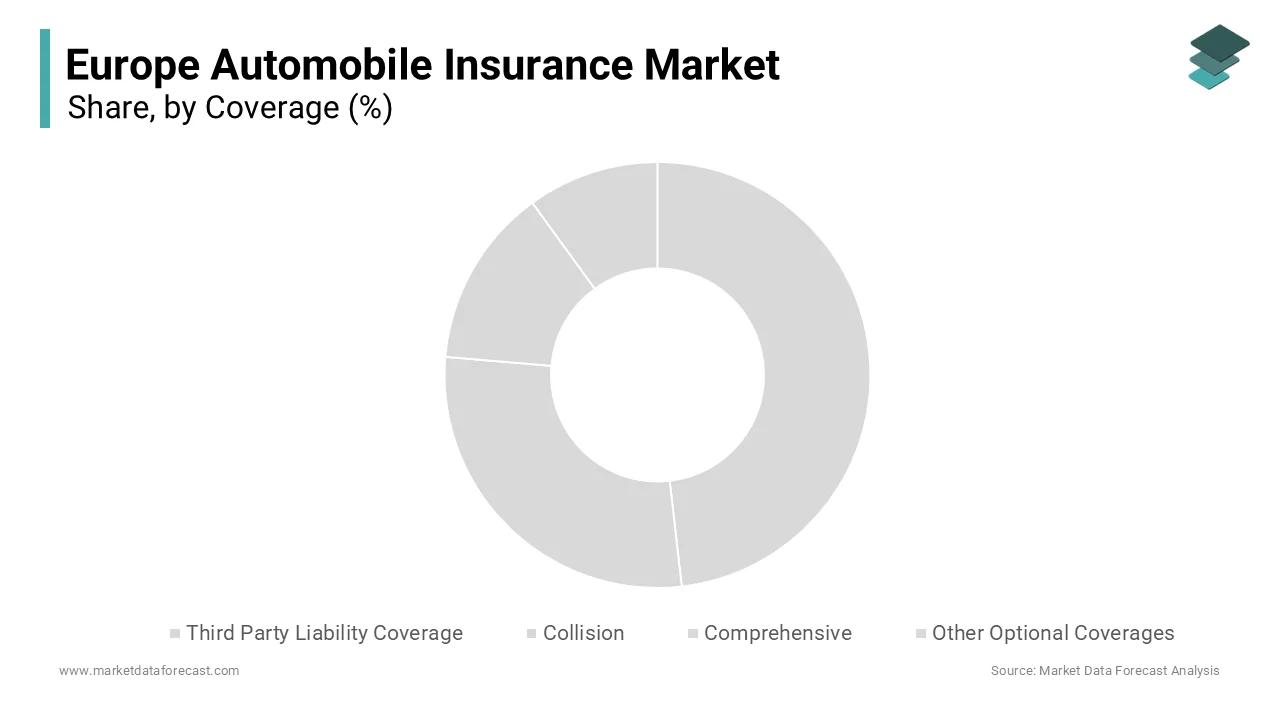
- Based on coverage, the third party liability insurance segment accounted for 58.3% of the Europe automobile insurance market share in 2024. The dominance of this segment is largely attributed to government regulations across European countries that mandate third party insurance coverage for all registered vehicles.
- Based on vehicle age, the used vehicles segment held a significant share of the Europe automobile insurance market in 2024. The large number of used vehicles in operation across Europe and the need for affordable insurance policies for older vehicles are contributing to the growth of this segment.
Regional Insights
- The Europe automobile insurance market is experiencing steady growth across major economies due to increasing vehicle ownership, strict insurance regulations, and rising demand for digital insurance services.
- Germany was the largest contributor, accounting for 22.3% of the Europe automobile insurance market share in 2024. The country’s large automotive fleet, well established insurance industry, and strong regulatory framework for vehicle insurance are supporting market growth.
Competitive Landscape
The Europe automobile insurance market is highly competitive with the presence of major global and regional insurance providers focusing on digital transformation, personalized insurance solutions, and advanced risk analytics. Companies are investing in telematics technologies, artificial intelligence driven underwriting, and customer centric digital platforms to strengthen their market position. Prominent players in the Europe automobile insurance market include PICC, Progressive Corporation, Allianz SE, Ping An Insurance, AXA, Sompo Japan, Tokyo Marine, Travelers Group, Liberty Mutual Group, Zurich, and CPIC.
Europe Automobile Insurance Market Size
The Europe automobile insurance market size was valued at USD 890.04 billion in 2025 and is projected to reach USD 1,479.62 billion by 2034 from USD 941.75 billion in 2026, growing at a CAGR of 5.81%.
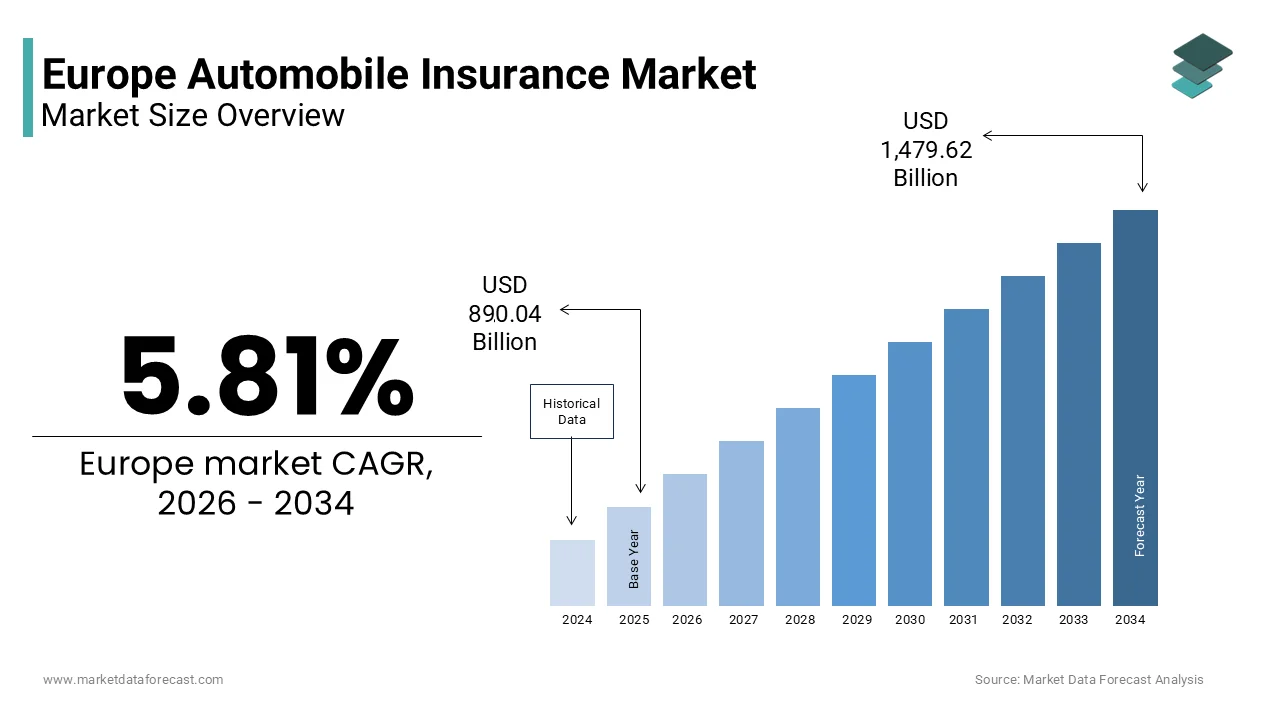
The automobile insurance is a mandatory financial protection mechanism covering third party liability and optional comprehensive coverage for vehicle owners, across the European Union and associated states. The highly regulated framework overseen by the European Insurance and Occupational Pensions Authority, which enforces solvency standards data transparency and cross border claim handling protocols. According to Eurostat, many motor vehicles were registered in the EU at the end of 2025 reflecting sustained car ownership, despite urban mobility shifts. The European Commission’s Road Safety Programme notes that road fatalities declined to 19600 in 2025, yet property damage claims remain elevated due to rising vehicle complexity. These forces are reshaping risk assessment models product design and customer engagement strategies across a landscape where regulatory compliance and technological adaptation intersect.
MARKET DRIVERS
Mandatory Third-Party Liability Coverage Sustains Universal Market Penetration
The legal requirement for third party motor insurance across all European jurisdictions ensures near universal participation by creating a stable foundational demand base irrespective of economic cycles. The mandatory third-party liability coverage is eventually leveraging the growth of Europe automobile insurance market. As per the European Commission’s implementation review of the Motor Insurance Directive, all 27 member states enforce compulsory coverage with minimum indemnity limits of 1.3 million euros for personal injury and 1.2 million euros for property damage per claim. This mandate applies to every registered vehicle including seasonal or rarely used cars generating consistent premium inflows. According to the European Transport Safety Council, over 99.4% of EU vehicles held valid insurance in 2025 with national databases like France’s Fichier des Vehicules Assures enabling real time verification by law enforcement. Non-compliance penalties are severe in Germany uninsured drivers face fines up to 10000 euros and vehicle impoundment. This regulatory backbone eliminates demand volatility seen in discretionary insurance lines and guarantees baseline revenue for insurers while enabling cross border enforcement through the Green Card system.
Rising Vehicle Repair Costs Amplify Comprehensive Coverage Demand
The increasing complexity and cost of modern vehicle repairs drive sustained demand for comprehensive automobile insurance policies is propelling the growth of Europe automobile insurance market. Advanced driver assistance systems sensors cameras and lightweight composite materials significantly inflate post collision repair bills. According to the European Association of Automotive Suppliers, replacing a single front radar sensor on a mid-range vehicle now costs an average of 2800 euros while recalibration adds another 650 euros. The German Insurance Association reports that average repair costs per claim rose annually between 2022 and 2025 for vehicles equipped with Level 2 automation. Electric vehicles exacerbate this trend, where battery pack replacements often exceed 15000 euros making total loss declarations more frequent. Consequently, consumers increasingly opt for comprehensive coverage to avoid catastrophic out of pocket expenses.
MARKET RESTRAINTS
Fragmented National Regulatory Frameworks Increase Operational Complexity
Despite EU harmonization efforts, significant disparities in national motor insurance regulations impose substantial compliance burdens on cross border operators. The fragmented National regulatory frameworks increase operational complexity is hampering the growth of Europe automobile insurance market. Each member state maintains distinct rules on no claims discounts bonus malus systems uninsured motorist compensation funds and claims settlement timelines. According to the European Insurance and Occupational Pensions Authority, insurers operating in five or more EU countries incur 35 to 50% higher administrative costs than domestic players due to duplicated reporting and localized policy wording. For instance, Italy requires pre-authorization for repairs exceeding 2000 euros, while Sweden mandates direct compensation from the policyholder’s own insurer regardless of fault. The European Court of Justice ruled in 2024 that such divergences violate the principle of free movement yet full alignment remains distant. These inconsistencies hinder pan European product standardization increase legal risk and deter entry by smaller insurers lacking regulatory expertise thereby reducing competition and consumer choice in several jurisdictions.
Data Privacy Restrictions Limit Telematics Based Risk Assessment
The stringent General Data Protection Regulation constrains the collection processing and retention of driving behavior data essential for usage-based insurance models, which is also hindering the growth of Europe automobile insurance market. While telematics can reduce premiums for safe drivers GDPR mandates explicit informed consent granular data minimization and the right to erasure, features that complicate continuous monitoring. According to the European Data Protection Board, over 22 enforcement actions targeted auto insurers in 2024 for unlawful retention of geolocation or braking pattern data beyond policy term. Consequently, many insurers offer only basic mileage based discounts rather than dynamic risk scoring. In Germany, the Federal Court of Justice invalidated clauses allowing automatic data transmission from connected cars without annual re-consent. These restrictions prevent European insurers from replicating the granular pricing seen in less regulated markets, thereby limiting personalization potential and slowing adoption of behavior based products despite proven safety benefits demonstrated in pilot programs by AXA and Allianz.
MARKET OPPORTUNITIES
Integration of Embedded Insurance in Vehicle Sales Channels Creates New Distribution Avenues
The automakers and dealerships are increasingly embedding insurance offerings directly into the vehicle purchase journey creating seamless point of sale conversion opportunities. The integration of embedded insurance in vehicle sales channels is leveraging new opportunities for the growth of Europe automobile insurance market. According to the European Automobile Manufacturers Association, over 60% of new car buyers in 2025 opted for manufacturer backed insurance packages often bundled with maintenance plans. Companies like Volkswagen Financial Services and Stellantis Insurance leverage OEM data on vehicle specifications driving patterns and warranty history to offer instant tailored quotes. In France, PSA Group’s partnership with MAIF enables real time policy issuance during online car configuration. This embedded model reduces acquisition costs increases policy duration and enhances customer lifetime value. It aligns with EU digital finance regulations promoting open banking style data sharing through standardized APIs.
Electric Vehicle Specific Products Unlock Premium Differentiation
The rapid adoption of electric vehicles necessitates specialized insurance products addressing unique risk factors, such as battery degradation charging infrastructure damage and high voltage system hazards. The rising number of electric vehicles with advanced features is also prompting the growth of Europe automobile insurance market. According to the International Energy Agency, over 3.2 million battery electric vehicles were newly registered in the EU in 2025 representing 24% of total car sales. Insurers respond with EV specific policies covering battery replacement mobile charging unit theft and home charger installation damage. Allianz launched a pan European EV policy in 2024 including roadside assistance with mobile battery top up units while Zurich partnered with IONITY to offer discounted premiums for users of its fast-charging network. Moreover, EVs exhibit 20% fewer collision claims than internal combustion counterparts as per Swiss Re data enabling competitive pricing.
MARKET CHALLENGES
Ambiguity in Automated Driving Liability Frameworks Delays Product Innovation
The absence of clear legal attribution for accidents, involving automated driving systems creates underwriting uncertainty that stifles development of next generation insurance products. The ambiguity in automated driving liability frameworks is one of the challenges for the growth of Europe automobile insurance market. While the EU’s Automated Driving Act establishes manufacturer responsibility for Level 3 and above systems during active automation national courts still apply traditional driver centric liability doctrines in practice. According to the European Transport Safety Council, Level 2 incidents in 2025 resulted in contested claims between policyholders and OEMs due to unclear handover protocols. Insurers lack actuarial data on system failure rates sensor reliability or cyber intrusion risks making accurate pricing impossible. The European Insurance and Occupational Pensions Authority acknowledges this gap but defers to future type approval regulations expected only by 2027.
Climate Change Induced Extreme Weather Events Escalate Physical Damage Claims
The increasing frequency and severity of climate related weather events, elevate physical damage claims for parked vehicles exposed to hailstorms floods and wildfires. The climate change induced extreme weather events is also to impede the growth of Europe automobile insurance market. According to the European Environment Agency, the number of severe convective storm days rose by between 2020 and 2025 with Germany, France, and Italy, experiencing record hail damage. These events strain reinsurance capacity and force premium hikes in affected regions. Compounding the issue standard policies rarely exclude weather perils making comprehensive coverage increasingly costly. Without advanced predictive modeling and real time weather integration insurers struggle to adjust territorial risk scores dynamically leaving portfolios exposed to acute climate volatility that traditional actuarial methods fail to capture.
REPORT COVERAGE
| REPORT METRIC | DETAILS |
| Market Size Available | 2025 to 2034 |
| Base Year | 2025 |
| Forecast Period | 2026 to 2034 |
| CAGR | 5.81% |
| Segments Covered | By Coverage, Distribution Channel, Vehicle Age, Application, and Region |
| Various Analyses Covered | Global, Regional, & Country Level Analysis; Segment-Level Analysis; DROC, PESTLE Analysis; Porter’s Five Forces Analysis; Competitive Landscape; Analyst Overview of Investment Opportunities |
| Regions Covered | UK, France, Spain, Germany, Italy, Russia, Sweden, Denmark, Switzerland, Netherlands, Turkey, and the Czech Republic |
| Market Leaders Profiled | PICC, Progressive Corporation, Allianz SE, Ping An Insurance, AXA, Sompo Japan, Tokyo Marine, Travelers Group, Liberty Mutual Group, Zurich, and CPIC |
SEGMENTAL ANALYSIS
By Coverage Insights
The third party liability insurance segment was accounted in holding 58.3% of the Europe automobile insurance market share in 2024. The growth of the segment was driven by its universal legal requirement and appeal to cost conscious drivers, particularly in Southern and Eastern Europe. As per the European Commission’s Motor Insurance Directive, all EU member states enforce compulsory third-party coverage with minimum indemnity limits ensuring baseline adoption across 248 million registered vehicles. In countries like Italy, Spain, and Poland, where average disposable income remains below the EU median consumers often opt for statutory minimum policies to reduce expenses. According to the Italian Insurance Supervisory Authority, vehicles in southern regions hold only third party coverage due to economic constraints. Similarly, Spain’s Directorate General of Insurance reports that policies issued in 2025 were liability only reflecting post pandemic budget tightening.
The comprehensive motor insurance segment is projected to register a fastest CAGR of 6.8% from 2025 to 2033. The growth of the segment is expected to grow with the electric and advanced driver assistance system equipped vehicles, necessitates comprehensive coverage due to exorbitant repair and replacement costs. According to the International Energy Agency, battery electric vehicle registrations in the EU reached 3.2 million in 2025 representing 24% of new car sales. These vehicles feature expensive components such as lithium-ion battery packs costing up to 15000 euros and radar sensor arrays requiring precise recalibration after minor collisions. Consequently, lenders increasingly mandate comprehensive insurance as a condition for auto loans. Automakers are integrating comprehensive insurance directly into vehicle sales channels creating seamless point of sale conversion. Volkswagen Financial Services and Stellantis Insurance leverage real time vehicle data to offer instant tailored quotes during online configuration. Volvo’s Care by Volvo subscription includes comprehensive insurance with EV specific coverages like mobile battery top up in Sweden. These embedded models reduce acquisition friction increase policy duration and command premium pricing due to perceived convenience and OEM trust.
By Vehicle Age Insights
The used vehicles segment held a significant share of the Europe automobile insurance market share in 2024 owing to the aging car fleet and economic realities of vehicle ownership. In Italy, over 78% of registered vehicles are more than 10 years old, while Poland’s Central Statistical Office notes that used imports from Germany and France constitute major annual registrations. These older vehicles are typically insured under third party liability policies due to lower residual value and higher mechanical risk deterring comprehensive coverage. Insurers respond with simplified underwriting and telematics lite offerings that monitor mileage rather than driving behavior. The sheer volume of used cars ensures this segment dominates policy counts despite lower average premiums creating a high frequency low severity claims environment that shapes operational strategies across the country. New vehicles generate disproportionate premium income due to mandatory comprehensive coverage under lease and loan agreements and higher insured values linked to advanced technology features.
The new vehicle insurance segment is expected to witness a fastest CAGR of 7.2% during the forecast period. As electric vehicle adoption accelerates lenders, increasingly require comprehensive insurance to protect collateral value. According to the study, over 92% of EV leases in 2025 included all risk policies as standard terms due to high residual value uncertainty and repair complexity. Battery degradation and charging infrastructure damage represent novel risks that only comprehensive products address. In Germany, major banks like Deutsche Bank and Commerzbank updated auto loan guidelines in 2024 to mandate comprehensive coverage for all EV financings. This institutional requirement transforms insurance from optional to obligatory for new EV buyers regardless of personal risk preference. Online vehicle purchasing platforms like Cazoo and Autohero integrate real time insurance quoting during checkout using VIN specific risk scoring. According to the European Digital Commerce Association, many new car buyers in 2025 completed their purchase digitally with accepting pre-populated insurance offers. These platforms share vehicle specifications driver history and delivery location with insurer APIs by enabling instant policy issuance without manual underwriting.
REGIONAL ANALYSIS
Germany Automobile Insurance Market Analysis
Germany was the largest contributor of the Europe automobile insurance market by holding 22.3% of share in 2024 with the high premium density stringent regulatory oversight and early adoption of telematics. The Federal Financial Supervisory Authority enforces strict solvency and data transparency rules ensuring market stability. Additionally, the rise of electric mobility, over 850000 EVs registered in 2025 fuels demand for specialized policies covering battery and charging risks.
France Automobile Insurance Market Analysis
France automobile insurance market growth is propelled with its centralized and highly granular bonus malus system administered by the Agira database. According to the French Insurance Federation, policyholders held coefficients below 1.0 in 2025, reflecting strong claim discipline. The system enables precise risk segmentation allowing insurers to offer highly personalized pricing. France, also mandates third party coverage verification at vehicle registration through the Systeme d’Immatriculation des Vehicules reducing uninsured driving to below 0.6%. The growth of embedded insurance via OEMs like Renault and PSA, further modernizes distribution.
Italy Automobile Insurance Market Analysis
Italy automobile insurance market growth is leveraging with the elevated litigation rates and regional disparities in risk perception. Southern regions exhibit higher fraud incidence with staged collisions accounting for 18% of property damage claims, as per some survey. Despite these challenges, Italy maintains near universal insurance penetration due to strict enforcement, where police conduct random checks using the Public Automotive Database identifying uninsured vehicles within seconds. The government’s recent reforms cap legal fees for minor injuries reducing claim volatility. Meanwhile, the rise of pay as you drive policies in urban centers like Milan and Rome addresses congestion and pollution concerns. This complex interplay of legal culture regulatory enforcement and urban innovation defines Italy’s unique market dynamics.
United Kingdom Automobile Insurance Market Analysis
The United Kingdom automobile insurance market growth is likely to grow with the regulatory independence to pilot innovative insurance models outside EU constraints. The Financial Conduct Authority permits greater flexibility in telematics data usage enabling true pay how you drive products without GDPR style restrictions. According to the Association of British Insurers, over 1.8 million UK policies used driving behavior data for pricing in 2025 the highest penetration in Europe. The UK also leads in electric vehicle insurance with specialized products covering battery degradation and home charger damage. London’s status as a fintech hub fosters insurtech partnerships, companies like By Miles offer per mile pricing integrated with smart dashcams. This regulatory agility combined with high digital adoption sustains the UK as a testing ground for next generation auto insurance despite reduced EU market access.
Spain Automobile Insurance Market Analysis
Spain automobile insurance market growth is expected to witness a fastest CAGR in next coming years with the sharp regional divides between comprehensive uptake in affluent urban centers and third-party dominance in rural areas. However, Madrid Barcelona and coastal tourist regions show rapid growth in comprehensive coverage driven by luxury car imports and ride hailing fleets. The government’s Plan Moves III subsidy for electric vehicles includes discounted insurance partnerships with MAPFRE and Mutua Madrilena accelerating EV adoption.
COMPETITIVE LANDSCAPE
Competition in the Europe automobile insurance market is characterized by a dual dynamic between large multinational insurers and agile local specialists each leveraging distinct advantages. Global players like Allianz AXA and Zurich compete on scale technological sophistication and cross border product harmonization enabling them to serve expatriates multinational fleets and digital nomads. Conversely domestic champions such as Generali in Italy MAPFRE in Spain and Admiral in the UK thrive on deep regulatory knowledge localized pricing models and entrenched distribution networks. The market is further disrupted by insurtechs offering niche products like pay as you drive or EV only policies often backed by legacy carriers seeking innovation without brand risk. Regulatory fragmentation remains a key barrier, while the EU mandates third party coverage national rules on claims handling bonus malus systems and data usage create significant operational complexity. Success increasingly depends on balancing pan European efficiency with local responsiveness while navigating the tension between data driven personalization and stringent privacy laws.
KEY MARKET PLAYERS
Some of the notable key players in the Europe automobile insurance market are
- PICC
- Progressive Corporation
- Allianz SE
- Ping An Insurance
- AXA
- Sompo Japan
- Tokyo Marine
- Travelers Group
- Liberty Mutual Group
- Zurich
- CPIC
Top Players in the Market
- Allianz SE is a Germany headquartered global insurance leader with deep integration across the European automobile insurance landscape through its multi country operating model and advanced telematics platforms. The company offers tailored motor policies in over 20 European markets combining traditional underwriting with real time driving behavior analysis via its MyDrive app. Allianz has pioneered electric vehicle specific coverage including battery degradation protection mobile charging assistance and cyber security extensions for connected cars. In 2025 it launched a pan European usage-based insurance product that adjusts premiums monthly based on verified mileage and driving smoothness using smartphone sensors. The firm also partners with Volkswagen Group to embed insurance quotes directly into vehicle configuration portals across Germany France and Italy. These initiatives reinforce Allianz’s position as a technology enabled insurer aligned with Europe’s mobility transformation.
- AXA SA is a France based multinational insurer leveraging its centralized data infrastructure and regulatory expertise to dominate automobile insurance, across Western and Southern Europe. The company utilizes France’s Agira bonus malus database to deliver hyper personalized pricing while complying with GDPR through on device data processing. AXA has integrated artificial intelligence into claims handling reducing average settlement time for minor collisions to under 48 hours across its European operations. It introduced a green driving discount rewarding low emission routes and eco-friendly acceleration patterns monitored via its DriveSense platform. AXA also collaborates with Stellantis to offer instant comprehensive insurance during online car purchases in Spain, Italy, and Belgium.
- Zurich Insurance Group Ltd is a Switzerland headquartered global insurer with a strategic focus on commercial auto and high net worth personal motor insurance across Northern and Central Europe. The company differentiates through embedded risk engineering services offering clients fleet safety audits driver training and real time vehicle health monitoring. Zurich has developed specialized policies for electric vehicle fleets covering battery performance guarantees and charging infrastructure liability. It partnered with IONITY to provide discounted premiums for corporate clients using its fast charging network across Germany Netherlands and Sweden. Zurich also leads in climate resilient pricing by integrating flood and hail risk maps from the European Environment Agency into territorial premium adjustments.
Top Strategies Used by the Key Market Participants
Key players in the Europe automobile insurance market invest heavily in telematics and smartphone based driving behavior monitoring to enable usage based pricing while ensuring GDPR compliance through on device data processing. They form strategic partnerships with automakers and digital car retailers to embed insurance offerings directly into vehicle purchase journeys. Companies develop electric vehicle specific policies covering battery degradation charging infrastructure damage and cyber risks associated with connected cars. Insurers leverage national bonus malus databases and centralized claims records to refine risk segmentation and personalize premiums. Additionally, firms integrate climate risk data and urban low emission zone regulations into territorial pricing models to reflect evolving environmental liabilities.
MARKET SEGMENTATION
This research report on the European automobile insurance market has been segmented and sub-segmented based on categories.
By Coverage
- Third Party Liability Coverage
- Collision
- Comprehensive
- Other Optional Coverages
By Distribution Channel
- Insurance Agents/Brokers
- Direct Response
- Banks
- Others
By Vehicle Age
- New Vehicles
- Used Vehicles
By Application
- Personal
- Commercial
By Country
- UK
- France
- Spain
- Germany
- Italy
- Russia
- Sweden
- Denmark
- Switzerland
- Netherlands
- Turkey
- Czech Republic
- Rest of Europe