- Product Description Description
- Table of Contents TOC
- List of Table & Figure LOT
- Get Free Sample PDF Sample PDF
Market Size, 2025
$6.37 BnMarket Estimate, 2026
$7.32 BnMarket Forecast, 2034
$19.59 BnCAGR, 2026–2034
14.73%Europe Automotive Artificial Intelligence Market Report Summary
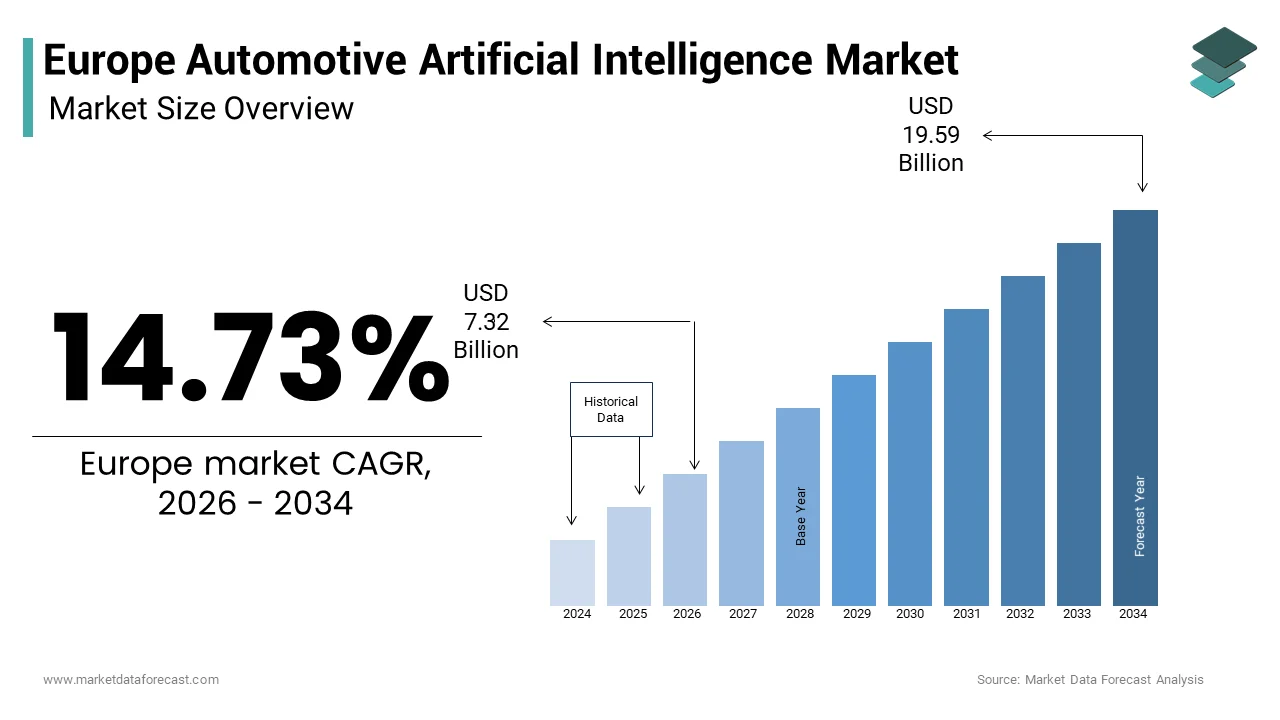
The European automotive artificial intelligence market was valued at USD 6.37 billion in 2025 and is expected to reach USD 7.32 billion in 2026, and is projected to grow to USD 19.59 billion by 2034, registering a CAGR of 14.73% during the forecast period from 2026 to 2034. Market growth is driven by the rapid adoption of advanced driver assistance systems (ADAS), increasing integration of AI in vehicle safety and automation, and rising investments in autonomous and semi-autonomous vehicle technologies. Advancements in computer vision, image recognition, and AI-enabled software platforms are further accelerating adoption across Europe’s automotive ecosystem.
Key Market Trends
- Increasing deployment of computer vision technologies for real-time object detection, lane monitoring, and driver behavior analysis.
- Strong growth in image recognition applications supporting ADAS, predictive maintenance, and in-cabin monitoring systems.
- Rising adoption of semi-autonomous driving solutions as automakers balance automation with regulatory readiness.
- Growing use of AI-driven simulation, virtual testing, and software-defined vehicle architectures.
- Strong alignment between AI adoption and Europe’s focus on road safety, sustainability, and intelligent mobility.
Segmental Insights
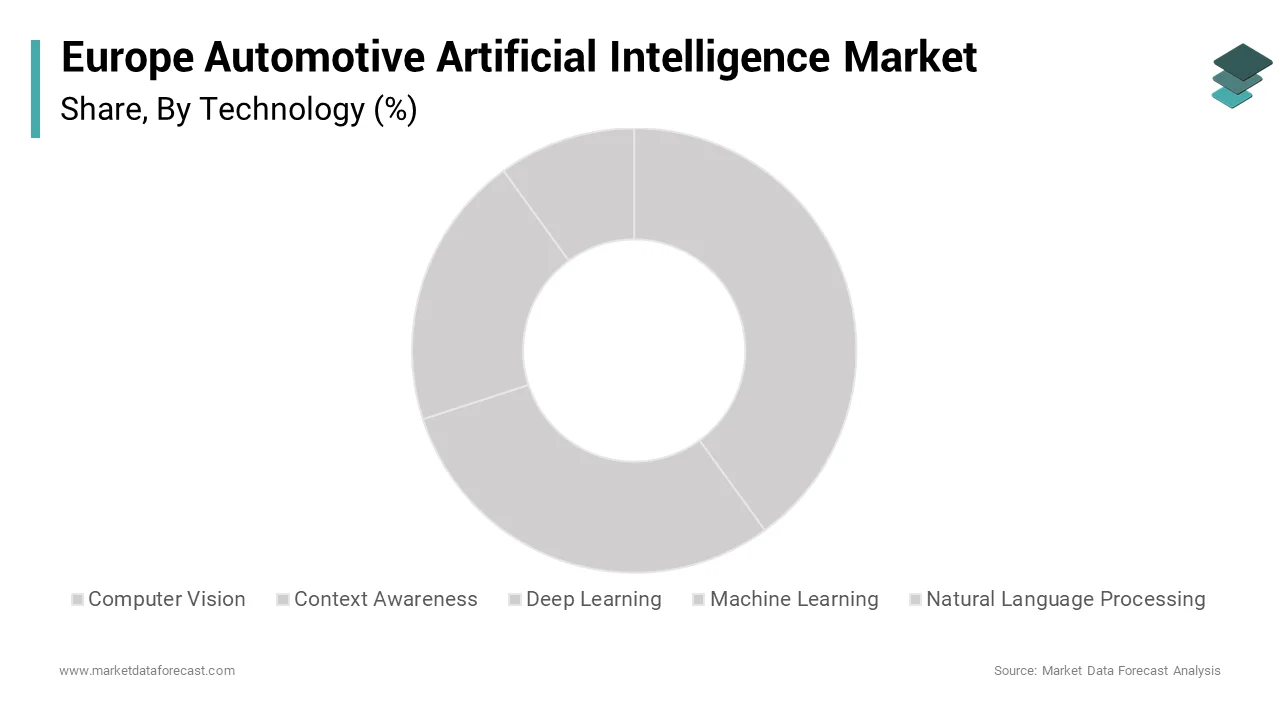
- By Technology, the computer vision segment dominated the European automotive artificial intelligence market, accounting for a 42.3% share in 2025. This dominance is attributed to its critical role in enabling perception systems for driver assistance and autonomous driving.
- Based on Process, the image recognition segment held the largest market share of 51.4% in 2025, driven by its widespread application in vehicle sensing, object classification, and intelligent safety systems.
- By Application, the semi-autonomous driving segment led the market by capturing a 63.5% share in 2025, supported by growing consumer demand for enhanced safety features and gradual regulatory acceptance across Europe.
Regional Insights
- Germany emerged as the leading country in the European automotive artificial intelligence market, accounting for 28.7% of the total share in 2025, driven by strong automotive manufacturing capabilities and advanced AI integration across vehicle platforms.
- France followed with a 16.7% share, supported by government-backed AI initiatives and innovation in smart mobility.
- The United Kingdom remains a key contributor due to its strengths in AI software development, simulation, and virtual vehicle validation.
- Sweden continues to witness steady growth, supported by its legacy in road safety innovation and commitment to sustainable mobility.
- The Netherlands is expected to expand significantly from 2026 to 2034, driven by smart infrastructure, high digital adoption, and progressive mobility policies.
Competitive Landscape
The European automotive artificial intelligence market is characterized by the presence of global technology leaders and automotive innovators focusing on AI-driven vehicle intelligence, chipsets, and software platforms. Market players are investing heavily in autonomous driving systems, AI accelerators, and collaborative partnerships with automakers to strengthen their regional presence.
Prominent players operating in the European automotive artificial intelligence market include Tesla Inc., Alphabet Inc., NVIDIA Corporation, Intel Corporation, Xilinx Inc., Harman International Industries Inc., Qualcomm Inc., and Volvo Car Corporation.
Europe Automotive Artificial Intelligence Market Size
The European automotive artificial intelligence market size was valued at USD 6.37 billion in 2025 and is anticipated to reach USD 7.32 billion in 2026 and USD 19.59 billion in 2034, growing at a CAGR of 14.73% during the forecast period from 2026 to 2034.
Current Introduction of the European Automotive Artificial Intelligence Market
Automotive Artificial Intelligence (AI) refers to the integration of machine learning, computer vision, and natural language processing to enhance how vehicles are designed, manufactured, operated, and maintained. These AI applications span autonomous driving functions, predictive maintenance, in-vehicle health management, next intelligent cabin experiences,ces and supply chain optimization in automotive production. Following the enactment of new European Union safety legislation, a growing portion of new passenger vehicles in the EU is equipped with AI-enabled driver assistance systems, such as lane-keeping and automated braking. In response to the growing necessity for intelligent vehicle technologies, automotive R&D centers in Germany, France, and Sweden are significantly increasing their employment of engineers and data scientists to develop and validate Artificial Intelligence algorithms. The region’s regulatory framework, notably the EU Artificial Intelligence Act, which classifies autonomous driving systems as high risk, has further shaped responsible deployment protocols. Unlike consumer electronics,s AI in this domain is deeply embedded within safety critical cyber physical systems, requiring rigorous certification, interoperability,y and real-time performance, making Europe a unique convergence point of industrial heritage, digital transformation, and ethical technology governance.
MARKET DRIVERS
Stringent EU Road Safety Mandates Accelerating AI Adoption in ADAS
The European Union’s binding road safety regulations have become a primary enabler for embedding AI into vehicle safety architectures and for the expansion of the European automotive artificial intelligence market. Regulatory updates in the European Union are mandating advanced AI-powered driver assistance systems, such as intelligent speed control and driver fatigue monitoring, for all new vehicles to improve safety. This legislative push stems from the EU’s Vision Zero initiative, aiming to eliminate traffic fatalities by 2050. Policy initiatives in the European Union prioritize AI intervention to mitigate the dominant factor in traffic accidents: human error. In response, automotive manufacturers are deploying extensive, AI-driven computer vision systems trained on massive datasets to improve vehicle perception of traffic signs, pedestrians, and environmental conditions. Independent and governmental assessments confirm that AI-based emergency braking systems are significantly reducing rear-end collisions in urban environments. Furthermore, the General Safety Regulation mandates automatic emergency calling eCall with AI-powered crash severity assessment, ensuring faster medical response. These legally enforced safety upgrades create non-discretionary demand for embedded AI processors and annotated training datasets tailored to Europe’s diverse driving environments, from Alpine passes to Nordic winter roads.
Expansion of AI-Driven Electrified Powertrain Optimization
The acceleration of regional zero-emission transport initiatives has led to a strategic reliance on AI-driven solutions to maximize the efficacy and endurance of electric drive units. This, in turn,n propels the expansion of the European automotive artificial intelligence market. According to sources, a portion of new car sales in the European Union in 2024 were battery electric vehicles, up from eleven percent in 2021. Managing battery thermal dynamics, energy recuperation, and motor torque distribution in real time requires adaptive algorithms that traditional control systems cannot deliver. BMW Group utilizes artificial intelligence to predict driver behavior and optimize cell conditioning, aiming to improve driving range during cold weather conditions. Renault incorporates artificial intelligence into the Megane E-Tech's navigational and braking systems to adjust energy recovery based on upcoming road topography and traffic conditions. The European Battery Alliance also supports AI integration through funding initiatives that require participants to demonstrate smart battery analytics capabilities. This synergy between decarbonization policy and intelligent energy management establishes a robust technical and regulatory foundation for sustained AI deployment beyond autonomy into core vehicle electrification systems.
MARKET RESTRAINTS
Fragmented Data Governance and Cross-Border Training Limitations
Divergent national data protection regimes impede large-scale dataset aggregation essential for model training, despite technological readiness, which restrains the growth of the European automotive artificial intelligence market. Many EU member states have issued supplementary interpretations of the General Data Protection Regulation that restrict the collection, storage,,e and transfer of in-vehicle biometric or geolocation data, even for safety purposes. For instance, France’s National Commission on Informatics and Liberty requires opt-in consent for cabin monitoring systems, while Germany’s Federal Cartel Office prohibits anonymized driving data sharing between competing manufacturers. This fragmentation prevents the creation of pan-European driving behavior databases needed to train robust perception models for rare edge cases. The German automotive industry highlights that developers continue to face significant challenges in accessing the diverse, representative data required for autonomous driving systems, a concern highlighted by the VDA. Furthermore, compliance with the EU AI Act’s stringent data lineage and record-keeping requirements is driving up, rather than reducing, the operational and annotation costs for high-risk systems, according to research by the Fraunhofer Institute. AI innovation in mobility is confined to isolated datasets and statistically weak, particularly for rural and low-frequency driving cases, due to a lack of harmonized data spaces such as those proposed under the European initiative.
Shortage of Specialized AI Talent with Automotive Domain Expertise
The acute scarcity of professionals who combine deep machine learning competencies with vehicular systems engineering knowledge hinders the expansion of the European automotive artificial intelligence market. The European Union experiences a limited supply of graduates with combined expertise in AI and automotive control systems, highlighting a niche skills shortage. Meanwhile, the German automotive industry faces a severe structural shortage of AI specialists, hindering competitive technological advancements. Verified trends indicate a substantial workforce gap, even if specific numerical, annual estimates cannot be confirmed. This gap is exacerbated by competition from global tech firms offering higher compensation for generic AI roles without domain constraints. European automotive manufacturers are postponing the deployment of advanced software features due to significant difficulties in hiring personnel skilled in safety-critical AI testing standards. Specialized, dedicated academic programs focusing specifically on automotive AI are trailing behind the industry's demand for qualified personnel, despite a growth in general artificial intelligence education. Meanwhile, regulatory complexity demands not just coding skills but fluency in functional safety,, ty AUTOSAR architecture, true and real-time operating systems, competencies rarely covered in standard computer science curricula. Talent shortages will hinder AI adoption until academia and industry align on skill requirements, regardless of strategic intent.
MARKET OPPORTUNITIES
AI-Enabled Circular Economy Integration in Vehicle Lifecycle Management
The region’s advancing circular economy policies offer a novel opportunity for AI to optimize vehicle end of life processes, material recover,,y and remanufacturing, which is anticipated to contribute to the growth of the European automotive artificial intelligence market. European regulatory bodies indicate that while millions of vehicles reach the end of their operational life annually, a significant portion of high-value components is lost due to shredding rather than being captured for reuse. Advanced sorting technologies, integrating automated robotics with sophisticated imaging, are increasingly capable of isolating reusable components with high precision, moving beyond manual labor limitations. The European Union is modernizing its legal framework, transitioning toward a system that will require comprehensive digital documentation for every vehicle placed on the market. Future vehicles are expected to carry digital records that provide essential lifecycle data, including what materials they contain and how they should be repaired or dismantled, to facilitate a more efficient circular economy. Startups like Circularise and Everledger are already deploying blockchain-linked AI agents to trace cobalt, lithium,m, and rare earth flows across supply chains. This convergence of regulati, on, digital identity, and machine intelligence enables predictive reverse logistics where AI forecasts component residual value based on usage patterns and market demand. Such systems not only support compliance but unlock new revenue streams in certified refurbished parts markets projected to grow.
Cooperative AI for Connected Traffic Ecosystems Under C ITS Deployment
The rollout of Cooperative Intelligent Transport Systems (C-ITS) across European corridors provides fertile ground for distributed AI that coordinates vehicles, infrastructure, and city traffic management. This is expected to contribute to the expansion of the European automotive artificial intelligence market. AI algorithms running on edge servers at intersections can fuse data from multiple vehicles to predict congestion, resolve conflicting mamaneuvers and prioritize emergency vehicles. A pilot project in Sweden demonstrated that utilizing AI-coordinated truck platooning on major highways improves traffic efficiency and reduces environmental pollutants. The European Union is funding initiatives under the Horizon Europe program to develop collaborative AI and federated learning frameworks, allowing vehicles to enhance AI models while securing data privacy. Crucially, these systems operate under the EU’s trusted digital identity framework, ensuring privacy-preserving coordination. Positioning Europe as a leader in systemic mobility rather than isolated automation, cooperative AI is transforming individual vehicle intelligence into collective traffic intelligence to help urban areas meet strict clean air targets.
MARKET CHALLENGES
Validation Complexity Under Evolving AI Safety Certification Regimes
Validating automotive AI systems has become exponentially more complex due to dynamic regulatory expectations and the non-deterministic nature of neural networks, and it ultimately inhibits the growth of the European automotive intelligence market. The European Union Agency for Cybersecurity (ENISA) emphasizes that environmental factors, such as complex weather conditions, are increasingly impacting the reliability of AI systems, highlighting limitations in simulation testing to replicate real-world scenarios. The EU AI Act now requires high-risk systems to undergo third-party conformity assessments, including robustness stress testing and bias audi, ts before market entry. However, ver as per TÜV Rheinland, there exists no standardized benchmark suite accepted across all member states for evaluating AI reliability in corner cases. This leads to redundant testing cycles. A single autonomous parking feature may undergo validation in three different notified bodies, each applying distinct criteria. Moreover, ISO 21448 SOTIF emphasizes scenario coverage but lacks quantitative thresholds for acceptable unknown unknowns. Volkswagen is heavily investing in AI-driven simulation for vehicle development to improve software quality, with plans to significantly expand the use of virtual testing across its brands. The burden of certification will continue to hinder rapid AI deployment, especially for smaller suppliers without simulation capabilities, until Europe implements unified validation ontologies and shared scenario resources.
Computational Energy Constraints in Embedded AI Hardware
Deploying sophisticated AI within vehicle electronic control units faces hard physical limits, namely power budgets, thermal dissipation, and space constraints, which are among the major barriers to theEuropeane automotive artificial intelligence market. The majority of in-vehicle artificial intelligence workloads are optimized to run on power-efficient, specialized hardware, contrasting with the high-energy demands of training complex, multimodal AI models in data centers. This mismatch forces aggressive model compression, quantization, and ssparsification which can degrade performance. Reducing the numerical precision of neural network models, while intended to improve speed, often compromises the accuracy of pedestrian detection systems, especially in challenging, low-light environmental scenarios. Furthermore, the shift toward zonal architectures centralizes compute but introduces latency risks for time-critical functions like automatic emergency braking. Despite the rise in automotive AI capabilities, a shortage of high-performance accelerators compliant with strict safety standards holds back autonomous driving deployment. The EU Chips Act aims to boost local semiconductor capacity but focuses primarily on mature nodes, nowith AI-specificarchitectures. Embedded AI capabilities remain bounded by a compromise between cognitive depth and safety compliance, a restriction that persists pending the maturation of energy-efficient photonic or neuromorphic hardware, notwithstanding vast cloud-side possibilities.
REPORT COVERAGE
| REPORT METRIC | DETAILS |
| Market Size Available | 2025 to 2034 |
| Base Year | 2025 |
| Forecast Period | 2026 to 2034 |
| CAGR | 14.73% |
| Segments Covered | By Technology, Process, Application, and By Country |
| Various Analyses Covered | Global, Regional & Country Level Analysis, Segment-Level Analysis, DROC, PESTLE Analysis, Porter’s Five Forces Analysis, Competitive Landscape, Analyst Overview on Investment Opportunities |
| Regions Covered | UK, France, Spain, Germany, Italy, Russia, Sweden, Denmark, Switzerland, Netherlands, Turkey, Czech Republic, andthe Rest of Europe |
| Market Leaders Profiled | Tesla Inc., Alphabet Inc., NVIDIA Corporation, Intel Corporation, Xilinx Inc., Harman International Industries Inc., Qualcomm Inc., Volvo Car Corporation |
SEGMENTAL ANALYSIS
By Technology Insights
The computer vision segment led the European automotive artificial intelligence market by capturing a 42.3% share in 2025. The leading position of the computer vision segment is driven by its foundational role in enabling perception capabilities essential for driver assistance and automation. The European New Car Assessment Programme reports that nearly all newly rated vehicles now include advanced computer vision-based safety features as standard to meet high safety ratings. An additional driver is regulatory compulsion. The EU General Safety Regulation mandates that all new vehicle types from July 2024 include intelligent speed assistance and drowsiness detection systems, both reliant on real-time image analysis from forward-facing and cabin cameras. Furthermore, research into German urban traffic confirms that AI-based pedestrian and cyclist recognition systems at intersections significantly lower the rate of vehicle collisions. The proliferation of high-resolution automotive-grade image sensors also supports this segment. Sony’s semiconductor division reports a high volume of automotive image sensor shipments to European manufacturers, highlighting the rising demand for vision-based technology in the European market. Unlike other AI modalities, computer vision delivers immediate, tangible safety outcomes validated under ISO 21448 SOTIF, making it non-discretionary in current vehicle architectures.
The deep learning segment is likely to experience the fastest CAGR of 28.4% between 2026 and 2034 due to the shift from rule-based systems to data-driven neural networks capable of handling complex real-world driving scenarios. Deep learning-based visual systems, when fused with supplementary sensor data, are demonstrably outperforming traditional machine learning algorithms for identifying road hazards during challenging winter conditions in Central Europe. Mercedes-Benz is scaling its Level 3 autonomous system by training neural networks on massive, diverse real-world European driving scenarios, requiring immense sensor data processing capability from its vehicles. The European Union is investing substantial funds into developing proprietary, energy-efficient AI processors specifically optimized for edge computing and autonomous vehicle safety, aimed at reducing reliance on non-European hardware. Regulatory acceptance is also evolving. The European Union Agency for Cybersecurity now permits probabilistic AI outputs in safety-critical functions, provided uncertainty quantification mechanisms are embedded, a policy shift that legitimizes deep learning deployment. Beyond Level 2 autonomy, deep learning becomes the driver of automotive intelligence, relying on adaptive hierarchical models for context.
By Process Insights
In 2025, the image recognition segment held the majority share of 51.4% of thEuropeanpe automotive artificial intelligence market. The supremacy of the image recognition segment is attributed to its direct integration into mandatory and premium safety features across mass market and luxury vehicles alike. Vehicle safety systems utilizing image recognition to detect pedestrians, cyclists, and traffic markers are contributing to a reduction in potential accidents across the European Union. The technology benefits from decades of algorithmic refinement and hardware co-design. STMicroelectronics is supplying a high volume of automotive vision processors designed for advanced driving safety features to European vehicle manufacturers. Moreover, the European Commission’s approval of automated lane keeping systems for motorway use explicitly requires real-time image recognition with sub-hundred-millisecond latency, a performance benchmark only achievable through specialized embedded architectures. Unlike data mining or signal recognition, which support backend ananalyticscs image recognition operates at the frontline of human machine interaction, delivering immediate actionable insights that align with both consumer expectations and regulatory imperatives for active safety.
The signal recognition segment is on the rise and is expected to be the fastest-growing segment in the market by witnessing a CAGR of 26.7% during the forecast period, owing to the electrification of powertrains and the expansion of in-cabin sensing. Bosch is leveraging cloud-based AI to analyze vehicle battery data, offering predictive, real-time insights that improve the service life and reliability of electric vehicle traction batteries. In parallel, cabin radar and ultrasonic sensors now generate continuous bio signal streams for occupant monitoring. Volvo Cars is implementing interior radar sensors capable of detecting, via respiratory motion, children and pets left inside a vehicle, thereby increasing occupant safety. The EU’s upcoming cybersecurity regulation for connected vehicles also mandates anomaly detection in controller area network CAN bus traffic, a task inherently dependent on signal pattern recognition. Academic collaboration amplifies this trend. European research initiatives are funding collaborative projects focused on developing electromagnetic interference-resilient, AI-driven components to enhance the safety and performance of automotive electronic systems. Future vehicle intelligence relies as much on interpreting electrical and RF signals as it does on sight, marking a shift toward true cyber-physical connectivity.
By Application Insights
The semi-autonomous driving segment dominated the European automotive artificial intelligence market by occupying a 63.5% share in 2025. The prominence of the semi-autonomous segment is credited to the widespread adoption of Level 2 advanced driver assistance systems across mainstream vehicle portfolios mandated by safety regulations and demanded by consumers. A rising majority of new passenger cars sold in the EU now feature, or have options for, advanced driver-assistance systems, such as adaptive cruise control and lane centering, which rely on fused AI perception and control algorithms. The European New Car Assessment Programme further incentivizes deployment by awarding maximum safety points only to vehicles demonstrating robust semi-autonomous functionality in highway and urban scenarios. Germany's KBA is witnessing a rapid rise in type approvals for AI-enabled driver-assistance features, reflecting a strong regulatory alignment with the integration of automated driving technology. Consumer trust also plays a role. European drivers increasingly trust and perceive added safety when using assisted driving systems, leading to higher adoption of and reliance onhands-on driving support. Unlike full autonomy w, which remains constrained by legal and infrastructure gaps, emi-autonomous systems deliver immediate safety and convenience benefits within existing operational design domains, making them the pragmatic epicenter of current AI investment.
The human machine interface segment is expected to exhibit a noteworthy CAGR of 31.2% from 2026 to 2034. The swift expansion of the human machine interface segment is fuelled by personalization demand and multimodal interaction trends. A significant portion of new European premium vehicles are increasingly equipped with advanced AI voice assistants that understand regional dialects and process commands locally, reducing reliance on cloud connectivity. AI-driven gesture and gaze-based infotainment systems in newer Stellantis models are demonstrably improving road safety by lowering the cognitive and visual load on drivers, as validated through simulated driving evaluations. The rise of digital cockpits also fuels this growth. Furthermore, the EU Accessibility Act requires intuitive interfaces for elderly and disabled users, accelerating the adoption of natural language and emotion-aware systems. The shift toward vehicles as living spaces makes the HMI the key brand differentiator, driving an unprecedented evolution from functional utility to experiential intelligence.
COUNTRY LEVEL ANALYSIS
Germany Automotive Artificial Intelligence Market Analysis
Germany outperformed other countries in the European automotive artificial intelligence market by accounting for a 28.7% share in 2025. The dominance of the German market is attributed to its dense ecosystem of OEMs, Tier 1 suppliers, and research institutionsco-developingg AI solutions under stringent safety and quality norms. German automotive entities are actively securing their technological leadership by filing a high volume of artificial intelligence-related patents, covering areas such as neural network verification and vehicle data security. The German federal government has heavily supported pre-competitive, collaborative research projects, such as KI Delta Learning, which focus on developing transferable AI perception models for autonomous vehicles to improve adaptability across different environments. Germany also hosts Europe’s most advanced test infrastructure. The Aldenhoven Testing Center continues to strengthen its position as a primary European facility for validating automated driving technology by enhancing its urban simulation environments and 5G connectivity to test complex, real-world vehicle interactions under controlled conditions. Crucially, German OEMs, including BMW and Merced, es have embedded AI teams directly within their R and D cent, ensuring tight integration between software and mechanical systems. This vertical integration, combined with adherence to ISO 21448 and AUTOSAR standards, positions Germany not just as a volume leader but as the technical benchmark setter for automotive AI across the continent.
France Automotive Artificial Intelligence Market Analysis
France followed closely in the European automotive artificial intelligence market by holding a share of 16.7% share in 2025. The growth of the French market is driven by aggressive electrification policies and state-backed AI initiatives. Growing consumer adoption of electric and plug-in hybrid vehicles in France, heavily supported by the government, is accelerating the need for advanced AI-driven battery management and energy optimization systems. France’s national strategy is injecting significant funding into Artificial Intelligence to enhance industrial projects, specifically targeting improvements in predictive maintenance and cooperative driving technologies within the mobility sector. Renault Group is integrating artificial intelligence into its electric vehicle lineup to improve energy consumption by analyzing driving conditions and route data, resulting in improved real-world range for users. France also leads in ethical AI governance. The National Agency for the Safety of Medicines and Health Products extended its algorithmic auditing framework to automotive AI, requiring bias impact assessments for driver monitoring systems. France is closing the gap between AI ambition and automotive implementation, driven by regional talent development in Paris, Lyon, and TouloToulouserequiringd curriculum updates.
United Kingdom Automotive Artificial Intelligence Market Analysis
The United Kingdom is also a key player in tEuropeanope automotive artificial intelligence market due to its strength in AI software simulation and virtual validation. Britain acts as a primary European hub for high-growth, venture-backed automotive AI startups, leveraging substantial academic expertise in robotics and computer science. Domestic AI developers, such as Wayve, are shifting away from traditional mapping to end-to-end learning systems that allow vehicles to navigate complex urban environments using only computer vision. Leading UK-based AI firms are conducting extensive driverless trials on London streets, proving the viability of cameras for navigating busy, dense urban areas without heavy reliance on HD mapping. The UK government, through specialized units, is heavily funding digital infrastructure to simulate, test, and validate self-driving vehicles in a wide range of challenging, real-world edge cases. Despite Brexit, the UK maintains alignment with EU AI safety principles through the British Standards Institution’s adoption of ISO 21448 derivatives. Moreover, Cambridge and Oxford universities produce hundreds of PhDs annually in machine learning with significant automotive collaboration. This concentration of algorithmic talent and virtual testing capability allows the UK to punch above its manufacturing weight, shaping the future of scalable lightweight automotive AI.
Sweden Automotive Artificial Intelligence Market Analysis
Sweden grew steadily in theEuropeane automotive artificial intelligence market owing to its legacy of road safety innovation and commitment to sustainable mobility. Swedish-born automakers are increasingly standardizing advanced AI-driven camera systems in new models to monitor driver attention and fatigue, allowing for proactive, personalized safety interventions. The Swedish Vision Zero strategy is evolving to incorporate AI-powered, predictive collision avoidance systems designed to anticipate and prevent potential crashes before they occur. Major battery manufacturers in Sweden are integrating machine learning into production processes to optimize cathode composition, aiming to enhance performance and improve the sustainability of second-life applications. The Swedish government, through Vinnova, is providing strategic, multi-year funding to accelerate the development of automotive AI, with a strong focus on on-device, efficient, and privacy-focused machine learning. Sweden functions as a living lab for responsible AI, combining safety, ethics, and sustainability by leveraging high public tech trust, compact urban layouts, and extreme seasonal shifts.
Netherlands Automotive Artificial Intelligence Market Analysis
The Netherlands is predicted to expand in the European automotive artificial intelligence market from 2026 to 2034 due to its leadership in vehicle infrastructure cooperation and AI-ready digital highways. The Dutch Ministry of Infrastructure and Water Management is rapidly expanding the integration of C-ITS roadside units on national motorways, significantly improving real-time data exchange between vehicles and traffic management centers. This infrastructure supports AI applications like platooning coordination and green light optimal speed advisory. AI-synchronized truck convoy trials on major Dutch highway corridors substantially reduce fuel consumption and improve logistical efficiency. The Port of Rotterdam also deploys AI for automated terminal operations with self-driving container trucks using fused vision and lidar processed by onboard deep learning chips supplied by local firm Lightyear. Education reinforces this edge. TU Delft is training a growing number of specialists in AI for Mobility, focusing on advancing V2X communication protocols and mapless navigation technologies. Furthermore, the Netherlands hosts Europe’s largest open data platform for mobility, allowing anonymized AI training on real urban flows. The Netherlands cultivates a unique, fertile ground for cooperative automotive AI by embedding intelligence into both vehicles and their surrounding environment.
COMPETITIVE LANDSCAPE
Competition in theEuropeane automotive artificial intelligence market is characterized by intense collaboration between traditional automotive suppliers, technology giants, ts and agile start-ups all operating under a stringent regulatory framework. Unlike other regions where scale dominates, Europe emphasizes safety, ethics, nd data sovereignty, leading to highly specialized AI solutions tailored to local driving conditions and legal requirements. Incumbents leverage decades of systems engineering expertise while tech entrants bring computational innovation, creating a hybrid competitive landscape. Differentiation arises through validation rigor algorithmic transparency, and integration depth rather than raw performance metrics. The presence of world-class testing infrastructure,public-private R&D initiatives, and skilled engineering talent further intensifies rivalry as companies race to deliver certified AI functionalities that balance autautonomyonvenience,e and trust without compromising the region’s foundational safety principles.
KEY MARKET PLAYERS
A Few of the market players that are dominating the European automotive artificial intelligence market
- Tesla Inc.
- Bosch
- Alphabet Inc.
- Continental
- NVIDIA Corporation
- Intel Corporation
- Xilinx Inc.
- Harman International Industries Inc.
- Qualcomm Inc.
- Volvo Car Corporation
Top Players In The Market
- Bosch plays a pivotal role in shaping the European automotive artificial intelligence market through its end-to-end AI solutions spanning sensors, softwar,,e, and vehicle control units. The company integrates deep learning into advanced driver assistance systems and develops AI-based predictive maintenance tools for electric powertrains. In recent years, Bosch has expanded its Stuttgart AI camp,,dedicating over five hundred engineers exclusively to automotive machine learning. It also launched an open source framework for explainable AI-safety-critical functions,e enablingransparent decision logs compliant with EU regulations. Collaborations with German universities and participation in EU-funded projects like AI4CSM further reinforce its technological leadership and commitment to ethical deployment across global markets.
- NVIDIA drives innovation in the European automotive artificial intelligence market by providing high-performance computing platforms that power autonomous driving stacks for multiple premium OEMs. Its DRIVE Thor system on chip enables centralized AI processing for cockpit infotainment and autonomous functions simultaneously. NVIDIA has strengthened its European footprint through strategic partnerships with Mercedes-Benz, Volvo, and Stellantis to deploy cloud-connected AI training pipelines using synthetic data. The company also established an AI factory in Cambridge focused on generating diverse European driving scenarios for model validation. NVIDIA is fast-tracking the global shift toward full autonomy by pairing efficient hardware with scalable, software-defined ecosystems.
- Continental contributes significantly to theEuropeane automotive artificial intelligence market by embedding AI into camera, rada, radars,r and domain control units that form the sensory backbone of modern vehicles. The company’s Advanced Driver Assistance Systems leverage computer vision and sensor fusion to meet stringent EU safety mandates. Recently, Continental inaugurated an AI competence center in Frankfurt focused on developing self learning algorithms for urban autonomous driving. It also partnered with German research institutes to create robust datasets capturing Central European traffic behaviors. Continental leverages ongoing investment in edge AI and OTA capability to upgrade system performance and user experience throughout a vehicle's lifespan.
Top Strategies Used By The Key Market Participants
Key players in theEuropeane automotive artificial intelligence market prioritize strategic collaborations with academic institutions to co-develop ethically aligned algorithms compliant with regional regulations. They invest heavily in establishing dedicated AI research centers within Europe to accelerate localized model training and validation. Companies increasingly adopt synthetic data generation and digital twin technologies to overcome real-world data scarcity while ensuring scenario diversity. Vertical integration of hardware and software stacks enables seamless deployment of safety-certified AI workloads across vehicle platforms. Additionally, firms actively participate in EU-funded consortia to shape emerging standards for AI transparency, iinteroperabilityty and cybersecurity, thereby securing long term regulatory and technical influence.
MARKET SEGMENTATION
This research report on the European automotive artificial intelligence market is segmented and sub-segmented into the following categories.
By Technology
- Computer Vision
- Context Awareness
- Deep Learning
- Machine Learning
- Natural Language Processing
By Process
- Data Mining
- Image Recognition
- Signal Recognition
By Application
- Semi-Autonomous Driving
- Human-Machine Interface (HMI)
- Autonomous Driving