- Product Description Description
- Table of Contents TOC
- List of Table & Figure LOT
- Get Free Sample PDF Sample PDF
Market Size, 2025
$3.33 BnMarket Estimate, 2026
$3.58 BnMarket Forecast, 2034
$6.37 BnCAGR, 2026–2034
7.47%Europe Automotive Audio Market Size, Growth, Trends & Forecast (2026–2034)
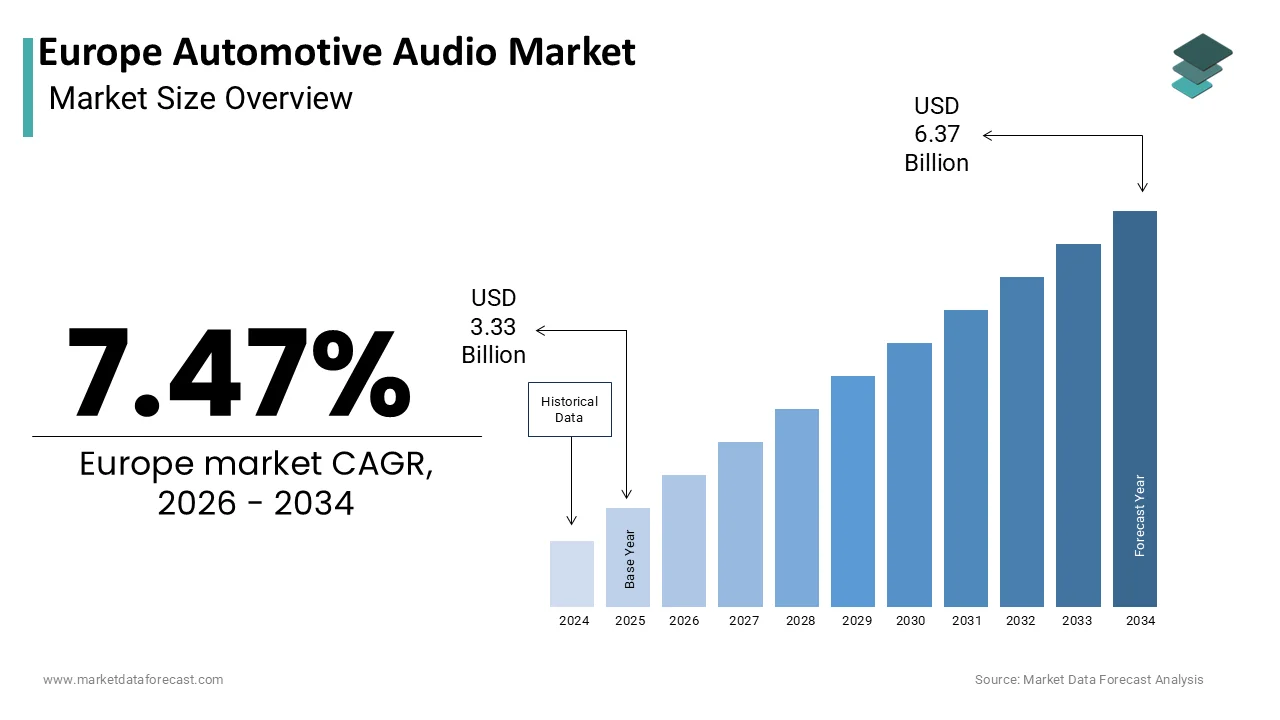
The Europe automotive audio market was valued at USD 3.33 billion in 2025, is estimated to reach USD 3.58 billion in 2026, and is projected to reach USD 6.37 billion by 2034, registering a compound annual growth rate (CAGR) of 7.47% during the forecast period from 2026 to 2034. Driven by rising consumer expectations for in-car entertainment, seamless smartphone connectivity, and the rapid adoption of electric vehicles providing quieter cabin environments, the European market continues to experience steady expansion.
Key Executive Metrics (At-a-Glance)
- 2025 Base Valuation: USD 3.33 Billion
- 2026 Current Valuation: USD 3.58 Billion
- 2034 Forecast Valuation: USD 6.37 Billion
- Compound Annual Growth Rate (CAGR): 7.47% (2026–2034)
- Leading Country Market: Germany (holding a 19.5% market share in 2025)
- Leading Component Segment: Speakers (48.4% market share in 2025)
- Leading Vehicle Type Segment: Passenger Cars (84.7% market share in 2025)
Core Market Drivers
- Rising Consumer Expectations: Escalating demand for superior in-car entertainment, music streaming services, and immersive audio features mimicking concert-like experiences.
- Proliferation of Electric Vehicles (EVs): The elimination of internal combustion engine background noise creates quieter cabins, making high-fidelity audio reproduction much more perceptible and vital.
Primary Market Restraints & Challenges
- High System Costs: Substantial research, component, and manufacturing costs associated with multi-speaker premium audio packages.
- Complex Integration Challenges: Intricate software and hardware compatibility requirements with modern vehicle electronic control units (ECUs).
- Supply Chain Volatility: Price fluctuations and import reliance for critical raw materials like rare earth elements and copper.
Europe Automotive Audio Market Segmentation Breakdown
| Segment Category | Largest / Dominant Segment | Fastest-Growing Segment |
|---|---|---|
| By Component | Speakers (48.4% Share in 2025) | Amplifiers (9.4% CAGR) |
| By Vehicle Type / Tech | Passenger Cars (84.7% Share) | AI-based Audio Systems (13.4% CAGR) |
| By Country Market | Germany (19.5% Share) | Sweden (9.1% CAGR) |
Major Industry Players Profiled
Key market participants shaping the European landscape include Harman International Industries, Inc., Bose Corporation, Sony Group Corporation, Panasonic Holdings Corporation, Pioneer Corporation, Alpine Electronics, Inc., Clarion Co., Ltd., JVCKENWOOD Corporation, Continental AG, Robert Bosch GmbH, Denso Corporation, and Faurecia SE.
 Download Free Sample Report
Europe Automotive Audio Market Size
The Europe automotive audio market was valued at USD 3.33 billion in 2025, is estimated to reach USD 3.58 billion in 2026, and is projected to reach USD 6.37 billion by 2034, growing at a CAGR of 7.47% from 2026 to 2034.
Automotive audio encompasses the sophisticated ecosystem of sound reproduction systems integrated into vehicles ranging from entry-level compact cars to luxury sedans and electric vehicles. This sector has evolved from basic radio units to complex immersive audio environments featuring multiple speakers, advanced digital signal processing, and active noise cancellation technologies. The integration of high-fidelity audio is increasingly viewed as a critical component of the overall user experience, influencing purchasing decisions in a competitive automotive landscape. According to the European Automobile Manufacturers Association, the production of passenger cars in the European Union reached 12.2 million units in 2023, which provides a substantial base for audio system installations. As per Eurostat, the average age of passenger cars in the EU is approximately 12.3 years, indicating a robust aftermarket potential for audio upgrades and replacements. The shift towards electric mobility further amplifies the importance of audio quality, as the absence of engine noise creates a quieter cabin environment where audio imperfections become more noticeable. Consumers are spending increasing amounts of time in their vehicles due to urban congestion and the rise of connected car services. This trend transforms the vehicle interior into a personal entertainment hub. Regulatory standards regarding driver distraction and safety also shape the design of audio interfaces, ensuring that advanced features do not compromise operational safety. The market is characterized by collaborations between traditional audio brands and automotive original equipment manufacturers to deliver branded premium sound experiences.
MARKET DRIVERS
Rising Consumer Expectations for In-Car Entertainment and Connectivity
The escalating consumer demand for superior in-car entertainment and seamless connectivity is majorly driving the growth of the Europe automotive audio market. Modern drivers view their vehicles as extensions of their digital lives, requiring high-quality audio systems that support streaming services, podcasts, and navigation prompts with clarity and depth. According to the International Federation of the Phonographic Industry, the number of paid music streaming subscribers in Europe reached 102 million in 2023, reflecting a strong preference for on-demand audio content. As per a survey by Deloitte, 70% of car buyers consider the quality of the audio system as a significant factor in their purchase decision, particularly in the premium segment. The integration of smartphone projection technologies, such as Apple CarPlay and Android Auto, necessitates audio systems capable of handling high-resolution audio files without latency or distortion. Automakers are responding by partnering with renowned audio brands like Bose, Harman Kardon, and Bang and Olufsen to offer branded sound packages that enhance perceived value. The proliferation of 5G connectivity enables high-bandwidth data transmission, allowing for lossless audio streaming directly to the vehicle. This technological convergence creates a compelling value proposition for consumers who prioritize auditory experiences. Furthermore, the trend towards autonomous driving features increases the time passengers spend engaging with entertainment systems rather than focusing solely on driving. This shift in usage patterns drives the adoption of multi-zone audio systems and personalized sound profiles. The expectation for a concert hall-like experience within the confined space of a vehicle cabin pushes manufacturers to innovate in speaker placement and acoustic tuning.
Proliferation of Electric Vehicles and Quiet Cabin Environments
The rapid adoption of electric vehicles across Europe significantly drives the demand for advanced automotive audio systems due to the unique acoustic characteristics of electric powertrains, which is further boosting the automotive audio market expansion in Europe. Unlike internal combustion engines, electric motors operate almost silently, eliminating the background noise that traditionally masked lower-quality audio reproduction. According to the European Automobile Manufacturers Association, electric car sales in Europe accounted for 14.6% of total car sales in 2023, marking a substantial shift in the vehicle parc. As per research by the Fraunhofer Institute, the absence of engine noise in electric vehicles raises the threshold for audible distractions, making high-fidelity audio systems more perceptible and critical for user satisfaction. This quiet environment allows for the appreciation of subtle audio details and dynamic range, which were previously obscured by road and engine noise. Consequently, automakers are investing heavily in premium audio solutions to differentiate their electric models in a crowded market. The need to mask wind and tire noise at higher speeds also drives the integration of active noise cancellation technologies, which rely on sophisticated audio processing capabilities. Additionally, electric vehicles often feature larger battery packs that free up interior space, allowing for the installation of larger subwoofers and additional speakers without compromising cargo capacity. The synergy between electric mobility and premium audio enhances the overall luxury perception of the vehicle. Manufacturers leverage this opportunity to create immersive soundscapes that complement the futuristic nature of electric driving. This technological alignment ensures that audio systems remain a key focus in the development of next-generation electric vehicles.
MARKET RESTRAINTS
High Costs of Premium Audio Systems and Components
The high costs associated with premium audio systems and specialized components act as a significant restraint on the Europe automotive audio market, particularly in the mass market segment. Advanced audio setups involving multiple speakers, amplifiers, and digital signal processors require substantial investment in research, development, and manufacturing. For instance, the average cost of adding a premium audio package can increase the vehicle price by 1,000 to 3,000 euros, depending on the brand and complexity. Many consumers in the entry-level and mid-range segments prioritize other features, such as safety assistance systems or fuel efficiency, over high-end audio capabilities. Economic inflation and rising raw material costs further exacerbate this issue, making it difficult for manufacturers to offer affordable premium audio options. The complexity of integrating audio systems with vehicle electronics also increases production time and labor costs. Supply chain disruptions for semiconductors and rare earth materials used in speakers and magnets have led to price volatility and availability issues. These financial barriers limit the penetration of high-quality audio systems to only the luxury and upper premium segments. Mass market vehicles often retain basic audio configurations to maintain competitive pricing. This segmentation restricts the overall market growth potential as the majority of vehicle sales occur in the price-sensitive categories. Consumers may also opt for aftermarket solutions, which are often cheaper but lack the seamless integration of factory-installed systems.
Complex Integration Challenges with Vehicle Electronics
The intricate integration of audio systems with modern vehicle electronics is further impeding the Europe automotive audio market growth due to technical compatibility and software complexity. Modern vehicles function as mobile computers with numerous electronic control units managing everything from engine performance to infotainment. According to the European Automobile Manufacturers Association, the average modern car contains approximately 100 electronic control units, creating a complex network that audio systems must interface with seamlessly. As per reports from automotive technology firms, integrating audio software with diverse operating systems and communication protocols, such as Controller Area Network and Ethernet, requires extensive testing and validation. Any incompatibility can lead to issues such as audio lag, interference with safety alerts, or system crashes, which pose safety risks. The rapid pace of software updates in vehicles necessitates continuous maintenance and compatibility checks for audio systems. This complexity increases development timelines and costs for both automakers and audio suppliers. Furthermore, the miniaturization of components to fit within constrained vehicle interiors while maintaining thermal management and acoustic performance is technically challenging. The lack of standardized interfaces across different vehicle platforms forces audio manufacturers to develop custom solutions for each model. This fragmentation reduces economies of scale and increases the burden on engineering resources. These technical hurdles can delay product launches and limit the flexibility of audio system upgrades.
MARKET OPPORTUNITIES
Expansion of Immersive Audio Technologies and Personalization
The emergence of immersive audio technologies and personalized sound experiences offers a significant opportunity for the Europe automotive audio market by enhancing user engagement and differentiation. Technologies such as Dolby Atmos and DTS X provide three-dimensional soundscapes that create a sense of presence and realism, transforming the vehicle cabin into a private concert hall. According to Dolby Laboratories, they have secured partnerships with over 10 major automotive brands to integrate immersive audio technology, indicating strong industry adoption. As per a study by McKinsey and Company, personalized user experiences are becoming a key driver of brand loyalty, with 60% of consumers willing to pay more for customized features. Audio systems that allow individual passengers to create and save personal sound profiles based on their hearing preferences and music genres add significant value. The integration of head tracking technology enables dynamic sound adjustment based on the listener's position, further enhancing immersion. Automakers can leverage these features to distinguish their models in a competitive market where mechanical performance differences are narrowing. The ability to update audio software over the air allows manufacturers to introduce new sound modes and improvements post-purchase, creating ongoing revenue streams. Partnerships with music streaming services to offer exclusive high-resolution content tailored for car audio systems also present new business models. This focus on experiential luxury appeals to younger demographics who value digital customization. The potential for audio systems to interact with other vehicle functions, such as lighting and climate control, creates holistic sensory experiences.
Growth of Aftermarket Audio Upgrades and Customization
The growing trend of aftermarket audio upgrades and customization presents a substantial opportunity for the Europe automotive audio market, driven by enthusiasts seeking superior performance beyond factory specifications. Many car owners are dissatisfied with standard audio systems and seek to enhance sound quality through component replacements and additions. According to the European Mobile Electronics Association, the aftermarket car audio sector remains resilient, with steady demand for speakers, subwoofers, and amplifiers. As per industry observations, the rise of social media platforms showcasing custom car builds has inspired a new generation of enthusiasts to invest in high-end audio modifications. The availability of plug-and-play components simplifies the installation process, encouraging DIY upgrades. Specialized retailers and installation centers offer expert advice and professional services catering to this niche market. The trend towards retaining older vehicles due to economic pressures also boosts the aftermarket sector as owners invest in improving their current cars rather than buying new ones. Customization allows for greater flexibility in choosing brands and configurations that suit individual tastes and budgets. The development of compact and powerful amplifiers enables upgrades in smaller vehicles where space is limited. Additionally, the integration of digital signal processors in aftermarket products allows for precise tuning and optimization of sound quality. This segment provides a viable alternative for consumers who find factory premium options too expensive or insufficient. The community aspect of car audio culture fosters brand loyalty and repeat purchases.
MARKET CHALLENGES
Supply Chain Volatility for Critical Raw Materials
A major challenge facing the Europe automotive audio market is the volatility in the supply chain for critical raw materials such as rare earth elements and copper, which are essential for speaker magnets and wiring. Rare earth metals like neodymium are crucial for producing high-performance permanent magnets used in compact and powerful speakers. According to the European Commission, the EU currently relies on imports for 98% of its rare earth supply, primarily from China, creating geopolitical risks. As per data from the United States Geological Survey, prices for rare earth elements have fluctuated significantly in recent years due to export restrictions and increased global demand. This instability affects production costs and lead times for audio component manufacturers. Copper prices, which are vital for voice coils and wiring harnesses, have also experienced upward pressure due to increased demand from the electric vehicle and renewable energy sectors. Supply chain disruptions caused by logistical bottlenecks or trade disputes can halt production lines and delay vehicle deliveries. Automakers and suppliers struggle to pass these costs onto consumers in a price-sensitive market. Diversifying supply sources and investing in recycling initiatives are long-term strategies but require significant time and capital. The uncertainty surrounding material availability complicates strategic planning and inventory management. Manufacturers must balance cost efficiency with supply security, which is increasingly difficult in a fragmented global market.
Regulatory Compliance and Standardization Issues
Navigating complex regulatory compliance and standardization issues poses a significant challenge for the Europe automotive audio market as safety and environmental regulations become stricter. Audio systems must comply with electromagnetic compatibility directives to ensure they do not interfere with other vehicle electronics or external devices. According to the European Commission, the Radio Equipment Directive 2014/53/EU imposes stringent requirements on wireless audio components, such as Bluetooth modules and Wi Fi antennas. As per the European Committee for Electrotechnical Standardization, harmonizing standards across different member states remains an ongoing challenge, leading to varying compliance requirements. Additionally, regulations regarding driver distraction mandate that audio interfaces must be intuitive and minimize visual attention away from the road. This limits the complexity of user interfaces and requires extensive human-machine interface testing. Environmental regulations, such as the Restriction of Hazardous Substances directive, restrict the use of certain materials in audio components, necessitating alternative sourcing and redesign. The introduction of new safety standards for autonomous vehicles may also impose additional requirements on audio systems for emergency alerts and communication. Keeping pace with evolving regulations requires continuous investment in compliance testing and certification. Failure to comply can result in recalls, fines, and reputational damage. The lack of uniform global standards forces manufacturers to develop region-specific solutions, increasing development costs. These regulatory burdens can slow down innovation and time to market for new audio technologies.
REPORT COVERAGE
| REPORT METRIC | DETAILS |
| Market Size Available | 2025 to 2034 |
| Base Year | 2025 |
| Forecast Period | 2026 to 2034 |
| Segments Covered | By Component, Vehicle Type, and Region. |
| Various Analyses Covered | Global, Regional and Country-Level Analysis, Segment-Level Analysis, Drivers, Restraints, Opportunities, Challenges; PESTLE Analysis; Porter’s Five Forces Analysis, Competitive Landscape, Analyst Overview of Investment Opportunities |
| Countries Covered | UK, France, Spain, Germany, Italy, Russia, Sweden, Denmark, Switzerland, Netherlands, Turkey, Czech Republic, Rest of Europe |
| Market Leaders Profiled | Harman International Industries, Inc., Bose Corporation, Sony Group Corporation, Panasonic Holdings Corporation, Pioneer Corporation, Alpine Electronics, Inc., Clarion Co., Ltd., JVCKENWOOD Corporation, Continental AG, Robert Bosch GmbH, Denso Corporation, Faurecia SE |
SEGMENTAL ANALYSIS
By Component Insights
The speakers segment led the market with the largest share of 48.4% in 2025. This leadership is driven by the fundamental necessity of speakers as the primary output device for all audio systems, regardless of vehicle class or technology level. Every vehicle requires a minimum set of speakers to function, making this component the most ubiquitous and volume-heavy part of the audio ecosystem. According to the European Automobile Manufacturers Association, over 10 million passenger cars were produced in Europe in 2023, each requiring multiple speakers ranging from four in entry-level models to over twenty in luxury vehicles. As per data from major audio suppliers like Harman and Bose, the average number of speakers per vehicle has increased from six to twelve over the past decade due to the adoption of surround sound and immersive audio technologies. The trend towards premiumization in mid-range vehicles further boosts demand for high-fidelity speaker units with advanced materials such as carbon fibre and Kevlar. Additionally, the replacement market for damaged or upgraded speakers contributes significantly to this segment's dominance. The sheer volume of installations, combined with the continuous innovation in driver technology,y ensures that speakers remain the largest component segment. Manufacturers focus on lightweight and compact designs to meet space constraints while delivering superior acoustic performance. This consistent demand across all vehicle segments solidifies the leading position of speakers in the market.
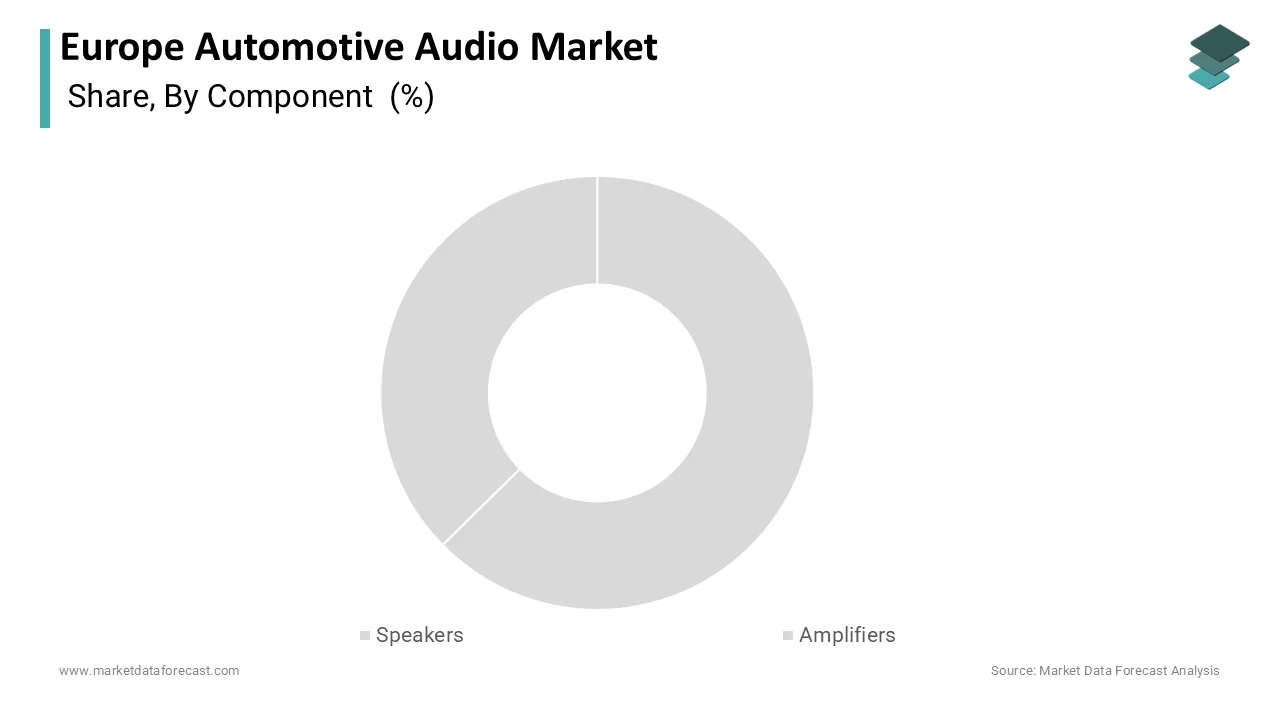
However, the amplifiers segment is another major segment and is estimated to register a CAGR of 9.4% over the forecast period. Modern automotive audio systems rely heavily on external amplifiers to power multiple speakers and subwoofers with high fidelity and dynamic range. According to a study by Yole Développement, the adoption of Class D amplifiers, which offer higher efficiency and lower heat generation, has surged in automotive applications. As per industry reports, the integration of active noise cancellation and engine sound enhancement systems requires powerful and sophisticated amplification capabilities, which are becoming standard in electric and hybrid vehicles. The shift towards branded audio packages in mainstream vehicles also drives demand for dedicated amplifiers that can deliver the specific sound signatures promised by brands like Bang and Olufsen or Meridian. Furthermore, the rise of multi-zone audio systems, where different passengers can listen to separate sources simultaneously, necessitates independent amplification channels. This technological evolution increases the value and complexity of amplifier units. Automakers are investing in digital amplifiers that integrate with vehicle networks for real-time adjustments based on driving conditions. The growing emphasis on immersive audio experiences, such as Dolby Atmos in cars, further propels the need for high-channel-count amplifiers. These factors collectively accelerate the growth of the amplifier segment, outpacing other components.
By Vehicle Type Insights
The passenger cars segment dominated the market and captured for 84.7% of the regional market share in 2025. This dominance is attributed to the high production volumes of passenger vehicles compared to commercial trucks and buses, as well as the greater consumer emphasis on comfort and entertainment in personal transportation. According to Eurostat, passenger cars constitute the vast majority of the vehicle parc in Europe, with over 250 million units registered. As per the European Automobile Manufacturers Association, new passenger car registrations consistently outnumber commercial vehicle sales by a factor of five to one. Consumer willingness to pay for premium audio features is significantly higher in the passenger car segment, where the vehicle serves as a personal sanctuary and status symbol. Luxury and premium sedans, SUVs, and hatchbacks often come equipped with advanced audio systems as standard or optional extras. The competitive nature of the passenger car market forces manufacturers to differentiate through interior amenities, including high-end audio. In contrast, commercial vehicles prioritize durability and cost efficiency over audio quality, resulting in basic radio units. The aftermarket sector for passenger cars is also more vibrant, with enthusiasts upgrading factory systems. The sheer scale of the passenger car industry ensures that it remains the primary driver of demand for automotive audio components and systems across Europe.
On the other hand, the AI-based audio systems segment is estimated to witness strong growth at 13.4% CAGR over the forecast period. AI technologies enable advanced voice recognition, natural language processing, and personalized audio experiences that adapt to user preferences and driving conditions. According to McKinsey and Company, the adoption of AI in automotive software is accelerating, with voice assistants becoming a key interface for drivers. As per data from tech firms like Nuance and Cerence, AI-powered audio systems can adjust equalization settings in real time based on cabin noise levels, passenger positions, and music genre. These systems also facilitate predictive maintenance by monitoring speaker performance and detecting anomalies. The rise of autonomous driving features increases the reliance on voice commands for controlling vehicle functions, reducing driver distraction. AI algorithms analyze user behavior to curate playlists and recommend content, enhancing engagement. Automakers are partnering with AI specialists to develop proprietary voice assistants that offer seamless connectivity with smart home devices and cloud services. The ability of AI to learn and adapt creates a sticky user experience that encourages brand loyalty. As vehicles become more connected and intelligent, the demand for AI-driven audio solutions will continue to surge. This technological leap represents a significant shift from passive audio reproduction to interactive and intelligent sound management.
COUNTRY-LEVEL ANALYSIS
Germany Automotive Audio Market Analysis
Germany stood as the largest national market for automotive audio in Europe in 2025, holding a market share of 19.5% in 2025. The country’s leadership is attributed to its robust automotive manufacturing base and the presence of global premium brands such as BMW, Mercedes-Benz, and Audi, which prioritize high-quality audio systems. According to the German Association of the Automotive Industry, the production of premium vehicles in Germany remains strong, driving demand for branded audio partnerships with companies like Burmester and Bang and Olufsen. As per data from the Federal Motor Transport Authority, new car registrations in Germany show a high uptake of optional equipment packages, including premium audio. The German consumer’s appreciation for engineering excellence and sound fidelity supports the adoption of advanced audio technologies. The presence of major audio component suppliers and research institutions in Germany fosters innovation in acoustic engineering. Government incentives for electric vehicles also boost the market,t as EVs require specialized audio solutions to manage cabin acoustics. The strong aftermarket culture in Germany further contributes to sales of high-end audio upgrades. Germany’s central role in the European automotive supply chain ensures it remains the hub for audio technology development and consumption. The combination of manufacturing strength and consumer sophistication sustains its dominant position.
United Kingdom Automotive Audio Market Analysis
The United Kingdom holds a significant position in the Europe automotive audio market, et and the region is expected to see a steady increase in demand for advanced audio features in luxury and passenger vehicles. The UK is home to prestigious automotive brands such as Aston Martin, Bentley, and Rolls-Royce, which set global standards for bespoke audio experiences. According to the Society of Motor Manufacturers and Traders, the UK luxury car market continues to grow with high demand for customized features, including premium sound systems. As per data from industry analysts, British consumers are among the highest spenders on optional extras per vehicle in Europe. The presence of renowned audio brands like Meridian, which supplies Jaguar Land Rover, enhances the local ecosystem. The UK’s vibrant aftermarket scene and car audio competitions also stimulate demand for high-performance components. Regulatory support for connected car technologies facilitates the integration of smart audio systems. The concentration of wealth in London and the South East drives sales of high-end vehicles with advanced audio capabilities. The UK’s influence on global automotive trends through media and events further promotes audio innovation. Despite economic fluctuations, the demand for premium audio remains resilient among affluent buyers. This combination of luxury manufacturing and consumer spending power ensures the UK’s prominent market status.
France Automotive Audio Market Analysis
France ranks among the top national markets in Europe, rope and the region is expected to grow as domestic manufacturers push towards electrification and digital cabin experiences. French manufacturers such as Renault, Peugeot, and Citroen are increasingly integrating branded audio systems from partners like Focal and Arkamys into their models. According to the French Automobile Manufacturers Committee, the push towards electrification and digitalization in French cars is boosting the adoption of advanced audio technologies. As per data from the National Institute of Statistics and Economic Studies, consumer spending on vehicle accessories, including audio upgrades, has shown steady growth. The French market is particularly receptive to innovative audio features such as 3D sound and voice assistance due to a tech-savvy population. Government policies promoting electric mobility support the installation of specialized audio systems in EVs. The presence of Focal, a leading high-fidelity speaker manufacturer, provides a competitive advantage in terms of local supply and expertise. French consumers value design and aesthetic features, which align with the premium positioning of branded audio systems. The expansion of car sharing and rental fleets also creates opportunities for durable and high-quality audio installations. France’s focus on innovation and design ensures its continued relevance in the regional market.
Italy Automotive Audio Market Analysis
Italy occupies a vital position in the regional market, and the region is expected to maintain its status through a strong heritage of luxury craftsmanship and high-fidelity sound. Italian automakers like Ferrari, Lamborghini, and Maserati collaborate with audio specialists to create bespoke sound systems that complement their performance vehicles. According to the Italian Automobile Federation, the luxury car segment in Italy remains robust, supporting demand for exclusive audio configurations. For instance, the Italian automotive speaker market was valued at USD 166.8 million in 2024 and is expected to grow steadily. Italian consumers have a strong cultural appreciation for music and sound, a quality that translates into a higher willingness to invest in premium audio. The presence of renowned audio brands and custom installers fosters a vibrant aftermarket community. The tourism sector also influences the market as rental agencies equip vehicles with high-quality audio to attract international visitors. Government incentives for sustainable mobility encourage the adoption of electric vehicles, which often feature advanced audio systems. Italy’s design leadership and passion for automotive excellence sustain its position in the market. The synergy between the automotive and audio industries creates unique value propositions for consumers.
Sweden Automotive Audio Market Analysis
Sweden ranks fifth in the Europe automotive audio market and is expected to grow at a CAGR of 9.1% during the forecast period, benefiting from the presence of Volvo and a strong tradition of audio innovation. Volvo’s partnership with Bowers & Wilkins has set a benchmark for premium audio in safety-focused vehicles, appealing to discerning customers. According to the Swedish Automobile Association, the high penetration of premium and electric vehicles in Sweden drives demand for sophisticated audio systems. As per data from Statistics Sweden, consumers prioritize sustainability and technology, leading to strong adoption of EVs with integrated high-fidelity audio. The Swedish market is characterized by high disposable income and a preference for quality and durability. The cold climate and long winters encourage people to spend more time in their vehicles, increasing the value placed on interior comfort and entertainment. Sweden’s leadership in telecommunications and software supports the development of connected audio features. The government’s aggressive climate goals accelerate the transition to electric mobility, further boosting the audio market. The reputation of Swedish design and engineering enhances the appeal of locally produced audio solutions.
COMPETITIVE LANDSCAPE
The competition in the Europe automotive audio market is intense,e characterized by established global giants and specialized niche players striving for technological superiority. Major competitors differentiate themselves through proprietary sound processing algorithms, exclusive brand partnerships, and integrated software solutions. The shift towards electric vehicles has intensified rivalry as companies develop specialized audio systems to address unique acoustic environments in silent cabins. Innovation in immersive audio formats such as Dolby Atmos serves as a key battleground for capturing premium segment demand. Price pressure in the mass market segment forces manufacturers to optimize costs while maintaining quality standards. Collaborations with tech firms for connectivity and artificial intelligence features are becoming common strategies to enhance product offerings. The aftermarket sector remains competitive with numerous providers offering customization options for enthusiasts. Regulatory compliance regarding safety and environmental standards adds complexity to product development cycles. Companies that successfully balance innovation, efficiency, and brand prestige tend to secure stronger positions. Continuous adaptation to changing consumer preferences and automotive trends is essential for sustaining competitiveness in this dynamic market environment.
KEY MARKET PLAYERS
Some of the companies that are playing a dominating role in the global Europe Automotive Audio Market include
- Harman International Industries, Inc.
- Bose Corporation
- Sony Group Corporation
- Panasonic Holdings Corporation
- Pioneer Corporation
- Alpine Electronics, Inc.
- Clarion Co., Ltd.
- JVCKENWOOD Corporation
- Continental AG
- Robert Bosch GmbH
- Denso Corporation
- Faurecia SE
TOP LEADING PLAYERS IN THE MARKET
- Harman International Industries stands as a global leader in connected car technology and automotive audio solutions with a strong presence in Europe. The company supplies premium branded audio systems to automakers, including Mercedes-Benz, Volkswagen, and Volkswagen. Harman recently expanded its Samsung Automotive portfolio to integrate advanced artificial intelligence and cloud-based services into vehicle audio experiences. The company focuses on developing immersive sound technologies such as Quantum Logic Surround and Active Road Noise Control. Strategic partnerships with semiconductor firms enhance their capability to deliver high-performance digital signal processing units. Harman also invests heavily in research and development for electric vehicle-specific audio solutions, addressing unique acoustic challenges. Their comprehensive approach combines hardware, software, re and services to create holistic entertainment ecosystems. This strategy strengthens their position as a preferred supplier for next-generation connected vehicles across the European market.
- Bose Corporation is a renowned name in the Europe automotive audio market known for its innovative sound technologies and premium brand reputation. The company collaborates with manufacturers like Porsche, Audi, i and Nissan to deliver customized audio systems that enhance driving experiences. Bose recently introduced UltraSpace technology,gy which creates a wider soundstage for passengers using advanced signal processing algorithms. The company focuses on lightweight speaker designs and efficient amplifiers to meet the weight constraints of electric vehicles. Bose also develops active noise cancellation systems that improve cabin comfort by reducing unwanted road and wind noise. Their commitment to sustainability drives the use of recycled materials in speaker components without compromising audio quality. Bose leverages its consumer electronics expertise to integrate seamless connectivity features into automotive products. These innovations help automakers differentiate their vehicles through superior auditory experiences. The brand's strong recognition among consumers adds significant value to partner vehicles in the competitive European landscape.
- Alpine Electronics is a key player in the Europe automotive audio market, specializing in high-fidelity sound systems and multimedia solutions. The company serves both original equipment manufacturers and the aftermarket sector with a wide range of products, including head units, speakers, rs and amplifiers. Alpine recently launched new digital media receivers with enhanced smartphone integration and high-resolution audio support. The company focuses on compact and modular designs that fit diverse vehicle architectures, particularly in the growing electric vehicle segment. Alpine also develops advanced tuning software that allows for precise acoustic calibration in different car models. Their strategic collaborations with automotive suppliers ensure seamless integration of audio systems with vehicle infotainment networks. Alpine emphasizes user-friendly interfaces and robust build quality to meet the demands of discerning European consumers. The company continues to innovate in sound processing technologies to deliver clear and powerful audio performance. This focus on quality and adaptability maintains their strong position in the dynamic European automotive audio industry.
TOP STRATEGIES USED BY KEY MARKET PARTICIPANTS
Key players in the Europe automotive audio market primarily focus on strategic partnerships with automotive manufacturers to secure long-term supply contracts. Companies invest heavily in research and development to create immersive audio technologies such as three-dimensional sound and active noise cancellation. Integration of artificial intelligence and voice recognition systems enhances user interaction and personalization capabilities. Manufacturers prioritize lightweight and energy-efficient components to support the transition towards electric mobility. Brand licensing agreements with prestigious audio names help automakers differentiate their vehicles in a competitive market. Expansion into software-defined vehicle architectures allows for over-the-air updates and continuous feature improvements. Sustainability initiatives, including the use of recycled material,s align with environmental regulations and consumer preferences. These strategies collectively drive innovation and maintain competitive advantages in the evolving automotive landscape.
MARKET SEGMENTATION
This research report on the europe automotive audio market is segmented and sub-segmented into the following categories.
By Component
- Speakers
- Amplifiers
By Vehicle Type
- Passenger Cars
- Commercial Vehicles
By Country
- Germany
- United Kingdom
- France
- Italy
- Sweden
- Rest of Europe