- Product Description Description
- Table of Contents TOC
- List of Table & Figure LOT
- Get Free Sample PDF Sample PDF
Market Size, 2025
$20.62 BnMarket Estimate, 2026
$22.25 BnMarket Forecast, 2034
$40.97 BnCAGR, 2026–2034
7.93%Europe Automotive Battery Market Report Summary
The Europe automotive battery market was valued at USD 20.62 billion in 2025, is estimated to reach USD 22.25 billion in 2026, and is projected to grow to USD 40.97 billion by 2034, registering a CAGR of 7.93% during the forecast period. Market growth is primarily driven by the rapid adoption of electric vehicles (EVs), stringent European emission regulations, and increasing investments in battery manufacturing and localization. Rising demand for high-performance lithium-ion batteries, advancements in battery energy density and charging efficiency, and the expansion of EV charging infrastructure across Europe are further accelerating market growth. Additionally, strong OEM partnerships and government incentives supporting electrification are strengthening the automotive battery ecosystem in the region.
Key Market Trends
-
Strong shift toward lithium-ion batteries due to their high energy density, longer lifespan, and suitability for electric and hybrid vehicles.
-
Rising penetration of electric passenger cars supported by government subsidies, low-emission zones, and consumer preference for sustainable mobility.
-
Increasing dominance of OEM supply channels as automakers focus on integrated battery sourcing and long-term supplier contracts.
-
Growing investments in gigafactories and battery recycling facilities to strengthen supply chain resilience and sustainability.
-
Technological advancements in solid-state batteries and fast-charging solutions shaping future market opportunities.
Segmental Insights
- Based on battery type, the lithium-ion batteries segment dominated the Europe automotive battery market in 2025. This dominance is attributed to their widespread use in electric and hybrid vehicles, superior performance characteristics, and continuous innovation by leading battery manufacturers.
- Based on vehicle type, the passenger cars segment held a significant share of the Europe automotive battery market in 2025. The segment’s leadership is driven by the rapid growth of electric passenger vehicles, rising urbanization, and increasing consumer awareness of low-emission transportation options.
- Based on sales channel, the original equipment manufacturer (OEM) segment was the largest in 2025. The dominance of this segment is supported by strong collaborations between battery manufacturers and automotive OEMs, ensuring consistent quality, performance optimization, and supply security.
Regional Insights
- The Europe automotive battery market is experiencing robust growth across key economies, supported by strong EV adoption, regulatory support, and industrial investments.
- Germany led the market by accounting for 28.1% of the European automotive battery market share in 2025, driven by its strong automotive manufacturing base, leadership in electric mobility, and extensive investments in battery production and R&D.
Competitive Landscape
The Europe automotive battery market is moderately consolidated, with the presence of global and regional players focusing on capacity expansion, technological innovation, and strategic partnerships with automotive OEMs. Companies are investing heavily in next-generation battery technologies, localized manufacturing, and sustainable production practices to gain a competitive edge. Prominent players operating in the Europe automotive battery market include Exide Technologies, A123 Systems, LG Energy Solution, Samsung SDI Co., Ltd., EnerSys, Robert Bosch Engineering & Business Solutions, East Penn Manufacturing Co., GS Yuasa Corp, Panasonic Holdings Corp, and Hitachi Ltd.
Europe Automotive Battery Market Size
The Europe automotive battery market size was valued at USD 20.62 billion in 2025 and is projected to reach USD 40.97 billion by 2034 from USD 22.25 billion in 2026, growing at a CAGR of 7.93%.
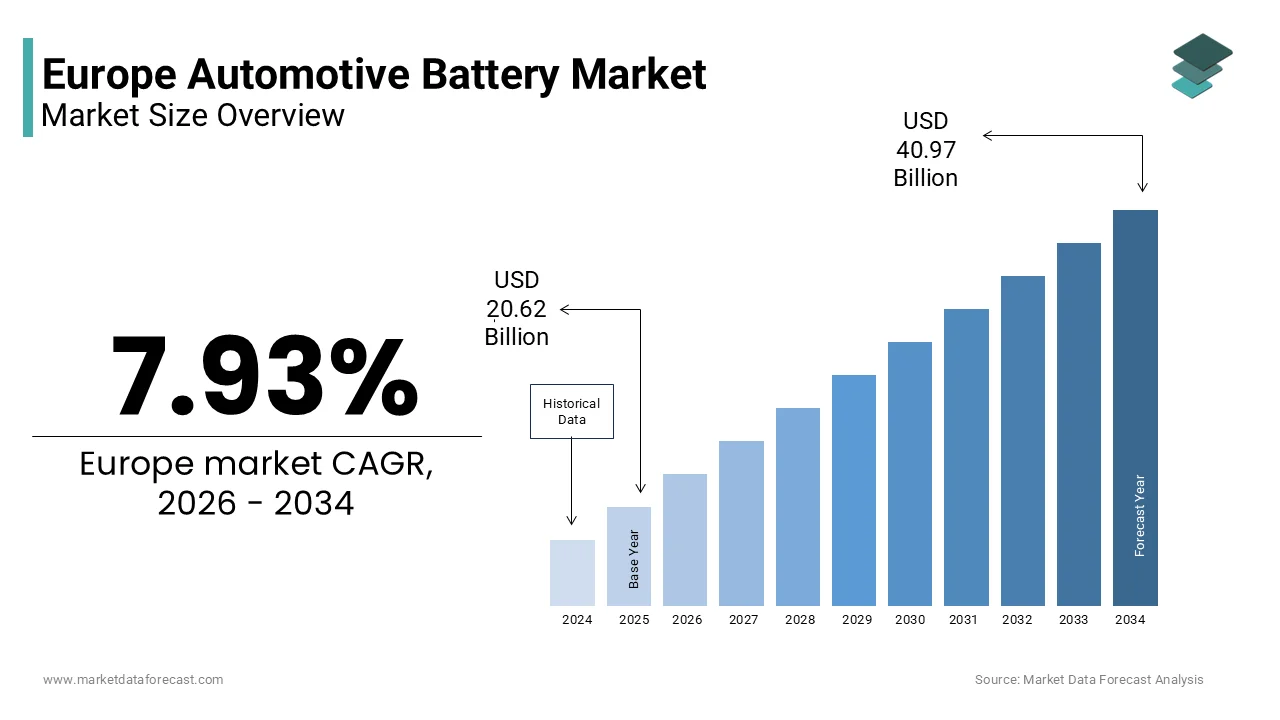
An automotive battery is a rechargeable energy storage device that converts chemical energy into electrical energy to power a vehicle's electrical systems. European markets represent a substantial portion of the international movement toward electric vehicle adoption. The transition in the regional automotive sector suggests an evolving pattern in how energy is consumed for transportation. The development of a localised battery supply chain is influenced by both the rise in electric transport and established environmental standards for vehicle fleets. Regional policy frameworks regarding carbon output serve as a primary driver for the strategic direction of manufacturers. A notable share of new passenger car registrations now consists of fully electric models, indicating a shift in consumer preferences and market availability. This transformation is driving unprecedented demand for lithium-ion and emerging solid-state battery chemistries while simultaneously reshaping supply chain architectures across Germany, France,ce and Eastern Europe, ope where gigafactories are redefining industrial policy and critical raw material dependencies.
MARKET DRIVERS
Accelerated Electrification Mandates by the European Union
The European Union’s binding regulatory framework is accelerating the growth of the European automotive battery market. Regulation (EU) 2023 851 formally enshrines the phase out of new internal combustion engine vehicle sales by 2035, compelling automakers to prioritize high capacity battery integration. Legislative frameworks focused on decarbonization are driving a shift toward mandatory tailpipe emission reductions for new vehicles in regional markets. Strict emissions benchmarks are causing major automotive manufacturers to reorganise long-term manufacturing roadmaps, accelerating investment in battery-powered vehicle portfolios. Prominent European manufacturers are setting high-percentage targets for electric vehicle sales within the region to align with regulatory timelines. These corporate commitments and policy mandates are increasing the requirement for localised battery production and raw material supply chains. National governments are providing financial support for the mobility transition through subsidies for manufacturing, infrastructure development, and raw material access. These coordinated policy instruments create a structurally supportive environment where battery demand is not merely market-driven but institutionally embedded.
Expansion of Domestic Battery Cell Manufacturing Capacity
The region’s strategic pivot toward localised battery cell production has become a major demand driver for the European automotive battery market. Europe is shifting from depending on external battery sources toward creating its own manufacturing, leading to a significant number of planned and operating production sites. Regional regulations focusing on sustainability, such as carbon footprint reporting and material recycling, are bolstering this expansion. Both Germany and France are becoming important centres for battery production, with several large-scale facilities being planned or built. These projects frequently combine component manufacturing with final assembly to strengthen the regional supply chain. Institutional funding is strongly backing the growth of the battery value chain in the region. This vertical integration strategy ensures a secure and sustainable battery supply for automakers while simultaneously positioning Europe as a net exporter of advanced battery systems by the late 2020s.
 MARKET RESTRAINTS
Critical Raw Material Supply Constraints and Geopolitical Dependencies
Its heavy reliance on imported critical minerals essential for cell production remains a restraint for the European automotive battery market. The continent exhibits a significant reliance on regions outside its borders for the majority of its lithium, cobalt, and graphite supply. A single nation processes a substantial portion of the world's lithium and cobalt, leading to supply chain concentration. Internal efforts to establish domestic lithium sources have encountered political and environmental obstacles, delaying projects, while the main global source for cobalt presents challenges related to governance and sourcing practices, complicating compliance with sustainability regulations. These dependencies pose risks of elevated material costs and exposure to potential trade disruptions. The absence of a fully integrated refining and precursor manufacturing base within Europe further exacerbates vulnerability, making raw material access a structural restraint rather than a cyclical challenge.
StringentEnd-of-Lifee Battery Recycling and Traceability Requirements
The European Union’s regulatory approach to battery circularity imposes substantial operational and financial burdens on automotive battery stakeholders. Consequently, this impedes the expansion of the European automotive battery market. New European regulations are beginning to require electric vehicle batteries to declare their carbon footprint and meet minimum recycled material content for key components. There is an observed shift towards increasingly strict mandatory targets for battery collection and recycling, emphasising high-efficiency recovery of materials like cobalt, copper, lead, and nickel. Meeting these recovery targets necessitates the expansion of specialised reverse logistics and advanced recycling infrastructure, which is currently underdeveloped. The growing volume of end-of-life electric vehicle batteries is creating a significant waste stream that is currently exceeding available recycling capacity. A substantial increase in industrial-scale recycling facilities and processing capacity is needed to align with the projected rise in retired batteries. This mismatch between waste generation and recycling capability risksnon-compliancee penalties and supply bottlenecks for recovered materials, thereby constraining the market’s ability to meet both regulatory and economic sustainability objectives.
MARKET OPPORTUNITIES
Second Life Applications for Retired Electric Vehicle Batteries
The emergence of second-life battery applications paves the way to extend the utility of automotive batteries beyond vehicle service life, which creates new opportunities for the European automotive battery market. Retired electric vehicle batteries often retain a significant portion of their original capacity, which enables their application in stationary energy storage scenarios. Projects have explored the utility of these repurposed systems for balancing grid frequency and smoothing renewable energy output. Collaborations focusing on this technology have demonstrated high round-trip efficiency in specific installations, indicating potential for effective energy storage. The European Union’s Net Zero Industry Act identifies battery repurposing as a strategic priority, with funding allocated under the Innovation Fund to scale such initiatives. Projections suggest a significant increase in the volume of used batteries available for repurposing within the region over the coming years. The cumulative capacity of these repurposed batteries presents a notable opportunity for energy storage applications and holds the potential to support residential energy needs, contributing to energy storage and providinlocaliseded power support. This not only mitigates waste but creates a circular revenue stream, reducing the total cost of ownership for electric vehicles and enhancing grid resilience in a region.
Strategic Development of Solid-State Battery Technology
The region’s coordinated investment in solid-state battery technology offers a major opportunity to leapfrog current lithium-ion limitations and secure long term competitiveness, which is expected to fuel the expansion of the European automotive battery market. Solid-state battery technology is being explored as a potential improvement over current battery types to achieve higher energy density, quicker charging, and enhanced safety by removing flammable components. Significant investment in the research and development of these batteries is being made by major entities, including national initiatives led by specific countries. Pilot production lines and prototyping efforts are underway with long-term plans for mass production and integration into electric vehicles. These initiatives align with regional sustainability goals, seeking to decrease dependence on specific raw materials and improve battery performance and safety, potentially leading to a notable change in the electric vehicle battery market, affecting manufacturing, supply chains, and vehicle design.
MARKET CHALLENGES
Fragmented Cross-Border Regulatory Implementation
The practical implementation of battery regulations varies significantly across European member states, despite a unified legislative framework, which creates operational friction for pan-European manufacturers and thereby negatively impacts the growth of the European automotive battery market. "National variations in transposition, enforcement, and permitting create an inconsistent landscape for battery producers and recyclers, despite the introduction of the unified EU Battery Regulation. Variations in national environmental assessment requirements for industrial phases can result in differing project approval speeds within the region. The use of modular approval processes in some countries may lead to faster project timelines compared to locations requiring separate assessments for each phase. Fragmented regulatory approaches across borders can increase compliance costs for manufacturers. Differing national interpretations of due diligence obligations may contribute to higher administrative overhead for companies operating across multiple jurisdictions. Furthermore, differences in extended producer responsibility schemes, such as France’s mandatory take-back contracts versus Sweden’s collective compliance systems, complicate logistics planning and inventory management. These discrepancies undermine the single market principle and delay the harmonised scaling of battery value chains essential for achieving EU climate targets.
Workforce Shortages in Advanced Battery Manufacturing and Engineering
The region faces a talent gap in the specialised disciplines required for next-generation battery development and production, which further challenges the expansion of the European automotive battery market. The expanding battery industry across the continent is generating substantial demand for a specialised workforce, including engineers, technicians, and electrochemists. However, current educational and vocational programs are not adequately preparing individuals with the specific skills needed for advanced battery technologies, such as solid-state or sodium-ion chemistries. This skills gap is identified as a factor slowing the progress of new large-scale battery manufacturing projects and contributing to operational delays in facilities. Moreover, competition from the United States and Asia, where government-backed workforce initiatives are more advanced, further drains European talent pools. Europe’s massive investment in battery manufacturing risks being neutralised by a chronic talent shortage, stalling innovation and reducing yield unless active, cross-sector training measures are implemented.
REPORT COVERAGE
| REPORT METRIC | DETAILS |
| Market Size Available | 2025 to 2034 |
| Base Year | 2025 |
| Forecast Period | 2026 to 2034 |
| CAGR | 7.93% |
| Segments Covered | By Battery Type, Vehicle Type, Sales Channel, and Region |
| Various Analyses Covered | Global, Regional, & Country Level Analysis; Segment-Level Analysis; DROC, PESTLE Analysis; Porter’s Five Forces Analysis; Competitive Landscape; Analyst Overview of Investment Opportunities |
| Regions Covered | UK, France, Spain, Germany, Italy, Russia, Sweden, Denmark, Switzerland, Netherlands, Turkey, and the Czech Republic |
| Market Leaders Profiled | Exide Technologies, A123 Systems, LG Energy Solution, Samsung SDI Co., Ltd., EnerSys, Robert Bosch Engineering & Business Solutions, East Penn Manufacturing Co., GS Yuasa Corp, Panasonic Holdings Corp, and Hitachi Ltd. |
SEGMENTAL ANALYSIS
By Battery Type Insights
The lithium-ion battery segment dominated the European automotive battery market by accounting for a substantial share in 2025. The dominance of the lithium ion batteries segment is driven by the rapid electrification of passenger vehicles, driven by regulatory mandates and consumer adoption. Stringent environmental targets for new vehicle emissions are driving manufacturers to adopt, rather than solely rely on, specific high-performance, long-lasting energy storage chemistries. The market is experiencing a significant rise in battery electric vehicle adoption, marked by a substantial year-over-year increase in registrations. Industrial policy, supported by both public and private investment, is aimed at developing a local supply chain and manufacturing capacity. The industry is shifting towards chemistriefavoureded for their high-density, long-life, and fast-charging capabilities, such as those that utilise nickel-rich or lithium-iron-phosphate compositions. The rapid growth of the electric vehicle market is contributing to a substantial increase in the demand forand development ofsustainable, high-performance battery technologies. Additionally, the technology’s compatibility with fast charging infrastructure further cements its primacy over legacy lead acid systems, which remain confined to auxiliary functions.
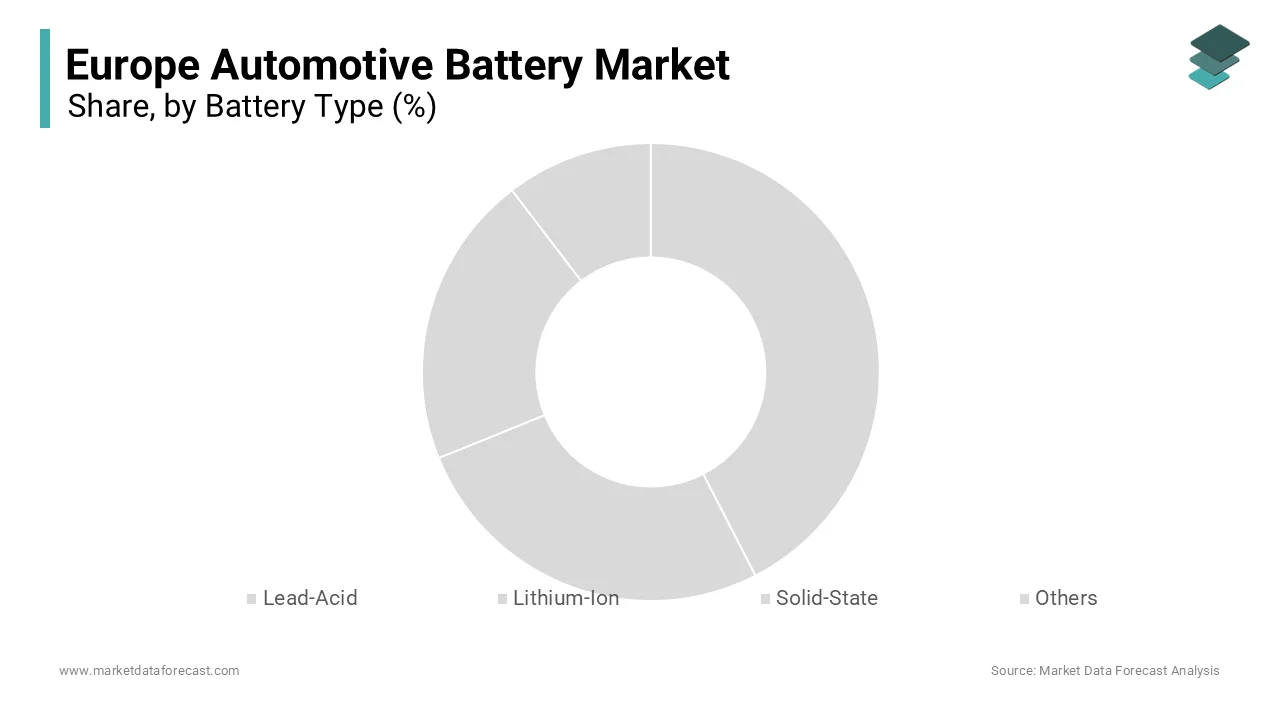
The solid state batteries segment is estimated to register the fastest CAGR of 42.3% between 2026 and 2034 due to its potential to overcome critical limitations of conventional lithium ion cel, ls including safety risks, energy density ceilings,s and reliance on scarce metals. Solid state technology replaces flammable liquid electrolytes with solid ceramic or polymer alternatives, eliminating thermal runaway risks. Solid-state technology demonstrates potential for increased energy capacity per unit weight, allowing for longer driving distances compared to conventional lithium-ion options. European initiatives are prioritising the advancement of this technology through strategic investment and collaborative ventures involving multiple industrial partners. Regulatory focus on sustainable material usage encourages battery designs that reduce reliance on specific raw materials, supporting broader environmental objectives. Vehicle manufacturers are outlining timelines for integrating this technology, which involves advancing production capabilities and qualifying suppliers within the region.
By Vehicle Type Insights
The passenger cars segment led theEuropeane automotive battery market by holding a significant share in 2025. The leading position of the passenger cars segment is attributed to aggressive consumer adoption of battery electric vehicles supported by national purchase incentives and urban access privileges. Northern European markets consistently exhibit a high market share for new electric passenger vehicles compared to other parts of the continent. Larger markets record a high overall volume of electric cars despite recent growth fluctuations. The European charging network is expanding, increasing the density of public chargers relative to the number of electric vehicles, especially in areas with high adoption. Automakers are dedicating resources to electric vehicle production, with major models achieving substantial annual volumes. Urban environmental policies, like expanded low-emission zones, accelerate fleet replacement and encourage private buyers to switch to electric vehicles. Unlike commercial segments, which face payload and total cost of ownership hurdles,s passenger cars enjoy favourable economics due to falling battery prices.
The commercial vehicle segment is estimated to register the fastest CAGR of 38.7% during the forecast period, owing to tightening urban logistics regulations and corporate sustainability commitments. Urban centres across Europe are imposing restrictions on conventional commercial vehicles, driving a shift toward zero-emission alternatives for city logistics. Major logistics operators are actively deploying large-scale electric van fleets to meet sustainability targets and comply with new, more rigorous urban access regulations. Updated emission standards for both light and heavy-duty vehicles, which include more stringent particulate and NOx limits, are reinforcing electric platforms as the primary compliance pathway for urban freight transport. Significant declines in battery costs for commercial applications are bringing electric vehicles closer to cost parity with internal combustion engines in high-utilisation, last-mile scenarios. Governmental financial incentives and grants are actively accelerating the adoption of electric vans and trucks, speeding up the transition of fleets. The expansion of e-commerce is creating rising demand for last-mile deliveries, turning the electrification of urban logistics into both a logistical and environmental necessity.
By Sales Channel Insights
The original equipment manufacturer segment was the largest in the European automotive battery market by capturing a substantial share in 2025. The supremacy of the original equipment manufacturer segment is credited to the direct integration of batteries into new vehicle production lines, where specifications, performance, and warranty are tightly controlled by automakers. The shift toward electric mobility has intensified this trend as battery packs are no longer modular components but structural elements of vehicle design, exemplified by Tesla’s structural battery pack and Volvo’s CEVT platform. European automakers are establishing long-term supply agreements for traction batteries, partnering with established cell manufacturers. These strategic partnerships often involve extended timelines, securing battery supply for a significant duration. Automakers are increasingly investing directly in battery manufacturing facilities to strengthen their position in the supply chain. This trend reflects a broader strategy among manufacturers to securelocalisedd battery production within the European region. Furthermore, OEMs retain control over battery software management systems, which govern charging health and second life potential,l reinforcing their central role. The aftermarket remains largely confined t12-voltlt auxiliary batteries and replacement units for ageing internal combustion engine vehicles,s which are declining in number.
The aftermarket segment is estimated to register the fastest CAGR of 18.4% between 2026 and 2034. The rapid expansion of the aftermarket segment is propelled by the expanding installed base of electric vehicles reaching the end of warranty period,s as the first mass market models registered in 2016 to 2018 begin requiring battery replacements. A substantial number of electric vehicles in Europe are moving beyond their initial factory warranty periods. Independent repair networks are enhancing their capabilities through investments in specialised tools and technician training for high-voltage systems. Regulatory changes are being implemented to ensure independent providers have access to vehicle battery information and parts. Vehicle owners are becoming more inclined to consider various service options as concerns about battery degradation increase. The aftermarket is becoming a more attractive choice for battery servicing due to potential cost efficiencies for both individual owners and fleet managers.
REGIONAL ANALYSIS
Germany Automotive Battery Market Analysis
Germany outperformed other countries in the European automotive battery market by accounting for a 28.1% share in 2025. The dominance of the German market is driven by its dual role as Europe’s top automotive producer and its strategic push to localise battery cell production. Germany is experiencing a significant influx of capital into the domestic production of battery cells, with major investments aimed at establishing large-scale manufacturing sites. The electric vehicle market in Germany has shifted towards a temporary period of market correction and volatility following the reduction of government purchase incentives, despite previously strong sales figures. National strategic efforts are focusing on strengthening the local battery value chain by dedicating substantial funding to secure raw materials and develop comprehensive battery recycling infrastructure. The expansion of public charging infrastructure is accelerating, with a notable, rapid increase in the total number of connectors to support the growing, though fluctuating, population of electric vehicles. The presence of research institutions like the Helmholtz Institute Ulm and Fraunhofer ISE ensures continuous innovation in cell chemistry and manufacturing processes, positioning Germany not just as an assembly hub but as afull-spectrumm battery technology leader.
France Automotive Battery Market Analysis
France was the second-largest player in theEuropeane automotive battery market, capturing a share of 19.1% in 2025. The growth of the French market is propelled by its integrated industrial policy combining public investment, automaker ambition,n and energy transition goals. Key French automotive manufacturers are aligning their production strategies toward a significant increase in electric vehicle output within Europe. These manufacturers are participating in collaborative investments to establish regional battery production capacity through joint ventures. Infrastructure projects for battery manufacturing are underway, aiming to increase regional supply capabilities. The reliance on a low-carbon, nuclear-based energy grid allows for cleaner manufacturing processes and charging solutions. The market for electric vehicles in the country is experiencing growth, with a notable percentage of new vehicle registrations being battery-powered. Government support mechanisms, such as purchasing bonuses and incentives for replacing older vehicles, are encouraging consumer adoption. Environmental regulations regarding battery traceability and recycling are fostering the development of a circular economy within the sector.
United Kingdom Automotive Battery Market Analysis
The United Kingdom holds a significant share of the European automotive battery market. Despite Brexit, the UK remains a pivotal player through its advanced electric vehicle manufacturing and battery innovation ecosystem. Production facilities in the UK are currently generating a significant volume of electric and hybrid vehicles, with ongoing expansion aimed at increasing capacity for future demand. There is a strategic investment in the development of battery manufacturing capabilities, including a focus on next-generation battery technologies. New car registrations in the UK are increasingly reflecting a transition toward battery-powered electric vehicles. The country is actively developing infrastructure for the reuse of batteries to support energy grid stability. However, the absence of a comprehensive domestic raw material strategy and reliance on EU-aligned regulations for battery certification pose challenges. Still, the UK’s strengths in engineering talent and agile manufacturing keep it firmly among Europe’s top battery markets.
Sweden Automotive Battery Market Analysis
Sweden grew steadily in the European automotive battery market due to its population size and its pioneering role in sustainable battery production powered by renewable energy. Production facilities designed for low-carbon manufacturing can generate battery cells with a lower carbon intensity than the current industry average. Utilising a largely fossil-free electricity grid, which draws heavily on hydropower and nuclear resources, facilitates the manufacturing of batteries with lower carbon footprints. These low-carbon production capabilities are becoming a compelling factor for European manufacturers looking to meet evolving battery footprint regulations. The high adoption rate of electric vehicles in specific markets highlights a significant shift in consumer preferences, positioning these regions among the leaders in the transition to electric transport within Europe. The government supports this through a bonus-malus system that taxes high-emission vehicles while rewarding electric buyers. Additionally, Sweden is developing a domestic lithium refining industry using spodumene from Finland and recycling streams. These vertical integration efforts position Sweden as Europe’s green battery benchmark.
Italy Automotive Battery Market Analysis
Italy is predicted to grow in the European automotive battery market from 2026 to 2034, owing to its strong commercial vehicle and two-wheeler segments, along with growing electric passenger car adoption in urban centres. Manufacturing facilities in Italy are adjusting their operations to produce battery-powered vehicles. The market for electric vehicles in Italy is in a period of change, influenced by shifting consumer interest and various support programs. Strategic national plans are directing funds towards the growth of electromobility, including upgrades to charging infrastructure and bolstering the battery industry. Regions in Southern Italy are becoming centres for battery recycling and reclaiming materials, using existing industrial resources. However, challenges remain, including grid limitations in rural areas and slower gigafactory development compared to Central Europe. Nevertheless,s Italy’s industrial base,se consumer demand, and strategic location linking Western and Eastern Europe ensure its continued relevance in the regional battery landscape.
COMPETITIVE LANDSCAPE
Competition in the European automotive battery market is intensifying as global cell manufacturers, regional startups, and automotive OEMs vie for influence across a rapidly consolidating value chain. The market features a dual dynamic where European ventures like Northvolt and ACCemphasisee sustainability and regulatory alignment, while Asian giants such as CATL and LG Energy Solution leverage scale and technological maturity to gain footholds through localised production. Automakers are increasingly becoming battery integrators, securing equity stakes in cell producers and co-developing proprietary formats to differentiate their vehicles. Regulatory pressure from the EU Battery Regulation, particularly on carbon fofootprintt recycled content, and due diligence,e has raised entry barriers favoring well capitalized and compliant players. Simultaneously, competition extends beyond manufacturing into services, including battery health monitoring, second life deployment and recycling infrastructure. This multifaceted rivalry is driving unprecedented collaboration between industry and public institutions, but also heightening geopolitical sensitivities around critical mineral access and technology sovereignty.
KEY MARKET PLAYERS
Some of the notable key players in theEuropeane automotive battery market are
- Exide Technologies
- A123 Systems
- LG Energy Solution
- Samsung SDI Co., Ltd.
- EnerSys
- Robert Bosch Engineering & Business Solutions
- East Penn Manufacturing Co.
- GS Yuasa Corp
- Panasonic Holdings Corp
- Hitachi Ltd
Top Players in the Market
- Northvolt AB is a Swedish battery innovator playing a pivotal role in reshaping the European automotive battery landscape through its vertically integrated and sustainability-driven approach. The company supplies lithium-ion cells to global automakers, including BM, Volkswagen, and Volvo and operates Europe’s largest homegrown gigafactory in Skellefteå. Northvolt has intensified its focus on circularity by launching Revolt, a dedicated recycling program that recovers most of the key metals from end of life batteries. These initiatives not only secure its European footprint but also position it as a strategic alternative to Asian battery suppliers in the global supply chain.
- ACC is a Franco-German joint venture formed by Stellantis Mercedes Benz and Saft TotalEnergies that serves as a cornerstone of Europe’s battery sovereignty strategy. The company is developing high-performance lithium-ion cells tailored for European premium and mass market vehicles with gigafactories in France, Germany,y and Italy. ACC recently launched its Gen3 cell platform featuring enhanced energy density and faster charging capabilities validated through real-world testing with Stellantis’s electric van fleets. Its move reduces dependency on overseas supply chains and aligns with EU Battery Regulation requirements, reinforcing ACC’s role as a vertically integrated and regionally anchored battery supplier on the global stage.
- Although headquartered in China, CATL has cemented a strong presence in the European automotive battery market through strategic manufacturing and customer partnerships. CATL contributes to the global market by pioneering cell-to-pack and sodium-ion technologies now being adapted for European vehicle platforms. Recently, the company signed along-termm supply agreement with Peugeot for its new electric SUV lineup and joined the European Battery Alliance’s recycling consortium. These actions demonstrate CATL’s commitment to local value creation, compliance with EU sustainability standards,s and deeper integration into Europe’s electrified automotive ecosystem.
Top Strategies Used by the Key Market Participants
Key players in thEuropeanpe automotive battery market are prioritising vertical integration by securing access to raw materials through long term offtake agreements and developing in-house recycling capabilities to meet EU regulatory requirements. Companies are investing heavily in gigafactory construction across Germany, France, Sweden, nd Hungary to localise production and reduce supply chain risks. Strategic joint ventures between automakers, energy companies, and technology firms are accelerating technology development and cost sharing. Innovation in cell chemistry,y such as solid-state and sodium-ion, is being pursued to enhance performance and reduce reliance on critical minerals. Additionally, firms are aligning with circular economy principles by implementing battery passport systems and second-life applications to maximise resource efficiency and strengthen brand sustainability credentials in a highly regulated market environment.
MARKET SEGMENTATION
This research report on the European automotive battery market has been segmented and sub-segmented based on categories.
By Battery Type
- Lead-Acid
- Lithium-Ion
- Solid-State
- Others
By Vehicle Type
- Passenger Cars
- Commercial Vehicles
- Two-Wheelers
- Others
By Drive Type
- Internal Combustion Engine (ICE)
- Hybrid
- Others
By Application
- Starting, Lighting, and Ignition (SLI)
- Propulsion
- Start-Stop
- Others
By Sales Channel
- OEM (Original Equipment Manufacturer)
- Aftermarket
By Country
- UK
- France
- Spain
- Germany
- Italy
- Russia
- Sweden
- Denmark
- Switzerland
- Netherlands
- Turkey
- Czech Republic
- Rest of Europe