- Product Description Description
- Table of Contents TOC
- List of Table & Figure LOT
- Get Free Sample PDF Sample PDF
Market Size, 2025
$2.08 BnMarket Estimate, 2026
$2.18 BnMarket Forecast, 2034
$3.12 BnCAGR, 2026–2034
4.60%Europe Automotive Composites Market Size, Growth, Trends & Forecast (2026–2034)
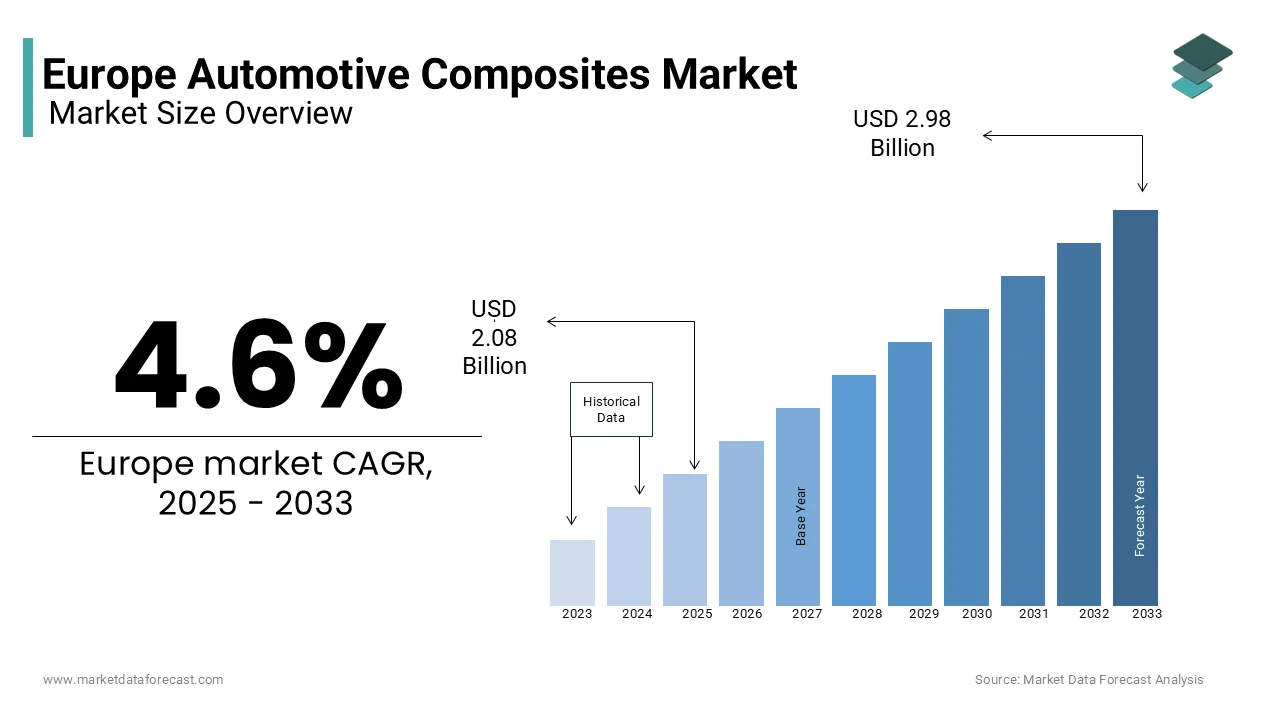
The Europe automotive composites market size was valued at USD 2.08 billion in 2025, stands at USD 2.18 billion in 2026, and is projected to reach USD 3.12 billion by 2034, growing at a compound annual growth rate (CAGR) of 4.6% from 2026 to 2034. Propelled by strict EU carbon emission targets, the rapid expansion of electric vehicle (EV) production requiring weight-offsetting materials, and increasing integration of sustainable bio-based and recyclable composite architectures, the European market demonstrates steady strategic growth.
Key Executive Metrics (At-a-Glance)
- 2025 Base Valuation: USD 2.08 Billion
- 2026 Current Valuation: USD 2.18 Billion
- 2034 Forecast Valuation: USD 3.12 Billion
- Compound Annual Growth Rate (CAGR): 4.6% (2026–2034)
- Regional Highlights: Germany leads the regional market with 28.4% share, followed by France and the UK, driven by robust automotive manufacturing and green lightweighting strategies.
Core Market Drivers & Growth Triggers
- Stringent Emission Regulations: European Commission mandates forcing automakers to adopt lightweight carbon and glass fiber composites to meet strict CO₂ limits.
- EV Expansion: Surging adoption of battery electric vehicles necessitating advanced composite components to offset heavy battery packs and extend driving ranges.
Primary Market Restraints & Challenges
- High Costs & Manufacturing Complexity: Expensive raw materials (such as CFRPs) and slow, complex production cycle times that hinder mass-market scalability.
- Recycling Limitations: Inadequate recycling infrastructure and difficulties in processing thermoset composites without degrading structural integrity.
Europe Automotive Composites Market Segmentation Breakdown
| Segment Category | Largest Segment | Fastest-Growing Segment |
|---|---|---|
| By Fiber Type | Glass Fiber | Carbon Fiber (CAGR: 12.7%) |
| By Resin Type | Thermoset Resins | Thermoplastic Resins (CAGR: 11.2%) |
| By Application | Exterior Applications (57.4% share) | Interior Applications (CAGR: 10.8%) |
Major Industry Players Profiled
Key advanced material companies shaping the European automotive composites market include SGL Carbon, TEIJIN LIMITED, BASF, Solvay, Hexcel Corporation, Zoltek Corporation, Evonik Industries AG, Mitsubishi Chemical Group Corporation, Covestro AG, and LANXESS.
Europe Automotive Composites Market Size
The Europe automotive composites market size was valued at USD 2.08 billion in 2025 and is anticipated to reach a valuation of USD 2.18 billion in 2026 and USD 3.12 billion by 2034, growing at a CAGR of 4.6% from 2026 to 2034.
The automotive composites are advanced lightweight materials used in vehicle manufacturing across European countries, primarily for enhancing performance, fuel efficiency, and emissions compliance. These composites, such as carbon fiber reinforced polymers (CFRP), glass fiber reinforced polymers (GFRP), and natural fiber composites, are increasingly replacing traditional metals like steel and aluminum due to their superior strength-to-weight ratios and corrosion resistance. According to the European Automobile Manufacturers’ Association (ACEA), passenger car production in Europe stood at approximately 12.6 million units in 2023, reflecting a gradual recovery from pandemic-related disruptions. Additionally, with the European Union’s Green Deal aiming for climate neutrality by 2050, the demand for energy-efficient manufacturing processes and sustainable materials is gaining momentum.
MARKET DRIVERS
Stringent Emission Regulations Driving Lightweighting Trends
One of the most influential drivers of the Europe Automotive Composites Market is the enforcement of stringent emission regulations by the European Commission. Under the EU’s CO₂ emission targets for passenger cars, manufacturers must ensure that new vehicles emit no more than 95 grams of CO₂ per kilometer (g/km) on average. As per data from the International Council on Clean Transportation (ICCT), reducing a vehicle's weight by 10% can lead to a 6–8% improvement in fuel economy. In response, major automotive companies, including BMW, Volkswagen, and Vo, have incorporated carbon fiber-reinforced plastics into body panels, hoods, and interior components. For instance, BMW’s i3 electric vehicle uses CFRP extensively in its passenger cell, reducing weight by approximately 250 kg compared to conventional materials. Additionally, the European Environment Agency (EEA) reported that transport accounted for nearly one-quarter of the EU’s total greenhouse gas emissions in 2022, reinforcing the urgency for material innovation.
Rise in Electric Vehicle Production and Demand
The rapid expansion of electric vehicle (EV) production in Europe is another key driver of the automotive composites market. As governments across the continent set ambitious electrification targets and offer subsidies to accelerate EV adoption, automakers are increasingly relying on composite materials to offset the added weight of large battery packs while extending driving range.
According to BloombergNEF, EV sales in Europe surpassed 2.3 million units in 2023, representing a year-over-year growth of 18%. With the European Commission proposing a ban on internal combustion engine (ICE) vehicles by 2035, the transition to electric mobility is expected to intensify. For example, the Renault Megane E-Tech Electric employs glass fiber-reinforced thermoplastics in its front-end structure, contributing to a 10% reduction in curb weight. As per the European Alternative Fuels Observatory, battery electric vehicles accounted for 12.1% of total new car registrations in the EU during the first half of 2024. This growing reliance on lightweight materials to enhance EV performance is directly fueling the demand for automotive composites across Europe.
MARKET RESTRAINTS
High Material and Manufacturing Costs
Despite the growing demand for automotive composites, high material and manufacturing costs remain a significant restraint in the Europe Automotive Composites Market. Composite materials, especially carbon fiber-reinforced polymers (CFRPs), are considerably more expensive than traditional metals like steel and aluminum. Moreover, the production process for composites involves complex molding, curing, and finishing techniques that require specialized machinery and skilled labor. This increases capital expenditure for automotive manufacturers, particularly smaller firms that may lack the financial flexibility of global OEMs. While luxury brands like BMW and Audi can absorb these costs due to premium pricing strategies, mass-market automakers face challenges in justifying the expense. As a result, the penetration of high-performance composites remains limited to niche segments. Additionally, the lack of standardized recycling methods further adds to lifecycle costs, discouraging widespread adoption.
Limited Recycling Infrastructure and Environmental Concerns
Another major restraint impeding the growth of the Europe Automotive Composites Market is the limited availability of effective recycling infrastructure for composite materials. Unlike metals such as aluminum and steel, which have well-established recycling systems, composites, particularly thermoset-based ones, are difficult to break down and reuse without compromising material integrity. According to the European Composites Industry Association (EuCIA), less than 10% of composite waste generated in Europe was recycled in 2023, with most of it ending up in landfills or incinerators. The absence of standardized recycling protocols poses a challenge for automakers striving to meet sustainability goals under the EU Circular Economy Action Plan. Furthermore, the increasing focus on end-of-life vehicle (ELV) regulations mandates higher recyclability rates, pressuring manufacturers to rethink material choices. In response, some industry players are exploring pyrolysis and solvolysis technologies to recover fibers from end-of-life composites. However, these methods are still in early stages and not yet economically scalable.
MARKET OPPORTUNITIES
Expansion of Hybrid Material Systems in Vehicle Design
An emerging opportunity within the Europe Automotive Composites Market lies in the development and integration of hybrid material systems in vehicle design. Automakers are increasingly adopting multi-material architectures that combine composites with metals, plastics, and other engineered materials to achieve optimal performance, weight reduction, and cost efficiency. According to a research paper published by the Society of Automotive Engineers (SAE), hybrid structures incorporating glass fiber composites with aluminum alloys have demonstrated a 15–20% improvement in crash energy absorption compared to monolithic metal frames. Notably, companies like Jaguar Land Rover have implemented aluminum-composite hybrid chassis designs in models such as the Range Rover PHEV, achieving a 10% reduction in body-in-white weight. Moreover, the German Aerospace Center (DLR) has been conducting extensive research on bonded hybrid joints that allow seamless integration of composites with metallic substructures, thereby enhancing durability and manufacturability.
Growth of Bio-Based and Recyclable Composites
The increasing emphasis on sustainability and circular economy principles is creating a significant opportunity for bio-based and recyclable composites within the European automotive sector. As automakers seek to reduce their environmental footprint, there is growing interest in renewable raw materials and eco-friendly manufacturing processes that align with the European Green Deal objectives.
According to a report by Ova-Institut, the production capacity for bio-based polymers in Europe reached over 800,000 metric tons in 2023, with automotive applications accounting for nearly 12% of total demand. Companies such as BASF, Covestro, and DSM are actively developing bio-resins derived from plant-based feedstocks like corn starch, lignin, and castor oil, offering lower carbon footprints without compromising mechanical properties.
Natural fiber composites (NFCs), made from flax, hemp, and kenaf, are also gaining traction. BMW and Audi have integrated NFCs into door panels, parcel shelves, and trunk liners, reducing both weight and CO₂ emissions. As per the European Bioplastics Association, natural fiber composites in European automotive interiors grew by 18% in 2023 compared to the previous year.
MARKET CHALLENGES
Complexity in Mass Production and Integration
A major challenge facing the Europe Automotive Composites Market is the complexity involved in scaling up production and integrating composite components into existing automotive manufacturing lines. Unlike stamped metal parts, which benefit from decades of streamlined automation, composite fabrication often requires manual labor, longer cycle times, and highly controlled environments, all of which hinder efficient mass production. According to a study conducted by the Karlsruhe Institute of Technology (KIT), the average cycle time for carbon fiber part production in automotive applications remains around 10–15 minutes per component, significantly slower than the 30–60 seconds typical for stamped steel parts. This inefficiency limits the feasibility of using composites in high-volume production scenarios for compact and mid-sized vehicles. Moreover, the integration of composites into mixed-material vehicle platforms presents additional engineering challenges. Joining composites with metals requires specialized adhesives, fasteners, and bonding techniques to prevent galvanic corrosion and maintain structural integrity. As per a white paper published by the European Aluminium Association, mismatched thermal expansion coefficients between composites and metals can lead to long-term fatigue and failure if not properly addressed. Automotive suppliers such as Magna Steyr and Plastic Omnium are investing in robotic layup systems and out-of-autoclave (OOA) curing technologies to overcome these hurdles.
Supply Chain Disruptions and Raw Material Volatility
Supply chain instability and fluctuating raw material prices pose a significant challenge to the sustained growth of the Europe Automotive Composites Market. The production of high-performance composites relies heavily on imported precursors such as polyacrylonitrile (PAN) for carbon fiber, epoxy resins, and specialty additives, many of which are sourced from Asia and North America. Furthermore, the energy crisis triggered by reduced natural gas supplies from Russia has impacted resin and polymer manufacturing plants across Germany and France. As per a report by McKinsey, several chemical producers were forced to curtail operations in 2022 due to soaring electricity prices, disrupting the availability of key composite inputs.
REPORT COVERAGE
| REPORT METRIC | DETAILS |
| Market Size Available | 2025 to 2034 |
| Base Year | 2025 |
| Forecast Period | 2026 to 2034 |
| CAGR | 4.6% |
| Segments Covered | By Fiber Type, Resin Type, Application, and Region. |
| Various Analyses Covered | Global, Regional & Country Level Analysis, Segment-Level Analysis, DROC, PESTLE Analysis, Porter’s Five Forces Analysis, Competitive Landscape, Analyst Overview on Investment Opportunities |
| Regions Covered | UK, France, Spain, Germany, Italy, Russia, Sweden, Denmark, Switzerland, Netherlands, Turkey, the Czech Republic, and the Rest of Europe |
| Market Leaders Profiled | SGL Carbon, TEIJIN LIMITED, BASF, Solvay, Hexcel Corporation, Zoltek Corporation, Evonik Industries AG, Mitsubishi Chemical Group Corporation, Covestro AG, and LANXESS. |
SEGMENTAL ANALYSIS
By Fiber Insights
The glass fiber segment was the largest and held a dominant share of the Europe Automotive Composites Market in 2025. This dominance is primarily attributed to its cost-effectiveness and widespread use across a variety of automotive applications, especially in mid-range and economy vehicles where budget constraints are significant. According to the European Composites Industry Association (EuCIA), over 450,000 metric tons of glass fiber composites were consumed in the European automotive sector in 2023, with major applications including under-the-hood components, body panels, and structural reinforcements. Moreover, government initiatives promoting lightweighting to meet CO₂ emission targets have further strengthened demand. As per the European Environment Agency (EEA), reducing vehicle weight by 10% can cut fuel consumption by up to 8%, making glass fiber a strategic choice for automakers seeking compliance without significantly increasing production costs.
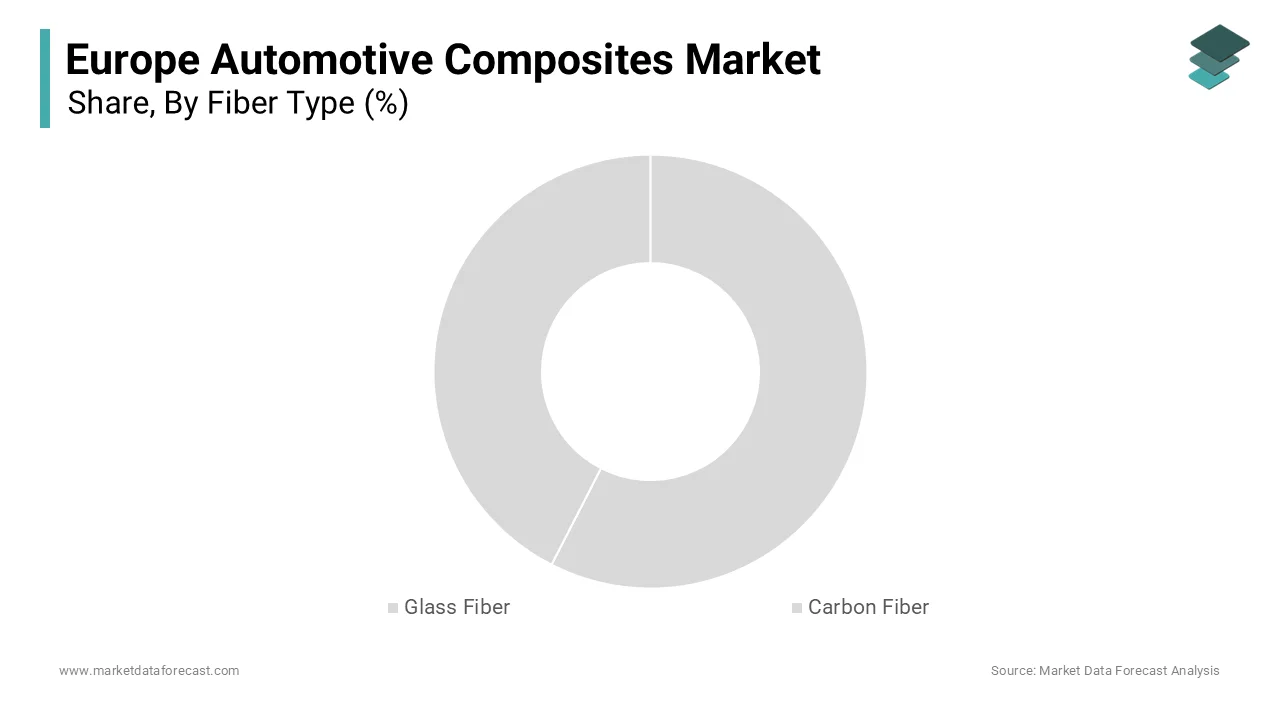
The carbon fiber segment is likely to grow with an estimated CAGR of 12.7% in the coming years. One of the primary growth drivers is the surge in electric mobility across Europe. As reported by BloombergNEF, EV sales in the region exceeded 2.6 million units in 2023, reflecting a year-over-year increase of 21%. Given that battery packs add considerable weight to vehicles, automakers like BMW and Mercedes-Benz are integrating carbon fiber-reinforced polymers (CFRPs) into chassis structures, roofs, and bumpers to offset this burden while extending driving range. Additionally, advancements in manufacturing technologies—such as automated fiber placement and resin transfer molding—are lowering production costs and cycle times. According to the Fraunhofer Institute for Chemical Technology (ICT), the cost of carbon fiber has declined by nearly 20% since 2019 due to process optimization and localized supply chain developments.
By Resin Insights
The thermoset resins segment was the largest by capturing a dominant share of the Europe Automotive Composites Market in 2025. Epoxy, polyester, and vinyl ester resins—key subcategories within the thermoset family—are extensively used in components such as hoods, fenders, and load-bearing panels. According to EuCIA, more than 320,000 metric tons of thermoset-based composites were deployed in the European automotive industry in 2023, which is driven largely by their compatibility with carbon and glass fibers. The aerospace-inspired processing techniques adopted by automotive manufacturers, such as autoclave curing and resin transfer molding, further reinforce the preference for thermosets. Additionally, regulatory mandates requiring improved fuel efficiency and lower emissions are pushing automakers to adopt these high-performance materials in premium and performance-oriented segments.
The thermoplastic resins segment is likely to grow with an estimated CAGR of 11.2% in the coming years. Unlike thermosets, which undergo irreversible chemical changes during curing, thermoplastics can be melted and reformed multiple times, aligning well with sustainability goals. According to a study published by the Journal of Cleaner Production, thermoplastic composites can reduce part production time by up to 50% due to their shorter molding cycles and ability to be injection molded or thermoformed. Automotive Tier-1 suppliers such as Faurecia and Johnson Controls are increasingly adopting thermoplastic polyurethane (TPU) and polypropylene-based composites for interior door panels, seat backs, and bumper beams. As per the European Bioplastics Association, bio-based thermoplastic composites accounted for nearly 9% of total resin demand in 2023, with brands like Volvo and BMW incorporating them into eco-conscious model lines.
By Application Insights
The exterior applications segment accounted in holding 57.4% of the share in the Europe Automotive Composites Market. Components such as hoods, spoilers, fenders, and front-end modules benefit significantly from composite materials, particularly glass fiber-reinforced plastics (GFRP) and carbon fiber-reinforced polymers (CFRP). According to the European Automobile Manufacturers’ Association (ACEA), reducing the weight of exterior body panels by just 10% can lead to a 4–6% improvement in fuel efficiency, reinforcing the incentive for automakers to adopt composites. Moreover, the European Commission’s push for stricter CO₂ emission norms has prompted manufacturers to replace metal exteriors with lighter alternatives.
The interior applications segment is swiftly growing with an estimated CAGR of 10.8% in the coming years. Modern interiors increasingly incorporate natural fiber composites (NFCs) and thermoplastic composites in door panels, instrument clusters, seat shells, and parcel shelves. According to the Nova-Institute, NFC usage in European automotive interiors grew by 19% in 2023, driven by environmental regulations and brand-specific sustainability commitments from companies like Audi, Volvo, and BMW. Additionally, the shift toward modular interior design strategies is encouraging the use of composites that offer design flexibility, ease of integration, and reduced assembly complexity. As per a white paper published by the Society of Plastics Engineers (SPE), thermoplastic olefins (TPOs) and polypropylene-based composites are now being preferred over traditional PVC and ABS due to their lower VOC emissions and recyclability. Furthermore, the rise of electric and autonomous vehicles is prompting automakers to redesign cabin spaces for comfort and functionality, necessitating advanced composite solutions. With ongoing innovations and increasing supplier collaborations, interior applications are set to outpace other segments in terms of growth velocity within the European automotive composites domain.
COUNTRY-LEVEL ANALYSIS
Germany Automotive Composites Market Analysis
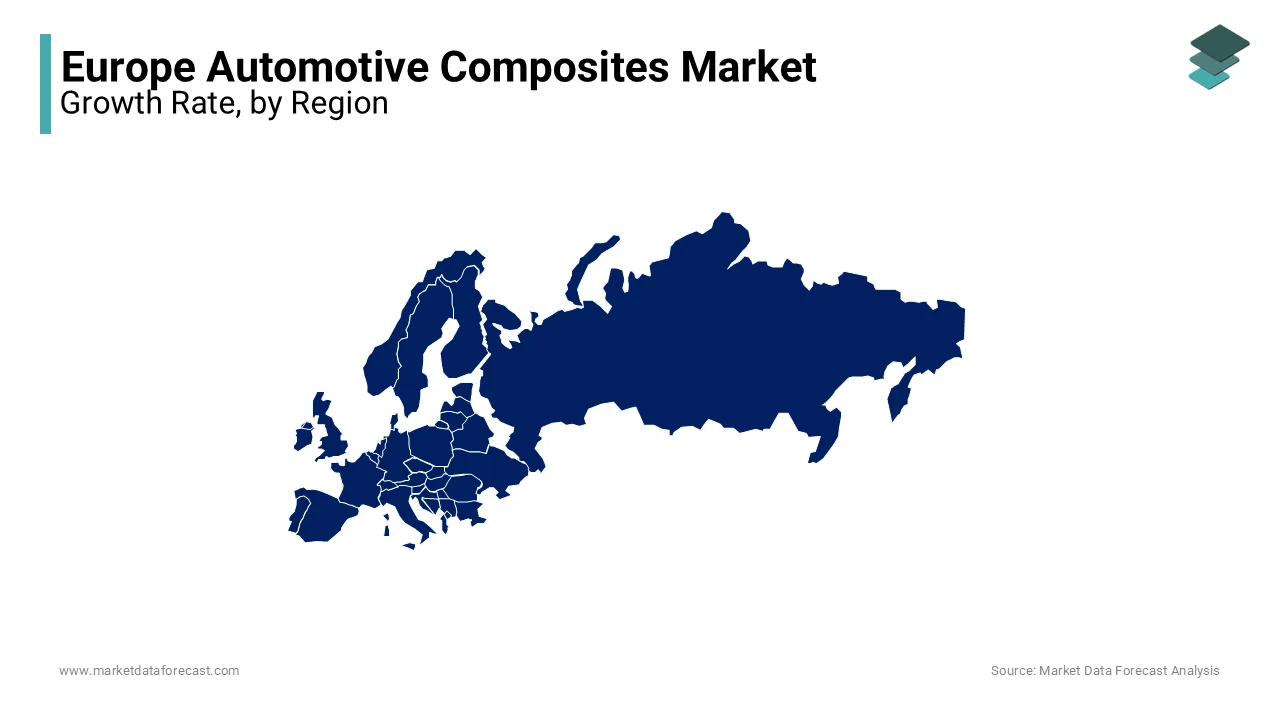
Germany was the top performer in the Europe Automotive Composites Market with 28.4% of the share in 2025. The country's leadership in lightweight technology is supported by national initiatives like the "Leichtbaustrategie" (Lightweight Strategy) introduced by the Federal Ministry for Economic Affairs and Climate Action (BMWK), which promotes the use of composites in transportation to meet climate neutrality goals. In addition, German research institutions such as Fraunhofer ICT and RWTH Aachen University are spearheading innovations in automated composite manufacturing and recycling methods.
France Automotive Composites Market Analysis
France was positioned second with 12.4% of the Europe Automotive Composites Market share in 2025. As per France Stratégie, the French government allocated €8 billion under its National Recovery Plan to support green automotive technologies, including lightweight materials and composite-based vehicle architectures. Additionally, the country’s composites industry is benefiting from collaborative R&D programs facilitated by organizations like IRT Jules Verne and Pôle de Compétitivité Véhicule du Futur. According to the French Composites Association (Plastic Omnium), domestic composite material usage in automotive applications grew by 9.4% in 2023, indicating a strong trajectory aligned with EU-wide decarbonization objectives.
Italian Automotive Composites Market Analysis
The Italian Automotive Composites Market is lucratively to grow with prominent growth opportunities in the coming years. According to ANFIA (Italian Association of Automotive Industries), Italy produced over 850,000 vehicles in 2023, with a notable portion incorporating carbon fiber components to improve power-to-weight ratios and dynamic performance. The Italian composites sector is also bolstered by specialized suppliers like Bucci Composites and Alantum, which provide tailored solutions for motorsport and luxury automotive segments. Moreover, the country has been proactive in fostering circular economy practices within the composites industry.
Spain Automotive Composites Market Analysis
Spain's automotive composites market is more likely to have a steady pace in the forecast period, with the country’s automotive sector, though not traditionally known for high-performance composites, has seen steady growth in composite utilization due to increasing foreign investment and a shift toward lightweight materials in compact and mid-sized vehicles. Additionally, the Spanish government has prioritized green mobility through the “Movilidad Inteligente” strategy, allocating €3.5 billion to support electromobility and sustainable manufacturing practices.
United Kingdom Automotive Composites Market Analysis
The United Kingdom Automotive Composites Market is expected to grow with a healthy CAGR throughout the forecast period. Companies like McLaren, Aston Martin, and Bentley have positioned the UK as a global leader in carbon fiber integration, leveraging local expertise from institutions such as the National Composites Centre (NCC) and the Advanced Manufacturing Research Centre (AMRC). Moreover, the UK government has committed £1.4 billion under the Automotive Transformation Fund to accelerate the adoption of lightweight and sustainable materials in future vehicle production.
COMPETITIVE LANDSCAPE
The competition in the Europe Automotive Composites Market is marked by a dynamic landscape where global and regional players coexist, striving to capture a larger share through innovation, strategic alliances, and localized manufacturing. As automotive manufacturers increasingly prioritize lightweight materials to comply with stringent emissions regulations and enhance vehicle efficiency, the demand for advanced composites continues to rise. This has led to intensified rivalry among established chemical and materials firms seeking to differentiate themselves through superior product portfolios and technological capabilities.
Several large multinational corporations maintain dominance due to their extensive R&D networks, deep industry partnerships, and broad product offerings. However, niche players are also gaining traction by focusing on specialized applications, sustainable materials, and cost-effective alternatives. The competitive environment is further shaped by ongoing investments in automation, recycling technologies, and new material formulations aimed at addressing the evolving needs of the automotive sector. With the shift toward electric mobility and circular economy principles, companies must continuously adapt their strategies to stay ahead in this rapidly transforming market.
KEY MARKET PLAYERS
A few of the market players in the Europe Automotive Composites Market include
- SGL Carbon
- TEIJIN LIMITED
- BASF
- Solvay
- Hexcel Corporation
- Zoltek Corporation
- Evonik Industries AG
- Mitsubishi Chemical Group Corporation
- Covestro AG
- LANXESS.
Top Players In The Market
- One of the leading players in the Europe Automotive Composites Market is Solvay S.A. The company has a strong presence in advanced composite materials in carbon fiber and high-performance thermoplastics. Solvay collaborates extensively with major automotive OEMs to develop lightweight solutions that enhance fuel efficiency and support electric vehicle development. Its expertise lies in offering tailored composite resins and fibers that meet stringent European emission norms and sustainability targets. Another key player is Toray Industries, Inc., known globally for its innovation in carbon fiber technology. Toray has been instrumental in advancing composite applications in European automotive manufacturing. The company supplies high-strength, lightweight materials used in structural components, hoods, and battery enclosures. Toray’s partnerships with German and French automakers have enabled the integration of composites into next-generation vehicles, contributing significantly to performance and emissions reduction strategies across the region.
- Hexcel Corporation is another dominant participant in the market, specializing in advanced composites for both aerospace and automotive sectors. In Europe, Hexcel plays a crucial role in supplying carbon fiber reinforcements and composite structures for premium and electric vehicles. The company's focus on sustainable manufacturing and recyclable composites aligns well with European environmental regulations. Through continuous R&D efforts and localized production facilities, Hexcel supports automotive manufacturers in achieving lightweighting goals while maintaining structural integrity and safety standards.
Top Strategies Used by Key Market Participants
- A primary strategy employed by key players in the Europe Automotive Composites Market is strategic partnerships and collaborations with automotive OEMs and Tier-1 suppliers. Companies are actively engaging in joint ventures and long-term agreements to co-develop customized composite solutions that align with evolving vehicle design requirements and regulatory mandates.
- Another major approach is investment in R&D for material innovation and process optimization. Leading firms are focusing on developing bio-based, recyclable, and hybrid composites to meet sustainability goals while improving mechanical properties and cost-efficiency. This includes exploring novel manufacturing techniques such as automated fiber placement and out-of-autoclave curing to enhance scalability.
- The companies are expanding their regional footprint through localized production units and supply chain integration. Establishing manufacturing hubs within Europe allows for faster response times, reduced logistics costs, and better alignment with regional demand patterns, particularly in the growing electric vehicle segment.
RECENT MARKET NEWS
- In February 2024, Solvay announced a collaboration with a leading German automaker to develop a new line of lightweight thermoplastic composites designed specifically for electric vehicle platforms. This initiative aims to reduce vehicle weight while enhancing durability and energy efficiency.
- In May 2023, Toray Industries launched a dedicated R&D center in France focused on creating recyclable carbon fiber composites tailored for European automotive applications, which is reinforcing its commitment to sustainability and innovation.
- In September 2023, Hexcel Corporation expanded its production facility in the UK to increase capacity for carbon fiber-reinforced components by supporting growing demand from premium and electric vehicle manufacturers across Europe.
- In November 2024, BASF SE introduced a new range of bio-based resins for automotive composites, targeting eco-conscious automakers looking to integrate sustainable materials without compromising performance or structural integrity.
- In January 2024, Plastic Omnium partnered with a French startup specializing in composite recycling technologies to develop closed-loop systems for end-of-life vehicle components by aligning with EU circular economy objectives.
MARKET SEGMENTATION
This research report on the Europe automotive composites market is segmented and sub-segmented into the following categories.
By Fiber Type
- Glass Fiber
- Carbon Fiber
By Resin Type
- Thermoset Resins
- Thermoplastic Resin
By Application
- exterior segment
- interior application
By Country
- UK
- France
- Spain
- Germany
- Italy
- Russia
- Sweden
- Denmark
- Switzerland
- Netherlands
- Turkey
- Czech Republic
- Rest of Europe