- Product Description Description
- Table of Contents TOC
- List of Table & Figure LOT
- Get Free Sample PDF Sample PDF
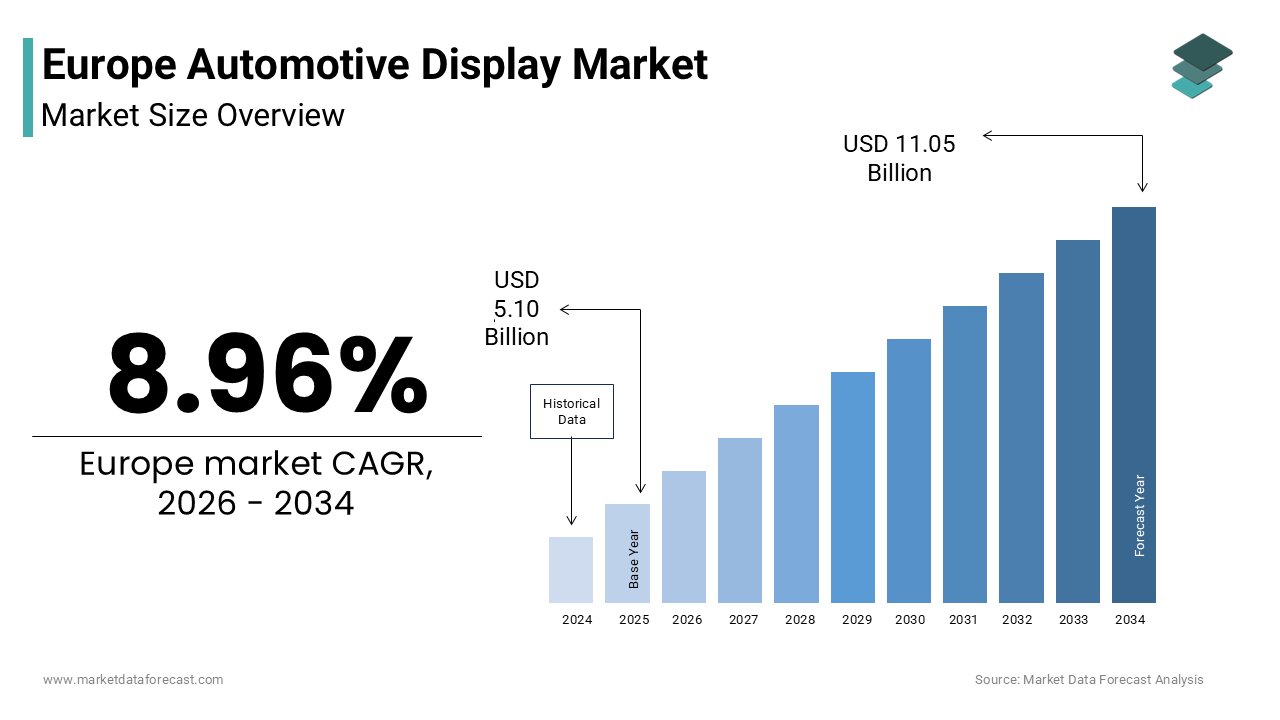
Market Size, 2025
$5.10 BnMarket Estimate, 2026
$5.56 BnMarket Forecast, 2034
$11.05 BnCAGR, 2026–2034
8.96%Europe Automotive Display Market Report Summary
The Europe automotive display market was valued at USD 5.10 billion in 2025, is expected to reach USD 5.56 billion in 2026, and is projected to grow to USD 11.05 billion by 2034, registering a CAGR of 8.96% from 2026 to 2034. The market growth is driven by rapid electrification of vehicles, increasing integration of advanced driver assistance systems (ADAS), and rising demand for enhanced in-car digital experiences. Additionally, regulatory mandates for safety features and the transition toward software-defined vehicles are accelerating the adoption of advanced display technologies across Europe.
Key Market Trends
- Increasing adoption of large-format digital cockpits in electric vehicles
- Rising demand for augmented reality head-up displays (AR-HUDs)
- Growth of multi-screen configurations and passenger entertainment systems
- Expansion of OLED and high-resolution display technologies
- Increasing focus on human-machine interface (HMI) and safety visualization systems
Segmental Insights
- Based on vehicle type, the passenger cars segment dominated the Europe automotive display market in 2025. This dominance is attributed to high production volumes and growing consumer demand for advanced infotainment and digital cockpit features.
- Based on product type, the center stack display segment held the largest share of 42.8% in 2025, owing to its central role in infotainment, navigation, and vehicle control systems.
- Based on sales channel, the OEM segment accounted for the largest share due to the deep integration of displays within vehicle architecture and software ecosystems.
Regional Insights
The Europe automotive display market is expanding across major automotive hubs, supported by strong manufacturing ecosystems and technological advancements.
- Germany led the market with 29.1% share in 2025, driven by the presence of premium automakers and advanced automotive technology suppliers.
- France accounted for 16.2% share, supported by strong production volumes and increasing adoption of digital interfaces in mass-market vehicles.
- United Kingdom holds a significant share due to its focus on luxury vehicles and advanced cockpit technologies.
- Italy is growing steadily with strong demand from luxury and performance vehicle manufacturers integrating advanced display systems.
- Spain is emerging as a key manufacturing hub, driven by high vehicle production volumes and increasing electric vehicle adoption.
Competitive Landscape
The Europe automotive display market is highly competitive, with major automotive suppliers and technology companies focusing on innovation, partnerships, and advanced display solutions. Companies are investing heavily in OLED displays, AR-HUDs, and software-driven cockpit systems to strengthen their market presence. Strategic collaborations with semiconductor and software firms are also shaping the competitive dynamics. Key players in the Europe automotive display market include Continental AG, Robert Bosch GmbH, Magneti Marelli S.p.A., Denso Corporation, Hyundai Mobis, Visteon Corporation, LG Electronics, JDI Europe GmbH, MTA S.p.A., and ZF Friedrichshafen AG.
Europe Automotive Display Market Size
The Europe automotive display market size was valued at USD 5.10 billion in 2025 and is anticipated to reach USD 5.56 billion in 2026 from USD 11.05 billion by 2034, growing at a CAGR of 8.96% during the forecast period from 2026 to 2034
An automotive display is a digital screen integrated into a vehicle's interior to provide the driver and passengers with critical information, entertainment, and control over vehicle systems. This market has evolved from simple monochrome instrument clusters to sophisticated high resolution organic light emitting diode and liquid crystal display panels that span entire dashboards. The current landscape is defined by a radical transformation in the cockpit architecture, driven by the electrification of fleets and the integration of advanced driver assistance systems. Regulatory mandates play a pivotal role in shaping this environment, as safety standards increasingly require digital interfaces for critical vehicle data. According to the European Commission, new safety regulations implemented in 2024 mandate the inclusion of intelligent speed assistance and driver drowsiness detection systems in all new vehicles, necessitating advanced graphical user interfaces to convey these alerts effectively. Furthermore, the shift towards electric mobility alters cabin design priorities, with manufacturers removing traditional mechanical gauges to create space for expansive digital screens. Data from the European Alternative Fuels Observatory indicates that battery electric vehicle registrations in the European Union surged to represent 14.6 percent of all new car sales in 2023, a demographic that almost exclusively features large format digital cockpits. This convergence of regulatory pressure and technological transition positions Europe as a critical hub for the adoption of next generation automotive visualization technologies.
MARKET DRIVERS
Accelerated Electrification and Redefined Cabin Architectures
The rapid transition to electric vehicles fundamentally reshapes interior design, mandating large format digital interfaces to replace analog components.
Aggressive shifts toward electric mobility are driving the European automotive display market. Consequently, vehicle cockpits are being redesigned to meet new aesthetic and information demands. Electric vehicles lack the internal combustion engine noise and vibration that traditionally justified analog gauges, leading manufacturers to adopt fully digital instrument clusters and central infotainment screens as standard features to convey battery status, range, and energy flow. According to the European Automobile Manufacturers’ Association (ACEA), the combined market share of electrified vehicles, specifically Hybrid Electric Vehicles (HEVs), has secured a significant quarter of the market, while the broader category of all electrically chargeable cars continues to rise, establishing a substantial user base for modern digital interfaces. Unlike premium models, budget-friendly electric vehicles in Europe often utilize smartphone integration stations or compact digital readouts in their base trims to maintain affordability, reserving large-format touchscreens for higher specification levels, contrary to the trend of universal large-screen adoption. The architectural freedom provided by electric platforms allows designers to implement pillar to pillar screen configurations that were previously impossible. The International Energy Agency (IEA) confirms that Europe remains the second-largest market for electric cars globally. This position encourages Original Equipment Manufacturers (OEMs) to invest in advanced cockpit technologies, though mass-market brands continue to balance high-resolution display adoption with cost-efficiency. This structural change ensures that every new electric vehicle entering the market contributes directly to the volume growth of advanced display units.
Stringent Safety Regulations Mandating Digital Human Machine Interfaces
Compulsory European Union safety protocols require sophisticated visual feedback systems, driving the adoption of advanced digital clusters and head up displays.
The European Union's implementation of rigorous safety regulations also contributes to the growth of the Europe automation display market. These regulations explicitly mandate the use of advanced digital human-machine interfaces to monitor driver behavior and vehicle status. The General Safety Regulation (GSR II), fully applicable to new registrations as of 2024, mandates advanced assistance features like Intelligent Speed Assistance (ISA) and Driver Drowsiness Detection. These systems necessitate the transition from traditional analog dials to digital instrument clusters capable of displaying dynamic real-time alerts and speed limit information to the driver. The European Transport Safety Council (ETSC) and safety advocates emphasize that modern assistance systems require clear, intuitive feedback loops. Consequently, traditional static gauges are being phased out in favor of digital solutions that can adapt to show critical safety warnings immediately. Consequently, automakers are integrating high brightness head up displays and configurable digital instrument clusters capable of projecting augmented reality navigation and hazard warnings directly into the driver line of sight. The European New Car Assessment Programme (Euro NCAP) has updated its "Safe Driving" assessment criteria. Crucially, recent protocols aim to reduce driver distraction by encouraging the retention of physical controls for essential safety functions (like turn signals and hazard lights), discouraging the industry's trend of burying critical inputs within complex touchscreen menus. The European Commission highlights that reducing road fatalities remains a primary policy objective. This focus drives the strict enforcement of technological mandates, ensuring that advanced safety systems are not just optional extras but standard requirements for vehicle certification across the continent. This regulatory compulsion ensures that even entry level vehicles in the European market must incorporate sophisticated display technologies, thereby expanding the total addressable market beyond premium segments to include mass market vehicles.
MARKET RESTRAINTS
Volatility in Raw Material Costs and Supply Chain Fragility
Fluctuating prices of rare earth elements and semiconductor shortages constrain production scalability and increase manufacturing expenses.
Volatility in raw material costs and fragile supply chains are creating significant hurdles for the Europe automotive display market. Key shortages affect the semiconductors and rare earth elements needed for production. The manufacturing of high resolution liquid crystal and organic light emitting diode displays relies heavily on indium, gallium, and specialized driver integrated circuits, the prices of which have experienced sharp fluctuations due to geopolitical tensions and mining constraints. According to the European Commission, the European Union remains almost entirely dependent on external imports for its rare earth element needs. This concentration of supply, particularly from a small number of global partners, leaves the automotive and green technology sectors highly exposed to trade disruptions and export restrictions. The European Semiconductor Industry Association (ESIA) note that while the automotive sector experienced extreme delivery delays during the peak of the global shortage, lead times for most components have recently returned to pre-pandemic levels. Manufacturers continue to monitor supply chains closely to prevent a recurrence of such prolonged shortages. These disruptions force automakers to delay vehicle launches or produce cars with reduced functionality, directly impacting display unit volumes. Furthermore, the rising cost of energy in Europe exacerbates production expenses for panel manufacturers operating within the region. Eurostat indicate that while general industrial producer prices have stabilised or even decreased in some sectors, the cumulative impact of past price hikes for raw materials and energy continues to put pressure on the profit margins of electronic component suppliers across the region. Until supply chains are diversified and localized, these cost and availability pressures will continue to restrain market growth and profitability.
Complex Integration Challenges and Cybersecurity Vulnerabilities
The increasing complexity of software defined vehicles introduces significant hurdles in system integration and exposes displays to cyber threats.
The escalating complexity associated with integrating diverse software ecosystems and the heightened risk of cybersecurity breaches in connected cockpits are among the major constraints for the Europe automotive display market expansion. Modern vehicles function as software defined machines where displays serve as the primary interface for dozens of electronic control units, requiring flawless interoperability between different operating systems and legacy components. As noted by the European Union Agency for Cybersecurity (ENISA), the increasing connectivity of modern vehicles has significantly expanded the potential for cyberattacks. Infotainment systems and vehicle-to-everything (V2X) interfaces are highlighted as critical areas where security must be reinforced to prevent unauthorized access to essential vehicle functions. The implementation of UNECE Regulation No 155 has established a new global benchmark for vehicle cybersecurity, making a certified management system mandatory for vehicle type approval in Europe. This shift requires manufacturers and their suppliers to integrate rigorous security protocols throughout the entire vehicle lifecycle, from initial design and production to post-sale monitoring. The fragmentation of software standards across different European automakers further complicates integration, leading to prolonged validation phases. Data from the German Association of the Automotive Industry (VDA) and safety regulators confirms that software-related defects are a primary driver of modern vehicle recalls. As vehicles evolve into "software-defined platforms," the complexity of validating millions of lines of code has become a major technical and operational hurdle for the industry. These technical and security challenges increase the time to market for new display technologies and raise the barrier to entry for suppliers who cannot guarantee robust cyber resilience, thereby limiting the pace of innovation deployment.
MARKET OPPORTUNITIES
Emergence of Augmented Reality Head Up Displays
The integration of augmented reality into head up systems offers a transformative opportunity to enhance navigation and safety perception.
The advent of augmented reality head up display technology creates growth possibilities for the Europe automotive display market. This is done by revolutionizing how drivers interact with navigation and safety information. Unlike traditional head up displays that project simple speed and arrow icons, augmented reality systems overlay dynamic, context aware graphics onto the real world view, such as highlighting lanes, marking pedestrians, and projecting navigation paths directly onto the road surface. According to sources, filings for augmented reality automotive applications increased in 2023, reflecting intense research and development activity by European OEMs and tier one suppliers. This technology addresses the growing issue of cognitive overload by presenting information exactly where the driver needs it, reducing eye strain and reaction times. The European New Car Assessment Programme is increasingly recognizing the safety benefits of such intuitive interfaces, potentially making them a key differentiator for safety ratings. Major European luxury manufacturers have already begun introducing these systems in flagship models, creating a trickle down effect to mid segment vehicles. Maturing technology and declining costs are set to unlock a new high-value display market segment. Consequently, this will drive revenue growth via premium pricing and mass adoption.
Expansion of Passenger Entertainment and Multi-Screen Configurations
The rise of autonomous driving features enables new interior layouts focused on passenger entertainment, driving demand for rear seat and side window displays.
The gradual progression towards higher levels of driving automation opens doors for the proliferation of multi screen configurations and dedicated passenger entertainment displays within the vehicle cabin, which is likely to promote the expansion of the Europe automotive display market. As drivers are relieved of certain operational tasks, the focus of the interior shifts from a purely driver centric cockpit to a shared living space where rear seat passengers demand high quality visual experiences for work and leisure. Automakers are responding by integrating large format organic light emitting diode panels on the back of front seats, ceiling mounted displays, and even transparent screens embedded in side windows. A study notes a growing demand for connectivity and digital services among passengers, pushing manufacturers to treat the cabin as a mobile entertainment hub. This trend is particularly strong in the premium segment where differentiation relies heavily on the passenger experience. This multiplication of screens per unit significantly expands the total market volume, offering suppliers opportunities to provide diverse form factors and specialized content management systems.
MARKET CHALLENGES
Standardization of Software Architectures and Operating Systems
The lack of unified software standards across manufacturers hinders scalable development and increases the cost of display integration.
The fragmentation of software architectures and the absence of standardized operating systems across different original equipment manufacturers is one of the impediments to the Europe automotive display market. Each automaker often develops proprietary software stacks or licenses distinct third party operating systems, resulting in a disjointed ecosystem where display hardware must be custom engineered for specific software environments. The inability to leverage economies of scale slows down the adoption of cutting edge display technologies such as high refresh rate panels or advanced touch feedback mechanisms. Furthermore, the rapid evolution of software requirements means that hardware can become obsolete before the vehicle lifecycle ends, creating warranty and support nightmares. The market must converge on common standards or embrace open-source platforms like Android Automotive OS. Until that happens, software fragmentation will continue to hamper the agility and profitability of the European display supply chain.
Environmental Regulations Regarding Manufacturing and Disposal
Stricter European environmental laws impose rigorous constraints on the production materials and end-of-life disposal of electronic display units.
Stringent environmental regulations are placing mounting pressure on the European automotive display market. Specifically, these rules dictate the handling of electronic components, covering everything from initial raw material extraction to final disposal. The European Green Deal and the updated End of Life Vehicles Directive impose strict limits on the use of hazardous substances and mandate high recycling rates for electronic waste, compelling manufacturers to rethink their material choices and production processes. According to sources, the automotive sector is under increasing scrutiny to reduce its carbon footprint, with specific targets for the recyclability of batteries and electronic modules including displays. The presence of rare earth metals and complex composites in modern liquid crystal and organic light emitting diode panels makes compliance with these recycling mandates technically challenging and costly. Manufacturers must invest in new disassembly technologies and establish reverse logistics networks to recover valuable materials, adding layers of complexity to the supply chain. Additionally, the push for carbon neutral manufacturing requires display producers to transition to renewable energy sources, which may not be readily available in all production locations. These regulatory hurdles increase the overall cost of ownership and create barriers for smaller players who lack the resources to implement comprehensive sustainability programs.
REPORT COVERAGE
| REPORT METRIC | DETAILS |
| Market Size Available | 2025 to 2034 |
| Base Year | 2025 |
| Forecast Period | 2026 to 2034 |
| CAGR | 8.96% |
| Segments Covered | By Vehicle Type, Technology Type, Product Type and Region. |
| Various Analyses Covered | Global, Regional & Country Level Analysis, Segment-Level Analysis, DROC, PESTLE Analysis, Porter’s Five Forces Analysis, Competitive Landscape, Analyst Overview of Investment Opportunities |
| Country Covered | UK, France, Spain, Germany, Italy, Russia, Sweden, Denmark, Switzerland, the Netherlands, Turkey, the Czech Republic, and the Rest of Europe. |
| Market Leaders Profiled | Continental AG, Robert Bosch GmbH, Magneti Marelli S.p.A., Denso Corporation, Hyundai Mobis, Visteon Corporation, LG Electronics, JDI Europe GmbH, MTA S.p.A., and ZF Friedrichshafen AG. |
SEGMENTAL ANALYSIS
By Vehicle Type Insights
The passenger cars segment dominated the Europe automotive display market and occupied a substantial share in 2025. This dominance of the segment is credited to the sheer volume of passenger vehicle production in Europe and the intense competition among original equipment manufacturers to differentiate their brands through advanced cabin technology and digital user experiences. The main force behind the dominance of the passenger car segment is the massive production volume combined with a shift in consumer expectations where digital interfaces are no longer luxury features but standard requirements. European consumers increasingly view the quality of the infotainment system and instrument cluster as key decision factors when purchasing a new vehicle. Unlike commercial vehicles where utility often dictates cost cutting, passenger car buyers demand high resolution organic light emitting diode screens, touch responsiveness, and seamless smartphone integration. The democratization of technology across all trim levels ensures that the passenger car segment consumes the majority of display panels produced for the automotive sector, solidifying its market supremacy through sheer unit volume and increasing content per vehicle. Also supporting this segment is the rapid electrification of the fleet, which fundamentally alters interior architecture to favor expansive digital displays over mechanical gauges. Electric vehicles require unique interfaces to monitor battery state of charge, energy consumption, charging station locations, and regenerative braking status, information that is best conveyed through dynamic graphical user interfaces. These electric platforms are designed from the ground up with digital first philosophies, often featuring pillar to pillar screen configurations that replace traditional dashboards entirely. The removal of the engine tunnel and transmission hump in many electric passenger cars allows for more flexible screen placement and larger form factors that were previously impossible. This structural shift ensures that every new electric passenger car contributes multiple high value display units to the market, driving both volume and revenue growth disproportionately compared to internal combustion engine vehicles or commercial trucks.
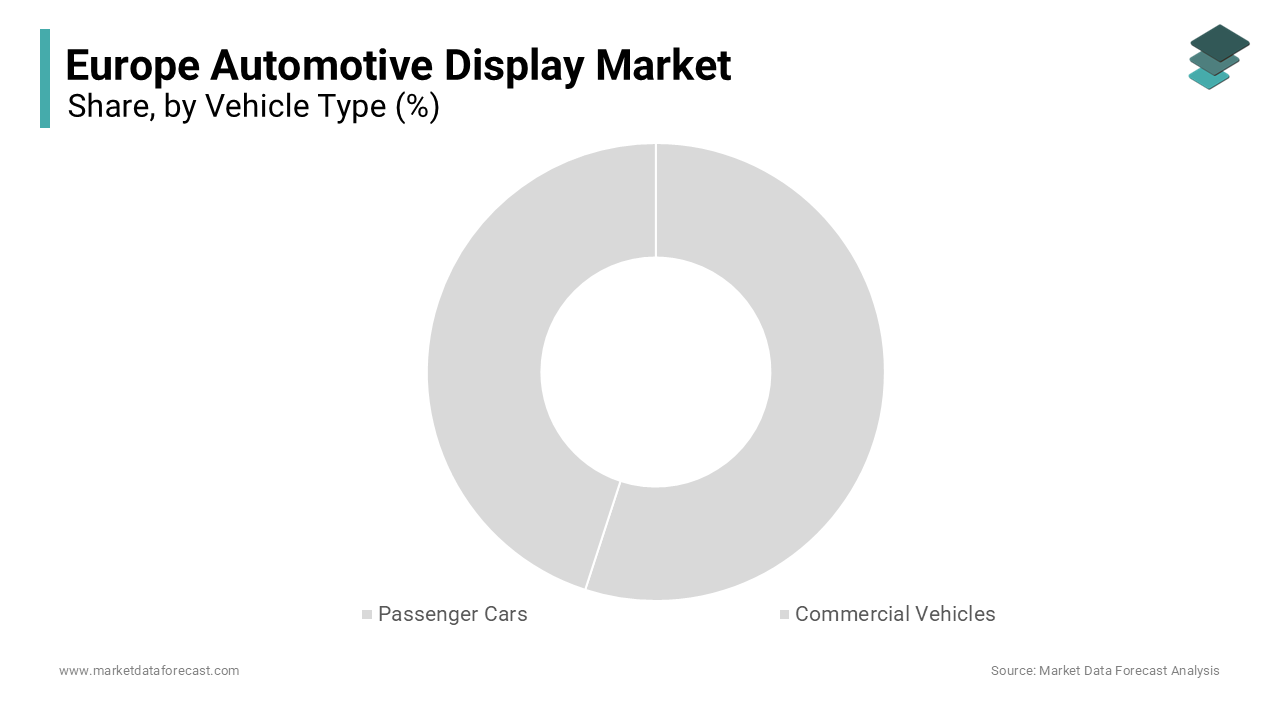
The commercial vehicle segment is predicted to witness the highest CAGR of 9.2% during the forecast period due to stringent regulatory mandates for driver monitoring systems, the rise of connected logistics fleets, and the modernization of heavy duty truck cabins to address driver shortages. The rapid expansion of the commercial vehicle segment is primarily driven by new European Union safety regulations that mandate the installation of advanced driver monitoring systems and digital tachographs in heavy duty trucks and buses. These regulations require real time visual feedback to alert drivers of fatigue, distraction, or lane departure, necessitating the integration of specialized high brightness displays within the instrument cluster or as standalone units. The digital tachograph, which records driving times and speeds, has also evolved to include larger, clearer screens to facilitate easier inspection and data reading by authorities. The regulatory push ensures that even budget conscious commercial vehicle manufacturers must prioritize display integration, driving a faster growth rate in this segment as the entire fleet turns over to meet legal requirements. Further boosting this segment is the accelerating trend towards fleet digitization and the integration of comprehensive telematics systems that rely on sophisticated in cab displays. Logistics companies and transport operators are increasingly adopting connected vehicle technologies to optimize route planning, monitor fuel efficiency, track cargo conditions, and manage driver performance in real time. These telematics systems require large, interactive center stack displays that can present complex data visualizations, navigation maps, and communication interfaces to the driver without causing distraction. The shift towards autonomous platooning and cooperative intelligent transport systems further increases the need for high reliability displays that can convey vehicle to infrastructure communication data. The modernization wave ensures that commercial vehicles are being equipped with multiple high end displays, transforming the cabin into a mobile command center and propelling the segment's growth rate ahead of the more saturated passenger car market.
By Product Insights
The center stack displays segment led the Europe automation display market and captured a share of 42.8% in 2025. This leading position of the segment is attributed to its role as the primary hub for infotainment, navigation, climate control, and vehicle settings, making them the most visible and frequently interacted with screen in the modern vehicle cockpit. The preeminence of the center stack display is fundamentally driven by the industry wide trend towards consolidating physical buttons and knobs into a single, unified touchscreen interface to streamline cabin design and enhance user experience. Modern European vehicles increasingly rely on these central screens to manage everything from media playback and smartphone projection to intricate vehicle dynamics and comfort settings. The elimination of physical controls allows manufacturers to create cleaner, more minimalist interiors that are perceived as more premium and technologically advanced. The consolidation not only reduces manufacturing complexity for switchgear but also enables over the air updates to improve functionality post purchase. As software defined vehicles become the norm, the center stack display serves as the primary gateway for these digital services, ensuring its position as the most critical and widely adopted display product in the market. Also helping this segment is the rapid adoption of large format, high resolution, and curved screen technologies that transform the center console into a focal point of the vehicle interior. Automakers are competing fiercely to offer immersive visual experiences, leading to the proliferation of ultra wide screens that span across the dashboard or curve towards the driver for better ergonomics. These larger canvases allow for split screen multitasking, displaying navigation maps alongside media controls or vehicle status information simultaneously. The shift towards organic light emitting diode technology in center stacks provides deeper blacks and higher contrast ratios, enhancing readability under various lighting conditions. This continuous evolution in form factor and visual quality ensures that the center stack remains the centerpiece of automotive interior innovation, driving sustained demand and market leadership.
The head-up display segment is estimated to register the fastest CAGR of 14.8% from 2026 to 2034 owing to the transition from basic monochrome projectors to advanced augmented reality systems, increasing safety awareness, and the desire to minimize driver distraction by keeping eyes on the road. The main reason behind the rapid expansion of the head-up display segment is the technological leap from simple speed projection to sophisticated augmented reality systems that overlay dynamic navigation arrows and hazard warnings directly onto the driver's view of the road. This advancement significantly enhances situational awareness and reduces cognitive load by eliminating the need for drivers to glance down at the instrument cluster or center screen. According to research, vehicles equipped with advanced head-up displays that integrate with active safety systems receive higher safety ratings, incentivizing manufacturers to include them as standard or optional equipment. The ability of augmented reality head-up displays to highlight pedestrians, cyclists, and lane markings in real time addresses critical safety concerns in complex urban environments. As the cost of laser scanning and waveguide technologies decreases, these advanced systems are trickling down from luxury sedans to mass market compact cars. This broadening applicability, combined with the clear safety benefits, drives a compound growth rate that far outpaces other display types as adoption becomes widespread across all vehicle segments. Following this, the segment is backed by the growing recognition of their ergonomic benefits in reducing driver distraction and eye strain during long journeys. By projecting critical information into the driver's natural line of sight, head-up displays minimize the refocusing effort required when shifting gaze between the road and internal instruments, a phenomenon known as the accommodation reflex. According to sources, studies have shown that drivers using head-up displays spend significantly less time looking away from the road compared to those relying solely on traditional clusters, leading to improved driving performance and reduced fatigue. This ergonomic advantage is particularly valued in Europe where long distance highway driving is common and traffic density is high. The integration of head-up displays with adaptive cruise control and lane keeping assist systems provides a seamless flow of information that helps drivers maintain confidence and control. Research indicates that user satisfaction scores for vehicles with head-up displays are consistently higher, influencing purchase decisions. Automakers are striving to differentiate their offerings through superior user experience and safety features. As a result, the inclusion of head-up displays is becoming a key competitive strategy, fueling rapid market expansion.
By Sales Channel Type Insights
The OEM (Original Equipment Manufacturer) channel segment was the largest in the Europe automotive display market and captured a significant share in 2025. This supremacy of the segment is due to the fact that automotive displays are integral, factory-installed components that are deeply embedded in the vehicle's electrical architecture, dashboard design, and software ecosystem, making aftermarket replacement rare and technically challenging. The dominance of this segment is also driven by the complex integration of modern displays into the vehicle's central computing architecture, where they serve as critical nodes for safety systems, infotainment, and vehicle control. Unlike generic accessories, automotive displays are custom engineered to fit specific dashboard contours, connect via proprietary high speed data buses, and run specialized operating systems that communicate with dozens of electronic control units. The rise of software defined vehicles further cements this dependency, as displays are paired with specific security certificates and encryption keys that prevent unauthorized third party replacements. A study indicates that the integration depth of modern organic light emitting diode clusters makes them virtually impossible to swap with aftermarket alternatives without compromising core vehicle functions. This technical lock in ensures that the vast majority of display procurement occurs directly between tier one suppliers and automobile manufacturers during the initial production phase, securing the OEM channel's stranglehold on the market. This segment is also built up by the stringent quality assurance standards and warranty requirements that govern automotive components, which aftermarket suppliers struggle to match. Original equipment manufacturers must adhere to rigorous testing protocols for temperature resistance, vibration durability, and electromagnetic compatibility to ensure displays function reliably over the 15 year lifespan of a vehicle. Consumers and fleet operators heavily rely on factory warranties that cover display failures, creating a strong preference for genuine OEM parts that guarantee compliance with these standards. Furthermore, insurance companies often refuse to cover damages resulting from non certified electronic installations, adding another layer of risk for aftermarket adoption. The trust in OEM quality and the comprehensive coverage provided by manufacturer warranties ensure that when displays fail or when new vehicles are purchased, the OEM channel remains the exclusive source for the vast majority of automotive display units.
The aftermarket segment is anticipated to witness the fastest CAGR of 6.5% over the forecast period due to the aging vehicle parc, the demand for retrofitted connectivity in older models, and the emergence of plug and play smart display solutions. This segment is also powered by the substantial aging vehicle population in Europe, where millions of cars lack modern connectivity features, prompting owners to seek retrofitted display solutions to bridge the technology gap. Drivers of these older vehicles increasingly demand access to navigation, Bluetooth calling, and apps like Apple CarPlay and Android Auto, which were not available in their original factory units. This demand has spurred a market for universal and model specific aftermarket head units that offer large displays and modern connectivity at a fraction of the cost of buying a new car. As economic pressures delay new car purchases, the incentive to upgrade existing interiors with modern displays continues to grow, fueling the expansion of the aftermarket channel. A further point supporting this is the development of innovative plug and play smart display modules that require minimal installation effort and do not interfere with existing vehicle electronics. Manufacturers have introduced sleek, adhesive mounted heads-up displays and dashboard screens that connect wirelessly to smartphones or via simple OBD II ports, bypassing the need for complex wiring harnesses or dashboard disassembly. These modules often feature augmented reality capabilities, voice control, and real time traffic updates, offering functionalities comparable to factory systems in high end vehicles. The rise of e commerce platforms has also made these products more accessible. This ease of installation and immediate functional upgrade creates a vibrant niche within the aftermarket, driving its growth rate higher than the mature OEM sector.
REGIONAL ANALYSIS
Germany Automotive Display Market
Germany outperformed other countries in the Europe automotive display market and captured a share of 29.1% in 2025. This dominance of the German market is attributed to its status as the largest automobile manufacturer in Europe, hosting global headquarters of premium brands that pioneer advanced cockpit technologies, and possessing a robust supply chain of tier one display suppliers. The strength of Germany’s automotive sector stems from its high concentration of top-tier manufacturers like Volkswagen, Mercedes-Benz, BMW, and Audi. These companies are sustaining their premium status by rapidly adopting advanced technologies, specifically large-format OLED and augmented reality (AR) displays. The country is home to major display suppliers such as Continental and Bosch, who collaborate closely with carmakers to develop cutting edge human machine interface solutions. The German government's strong support for electric mobility through subsidies and infrastructure investment has accelerated the adoption of digital cockpits, as electric vehicles from German makers almost exclusively feature fully digital instrument clusters and massive center consoles. This ecosystem of innovation, production scale, and technological leadership ensures that Germany remains the primary engine driving demand and supply for automotive displays across the continent.
France Automotive Display Market Analysis
France followed closely behind in the European market and occupied a 16.2% share in 2025. This expansion of the French market is driven by the strategic initiatives of Stellantis and Renault to democratize digital interfaces across their mass market portfolios and a strong push towards connected vehicle services. France maintains a strong market position, driven heavily by the aggressive strategies of domestic giants Stellantis and Renault Group. A key component of this success is the standardization of large touchscreens and digital clusters across all vehicle segments. The French automotive industry has embraced the "software defined vehicle" concept early, integrating Google Android Automotive OS and proprietary systems that rely heavily on high quality central displays for operation. The French government's bonus scheme for electric vehicles has further stimulated production of these digitally rich cars, boosting display volumes. Additionally, France hosts significant research centers for automotive electronics and human machine interface design, fostering innovation in user experience. The focus on making technology accessible to the mass market rather than just luxury buyers ensures a high volume of display units flowing through the French manufacturing base.
United Kingdom Automotive Display Market Analysis
The United Kingdom holds a noteworthy position in the Europe automotive display market owing to its strong luxury and premium vehicle manufacturing sector, significant investment in autonomous driving research, and the presence of major engineering hubs for global brands. The UK's market strength is underpinned by its specialization in high value premium and luxury vehicles from manufacturers like Jaguar Land Rover, Bentley, Rolls Royce, and Aston Martin, which traditionally lead the industry in adopting the most advanced and largest display configurations. These brands view the cabin experience as a key differentiator, often equipping their vehicles with multiple high resolution screens, rear seat entertainment systems, and pioneering augmented reality head-up displays. According to stdies, while total UK vehicle production volume is lower than Germany, the value per unit in terms of electronic content is among the highest in Europe. The UK is also a global hub for autonomous vehicle research, with numerous pilot projects in cities like London and Milton Keynes driving demand for sophisticated sensor fusion displays and operator interfaces. A study indicates that billions of pounds have been invested in low carbon and connected vehicle technologies, much of which flows into display and interface development. The presence of major technical centers for global companies like Nissan and Toyota in the UK further contributes to the development and integration of next generation display systems, ensuring the country remains a critical node in the high end automotive display value chain.
Italy Automotive Display Market Analysis
Italy experienced a consistent growth in the European market due to its iconic supercar and luxury sports car manufacturers who set trends in cockpit design, and a growing focus on electrification within its niche performance segment. Moreover, Italy's significant market presence is driven by its world renowned manufacturers such as Ferrari, Lamborghini, Maserati, and Alfa Romeo, who utilize automotive displays not just for function but as artistic elements of the interior design language. These companies are pioneers in implementing unique display shapes, curved organic light emitting diode panels, and highly customizable digital instrument clusters that reflect brand heritage while offering modern connectivity. The recent push towards hybridization and electrification by brands like Ferrari and Maserati has necessitated the integration of complex energy management displays and enhanced infotainment systems to compete with tech focused rivals. The emphasis on exclusivity and bespoke customer experiences means that Italian manufacturers often adopt new display technologies earlier than mass market producers to offer unique features. This trendsetting role combined with a resilient luxury market ensures Italy maintains a influential position in the European automotive display landscape.
Spain Automotive Display Market Analysis
Spain is anticipated to expand significantly in the Europe automation display market from 2026 to 2034 owing to its massive production volume of compact and mid-size vehicles for major international groups, and its strategic role as a manufacturing hub for electric vehicles and their associated digital components. Spain's market growth is influenced by its status as the second largest vehicle producer in Europe after Germany, hosting large scale manufacturing plants for Volkswagen Group, Stellantis, and Ford that produce millions of units destined for the entire European market. These factories have recently undergone significant retooling to produce electric vehicles such as the Cupra Born and Citroen e C4, which come equipped with modern digital cockpits as standard, thereby boosting display attachment rates. The Spanish government's strategic plan for electric and connected vehicles has attracted billions in investment to localize battery and electronic component production, strengthening the domestic supply chain for displays. The combination of high production volumes, a shift towards electric platforms, and strong export orientation ensures that Spain remains a vital contributor to the overall volume of the European automotive display market.
COMPETITIVE LANDSCAPE
The competition in the Europe automotive display market is characterized by intense rivalry among established multinational corporations and agile technology specialists vying for dominance in specific cockpit segments. Large automotive suppliers leverage their extensive manufacturing networks and deep relationships with original equipment manufacturers to secure long term contracts for integrated cockpit systems. This trend towards comprehensive solution providers creates high barriers to entry for smaller firms unless they possess highly differentiated display technologies or proprietary software algorithms. The competitive landscape is further complicated by stringent safety regulations and varying quality standards across different European nations which demand rigorous testing and validation before market approval. Companies must therefore invest significantly in research and development to demonstrate superior brightness, contrast, and durability while navigating complex procurement processes. Innovation speed and the ability to provide customizable software experiences are critical differentiators that determine market success. Furthermore, strategic alliances between display manufacturers and chipmakers have become essential for accessing cutting edge processing capabilities and accelerating product adoption. The market remains dynamic with continuous entries of organic light emitting diode and micro light emitting diode technologies challenging traditional liquid crystal display standards and reshaping competitive dynamics.
KEY MARKET PLAYERS
Some of the companies that are playing a dominating role in the Europe Automotive Display Market include
- Continental AG
- Robert Bosch GmbH
- Magneti Marelli S.p.A.
- Denso Corporation
- Hyundai Mobis
- Visteon Corporation
- LG Electronics
- JDI Europe GmbH
- MTA S.p.A.
- ZF Friedrichshafen AG
Top Players in the Europe Automotive Display Market
Robert Bosch GmbH
Robert Bosch GmbH stands as a global titan in automotive technology with a profound impact on the European display sector through its advanced cockpit solutions and human machine interface systems. The company contributes significantly to the global market by supplying integrated digital instrument clusters and large format center stack displays that define modern vehicle interiors. Recently Bosch has strengthened its position by launching next generation curved display units that combine high resolution organic light emitting diode technology with advanced driver assistance data visualization. The firm actively collaborates with major European original equipment manufacturers to develop software defined cockpit architectures that enable over the air updates and personalized user experiences. These strategic moves ensure their technologies remain at the forefront of safety and connectivity while addressing the growing demand for seamless digital integration across all vehicle segments in the continent.
Continental AG
Continental AG operates as a leading innovator in automotive electronics with a dominant presence in the European display landscape particularly within augmented reality head up displays and flexible screen technologies. The company contributes globally by developing sophisticated visual interfaces that project critical navigation and safety information directly into the driver line of sight. Their recent actions to solidify market presence include the introduction of panoramic curved displays that span the entire dashboard width for premium electric vehicles produced in Germany and France. Continental has also invested heavily in expanding its research facilities in Czech Republic and Hungary to accelerate the development of sustainable and energy efficient display modules. The firm frequently engages in partnerships with semiconductor companies to optimize processing power for real time graphics rendering. By focusing on ergonomic design and reduced driver distraction Continental enhances road safety and user satisfaction. These efforts demonstrate their commitment to driving technological advancement and maintaining leadership in the competitive European automotive interior arena.
Visteon Corporation
Visteon Corporation is a specialized automotive technology company that has established itself as a key player in the European market through its focus on fully digital cockpits and smart surface solutions. The company makes a substantial global contribution by providing scalable display platforms that range from entry level liquid crystal displays to high end organic light emitting diode clusters for luxury brands. Their recent strategy to strengthen their European position involves securing long term supply contracts with major electric vehicle manufacturers in the region for their next generation cockpit domain controllers. Visteon has also expanded its engineering centers in the United Kingdom and Spain to support local original equipment manufacturers with rapid prototyping and customization services. The firm continues to invest in artificial intelligence driven user interface designs that adapt to driver behavior and preferences. By maintaining a dedicated focus on modularity and cost efficiency Visteon addresses the diverse needs of both mass market and premium segments. Their persistent innovation in display integration ensures they remain a vital partner for automakers seeking cutting edge digital cabin experiences.
Top Strategies Used by Key Market Participants
Key players in the Europe automotive display market predominantly employ strategic product innovation and vertical integration to expand their portfolios and enhance technological capabilities. Companies frequently launch next generation curved and flexible display panels embedded with augmented reality features to differentiate their offerings and meet evolving consumer expectations. Another major strategy involves forming extensive collaborations with semiconductor manufacturers and software developers to optimize processing power and create seamless user interfaces. Market participants also focus heavily on expanding their manufacturing footprint within the European Union to ensure supply chain resilience and comply with local content regulations. Investment in research and development remains a cornerstone strategy as firms strive to develop energy efficient and sustainable display technologies that align with environmental goals. Additionally, companies pursue targeted acquisitions of specialized startups to rapidly incorporate novel touch sensing or holographic projection tools into their existing platforms. These combined approaches allow industry leaders to navigate complex regulatory landscapes while maintaining a competitive edge in this rapidly evolving technological sector.
MARKET SEGMENTATION
This research report on the Europe Automotive Display Market has been segmented and sub-segmented based on the following categories.
By Vehicle Type
- Passenger Cars
- Commercial Vehicles
By Technology Type
- LCD
- OLED
By Product Type
- Center Stack Display
- Instrument Cluster Display
- Heads-up Display
- Other Product Types
By Sales Type
- OEM
- Aftermarket
By Country
- UK
- France
- Spain
- Germany
- Italy
- Russia
- Sweden
- Denmark
- Switzerland
- Netherlands
- Turkey
- Czech Republic
- Rest of Europe