Europe Automotive Ethernet Market Size, Share, Trends, & Growth Forecast Report By Component (Hardware, Software, Services), Bandwidth/Operating Speed and Country (UK, France, Spain, Germany, Italy, Russia, Sweden, Denmark, Switzerland, Netherlands, Turkey, Czech Republic and Rest of Europe), Industry Analysis From 2026 to 2034
Market Size, 2025
$1.36 BnMarket Estimate, 2026
$1.67 BnMarket Forecast, 2034
$8.61 BnCAGR, 2026–2034
22.77%Europe Automotive Ethernet Market Report Summary
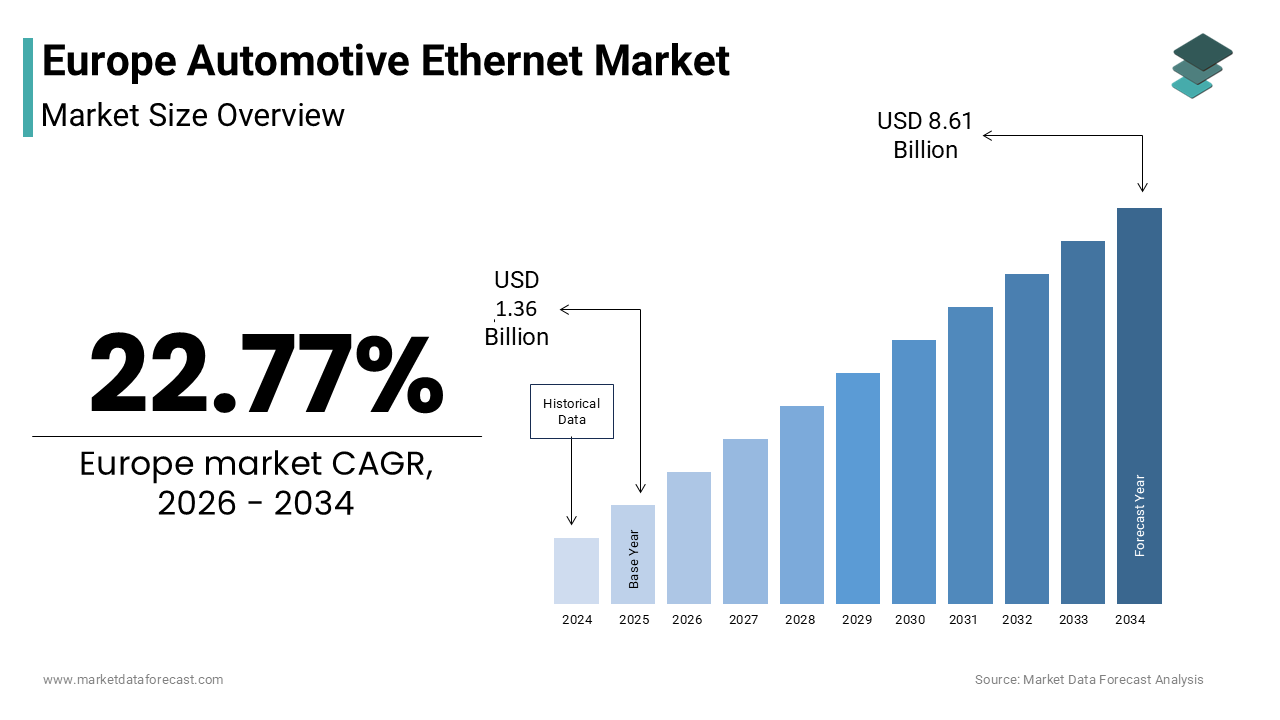
The Europe automotive ethernet market was valued at USD 1.36 billion in 2025, is projected to reach USD 1.67 billion in 2026, and is expected to grow to USD 8.61 billion by 2034, expanding at a CAGR of 22.77% during the forecast period from 2026 to 2034. The growth of the Europe automotive ethernet market is driven by the rapid expansion of advanced driver assistance systems, the shift toward centralized and zonal vehicle architectures, and increasing adoption of software-defined vehicle platforms. Automotive Ethernet enables high-speed data transmission between sensors, cameras, and electronic control units, supporting real-time processing, over-the-air updates, and cybersecurity compliance. Moreover, stringent European safety mandates and the rise of connected electric vehicles are positioning Ethernet as a foundational communication backbone across next-generation mobility ecosystems.
Key Market Trends
-
Increasing integration of multi-gigabit Ethernet networks to support high-resolution sensor fusion and automated driving functions.
-
Strong adoption of zonal and centralized electrical architectures reducing wiring complexity and enabling scalable software platforms.
-
Rising deployment of secure over-the-air update systems supported by automotive Ethernet connectivity.
-
Growing use of time-sensitive networking to ensure deterministic communication for safety-critical applications.
-
Expansion of automotive Ethernet adoption in commercial vehicles and off-highway machinery for telematics and diagnostics.
Segmental Insights
-
Based on component, the hardware segment accounted for 60.5% of the Europe automotive ethernet market share in 2025, driven by demand for switches, PHY transceivers, cables, and connectors required for high-speed in-vehicle networks.
-
Based on bandwidth/operating speed, the 100 Mbps (100BASE-T1) segment held 70.5% of the Europe automotive ethernet market share in 2025, supported by its optimal balance of cost, maturity, and performance for mainstream ADAS and infotainment applications.
-
The above 100 Mbps segment is projected to witness the fastest growth, fueled by increasing deployment of multi-gigabit backbones for automated driving, sensor fusion, and centralized computing platforms.
Regional Insights
The Europe automotive ethernet market is experiencing strong regional growth supported by vehicle electrification, software-defined architectures, and advanced automotive manufacturing ecosystems.
-
Germany led the Europe automotive ethernet market by holding 28.8% of the regional share in 2025, driven by premium OEM innovation, semiconductor R&D presence, and advanced zonal vehicle architectures.
-
France maintains a strong position with widespread adoption of Ethernet-enabled ADAS platforms across Stellantis and Renault vehicle lineups.
-
The United Kingdom is emerging as a high-growth market supported by expertise in automotive cybersecurity, software stacks, and AUTOSAR-based Ethernet solutions.
-
Italy and Sweden are witnessing steady expansion due to commercial vehicle integration, premium automotive innovation, and government support for software-defined mobility initiatives.
Competitive Landscape
The Europe automotive ethernet market features a collaborative yet highly competitive ecosystem involving semiconductor vendors, software developers, and Tier 1 automotive suppliers. Competition centers on performance, cybersecurity compliance, interoperability, and support for high-bandwidth applications rather than price alone. Leading companies focus on developing multi-gigabit PHYs, AUTOSAR-based software stacks, and time-sensitive networking solutions aligned with European safety regulations. Prominent players operating in the Europe automotive ethernet market include NXP Semiconductors, Infineon Technologies, STMicroelectronics, Renesas Electronics, Broadcom, Texas Instruments, Robert Bosch GmbH, Continental AG, Aptiv, ZF Friedrichshafen, Valeo, Vector Informatik, TTTech Auto, Rohde & Schwarz, TE Connectivity, and Leoni AG.
Europe Automotive Ethernet Market Size
The Europe automotive ethernet market size was valued at USD 1.36 billion in 2025 and is anticipated to reach USD 1.67 billion in 2026 from USD 8.61 billion by 2034, growing at a CAGR of 22.77% during the forecast period from 2026 to 2034.
Automotive Ethernet refers to high speed standardized networking technology based on IEEE 802.3 standards adapted for in vehicle communication between electronic control units, sensors, cameras and domain controllers. Unlike legacy protocols such as CAN or LIN that operate at kilobit per second speeds, automotive Ethernet supports data rates from 100 megabits per second to 10 gigabits per second enabling real time transmission of high-definition video, radar point, clouds and over the air software updates. Europe’s adoption is driven by stringent vehicle safety mandates advanced driver assistance systems proliferation and the architectural shift toward zonal and centralized computing in next generation vehicles. As per the European Commission, all new vehicles sold in the EU since 2022 must include autonomous emergency braking and lane keeping assist as these are the features that require multiple high bandwidth sensors interconnected via Ethernet backbones. According to Eurostat, millions of new passenger cars were registered in the EU in 2024, with a significant portion classified as Level 2+ automated driving capable. The European New Car Assessment Program now awards maximum safety scores only to vehicles with redundant high-speed networks for critical functions. This regulatory and technological convergence positions automotive Ethernet not as an optional upgrade, but as the central nervous system of Europe’s intelligent and connected vehicle fleet.
MARKET DRIVERS
Mandated Expansion of Advanced Driver Assistance Systems and Automated Driving Features
The European Union’s binding safety regulations is one of the key factors propelling the growth of the European automotive ethernet market. As per the European Commission, Regulation (EU) 2021/641 mandates that all new vehicle types approved after July 2022 include autonomous emergency braking, intelligent speed assistance, and lane keeping assist. These systems rely on data fusion from cameras, radars, and ultrasonic sensors, generating far more data than CAN bus can handle. The European New Car Assessment Program’s 2024 protocol awards five-star ratings only to vehicles with redundant communication architectures for safety critical functions, which is effectively requiring Ethernet backbones. As per the European Automobile Manufacturers Association, millions of new EU registered vehicles in 2024 featured Level 2 or higher automation. Each such vehicle contains multiple Ethernet nodes connecting domain controllers to sensors. With Euro NCAP planning to require automated lane change and intersection assist by 2026, Ethernet deployment will become even more pervasive as data demands multiply across the vehicle platform.
Shift Toward Centralized and Zonal Electrical/Electronic Architectures
The European automotive industry is undergoing a fundamental redesign of vehicle electrical architectures, which is moving from distributed electronic control units to centralized zonal topologies that rely heavily on high-speed Ethernet for intra vehicle communication. As per the German Association of the Automotive Industry, most new premium vehicle platforms launched in Europe in 2024 adopt zonal architectures that reduce wiring harness weight and consolidate software onto central compute units. These architectures use multi gigabit Ethernet as the primary data highway connecting zone controllers to domain processors for infotainment, ADAS, and powertrain functions. The AUTOSAR Adaptive standard now mandates Ethernet for software over the air updates, enabling secure high speed downloads during parking. Companies like Bosch and Continental have developed Ethernet switches with time sensitive networking capabilities to guarantee deterministic latency for safety critical messages. This architectural transformation makes Ethernet the foundational protocol for software defined vehicles, aligning with the EU’s vision of updatable and cyber secure mobility platforms.
MARKET RESTRAINTS
High Cost and Complexity of Electromagnetic Compatibility Compliance
Automotive Ethernet deployment in Europe faces significant cost and engineering barriers due to stringent electromagnetic compatibility requirements under the EU’s Whole Vehicle Type Approval framework. As per the European Commission’s Directive 2014/30/EU, all vehicle electronics must pass rigorous immunity and emissions tests across wide frequency ranges to prevent interference with radio navigation and emergency services. Automotive Ethernet’s high frequency signals are prone to radiated emissions, requiring extensive shielding, twisted pair cables, and common mode chokes that increase wiring harness costs, as documented by the European Electrical Equipment Association. Validating EMC compliance for a single Ethernet node is expensive and time consuming at certified labs such as TÜV Rheinland. As per the European Automotive Electronics Council, many Tier 1 suppliers delayed platform launches in 2024 due to EMC issues with multi gigabit links. Until standardized shielding solutions and predictive simulation tools mature, these compliance burdens will constrain Ethernet adoption, especially in cost sensitive mass market segments.
Limited Availability of Qualified Engineering Talent for AUTOSAR Ethernet Integration
The Europe automotive Ethernet market is constrained by a critical shortage of engineers skilled in integrating Ethernet networks with AUTOSAR software stacks and time sensitive networking protocols. As per the European Association of Automotive Suppliers, most OEMs and Tier 1 firms report significant delays in Ethernet enabled platform development due to lack of in-house expertise in switch configuration, network diagnostics, and secure boot over Ethernet. As per the German Engineering Association, only a limited number of professionals in the EU possess validated experience in automotive Ethernet deployment, which is a gap that widens as 10 gigabit Ethernet enters production. University curricula remain focused on legacy protocols, with only a small number of European engineering schools offering dedicated automotive networking courses, as per the European University Association’s 2024 audit. This talent deficit inflates consulting costs and increases reliance on semiconductor vendors like NXP and Marvell for integration support. Without coordinated upskilling initiatives through Horizon Europe or national programs, the engineering bottleneck will continue to slow the rollout of Ethernet intensive vehicle architectures across the continent.
MARKET OPPORTUNITIES
Integration into Software Defined Vehicle Platforms and Over the Air Update Ecosystems
The push of Europe toward software defined vehicles creates a strategic opportunity for the European automotive ethernet market. As per the European Commission, new regulations on cybersecurity and software updates mandate that all new vehicles support secure remote updates for safety critical functions, which is a requirement impossible to meet with legacy networks. Automotive Ethernet enables high speed download rates, allowing full ECU software refreshes in minutes during parking. As per the European Automobile Manufacturers Association, millions of new vehicles registered in the EU in 2024 featured full over the air capability with Ethernet connecting central gateways to all domain controllers. Companies like Elektrobit and Vector Informatik now offer AUTOSAR Adaptive stacks with Ethernet based secure boot and update mechanisms certified under UN R155/R156. With the EU planning to require remote vulnerability patching by 2027, Ethernet’s role as the secure high bandwidth nervous system of the software defined vehicle will become non-negotiable, which is creating a premium and scalable market for advanced networking components.
Adoption in Commercial and Off Highway Vehicles for Telematics and Remote Diagnostics
The expansion of automotive Ethernet beyond passenger cars into commercial and off highway machinery presents a high value growth corridor in Europe. As per the European Automobile Manufacturers Association, hundreds of thousands of heavy-duty trucks and construction machines were sold in the EU in 2024, all requiring telematics for fleet management and predictive maintenance. Modern excavators and agricultural tractors now feature numerous cameras and sensors generating large volumes of operational data daily as transmitted via Ethernet to central controllers for real time analysis. The European Commission’s Stage V emissions standards for non-road machinery mandate remote diagnostic capabilities, which rely on Ethernet for high bandwidth data streaming to cloud platforms. Companies like Bosch Rexroth and ZF use gigabit Ethernet in off highway vehicle control systems to enable remote operation and software updates. With the EU allocating billions of euros to smart logistics and precision agriculture under the Digital Europe Programme, commercial and off highway segments offer durable demand insulated from passenger vehicle market volatility and aligned with Europe’s industrial digitalization agenda.
MARKET CHALLENGES
Interoperability Issues Across Multi-Vendor Ethernet Component Ecosystems
Despite standardization efforts, Europe’s automotive Ethernet market suffers from persistent interoperability challenges due to fragmented implementation of IEEE and AUTOSAR protocols across semiconductor manufacturers and Tier 1 suppliers. As per the European Automotive Electronics Council, a significant share of Ethernet integration delays in 2024 stemmed from incompatibilities between switch chips and software stacks from different vendors. Time sensitive networking—a critical feature for deterministic ADAS communication—exhibits variable latency performance depending on vendor specific traffic shaping algorithms. Additionally, secure boot over Ethernet lacks uniform key management practices, leading to integration failures during cybersecurity audits under UN R155. The OPEN Alliance’s test specifications cover only physical layer compliance, leaving higher layer interoperability to ad hoc OEM validation. As per Volkswagen Group’s 2024 assessment, resolving Ethernet stack conflicts consumed a notable portion of total E/E development time. Until the industry adopts end to end conformance testing and reference implementations, these interoperability gaps will increase development costs and compromise system reliability in safety critical applications.
Thermal and Mechanical Stress on Ethernet Cabling in Harsh Vehicle Environments
Automotive Ethernet cabling faces severe durability challenges in Europe’s diverse climatic and mechanical operating conditions, which threaten signal integrity and long-term reliability, which is further challenging the expansion of the European market. Unlike consumer Ethernet cables, automotive variants must withstand extreme temperature cycles, vibration, and exposure to oils and coolants over many years. As per the German Aerospace Center, high frequency signals above 1 gigabit per second are particularly susceptible to impedance mismatches caused by micro cracks in cable insulation or connector wear. In 2024, field reports from OEMs indicated failure rates in certain Ethernet links due to connector corrosion in high humidity regions. Shielded twisted pair cables mitigate this but add weight and cost. As per the European Cable Makers Association, new thermoplastic elastomer jackets with enhanced thermal stability are under development, but qualification takes considerable time. Until cabling standards evolve to address these harsh environment realities, Ethernet’s performance advantages may be undermined by real world durability issues in demanding European vehicle applications.
REPORT COVERAGE
| REPORT METRIC | DETAILS |
| Market Size Available | 2025 to 2034 |
| Base Year | 2025 |
| Forecast Period | 2026 to 2034 |
| CAGR | 22.77% |
| Segments Covered | By Component, Bandwidth/Operating Speed and Region |
| Various Analyses Covered | Regional & Country Level Analysis, Segment-Level Analysis, DROC, PESTLE Analysis, Porter’s Five Forces Analysis, Competitive Landscape, Analyst Overview on Investment Opportunities |
| Countries Covered | UK, France, Spain, Germany, Italy, Russia, Sweden, Denmark, Switzerland, the Netherlands, Turkey, the Czech Republic, and the Rest of Europe. |
| Market Leaders Profiled | NXP Semiconductors, Infineon Technologies, STMicroelectronics, Renesas Electronics, Broadcom, Texas Instruments, Robert Bosch GmbH, Continental AG, Aptiv, ZF Friedrichshafen, Valeo, Vector Informatik, TTTech Auto, Rohde & Schwarz, TE Connectivity, and Leoni AG. |
SEGMENTAL ANALYSIS
By Component Insights
The hardware segment accounted for 60.5% of the Europea automotive ethernet market share in 2025. The dominance of the hardware segment in the European market is attributed to the physical infrastructure required to support high speed in vehicle networks, including Ethernet switches, cables, connectors, and magnetics. Each modern vehicle with zonal architecture contains numerous Ethernet switches, shielded twisted pair cabling, and high-speed connectors, all of which must meet stringent automotive grade reliability standards. As per the European Commission’s Whole Vehicle Type Approval framework, these components undergo extensive thermal cycling and vibration testing before deployment. Semiconductor firms like NXP and Marvell supply Ethernet controller chips, while TE Connectivity and Rosenberger produce connectors resistant to corrosion and signal loss. The shift toward centralized computing has further increased hardware demand. With millions of new vehicles registered in the EU in 2024 and wiring harnesses representing a large share of total E/E system cost, hardware remains the foundational and highest value component of the automotive Ethernet stack.
The software segment is the fastest growing component segment in the Europe automotive Ethernet market and is estimated to grow at a CAGR of 19.2% over the forecast period owing to the rising need for robust middleware, cybersecurity protocols, and network management stacks that enable secure high-speed communication across domain controllers. As per the European Commission’s UN R155 regulation, all new vehicles must implement secure boot over Ethernet and encrypted software updates as these functions are managed entirely by software. Companies like Vector Informatik and Elektrobit now offer AUTOSAR Adaptive stacks with time sensitive networking schedulers and intrusion detection systems tailored for Ethernet backbones. In 2024, millions of EU registered vehicles featured full over the air update capability requiring software to orchestrate high speed data flows across multiple ECUs. Additionally, software enables dynamic bandwidth allocation for ADAS cameras during emergency braking events. With the EU requiring remote vulnerability patching by 2027 and vehicle software content doubling every two years, software is evolving from enabler to strategic differentiator in Europe’s connected and secure mobility ecosystem.
By Bandwidth/Operating Speed Insights
The 100 Mbps [100BASE-T1] segment held the major share of 70.5% of the European market share in 2025. The dominance of 100 Mbps segment in the European market is attributed to its optimal balance of bandwidth, cost, and maturity for mainstream ADAS and infotainment applications. 100BASE-T1 supports data rates sufficient for surround view cameras, digital clusters, and over the air updates as these cover the majority of current vehicle functions. As per the European New Car Assessment Program, vehicles earning five star safety ratings in 2024 averaged multiple 100BASE-T1 links per platform connecting radar sensors to central ADAS controllers. The standard’s single twisted pair cabling reduces weight compared to legacy multi wire harnesses and meets EMI requirements, as validated by TÜV Rheinland. Most Ethernet enabled vehicles produced by major European OEMs in 2024 used 100BASE-T1 as the primary backbone. Its widespread adoption is further reinforced by mature semiconductor availability from NXP, Marvell, and Microchip, ensuring supply stability and competitive pricing across mass market and premium segments alike.
The above 100 Mbps segment is the fastest growing bandwidth category in the Europe automotive Ethernet market and is estimated to witness a CAGR of 25.5% over the forecast period. The next generation applications demanding massive data throughput, including high resolution cameras, imaging radars, and centralized zonal architectures is primarily driving the expansion of above 100 Mbps segment in the European market. Premium platforms from leading OEMs already integrate multi gigabit links for real time sensor fusion and neural network processing. As per Euro NCAP’s draft protocol for 2026, advanced automated driving functions will require multi gigabit backbones to handle large volumes of point cloud data. Semiconductor vendors like Marvell and Aquantia now offer automotive grade 10 gigabit PHYs with time sensitive networking support. As zonal architectures replace distributed ECUs and software defined vehicles scale, multi gigabit Ethernet is transitioning from luxury to necessity in Europe’s high performance automotive landscape.
REGIONAL ANALYSIS
Germany Automotive Ethernet Market Insights
Germany captured the dominating share of the European automotive ethernet market in 2025 by holding 28.8% of the regional market share in 2025. The country’s leadership stems from its concentration of premium OEMs, Tier 1 suppliers, and semiconductor developers driving Ethernet integration. Volkswagen, BMW, and Mercedes Benz pioneered zonal architectures with multiple Ethernet nodes per vehicle, while Bosch, Continental, and ZF supply switches, controllers, and cabling across Europe. The German government’s “Software Defined Vehicle 2030” initiative allocated significant funding to develop sovereign Ethernet stacks compliant with UN R155 cybersecurity rules. Additionally, Germany hosts key semiconductor R&D centers, including NXP’s Hamburg facility and Infineon’s Dresden plant producing automotive grade Ethernet PHYs. With millions of vehicles manufactured in 2024 and E/E systems representing a large share of development costs, Germany remains the continent’s technological and production nucleus for automotive Ethernet innovation.
France Automotive Ethernet Market Insights
France held the second largest share of the European automotive ethernet market in 2025. The country’s demand is shaped by Stellantis and Renault’s aggressive rollout of Ethernet enabled platforms across mass market segments to meet Euro NCAP and EU safety mandates. As per industry data, a majority of new Peugeot, Citroën, and Renault vehicles in 2024 included 100BASE-T1 backbones for ADAS and infotainment, which is up significantly from earlier years. The French Directorate General for Enterprises funds the “Secure Automotive Networks” consortium developing AUTOSAR Ethernet stacks for over the air updates. Additionally, France’s national cybersecurity agency ANSSI certifies Ethernet based secure boot mechanisms for all new vehicle types. With millions of vehicles produced in 2024 and strong focus on cost effective compliance, France ensures Ethernet adoption extends beyond luxury brands into high volume mainstream models, accelerating market penetration across Southern Europe.
United Kingdom Automotive Ethernet Market Insights
The United Kingdom is predicted to witness a promising CAGR in the European market during the forecast period. Despite Brexit, the UK maintains leadership in automotive Ethernet software and cybersecurity solutions. Companies like Vector Informatik UK and Elektrobit UK develop AUTOSAR Adaptive stacks with time sensitive networking and intrusion detection certified under UK type approval rules aligned with UN R155. Jaguar Land Rover’s 2024 electric models use gigabit Ethernet for sensor fusion and over the air updates managed by UK developed middleware. The UK’s Centre for Connected and Autonomous Vehicles allocated substantial funding in 2024 to secure in vehicle networking. With strong university programs in embedded systems and a growing cluster of automotive cybersecurity startups, the UK sustains a high value software niche that complements European hardware ecosystems while ensuring regulatory alignment.
Italy Automotive Ethernet Market Insights
Italy is estimated to hold a notable share of the European automotive ethernet market over the forecast period. The country’s strength lies in its dual focus on commercial vehicles and premium passenger cars. Stellantis’ Fiat Professional and Iveco integrate Ethernet into urban delivery vans and heavy trucks for telematics and ADAS compliance. Simultaneously, Ferrari, Lamborghini, and Maserati use multi gigabit Ethernet in their 2024 models for real time telemetry and digital cockpit integration. The Italian National Recovery Plan allocated significant funding to automotive electronics, including Ethernet cabling and switch development under the “Made in Italy Tech” pillar. Companies like Prysmian and LEONI produce automotive grade Ethernet cables in Emilia Romagna serving both domestic and German OEMs. Italy’s blend of industrial vehicle scale and luxury engineering ensures balanced and technically diverse Ethernet adoption.
Sweden Automotive Ethernet Market Insights
Sweden is anticipated to record a healthy CAGR in the European automotive ethernet market during the forecast period. The country’s approach is defined by Volvo Cars and Polestar’s leadership in zonal architectures and software defined vehicles. Volvo’s 2024 EX90 uses a centralized compute platform connected via multi gigabit Ethernet to numerous cameras, radars, and ultrasonic sensors—enabling advanced automation. The Swedish government’s “Future Mobility” program mandates that all new vehicles support secure over the air updates by 2026, driving Ethernet integration even in compact models. Additionally, Scania integrates Ethernet into electric trucks for fleet telematics and remote diagnostics. The Royal Institute of Technology leads R&D in time sensitive networking for safety critical messages with EU Horizon Europe funding. With all new Volvo and Polestar vehicles featuring advanced Ethernet backbones and strong public policy support, Sweden exemplifies a sustainable and software centric model for next generation automotive networking.
COMPETITITVE LANDSCAPE
The Europe automotive ethernet market is characterized by intense collaboration and competition among semiconductor vendors software specialists and Tier 1 suppliers, all operating within a highly regulated and standards driven environment. Competition is not price based but centered on performance security interoperability and regulatory certification, which are particularly under UN R155/R156 and AUTOSAR Adaptive. Incumbents like NXP Vector and Marvell dominate through early engagement in standardization, deep OEM relationships, and comprehensive hardware software portfolios. Barriers to entry are high due to the need for automotive grade reliability AEC Q100 qualification and years long platform development cycles. While US and Asian firms participate the European market is distinguished by its regulatory rigor and focus on centralized architectures, creating a preference for vendors with local engineering support and cybersecurity expertise. The competitive landscape rewards integrated solutions that bridge silicon middleware and validation tools, which is fostering a tightly coupled ecosystem where collaboration on standards coexists with differentiation in security and bandwidth capabilities
KEY MARKET PLAYERS
Some of the companies that are playing a dominating role in the Europe automotive ethernet market include
- NXP Semiconductors
- Infineon Technologies
- STMicroelectronics
- Renesas Electronics
- Broadcom
- Texas Instruments
- Robert Bosch GmbH
- Continental AG
- Aptiv
- ZF Friedrichshafen
- Valeo
- Vector Informatik
- TTTech Auto
- Rohde & Schwarz
- TE Connectivity
- Leoni AG
Top Players in the Market
NXP Semiconductors N.V.
NXP Semiconductors is a Netherlands based global leader in automotive semiconductors and a foundational enabler of automotive Ethernet in Europe. The company supplies S32G vehicle network processors and TJA110x PHY transceivers that power Ethernet backbones in vehicles from Volkswagen BMW and Stellantis. In 2024 NXP launched its next generation S32G3 processor with integrated 10 gigabit Ethernet support and hardware enforced cybersecurity for software defined vehicles. The firm also co leads the OPEN Alliance’s technical committee defining interoperability standards for multi gigabit automotive Ethernet. Through deep integration with European OEMs and Tier 1 suppliers NXP ensures its silicon forms the secure scalable foundation for Europe’s transition to centralized zonal architectures and over the air enabled mobility platforms.
Vector Informatik GmbH
Vector Informatik is a German software and tools specialist and a critical contributor to automotive Ethernet deployment through its AUTOSAR Adaptive middleware network diagnostics and cybersecurity solutions. The company’s MICROSAR Ethernet stack supports time sensitive networking secure boot and over the air updates certified under UN R155 cybersecurity regulations. In 2023 Vector released its VN5650 multi gigabit Ethernet interface enabling real time validation of 10 gigabit links in lab and vehicle environments. In 2024 the firm partnered with major European OEMs to integrate its Ethernet intrusion detection system into central gateways. By providing end to end software and validation tools Vector strengthens Europe’s capacity to develop secure interoperable and updateable Ethernet networks aligned with regulatory and functional safety requirements.
Marvell Technology Inc.
Marvell Technology is a US headquartered but Europe active semiconductor company that supplies high performance automotive Ethernet PHYs and switches for next generation vehicle platforms. The company’s 88Q5152 10 gigabit Ethernet PHY is used in premium European EVs for sensor fusion and centralized computing. In 2024 Marvell expanded its automotive design center in Munich to support European OEMs transitioning to multi gigabit backbones and zonal architectures. The firm also collaborated with Bosch and Continental on time sensitive networking implementations for ADAS and brake by wire systems. Through its focus on high speed connectivity and strategic European R and D presence Marvell enables the bandwidth intensive applications that define the future of software defined and automated vehicles across the continent.
Top Strategies Used by the Key Market Participants
Key players in the Europe automotive ethernet market are co developing secure and interoperable Ethernet stacks with OEMs and Tier 1 suppliers to meet UN R155 cybersecurity and UN R156 software update regulations. Companies are investing in multi gigabit PHY and switch technologies to support zonal architectures and high resolution sensor fusion in next generation vehicles. Strategic leadership in OPEN Alliance standardization ensures compatibility across vendor ecosystems and accelerates adoption. Firms are also expanding European design and validation centers to provide localized support for time sensitive networking secure boot and over the air update integration. Additionally semiconductor providers are embedding hardware based security modules into Ethernet controllers to enable trusted communication from chip to cloud. These strategies collectively address performance security interoperability and regulatory compliance in a market transitioning toward software defined mobility.
MARKET SEGMENTATION
This research report on the Europe automotive ethernet market has been segmented and sub-segmented based on the following categories.
By Component
- Hardware
- Software
- Services
By Bandwidth/Operating Speed
- 10 Mbps (10BASE-T1S)
- 100 Mbps (100BASE-T1)
- 1 Gbps (1000BASE-T1)
- 2.5/5/10 Gbps Multi-Gig (2.5G/5G/10GBASE-T1)
By Country
- UK
- France
- Spain
- Germany
- Italy
- Russia
- Sweden
- Denmark
- Switzerland
- Netherlands
- Turkey
- Czech Republic
- Rest of Europe
Frequently Asked Questions
What is the Europe Automotive Ethernet Market?
It refers to the market for Ethernet-based networking technologies used in vehicles across Europe to enable high-speed data communication.
What is Automotive Ethernet?
Automotive Ethernet is a wired communication technology that allows fast and reliable data transfer between electronic control units (ECUs) inside vehicles.
What is driving the growth of the Europe Automotive Ethernet Market?
Increasing adoption of ADAS, autonomous driving systems, infotainment systems, and connected vehicle technologies is driving market growth.
Which countries dominate the Europe Automotive Ethernet Market?
Germany, France, the UK, and Italy are key contributors due to their strong automotive manufacturing base.
What are the key applications of Automotive Ethernet in Europe?
Applications include ADAS, infotainment, powertrain systems, body electronics, and in-vehicle networking
How does Automotive Ethernet differ from traditional CAN or LIN protocols?
Automotive Ethernet offers significantly higher bandwidth and faster data transmission compared to CAN and LIN protocols.
What challenges does the Europe Automotive Ethernet Market face?
High implementation costs, cybersecurity concerns, and integration complexities are key challenges.
Who are the key players in the Europe Automotive Ethernet Market?
Major players include NXP Semiconductors, Infineon Technologies, STMicroelectronics, Bosch, and Continental AG.
What trends are shaping the Europe Automotive Ethernet Market?
Autonomous driving development, software-defined vehicles, and zonal architecture are key trends.
What is the forecast outlook for the Europe Automotive Ethernet Market?
The market is expected to witness strong growth due to rising demand for high-bandwidth in-vehicle communication systems.
Access the study in MULTIPLE FORMATS
Purchase options starting from
$ 2000
Didn’t find what you’re looking for?
TALK TO OUR ANALYST TEAM
Need something within your budget?
NO WORRIES! WE GOT YOU COVERED!
Call us on: +1 888 702 9696 (U.S Toll Free)
Write to us: sales@marketdataforecast.com