- Product Description Description
- Table of Contents TOC
- List of Table & Figure LOT
- Get Free Sample PDF Sample PDF
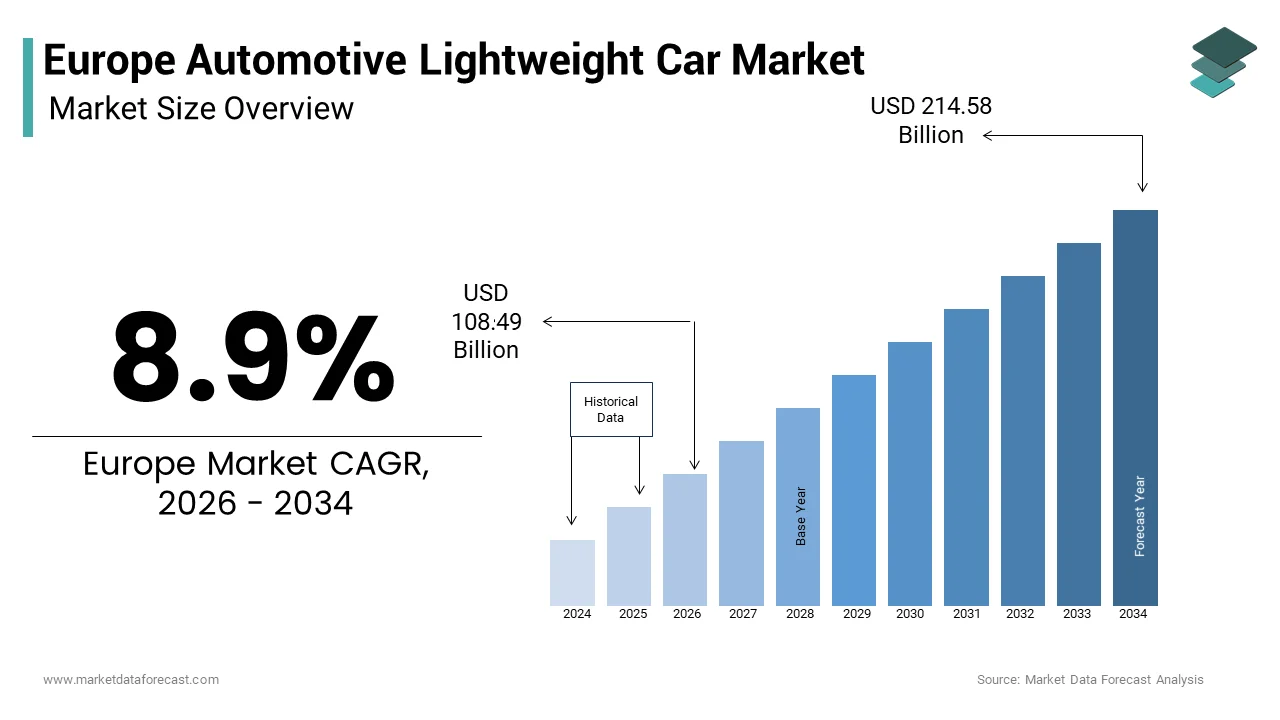
Market Size, 2025
$99.62 BnMarket Estimate, 2026
$108.49 BnMarket Forecast, 2034
$214.58 BnCAGR, 2026–2034
8.9%Executive Summary: Europe Automotive Lightweight Car Market
- Market Scope: Comprehensive analysis of the European automotive lightweight car market covering material types, advanced manufacturing processes, vehicle applications, and country-level market performance.
- Market Valuation: Valued at USD 99.62 billion in 2025, estimated at USD 108.49 billion in 2026, and projected to reach USD 214.58 billion by 2034, expanding at a robust CAGR of 8.9% from 2026 to 2034.
- Primary Growth Drivers: Stringent EU emission regulations (stricter 93.6 g/km CO2 target starting in 2025) and rising consumer demand for extended electric vehicle (EV) driving ranges to combat range anxiety.
Key Market Segment Metrics (2026–2034)
| Category | Leading Segment (Base Position) | Fastest-Growing / High-Growth Segment |
|---|---|---|
| By Material Type | Metals Segment (captured a substantial share in 2025 through advanced high-strength steels and aluminum alloys) | Composites (predicted to witness the highest CAGR of 13.6% due to exceptional strength-to-weight ratios in premium EVs) |
| By Manufacturing Process | Stamping (led with a 52.1% share in 2025 driven by optimized high-speed press lines and metal sheet forming) | Casting (estimated to register the fastest CAGR of 11.9% fueled by large single-piece aluminum/magnesium EV structural castings) |
| By Application | Structural Applications (dominated with a 47.6% share in 2025 for safety cages, chassis frames, and crash performance) | Exterior Applications (anticipated to witness the fastest CAGR of 12.4% driven by aerodynamics and EV closure panels) |
| By Country / Region | Germany (top performer capturing a 26.9% share in 2025 as a premier automotive engineering and luxury hub) | France, UK, Italy, & Spain (key high-growth markets propelled by EV production hubs, supercars, and state decarbonization plans) |
Major Market Players & Industry Landscape
Market Structure: Intense competition among premium manufacturers, mass-market OEMs, and specialized material suppliers shifting toward multi-material vehicle architectures and sustainable bio-composites to comply with strict EU climate standards.
Key Companies: Toyota Motor Corporation, Volkswagen AG, Ford Motor Company, Hyundai Motor Corporation, Nissan Motor Co. Ltd, General Motors Company, Honda Motor Co. Ltd, Kia Motors Corporation, Ferrari SpA, Automobili Lamborghini S.p.A., and Porsche AG.
Europe Automotive Lightweight Car Market Size
The Europe automotive lightweight car market size was valued at USD 99.62 billion in 2025 and is anticipated to reach USD 108.49 billion in 2026 to USD 214.58 billion by 2034, growing at a CAGR of 8.9% during the forecast period from 2026 to 2034.
Current Introduction of the Europe Automotive Lightweight Car Market
Automotive lightweighting is a strategic design and manufacturing approach focused on reducing the overall mass of a vehicle to improve fuel efficiency, performance, and sustainability without compromising safety or comfort. This design philosophy aims to enhance fuel efficiency extend electric vehicle range and reduce greenhouse gas emissions in alignment with stringent EU environmental mandates. According to the European Environment Agency, average CO2 emissions from new cars registered in the EU rose slightly to 106.8 grams per kilometer in 2024, up from 106.4 g/km in 2023 due to a decline in electric vehicle market share. This remains below the 115.1 g/km WLTP-equivalent target applicable through 2024 under Regulation (EU) 2019/631, though manufacturers face much stricter targets of 93.6 g/km starting in 2025. To offset the added mass of safety systems and EV batteries, which saw the average car mass reach 1,559 kg in 2024, European manufacturers are increasing the use of lightweight materials such as high-strength steel (HSS), aluminum alloys, and carbon fiber-reinforced polymers. While specific adoption rates vary by manufacturer, Eurostat data highlights that over 61% of new cars in some regions (e.g., Latvia) now have an unladen weight of 1,500 kg or more, driving the industry-wide push for advanced material integration. The European Commission’s Green Deal Industrial Plan further incentivizes lightweighting by linking carbon footprint benchmarks to access for innovation funding. Additionally, the European New Car Assessment Programme has maintained five star safety ratings for several sub 1200 kilogram models demonstrating that mass reduction can coexist with occupant protection through intelligent structural design and crash energy management systems.
MARKET DRIVERS
Stringent EU Emission Regulations and Corporate Average Fuel Economy Targets
The European Union’s legally binding CO2 emission standards for passenger cars serve as the foremost enabler for lightweight vehicle development across the continent and for the growth of the Europe automotive lightweight car market. Under Regulation (EU) 2019/631, automakers must meet fleet-wide targets which, following the transition to the WLTP cycle, average approximately 115.1 grams of CO2 per kilometer for the 2020–2024 period. Starting in 2025, this target will decrease significantly to 93.6 g/km, requiring a fuel efficiency equivalent of approximately 4.0 liters of gasoline per 100 kilometers. European Commission technical assessments indicate that for internal combustion engine vehicles, a 10 percent reduction in weight yields a 6 to 8 percent improvement in fuel economy. However, for Battery Electric Vehicles (BEVs), the same 10 percent weight reduction provides a more modest range extension of approximately 3 to 5 percent, as regenerative braking systems partially offset the energy costs associated with vehicle mass. While the Volkswagen ID. series utilizes advanced high-strength steels and lightweight battery housings to manage mass, these electric models remain approximately 25 to 40 percent heavier than comparable ICE platforms like the Golf. Despite this weight penalty, the ID.4 achieves a WLTP range of over 520 kilometers through high-density battery chemistry and a low drag coefficient (CO2) of 0.28. Failure to comply incurs penalties of 95 euros per gram exceeded per vehicle, amounting to potential fines exceeding 1 billion euros annually for large manufacturers as documented by the International Council on Clean Transportation. This regulatory pressure compels continuous investment in lightweight architectures making mass optimization a non negotiable pillar of European automotive engineering strategy.
Rising Consumer Demand for Extended Electric Vehicle Range
The regional consumers increasingly prioritize driving range as a decisive factor in electric vehicle adoption and in the Europe automotive lightweight car market expansion. This trend is directly fueling demand for lightweight platforms that maximize battery efficiency. The European Automobile Manufacturers Association identifies range anxiety as a significant, persistent barrier to electric vehicle adoption in key European markets, highlighting the need for enhanced charging infrastructure. Lightweighting strategies, such as the use of aluminum in Renault's Megane E-Tech body, effectively extend range, enabling a high WLTP rating from a moderate-sized battery. Research from organizations like the Fraunhofer Institute supports that substituting steel with lightweight materials, such as aluminum body panels and carbon fiber-reinforced plastics, can significantly reduce total vehicle mass and optimize torsional rigidity. Automakers like Polestar and Cupra now market weight savings as a core brand attribute highlighting reductions in unsprung mass and rotational inertia to enhance handling and energy recuperation. This consumer driven performance imperative transforms lightweighting from a compliance tactic into a competitive differentiator in Europe’s rapidly electrifying automotive landscape.
MARKET RESTRAINTS
High Material and Manufacturing Costs of Advanced Lightweight Substitutes
High production costs relative to steel continue to limit the mass adoption of lightweight materials like aluminum, magnesium, and carbon fiber composites, which restricts the growth of the Europe automotive lightweight car market. According to the European Aluminium Association and European Composite Industry Association, primary aluminum remains significantly more expensive than high-strength steel, with carbon fiber composites representing the highest financial investment among common lightweighting materials. The VDMA (German Engineering Federation) reports that adopting a full aluminum body-in-white structure leads to a notable increase in the total bill of materials compared to traditional steel-heavy architectures. Moreover, as documented by the European Investment Bank, integrating advanced lightweight materials into mass production necessitates extensive capital expenditure for specialized manufacturing equipment, complex joining technologies, and advanced quality monitoring systems. Small and medium volume manufacturers lack the scale to absorb these expenses leading to a two tier market where only premium brands can afford extensive lightweighting. High costs for lightweight materials will persist in mass markets until better recycling infrastructure and closed-loop supply chains are in place.
Limited Recycling Infrastructure for Multi Material Vehicle Architectures
The absence of efficient separation and recycling technologies across the region causes significant end of life problems for the increasing use of hybrid material combinations in lightweight vehicles and hinders the expansion of the Europe automotive lightweight car market. Current European end-of-life vehicle treatment facilities struggle with high,, technically challenging, and often, non-recyclable materials in residue fractions, resulting in significant portions still being directed to energy recovery or landfill. Aluminum contaminated with carbon fiber or adhesives cannot be remelted using standard processes while thermoset composites resist mechanical reprocessing. The EU already mandates a high percentage of reuse and recovery for end-of-life vehicles, but existing infrastructure struggles to process complex, mixed, and composite materials, often relying on energy recovery instead of material recycling. Specialized advanced recycling technologies, such as pyrolysis, required for reclaiming carbon fiber from automobiles are currently scarce within the EU. Under the new EU Battery and Vehicle Sustainability Regulation, manufacturers that lack scalable circularity risk penalties and reputational damage due to mandatory disclosure requirements for recycled content and recyclability. This systemic gap undermines the environmental credibility of lightweighting and discourages investment in next generation material systems.
MARKET OPPORTUNITIES
Integration of Bio Based and Sustainable Composites
The emergence of bio-based composites derived from flax, hemp, and lignin opens up major possibilities to reconcile lightweighting with circular economy principles, which is likely to promote the growth of the Europe automotive lightweight car market. European Bioplastics and research partners indicate that agricultural residues from EU farms are a significant, growing source of renewable fibers for the automotive industry to replace conventional glass fibers in non-structural applications. BMW is incorporating flax-based composites developed with Bcomp to replace carbon and glass fiber components in production vehicles, achieving significant weight savings and reducing embodied carbon compared to conventional plastic components. The Circular Bio-based Europe Joint Undertaking (CBE JU) funds research and innovation projects to scale up bio-based industries, including the development of enhanced bio-composites for applications in sectors like automotive. These materials offer comparable vibration damping and acoustic performance to synthetics with the added benefit of biodegradability at end of life. Bio-composites are positioning European automakers at the forefront of innovation as EU regulations on fossil-based plastics continue to tighten. This sustainable, lightweight approach ensures that automotive engineering goals remain within planetary boundaries.
Adoption of Modular and Scalable Lightweight Platforms for EVs
The shift toward dedicated electric vehicle architectures enables systematic lightweighting through modular platform strategies that optimize material use across multiple models and thereby creates fresh prospects for the Europe automotive lightweight car market. Stellantis’ STLA Small platform is designed for cost-efficient, compact, and subcompact electric vehicles, leveraging modularity for improved production efficiency. This approach lowers both weight and assembly complexity enabling cost effective lightweighting even in compact segments. Similarly, Volvo’s SPA2 architecture, as utilized in the EX90 and Polestar 3, adapts traditional premium vehicle structures to optimize battery packaging and safety, moving towards more advanced, mixed-material construction. European automotive manufacturers are increasingly adopting multi-material, modular platform architectures to improve structural efficiency and accelerate production turnaround for new electric vehicles. The European Investment Bank actively funds European EV platform development and battery technology through low-interest financing, focusing on circular economy principles and enhanced vehicle sustainability. Decoupling lightweighting from specific vehicle programs allows automakers to leverage economies of scale for advanced materials, thereby accelerating the transition to a greener, lower-emission European automotive market.
MARKET CHALLENGES
Skill Gaps in Multi Material Joining and Repair Technologies
The transition to lightweight multi-material vehicle structures has exposed a critical shortage of technicians, which is a major barrier to the growth of the Europe automotive lightweight car market. These professionals need training in specialized joining and repair techniques across the region’s manufacturing and after-sales networks. Studies indicate that significant skill gaps exist in the European automotive repair sector regarding advanced materials, as training initiatives struggle to keep pace with the adoption of lightweight vehicles. Expert analysis suggests that failure to properly repair modern lightweight vehicles, such as those with aluminum-intensive bodies, increases the risk of structural failure after a collision. Original equipment manufacturers now mandate certified repair centers for warranty compliance but scaling training remains slow with only thirty five accredited programs operating across the EU as per the European Automobile Manufacturers Association. Manufacturers require certified repair centers to maintain vehicle warranties. However, the availability of comprehensive, accredited training programs across the EU has not kept pace with the growing demand.
Supply Chain Vulnerability for Critical Lightweight Raw Materials
The region’s reliance on imported raw materials for lightweight automotive production creates strategic vulnerabilities that threaten long term scalability, and therefore challenges the expansion of the Europe automotive lightweight car market. The European Union relies significantly on international partners for the primary materials required in vehicle manufacturing, with a substantial portion of its total supply arriving from non-member nations, including major producers in Asia and neighboring non-EU European countries. Global supply chain interruptions and trade limitations on raw ores can trigger rapid increases in market costs for processed metal, as seen when major international exporters halt shipments of critical base materials. The EU’s Critical Raw Materials Act identifies lithium graphite and rare earths as strategic but omits key lightweight inputs like high purity alumina and polyacrylonitrile creating policy gaps. Local manufacturing of primary metal has seen a significant downturn as escalating power expenses have rendered many regional facilities non-competitive, leading to widespread closures or reduced operations across the continent. Europe’s automotive lightweighting ambitions and industrial sovereignty are at risk from external shocks until the region establishes secure, circular supply chains through urban mining and secondary refining.
REPORT COVERAGE
| REPORT METRIC | DETAILS |
| Market Size Available | 2025 to 2034 |
| Base Year | 2025 |
| Forecast Period | 2026 to 2034 |
| CAGR | 8.9% |
| Segments Covered | By Material Type, Manufacturing Process, Application, and Country. |
| Various Analyses Covered | Global, Regional, and Country Analysis, Segment-Level Analysis, DROC, PESTLE Analysis, Porter’s Five Forces Analysis, Competitive Landscape, Analyst Overview of Investment Opportunities |
| Regions Covered | North America, Europe, APAC, Latin America, Middle East & Africa |
| Market Leaders Profiled | Toyota Motor Corporation, Volkswagen AG, Ford Motor Company, Hyundai Motor Corporation, Nissan Motor Co. Ltd, General Motors Company, Honda Motor Co. Ltd, Kia Motors Corporation, Ferrari SpA, Automobili Lamborghini S.p.A., Porsche AG, and Others. |
SEGMENTAL ANALYSIS
By Material Insights
In 2025, the metals segment was the largest segment in the Europe automotive lightweight car market and captured a substantial share. The supremacy of the segment is attributed to the widespread adoption of advanced high strength steels and aluminum alloys which offer an optimal balance of weight reduction cost efficiency and crash performance. he vast majority of passenger cars manufactured within the European region now integrate advanced steel alloys with exceptional load-bearing capabilities into their primary structural frames to enhance occupant protection during collisions. The quantity of lightweight metal integrated into each new automobile has grown steadily over recent years, driven largely by the industry's transition toward electric powertrains and the need for greater efficiency. The high rate at which metal components are reclaimed from retired vehicles supports regional sustainability goals and ensures that a significant majority of these materials are reintroduced into the manufacturing cycle. Additionally established supply chains and mature joining technologies such as self piercing riveting and laser welding enable seamless integration into high volume production lines reinforcing metals as the backbone of European lightweighting strategies.
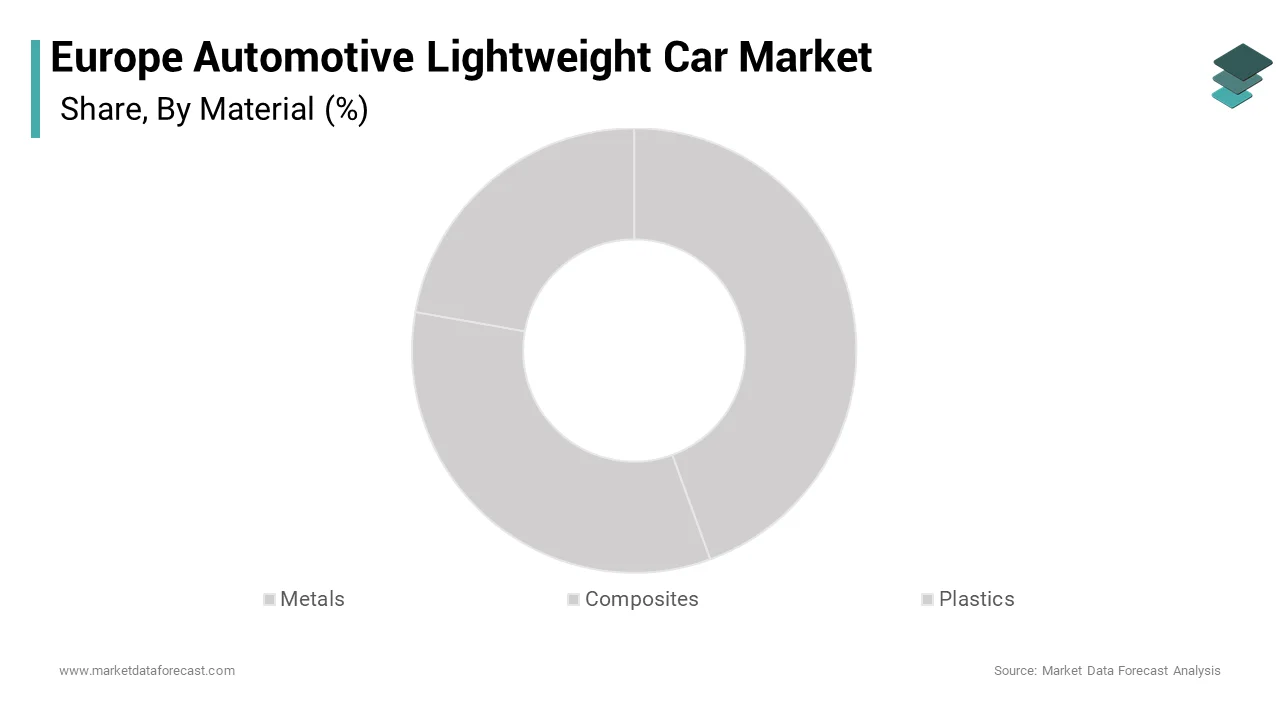
The composites segment is predicted to witness the highest CAGR of 13.6% between 2026 and 2034 due to its exceptional strength to weight ratio and design flexibility enabling significant mass savings in structural and body components. Advanced composite materials are increasingly integrated into premium electric vehicle architectures to achieve significant weight savings in structural and body components compared to traditional metal alternatives. Natural fiber composites derived from flax and hemp are gaining traction in interior panels. Major automotive manufacturers are exploring specialized fiber reinforcements to balance the trade-offs between vehicle weight reduction and the total environmental impact of the manufacturing process. Regional research initiatives are providing substantial financial support to modernize composite manufacturing techniques, aiming to move away from slow, traditional curing processes toward high-speed, automated production methods. Battery electric vehicles prioritize every kilogram to extend range. Therefore, composites are transitioning from niche luxury applications to strategic enablers of mainstream electrification.
By Manufacturing Process Insights
The stamping segment led the Europe automotive lightweight car market and accounted for a 52.1% share in 2025. The leading position of the segment is credited to decades of optimization in high speed press lines capable of forming complex geometries from advanced high strength steel and aluminum sheets with micron level precision. Conventional forming techniques for metal sheets continue to be the primary method for creating the structural framework of vehicles, providing the necessary strength for safety components like the pillars and internal rails. Modern servo presses achieve cycle times under ten seconds while maintaining dimensional tolerances within plus or minus 0.2 millimeters. The process benefits from extensive automation with robotic transfer systems handling over 2000 parts per shift per line ensuring consistency and labor efficiency. Furthermore stamping integrates seamlessly with existing paint and assembly shops minimizing capital disruption during platform transitions. This combination of speed scalability and compatibility with multi material strategies solidifies stamping as the foundational manufacturing method in Europe’s lightweight vehicle ecosystem.
The casting segment is estimated to register the fastest CAGR of 11.9% over the forecast period owing to the rise of large single piece aluminum and magnesium castings that replace dozens of stamped and welded components in electric vehicle platforms. Large-scale integrated casting is being integrated by major automotive groups to replace numerous traditionally stamped and joined components with single, massive structural units, significantly streamlining the vehicle assembly process and lowering related production expenses. By consolidating many separate pieces into a unified cast structure, manufacturers are able to increase the overall stiffness of the vehicle frame while simultaneously achieving a lighter total chassis compared to conventional multi-part steel assemblies. Regional financial institutions are providing substantial capital to modernize metal-forming facilities, supporting the implementation of advanced quality-control sensors and specialized casting techniques to guarantee the reliability of large-scale structural components. Casting is revolutionizing EV manufacturing by enabling significant weight reduction and simplified assembly, while maintaining high production feasibility.
By Application Insights
The structural applications segment dominated the Europe automotive lightweight car market and held a 47.6% share in 2025. The prominence of the segment is driven by the critical role of mass reduction in safety cages chassis frames and suspension subframes where every kilogram saved enhances both crash performance and dynamic efficiency. Ultra-high-strength steel grades are increasingly deployed in the critical structural reinforcements of new automobiles, helping manufacturers meet rigorous regional safety standards while enabling significant reductions in chassis weight compared to traditional steel variants. Aluminum intensive spaceframes in premium EVs like the Audi Q6 e tron further exemplify this trend with bonded extrusions and cast nodes creating rigid yet light load bearing skeletons. The European Commission’s General Safety Regulation mandates pedestrian protection and occupant safety simultaneously compelling engineers to optimize structural mass distribution. This dual imperative ensures structural components remain the primary focus of lightweight innovation across all vehicle segments.
The exterior applications segment is anticipated to witness the fastest CAGR of 12.4% during the forecast period. The rapid growth of the segment is propelled by the aesthetic and aerodynamic demands of electric vehicles where lightweight closures directly influence range and brand identity. Hood trunk lid and fender assemblies now increasingly use aluminum or sheet molding compound composites reducing unsprung mass and improving handling response. The integration of lightweight composite materials into the upper structural frame of high-end electric SUVs helps reduce overhead mass, which contributes to a more stable driving experience during turns by keeping the vehicle's weight concentrated closer to the ground. Utilizing advanced materials allows for complex, aerodynamic body shapes that minimize air resistance, which in turn helps extend the operational distance an electric vehicle can travel on a single charge at sustained high speeds. Consumer preference for premium surface finishes also favors composites which enable complex Class A surfaces unattainable with metal stamping. Exterior lightweighting is evolving from a strictly functional requirement into a key brand-differentiating expression as manufacturers differentiate their electric vehicle lineups.
COUNTRY ANALYSIS
Germany Automotive Lightweight Car Market Analysis
Germany was the top performer in the Europe Automotive Lightweight Car Market and accounted for a 26.9% share in 2025. The demand for lightweight cars in Germany is supported by its position as the premier automotive engineering hub and home to luxury performance brands. In addition, the market shows an aggressive transition toward multi material vehicle architectures that combine high strength steel, aluminum, and carbon fiber reinforced polymers to offset the heavy weight of electric vehicle battery packs. A primary driving factor is the stringent fleet emission targets set by the European Union which compel German manufacturers to reduce vehicle mass to meet carbon dioxide limits without sacrificing range or safety. As per various sources, the average weight of vehicles produced in Germany continues to rise, primarily driven by the increasing market share of heavy SUVs and electric vehicles, which have seen weight increases of 20-30% compared to traditional internal combustion engines. However, Volkswagen, BMW, and Mercedes-Benz are mitigating this 'autobesity' trend through the extensive adoption of advanced lightweighting technologies, such as carbon-fiber reinforced plastics, high-strength aluminum, and structural innovations, to partially offset the weight of batteries, according to company reports and independent industry analysis. One more reason for growth here is the robust domestic supply chain for advanced materials, with companies like BASF and SGL Carbon leading global innovation in thermoplastics and carbon fiber production. The Federal Ministry for Economic Affairs and Climate Action supports this shift through funding programs dedicated to resource efficient manufacturing processes. Furthermore, the premium segment dominance in Germany allows for higher cost tolerance for expensive lightweight materials like magnesium and carbon fiber which are essential for high performance electric sports cars. This synergy of regulatory pressure, material science leadership, and premium brand strategy ensures Germany remains the largest and most technologically advanced market for lightweight automotive solutions in the region.
France Automotive Lightweight Car Market Analysis
France was the second largest country in the Europe lightweight car market and captured a share of 17.2% share in 2025. The expansion of the French market is attributed to its strategic focus on affordable electric mobility and the development of next generation composite materials. Moreover, the market currently shows strong collaboration between state owned enterprises, private automakers, and research institutes to create cost effective lightweight vehicles for the mass market. A key driving factor is the national industrial plan France 2030 which allocates billions of euros to decarbonize the automotive sector and support the production of small electric vehicles that rely heavily on lightweight design to maximize battery efficiency. As per research, the transition toward electric mobility is prompting major domestic automotive groups to increasingly integrate lightweight metals and advanced polymer materials into their vehicle architectures. An added boost for this market is the presence of world leading material suppliers like Arkema and Solvay who develop advanced thermoplastic composites specifically designed for high volume automotive applications. Data from the French Alternative Energies and Atomic Energy Commission emphasizes ongoing research into recycling carbon fiber and developing bio based lightweight materials to ensure sustainability throughout the vehicle lifecycle. Additionally, government incentives for purchasing low emission vehicles have boosted sales of compact electric cars where every kilogram of weight reduction directly translates to extended driving range. The combination of state backed industrial strategy, advanced material innovation, and a focus on accessible electric mobility secures France's status as a pivotal and forward looking market for lightweight automotive technologies.
United Kingdom Automotive Lightweight Car Market Analysis
The United Kingdom occupies a significant position in the Europe Automotive Lightweight Car Market by leveraging its heritage in high performance sports car manufacturing and a growing electric vehicle sector. This region has a unique blend of low volume exotic car production that pioneers carbon fiber usage and high volume projects aimed at electrifying commercial fleets. A major factor accelerating this growth is the prestigious supercar and luxury sports car segment where manufacturers like McLaren, Aston Martin, and Jaguar Land Rover utilize extensive carbon fiber monocoques and aluminum space frames to achieve exceptional power to weight ratios. As per data from the Society of Motor Manufacturers and Traders, the UK automotive sector continues to invest heavily in advanced manufacturing techniques, with the High Value Manufacturing Catapult providing expertise in lightweight material processing and joining technologies. An additional driver is the government mandate to end the sale of new petrol and diesel cars by 2030, which has spurred massive investment in electric vehicle production facilities that prioritize lightweighting to counteract battery mass. Statistics from the Advanced Propulsion Centre UK indicate substantial funding for projects focused on reducing vehicle mass through innovative design and material substitution. Furthermore, the aerospace industry crossover provides a skilled workforce and supply chain capable of handling complex composite materials. The synergy between high performance engineering legacy, aggressive electrification targets, and cross sector technological transfer sustains the UK's strong standing as a key market for cutting edge lightweight automotive solutions.
Italy Automotive Lightweight Car Market Analysis
Italy grew steadily in the Europe lightweight car market due to a unique demand profile driven by its iconic supercar brands and a specialized network of design houses and component manufacturers. The market growth is also supported by the integration of exotic lightweight materials such as forged carbon fiber and magnesium alloys into limited production hypercars that set benchmarks for the entire industry. A primary driving factor is the concentration of ultra luxury automotive brands like Ferrari, Lamborghini, and Pagani who view lightweight construction not just as a regulatory necessity but as a core element of brand identity and driving dynamics. Elite domestic manufacturers are at the forefront of adopting advanced composite fabrication techniques, establishing a technical foundation that informs the long-term evolution of production methods for a broader range of vehicles. Further support for this market comes from the vibrant ecosystem of design firms and tier one suppliers in regions like Piedmont and Emilia Romagna who specialize in creating lightweight body panels and interior components for global automakers. The National Institute of Statistics notes that the automotive supply chain in Italy is highly specialized in high value added components, fostering innovation in material science. Additionally, the government supports research collaborations between universities and industries to develop sustainable lightweight materials derived from natural fibers. The blend of exclusive high performance manufacturing, specialized supply chain capabilities, and academic research creates a distinctive market dynamic where innovation and craftsmanship are paramount, ensuring Italy remains a vital player in the European lightweight automotive landscape.
Spain Automotive Lightweight Car Market Analysis
Spain is likely to expand in the Europe lightweight car market from 2026 to 2034 due to its role as a major manufacturing hub for volume electric vehicles and a growing commitment to sustainable mobility solutions. The market status in Spain is marked by large scale investments from international automakers to retool factories for the production of lightweight electric platforms destined for the broader European market. A key driving factor is the strategic positioning of Spain as the second largest car manufacturer in Europe, hosting major plants for SEAT, Cupra, and Ford that are transitioning to produce dedicated electric vehicles requiring extensive use of aluminum and high strength steel. As per data from the Spanish Association of Automotive Manufacturers, billions of euros in public and private investment have been committed to establishing gigafactories and modernizing assembly lines to support lightweight electric vehicle production. A further keu driver is the national strategy for sustainable mobility which includes incentives for both manufacturers and consumers to adopt lighter and more efficient vehicles. The Spanish Ministry of Industry reports that the shift toward electric mobility is driving demand for multi material structures that optimize cost and weight for high volume segments. Furthermore, the presence of a strong auxiliary industry capable of producing lightweight components such as aluminum wheels and plastic fuel tanks supports the domestic assembly ecosystem. The convergence of large scale manufacturing capacity, strategic electrification investments, and supportive government policies creates a dynamic environment for lightweight automotive adoption, securing Spain's position as a key growth market in the region.
COMPETITIVE LANDSCAPE
The Europe automotive lightweight car market features intense rivalry among premium manufacturers mass market OEMs and specialized material suppliers competing on technological sophistication sustainability credentials and cost efficiency. Premium brands like BMW and Mercedes Benz lead in carbon fiber and aluminum integration setting performance benchmarks but face pressure to democratize these technologies. Mass market players such as Stellantis and Renault focus on high strength steel and scalable casting solutions to meet CO2 targets affordably. Material giants like ArcelorMittal Hydro and SGL Carbon compete to offer certified low carbon inputs with traceable environmental footprints. Regulatory scrutiny under the EU Battery Regulation and End of Life Vehicle Directive intensifies focus on recyclability influencing material selection. Meanwhile Chinese and American EV makers challenge European incumbents with radical lightweight architectures forcing rapid innovation. This dynamic environment rewards agility cross sector collaboration and lifecycle thinking making lightweighting not just an engineering exercise but a strategic differentiator in Europe’s race toward sustainable mobility.
KEY MARKET PLAYERS
Companies playing a key role in the Europe automotive light
- Toyota Motor Corporation
- Volkswagen AG
- BMW Group
- Volvo Cars
- Stellantis NV
- Ford Motor Company
- Hyundai Motor Corporation
- Nissan Motor Co. Ltd.
- General Motors Company
- Honda Motor Co. Ltd.
- Kia Motors Corporation
- Ferrari SpA
- Automobili Lamborghini S.p.A.
- Porsche AG.
Top Players In The Market
- BMW Group is a pioneer in automotive lightweighting with its extensive use of carbon fiber reinforced polymers aluminum spaceframes and multi material architectures across its i and core vehicle lines. The company co founded the Carbon Fiber Alliance with SGL Carbon to secure sustainable precursor supply and operates one of Europe’s most advanced composite production facilities in Landshut Germany. It also launched a closed loop recycling system for carbon fiber offcuts achieving significant material recovery. Through these initiatives BMW continues to set benchmarks in scalable lightweight engineering that influence global premium vehicle design.
- Stellantis NV leverages its pan European manufacturing footprint to deploy lightweight strategies across mass market and premium brands including Peugeot Citroën Opel and Alfa Romeo. The company’s STLA platforms utilize high pressure aluminum castings hydroformed extrusions and ultra high strength steels to optimize weight across electric and internal combustion vehicles. It also partnered with Hydro to source low carbon aluminum produced using renewable hydropower. These actions reinforce Stellantis’ commitment to affordable lightweighting that meets EU emission targets without compromising affordability.
- Volvo Cars integrates lightweighting as a core pillar of its all electric strategy emphasizing safety sustainability and efficiency. The company’s SPA2 architecture features bonded aluminum chassis components and large single piece castings that reduce part count and curb weight while maintaining five star crash performance. It also introduced flax fiber composites in interior panels cutting embodied carbon versus conventional materials. By aligning lightweight innovation with its climate plan Volvo strengthens its position as a leader in responsible automotive engineering across Europe and global markets.
Top Strategies Used By The Key Market Participants
Key players in the Europe automotive lightweight car market pursue integrated strategies centered on multi material architectures circular material sourcing and platform standardization. Companies are investing in gigacasting and bonded aluminum spaceframes to simplify assembly and reduce mass simultaneously. Strategic partnerships with raw material suppliers ensure access to low carbon aluminum bio based composites and fossil free steel aligned with EU Green Deal objectives. Co development with recyclers enables closed loop systems for carbon fiber and mixed metals enhancing end of life value. Digital twin simulations accelerate lightweight validation while reducing physical prototyping costs. Additionally firms embed lightweighting into modular EV platforms to achieve economies of scale across multiple brands and segments ensuring cost effective deployment even in volume segments.
MARKET SEGMENTATION
This research report on the Europe automotive lightweight car market has been segmented and sub-segmented based on material type, manufacturing process, application, and country.
By Material Type
- Metals
- Composites
- Plastics
By Manufacturing Process
- Extrusion
- Stamping
- Forging
- Casting
- Others
By Application
- Structural
- Powertrain
- Interior
- Exterior
By Country
- UK
- Russia
- Germany
- Italy
- France
- Spain
- Sweden
- Denmark
- Poland
- Switzerland
- Netherlands
- Rest of Europe