- Product Description Description
- Table of Contents TOC
- List of Table & Figure LOT
- Get Free Sample PDF Sample PDF
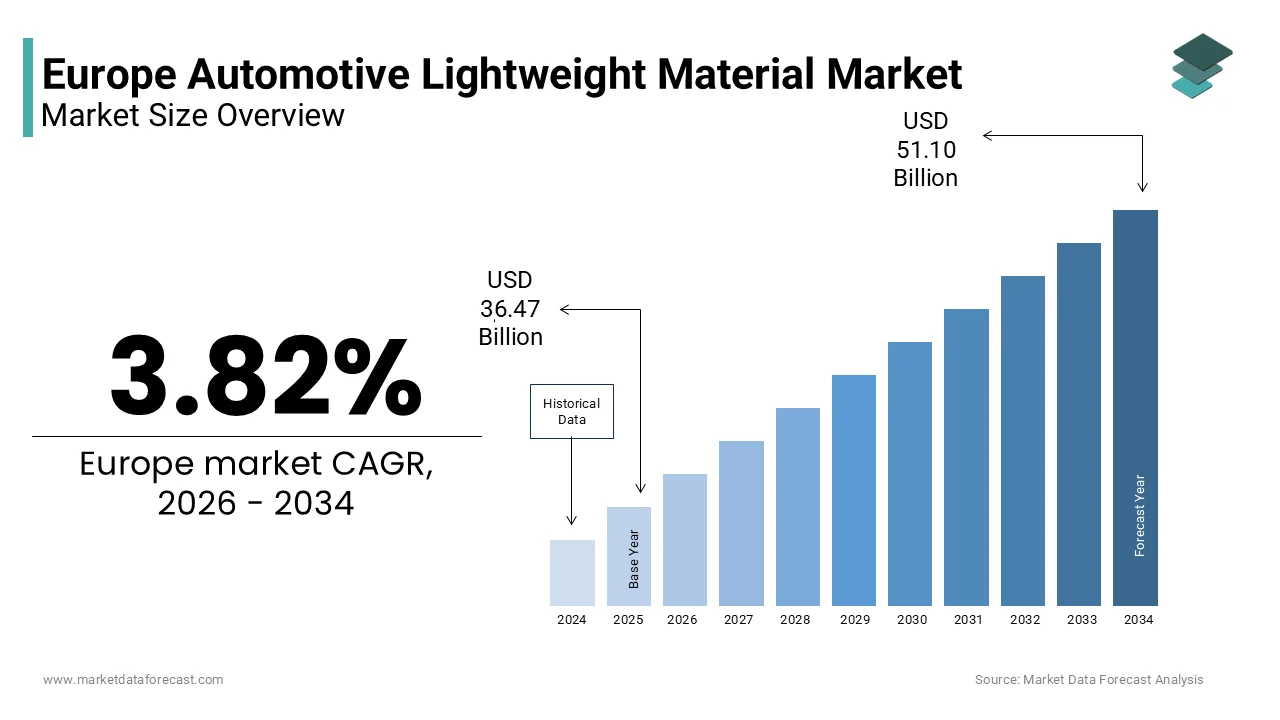
Market Size, 2025
$36.47 BnMarket Estimate, 2026
$37.86 BnMarket Forecast, 2034
$51.10 BnCAGR, 2026–2034
3.82%Executive Summary: Europe Automotive Lightweight Material Market
- Market Scope: Comprehensive European market analysis covering material types, application verticals, component classifications, vehicle types, regional leadership frameworks, and lightweighting adoption drivers.
- Market Valuation: Valued at USD 36.47 billion (2025), estimated at USD 37.86 billion (2026), and projected to reach USD 51.10 billion by 2034, registering a robust CAGR of 3.82% (2026–2034).
- Primary Growth Drivers: Strict European emission standards and fuel-efficiency regulations, government initiatives to reduce vehicle weight, and the rising manufacturing and adoption of electric and hybrid vehicles across the region.
Key Market Segment Metrics (2026–2034)
| Category | Leading Segment (2025 Position) | Fastest-Growing Segment |
|---|---|---|
| By Material Type | Metal (dominated due to high adoption of aluminum and high-strength materials) | Composites (projected to experience the highest demand due to exceptional physical and mechanical properties) |
| By Application | Under Bonnet (accounts for the prominent share in the market) | Under Bonnet and Exterior structural applications |
| By Component | Engine (estimated to continue its lead, driven by the need for highly efficient engine performance) | Frame and Closure components requiring weight reduction |
| By Vehicle Type | Internal Combustion Engine (ICE) vehicles | Electric and Hybrid vehicles (witnessing tremendous growth rates due to mounting production and government incentives) |
| By Region | Europe (the second-largest market globally, with Germany as a noteworthy contributor) | Emerging European automotive manufacturing hubs focusing on green mobility |
Major Market Players & Market Structure
Market Structure: Highly competitive European automotive lightweight materials landscape featuring major chemical suppliers, metal producers, and automotive OEMs competing intensely on emission compliance, advanced material development, cost-effective scaling, and vehicle electrification.
Key Companies: BASF SE, LyondellBasell Industries N.V., Diamler, Ford Corporation, BMW Motors, Toray Industries, Inc., Bayer A.G., Covestro AG, ArcelorMittal, ThyssenKrupp AG, SABIC, Novelis Inc., Owens Corning Corporation, and PPG Industries, Inc.
Europe Automotive Lightweight Material Market Size
The Europe automotive lightweight material market size was valued at USD 36.47 billion in 2025 and is projected to reach USD 51.10 billion by 2034 from USD 37.86 billion in 2026, growing at a CAGR of 3.82%.
The Europe automotive lightweight material market is fundamentally driven by the imperative to enhance fuel efficiency and extend the driving range of electric vehicles. According to the European Automobile Manufacturers Association, the average weight of new passenger cars in Europe has increased by 20% over the last decade due to safety features and electrification components, creating an urgent need for weight reduction strategies. According to the International Council on Clean Transportation, reducing vehicle mass by 10% can improve fuel economy by 6% to 8%, directly supporting emission reduction targets. Furthermore, Eurostat indicates that transport accounts for approximately 25% of total greenhouse gas emissions in the European Union, prompting stringent regulatory interventions. As per the European Commission, CO2 emission standards for new cars mandate a 37.5% reduction by 2030 compared to 2021 levels. These regulatory pressures compel automakers to integrate lightweight solutions extensively. The market thrives on the synergy between material science innovation and sustainable mobility goals, ensuring that vehicles meet rigorous environmental standards while maintaining performance and safety for consumers across the continent.
MARKET DRIVERS
Stringent Emission Regulations and Fuel Efficiency Mandates
Stringent emission regulations and fuel efficiency mandates fuels the Europe automotive lightweight material market growth. According to the European Commission, the Fit for 55 package aims to reduce net greenhouse gas emissions by at least 55% by 2030, forcing automakers to adopt aggressive weight reduction strategies. Vehicle weight is directly correlated with energy consumption, meaning lighter vehicles emit less CO2 per kilometer traveled. According to the International Energy Agency, every 100 kilograms of weight reduction can lower CO2 emissions by approximately 8 grams per kilometer for internal combustion engine vehicles. These statistics create a direct financial and regulatory incentive for manufacturers to replace traditional steel with aluminum and composites. Additionally, the Corporate Average Fuel Economy standards in various European nations penalize manufacturers who fail to meet efficiency targets, further accelerating adoption. As per data from the Society of Motor Manufacturers and Traders, non-compliance fines can reach billions of euros annually, making lightweighting a cost-effective compliance strategy. This regulatory landscape ensures that lightweight materials are not merely optional enhancements but essential components for legal market access. Consequently, the pressure to meet these ambitious environmental goals drives sustained investment in advanced material technologies and manufacturing processes across the European automotive industry.
Rapid Electrification and Battery Range Optimization
The rapid transition toward electric mobility profoundly further contributes to the Europe automotive lightweight material market expansion. According to BloombergNEF, electric vehicle sales in Europe accounted for 20% of total car registrations in 2023, reflecting a massive shift in powertrain technology. Battery systems typically add 300 to 500 kilograms to a vehicle, significantly impacting handling and energy efficiency. According to the Argonne National Laboratory, reducing vehicle mass by 10% can increase the driving range of an electric vehicle by 5% to 7%, addressing one of the primary consumer concerns regarding EV adoption. This relationship between weight and range makes lightweight materials critical for competitive EV design. As per the European Battery Alliance, the average battery capacity is increasing to support longer ranges, which exacerbates the weight issue and necessitates compensatory lightweighting in the chassis and body structures. Automakers are increasingly using aluminum-intensive architectures and carbon fiber components to maintain vehicle dynamics and maximize range. This technical necessity drives demand for high-performance lightweight materials that offer superior strength-to-weight ratios. The electrification trend thus acts as a powerful multiplier for the lightweight material market, ensuring long-term growth as the share of electric vehicles continues to expand across the region.
MARKET RESTRAINTS
High Production Costs and Raw Material Volatility
The high production costs associated with advanced lightweight materials and significant raw material volatility hampers the Europe automotive lightweight material market. According to the London Metal Exchange, the price of aluminum fluctuated by up to 30% in recent years due to energy crises and supply chain disruptions, making cost forecasting difficult for manufacturers. Carbon fiber reinforced polymers, while offering superior weight savings, remain 10 to 15 times more expensive than conventional steel, limiting their use to premium vehicle segments. According to the European Aluminum Association, energy-intensive production processes for primary aluminum contribute to high baseline costs, which are further exacerbated by rising electricity prices in Europe. These financial barriers prevent widespread adoption in mass-market vehicles where price sensitivity is high. As per data from McKinsey and Company, the cost premium for lightweighting a standard vehicle can exceed 1,000 euros, which manufacturers struggle to pass on to consumers without affecting sales volumes. Small and medium-sized suppliers lack the capital to invest in expensive processing equipment, leading to supply bottlenecks. Additionally, the complexity of joining dissimilar materials increases assembly costs and which is further straining budgets. These economic constraints restrict the pace of material substitution, keeping traditional steel dominant in many applications despite its weight disadvantage.
Complex Recycling and End of Life Management Issues
Complex recycling challenges and inadequate end-of-life management infrastructure significantly restrain the growth of the Europe automotive lightweight material market. According to the European Environment Agency, while steel recycling rates exceed 90%, the recycling rate for carbon fiber composites remains below 10% due to technical difficulties in separating fibers from resin matrices. This disparity creates environmental concerns and regulatory hurdles for manufacturers aiming for circular economy compliance. According to the International Resource Panel, mixed-material vehicles complicate shredding and sorting processes, often resulting in downcycling rather than true material recovery. As per the End of Life Vehicles Directive, manufacturers are responsible for ensuring 95% of vehicle weight is reused or recovered, a target that becomes harder to achieve with complex composite structures. The lack of standardized recycling protocols for multi-material assemblies increases disposal costs and reduces the economic viability of using advanced lightweight materials. Additionally, the energy required to recycle certain composites can negate the environmental benefits gained during the vehicle's operational life. These logistical and environmental challenges discourage some automakers from fully committing to lightweight solutions, particularly when regulatory frameworks do not yet provide clear incentives for composite recycling. Consequently, the European market faces a sustainability paradox that limits broader market penetration.
MARKET OPPORTUNITIES
Advancements in Multi Material Joining Technologies
Advancements in multi-material joining technologies is a significant opportunity for the Europe automotive lightweight material market by enabling the efficient integration of diverse materials. According to the Fraunhofer Institute, new adhesive bonding and laser welding techniques allow for the seamless combination of aluminum, steel, and composites, optimizing weight distribution and structural performance. These innovations reduce the need for heavy mechanical fasteners, contributing to further weight savings. According to the European Research Council, hybrid material structures can reduce vehicle weight by up to 20% compared to all-steel designs, offering substantial efficiency gains. This technological progress allows manufacturers to use the right material for the right application, balancing cost and performance. As per data from the Association of European Automotive and Industrial Battery Manufacturers, improved joining methods also enhance battery pack integration in electric vehicles, supporting safer and lighter designs. The ability to bond dissimilar materials reliably opens new design possibilities for chassis and body panels. Manufacturers who master these joining techniques can differentiate their products through superior engineering and efficiency. This capability aligns with the industry’s move toward modular platforms, where lightweight components can be easily swapped or upgraded. By leveraging these advanced joining technologies, companies can unlock new value propositions and drive adoption of lightweight materials across broader vehicle segments.
Growth in Autonomous Vehicle Platforms
The emergence of autonomous vehicle platforms offers a lucrative opportunity for the Europe automotive lightweight material market by reshaping vehicle architecture and component requirements. According to the European Commission, autonomous driving technologies require extensive sensor arrays and computing hardware, which add significant weight to vehicles. To compensate, manufacturers are exploring lightweight materials for sensor housings, lidar mounts, and interior components. According to the Institute of Electrical and Electronics Engineers, autonomous systems can increase vehicle mass by 50 to 100 kilograms, necessitating aggressive lightweighting elsewhere to maintain efficiency. This shift creates demand for specialized lightweight solutions that do not interfere with sensor functionality. As per data from Waymo and other autonomous tech developers, reducing vehicle weight improves energy efficiency, which is critical for the viability of robotaxi fleets that operate continuously. Lightweight interiors made from natural fiber composites also enhance sustainability credentials, appealing to eco-conscious urban users. The redesign of vehicles without traditional driver controls allows for innovative use of space and materials, fostering creativity in lightweight design. By targeting the autonomous sector, material suppliers can tap into a high-growth niche that prioritizes efficiency and technological integration. This alignment with future mobility trends positions lightweight materials as enablers of next-generation transportation solutions.
MARKET CHALLENGES
Supply Chain Fragility and Geopolitical Risks
Supply chain fragility and geopolitical risks pose significant challenges to the Europe automotive lightweight material market by disrupting the availability of critical raw materials. According to the European Critical Raw Materials Act, the EU relies on imports for 98% of its rare earth elements and significant portions of its aluminum and magnesium, creating vulnerability to external shocks. Trade tensions and export restrictions from key supplier countries can lead to sudden shortages and price spikes. According to the World Bank, supply chain disruptions can increase material costs by 15% to 20%, impacting production schedules and profitability. These uncertainties force manufacturers to hold larger inventories, tying up capital and increasing storage costs. As per data from the German Automotive Industry Association, just-in-time manufacturing models are becoming less viable due to these risks, requiring a shift to more resilient but costly supply strategies. Additionally, the carbon footprint of transporting materials from distant sources conflicts with sustainability goals, adding regulatory pressure. Diversifying supply sources is slow and capital-intensive, leaving many companies exposed to single points of failure. This geopolitical instability complicates long-term planning and investment in lightweight material projects, hindering market stability and growth potential in the region.
Technical Limitations in Mass Production Scalability
Technical limitations in scaling up production for advanced lightweight materials present a major challenge for the Europe automotive lightweight material market. According to the American Composites Manufacturers Association, the cycle time for producing carbon fiber parts is significantly longer than stamping steel, making it difficult to meet high-volume automotive production rates. Traditional autoclave curing processes can take hours, whereas steel stamping takes seconds, creating a bottleneck in assembly lines. According to the European Composite Industry Association, achieving consistent quality in large-scale composite manufacturing remains a technical hurdle, with defect rates higher than those for metals. As per data from automotive engineering firms, retooling factories for lightweight material production requires billions of euros in investment, which many manufacturers are hesitant to commit amidst uncertain demand. The lack of skilled labor proficient in handling and processing these advanced materials further exacerbates the issue. Training workers takes time and resources, slowing down implementation. Additionally, the variability in material properties requires rigorous quality control measures, increasing operational complexity. These technical and operational barriers limit the ability of manufacturers to rapidly adopt lightweight solutions for mass-market vehicles, constraining market expansion and keeping costs elevated until scalable processes are fully developed and standardized.
REPORT COVERAGE
| REPORT METRIC | DETAILS |
| Market Size Available | 2025 to 2034 |
| Base Year | 2025 |
| Forecast Period | 2026 to 2034 |
| CAGR | 3.82% |
| Segments Covered | By Material Type, Application, Component, Vehicle Type, and Region |
| Various Analyses Covered | Global, Regional, & Country Level Analysis; Segment-Level Analysis; DROC, PESTLE Analysis; Porter’s Five Forces Analysis; Competitive Landscape; Analyst Overview of Investment Opportunities |
| Regions Covered | UK, France, Spain, Germany, Italy, Russia, Sweden, Denmark, Switzerland, Netherlands, Turkey, and the Czech Republic |
| Market Leaders Profiled | BASF SE, LyondellBasell Industries N.V., Daimler, Ford Corporation, ArcelorMittal, BMW Motors, Toray Industries, Inc., Bayer A.G., Covestro AG, ArcelorMittal, ThyssenKrupp AG, SABIC, Novelis Inc., SGL Carbon SE, Owens Corning Corporation, and PPG Industries, Inc. |
SEGMENTAL ANALYSIS
By Material Type Insights
The metal segment had the major share of the Europe automotive lightweight material market in 2025 due to its established manufacturing infrastructure and relative cost efficiency compared to advanced composites. According to Eurofer, the European Steel Association, high-strength steel accounts for approximately 60% of the average vehicle body weight, providing a balance of safety, durability, and affordability that is difficult for newer materials to match. The widespread availability of stamping and welding equipment for metals allows automakers to produce vehicles at high volumes without significant capital expenditure retooling. According to the International Aluminum Institute, aluminum usage in European passenger cars has increased by 50% over the last decade, driven by its ability to reduce weight by up to 40% compared to steel while maintaining structural integrity. These statistics highlight the industry's reliance on metal alloys as the primary solution for mass-market lightweighting. The recyclability of metals also aligns with circular economy goals, with steel recycling rates exceeding 90% in Europe. This combination of economic viability, technical maturity, and environmental compliance ensures that metals remain the backbone of automotive construction. Manufacturers continue to innovate with advanced high-strength steels that offer higher strength-to-weight ratios, further cementing the segment's leadership by addressing regulatory pressures without disrupting existing production workflows.
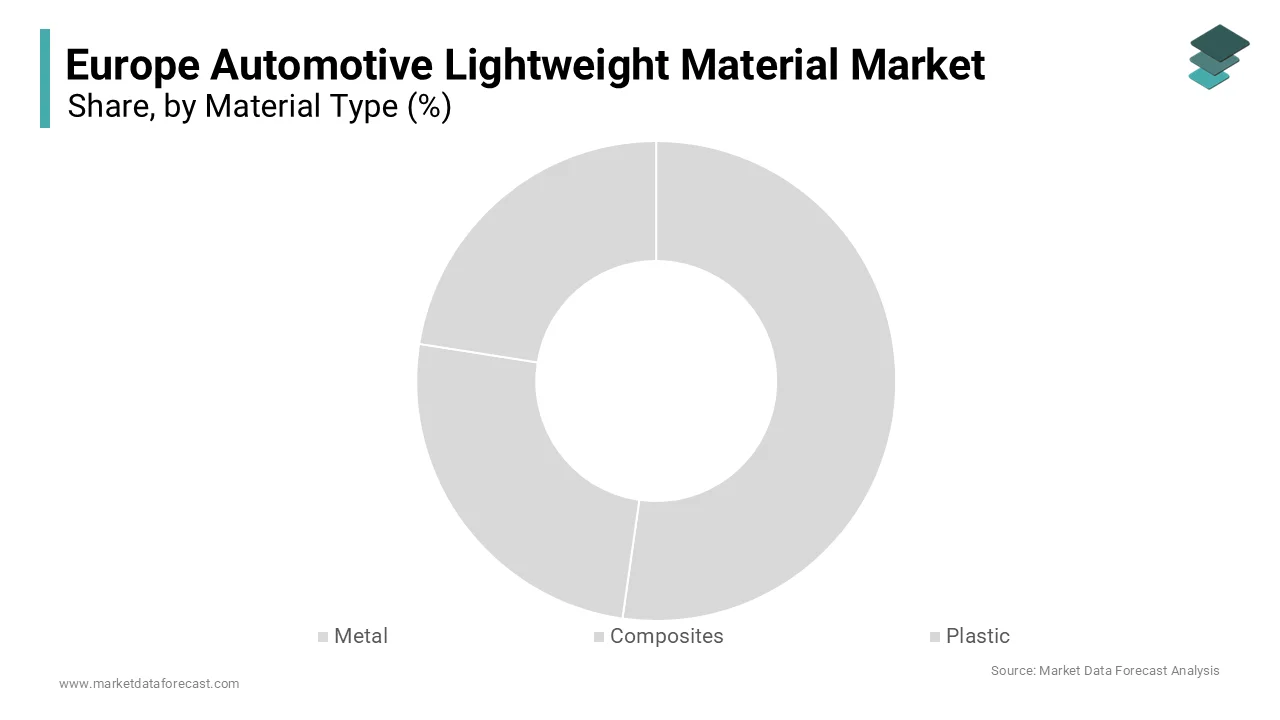
However, the composite segment is experiencing the fastest growth in the Europe automotive lightweight material market and is predicted to record a promising CAGR in the European market over the forecast period owing to the urgent need for extreme weight reduction in electric vehicles to maximize battery range. According to the European Composites Industry Association, the use of carbon fiber reinforced polymers in automotive applications is projected to grow at a compound annual growth rate of 11% through 2030, outpacing all other material categories. Composites offer a strength-to-weight ratio that is significantly higher than metals, allowing for weight savings of up to 50% in specific components. According to the Fraunhofer Institute for Chemical Technology, replacing metal body panels with composite alternatives can reduce overall vehicle mass by 200 kilograms, directly translating to an additional 30 to 50 kilometers of driving range for electric vehicles. These statistics underscore the critical role of composites in overcoming range anxiety, a primary barrier to EV adoption. As automakers strive to meet rigorous CO2 emission targets, the ability of composites to deliver substantial weight reductions without compromising structural rigidity makes them increasingly attractive. Although costs remain higher than metals, economies of scale and advancements in rapid curing technologies are lowering barriers to entry. This technological evolution enables broader adoption in mainstream vehicles, positioning composites as the fastest-growing material segment as the industry transitions toward electrification and sustainability.
By Application Insights
The exterior segment led the market by capturing the leading share of the Europe automotive lightweight material market in 2025 due to stringent regulatory pressure for aerodynamic efficiency and crash safety. According to the European Automobile Manufacturers Association, exterior components such as doors, hoods, and fenders account for nearly 30% of a vehicle's total weight, making them prime targets for lightweighting initiatives to improve fuel economy. Reducing the mass of these large surface-area components significantly lowers the energy required for acceleration and braking. According to the International Council on Clean Transportation, improving aerodynamic drag by 10% through lightweight and optimized exterior designs can reduce fuel consumption by 2% to 3%, contributing directly to compliance with EU emission standards. These statistics highlight the direct correlation between exterior weight reduction and regulatory compliance. Additionally, exterior panels must meet rigorous pedestrian safety standards, requiring materials that absorb impact energy effectively. Advanced high-strength steels and aluminum alloys are widely used in these applications to balance weight savings with protection. As per data from the European New Car Assessment Programme, vehicles with lightweight aluminum hoods and composite bumpers perform better in pedestrian impact tests. This dual requirement for efficiency and safety ensures that exterior applications remain the largest consumer of lightweight materials, driving continuous innovation in material selection and design optimization across the industry.
However, the interior segment is the fastest growing in the Europe automotive lightweight material market and is estimated to grow at a prominent CAGR in the regional market over the forecast period owing to an increasing focus on passenger comfort and noise reduction in premium and electric vehicles. According to the European Acoustics Association, interior noise levels are a key determinant of perceived vehicle quality, with electric vehicles requiring advanced sound damping materials since they lack engine noise to mask road vibrations. Lightweight acoustic foams and natural fiber composites are increasingly used in door panels, headliners, and floor carpets to absorb sound without adding significant mass. According to the Fraunhofer Institute for Building Physics, replacing traditional heavy insulation with lightweight porous materials can reduce interior weight by 15% while improving noise attenuation by 20%. These statistics demonstrate the dual benefit of lightweight interior solutions. As consumers spend more time in vehicles due to autonomous driving features, comfort becomes paramount, driving demand for ergonomic and lightweight seating structures. As per data from automotive suppliers, the use of magnesium and composite frames in seats has grown by 12% annually, contributing to overall vehicle weight reduction. This trend towards enhanced cabin experience positions interior applications as a high-growth area where lightweight materials directly contribute to user satisfaction and brand loyalty.
REGIONAL ANALYSIS
Germany Market Analysis
Germany dominated the market in 2025 and is likely to experience robust expansion over the next few years and Germany is serving as the hub for premium automotive manufacturing and engineering innovation. According to the German Federal Statistical Office, the automotive sector contributes over 5% to the national GDP, driving substantial investment in advanced materials. Major manufacturers like BMW, Mercedes Benz, and Volkswagen are pioneers in using aluminum and carbon fiber composites to enhance vehicle performance and efficiency. According to the German Automotive Industry Association, research and development spending on lightweight technologies exceeded 20 billion euros in 2023, reflecting a strong commitment to innovation. This financial backing supports the development of next-generation materials and manufacturing processes. Additionally, Germany’s robust supply chain for high-strength steel and aluminum ensures steady availability of raw materials. The country’s strict adherence to EU emission standards further accelerates the adoption of lightweight solutions. As per data from the VDA, German automakers aim to reduce average vehicle weight by 15% by 2030, creating sustained demand for lightweight materials. This combination of industrial strength, technological leadership, and regulatory compliance positions Germany as the primary driver of market growth in Europe.
France Market Analysis
France is poised to accelerate its transition toward sustainable manufacturing over the coming years, representing a significant market for automotive lightweight materials characterized by a strong focus on electric mobility and sustainable manufacturing practices. According to the French Ministry of Economy, the government has allocated 5 billion euros to support the electric vehicle transition, indirectly boosting demand for lightweight components to extend battery range. Automakers like Renault and Stellantis are actively integrating aluminum and recycled plastics into their vehicle architectures to meet environmental goals. According to the French Automotive Industry Committee, the use of lightweight materials in new models has increased by 12% annually, driven by regulatory pressures and consumer preferences. France’s emphasis on circular economy principles encourages the use of recyclable lightweight materials, aligning with national sustainability targets. As per data from Ademe, the French Environment and Energy Management Agency, lightweighting can reduce the carbon footprint of vehicle production by 10%, supporting policy objectives. The presence of major research institutions focused on materials science further fosters innovation. This supportive ecosystem of policy, industry commitment, and research capability ensures France remains a key player in the European lightweight material landscape.
United Kingdom Market Analysis
The United Kingdom is projected to maintain steady progress in the near future, maintaining a specialized position in the Europe automotive lightweight material market and leveraging its expertise in high-performance and luxury vehicle segments. According to the Society of Motor Manufacturers and Traders, the UK automotive industry produces over 1 million vehicles annually, with a significant portion being premium brands that prioritize lightweight construction. Companies like Jaguar Land Rover are leaders in aluminum-intensive vehicle design, having reduced vehicle weight by up to 40% in certain models. According to the UK Department for Business and Trade, investment in advanced manufacturing technologies, including composite fabrication, has grown by 8% year-over-year. This focus on high-value engineering drives demand for sophisticated lightweight materials. Additionally, the UK’s commitment to net-zero emissions by 2050 mandates stricter efficiency standards, encouraging broader adoption of lightweight solutions. As per data from the Advanced Propulsion Centre, lightweighting is a key strategy for improving electric vehicle range in UK-produced models. The combination of luxury brand heritage, technological innovation, and regulatory alignment sustains the UK’s relevance in the market.
Italy Market Analysis
Italy is anticipated to see gradual evolution in the upcoming years, exhibiting a dynamic market for automotive lightweight materials driven by its strong presence in sports car manufacturing and design excellence. According to ISTAT, the Italian automotive sector is renowned for producing high-performance vehicles that rely heavily on carbon fiber and aluminum to achieve superior speed and handling. Ferrari and Lamborghini are pioneers in using carbon fiber monocoques, setting industry benchmarks for lightweight construction. According to the Italian Automotive Industry Association, the use of advanced composites in Italian supercars has increased by 15% annually, reflecting continuous innovation. Italy’s design houses also influence global trends, promoting lightweight aesthetics and functionality. As per data from Confindustria, collaborations between material suppliers and automakers have accelerated the development of new lightweight alloys. The country’s focus on niche high-value segments ensures steady demand for premium lightweight materials. Additionally, government incentives for green manufacturing support the adoption of sustainable lightweight solutions. This blend of performance heritage, design leadership, and industrial collaboration positions Italy as a key innovator in the European lightweight material market.
Spain Market Analysis
Spain is expected to show accelerated development ahead, serving as a major production hub for the Europe automotive lightweight material market and benefiting from its large manufacturing capacity and strategic location. According to the Spanish Association of Automobile and Truck Manufacturers, Spain produces over 2 million vehicles annually, many of which incorporate lightweight materials to meet EU standards. Major plants operated by Stellantis, Ford, and Volkswagen are increasingly adopting aluminum and high-strength steel in their production lines. According to the Spanish Ministry of Industry, investments in modernizing manufacturing facilities for lightweight construction have reached 3 billion euros in recent years. This capital infusion supports the integration of advanced materials into mass-market vehicles. Spain’s growing electric vehicle production also drives demand for lightweight battery enclosures and structural components. As per data from ICEX, the Spanish Institute for Foreign Trade, exports of lightweight automotive components have increased by 10% annually. The combination of high production volume, strategic investments, and export orientation ensures Spain plays a crucial role in the regional market.
COMPETITIVE LANDSCAPE
The competition in the Europe automotive lightweight material market is characterized by intense rivalry among established multinational corporations and emerging niche brands seeking to capture market share. Large dairy conglomerates leverage their extensive distribution networks and brand recognition to dominate mainstream segments while specialized biotechnology firms focus on high potency supplements and personalized solutions. Price competition is moderate due to the premium nature of functional foods but private label offerings from major retailers exert pressure on branded products. Innovation serves as a key differentiator with companies constantly launching new formats and strains to appeal to health conscious consumers. Regulatory compliance creates barriers to entry favoring players with robust scientific validation capabilities. Digital transformation has intensified competition as online platforms enable direct to consumer models that bypass traditional retail channels. Collaborations with healthcare professionals enhance credibility and drive prescription based sales. The market sees frequent mergers and acquisitions as companies seek to consolidate resources and expand portfolios. Consumer loyalty is driven by perceived efficacy and brand trust making reputation management crucial. Overall the competitive landscape demands continuous adaptation to technological advancements and shifting consumer preferences to sustain growth and profitability in this dynamic sector.
KEY MARKET PLAYERS
Some of the key players in the Europe automotive lightweight material market are
- BASF SE
- LyondellBasell Industries N.V.
- Diamler
- Ford Corporation
- ArcelorMittal
- BMW Motors
- Toray Industries, Inc.
- Bayer A.G.
- Covestro AG
- ArcelorMittal
- ThyssenKrupp AG
- SABIC
- Novelis Inc.
- SGL Carbon SE
- Owens Corning Corporation
- PPG Industries, Inc.
Top Players in the Market
- ArcelorMittal stands as a pivotal force in the Europe Automotive Lightweight Material Market by supplying advanced high strength steel solutions that balance safety and weight reduction. The company actively invests in research to develop next generation steel grades that offer superior formability and crash performance for modern vehicle architectures. Recent initiatives include partnering with major European automakers to co engineer lightweight body structures that meet stringent emission standards. ArcelorMittal also focuses on sustainable production methods to reduce the carbon footprint of its steel manufacturing processes. By providing comprehensive technical support and innovative material portfolios, the company enables manufacturers to achieve significant weight savings without compromising structural integrity. This commitment to innovation and sustainability strengthens its position as a trusted supplier in the evolving automotive landscape.
- Novelis Inc plays a critical role in the Europe Automotive Lightweight Material Market as a leading producer of rolled aluminum products tailored for automotive applications. The company leverages its extensive recycling infrastructure to provide low carbon aluminum sheets that help automakers meet environmental goals. Recent actions include expanding its recycling capabilities in Germany to support the growing demand for sustainable automotive materials. Novelis collaborates closely with vehicle manufacturers to design aluminum intensive platforms that enhance fuel efficiency and electric vehicle range. The company emphasizes closed loop recycling systems to minimize waste and resource consumption. By delivering high quality aluminum solutions and promoting circular economy principles, Novelis strengthens its market presence and supports the industry transition toward lighter and more sustainable mobility solutions across Europe.
- SGL Carbon SE contributes significantly to the Europe Automotive Lightweight Material Market through its expertise in carbon fiber reinforced polymers and composite technologies. The company specializes in producing high performance carbon fibers that enable substantial weight reductions in premium and electric vehicles. Recent strategies involve scaling up production capacity for automotive grade carbon fibers to meet increasing demand from luxury car manufacturers. SGL Carbon also develops innovative manufacturing processes such as resin transfer molding to reduce cycle times and costs for composite parts. The company partners with automotive OEMs to integrate carbon fiber components into structural and aesthetic applications. By focusing on technological advancement and cost effective production methods, SGL Carbon enhances its competitive edge and drives the adoption of lightweight composite materials in the European automotive sector.
Top Strategies Used by Key Market Participants
Key players in the Europe Automotive Lightweight Material Market employ diverse strategies to maintain competitive advantage and drive growth. Product innovation remains a primary focus with companies investing heavily in research and development to create novel formulations that address specific health needs such as immune support and mental well being. Strategic partnerships and collaborations with academic institutions enable firms to validate product efficacy through rigorous clinical trials enhancing consumer trust and regulatory compliance. Expansion into digital health platforms allows brands to offer personalized nutrition advice and subscription services fostering long term customer loyalty and recurring revenue streams. Mergers and acquisitions facilitate access to new technologies and distribution networks enabling rapid market penetration and portfolio diversification. Sustainability initiatives are increasingly central to corporate strategies with manufacturers adopting eco friendly packaging and ethical sourcing practices to align with consumer values and regulatory requirements. Marketing efforts emphasize transparency and scientific backing leveraging social media and influencer partnerships to educate consumers and build brand credibility. These multifaceted approaches ensure that leading participants remain agile and responsive to evolving market dynamics while strengthening their position in the competitive Europe landscape.
MARKET SEGMENTATION
This research report on the Europe automotive lightweight material market is segmented and sub-segmented into the following categories.
By Material Type
- Metal
- Composites
- Plastic
By Application
- Under Bonnet
- Interior
- Exterior
By Component
- Frame
- Engine
- Exhaust
- Transmission
- Closure
- Interior.
By Vehicle Type
- ICE
- Electric
- Hybrid
By Country
- UK
- France
- Spain
- Germany
- Italy
- Russia
- Sweden
- Denmark
- Switzerland
- Netherlands
- Turkey
- Czech Republic
- Rest of Europe