- Product Description Description
- Table of Contents TOC
- List of Table & Figure LOT
- Get Free Sample PDF Sample PDF
Market Size, 2025
$469.04 BnMarket Estimate, 2026
$529.41 BnMarket Forecast, 2034
$1394 BnCAGR, 2026–2034
12.87%Executive Summary: Europe Automotive Powertrain Market Analysis
- Market Scope: Comprehensive European automotive powertrain industry evaluation covering vehicle types, engine categories, country-level adoption dynamics, regulatory environmental frameworks, and electrification trends.
- Market Valuation: Valued at USD 469.04 billion in 2025, and projected to reach USD 1,394.49 billion by 2034, registering a robust compound annual growth rate (CAGR) of 12.87% during the forecast period from 2026 to 2034.
- Primary Growth Drivers: Rapid expansion of the electric and hybrid vehicle markets, declining battery costs coupled with improved energy storage capacity, stricter regional greenhouse gas emission standards, and favorable regulatory subsidies or tax exemptions.
Key Market Segment Metrics (2026–2034)
| Category | Leading Segment (2025 Position) | Fastest-Growing Segment |
|---|---|---|
| By Vehicle Type | Passenger Cars (held a prominent market share due to rising production, disposable incomes, and supportive government initiatives) | Light & Heavy Commercial Vehicles (scaling through fleet sustainability targets) |
| By Engine Type | Gasoline & Diesel Internal Combustion Engines (traditional high demand, transitioning toward hybrid models) | Hybrid and Electric Powertrains (accelerating due to lower battery costs and strict emissions regulations) |
| By Region / Country | Germany (largest and fastest-growing automotive powertrain market in Europe, anchored by prominent industry leaders) | UK, France, Italy, and Spain (scaling via clean mobility frameworks) |
Major Market Players & Industry Structure
Market Structure: Highly competitive landscape featuring major global automotive original equipment manufacturers (OEMs) and advanced tier-1 powertrain component suppliers competing on e-axle innovations, electric drive efficiency, and emission reduction technologies.
Key Companies: Nissan, Toyota Motor Corporation, General Motors Company, Ford Motor Company, Sling, BMW, Hyundai Motor, ZF Friedrichshafen AG, GKN plc, Volkswagen AG, BorgWarner Inc., Aisin Seiki Co., Ltd, and Jtekt Corporation.
Europe Automotive Powertrain Market Size
The Europe automotive powertrain market size was valued at USD 469.04 billion in 2025 and is anticipated to reach USD 529.41 billion in 2025, to reach USD 1394.49 billion by 2034, registering a compound annual growth rate (CAGR) of 12.87% during the forecast period from 2026 to 2034.
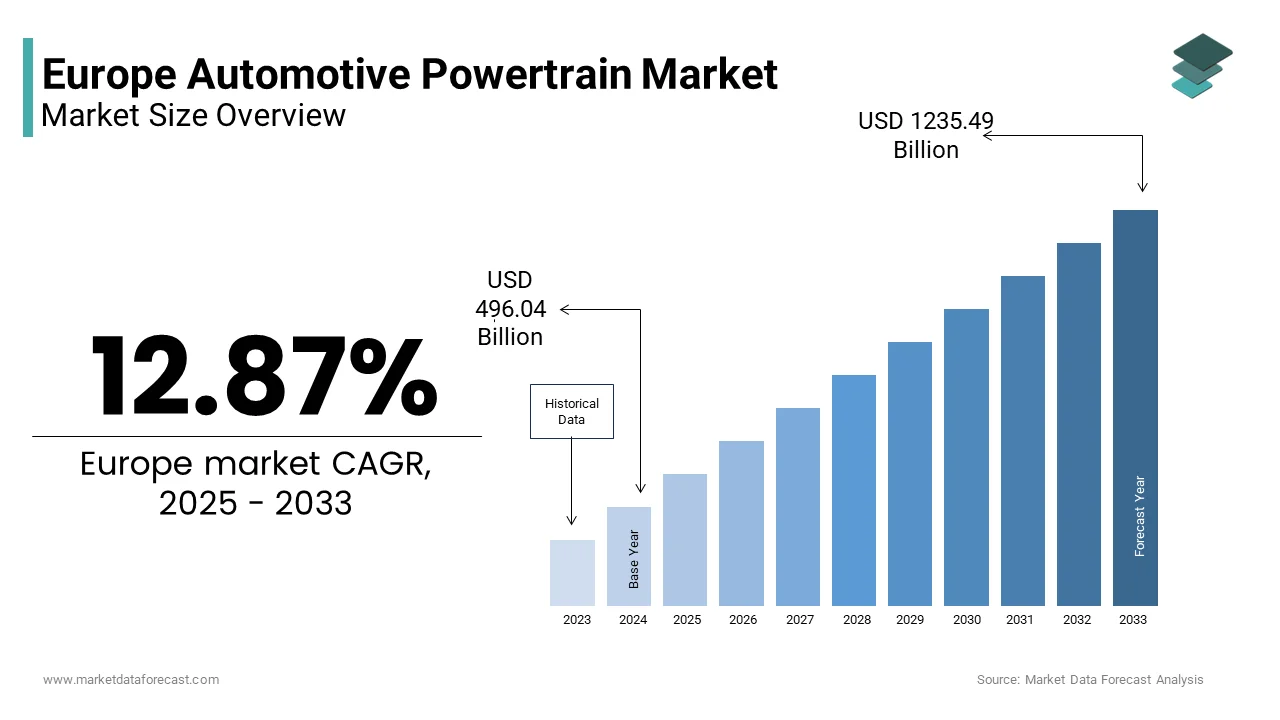
The powertrain of any vehicle defines its performance, comfort, and safety. The engine and transmission are considered the main components of the powertrain, and other key elements include the clutch/torque converter, the drive shaft/propeller shaft, the differential, and the axles.
MARKET DRIVERS
One of the main drivers of the automotive engine market is the expansion of the electric and hybrid vehicle market. The electric vehicle market has grown considerably around the world. Sales of electric vehicles are expected to increase due to lower battery costs and technological improvements, such as increased storage capacity, which has led to greater consumer adoption. As global temperatures rise at an alarming rate, governments and industries around the region are committed to reducing greenhouse gas emissions.
The transport sector was one of the main areas of intervention since transport and mobility represent the second-largest share in terms of emissions after the production of electricity. The production and sales of electric vehicles in Europe have increased at a high rate due to a favorable regulatory environment, such as subsidies and tax exemptions for industry and consumers in Europe and the Asia-Pacific regions.
MARKET RESTRAINTS
Customers' reluctance to pay more for a sustainable transmission system and the high investment costs associated with the system are presumed to hamper the automotive powertrain market. In addition, strict emission standards in several countries can be a challenge for demand.
MARKET OPPORTUNITIES
Growing demand for automated transmissions and the growing trend to reduce engine size, which reduces emissions and fuel consumption, are expected to drive growth in the powertrain market. The increasing need for better traction, higher towing capacity, and increased vehicle acceleration for safe driving to navigate adverse terrain and inclement weather is expected to stimulate demand during the forecast period.
The increased development of advanced automotive features should provide lucrative opportunities for market growth.
REPORT COVERAGE
| REPORT METRIC | DETAILS |
| Market Size Available | 2025 to 2034 |
| Base Year | 2025 |
| Forecast Period | 2026 to 2034 |
| CAGR | 12.87% |
| Segments Covered | By Vehicle Type, Engine, and Region. |
| Various Analyses Covered | Global, Regional, and Country-Level Analysis, Segment-Level Analysis, DROC, PESTLE Analysis, Porter’s Five Forces Analysis, Competitive Landscape, Analyst Overview of Investment Opportunities |
| Regions Covered | North America, Europe, APAC, Latin America, Middle East & Africa |
| Market Leaders Profiled | Nissan, Toyota Motor Corporation, General Motors Company, Ford Motor Company, Sling, BMW, Hyundai Motor, ZF Friedrichshafen AG, GKN plc, Volkswagen AG, Borgwarner Inc., Aisin Seiki Co., Ltd, Jtekt Corporation, and Others. |
SEGMENT ANALYSIS
By vehicle Insights
Based on the vehicle type, passenger cars held a prominent share in the European market due to increasing production, rising consumer demand and disposable income, and government support initiatives.
By Engione Insights
Depending on the type of engine, gasoline engines have more demand; however, they are predicted to be substituted by diesel engines due to the growing difference in prices. To overcome such issues, component manufacturers are concentrating on the development of hybrid powertrains to reduce fuel consumption in vehicles.
COUNTRY ANALYSIS
The Europe automotive powertrain market is anticipated to experience a stable growth rate during the forecast period after the economic recession in 2009. Germany is the largest automotive powertrain market in Europe, which is also expected to be the fastest-growing market in this region over the estimated period. The presence of the leading industry players in the area has dramatically stimulated the growth of the industry.
COMPETITIVE LANDSCAPE
KEY MARKET PLAYERS
A few of the market players in the Europe automotive powertrain market include
- Nissan
- Toyota Motor Corporation
- General Motors Company
- Ford Motor Company
- Sling
- BMW
- Hyundai Motor
- ZF Friedrichshafen AG
- GKN plc
- Volkswagen AG
- Borgwarner Inc.
- Aisin Seiki Co., Ltd
- Jtekt Corporation
MARKET RESEARCH REPORT HIGHLIGHTS
- A full context analysis, which includes an evaluation of the parent market
- Significant changes in market dynamics.
- Market segmentation is in the second or third level.
- Historical market size, current, and projected in terms of value and volume.
- Reports and evaluations of recent industry developments.
- Market shares and strategies of the main actors.
- Niche of emerging segments and regional markets.
- An objective evaluation of the market trajectory.
- Recommendations to companies to strengthen their presence in the market.
RECENT MARKET NEWS
- In September 2017, Bosch and Nikola established a partnership to develop an electric powertrain, using Bosch e-Axle technology, which transmits the engine transmission. These electric powertrains are designed for long-distance trucks.
- In August 2017, Bosch launched an electronic axle transmission for electric cars. The engine, power electronics, and drive transmission that are essential in the movement of the car shaft are recorded to improve the efficiency of the electric drive.
MARKET SEGMENTATION
This research report on the Europe Automotive Powertrain market is segmented and sub-segmented into the following categories.
By Vehicle Type
- Light Commercial Vehicles
- Passenger Cars
- Heavy Commercial Vehicles
By Engine
- Gasoline
- Diesel
By Region
- UK
- Russia
- Germany
- Italy
- France
- Spain
- Sweden
- Denmark
- Poland
- Switzerland
- Netherlands
- Rest of Europe