Europe Automotive Semiconductors Market Size, Share, Trends & Growth Forecast Report By Vehicle Type, Application, and By Country (Germany, France, United Kingdom, Italy, Sweden, Rest of Europe) – Industry Analysis and Forecast, 2025 to 2033
Europe Automotive Semiconductors Market Summary
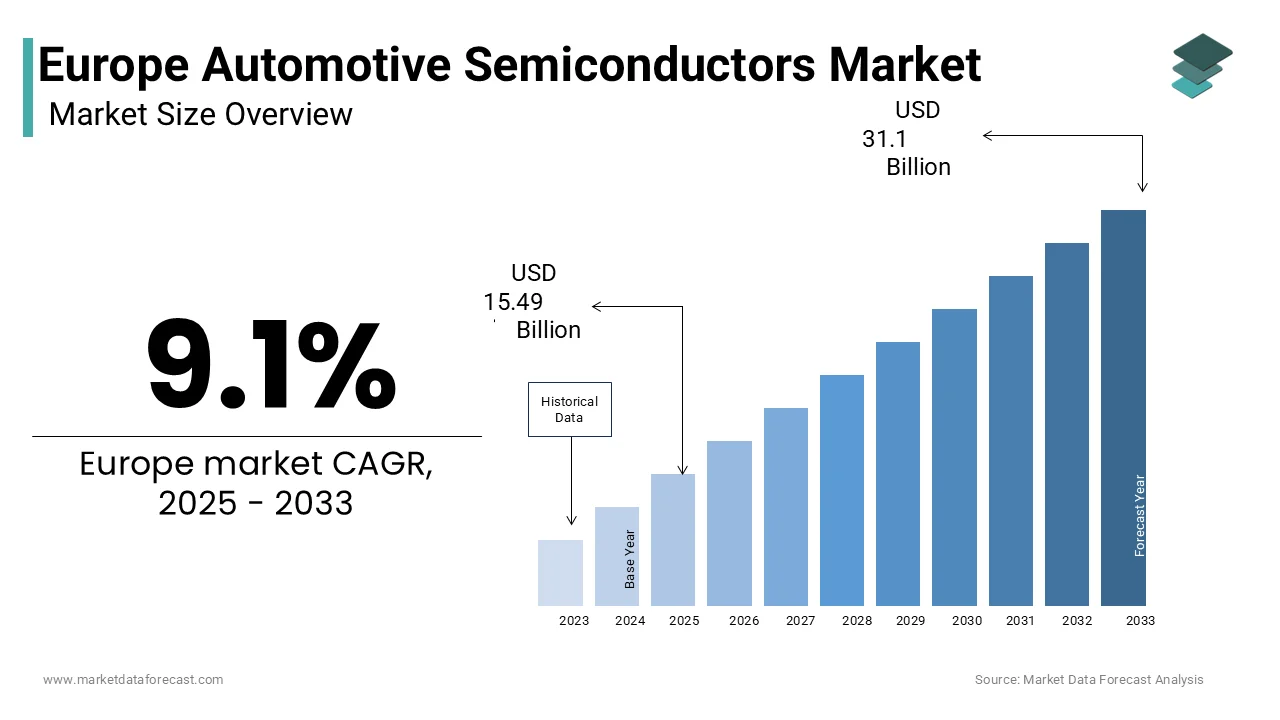
The Europe automotive semiconductors market was valued at USD 14.20 billion in 2024, is estimated to reach USD 15.49 billion in 2025, and is projected to grow at a CAGR of 9.1% from 2025 to 2033, reaching USD 31.1 billion by 2033, driven by mandatory vehicle electrification, ADAS regulations, and the EU Chips Act’s push for semiconductor supply-chain sovereignty.
Key Market Insights
- 2024 Market Size: USD 14.20 billion
- 2025 Estimate: USD 15.49 billion
- 2033 Forecast: USD 31.10 billion
- CAGR (2025–2033): 9.1%
Quick Growth Drivers
- EU mandate to phase out new ICE vehicle sales, accelerating EV adoption
- Rapid increase in semiconductor content per vehicle (2–3× in BEVs)
- Mandatory ADAS features under the EU General Safety Regulation
- Strong demand for silicon carbide (SiC) and gallium nitride (GaN) power devices
- EU Chips Act investments supporting regional automotive chip production
Principal Restraints
- Heavy reliance on Asian foundries for advanced logic and memory chips
- Long development and certification cycles under ISO 26262 and UN R155
- High qualification and compliance costs for automotive-grade semiconductors
- Limited near-term availability of advanced logic fabs within Europe
High-Value Opportunities
- Localization of silicon carbide and gallium nitride power electronics manufacturing
- Automotive system-on-chip solutions for software-defined vehicles
- Co-design partnerships between European OEMs and semiconductor suppliers
- Secure, automotive-grade AI accelerators and zonal architecture chips
- Chips Act–backed fabs focused on power, sensors, and safety ICs
Key Market Challenges
- Acute shortage of skilled semiconductor design and packaging engineers
- Extremely high capital intensity and long payback periods for automotive fabs
- Demand volatility linked to automotive production cycles
- Scaling advanced packaging and thermal management capabilities
Fastest-Growing Segments
- Light Commercial Vehicles: 9.8% CAGR — electrified urban delivery fleets
- Safety Systems: 11.2% CAGR — mandatory ADAS and vision technologies
- Power Electronics: Largest segment (34.3% share in 2024) — EV inverters & chargers
Regional Leadership & Dynamics
- Germany (32.2%) — strong OEM base, Infineon & Bosch leadership, SiC hubs
- France (14.7%) — France 2030 semiconductor investments, EV platform demand
- United Kingdom — automotive electronics design, cybersecurity leadership
- Italy — commercial vehicle electrification, STMicroelectronics footprint
- Sweden — software-defined vehicles and sustainable mobility focus
What Wins Commercially
- Vertical integration from wafer to system
- Leadership in SiC/GaN power electronics
- Early compliance with safety and cybersecurity standards
- Close co-development with OEMs and Tier-1 suppliers
- Alignment with EU Chips Act funding and industrial policy
Top Strategic Ask for Executives
- Accelerate the localization of power semiconductor manufacturing
- Invest aggressively in automotive safety- and security-certified SoCs
- Build long-term OEM partnerships for platform-specific chip design
- Expand semiconductor talent pipelines and advanced packaging expertise
- Balance capital discipline with strategic onshoring priorities
Leading Players
Some of the companies that are playing a dominating role in the Europe automotive semiconductors market include:
- NXP Semiconductors
- Infineon Technologies
- STMicroelectronics
- Renesas Electronics
- Bosch
- Texas Instruments
- ON Semiconductor
- Qualcomm
- Analog Devices
Europe Automotive Semiconductors Market Size
The europe automotive semiconductors market was valued at USD 14.20 billion in 2024, is expected to reach USD 15.49 billion in 2025, and is growing at a CAGR of 9.1% from 2025 to 2033 and reach USD 31.1 billion by 2033.
Automotive semiconductors are specialized integrated circuits (chips) designed to control, monitor, and power nearly every function in modern vehicles. These components serve as the digital nervous system of modern automobiles. Modern vehicles incorporate a very large and growing number of semiconductor components as digital technology integration increases. The market is shaped by Europe’s aggressive regulatory framework. The European Union has established strict environmental regulations that aim to phase out the sale of new internal combustion engine vehicles by the middle of the next decade. As per the International Energy Agency's and European Environment Agency's data, approximately 1.4 million new battery electric vehicles (BEVs) were registered in the European Union in 2024, representing 13.6% of total new car sales. This occurred amid a general stagnation of EV sales growth in Europe due to policy changes, but the broader market trend still points to a growing, albeit fluctuating, demand for advanced components such as silicon carbide power modules and battery management chips as the global electric vehicle fleet expands. Furthermore, the European Chips Act has allocated 43 billion euros to bolster regional semiconductor design and manufacturing capacity, with automotive applications designated as a strategic priority. This convergence of policy, industrial strategy,y and technological transformation positions automotive semiconductors as a critical enabler of Europe’s mobility sovereignty and industrial competitiveness.
MAKET DRIVERS
Mandated Electrification and Advanced Driver Assistance Systems Driving Content Per Vehicle
Regulatory mandates that require extensive electronic integration for vehicle electrification and safety propel the growth of the European automotive semiconductors market. The evolving regulatory framework within the European Union, which aims to phase out the sale of new conventional internal combustion engine vehicles over the coming decade, is a significant factor driving a widespread shift in automotive industry strategies towards offering a growing range of electric and alternative fuel-powered vehicles. Each battery electric vehicle requires two to three times more semiconductor content than its combustion counterpart, particularly wide bandgap devices like silicon carbide MOSFETs for inverters and high precision analog chips for battery management. The automotive industry has experienced a substantial increase in the average value of embedded semiconductor components per vehicle, a trend largely influenced by the growing technological sophistication of modern cars, especially the rise of electric models and advanced safety systems. Simultaneously, European safety regulations are increasingly requiring the integration of advanced driver assistance systems, such as automatic emergency braking and lane keeping assist, in all new vehicles; these systems rely on a significantly higher number of complex electronic components compared to earlier models. This regulatory double imperative ensures sustained and escalating semiconductor demand regardless of macroeconomic fluctuations.
EU Chips Act and Strategic Push for Supply Chain Sovereignty
The region’s strategic vulnerability in semiconductor supply has caused unprecedented public investment to localize automotive chip production and reduce reliance on Asian foundries, which further contributes to the expansion of the European automotive semiconductor market. The European Chips Act, enacted in 2023, is driving substantial investment to increase the continent's semiconductor production and lessen reliance on external suppliers. This comprehensive plan seeks to significantly expand the region's global market presence by the end of the decade through large-scale public and private capital mobilization. The initiative encourages the development of cutting-edge technology and capacity for high-demand areas like power electronics and sensor components, which are increasingly crucial for key European industries such as automotive manufacturing. Leading semiconductor firms, including Infineon, Bosch, STMicroelectronics, and others, are pursuing major fabrication facility expansions and joint ventures across various EU locations to meet these evolving industrial demands and benefit from the supportive legislative environment. The European Processor Initiative further supports the development of automotive-grade AI accelerators compliant with ISO 26262 functional safety standards. This coordinated industrial policy not only secures supply but also fosters innovation in Europe-specific automotive architectures, reducing lead times and enhancing resilience against global disruption,s as witnessed during the 2021 2023 chip shortage that idlea d large volume of European vehicles.
MARKET RESTRAINTS
Heavy Reliance on Asian Foundries for Advanced Logic and Memory Chips
The region remains critically dependent on Taiwan and South Korea for advanced semiconductor manufacturing, particularly for logic and memory chips used in infotainment and autonomous driving systems, which restricts the growth of the European automotive semiconductors market. The European automotive sector maintains a critical reliance on Asian foundries for high-performance logic chips, as the regional transition toward advanced manufacturing nodes is still catching up to the demands of modern vehicle architectures. Moreover, the concentration of advanced semiconductor fabrication in specific geographic regions exposes the automotive industry to potential production delays, as seen during periods of global supply instability, where delivery schedules were significantly extended. Major European vehicle manufacturers are increasingly seeking to diversify their sourcing and support domestic manufacturing initiatives to mitigate the risks associated with geopolitical volatility and ensure a stable supply of essential components. Unlike power semiconductors,s which Europe produces domestically, ly automotive logic chips requicutting-edgedge lithography tools, only accessible through global supply chains dominated by ASML, but fabricated offshore. An extended interruption in production at key manufacturing centers outside the region could substantially decrease the output of vehicles within the continent. The legislative framework supports the establishment of new local manufacturing facilities. Current domestic production efforts are concentrated on established and specialized component types. Advanced logic manufacturing capabilities are not expected to be operational in the immediate future. Presently, the sector is still at the mercy of geopolitical events and logistical disruptions it cannot manage.
Stringent Functional Safety and Cybersecurity Certification Delays Time to Market
Rigorous functional safety and cybersecurity certification requirements under ISO 26262 and UN Regulation No 155 impede the expansion of theEuropeane automotive semiconductors market. Every automotive chip must undergo extensive validation, including fault injection testing,g thermal stress analysis, and failure mode effects analysis, which can extend development cycles by several months. Stricter safety and cybersecurity regulations are leading to increased scrutiny of automotive components, which oftennecessitates significant design revisions for semiconductor integrated circuits. Additionally, the UN mandates that manufacturers implement a certified cybersecurity management system covering the entire vehicle lifecycle, requiring semiconductor vendors to provide detailed threat models and secure boot capabilities. The complexity of new automotive system-on-chip designs, coupled with emerging and stringent cybersecurity certification requirements, is resulting in extended timelines for product certification and market readiness. These compliance burdens disproportionately affect smaller European chip designers lacking dedicated safety teams and delaythe adoption of innovative architectures. The necessity of these safety standards for passengers elevates development costs and slows technological advancements in an industry characterized by rapid evolution.
MARKET OPPORTUNITIES
Localization of Silicon Carbide and Gallium Nitride Power Electronics Manufacturing
The regional localization of wide bandgap semiconductor production for electric vehicle powertrains opens new opportunities for the European automotive semiconductor market growth. Silicon carbide devices offer greater inverter efficiency than traditional silicon, enabling extended driving range, a critical competitive factor in Europe’s EV market. The European Chips Act has fast-tracked investments in this domain. Leading European semiconductor companies are significantly increasing their financial commitments to expand domestic silicon carbide manufacturing capabilities within the EU, with investments distributed across various fabrication and assembly projects. European silicon carbide wafer production capacity is experiencing a major and rapid expansion in the next few years due to high demand, particularly from the electric vehicle and renewable energy sectors. This localization reduces supply chain risk and transportation emissions while enabling co-design with European OEMs. Europe's semiconductor sovereignty within a high-value, strategic segment will be secured by the demand for efficient power electronics as battery electric vehicle production increases.
Integration of Automotive Semiconductors in Software-Defined Vehicle Architectures
The rise of software-defined vehicles offers a potential opportunity for European semiconductor companies to move beyond hardware into integrated hardware and software platforms, which is expected to fuel the growth of the European automotive semiconductor market. Modern vehicles now run millions of lines of code with centralized compute architectures requiring high-performance automotive system on chips with secure over-the-air update capabilities. The European automotive industry is moving toward domain and zonal architectures, consolidating many electronic control units into a smaller number of powerful computing clusters. European chipmakers are responding by embedding hypervisors, functional safety monitors,s and hardware security modules directly into silicon. NXP Semiconductors’ vehicle network process, for example, integrates safety cores with cryptographic accelerators to support secure vehicle-to-cloud communication. European Union initiatives and funding programs, such as those under the Chips Joint Undertaking, support cross-industry collaboration to develop open-standard, software-defined vehicle platforms for future mobility. This shift positions semiconductors as the foundation of vehicle software ecosystems, unlocking recurring revenue anlong-termrm OEM partnerships.
MARKET CHALLENGES
Persistent Shortage of Skilled Semiconductor Design and Packaging Engineers
An acute shortage of specialized engineers capable of designing and packaging automotive-grade chips that meet extreme reliability and safety standards challenges the growth of the European automotive semiconductors market. The European Union faces a widening structural imbalance in its semiconductor workforce, driven by an aging talent pool and a slow influx of new university graduates. The most critical shortages are concentrated in high-complexity technical roles, particularly those supporting the automotive sector’s transition toward advanced safety standards and specialized chip design. Educational output remains steady, but it is failing to keep pace with the massive scaling of manufacturing and design capacity intended by regional industrial strategies. The sector is, consequently, reliant on international recruitment and aggressive upskilling initiatives. This gap prolongs development cycles and increases reliance on costly external design houses, often located outside Europe. The problem is exacerbated in advanced packaging where automotive chips require copper clip bonding andouble-sideded cooling solutions unfamiliar to general-purpose semiconductor engineers. Workforce growth through CHIPS-funded Centers of Excellence isn't keeping pace with the massive expansion of fabrication plants. Without rapid upskilling, Europe’s ambition for automotive semiconductor sovereignty will be constrained by human capital shortages.
High Capital Intensity and Long Payback Periods for Automotive Fabs
Establishing new semiconductor fabrication facilities for automotive applications in the region faces formidable financial barriers, which are among the major obstacles to the European automotive semiconductors market. This is due to extreme capital requirements and extended return on investment timelines. Building a large-scale, advanced semiconductor manufacturing facility requires a massive initial financial commitment, and it generally takes a considerable period of time, often extending over many years, before such a plant becomes profitable. Unlike consumer electronics, automotive chips demand lower volume,s higher qualification cos, ts, and longer product lifecycles,les making them less attractive to pure play foundries seeking rapid turnover. Industry analysis indicates that a high operational capacity must be maintained for an automotive semiconductor plant to be economically viable; however, the nature of vehicle production cycles inherently leads to fluctuating demand patterns, making consistent capacity utilization a significant planning challenge. Furthermore, automotive chips require specialized contamination controls and traceability systems that increase operational costs compared to standard logic,f abs as per research. While public subsidies under the Chips Act offset some risk,k private investors remain cautious. This financial calculus slows the pace of onshoring and leaves Europe dependent on external sources for the foreseeable future despite strategic urgency.
REPORT COVERAGE
| REPORT METRIC | DETAILS |
| Market Size Available | 2024 to 2033 |
| Base Year | 2024 |
| Forecast Period | 2025 to 2033 |
| Segments Covered | By Vehicle Type, Application, and Region. |
| Various Analyses Covered | Global, Regional, and Country-Level Analysis, Segment-Level Analysis, Drivers, Restraints, Opportunities, Challenges; PESTLE Analysis; Porter’s Five Forces Analysis, Competitive Landscape, Analyst Overview of Investment Opportunities |
| Countries Covered | UK, France, Spain, Germany, Italy, Russia, Sweden, Denmark, Switzerland, Netherlands, Turkey, Czech Republic, Rest of Europe |
| Market Leaders Profiled | NXP Semiconductors, Infineon Technologies, STMicroelectronics, Renesas Electronics, Bosch, Texas Instruments, ON Semiconductor, Qualcomm, Analog Devices, ROHM, Microchip Technology, NVIDIA, Intel, Samsung Electronics, SK hynix, Sony Semiconductor, Continental, Valeo, Magna International |
SEGMENTAL ANALYSIS
By Vehicle Type Insights
The passenger vehicles segment dominate Europe automotive semiconductors market by accounting for a substantial share in 2024. The dominance of the passenger vehicles segment is driven by high production volumes, advanced electrification mandates, and consumer demand for connected and automated features. The automotive sector in Europe sustains a substantial level of passenger car manufacturing, with a considerable segment of current production comprising electrified models. Contemporary vehicle engineering depends on a broad selection of semiconductor units for various operations, including in-cabin information systems and advanced power modules. Policy changes related to powertrain emissions in the region have prompted a move towards electric vehicle designs. This architectural evolution has resulted in a greater dependency on semiconductor elements, as electric vehicles necessitate more electronic components than conventional gasoline or diesel vehicles. Additionally, passenger cars are the primary platform for advanced driver assistance adoption. The General Safety Regulation mandates automatic emergency braking and driver drowsiness detection in all new models from 2024, directly increasing demand for radar image sensors andAI-enabled system-on-chips. Consumer demand for robust connectivity and advanced safety features is leading OEMs to continuously enhance semiconductor content, solidifying passenger vehicles as a dominant segment for semiconductor consumption.
The light commercial vehicles segment is anticipated to witness the fastest CAGR of 9.8% from 2025 to 2033. The swift acceleration of the light commercial vehicles segment is fueled by the rapid electrification of urban delivery fleets driven by zero-emission zone regulations in major European cities. A growing number of urban centers are introducing initiatives that regulate vehicle emissions within their boundaries, creating specific zones with access restrictions for high-emission vehicles. The implementation of these urban policies has prompted major logistics and delivery service providers to adjust their long-term operational strategies. Several large postal and e-commerce companies have publicly committed to transitioning their entire last-mile delivery fleets to fully electric vehicles within the current decade. There has been a substantial and rapid increase in the registration of electric light commercial vehicles across the continent, indicating a significant market shift. These vehicles require sophisticated battery management systems, DC-DCC converters, and thermal control semiconductors to support daily high duty cycles. Additionally youry telematics and route optimization systems, enabled by cellular and GNSS chips, are standard in modern delivery vans to improve fleet efficiency. The dual pressures of surging e-commerce and stricter municipal rules are transforming light commercial vehicles from mere utility platforms into advanced, high-tech mobile nodes that necessitate deeper semiconductor integration.
By Application Insights
The power electronics segment led the European automotive semiconductors market and captured a 34.3% share in 2024. The leading position of the power electronics segment is attributed to the electrification of powertrains and the adoption of high-efficiency wide-bandgap semiconductors. Each battery electric vehicle requires multiple power semiconductor modules, including an inverter,s onboard chargers, andDC-DCC converters, with silicon carbide devices increasingly replacing traditional silicon IGBTs. According to a source, the average silicon carbide content in European electric vehicles is increasing, driven by the adoption of 800-volt architecture. European Union regulations aimed at reducing CO2 emissions incentivize efficiency gains through advanced power electronics. Major manufacturers are expanding silicon carbide wafer production in several European countries to meet this growing demand. Additionally, our regenerative braking systems rely on bidirectional power converters that require high-reliability automotive-grade MOSFETs. The increasing scale of electrification elevates power electronics to the most significant semiconductor cost center in modern vehicles, a greater expense than infotainment and body electronics combined.
The safety segment is likely to experience the fastest CAGR of 11.2% during the forecast period because European Union regulations increasingly require a broad spectrum of mandatory advanced driver assistance systems in all newly registered vehicles to enhance road safety. This includes automated emergency braking, intelligent speed assistance, and driver drowsiness detection. The number of safety-related sensors and microcontrollers integrated into each vehicle has seen substantial growth, driven by the adoption of sophisticated assistance systems. Each system relies on automotive-grade semiconductors compliant with ISO 26262 ASIL B to D standards; for example, automated lane keeping requires dual redundant microcontrollers and high dynamic range cameras with embedded vision processors. The European New Car Assessment Programme now awards five-star ratings only to vehicles with comprehensive ADAS suites, pushing OEMs to adopt full sensor suites. Additionally, European Union legislation increasingly requires trucks and buses to be equipped with technologies designed to improve indirect and direct vision, such as systems for detecting vulnerable road users in blind spots and when reversing. Heightened regulatory pressure is transforming safety from a discretionary measure into a fundamental requirement.
COUNTRY LEVEL ANALYSIS
Germany Automotive Semiconductors Market Analysis
Germany outperformed other countries in theEuropeane automotive semiconductors market and held a 32.2% share in 2024. The prominence of the German market is credited to its world-leading automotive OEMs and homegrown semiconductor champions. The country hosts global leaders like Infineon, Bosc,h andZF, whose R&D centers develop chips with BMW Mercedes Benz and Volkswagen for next-generation electric and autonomous platforms. A significant portion of European automotive semiconductor design activity is concentrated within Germany. Dresden has transitioned into a prominent hub for silicon carbide manufacturing following substantial private sector infrastructure investments. National strategic initiatives are increasingly aligned with broader regional legislative frameworks to prioritize the development of automotive-grade components. Governmental fiscal participation in industrial programs is being utilized to enhance the stability of the domestic supply chain. Regional industrial policy is increasingly focused on securing long-term availability of specialized chips essential for vehicle electrification. Additionally, Germany’s stringent vehicle safety standards, aligned with but often exceeding EU mandates, aaccelerate theadoption of advanced safety chips. Germany is Europe's semiconductor innovation hub, driven by its dense network of automotive Tier 1 suppliers and strong ties between chipmakers and car manufacturers, making it central to the continent's automotive tech future.
France Automotive Semiconductors Market Analysis
France was the next prominent country in the European automotive semiconductors market by accounting for a 14.7% share in 2024 and stands out for its strategic alignment of semiconductor policy with national automotive electrification goals. The French government’s France 2030 investment plan allocated €5.5 billion to semiconductor sovereignty with a focus on a wide range of electronics applications, including automotive power electronics and sensors. This includes STMicroelectronics’ joint venture with GlobalFoundries to build a 300-millimeter fab in Crolles dedicated to producing chips for multiple sectors, including the electric vehicle segment. Renault and Stellantis design their EV platforms in France,e requiring localized semiconductor supply for battery management and motor control. Additionally, ly the French Alternative Energies and Atomic Energy Commission operates open R&D labs for automotive chip prototyping, ing fostering collaboration between academia and industry. Thiblendstate-directedon industrial policy and OEM demand positions France as Europe’s second pillar of automotive semiconductor resilience.
United Kingdom Automotive Semiconductors Market Analysis
The United Kingdom is another key player in tEuropeanope automotive semiconductors market due to its strength in automotive electronics design and software integration. Despite Brexit, the UK remains a key player through companies like NXP Semiconductors’ automotive R&D center in Eindhoven,n serving UK OEMs and InnovatUK-funded projects on vehicle cybersecurity and AI accelerators. Vehicle production within the region has been significant, with a notable portion consisting of electric models, including those in the premium market segment. These high-end electric vehicles require advanced semiconductor technology. Funds have been allocated to support the development and use of specialized semiconductor materials for vehicle components. Additionally, the UK hosts Europe’s largest automotive cybersecurity cluster in Bristol,l developing hardware security modules compliant with UN R155. The United Kingdom acts as a hub for specialized innovation in high-value automotive chip design and validation due to its strong university-industry connections and a workforce of English-speaking engineering talent.
Italy Automotive Semiconductors Market Analysis
Italy witnessed a consistent expansion inthe Europeane automotive semiconductors market because of its dominant position in light and heavy commercial vehicle manufacturing. Companies like Iveco and Piaggio produce a large volume of commercial vehicles annually, requiring robust power electronics for electrified urban delivery and long-haul applications. The adoption of new electric light commercial vehicles in Italy experienced significant growth during 2024, despite representing a relatively small portion of the overall market compared to traditional diesel-powered vehicles. STMicroelectronics’ Agrate Brianza facility is a key supplier of automotive-grade microcontrollers and silicon carbide devices for these platforms. Italy's comprehensive National Recovery and Resilience Plan directs substantial funding toward major investments in sustainable mobility and digital innovation across various sectors to support a green and digital economic transition. Additionally, Italy’s strong industrial automation sector enables integration of automotive semiconductors into factory logistics vehicles, further expanding demand. This focus on commercial electrification and embedded power electronics gives Italy a distinct and growing role in Europe’s semiconductor ecosystem.
Sweden Automotive Semiconductors Market Analysis
Sweden is predicted to grow in theEuropeane automotive semiconductors market from 2025 to 2033. It exemplifies Europe’s shift toward software-defined and sustainable mobility. Volvo Cars and Polestar, both headquartered in Gothenburg, design fully electric platforms that integrate centralized compute architectures requiring high-performance automotive system-on-chip with secure over-the-air capabilities. Swedish semiconductor engagement is software-centric; companies like Ericsson and Combitech develop automotive communication stacks and functional safety middleware that run on chips from global suppliers. The Swedish Energy Agency funds R&D in energy-efficient semiconductor design for battery management systems targeting range extension. Additionally, Sweden’s stringent environmental standards prohibit conflict minerals,s driving demand for fully traceable semiconductor supply chains. With a culture of innovation, on a strong digital infrastructure, and commitment to fossil-free transport, Sweden positions automotive semiconductors as enablers of ethical and intelligent mobility.
COMPETITIVE LANDSCAPE
Competition in the European automotive semiconductors market is defined by a triad of integrated device manufacturers—Infineon, STMicroelectronics, and Bosch—competing through technological leadership, vertical integration, and strategic alignment with regional industrial policy. Unlike in consumer electronics, where fabless models dominate, automotive semiconductors require in-house manufacturing due to stringent quality, safety, and traceability requirements. These European players leverage their proximity to OEMs to co-design chips for specific vehicle platforms,s from electric powertrains to zonal architectures. The market is further shaped by the European Chips Act, which provides subsidies for fab construction but also intensifies scrutiny on project viability and environmental impact. While global players like NX, P Texas Instruments, ts, and Renesas maintain strong design centers in Europe, they rely on Asian foundries for advanced nodes,s creating a strategic gap in logic and memory. As a result, the competition centers on power electronics sensors and safety microcontroll, ers where Europe holds technological and manufacturing advantages. The race is no longer just about performance but about resilient sovereign supply chains that can withstand geopolitical and climatic disruptions.
KEY MARKET PLAYERS
Some of the companies that are playing a dominating role in the global europe automotive semiconductors market include
- NXP Semiconductors
- Infineon Technologies
- STMicroelectronics
- Renesas Electronics
- Bosch
- Texas Instruments
- ON Semiconductor
- Qualcomm
- Analog Devices
- ROHM
- Microchip Technology
- NVIDIA
- Intel
- Samsung Electronics
- SK hynix
- Sony Semiconductor
- Continental
- Valeo
- Magna International
TOP LEADING PLAYERS IN THE MARKET
- Infineon Technologies AG is a German semiconductor leader with a commanding presence in Europe’s automotive market through its power electronics, sensors,s and microcontrollers. The company contributes globally by pioneering silicon carbide and gallium nitride devices thatenable high-efficiencyy electric vehicle inverters and onboard chargers. In Europe, Infineon has strengthened its position by beginning construction on a 5 billion euro 300 millimeter Smart Power Fab in Dresden (scheduled to begin production in 2026) dedicated to power semiconductors and analog/mixed-signal components for various applications, including automotive use, and expanding its silicon carbide module assembly capacity in Austria. These strategic investments align with the European Chips Act and solidify Infineon’s role as a cornerstone of Europe’s automotive semiconductor sovereignty.
- STMicroelectronics N.V. is a Franco-Italian semiconductor giant serving European automakers with a comprehensive portfolio of microcontrollers,s power management ICs, Cs, and silicon carbide solutions. The company contributes globally by co-developing automotive system-on-chip with major OEMs and Tier 1 suppliers for electrification and advanced safety systems. The company also expanded its silicon carbide substrate production in Italy to support electric vehicle inverter demand from Stellantis and Renault. STMicroelectronics enhances supply resilience and accelerates time to market for European automotive platforms by integrating design, manufacturing, and packaging within the EU.
- Bosch GmbH is a German multinational technology and services provider with a significant footprint in automotive semiconductors through iin-houseuse semiconductor division. The company contributes globally by manufacturing MEMS sensors, power semiconductors, and radar chips used in advanced driver assistance and electrified powertrains. In Europe,e Bosch has strengthened its position by operating Europe’s first volume automotive 300 millimeter wafer fab in Dres d, en which produces application-specific ICs for its own systems and external automotive customers. The company recently invested substantial funds to expand its semiconductor operations across its Dresden, Reutlingen (Germany), and Penang (Malaysia) sites. Bosch’s vertical integration, from chip to systeenables engineeringing with European OEMs and ensures long term supply security for critical automotive electronics.
TOP STRATEGIES USED BY THE KEY MARKET PARTICIPANTS
Key players in the European automotive semiconductors market pursue vertical integration by controlling wafer fabrication, packaging,g and system design to ensure supply security and accelerate development with OEMs. They expand silicon carbide and gallium nitride production capacity within the EU to meet rising demand for electric vehicle power electronics. Strategic partnerships with automotive manufacturers and Tier 1 suppliers enable joint development of application-specific chips compliant with ISO 26262 and UN R155 cybersecurity standards. Companies align investments with the European Chips Act to access public funding and fast-track regulatory approvals for new fabs. Additionally, they focus on workforce development through university collaborations and semiconductor academies to address the critical shortage of qualified design and process engineers across the region.
MARKET SEGMENTATION
This research report on the europe automotive semiconductors market is segmented and sub-segmented into the following categories.
By Vehicle Type
- Passenger Vehicles
- Light Commercial Vehicles
By Application
- Power Electronics
- Safety Systems
By Country
- Germany
- France
- United Kingdom
- Italy
- Sweden
- Rest of Europe
Frequently Asked Questions
1. Who are the key players in the Europe Automotive Semiconductors Market?
Leading players in the Europe Automotive Semiconductors Market include Infineon Technologies, NXP Semiconductors, STMicroelectronics, Robert Bosch, and Texas Instruments. These firms dominate through R&D in power management and partnerships with OEMs like BMW and Volkswagen for EV and ADAS solutions.
2. What drives growth in the Europe Automotive Semiconductors Market?
Growth in the Europe Automotive Semiconductors Market stems from surging EV adoption, ADAS proliferation, and strict emissions regulations. Power semiconductors for inverters and chargers lead, supported by the European Chips Act enhancing local production in Germany and France.
3. What is the role of power semiconductors in the Europe Automotive Semiconductors Market?
Power semiconductors dominate the Europe Automotive Semiconductors Market, especially for EV power conversion using SiC and GaN technologies. They manage energy efficiency in vehicles from major manufacturers, aligning with EU sustainability goals and reducing road fatalities via advanced systems.
4. How does EV adoption impact the Europe Automotive Semiconductors Market?
EV adoption significantly boosts the Europe Automotive Semiconductors Market, with demand for onboard chargers, DC-DC converters, and battery management chips. Germany's robust auto sector and government incentives accelerate this, projecting strong revenue from electrified powertrains.
5. What trends shape the Europe Automotive Semiconductors Market?
Key trends in the Europe Automotive Semiconductors Market involve AI integration, V2X connectivity, and cybersecurity in chips for autonomous driving. Sustainability focuses like energy-efficient solutions and the European Chips Act foster innovation amid supply chain resilience efforts.
6. What challenges face the Europe Automotive Semiconductors Market?
Challenges in the Europe Automotive Semiconductors Market include supply chain disruptions, silicon shortages, and high costs for complex integrations. Geopolitical factors and raw material dependencies push for regional manufacturing under the Chips Act.
7. Which countries lead the Europe Automotive Semiconductors Market?
Germany, France, and the UK lead the Europe Automotive Semiconductors Market due to high vehicle production and semiconductor hubs. Germany's facilities like Infineon's expansions drive capacity for ADAS and EV chips.
8. What is the market share of sensors in the Europe Automotive Semiconductors Market?
Sensors hold significant share in the Europe Automotive Semiconductors Market for ADAS features like drowsiness detection. Mandated by EU safety rules, they grow alongside microcontrollers for enhanced vehicle intelligence.
9. How does ADAS influence the Europe Automotive Semiconductors Market?
ADAS drives the Europe Automotive Semiconductors Market via demand for processors, sensors, and logic ICs in safety systems. EU regulations like Vision Zero amplify this, with automakers integrating advanced monitoring tech.
10. What is the future outlook for the Europe Automotive Semiconductors Market?
The Europe Automotive Semiconductors Market outlook features AI-powered, software-defined vehicles with 5G and V2X. Electrification and autonomy will sustain double-digit growth, supported by R&D investments.
Related Reports
Access the study in MULTIPLE FORMATS
Purchase options starting from
$ 2000
Didn’t find what you’re looking for?
TALK TO OUR ANALYST TEAM
Need something within your budget?
NO WORRIES! WE GOT YOU COVERED!
Call us on: +1 888 702 9696 (U.S Toll Free)
Write to us: sales@marketdataforecast.com