- Product Description Description
- Table of Contents TOC
- List of Table & Figure LOT
- Get Free Sample PDF Sample PDF
Market Size, 2025
$6.39 BnMarket Estimate, 2026
$6.94 BnMarket Forecast, 2034
$12.59 BnCAGR, 2026–2034
8.53%Europe Automotive Software Market Report Summary
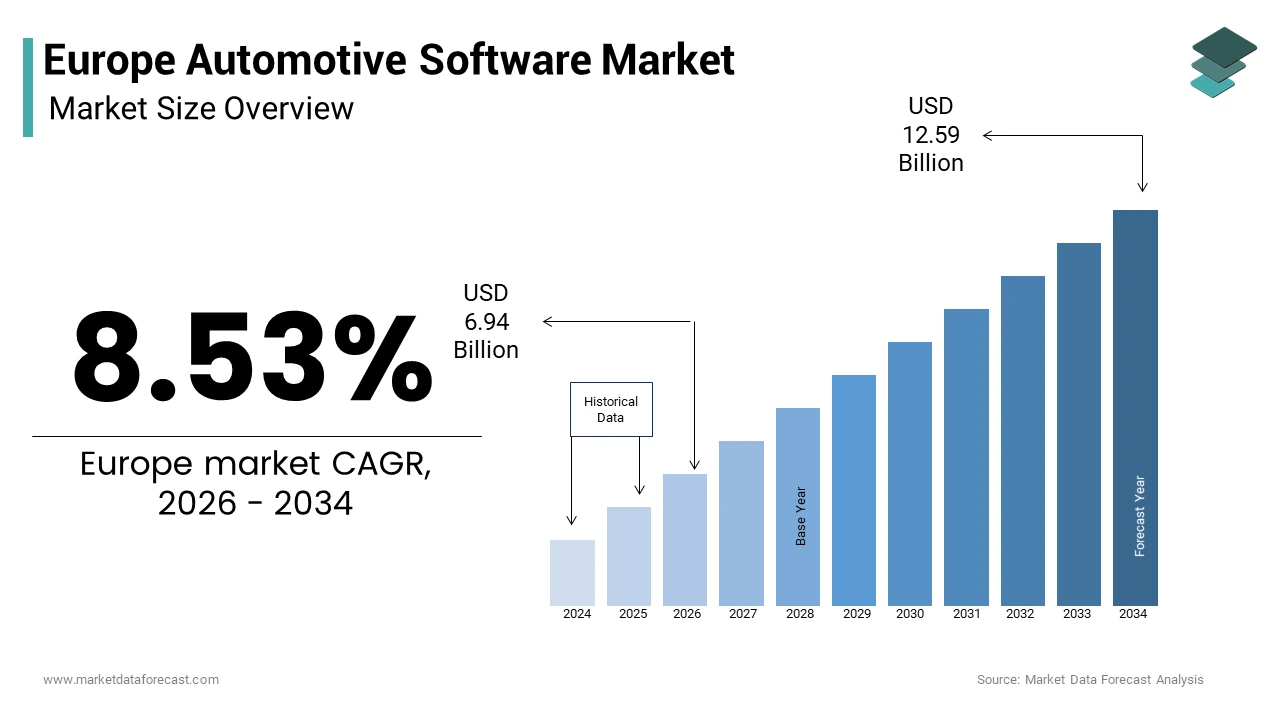
The European automotive software market was valued at USD 6.39 billion in 2025, is estimated to reach USD 6.94 billion in 2026, and is projected to reach USD 12.59 billion by 2034, growing at a CAGR of 8.53% during the forecast period from 2026 to 2034.
The growth of the European automotive software market is driven by the rapid shift toward software-defined vehicles (SDVs), rising adoption of connected and electric vehicles, and increasing integration of ADAS, infotainment, and vehicle operating systems. Automakers across Europe are investing heavily in embedded software platforms, cloud connectivity, and AI-driven vehicle intelligence to enhance safety, personalization, and lifecycle management. Regulatory pressure for vehicle cybersecurity, emissions compliance, and digital safety standards is further accelerating software adoption across the automotive ecosystem.
Key Market Trends
- Growing demand for software-defined and connected vehicles with centralized vehicle architectures.
- Rising adoption of ADAS, autonomous driving, and driver monitoring software to meet EU safety mandates.
- Increasing deployment of on-board embedded software systems for real-time vehicle control and diagnostics.
- Expansion of OTA (over-the-air) updates for feature enhancements and cybersecurity management.
- Strong integration of AI, cloud computing, and digital twins into automotive software platforms.
Segmental Insights
- Based on the software layer, the application software segment dominated the European automotive software market by holding 48.2% share in 2025. This dominance is attributed to the growing use of ADAS, infotainment systems, powertrain management, and in-vehicle operating platforms that enhance safety, performance, and user experience.
- Based on vehicle type and propulsion, the passenger cars segment held the largest share of the European automotive software market in 2025, driven by the rising penetration of electric and connected vehicles across major European economies.
- Based on deployment, the on-board embedded software segment accounted for a significant share in 2025, as OEMs prioritize real-time processing, cybersecurity control, and hardware-software integration within vehicle architectures.
Regional Insights
The European automotive software market is witnessing strong growth across leading automotive nations.
- Germany was the largest contributor, accounting for 24.3% of the market share in 2025, supported by its global automotive OEM base and leadership in EV and ADAS innovation.
- France ranked second with 14.3% share, driven by smart mobility programs and digital vehicle platforms.
- The United Kingdom is expected to grow at a strong CAGR, supported by connected mobility initiatives and automotive AI development.
- Sweden is emerging as a key hub for sustainable, user-centric automotive software solutions.
- The Netherlands is gaining momentum through smart mobility projects and national digital infrastructure integration.
Competitive Landscape
The European automotive software market is highly competitive and innovation-driven. Leading companies are focusing on vehicle operating systems, embedded platforms, cybersecurity, AI-driven mobility software, and cloud connectivity solutions. Strategic partnerships between OEMs, semiconductor firms, and software providers are accelerating platform standardization and digital transformation across Europe.
Key players in the European automotive software market include:
Robert Bosch GmbH, Continental AG, Elektrobit, BlackBerry Limited (QNX), Google LLC (Alphabet Inc.), Microsoft Corporation, Wind River Systems, NXP Semiconductors N.V., NVIDIA Corporation, Aptiv PLC, TTTech Auto AG, Vector Informatik GmbH, Infineon Technologies AG, Intel Corporation, LG Electronics Vehicle Solutions, DENSO Corporation, Panasonic Automotive Systems, KPIT Technologies Ltd., Intellias Ltd., Tata Elxsi Ltd., Airbiquity Inc., MontaVista Software LLC, Renesas Electronics Corporation, HARMAN International, and GlobalLogic Inc.
Europe Automotive Software Market Size
The Europe automotive software market size was valued at USD 6.39 billion in 2025 and is anticipated to reach USD 6.94 billion in 2026 to USD 12.59 billion by 2034, growing at a CAGR of 8.53% during the forecast period from 2026 to 2034.
Current Introduction of the Europe Automotive Software Market
The automotive software is the development, integration, and management of embedded and cloud based software systems that enable vehicle functionality ranging from powertrain control and advanced driver assistance to infotainment, connectivity, and over the air updates. Unlike conventional mechanical components, software now constitutes a core architectural layer of modern vehicles, with the European Commission estimating that software accounts for over 35% of a vehicle’s value in premium segments. This transformation is driven by regulatory mandates, electrification, and consumer expectations for digital experiences akin to smartphones. As per Eurostat, 92% of new passenger cars registered in the European Union in 2024 featured at least one advanced driver assistance system, all reliant on real time software processing. Additionally, the European Environment Agency reported that over 2.1 million public and private electric vehicle charging points were operational across the EU by the end of 2024, necessitating interoperable software protocols for authentication, billing, and grid communication. These infrastructural and regulatory evolutions position automotive software not merely as an enabler but as the central nervous system of Europe’s mobility future.
MARKET DRIVERS
Mandated Deployment of Advanced Driver Assistance Systems
The phased regulatory enforcement of advanced driver assistance systems, across the European Union serves as a primary factor for the growth of Europe automotive software market. As per the European Commission’s General Safety Regulation 2022, all new vehicle types homologated from July 2024 must include mandatory software enabled safety features, such as intelligent speed assistance, driver drowsiness detection, and advanced emergency braking. By 2026, these requirements will extend to all new vehicle registrations. The European Transport Safety Council confirmed that these systems rely on complex software stacks integrating camera radar and ultrasonic sensor data through real time algorithms, each requiring millions of lines of certified code. Volkswagen Group alone reported in 2024 that its next generation platform would contain over 100 million lines of software, a threefold increase from 2020. National type approval authorities now mandate rigorous software validation including cybersecurity assessments under UNECE Regulation 155, compelling manufacturers to invest heavily in secure software development lifecycles. This regulatory trajectory ensures sustained demand for safety critical software across passenger and commercial fleets, transforming compliance into a strategic software engineering imperative for every automaker operating in Europe.
Rapid Electrification and Battery Management System Complexity
The accelerated shift toward electric vehicles, particularly in battery management and thermal control domains is additionally escalating the growth of Europe automotive software market. According to the European Automobile Manufacturers Association, 24% of all new cars sold in the EU in 2024 were battery electric or plug in hybrid, a figure projected to exceed 50% by 2028. Each electric vehicle relies on a battery management system governed by proprietary software that monitors cell voltage temperature state of charge and degradation in real time to ensure safety efficiency and longevity. The software must also coordinate with regenerative braking inverters and charging protocols, creating a tightly integrated control ecosystem. In 2024, Stellantis disclosed that its new STLA Large platform dedicates over 40% of its embedded software to battery and energy management alone. Furthermore, the EU’s Battery Regulation mandates digital battery passports from 2026 requiring software to log and transmit lifecycle data including carbon footprint and material sourcing with a requirement that necessitates cloud connected firmware architectures. This emergence of performance safety and regulatory demands has elevated battery software from a supporting module to a mission critical system, driving recruitment of specialized software engineers and partnerships with AI firms for predictive analytics.
MARKET RESTRAINTS
Fragmented Legacy Architectures and Integration Bottlenecks
The persistent reliance on fragmented electronic control unit architectures and legacy codebases that impede agile software development is restraining the growth of Europe automotive software market. As per the German Association of the Automotive Industry, over 70% of current European vehicle platforms still utilize distributed networks of 50 to 100 discrete electronic control units running heterogeneous operating systems and communication protocols. This fragmentation complicates over the air update deployment increases validation costs and creates cybersecurity vulnerabilities due to inconsistent patching. A 2024 study by the Fraunhofer Institute for Integrated Circuits found that integrating new software features into legacy platforms required an average of 14 months of validation, nearly double the development time for hardware. Moreover, many control units run on outdated AUTOSAR Classic stacks that lack support for dynamic memory allocation or secure boot, limiting functional safety scalability. While automakers like Mercedes Benz and Volvo have transitioned to centralized domain controller architectures, mass market brands face financial and technical barriers to platform replacement.
Stringent and Evolving Cybersecurity Certification Requirements
The increasing rigorous and inconsistently implemented cybersecurity regulations that escalate compliance complexity and delay time, which is additionally hampering the growth of Europe automotive software market. Under UNECE Regulation 155, enforced across the EU since 2022, manufacturers must establish certified cybersecurity management systems and demonstrate risk mitigation for all vehicle software. However, as per the European Union Agency for Cybersecurity, only 11 of 27 EU member states have fully accredited national approval authorities as of early 2025, leading to divergent interpretation and redundant audits. Volkswagen reported in 2024 that it underwent three separate cybersecurity assessments for the same vehicle model in Germany France and Italy due to procedural discrepancies. Additionally, the EU’s upcoming Cyber Resilience Act will impose developer liability for software vulnerabilities throughout a vehicle’s 15 year lifecycle with a provision that demands continuous monitoring and patching infrastructure. The European Data Protection Supervisor, also requires granular data flow mapping for all connected vehicle software under GDPR, further increasing documentation burdens.
MARKET OPPORTUNITIES
Monetization Through Software Defined Vehicle Features
The emergence of the software defined vehicle paradigm to generate recurring revenue through post purchase feature activation is to set up new opportunities for the growth of Europe automotive software market. According to a 2024 survey by the European Consumer Organisation, 38% of new car buyers in Germany and Sweden expressed willingness to pay for on demand features if pricing was transparent and reversible. BMW led this shift by offering heated seats and trailer assistance, as monthly subscriptions across 18 EU countries in 2024, while Volvo introduced a “Care Key” software package limiting speed for young drivers. The European Commission’s revised Type Approval Framework now permits such activations provided they do not compromise safety or emissions, thereby creating a regulated pathway for digital monetization. Moreover, the integration of vehicle software with mobile and home ecosystems, such as pre-conditioning cabins via smart speakers that opens cross industry partnership avenues.
Expansion of Vehicle to Grid and Smart Charging Integration
The growing integration of electric vehicles into energy ecosystem offers a high potential opportunity for specialized automotive software focused on vehicle to grid communication and smart charging orchestration. The expansion of vehicle to grid and smart charging integration is additionally to fuel the growth of the Europe automotive software market. As per the European Network of Transmission System Operators for Electricity, over 15 million electric vehicles are expected to be connected to the EU grid by 2030, capable of acting as distributed energy assets. This automotive software that can securely authenticate with charging networks negotiate load timing based on electricity prices and modulate battery discharge during peak demand. In 2024, the Netherlands launched a nationwide vehicle to grid pilot involving 10000 vehicles coordinated through ISO 15118 compliant software embedded in Hyundai and Kia models. Similarly, Germany’s Federal Network Agency mandated that all public chargers support smart charging protocols from 2025, requiring automakers to embed bidirectional communication stacks. The EU’s Alternative Fuels Infrastructure Regulation further stipulates that new charging points must be capable of dynamic load management by 2026. These regulatory and infrastructural shifts position automotive software as a critical interface between mobility and energy sectors, enabling automakers to participate in grid balancing markets and offer energy services to consumers, thus unlocking new revenue beyond transportation.
MARKET CHALLENGES
Shortage of Embedded Software Talent
The acute shortage of engineers skilled in real time embedded systems functional safety and automotive specific frameworks like AUTOSAR is acting as a barrier for the growth of Europe automotive software market. According to the European Centre for the Development of Vocational Training, over 120000 automotive software engineering roles remained unfilled across the EU in 2024, with Germany and France reporting vacancy rates exceeding 25% in this specialty. This deficit stems from a mismatch between academic curricula and industry needs, only 18% of computer science programs in Europe, offer dedicated automotive software modules, as per the European University Association. The automakers are diverting resources to in house academies in 2024 Renault established a software engineering campus in Paris training 2000 developers annually in safety critical coding. The competition for talent is intensified by tech firms and semiconductor companies offering higher salaries and remote work options luring potential candidates away from traditional OEMs. Without a coordinated education industry initiative to scale specialized training, Europe’s ambition to lead in software defined mobility will be constrained by human capital bottlenecks that delay development cycles and increase outsourcing dependency.
Complexity of Multisource Software Supply Chains
The complexity and opacity of multisource software supply chains involving tier one suppliers open source communities and third party vendors is also degrading the growth of Europe automotive software market. Modern vehicles integrate software from over 50 different providers with a single infotainment system potentially containing code from Linux foundations Android Automotive Qualcomm and proprietary middleware. As per the European Commission’s 2024 Cybersecurity in Automotive report 63% of software vulnerabilities in vehicles originated from third party components with limited visibility into their development practices. This fragmentation complicates compliance with UNECE Regulation 155 which requires end to end accountability for cyber risks. In 2024, a major European OEM recalled 180000 vehicles due to a vulnerability in an open source library used by a tier two supplier with a flaw undetected during integration testing. Moreover licensing ambiguities in open-source code risk intellectual property conflicts, under the EU’s proposed Cyber Resilience Act. Unlike hardware where traceability is mature, software provenance remains poorly standardized, exposing manufacturers to legal operational and reputational risks. Until a unified software bill of materials framework is adopted across Europe, supply chain opacity will remain a structural vulnerability in automotive software deployment.
REPORT COVERAGE
| REPORT METRIC | DETAILS |
| Market Size Available | 2025 to 2034 |
| Base Year | 2025 |
| Forecast Period | 2026 to 2034 |
| CAGR | 8.53% |
| Segments Covered | By Software, Application, Vehicle, Propulsion, Deployment, And By Region |
| Various Analyses Covered | Global, Regional, and Country-Level Analysis; Segment-Level Analysis; DROC; PESTLE Analysis; Porter’s Five Forces Analysis; Competitive Landscape; Analyst Overview of Investment Opportunities |
| Regions Covered | UK, France, Spain, Germany, Italy, Russia, Sweden, Denmark, Switzerland, Netherlands, Turkey, the Czech Republic, and the Rest of Europe |
| Market Leaders Profiled | Robert Bosch GmbH, Continental AG, Elektrobit, BlackBerry Limited (QNX), Google LLC (Alphabet Inc.) , Microsoft Corporation , Wind River Systems, NXP Semiconductors N.V., NVIDIA Corporation, Aptiv PLC, TTTech Auto AG, Vector Informatik GmbH, Infineon Technologies AG, Intel Corporation, LG Electronics Vehicle Solutions, DENSO Corporation, Panasonic Automotive Systems, KPIT Technologies Ltd., Intellias Ltd., Tata Elxsi Ltd., Airbiquity Inc., MontaVista Software LLC, Renesas Electronics Corporation, HARMAN International, GlobalLogic Inc. |
SEGMENTAL ANALYSIS
By Software Layer Insights
The application software segment was the largest by holding 48.2% of the Europe automotive software market share in 2024 with the layer encompasses user facing and vehicle functionality software, including infotainment, telematics, advanced driver assistance systems, and digital cockpit interfaces that directly shape the driving and ownership experience. The consumer expectation for smartphone like digital experiences in vehicles is also elevating the growth of segment. As per the European Consumer Organisation’s 2024 Mobility Survey, 67% of new car buyers in Western Europe ranked intuitive infotainment and seamless smartphone integration as top three purchase, surpassing engine performance. This has compelled automakers to invest heavily in application software with natural language voice assistants over the air update capabilities and app ecosystems. Mercedes Benz’s proprietary MBUX system alone runs over 30 million lines of application code and supports third party services like Spotify and parking reservation platforms. Additionally, regulatory mandates such as the EU’s General Safety Regulation require application layer integration for features like intelligent speed assistance, which overlays GPS and traffic sign recognition data onto the driver display.
The middleware segment is esteemed to witness a fastest CAGR of 11.2% from 2025 to 2033. Middleware acts as the critical abstraction layer between hardware dependent embedded systems and higher level applications enabling modularity interoperability and real time communication across electronic control units. The industry wide transition to service-oriented architectures and centralized computing platforms, which is also propelling the growth of the segment. As automakers consolidate dozens of legacy control units into domain controllers or zonal architectures, middleware frameworks like AUTOSAR Adaptive and POSIX compliant real time operating systems become essential to manage data flow between sensors actuators and applications. In 2024, Volkswagen confirmed that its next generation Scalable Systems Platform would rely entirely on Adaptive AUTOSAR middleware to support dynamic software loading and secure over the air updates. Similarly, Stellantis partnered with BlackBerry QNX to deploy a unified middleware stack across its European EV lineup by enabling consistent cybersecurity and functional safety across brands. The European Union’s UNECE Regulation 156 on software update management that further mandates that all update capable vehicles implement a standardized software identification framework with a requirement that middleware uniquely fulfills.
By Vehicle Type and Propulsion Insights
The passenger cars segment was the largest by holding a significant share of the Europe automotive software market in 2024 owing to the sheer volume of passenger vehicle production high consumer demand for digital features and stringent safety regulations that apply uniformly. The regulatory and consumer-driven feature proliferation in passenger vehicles is also to boost the growth of this segment. Unlikecommercial fleets which prioritize durability and total cost of ownership, passenger car buyers expect continuous innovation in comfort convenience and safety. The European Commission’s General Safety Regulation mandates that all new passenger cars homologated from 2024 include driver monitoring systems emergency lane keeping and data recorders, all requiring dedicated application and middleware software. Furthermore, the average European passenger car now contains over 150 million lines of code according to the German Association of the Automotive Industry reflecting deep software integration into powertrain chassis and cabin systems. Premium brands like BMW and Volvo further accelerate software intensity by offering subscription-based features such as enhanced navigation or performance modes.
The Battery Electric Vehicles segment is likely to witness a fastest CAGR of 22.7% throughout the forecast period owing to the architectural necessity for integrated software in battery and thermal management. Unlike internal combustion engines which rely on mechanical feedback loops, EVs depend on real time software algorithms to balance cell voltages optimize regenerative braking and prevent thermal runaway. The European Battery Alliance reported in 2024 that EV battery management systems now contain 3 to 5 times more software than comparable ICE engine control units. Additionally, EVs serve as nodes in the energy grid requiring software for ISO 15118 compliant plug and charge authentication smart charging coordination and vehicle to grid communication. In 2024, the Netherlands mandated that all new EVs sold must support bidirectional charging software with a policy expected to be adopted EU wide by 2027. Furthermore, the EU’s upcoming digital battery passport regulation requires embedded software to log and transmit carbon footprint material origin and health status throughout the battery’s lifecycle. These regulatory and technical imperatives make BEVs not just cleaner vehicles but software dense platforms driving disproportionate growth in automotive software value per unit sold.
By Deployment Insights
The On Board Embedded Software segment was accounted in holding a significant share of the Europe automotive software market in 2024 with all software physically integrated into vehicle electronic control units from engine control modules to infotainment head units and advanced driver assistance processors. As per UNECE Regulation 131 and ISO 26262 standards, systems like automatic emergency braking must respond within milliseconds and a requirement only achievable through local embedded processing. The German Federal Motor Transport Authority reported that over 95% of advanced driver assistance computations in 2024 occurred on board due to reliability and latency constraints. Additionally, data privacy considerations under the General Data Protection Regulation encourage local processing of biometric and location data to minimize unnecessary transmission. Even as cloud connectivity expands, core vehicle dynamics powertrain control and chassis functions remain firmly embedded. This architectural necessity ensures that despite the rise of connected services, the majority of automotive software value and complexity resides within the vehicle itself, governed by rigorous automotive safety and cybersecurity protocols.
The off-board cloud and edge deployment segment is expected to register a fastest CAGR of 18.4% from 2025 to 2033. The growth of the segment is propelled with the EU’s regulatory push for continuous vehicle software lifecycle management. UNECE Regulation 156 mandates that all new vehicles support secure and validated software updates throughout their operational life, a capability that requires cloud based version control signing and rollback infrastructure. In 2024, Tesla and Polestar reported that over 80% of their software updates in Europe were delivered via cloud platforms with edge nodes in Frankfurt and Stockholm reducing latency for Nordic users. Additionally, the European Commission’s Data Act requires automotive manufacturers to provide third party repairers with secure access to vehicle generated data, thereby cloud hosted data sharing platforms compliant with GAIA-X architecture principles.
COUNTRY LEVEL ANALYSIS
Germany Automotive Software Market Analysis
Germany was the largest contributor of the Europe automotive software market by holding 24.3% of share in 2024 with its concentration of premium OEMs Tier 1 suppliers and world class engineering institutions that collectively define automotive software standards. Volkswagen, BMW, and Mercedes Benz, alone invested over 12 billion euros in software development in 2024 with dedicated divisions like CARIAD and Mercedes Benz Tech driving centralized architectures. The Technical Inspection Association TUV plays a pivotal role by certifying software under ISO 21434 and UNECE cybersecurity regulations by making Germany the de facto testing ground for EU compliance. With over 4000 automotive software startups clustered in Berlin Stuttgart and Munich and a dual education system producing 15000 embedded software engineers annually Germany remains the undisputed nerve center of Europe’s automotive software ecosystem.
France Automotive Software Market Analysis
France was ranked second by capturing 14.3% of the Europe automotive software market share in 2024 with a national strategy emphasizing technological sovereignty and green mobility transformation. The French government’s “France 2030” investment plan committed 4 billion euros to automotive electrification and software autonomy including the development of a European alternative to Android Automotive. Stellantis’ Software Factory in Paris, now employs over 4000 engineers focused on AI driven battery management and over the air update platforms. Renault Group’s partnership with Qualcomm and Google has yielded a unified infotainment stack deployed across 1.2 million vehicles in 2024 alone. France enforces the strictest data localization rules in Europe requiring all vehicle generated data from French residents to be processed on EU soil with a policy accelerating investment in GAIA-X compliant cloud infrastructure by Orange and OVHcloud. Additionally, the National Cybersecurity Agency ANSSI conducts mandatory penetration testing for all connected vehicles sold in France setting a high bar for software resilience.
United Kingdom Automotive Software Market Analysis
The United Kingdom automotive software market growht is likely to have an anticipated CAGR in coming years with growing software engineering talent specialized startups and advanced R&D facilities. Companies like Oxbotica and FiveAI, lead in autonomous driving software with trials approved, across London and Oxford. The UK’s Vehicle Certification Agency was among the first to implement UNECE Regulation 155 certification enabling rapid market entry for software defined vehicles. In 2024, the UK launched the National Automotive Innovation Centre’s software validation lab, where the largest in Europe by offering real time cybersecurity testing for OEMs and suppliers. The country also excels in off board services, such as Arrival and Zenitech developed cloud based fleet management platforms now used by Royal Mail and DPD, across 20000 vehicles.
Sweden Automotive Software Market Analysis
Sweden automotive software market growth is driven by its integration of sustainability ethics and user centric design into automotive software development. Volvo Cars and Polestar, both headquartered in Gothenburg pioneered transparent software practices, including open-source driver monitoring algorithms and consumer-controlled data sharing dashboards. Sweden was the first EU country to mandate that all new EVs sold from 2025 must support vehicle to grid communication software, a move that has attracted partnerships with Vattenfall and Northvolt to develop bidirectional charging stacks. The Swedish Transport Agency enforces stringent ethical AI guidelines requiring all autonomous driving software to undergo bias testing for pedestrian recognition across age and ethnicity groups. Furthermore, the KTH Royal Institute of Technology leads EU funded projects on energy efficient middleware that reduces onboard compute power by up to 30%.
Netherlands Automotive Software Market Analysis
The Netherlands automotive software market growth is propelling with the smart mobility, where automotive software intersects with national digital infrastructure. All new vehicles sold in the Netherlands must comply with the National Road Transport Agency’s digital type approval system, which validates software for interoperability with national charging smart traffic and emergency response networks. In 2024, the Netherlands became the first EU member state to fully implement the EU’s Data Act for vehicles requiring manufacturers to provide standardized APIs for independent repairers with a move that spurred local startups like Wejo and AutoSoft to develop compliance middleware. The Dutch government also mandated that all public EV charging points support ISO 151182 plug and charge software by 2025 driving integration demands for automakers. Additionally, Amsterdam’s AI Coalition launched a secure data exchange platform where vehicle software shares anonymized traffic data with municipal systems to optimize congestion pricing. This ecosystem approach, where national policy municipal innovation and private sector agility converge positions the Netherlands as a critical testbed and early adopter of next generation automotive software in Europe.
COMPETITIVE LANDSCAPE
Competition in the Europe automotive software market is characterized by a strategic race among OEMs suppliers and tech entrants to control the vehicle software stack amid unprecedented regulatory and technological transformation. Traditional automakers are vertically integrating software capabilities through dedicated subsidiaries while Tier 1 suppliers pivot from hardware delivery to full software solutions. The market is highly fragmented due to legacy architectures but is consolidating around service oriented platforms compliant with AUTOSAR Adaptive and EU cybersecurity standards. Regulatory pressure, notably UNECE Regulations 155 and 156 and the EU Data Act acts as a barrier, favoring players with robust compliance infrastructure. Talent scarcity intensifies rivalry as companies compete for embedded software engineers functional safety experts and AI specialists. Unlike consumer software markets, automotive software competition is defined by long validation cycles safety criticality and deep integration with mechanical systems. Success hinges on balancing innovation speed with certification rigor while building sovereign European alternatives to global tech ecosystems in alignment with EU digital and green policy objectives.
KEY MARKET PLAYERS
A few of the dominating players in the Europe automotive software market are
- Robert Bosch GmbH
- Continental AG
- Volkswagen Group (CARIAD SE)
- Mercedes Benz Group AG
- Elektrobit
- BlackBerry Limited (QNX)
- Google LLC (Alphabet Inc.)
- Microsoft Corporation
- Wind River Systems
- NXP Semiconductors N.V.
- NVIDIA Corporation
- Aptiv PLC
- TTTech Auto AG
- Vector Informatik GmbH
- Infineon Technologies AG
- Intel Corporation
- LG Electronics Vehicle Solutions
- DENSO Corporation
- Panasonic Automotive Systems
- KPIT Technologies Ltd.
- Intellias Ltd.
- Tata Elxsi Ltd.
- Airbiquity Inc.
- MontaVista Software LLC
- Renesas Electronics Corporation
- HARMAN International
- GlobalLogic Inc.
Top Players In The Market
- Volkswagen Group, through its wholly owned software subsidiary CARIAD SE headquartered in Germany, is a central architect of automotive software transformation in Europe. CARIAD develops the unified E³ 2.0 software platform that will underpin all Volkswagen Group brands including Audi Porsche and Škoda from 2025 onward. In 2024, CARIAD finalized strategic partnerships with Qualcomm and NVIDIA to co-develop high performance computing stacks and secured certification under UNECE Regulation 155 for its cybersecurity management system. The company also launched a new over the air update infrastructure across 24 European countries enabling secure feature deployment throughout vehicle lifecycles.
- Mercedes Benz Group AG has emerged as a pioneer in premium automotive software with its in house developed MB.OS operating system and digital vehicle architecture. The company’s software division employs over 5000 engineers across Berlin Stuttgart and Tel Aviv focusing on AI driven user experience autonomous driving middleware and cloud connected services. In 2024 Mercedes Benz achieved full type approval for its Level 3 Drive Pilot system in Germany, France, and the UK, a feat enabled by its proprietary sensor fusion and real time validation software. The company also introduced a new subscription management platform compliant with EU digital fairness rules allowing customers to activate features like rear axle steering post purchase. Through vertical integration and luxury digital differentiation, Mercedes Benz is redefining software as a core brand asset in the European premium segment.
- Continental AG, a Germany based global automotive technology supplier, plays a role in the Europe automotive software market through its embedded systems middleware and domain control units. The company’s Software Defined Vehicle division delivers AUTOSAR Adaptive stacks secure bootloaders and over the air update clients to multiple European OEMs. In 2024 Continental launched its third generation Edge Cloud Platform enabling real time data processing for advanced driver assistance and vehicle to infrastructure communication. It also partnered with the French startup Verkor to develop battery management software for next generation electric vehicles.
Top Strategies Used By The Key Market Participants
Key players in the Europe automotive software market are consolidating software development into centralized in house platforms to reduce dependency on external vendors and accelerate innovation cycles. They pursue strategic technology partnerships with semiconductor and cloud providers to co- develop high performance computing and secure connectivity stacks. Companies invest heavily in cybersecurity certification under UNECE Regulations 155 and 156 to ensure regulatory compliance and consumer trust. They implement over the air update capabilities with granular feature activation to enable new revenue streams through post purchase software subscriptions. Additionally, firms are aligning their software roadmaps with EU sustainability mandates including digital battery passports and energy efficient computing to meet environmental and data governance requirements.
MARKET SEGMENTATION
This research report on the Europe automotive software market is segmented and sub-segmented into the following categories.
By Software Layer
- Application Software
- Middleware
- Operating System
- Firmware / Basic Input-Output Software
By Application
- ADAS and Safety Systems
- Infotainment and Telematics
- Powertrain and Battery-Management
- 5.2.4 Body Control and Comfort
- 5.2.5 Connected Vehicle Services
By Vehicle Type
- Passenger Cars
- Light Commercial Vehicles
- Heavy Commercial Vehicles
By Propulsion
- Internal Combustion Engine Vehicles (ICE)
- Battery Electric Vehicles (BEV)
- Hybrid Electric Vehicles (HEV/PHEV)
By Deployment
- On-Board (Embedded)
- Off-Board (Cloud / Edge)
By Country
- UK
- France
- Spain
- Germany
- Italy
- Russia
- Sweden
- Denmark
- Switzerland
- Netherlands
- Turkey
- Czech Republic
- Rest of Europe