- Product Description Description
- Table of Contents TOC
- List of Table & Figure LOT
- Get Free Sample PDF Sample PDF
Market Size, 2025
$0.78 BnMarket Estimate, 2026
$0.82 BnMarket Forecast, 2034
$1.28 BnCAGR, 2026–2034
5.67%Executive Summary: Europe Azimsulfuron Market
- Market Scope: In-depth assessment of the European azimsulfuron herbicide market segmented by product formulation, application/crop type, and country-level markets.
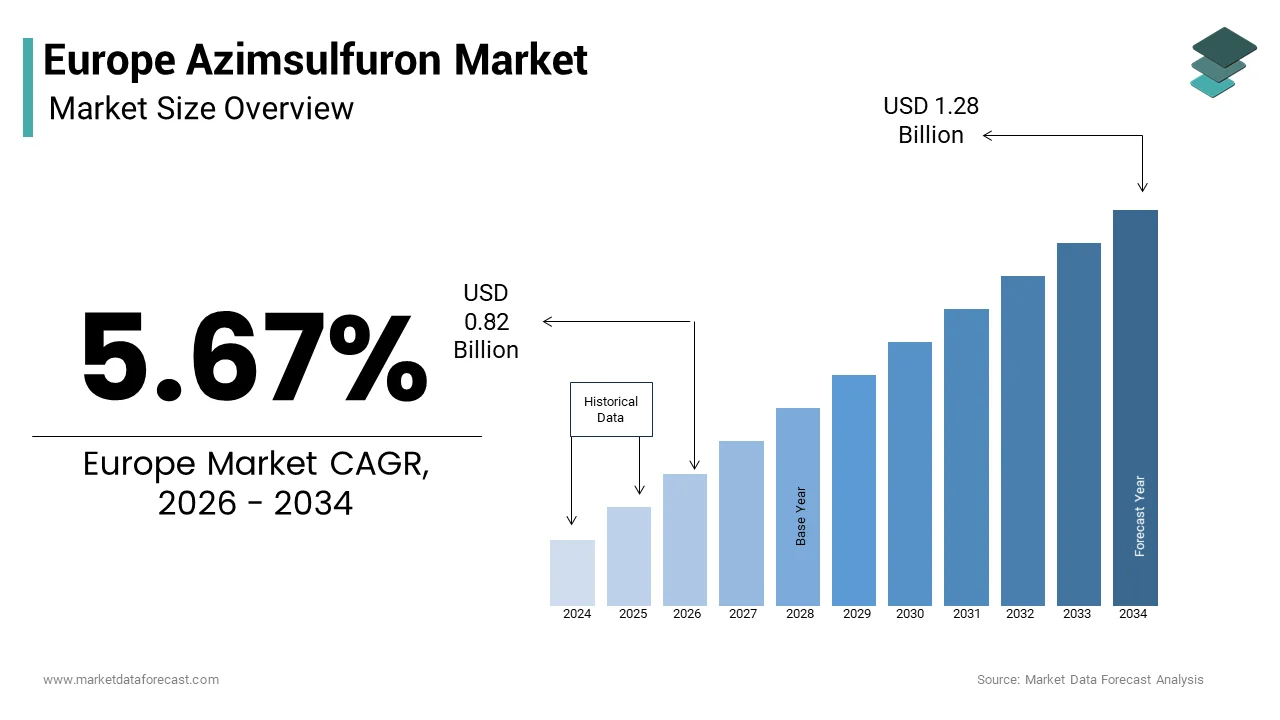
- Market Valuation: Valued at USD 0.78 billion in 2025, estimated at USD 0.82 billion in 2026, and projected to reach USD 1.28 billion by 2034, growing at a compound annual growth rate (CAGR) of 5.67% from 2026 to 2034.
- Primary Growth Drivers: Geographic concentration of specialized rice cultivation in Mediterranean countries (Italy, Spain, Portugal), adoption of sustainable water-saving and direct-seeded rice systems, and alignment with EU Common Agricultural Policy (CAP) objectives.
Key Market Segment Metrics (2026–2034)
| Category | Leading Segment Focus | Detailed Taxonomy & Sub-Segments |
|---|---|---|
| By Product Formulation | Water Dispersible Granules (WDG - Market Leader) / Conventional Granules (Fastest-growing at 7.17% CAGR) | Water Dispersible Granules (WDG), Granules (Conventional/Soil-Applied), & Others |
| By Application | Cereals and Grains / Rice Paddies (Dominant Share) | Cereals and Grains (Rice), Fruits & Vegetables, Oilseeds & Pulses, & Other Crops |
| By Country Focus | Italy (48.8% regional market share in 2025) & Spain (Second largest) | United Kingdom, France, Spain, Germany, Italy, Russia, Sweden, Denmark, Switzerland, Netherlands, & Rest of Europe |
Regional Insights & Market Dynamics
Southern Europe (Italy & Spain): Italy leads the market owing to intensive rice production in the Po Valley. Spain follows closely, anchored by the Ebro Delta and Guadalquivir Valley, where direct seeding and water-saving agronomic practices drive demand for granular formulations. Portugal, France, and Greece also contribute niche yet vital demand.
Market Restraints & Challenges: Stringent EU regulatory re-evaluation under Regulation (EC) No 1107/2009 (with reapproval uncertainties ahead of 2028), high costs of generating comprehensive ecotoxicological data, limited crop spectrum restricted to rice, and emerging ALS-inhibitor weed resistance biotypes.
Key Market Leaders Profiled: Nufarm Limited, FMC Corporation, Sipcam Oxon S.p.A., DuPont, Bayer Crop Science AG, Dow AgroSciences, Amvac Chemical Corporation, and regional chemical specialists.
 Download Free Sample Report
Europe Azimsulfuron Market Size
The Europe Azimsulfuron Market size was valued at USD 0.78 billion in 2025 and is anticipated to reach USD 0.82 billion in 2026 from USD 1.28 billion by 2034, estimated to be growing at a CAGR of 5.67%, from 2026 to 2034.
Current Introduction of the Europe Azimsulfuron Market
Azimsulfuron is a selective systemic sulfonylurea herbicide primarily used for post emergence control of broadleaf weeds and certain grasses in rice cultivation. It functions by inhibiting the acetolactate synthase (ALS) enzyme, disrupting branched chain amino acid synthesis in susceptible plants, leading to growth cessation and eventual death. In Europe, its application is highly specialized and geographically concentrated in rice growing regions, notably in Italy, Spain, and Portugal, where it plays a critical role in integrated weed management programs. The European market for azimsulfuron operates under stringent regulatory oversight by the European Food Safety Authority (EFSA) and national competent authorities, with approvals contingent on rigorous environmental and toxicological assessments. According to the European Commission’s Pesticide Residues in Food report 2024, azimsulfuron residues were detected in rice samples, reflecting controlled usage and compliance with maximum residue levels. Its niche yet vital role in sustainable rice production, enabling reduced tillage and lower water consumption, defines its unique position within Europe’s tightly regulated agrochemical landscape.
MARKET DRIVERS
Concentration of Rice Cultivation in Southern Europe
The geographic concentration of rice farming in Mediterranean countries, where specific agronomic conditions necessitate targeted weed control solutions is one of the key factors driving the growth of the Europe azimsulfuron market. According to Eurostat, Italy, Spain, and Portugal account for the majority of the EU’s rice production, cultivating large areas annually. These regions face persistent infestations of problematic weeds such as red rice, barnyard grass, and Cyperus species, which compete aggressively with cultivated rice for nutrients and water. Azimsulfuron’s selectivity allows it to control these weeds without harming the rice crop, a critical advantage in direct seeded systems that are increasingly adopted to conserve water. In Italy’s Po Valley, farmers integrate azimsulfuron into their weed management protocols as per the Italian Rice Association. This localized but intensive demand, driven by ecological and economic necessity, sustains the herbicide’s relevance despite its narrow crop spectrum.
Regulatory Approval for Use in Sustainable Rice Systems
The azimsulfuron’s alignment with European agricultural policies promoting resource efficient and low impact farming practices, particularly in water stressed regions is further contributing to the expansion of the Europe azimsulfuron market. The EU’s Common Agricultural Policy encourages techniques that reduce irrigation demand and greenhouse gas emissions, such as alternate wetting and drying in rice paddies. These systems favor the use of systemic herbicides like azimsulfuron over mechanical weeding, which is impractical in intermittently flooded fields. As per the European Environment Agency, rice cultivation accounts for a notable share of agricultural water use in Southern Europe, making water saving technologies essential. Azimsulfuron enables effective weed control in these reduced tillage, water efficient systems, supporting compliance with the EU Green Deal objectives. National authorities in Italy and Spain have specifically endorsed its use in certified sustainable rice programs, providing farmers with both agronomic and regulatory incentives to adopt it as part of integrated pest management strategies.
MARKET RESTRAINTS
Stringent EU Regulatory Scrutiny and Reapproval Uncertainty
A major restraint on the Europe azimsulfuron market stems from the European Union’s rigorous and evolving pesticide re-evaluation process under Regulation (EC) No 1107/2009 No 1107/F2009). Active substances must undergo periodic renewal every 10 to 15 years, requiring extensive new data on environmental fate, ecotoxicity, and human health impacts. Azimsulfuron’s current approval expires in 2028, and its reauthorization is uncertain due to concerns about its persistence in aquatic environments and potential effects on non-target plants. According to the European Food Safety Authority, azimsulfuron showed moderate mobility in soil and potential for groundwater contamination in vulnerable regions. The high cost of generating required studies discourages manufacturers from pursuing renewal unless market volume justifies the investment. This regulatory limbo creates supply insecurity for farmers and limits long term planning, constraining market stability despite current agronomic utility.
Limited Crop Spectrum and Resistance Development
The Europe azimsulfuron market faces a structural limitation due to its exclusive registration for rice, a minor crop in the broader European agricultural context. Unlike broad spectrum herbicides used across cereals, oilseeds, or horticulture, azimsulfuron’s applicability is confined to rice cultivation. This narrow scope restricts economies of scale and reduces manufacturer incentive for innovation. Compounding this issue is the documented emergence of ALS inhibitor resistant weed biotypes in European rice fields. As per a 2024 study by the University of Milan, resistance in Echinochloa crus-galli populations in Lombardy reduced azimsulfuron’s field efficacy in affected areas. Without robust resistance management strategies, including rotation with herbicides of different modes of action, its long-term viability is threatened. This dual constraint of limited use and biological obsolescence curtails market expansion and increases dependency on integrated approaches.
MARKET OPPORTUNITIES
Integration into Precision Agriculture and Digital Farming Platforms
A significant opportunity for the Europe azimsulfuron market lies in its incorporation into precision agriculture systems that optimize input use and minimize environmental impact. With the EU promoting digital farming under the CAP Strategic Plans, tools like drone-based weed mapping and variable rate application technology enable targeted herbicide deployment. Azimsulfuron’s high potency at low use rates makes it suitable for these systems, reducing overall chemical load while maintaining efficacy. In Spain’s Ebro Delta, pilot projects supported by the Spanish Ministry of Agriculture demonstrated reductions in application through drone guided spot treatment without compromising weed control. Partnerships between agrochemical distributors and agri-tech firms, such as those between Syngenta and Bosch, facilitate integration into farm management software. By positioning azimsulfuron as a precision tool rather than a blanket solution, the market can align with EU sustainability goals and enhance its value proposition in an era of data driven farming.
Development of Formulation Enhancements for Reduced Environmental Impact
Innovation in formulation science presents a strategic opportunity for the Europe azimsulfuron market. Advanced delivery systems such as microencapsulation, polymer coated granules, or adjuvant optimized liquid concentrates can minimize leaching, drift, and off target exposure while improving rainfastness and foliar uptake. These enhancements directly address EFSA concerns and support renewal dossiers with improved risk mitigation data. In Germany, the Federal Institute for Risk Assessment acknowledged that next generation formulations could reduce groundwater exposure compared to conventional products. Companies investing in such R&D can differentiate their offerings, secure extended authorizations, and command premium pricing from environmentally conscious rice cooperatives. Furthermore, biodegradable packaging and closed transfer systems align with the EU’s Sustainable Use Regulation, transforming azimsulfuron from a legacy chemical into a modern, responsible solution within circular agricultural frameworks.
MARKET CHALLENGES
High Cost of Regulatory Compliance and Data Generation
A persistent challenge confronting the Europe azimsulfuron market is the escalating financial burden of meeting EU regulatory requirements for active substance renewal. Generating the comprehensive dataset needed for reapproval, including advanced ecotoxicology studies, endocrine disruption screening, and cumulative risk assessments, can be highly expensive. According to the European Crop Protection Association, costs for such studies are substantial. For a niche product like azimsulfuron, used on limited hectares across the EU, this investment may not yield sufficient return, especially as generic competition erodes margins. Smaller manufacturers often lack the capital to fund these studies, leading to market exit or reliance on larger entities for stewardship. This economic barrier risks the discontinuation of effective tools not due to safety failures but to financial impracticality, undermining the availability of specialized solutions for minor crops and contradicting the EU’s stated support for crop diversification and regional agricultural heritage.
Fragmented National Authorization Processes Post EU Renewal
Even if azimsulfuron secures EU level renewal, a critical challenge remains in the fragmented national authorization landscape. Each member state conducts its own assessment for product registration, leading to divergent decisions based on local environmental conditions or political pressures. For instance, a formulation approved in Italy may be rejected in France due to differing interpretations of groundwater vulnerability. According to the European Commission’s Pesticide Database, only a portion of member states currently authorize azimsulfuron containing products despite EU approval. This patchwork creates logistical complexity for distributors, increases time to market, and discourages manufacturers from launching new formulations across the bloc. The lack of harmonization contradicts the single market principle and disproportionately affects minor use pesticides, limiting farmer access to essential tools and fragmenting what should be a unified regulatory environment for agricultural innovation.
REPORT COVERAGE
| REPORT METRIC | DETAILS |
| Market Size Available | 2024 to 2033 |
| Base Year | 2024 |
| Forecast Period | 2025 to 2033 |
| CAGR | 5.67% |
| Segments Covered | By Product, Application, and By Country |
| Various Analyses Covered | Global, Regional & Country Level Analysis, Segment-Level Analysis, DROC, PESTLE Analysis, Porter’s Five Forces Analysis, Competitive Landscape, Analyst Overview on Investment Opportunities |
| Regions Covered | UK, France, Spain, Germany, Italy, Russia, Sweden, Denmark, Switzerland, Netherlands, Turkey, the Czech Republic, and the Rest of Europe |
| Market Leaders Profiled | DuPont, Jiangsu Fengdeng Pesticide, Bayer Crop Science AG, Dow AgroSciences, Amvac Chemical Corporation, Jiangxi Anlida Chemical, Royal Agro, Wenzhou FJ Chemical, Jiangsu Agrochem Laboratory. |
SEGMENTAL ANALYSIS
By Product Formulation Insights
The water dispersible granules segment dominated the Europe azimsulfuron market by holding the leading share of the regional market in 2025. The leading position of water dispersible granules segment in the European market is attributed to their superior environmental and operational profile compared to liquid or dust formulations. WDGs dissolve completely in spray tanks, eliminating clogging risks and ensuring uniform application, which is critical for precision weed control in rice paddies. Their dry format reduces transport costs and eliminates flammability concerns associated with solvent based liquids. More importantly, WDGs align with EU regulatory preferences for reduced risk formulations. According to the European Food Safety Authority, granular forms generally exhibit lower drift potential and operator exposure than emulsifiable concentrates. As per the European Commission’s Pesticide Database, most azimsulfuron based products authorized in the EU were registered as WDGs in 2024. Leading manufacturers like Nufarm and FMC have standardized on this format across Southern Europe, where rice farmers prioritize ease of handling, tank mix compatibility, and compliance with integrated pest management protocols.

The conventional granule segment is anticipated to record a CAGR of 7.17% over the forecast period owing to the adoption of direct seeded rice systems in water scarce regions of Spain and Italy, where pre-emergence soil application of herbicide granules offers significant advantages. Granules can be applied mechanically during sowing, reducing labor and enabling integration into no tillage workflows that conserve moisture and reduce methane emissions. According to the Spanish Ministry of Agriculture, direct seeded rice area expanded in 2024, with granular herbicides playing a key role. These formulations provide controlled release of active ingredient as fields are flooded, ensuring extended residual control of early emerging weeds like red rice. As climate pressures intensify and EU policies incentivize water efficient agriculture, soil applied granules are gaining traction as a sustainable, operationally efficient delivery method tailored to evolving rice cultivation practices.
By Application Insights
The cereals and grains segment had the major share of the Europe azimsulfuron market in 2025. The growth of the cereals and grains segment in the European market is driven by its highly selective registration profile. Azimsulfuron is approved exclusively for use in rice cultivation across the EU, with no authorized applications in wheat, barley, or other cereals. This singular focus stems from its unique selectivity in flooded rice systems, where it effectively controls problematic weeds like Cyperus difformis and Echinochloa species without injuring the crop. According to Eurostat, the EU produced paddy rice in 2024, with most grown in Italy, Spain, and Portugal—regions where azimsulfuron is a cornerstone of weed management. National guidelines, such as Italy’s Technical Guidelines for Sustainable Rice Farming, explicitly recommend azimsulfuron for post emergence control in integrated programs.
COUNTRY ANALYSIS
Italy Azimsulfuron Market Analysis
Italy led the azimsulfuron market in Europe with a 48.8% of the regional market share in 2025. The leading position of Italy in the European market is driven by its status as the EU’s largest rice producer and the epicenter of intensive paddy farming. The Po Valley cultivates extensive rice acreage, accounting for half of EU production according to ISTAT. Italian farmers face severe pressure from red rice and barnyard grass, making azimsulfuron a critical component of their weed control strategy. The Italian Ministry of Agricultural, Food and Forestry Policies includes azimsulfuron in its national list of recommended substances for sustainable rice farming, reinforcing its legitimacy. Farmers in Lombardy and Piedmont integrate azimsulfuron annually, often in rotation with other ALS inhibitors to manage resistance. This deep agronomic integration, supported by cooperative purchasing groups and technical agronomists, establishes Italy as the undisputed core of European azimsulfuron demand.
Spain Azimsulfuron Market Analysis
Spain held the second largest position with a prominent share of the regional market in 2025. The growth of Spain in the European market is anchored in the Ebro Delta and Guadalquivir Valley, which produce significant rice acreage annually as per the Spanish Ministry of Agriculture. Spanish rice systems increasingly adopt direct seeding to conserve water in drought prone regions, creating ideal conditions for azimsulfuron use in both pre and post emergence applications. The country’s warmer climate accelerates weed germination, necessitating reliable systemic herbicides with residual activity. National research institutes like IRAC have validated azimsulfuron’s efficacy against local biotypes of Cyperus and Echinochloa. Recent government subsidies for water saving technologies have indirectly boosted adoption, as azimsulfuron enables effective weed control in alternate wetting and drying systems.
Portugal Azimsulfuron Market Analysis
Portugal is anticipated to command for a promising share of the Europe azimsulfuron market during the forecast period. Spain is concentrated in the Tejo and Sado river basins where rice is cultivated. Portuguese farmers rely heavily on azimsulfuron due to limited alternatives for controlling resistant broadleaf weeds in organic matter rich soils. The Portuguese Directorate General for Agriculture and Rural Development lists azimsulfuron as a key tool in its Integrated Production Manual for Rice, providing official endorsement. Smallholder farms dominate the sector, and cooperative unions facilitate bulk purchasing and technical training, ensuring consistent usage. With climate change increasing salinity and weed pressure in coastal paddies, demand for reliable herbicides like azimsulfuron is expected to grow.
France Azimsulfuron Market Analysis
France is expected to showcase a healthy CAGR in the Europe azimsulfuron market during the forecast period. While smaller in volume, French usage is highly strategic, focusing on premium aromatic rice varieties like Camargue Red Rice that require meticulous weed control to maintain purity and certification. The French Agency for Food, Environmental and Occupational Health & Safety maintains strict oversight, but azimsulfuron remains authorized due to its low application rates and targeted efficacy. Research institutions like INRAE conduct ongoing trials on resistance management, influencing best practices across Europe.
Greece Azimsulfuron Market Analysis
Greece is estimated to hold a notable share of the Europe azimsulfuron market during the forecast period. Greek farmers face intense weed competition in high temperature environments, and azimsulfuron is valued for its stability under heat stress and effectiveness against Cyperus species prevalent in Mediterranean soils. The Hellenic Ministry of Rural Development includes azimsulfuron in its national pesticide registry with specific guidelines for use in water managed systems. Though small, Greece’s market is growing as climate change extends the rice belt northward and increases reliance on chemical control in newly converted fields. This emerging demand, coupled with EU funding for modern irrigation, positions Greece as a modest but expanding frontier for azimsulfuron adoption in Southern Europe.
COMPETITIVE LANDSCAPE
The competition in the Europe azimsulfuron market is highly specialized and constrained by the herbicide’s exclusive registration for rice, a minor crop in the EU context. The market features a mix of multinational agrochemical companies and regional specialists, all operating under intense regulatory scrutiny and limited commercial scale. Competition is not driven by price but by technical service, formulation quality, and alignment with sustainability mandates. Multinationals like FMC leverage global R&D to integrate azimsulfuron into broader crop protection platforms, while regional players like Sipcam Oxon excel through localized agronomic support and regulatory agility. The looming 2028 reapproval deadline creates uncertainty, discouraging new entrants and pressuring incumbents to justify continued investment. Success hinges on demonstrating environmental responsibility, supporting resistance management, and proving necessity in water efficient rice systems—making scientific credibility and farmer trust more valuable than market share in this tightly regulated, niche segment.
KEY MARKET PLAYERS
These are the market players that are dominating the Europe azimsulfuron market.
- DuPont
- Jiangsu Fengdeng Pesticide
- Nufarm Limited
- FMC Corporation
- Bayer Crop Science AG
- Sipcam Oxon S.p.A.
- Dow AgroSciences
- Amvac Chemical Corporation
- Jiangxi Anlida Chemical
- Royal Agro
- Wenzhou FJ Chemical
- Jiangsu Agrochem Laboratory
Top Players In The Market
- Nufarm is a key player in the Europe azimsulfuron market, offering specialized formulations tailored to rice cultivation in Southern Europe. The company leverages its global expertise in sulfonylurea chemistry to provide water dispersible granules that meet stringent EU regulatory standards for environmental safety and efficacy. To strengthen its position, Nufarm has recently invested in stewardship programs across Italy and Spain, educating rice farmers on resistance management and integrated weed control strategies. It has also partnered with local agricultural cooperatives to ensure consistent supply and technical support. These initiatives reinforce Nufarm’s commitment to sustainable rice farming while extending its influence in minor crop herbicide markets globally through science-based solutions and farmer engagement.
- FMC maintains a strategic presence in the Europe azimsulfuron market through its portfolio of precision herbicides designed for water managed cropping systems. The company integrates azimsulfuron into broader rice protection platforms, combining it with complementary actives to enhance performance and delay resistance. In recent years, FMC has focused on digital agronomy, launching advisory tools that guide optimal application timing based on weather and weed emergence models. It has also supported field trials in the Ebro Delta to validate reduced dose protocols under EU sustainability frameworks. These actions position FMC as an innovator in responsible herbicide use, aligning its offerings with European policy goals while reinforcing its global leadership in specialty crop protection.
- Sipcam Oxon, an Italian agrochemical specialist, holds a distinctive role in the Europe azimsulfuron market by focusing on localized solutions for Mediterranean rice systems. The company produces high quality granular and water dispersible formulations that cater to the specific agronomic needs of Po Valley and Camargue farmers. To enhance its market reach, Sipcam Oxon has expanded its technical agronomist network to provide on farm consultation on azimsulfuron integration within crop rotation and water management plans. It has also invested in eco formulation technologies to reduce environmental impact. These regionally attuned strategies allow Sipcam Oxon to compete effectively against multinationals by emphasizing proximity, expertise, and compliance with national sustainability directives.
Top Strategies Used by the Key Market Participants
Key players in the Europe azimsulfuron market are investing in stewardship programs to promote resistance management and responsible use among rice farmers. They are developing advanced formulations such as water dispersible and soil applied granules to improve efficacy and reduce environmental impact. Companies are partnering with agricultural cooperatives and research institutions to conduct field trials and validate sustainable application protocols. Strategic alignment with EU and national policies on water conservation and integrated pest management is being leveraged to reinforce product relevance. Additionally, firms are enhancing technical support through digital agronomy tools and localized agronomist networks to build trust and ensure correct usage in niche cropping systems.
MARKET SEGMENTATION
This research report on the Europe Azimsulfuron Market is segmented and sub-segmented into the following categories
By Product
-
water dispersible granules
-
granules
-
others
By Application
-
cereals and grains
-
fruits and vegetables
-
oilseeds & pulses
-
other crops
By Country
-
United Kingdom
-
France
-
Spain
-
Germany
-
Italy
-
Russia
-
Sweden
-
Denmark
-
Switzerland
-
Netherlands
-
Rest of Europe